

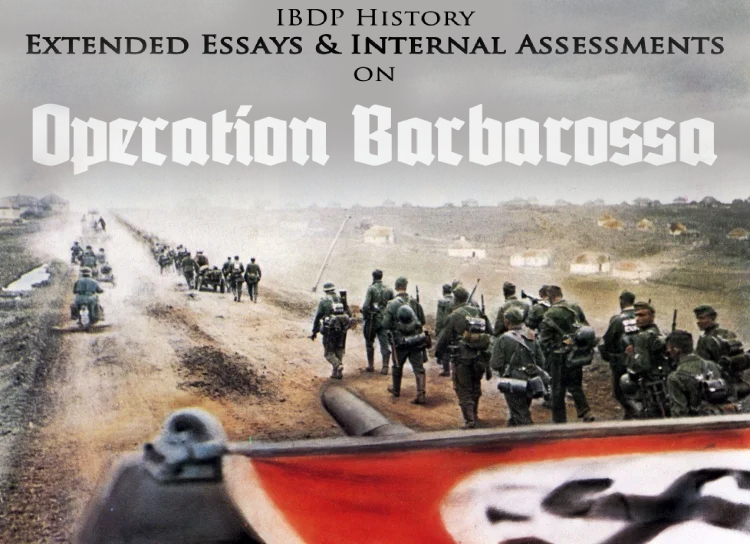
IBDP History Extended Essay
The Turning Point of Hitler’s War with the Soviet Union; August-October 1941
Was Operation Barbarossa a preemptive strike? This Internal Assessment will analyse whether Operation Barbarossa was a preemptive strike on Germany’s part. The controversial Icebreaker: Who Started the Second World War by Viktor Suvorov will be used as it argues that Operation Barbarossa, contrary to the widely accepted view, was a preemptive strike. A lecture from 2010 by Suvorov will be used to gain an overview of the newest developments on the ‘Icebreaker-Theory’. In addition the article Der Sinn des Kampfes published in the Nazi propaganda magazine Signal will provide Hitler’s reason as to why the USSR was attacked as well as providing an account from the time . The Molotov-Ribbentrop Pact will help put the conflict between the two powers into perspective. Furthermore, accounts from other historians such as Klaus Hildebrand’s Das Dritte Reich and Wolfgang Michalka’s Deutsche Geschichte 1933-1945: Dokumente Zur Innen- Und Aussenpolitik, will be used to gain a variety of viewpoints.
Between 3:00 and 3:30 on Sunday, 22 June 1941 Operation Barbarossa was initiated with the bombing of Soviet-occupied cities in Poland. 3.2 million German ground troops invaded the USSR1. There were also 600,000 horses, 2000 aircraft and 3350 tanks 1. With this Operation Barbarossa was the largest military operation of its type in history.
On 23 August 1939 the Molotov-Ribbentrop pact was signed by the USSR and Germany2. According to article 1 of the pact, both nations would refrain from attacking the other country3. Article 2 stated that in the event of a third power attacking either the USSR or Germany the attacked country would not be helped by the other 3. In the ‘Geheimes Protokoll’ it was agreed that if the borders of Poland were to be redrawn, the Germans and the USSR would divide the country among themselves, establishing later, whether Poland was to keep its own government or become part of the invading powers 3. On 1 September 1939 Germany invaded Poland4 starting the Second World War. Days later, on 17 September 1939 the Soviet Union invaded Poland5. Both countries now occupied their territory of Poland according to the Molotov-Ribbentrop pact.
In Mein Kampf Adolf Hitler stated that he wished to gain ‘Lebensraum’ for the German race6 As early as 1933 Hitler had publicly spoken of wishing to gain ‘Lebensraum’ in the East and freeing Russia of the Jews that had gained control through Bolshevism7. Hitler promised that the USSR would first be invaded and then be turned into the leading state in Asia, guided by the Nazis. With Russia and Europe under national socialist rule the whole of the world would be conquered8. In December of 1940 Hitler created a plan to invade the USSR9. The plan was that the German troops were to attack the Red Army on Russian territory and destroy it before they could retreat and establish a defensible position. On June 31 1940 this plan was created and in the autumn of the same year it was integrated into the ‘Gesamtkriegsplan’10. Hitler reported, on 5 December 1941, to Brauchitsch and Halder that the USSR would be easy to beat11. No military leader, under Hitler’s command raised objections or challenged Hitlers views12. Hitler wished to invade the USSR to carry out his vigorous programme13 and eradicate Bolshevism14.
After signing the the Molotov-Ribbentrop pact Stalin did not believe that Hitler would keep his promise and refrain from attacking the USSR. However, he believed that before Britain was defeated, Hitler would not strike the USSR unless forced to. Stalin believed that the war between Germany and Britain would prevent Hitler from engaging in two conflicts15. During the time leading up to the German invasion Stalin refused to see the signs of Hitler’s upcoming attack16. The USSR chief of state for army, Boris Shaposhnikov, predicted what the attack from Germany might look like. He forecast a ‘three prong assault’, which closely resembled the actual attack17. The Soviets built up a thin line of defence along the border. They were confident that this would prevent a full invasion on Germany‘s part 17. It would also give the USSR time to mobilise its troops, drive Germany back and destroy the German army on its own territory17.
The article Der Sinn des Kampfes was published on 1 August 1941, in the Signal, a magazine released twice a month. It served as propaganda for the Nazi party. It was mainly published in other languages18 to justify German control over other European nations and gain support from them19. The purpose of this article was to convey to the readers why Stalin had not yet attacked Germany but had signed the Molotov-Rippentropp Pact. In addition, the intention of the article was to show that Europe was behind the advance on the German enemy. It states that the plan for the USSR to attack the Third Reich had existed for a long time. Overall the source gives an accurate view of the public’s motive and shows the general attitudes expressed towards other nations, especially Russian. The article is limited as it speaks of Stalin’s plans for war, for example: ”Stalin's calculations were wrong”18 without giving any reason as to how the Germans were able to obtain this information. It also states, that “England and the United States are attempting to cut off all of the European continent from oceanic commerce”18. Again, how this information was found out remains unknown and in retrospect it did not come true.
The book Icebreaker: Who Started the Second World War, published in 1987, written by Viktor Suvorov, examines the causes of the Second World War and blames the USSR, who wished to gain control over Europe and then conquer the whole world. He worked as a military leader and for military intelligence in the Soviet government20. He then defected to the United Kingdom, where he then wrote Icebreaker: Who Started the Second World War20. Therefore, the book will be of value for the investigation, as Suvorov has had access to documents that others may never have had the chance to come into contact with. A limitation of his viewpoint is that he goes against the common view that the Nazis started WWII and that throughout the book the Nazi involvement in the starting in the war is largely ignored.
The common belief on the Molotov-Ribbentrop Pact is that Stalin thought that most Western Powers could not be counted on for support if war arose. This could be seen with the repeated failures of Appeasement. To Stalin it seemed that the West was avoiding a war at all cost and would certainly not help him if Hitler were to attack the USSR. To be able to survive a war, Stalin wanted a non aggression pact. This would postpone a conflict between the USSR and Germany and allow for more time to make preparations21. Suvorov, however believes that the USSR wanted Hitler to start a second World War22. This war would then engulf and weaken all capitalist powers22. Using the Molotov-Ribbentrop Pact, Stalin wished to prevent an immediate war between himself and Hitler22.
According to Suvorov the Soviet Union was instigating a war by destroying the buffer zone between himself and the Nazis by signing the Molotov-Ribbentrop Pact23. As soon as Germany had gained ‘their’ half of Poland, Stalin’s enemy was closer to the USSR. Later, when Stalin invaded Poland, the enemy was on the Soviet border. Thus, Suvorov concludes that the Soviet Union was planning on attacking Germany. However, had Stalin not signed the Molotov-Ribbentrop Pact, Hitler would have most likely taken all of Poland. According to claims made as early as February 1933, he wished to expand the German Reich in the East24. In Czechoslovakia, Hitler had shown that he was would do anything to carry out this expansionist policy, even ignore western agreements. It also showed that he was not just content with half of a country. Once a nation is attacked and their army virtually destroyed, it would take hardly any effort taking the rest of the country for land and resources. With the potential threat of having Hitler on the actual border to the USSR, it was a clever move to still have a buffer zone between himself and German territory. While this buffer zone was no longer another country, it still was newly gained territory for Stalin.
Suvorov’s statement that the Soviet Union had betrayed Hitler22 by not invading on the same day, is untrue as the ‘Geheimes Protokoll’ of the Molotov-Ribbentrop Pact only states where Poland would be divided and that it would be decided later whether Poland was to keep its own government or become part of the invading powers25. In addition, one fact that also contradicts Suvorov’s theory was that the full plan for Soviet mobilization was not finished by the start of the German invasion26. During the time leading up to Barbarossa, Stalin refused to recognize the signs that Hitler would attack27. For example, the evacuation of most German citizens out of Soviet territory long before the attack on the USSR was initiated28. Valentin Bereschkow claims that Stalin’s refusal to evacuate any of his citizens in Germany is a clear sign that the USSR was not planning on invading Germany28.
The type of Soviet forces positioned on the border to Germany, according to Suvorov, were for aggressive, not defensive, purposes28. The article, Der Sinn des Kampfes, generally agrees with Suvorov’s theory stating that the Soviets had built up an offensive army along the border to Germany29. This propaganda does its best in portraying Russians as negatively as possible: “the nightmare of Bolshevism” 29. According to the article, there were 70% of all infantry divisions, 60% of all cavalry divisions and 85% of all motorized and tank units of the USSR positioned along the front29. However, according to Anthony Beevor, Hitler was lying in the the official numbers he presented to the public 30. Also Hitler and the other military leaders believed that the USSR would be easy to beat. As early as Mein Kampf, Hitler claimed he wanted to invade and conquer Russia. Hitler’s motive was never to attack the USSR to prevent it from attacking but rather to gain “Lebensraum” and crush Bolshevism31. To Hitler the war on the USSR was a war on Jews, Bolshevism and Slavs 32. He had on numerous occasions claimed that he wished to expand and eradicate Bolshevism 31, to rid Russia of the Jews who had taken power 33. Hans-Ulrich Thamer, in his account of the Second World War, also states that Operation Barbarossa was not initiated by Hitler to prevent a pre-emptive strike but rather to carry out his vigorous policies in the East 34.
Operation Barbarossa was not a preemptive strike. Stalin did not plan to trick Hitler into invading Poland and neither was the USSR provoking a war by having Germany on its border. Stalin saw the Molotov-Ribbentrop Pact as an opportunity to postpone a German-Russian war. This would give him more time to to ready his army for the inevitable German attack, for him to regain his land lost in the Great War easily and to take land that Germany would have otherwise occupied. Hitler had long planned to invade and conquer Russia. As early as June 1940, when a strategic plan was integrated into the ‘Gesamtkriegsplan’, Hitler had planned to attack Russia, making Operation Barbarossa an attack planned well in advance rather than a pre-emptive strike. Although Hitler may claim that he was acting to prevent a Soviet attack, he had also stated, ever since the National Socialists came to power, that he wished to attack the USSR. Even if Stalin had planned to attack Germany first as Suvorov claims, to Hitler Operation Barbarossa was never a pre-emptive strike. It was a war of aggression. He had always planned on taking ‘Lebensraum’ from Eastern Europe.
List of Sources
Bedürftig, Friedemann. Lexikon III. Reich. Hamburg: Carlsen, 1994. Print. Beevor, Anthony. Stalingrad. Munich: C.Bertesmann Verlag, 1999. Print. Harenberg, Bodo. Chronik Des 20. Jahrhunderts. Dortmund: Chronik-Verl., 1988. 541. Print. Hildebrand, Klaus. Das Dritte Reich. München: Oldenbourg, 1980. 65. Print. Kershaw, Ian. Hitler. London: Penguin, 2001. 334. Print. Knopp, Guido. Der Verdammte Krieg: Stalingrad 1942-43. München: Bertelsmann, 1998. Print. Müller, Helmut M. Schlaglichter Der Deutschen Geschichte. Bonn: Bundeszentrale Für Politische Bildung, 1986. 283. Print. Overy, Professor Richard. "BBC - History - World Wars: The Soviet-German War 1941 - 1945." BBC - Homepage. Web. 03 Oct. 2011. . Overy, R. J. The Dictators: Hitler's Germany and Stalin's Russia. New York: W.W. Norton &, 2004. Print. Thamer, Hans-Ulrich. Verführung Und Gewalt: Deutschland 1933-1945. Berlin: Siedler, 1986. Print. Michalka, Wolfgang. Deutsche Geschichte 1933-1945: Dokumente Zur Innen- Und Aussenpolitik. [Frankfurt Am Main]: Fischer Taschenbuch Verlag, 1993. Print. "The Nazi Invasion of Russia Justified." The Bytwerk Page. Web. 06 Nov. 2011. . Schreiber, Gerhard. Der Zweite Weltkrieg. München: C.H. Beck, 2002. Print. Signal Magazine 1940 - 1945. Web. 13 Nov. 2011. Suvorov, Viktor. Icebreaker: Who Started the Second World War? London: H. Hamilton, 1990. 11. Print. Suvorov, Victor. "Who Started World War II." United States Naval Academy. 5 Nov. 2011. Lecture. Valentin, Veit. Geschichte Der Deutschen. München: Knaur, 1984. 782. Print. "Viktor Suvorov - ENotes.com Reference." ENotes - Literature Study Guides, Lesson Plans, and More. Web. 17 Nov. 2011.
Was The Soviet Union Planning to Attack Germany in 1941?
Plan of Investigation The conventional view is that Germany invaded an innocent Soviet Union with Operation Barbarossa. This investigation will explore the revisionist theory1 – “Was the Soviet Union planning to attack Germany in 1941?”. Viktor Suvorov’s Icebreaker: Who started the World War, which renewed debate on the question, and his more recent findings will be challenged to evaluate the hypothesis. Contrasting views of western and Russian historians will be investigated to gather perspectives of various sides of the argument. Primary militaristic and propagandistic sources from both Soviet and German authorities are examined in search of evidence regarding Soviet offensive plans, German officials having kept such records throughout the war on their apparent enemy. An article justifying Operation Barbarossa from the Nazi propaganda magazine Signal will also be analyzed as it made use of these records and had a substantial impact on public opinion due to its wide European readership.
Summary of Evidence
Germany attacked the Soviet Union early in the morning of 22 of June, not two years after German and Soviet foreign ministers signed the German-Soviet Non-Aggression Pact on August 23, 1939. Article I forbade any aggression between the two nations for 10 years.2 The Pact divided Poland between the nations and for the first time in the life of each regime, the USSR and Germany shared a common border. Along a 1800-kilometer front, this was the greatest military operation Germany had ever tackled.3
Hitler issued formal orders on 18 December 1940 stating the Wehrmacht must be prepared to crush the Soviet Union.4 The Nazi propaganda magazine Signal justified the act as a defensive, pre-emptive strike against Soviet invasion.5 Additionally it states that there were from 1 of May 118 Soviet infantry divisions, 20 cavalry divisions, and 40 motorized and tank units mobilized along Germany’s eastern border with offensive intentions. On 17 June 1941 Russian soldiers crept into Germany territory to be quickly stopped by German forces and retreated.6 Since the beginning of 1941, 41 Russian frontier violations were recorded by the Germans.7 A report from the same time showed that Russia had increased the amount of Red Army divisions on the western frontier while other areas decreased in their amount of army divisions.8 As early as the first day of 1941, Germany saw 71% of Russia’s forces on the western front. 9 A week before the attack, Stalin broadcasted on public radio that there was no threat from the Nazi Regime.10 One day before, Stalin ordered a German man, who crossed the border to warn of the impending attack, be shot.11 When Stalin was made aware of the attack, he remarked, “Hitler surely does not know about it”.12
The Soviet Union cleared all defensive weapons, such as mines, which would have sufficiently hindered a German invasion by means of the railway lines, from its eastern border.13 On the same day of Stalin’s radio announcement, orders in secret were sent out to all divisions in the Ural district to mobilize to the western frontier,14 138 divisions in total,15 yet soldiers expected no offensive plans of either side.16 On May 5, Stalin gave a speech proclaiming “...now it is necessary to go from defence to offence...The Red Army is a modern army and a modern army is an offensive army.”17 The Chief of the German High Command of Armed Forces Alfred Jodl testified in the Nuremberg Trials that “Russia was fully prepared for war” when they attacked with Barbarossa.18 Hitler proclaimed on the day Operation Barbarossa commenced to the German people that the German Reich possessed evidence which proves that Russia is supplying Serbia with arms for the intention of entering the war against Germany.19
Defence minister Timoshenko proposed to Stalin and Molotov tactical war plans (Plan MP-41) against Germany, which were approved by the Politburo on 14 October 1940 and frequently revised and improved through until May 1941.20 MP-41 would increase military equipment procurement by January 1942; however, projections predicted insufficient supplies by the end of 1941.21 The final plan created in May was more offensive than defensive, as it envisioned a surprise attack led by the Red Army against Nazi-occupied lands.22 A specified date for commencement was not given. The Red Army’s personnel, divisions, guns, mortars, and Combat aircraft were more than doubling in the period between 1939 and the day of Barbarossa; the production of tank units increased much less: only 21%.23
On 15 March 1941, Soviet propaganda posters captioned with “Forward to victory”24; and “The Motherland calls!” called for soldiers for the Red Army.25 A Russian military handbook published on 29 May 1941 translates phrases like “which village is this?” from Russian to German.26
Evaluation of Sources
The Nazi propaganda magazine Signal, released twice monthly, published an article on 1 August 1941 titled Der Sinn des Kampfes.27 The article was intended to justify Operation Barbarossa which had begun a month before by revealing to the readers that Germany was supported by much of Europe because of their common enemy: Russia, who was planning to attack. Because Signal was published for foreign readers in Europe and became highly popular with a maximum circulation of 2.5 million copies per issue28, it is valuable as its message was not only popular under the Nazi flag but was in fact also read widely across Europe. Signal was a publication of the Wehrmacht, independent of Goebbels’ propaganda,29 which allowed for the direct access of militaristic information. As a German source, this provides a valuable perspective on a nation which the German government kept a watchful eye on, as an attack against the USSR was in the making. Because the magazine was intended to promote Nazi ideas, facts could be skewed. However, the data pertaining to the amount of Soviet divisions on the front corresponds with private governmental documents at the time.30 Nonetheless, some statements lack evidence: The author claims to know the plans and intentions of the Bolsheviks in Romania as well as “Stalin’s calculations” when it can only be speculation.
Vladimir Rezun, under the pseudonym Viktor Suvorov, published his book, Icebreaker: Who Started World War II? in 1990 in English. The author is an ex-KGB agent who fled to the UK in 1978 and wrote this book while being pursued by the USSR. The purpose of his book was to counter the common view that Hitler attacked an innocent USSR and express the revisionist view that Stalin was planning his own invasion against the Third Reich.31 This source is valued in that the author had valuable knowledge and access to sources in Russia while western historians didn’t. Because Suvorov’s thesis was published before the Soviet archives were open, Suvorov uniquely used his hands-on knowledge of Soviet Military strategy and the habits of Stalin, stating that he preferred to execute operations on Sundays, both of which would be difficult for a non-Russian historian without Soviet military experience to notice at the time.32 However, there are only minimal footnotes and statistical evidence. Assertions like “at that moment the Soviet Union stopped producing anti-aircraft and anti-tank guns”33 are stated but not proven with evidence. Also, due to his inability to return to the USSR, a large amount of his cited sources were unable to be verified.
Analysis
Had Stalin also been preparing for war against Germany in 1941, the blame for the outbreak of war would rest not only on German shoulders. This great controversy has led heated debate since the 1980s34, sparked by ex-KGB agent Suvorov (Rezun) who claimed Stalin used the Molotov- Ribbentrop Pact to provide himself with an attacking border.35 The Nazi military magazine Signal states that Russian military divisions at the German border were dangerously increasing. Normally such a potentially partial source would be questioned for its reliability, however, private governmental documents, with no need to fabricate evidence, confirm the high numbers.36 However, if it is agreed the Soviet Union would eventually attack, it is important whether the USSR was planning to execute the offensive in 1941.
Suvorov claims two events as a result of Barbarossa only occurred because the Red Army was preparing offensively: (1) the line-up of troops along the Romanian border prevented the German spearhead of tanks from being any more catastrophic;37 and (2) the placement of Soviet troops in the forest rather than defensive positions in the ground contributed to great losses in the initial onset of Barbarossa.38 In both cases, Suvorov is speculating on subjunctive events which could have turned out a number of ways.
The Wehrmacht decimated the Red Army in the onset of the attack. As Suvorov argues, they were planning for offense which makes defensive maneuvers unachievable and yourself vulnerable.39 Professor Mawdsley illustrates the Soviet military plan MP-41 was offensive and being crafted in the months before Barbarossa and Glantz agrees the plans were offensive40. Meltyuhov shows that the production of more defensive weapons, like tanks, was not increased, while offensive weapon production was.41 Russian military historians V. A. Anfilova, B. N. Petrov, and V. A. Semidetko agree the forces set up were better able to attack than defend.42 Normally, an army preparing to defend itself would dig anti-tank trenches, build cover, or set up barricades. The Red Army did nothing like this, in fact, the Soviet troops were organized in the same type of offensive formation as the Germans were right before the attack.43 V. A. Anfilov claims the Red Army could have taken all the necessary defensive precautions but did not.44 Additionally Ilya Starinov, Colonel during the “Great Patriotic War”, remembers entire defensive installments being abandoned and even dismantled.45
Suvorov in fact calculates an exact date for the planned Soviet offensive attack: 6 July 1941, coinciding with typical habits of Stalin as well as a quote from General Ivanov: “The German troops succeeded in forestalling us by literally two weeks.”46 In this estimate, Suvorov is using something a western historian does not have in his arsenal, knowledge of Soviet military strategy and habits Suvorov has noticed in studying Stalin. However, like most of his other claims, the evidence is circumstantial. MP-41 was also a defensive plan as Mawdsley explains, and the Soviet war generals knew the supplies for the plan would not be sufficient by the end of 1941.47 The Military statistics referenced in Suvorov and Meltyuhov’s works are only statistics from which assumptions are made.
The Soviet war propaganda calls for soldiers, even before the war started, implying the presence of Soviet military preparations. Because all defense installations were being dismantled, these plans must be offensive. The Soviet soldier phrasebook published May 1941 translates phrases like “Which city is this?” into German.48 In defensive war, Soviets would be fighting on Soviet territory and would certainly know their country at least better than a German. Also, phrases like “stop, or I’ll shoot” show the aggression towards Germans. This phrasebook was thus created to prepare soldiers to fight Germans in German lands. “Anti-Suvorov” historians published their rebuttals before Suvorov publicized this evidence.
Conclusion
According to the evidence provided in this investigation, Stalin was planning to attack Germany in 1941. Despite strong criticism of Suvorov, his thesis is correct as it is supported by various other historians and evidence. Since 1939, the Red Army had been more than doubling its offensive forces and creating a plan which both revisionist and orthodox historians agree was offensive towards Germany. Russian historians with valuable access to Soviet documents, statistics and knowledge of military strategy have agreed the military showed it was preparing for offensive war. Stalin did not believe Hitler would attack and thus Soviet war propaganda calling for soldiers shows the offensive preparation of the Red Army. Additionally, Soviet Russo-German phrasebooks for soldiers reveal the intention that Russians would be engaged in German lands. Although it is still debated whether Stalin signed the Molotov-Ribbentrop Pact as a strategy to become closer to Germany, he planned to take advantage of the situation and attacking Germany. Hitler however acted faster and, because Stalin was preparing offensively and not defensively, inflicted great damages to the USSR.
47 Mawdsley, Evan. "Crossing the Rubicon: Soviet Plans for Offensive War in 1940-1941."The International History Review 25.4 (2003): 828. JSTOR. Web. 13 Nov. 2012.
48 Suvorov, Viktor. "Who Started World War II?" United States Naval Academy, Annapolis. 7 Oct. 2009. Lecture. 8
Works Cited
Anfilov, V. A. Nachalo Velicoi Otechestvennoi Voiny. Moscow: Voenizdat, 1962. Print. "Der Sinn Des Kampfes." Signal 1 Aug. 1941: 4-5. German Propaganda Archive. Web. 11 Nov.
2012. Ferguson, Niall. The War of the World: Twentieth-century Conflict and the Descent of the West.
New York: Penguin, 2006. Print. "The Führer’s Proclamation to the German People and the Note of the Foreign Office to the Soviet
Government Together with Appendices." Archive.org. N.p., n.d. Web. 23 Feb. 2013. Glantz, David M. Barbarossa: Hitler's Invasion of Russia, 1941. Stroud, Gloucestershire: Tempus,
2001. Print. Hoffmann, Joachim. Stalins Vernichtungskrieg, 1941-1945. Planung, Ausführung Und
Dokumentation. München: Herbig, 6. Auflage, 2000. 23-84. Print. Mawdsley, Evan. "Crossing the Rubicon: Soviet Plans for Offensive War in 1940–1941." The
International History Review 25.4 (2003): 818-65. Print. Meltyuhov, Mikhail. Lost Chance of Stalin. The Soviet Union and the Struggle for Europe:
1939-1941. Moscow: Veche, 2000. Militera Project. Web. 11 Nov. 2012. Michaels, David. "New Evidence on the 1941 'Barbarossa' Attack: Why Hitler Attacked Soviet
Russia When He Did." The Journal for Historical Review 18.3 (1999): 40. Print. O Vystuplenii I. V. Stalina v Kremle, 5 Maya 1941. 5 May 1941. N. Lyashchenko, Volkogonov
Papers, reel no.8, pg.1. Roberts, Geoffrey. Stalin's Wars: From World War to Cold War, 1939-1953. New Haven [Conn.:
Yale UP, 2006. Print. Starinov, I. G. Miny Zhdut Svoego Chasa. Moskva: Voen. Izd-vo, 1964. Print. Sužiedėlis, Saulius. "The Molotov-Ribbentrop Pact: The Documents." Lituanus: Lithuanian
Quarterly Journal of Arts and Sciences 35.1 (1989): n. pag. Print. 9 Suvorov, Viktor. Icebreaker.: Who Started The Second World War?. London: Hamish Hamilton, 1990. Print.
Suvorov, Viktor. "Who Started World War II?" United States Naval Academy, Annapolis. 7 Oct. 2009. Lecture.
Suvorov, Viktor. "Who Was Planning to Attack Whom in June 1941, Hitler or Stalin?" The RUSI Journal 130.2 (1985): 50-55. Print.
United States. United States Department of State. United States Government Printing Office. Führer's Directive. Hitler Orders Operation Barbarossa on Dec. 18 1940. N.p., n.d. Web. 17 Feb. 2013.Documents on German Foreign Policy: From the Archives of the German Foreign Ministry. English translation accredited to US Department of State Division of Language Services.
Zöller, Alexander. "Signal Magazine 1940-1945." Signal Magazine. N.p., 3 Feb. 2010. Web. 17 Feb. 2013.
10
HISTORY HIGHER LEVEL
INTERNAL ASSESSMENT
TO WHAT EXTENT WAS HITLER’S FAILURE IN OPERATION BARBAROSSA INEVITABLE?
MAY 2026
WORD COUNT: 2199
I. SECTION A
IDENTIFICATION AND EVALUATION OF SOURCES
This
investigation relies on a wide range of primary and secondary sources.
However, two sources are especially central in effectively anchoring the
analysis. These sources are Directive No. 21, written by Adolf Hitler,
and The Diary Entry by Felix Landau. Each offers extremely valuable
insight into the question, that being: To what extent was Hitler’s failure in Operation Barbarossa inevitable?
The
origin of Directive No. 21 is a Führer directive issued by Hitler to
the Wehrmacht high command on December 18, 1940. Its purpose was to act
as a planning document that outlined the intended objectives and
priorities of the invasion of the Soviet Union. In terms of content, the
directive calls for the rapid destruction of Soviet forces in western
Russia, deep pushes toward key urban centres, and highly necessary
coordination and organisation between the Army, Luftwaffe, and Navy, all
under the assumption that Soviet resistance would collapse swiftly. As
the foundational blueprint for the operation, it is inconceivably
valuable for understanding what “success” meant from the German
perspective. Its value lies in providing direct access to Hitler’s
strategic assumptions and expectations before the campaign, allowing
historians to measure the area between ambition and outcome.
However,
its limitations are equally significant. The document reflects just
intention rather than execution. It isn’t an after-action report or plan
of battle meant to be forwarded onto all of the lowest ranking
soldiers, but rather an idealistic plan forwarded to High Command, meant
to act simply as a general guide rather than a specific tactical
operations briefing. The document is also infused with overconfidence,
which is standard for Nazi strategic planning. Seemingly deliberately,
the document omits key uncertainties like logistical capacities, Soviet
industrial depth, and the possibility of protracted warfare. It reveals
extremely little about the internal debates within the Wehrmacht of its
actual practical feasibility. Consequently, while Directive No. 21
establishes the conceptual definition of success, it must be interpreted
critically and be properly tested against evidence to judge whether or
not the goals listed were actually achievable.
The origin of the
Diary Entry is a personal written work dated 12 July 1941 by Felix
Landau, an SS operative in an Einsatzkommando unit operating in occupied
Eastern Europe. Its purpose was to record his thoughts and daily
occurrences, such as executions, security duties, and impressions of the
war. Its content, though not a formal military report, offers an
intimate and more nuanced view of the occupation's ideological and
logistical burdens. Landau’s description of participating in the
execution of twenty-three civilians exposes how the campaign's genocidal
policies diverted manpower, consumed resources, and undermined
operational focus. Its value lies in illuminating how the ideological
and security operations hampered military efficiency, adding to the
arguments about why Germany failed to consolidate early gains.
However,
akin to the Directive above, the source's limitations are clear. It
represents one individual’s subjective experience, shaped by ideological
bias and moral desensitisation. It offers no realistic overview of
strategic decisions or large-scale movements, and its narrow focus
requires extremely careful contextualization alongside the presence of
other, broader operational records. The fact that the author's position
in the war was that of a lower rank within the SS rather than a member
of the higher portion of the chain of command calls into question the
credibility of their claims. Despite these constraints, however,
Landau’s diary remains vital for understanding the human and ideological
dimensions that complicated Germany’s war effort, and by extension, the
Führer's prospects for success.
II. SECTION B
INVESTIGATION
“All we’ve got to do is kick the door in and the whole edifice will come crumbling down.”
Adolf Hitler
Operation
Barbarossa, launched on the 22nd of June 1941, was Nazi Germany’s
ambitious and ideologically driven invasion of the Soviet Union. What
began as a rapid assault quickly became a grinding war of attrition,
culminating in a catastrophic failure that reshaped the fate of Europe.
Yet beneath the battlefield carnage lies a counterfactual question that
continues to fascinate historians to this day: Could Hitler, under
alternative strategic or logistical conditions, realistically have
succeeded in Barbarossa?
From the start, German command planning was
shaped by Hitler’s ideological assumptions and desire for symbols and
resources, rather than military efficiency. Directive no. 21, as
discussed prior, lays out a three-pronged offensive aiming for Leningrad
with Army Group North, Moscow with Army Group Centre, and Ukraine with
Army Group South, therefore diffusing the Wehrmacht’s striking power.
The later translation of the directive by the US Department of State
confirms the ideological and strategic imperatives embedded in the
directive.
According to Stahel, Hitler’s shifting priorities
undermined the unity of his operational bodies. Notably, Panzer Group
2’s diversion to capture Kiev delayed the Moscow push, sacrificing
momentum for territorial gains. The US Army’s The German Campaign In
Russia further observes that this diversion enabled the Soviet command
to reconstitute defenses around Moscow, even stating that “Army Group
South was to conclude the battle east of Kiev as soon as possible so
that Second Panzer Group and Second Army would revert to Army Group
Center without delay,” showing that even the Germans regretted the
decision and needed the two groups back to Moscow to assist Army Group
Center.
An article from the NCO Journal uses operational factors to
further critique Hitler’s strategic planning - he failed to align ends,
ways, and means, ignoring historical lessons about extended lines of
communication and primacy of concentrating force. All of these failures
demonstrate a key portion of the failure of Barbarossa, that being the
operational incoherence and ineptitude, as well as the deliberate and
repeated interference by the Führer. The lack of connection between the
ideological wants of Hitler and the needs of the Wehrmacht in terms of
the campaign itself demonstrates that even if tactical victories were
made, they would be undermined by the fragmentation of German command.
The
extremely vast distances of the Soviet Union, coupled with primitive
infrastructure, overwhelmed German logistics significantly. Looking back
to a previous source, The German Campaign in Russia, it reports that
supply convoys were frequently immobilised by poor roads and
overstretched maintenance lines. Stahel then further documents that by
late summer of 1941, many Panzer formations were running at half
strength due to the fuel shortages and mechanical failures.
In In the
Eyes of a German Soldier and a General, Corporal Hans Roth recalls the
endless marches, abandoned vehicles, and scarcity of petrol, while
General Heinrici notes the weakening at failures at the forefront of the
operation. The reason these two men are especially valuable is due to
the contrast in their roles, with Roth being an ordinary trenchman and
Heinrici serving in field command. As a result, the similarities between
their statements help to verify the credibility of the source as a
whole, confirming that German planning underestimated the strain of
sustaining warfare deep into Russian territory.
Further confirmation
comes from soldier diaries such as Diary of a German Soldier, which
reports frequent shortages of food, ammunition, and reliable
transportation. Also, The German Soldier on the Eastern Front 1941-43
includes several testimonies of overwhelmed logistics systems and
prisoner transports, overall increasing the stress on German high
command and their logistical capabilities of the time.
From the
perspective of the Germans, their plans presumed that the Soviet state
would collapse quickly, which was entirely logical. Due to the numerous
prior successes that Germany had in Norway and Poland, the technological
superiority of the German forces, and the political instability of the
USSR, the Germans were justified in their presumptions. However, a
common counter to this perspective is that the Germans failed to factor
in Soviet political will and mobilisation abilities. As an Imperial War
Museum article notes, Germany underestimated not only manpower but the
Red Army’s capacity to absorb losses and continue resistance.
Roth’s
diary further contradicts these early German assumptions. By mid-summer,
he describes waves of Russians who fought like men without fear,
defying the notions of passive collapse. Historians, such as Vincent
Castaño, point out that strategic depth and reserves turned Germany’s
tactical gains into incremental, contested territory. An academic
article “Barbarossa Revisited” argues that Soviet reserves, the capacity
for industrial displacement, and the strategic flexibility that the Red
Army held meant that no blitzkrieg or other type of attack could ever
deliver permanent collapse.
In fact, the war of attrition that
followed was actually favourable to the USSR’s capacity to sustain
losses far longer than Germany could. This sheer resilience went unseen
and completely disregarded by the German High Command, demonstrating the
narrow views of the time. Thus, even if German arms had somehow
advanced farther, Soviet resilience would have likely prevented a
decisive collapse before winter.
Environmental conditions on the
Eastern Front - such as the terrain, climate, and seasons - played a
decisive role in halting the German advance. While Directive No. 21
demanded a swift victory “before the onset of winter,” reflecting the
belief that the Soviet Union would collapse in weeks., the Wehrmacht and
Hitler both critically underestimated the vast distances and poor
infrastructure of the Soviet Union. According to David Glantz, even in
ideal weather, German forces suffered from slow transport and exhausted
supplies before Moscow was even within reach.
By October, heavy rains
turned dirt roads into swamps during Rasputitsa, the seasonal mud.
Heinz Guderian later recalled panzer columns completely immobilized,
“sunk into the muck,” with soldiers forced to abandon vehicles and march
on foot. Even far later in 1956, a US military study reports convoys
delayed for days due to collapsed bridges and impassable roads.
Then
came winter, which was brutal and paralyzing. Temperatures are said to
have fallen below -30 degrees celsius. Engines froze, weapons jammed,
and soldiers lacked proper winter gear. Renowned historian Antony Beevor
writes that German rifles failed to fire in the cold, and that
frostbite became deadlier than soviet bullets.
Chris Bellamy
similarly describes how mobile warfare collapsed into pure misery as
German logistics failed to meet the pace needed, phrasing it as the
Blitzkrieg transitioning into a “frozen positional warfare” as supply
columns fell in the snow and ice. Soviet forces, though equally
strained, adapted faster. Alexander Werth observed that Soviet
logistics, operating on shorter internal lines, regained equilibrium
just as the German advance froze. Richard Overy than further argues that
the environment did not cause defeat but “revealed the overreach and
exhaustion already inherent in German planning”.
Finally, after
observing several sources carefully and consistently, Operation
Barbarossa’s failure was not a singular, preventable accident, but
rather a culmination of interlocking flaws such as strategic overreach,
logistical collapse, ideological rigidity, and the inescapable reality
of the Russian geography and climate. Hitler’s insistence on
simultaneous offensives and his deliberate misjudgements of Soviet
endurance guaranteed the exhaustion of German forces before any decisive
victory could be achieved. Even without the ideological distractions or
command interference, the campaign’s ambitions exceeded its practical
means. As David Stahel stated, Barbarossa “collapsed under the weight of
its own design”. The invasion’s defeat was therefore not just a
possibility, but an inevitability, revealing the clear limits of
Hitler’s tactical strength when confronted with the scale and resilience
of the Soviets.
III. SECTION C
REFLECTION
Conducting
this investigation made me realize just how difficult it was to
determine between causality and inevitability when observing historical
events, especially in somewhat counterfactual questions such as the one
being discussed. The deeper I went into examining planning documents,
diaries, and analyses, the clearer it became that history is not a
single linear narrative. Instead, it is an almost patchwork of competing
perspectives, shreds of evidence, and interpretations that often
contradict one another.
One of the most valuable insights I gained
was a deeper understanding of the tension between intentions and
outcomes. Hitler’s Directive No. 21 appeared, at my first glance, to be a
straightforward blueprint for success. But as I compared it to
frontline accounts and records, it became clear that the directive
reflected overconfidence rather than feasibility. This taught me to read
primary sources not just for what they say, but for what they assume or
omit entirely.
I also encountered the problem of bias and selection,
particularly with sources like Felix Landau’s diary. Though it provided
a great insight into ideological distractions, it required extremely
careful and deliberate contextualization. I had to balance his personal
narrative with all of the broader military reports I had gathered in
order to avoid giving undue weight to purely anecdotal evidence. This
reinforced the importance of locating multiple types of sources - such
as official records, field accounts, and modern interpretations - to get
closer to a balanced understanding.
Furthermore, I became more aware
of how logistical, ideological, and environmental factors intertwine in
shaping the events and outcomes of history. They aren’t isolated
categories that stand apart, but instead reinforce each other. For
example, Germany’s logistical collapse wasn’t just about the trucks and
fuel present in the area - it was also caused by ideological diversions,
unrealistic mapping and planning of the Russian geography, and poor
strategic coordination. Exploring this helped me further appreciate the
complexity historians must manage when evaluating not just what
happened, but what could have happened.
Ultimately, this
investigation really deepened my appreciation for the challenges of
historically investigating sources, as well as strengthened my abilities
in terms of approaching complex problems with objective analysis and
evidence-based reasoning.
IV. SECTION D
CITATIONS
Beevor, Antony. Stalingrad: The Fateful Siege, 1942–1943. Penguin Books, 1999. Accessed 18 Oct. 2025.
Bellamy, Chris. Absolute War: Soviet Russia in the Second World War. Vintage, 2008. Accessed 18 Oct. 2025.
Castaño,
Vincent J. The Failure of Operation Barbarossa: Truth versus Fiction.
Honors Project, University of North Carolina at Pembroke, 1997. UNCP
Institutional Repository,
libre.uncg.edu/ir/uncp/f/Castano,%20Vincent.pdf. Accessed 10 Oct. 2025.
Carter,
Ian. “Operation ‘Barbarossa’ and Germany’ s Failure in the Soviet
Union.” Imperial War Museums,
www.iwm.org.uk/history/operation-barbarossa-and-germanys-failure-in-the-soviet-union.
Accessed 7 Oct. 2025.
Delaney, John. “Operation Barbarossa
Explained: Why Hitler Failed to Defeat Russia.” Imperial War Museums,
www.iwm.org.uk/history/operation-barbarossa-explained-why-hitler-failed-to-defeat-russia.
Accessed 2 Oct. 2025.
“Diary Entry by Felix Landau, Member of a
Mobile Killing Squad (July 12, 1941).” German History in Documents and
Images, germanhistorydocs.org. Accessed 2 Oct. 2025.
“Directive No.
21: Operation Barbarossa.” German History in Documents and Images,
ghdi.ghi-dc.org/pdf/eng/English57_new.pdf. Accessed 4 Oct. 2025.
“Führer
’ s Directive (December 18, 1940).” Documents on German Foreign Policy,
From the Archives of the German Foreign Ministry. United States
Government Printing Office, 1957–1964. Series D (1939–1945), The War
Years, Volume 11: February 1 – June 22, 1941, Document 532, pp. 899–902.
Accessed 3 Oct. 2025.
Fenrick, Phillip W. “Operation Barbarossa: A
Lesson in Hubris and Strategy.” NCO Journal, 2 May 2022, Army University
Press,
www.armyupress.army.mil/Journals/NCO-Journal/Archives/2022/May/Operation-Barbarrosa/.
Accessed 5 Oct. 2025.
Glantz, David M., and Jonathan M. House. When
Titans Clashed: How the Red Army Stopped Hitler. University Press of
Kansas, 2015. JSTOR, www.jstor.org/stable/j.ctt1gsmvk1. Accessed 13 Oct.
2025.
Guderian, Heinz. Panzer Leader. Translated by Constantine
Fitzgibbon. Internet Archive, 2015,
https://archive.org/details/PanzerLeaderHeinzGuderian/page/n1/mode/2up.
Accessed 15 Oct. 2025.
Hoffman, William. Diary of a German Soldier,
1941–1945. Gilder Lehrman Institute of American History,
https://www.gilderlehrman.org/sites/default/files/inline-pdfs/william_hoffman_diary_of_a_germany_soldier.pdf.
Accessed 19 Oct. 2025.
Kondratiuk, I. “In the Eyes of a German
Soldier and a General on the Eastern Front in 1941.” Longdom Publishing,
2022,
www.longdom.org/open-access/in-the-eyes-of-a-german-soldier-and-a-general-on-the-eastern-front-in-1941-93302.html.
Accessed 6 Oct. 2025.
Overy, Richard. Russia’ s War: A History of the Soviet Effort: 1941–1945. Penguin Books, 1998. Accessed 19 Oct. 2025.
Stolfi,
Russel H. S. “Barbarossa Revisited: A Critical Reappraisal of the
Opening Stages of the Russo-German Campaign (June–December 1941).” The
Journal of Modern History, vol. 54, no. 1, 1982, pp. 27–46. JSTOR,
www.jstor.org/stable/1906049. Accessed 10 Oct. 2025.
Stahel, David.
Operation Barbarossa and Germany’ s Defeat in the East. Cambridge
University Press, 2009. Archive.org,
archive.org/details/operationbarbaro0000stah. Accessed 4 Oct. 2025.
Steven
Thomas. “Rasputitsa – Quagmire on the Eastern Front.” Steven’ s
Balagan, 24 Mar. 2018,
balagan.info/rasputitsa-quagmire-on-the-eastern-front. Accessed 13 Oct.
2025.
United States Army. Catalog of the Army Historical Program
2004. U.S. Army Center of Military History, 2004.
https://history.army.mil/portals/143/Images/Publications/catalog/104-21.pdf.
Accessed 15 Oct. 2025.
Werth, Alexander. Russia at War, 1941–1945. Barrie & Rockliff, 1964. Accessed 18 Oct. 2025.
The
German Soldier on the Eastern Front 1941–43. Cutters Guide, Apr. 2025,
https://www.cuttersguide.com/pdf/ww2/uploads/april2025/pdf/The_German_Soldier
