


The November Revolution of 1918 after the First World War saw the eight Thuringian monarchs abdicate between November 9-25, 1918, clearing the way for the establishment of a unified state in Thuringia. On May 1 1920, therefore, the state of Thuringia was founded. In the Free State of Saxony-Gotha formed a communist council as it fell into political turmoil and civil war-like conditions until 1920. A special incident was the murders of Mechterstädt in 1920.
Because of the political unrest in Berlin, the new constitution was drafted by the National Assembly as the Weimar Constitution in Weimar in 1919, signed in Schwarzburg by Reich President Ebert and thus established the first democratic constitution for the whole of Germany. Society here as with the rest of the country was divided as young modernisers who gathered at the Bauhaus in Weimar from 1919 onwards faced off against old traditionalists who longed for the monarchy.
 |
| Memorial to the Death marches at the end of the war |
As early as 1930 Thuringia was one of the free states where the Nazis gained actual political power when Wilhelm Frick was appointed Minister of the Interior for the state of Thuringia after the Nazis won six delegates to the Thuringian Diet. In this position he removed from the Thuringia police force anyone he suspected of being a republican and replaced with men favourable towards the Nazi Party. He also ensured that whenever an important position came up within Thuringia, he used his power to ensure that a Nazi was given that post. After the seizure of power by the Nazis, the state of Thuringia was brought into line with its Gauleiter being Fritz Sauckel.
 The Nazis established three concentration camps in addition to the briefly operated Nohra concentration camp in 1933: the Bad Sulza concentration camp from 1933 to 1937, its successor, the Buchenwald concentration camp at Weimar from 1937 to 1945 and the Dora Mittelbau concentration camp at Nordhausen from 1943 to 1945. The British air raids on Nordhausen in April 1945 destroyed the city almost completely, with about 8,800 people died. Damage caused by bombardment and artillery fire also occurred in Erfurt, Gera, Jena, Weimar, Eisenach and some smaller towns and villages. Thuringia was occupied between April 1-6, 1945 by the Americans and handed over to the Soviet military administration on July 1, 1945, with areas around the city of Bad Sachsa in exchange for parts of the district of Blankenburg to the British military administration were left. The exclave Ostheim before the Rhön remained under American military administration and later became part of Bavaria. The state of Thuringia was restored and extended to the former Prussian administrative district of Erfurt. It was dissolved by the East German government in 1952 and replaced by the district of Erfurt, the district of Gera and the district Suhl. The Soviet occupation maintained the "special camp No. 2 Buchenwald" in the area of the former concentration camp near Weimar from August 1945 to 1950.
 Blankenburg: The Wehrmacht garrison repurposed from Nazi militarism to Soviet occupation and luxury tourism

The former barracks, seen in here in Nazi-era postcard flying the war ensign, is now classified as a schlosshotel. Built between 1857 and 1860, the barracks served as a training facility for recruits from various military units until the First World War. The palace barracks complex also includes some additional buildings, such as the military hospital (now a residential and commercial building), the drill and riding hall (now serving as a sports hall) and the NCO's house in Hasselfelder Street. After the Great War, the barracks had to be closed due to the Versailles Treaty. During the Third Reich the castle barracks were used again for military purposes, serving the purpose of accommodating various military units.
On May 13, 1946, the barracks was cleared by the Soviet military administration and made usable exclusively for residential purposes with a permit. Parts of the castle barracks were still inhabited until the beginning of 2009 when, from April 2009 until the opening on February 1, 2010, the palace barracks were converted into a four-star hotel.
Jena: The Carl Zeiss industrial complex compromised by Nazi racial hygiene and the systematic expulsion of Jewish scientists
Important for being the site where, on October 14, 1806, Napoleon fought and defeated the Prussian army in the Battle of Jena-Auerstedt, near the district of Vierzehnheiligen. 
The Volkshaus at Carl-

The Stadtkirche as seen from the town square then, flying the swastika flag, and now
 |
| The Fuchsturm, Jena's oldest landmark, then & now |
The law for the prevention of offspring with hereditary diseases made it possible to carry out numerous forced sterilisations in the surgical clinic and the women's clinic. Later, patients were delivered to euthanasia institutions. Meanwhile, thousands of forced labourers were employed in the Jena armaments factories. Shortly before the end of the war, a sabotage group carried out a bomb attack on the Nazi Party office. From September 1944 onwards, up to a thousand prisoners had to do forced labour in the adjacent Reichsbahnausbesserungswerk (RAW) in the subcamp "RAW Jena", a subcamp of the Buchenwald concentration camp .

A couple of historic buildings in town that managed to survive the war. On the left, the so-called Schillerkirche, where Friedrich Schiller married in 1790. On the right bottom, the Zeiss Planetarium, is the oldest continuously operating planetarium in the world which opened on July 18, 1926. Its renowned scientific director, Rudolf Straubel, chose to resign his post rather than divorce his Jewish wife. As Daniel Engber relates in his fascinating piece on the man,
The local Nazi minister of the interior, a brutal ideologue and drunk named Fritz Wächtler, sought to overhaul the management at Zeiss, which he described as being “infested with Marxists and Liberals.” (Wächtler would later be executed by the ϟϟ for cowardice.) Straubel was given an ultimatum by his fellow directors at Zeiss, who now included Walther Bauersfeld: Either divorce his wife or quit his job. He chose the latter.
 Engber goes on to reveal that the fall of the Nazis did not restore Straubel’s name.
 The Zeiss company was split during the Allied occupation, with one half based in West Germany and the other in East Germany. The directors who had ousted Straubel—a group that still included Bauersfeld—ended up in charge at Zeiss West. Soon the two branches were engaged in a battle for control of Zeiss trademarks and other assets. Peter Volz believes that the Western firm could not acknowledge Straubel’s contributions because doing so would mean admitting that its directors had acquiesced to Nazi pressure. That in turn would legitimate its rivals at Zeiss East.
 After the war when Anglo-American bombing raids, particularly in February and March 1945, caused extensive destruction. The heaviest bombardment took place on March 19, 1945 when the US Army Air Forces dropped a total of 870 tonnes of bombs on Jena during their attacks. The bombings caused severe damage and total destruction, a large part of the city centre was completely destroyed; the ruins of the partly historic town houses were later removed. The house on the market square where Goethe and Schiller had formed their bond of friendship, the Griesbachsche and Bachsteinsche house, the city museum and the historic castle cellar were lost.
  The town church of St. Michael suffered severe damage as seen here on the right. The college or university church was destroyed and the ruins removed in 1956. Its tower as well as the Collegien buildings were damaged. The town hall was partially destroyed, the court and council pharmacy as well as the university library were destroyed and later removed. The Abbeanum suffered severe damage and was rebuilt by 1951. The university library and six university institutes were completely destroyed, and several clinics on Bachstrasse were partially destroyed. 709 people lost their lives and 2000 were seriously injured. When the city was shelled by American artillery on April 11, 1945, forty people were killed. By April 13, 1945, American troops occupied the city without a fight. By now large parts of the city had been destroyed. 1,424 apartments and 140 business and department stores were totally destroyed, 4,743 apartments were badly damaged. After Nordhausen, Jena was the most destroyed city in Thuringia. On July 1, 1945, American troops on April
13, 1945 and was left to units of the Red Army who moved into the city and Jena became part of the Soviet occupation zone.
The town church of St. Michael suffered severe damage as seen here on the right. The college or university church was destroyed and the ruins removed in 1956. Its tower as well as the Collegien buildings were damaged. The town hall was partially destroyed, the court and council pharmacy as well as the university library were destroyed and later removed. The Abbeanum suffered severe damage and was rebuilt by 1951. The university library and six university institutes were completely destroyed, and several clinics on Bachstrasse were partially destroyed. 709 people lost their lives and 2000 were seriously injured. When the city was shelled by American artillery on April 11, 1945, forty people were killed. By April 13, 1945, American troops occupied the city without a fight. By now large parts of the city had been destroyed. 1,424 apartments and 140 business and department stores were totally destroyed, 4,743 apartments were badly damaged. After Nordhausen, Jena was the most destroyed city in Thuringia. On July 1, 1945, American troops on April
13, 1945 and was left to units of the Red Army who moved into the city and Jena became part of the Soviet occupation zone.Hummelshain: The REIMAHG armaments labour hospital where Italian prisoners perished now functioning as a residential care facility

The former Bauernschule (with flag of the Hitlerjugend in front) and today, now a seniors' home. During the war the Nazi armaments company REIMAHG (an abbreviation of Reichsmarschall Hermann Göring) established a hospital for its forced labourers in the form of six barracks built in the castle grounds, each with 89 beds. The REIMAHG underground armaments factory itself was sited in Walpersberg near Kahla in thelast years of the war where the Messerschmitt Me 262, the first mass-produced jet fighter, was to be produced. According to propaganda, 1,200 units were to have been completed each month, but in the end only 17-27 units were made, depending on the source. Under catastrophic hygienic conditions and constantly overwhelmed, the death rate among the 1,088 patients, including 980 foreigners, was correspondingly high. In this hospital a total of 175 forced labourers died, most of whom came from Italy. The dead were buried in a field east of the cemetery. In 1967, young people from the Jugendwerkhof erected a memorial made up of 175 stones from the former armaments factory to commemorate the forced labourers who died here.
Oberdorla: The unmarked village crossing where an American infantryman died liberating a community that erected no memorial

A photograph taken on April 4, 1945 by American reporter Charles Eugene Sumners showing infantrymen of 'B' Company, 44th Armoured Infantry Battalion, 6th American Armoured Division crossing the street past the body of 19 year old Pfc. Robert Vardy Wynne from Texas who had just been mortally wounded by a sniper. As subsequent research has revealed, the then 21-year-old photographer is said to have stood directly behind his fallen compatriot and had just inserted a new film in the camera. At the time Sumners served with the 166th Signal Photo Company, a unit attached to General Patton’s Third Army. This photo is the one used for the cover of his 2002 memoirs, Darkness Visible: Memoir of a World War II Combat Photographer, which recounts the author’s life as a photographer covering the war in Northwest Europe. He accompanied soldiers not only from the 6th Armoured Division but the 10th Armoured Division and other combat outfits.
Eisfeld: The early Nazi stronghold that awarded Hitler honorary citizenship through political purges before vanishing behind the inner German border

Looking at the Dreifaltigkeitskirche St. Nikolai from 1535 at the end of what was Straße der SA from a Nazi-era postcard and today, renamed Markstraße. Eisfeld had been dubbed called the "brown town" because as early as 1932, twelve of the sixteen city councilors belonged to the Nazi Party and and made Hitler an honorary citizen. This took place on December 3 that year during a Nazi rally in which Hitler spoke. According to the Eisfelder Zeitung, Hitler appeared "quite healthy and strong" and "had made a strong impression." The local Nazi group leader in Eisfeld, Werner Büchner, presented him with honorary citizenship of the city of Eisfeld after the city council unanimously agreed, claiming "that 75% of the Eisfeld population, i.e. in their overwhelming majority, opted for the leadership of the German freedom movement". Hahne - city council member of the KPD, who was the only one against the proposal - was excluded from the event. From 1933 officials and members of the other parties were intensively persecuted. During the war, 733 foreign forced labourers, including 542 women, were forced to work in the Bruhn works, in the Ritzma works, in the Eiso-Schrauben GmbH and at the Günsel and Dressel companies. Three of the forced labourers who died from the inhumane living conditions are buried in the local cemetery.
In
1920, Albin Ritzmann founded a company here, the Ritzma-Werke, which
manufactured razor blades among other things. After the war, Ritzmann
was detained by the Soviets and died in Buchenwald Special Camp No. 2 in 1947.
After the war Eisfeld found itself in the so-called restricted area along the inner-German border until 1972 due to its proximity to the border.
Hermsdorfer Kreuz: The historic trade junction appropriated by the Nazi regime

The
Nazi-era Hermsdorfer Kreuz resthouse built 1936-38 south of the Dresden
- Weimar autobahn. Here the federal motorways A 4 (Aachen - Eisenach)
and A 9 (Berlin - Leipzig - Munich) cross Görlitz. It has existed in its current basic form since December 1936 when it was built in the course of creating the continuous motorway connection between the Reich capital Berlin and Munich making the Hermsdorfer Kreuz the second oldest motorway junction in Germany after the Schkeuditzer Kreuz. Two kilometres west of the Hermsdorfer Kreuz, one of the largest reinforced concrete arch bridges in Europe at the time was also built in 1938 with the Teufelstalbrücke. In the vicinity there are historically significant trading inns.
Gotha: The Thuringian arms manufacturing hub that sustained the Nazi war machine through thousands of forced labourers whilst eradicating its Jewish community

The fountain at what was once Adolf-Hitler-Platz and today, the Hauptmarkt. Hitler spoke here on January 21, 1927, declaring that
The idea of the national bourgeoisie was opposed by Marxism, which wanted to establish its rule over the corpse of capitalism and the bourgeoisie. He failed in his ultimate goals, just as the conclusion of the political-national direction was wrong, because the entire culture and the nation does not rest on one group, but on the shoulders of one as well as on them of the other. In the wrong direction of the struggle, Marxism has not succeeded in forcing its idea on the people; here, too, failure is decisive. In the battle of the two great directions, the head and the fist, there is no victor, only two vanquished. The two tendencies, which have not been able to bring the people under one roof, face the great common demand to place the people under a unified idea. If the energy of the masses is put into the national idea, then the goal is achieved. The question is not whether this mass can tear down, but whether it can build up. There will never be a socialist state if the architect does not work alongside the bricklayer and vice versa. The coming together of the representatives of the head and the fist on a common idea is everything. The economy is the destiny of the nation.

Stolpersteine shown on the right at Hauptmarkt 14 commemorating the Wirths, deported to Poland where they were killed. Under the Nazis the town became a centre of the arms industry with nearly 7,000 forced labourers working in the city's factories, where more than two hundred died. Furthermore, the Gotha barracks in the southern periphery were enlarged and the synagogue was destroyed during the Kristallnacht in 1938. Bombings in 1944 and 1945 damaged some buildings in the city, in particular the theatre (whose ruins were demolished in 1958) and the main station (which remains only half a building today) and the main church (rebuilt after the war). Nevertheless, some 95% of the city's buildings survived the war unscathed. The American Army reached the city in April 1945 but was replaced by the Soviets in July 1945 and in 1949 Gotha became part of the DDR.
Friedrichroda: The alpine resort that concealed prototype Nazi jet aircraft production

Nordhausen: The subterranean V2 rocket complex built on concentration camp slave labour

Inauguration
of the "Wehrfreiheits-Denkmals" in front of the Theater Nordhausen
March 15, 1936 during the crisis in the Rhineland. During
this ceremony the theatre staged a show dramatising the destruction of
the "chains of Versailles" using imagery corresponding to the usual
repulsive anti-Semitic stereotypes. In October 1933, the Nordhäuser Zeitung had described the theatre as "an important helper in the formation of the German people". Three Jewish artists - the general music director and two singers - had to leave the Stadttheater; nothing is known about what happened to them. The theatre manager Hans Bensch-Rutzer, appointed by the local rulers, saw his main task as "making the theatre a common property of the entire national community", as he wrote in 1937. In order to achieve this goal, the theater management lowered the ticket prices, launched a wide-ranging advertising campaign and included only "appropriate" theater art in the repertoire. A year before the end of the war, the Nordhäuser Theater, like most German theatres, ceased operations. The artists were employed in the armaments production of the Mittelwerk and other operations important to the war effort.
The theatre, formerly on Straße der
S.A., is now at Käthe-Kollwitz-Straße.
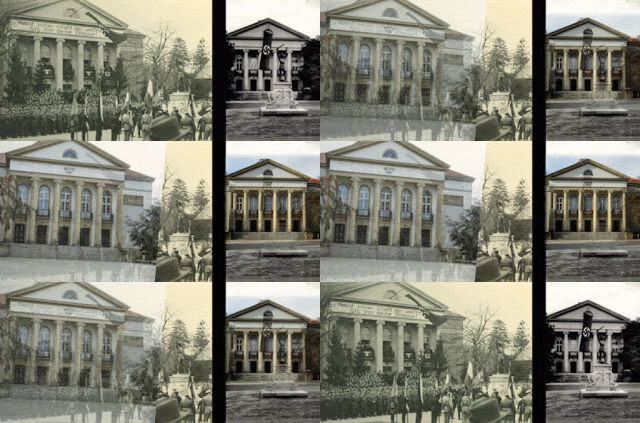

The memorial was removed on the orders of the Bürgermeister on May 27 1945.
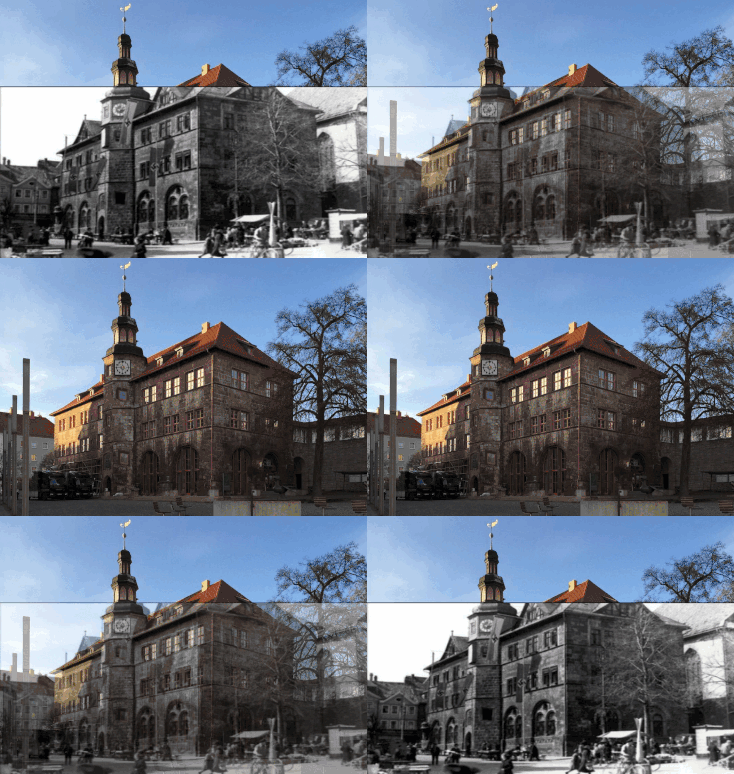
 Nazi flag flying from the stadthaus on the kornmarkt. From December 1939 to June 1940, around 9,000 Saarlanders were accommodated in Nordhäuser private households and collective accommodations. In the autumn of 1939 the first Polish prisoners of war arrived; at the beginning of 1942 there were about 450 prisoners and in March 1945 700 prisoners of war. From 1937 to 1945, Nordhausen hosted the Mittelwerk Dora armament centre, and from August 1943 the Dora-Mittelbau concentration camp with 60,000 inmates (of whom 20,000 died until 1945), in which after the attack on Peenemünde the production of so-called retaliatory weapons, especially the new V2, but also the older V1, took place. In addition, 10,000 German prisoners and foreign forced labourers, housed in 38 camps, had to force-work in various companies. The largest forced labour camp with a maximum 6,000 inmates, some of whom worked for the Junkers Group, were in the Boelcke barracks. This was from the end of January 1945 a "sick and death camp of the Mittelbau complex" and was located in southeastern Nordhausen. It was severely hit during the British bombing raids on April 3 and 4. The American Army forced the inhabitants of Nordhausen to salvage, transport and burial of the dead. The 1,300 victims were buried at the Ehrenfriedhof on Stresemann-Ring. It is reminiscent of a monument erected in 1999. Next to it is a memorial cemetery designed in 1946 for 215 Soviet fatalities.
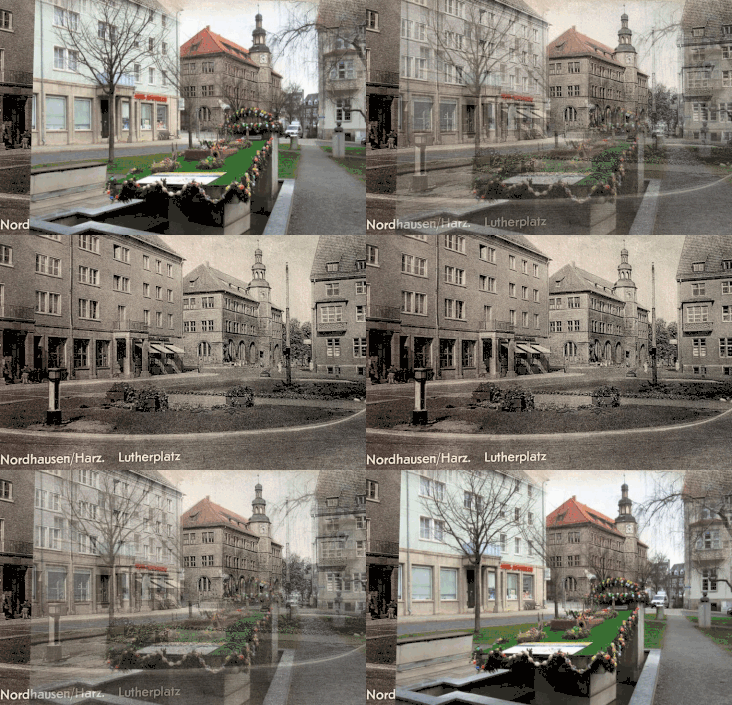
Lutherplatz
then and now. The Martini Festival on Luther Day in 1933 was used by the Nazis as a propaganda event. Superintendent Hammer, Mayor Sting and the Thuringian Gauleiter Sauckel gave speeches at Adolf-Hitler-Platz and later that same evening a public book burning took place, organised by the Hitler Youth. This took place on the occasion of Luther's 450th birthday and was intended to serve the Nazi ideology with the blessing of the Church- in one case the superintendent and senior pastor at the town and parish church of St. Marien in Wittenberg, Maximilian Meichßner, spoke of
God's providence that Luther's 450th birthday falls at a time that in German history can only be compared with the time of the Reformation. It is a providence of God that Dr. Martin Luther comes alive again in a time of national awakening. Luther stands before us as a German man... It is a gift of God that Dr. Martin Luther comes alive again in the days of Adolf Hitler. Today we have opened our eyes again to what a God-appointed leader means to a people. It is a providence of God that Dr. Martin Luther comes alive to us again in the days of national renewal. Rotten, rotten things are torn away. Stones are carried to the new building of the Third Reich. Then we understand better than usual what reformation means to the church... et cet.

The day itself had originally been scheduled for November 10, 1933, Luther's actual birthday, as noted in the poster above promoting the event. However, since Hitler had called for Reichstag elections and a “referendum” on leaving the League of Nations for November 12, Luther Day was postponed to November 19.

The regional courthouse in Nordhausen (now the Amtsgericht) and the adjoining court prison were integrated into the Nazi apparatus of persecution and suppression as early as 1933 when several communists and social democrats were held in the prison.From the mid-1930s the inmates of the court gaol, many of whom were imprisoned for political crimes, were used for forced labour. The prisoners worked for the R.Schulze & Co. brickworks, the A. and F. Probst gypsum factory and the Kornhaus Nordhausen GmbH, among others. The prisoners on remand were used to fold boxes for the domestic chewing tobacco industry. Sick people, those suspected of escaping and prisoners with pending proceedings before the special court in Erfurt had to work in the prison's own wood cutting plant, which supplied 1,500 households in Nordhausen with wood. Up until the spring of 1943, the Nordhausen court prison was mainly occupied by male pre-trial detainees and convicts. In February 1943, the Reich Ministry of Justice converted the prison into a prison for "fallen" women as part of the social-racist policy of persecution and had more than 100 women transferred from various central German prisons to Nordhausen. Most of them had to work in the army munitions facility in Wolkramshausen and were driven daily by truck from the prison to Wolkramshausen and back with their guards. They were accommodated in the confined space of the prison, and many prisoners had to share their cell with up to twelve other women.

 After the Reichskristallnacht of November 1938, the fashion house was 'aryanised' and taken over by the Muehlhaeuser department store and renamed the Modehaus Kramer.
After this forced sale of the family business some of the Weinbaum
family managed to emigrate to the Netherlands, surviving the German
occupation and the war whilst others stayed in Nordhausen and sent to
the camps from where they never returned.The
Nazi rule led to the destruction of the synagogue during the
Kristallnacht in 1938. The Jews emigrated or were deported to the death
camps. The Mittelbau-Dora Nazi concentration camp, established in 1943
after the destruction of Peenemünde, was located on the outskirts of
Nordhausen during the war to provide labour for the Mittelwerk V-2
rocket factory in the Kohnstein. Over its period of operation, around
60,000 inmates passed through Dora and its system of subcamps, of whom
around 20,000 died from bad working conditions, starvation and diseases
or were murdered. Around ten thousand forced labourers were deployed in
several factories within the city, up to six thousand of them were
interned at Boelcke Kaserne, working for a Junkers factory.
After the Reichskristallnacht of November 1938, the fashion house was 'aryanised' and taken over by the Muehlhaeuser department store and renamed the Modehaus Kramer.
After this forced sale of the family business some of the Weinbaum
family managed to emigrate to the Netherlands, surviving the German
occupation and the war whilst others stayed in Nordhausen and sent to
the camps from where they never returned.The
Nazi rule led to the destruction of the synagogue during the
Kristallnacht in 1938. The Jews emigrated or were deported to the death
camps. The Mittelbau-Dora Nazi concentration camp, established in 1943
after the destruction of Peenemünde, was located on the outskirts of
Nordhausen during the war to provide labour for the Mittelwerk V-2
rocket factory in the Kohnstein. Over its period of operation, around
60,000 inmates passed through Dora and its system of subcamps, of whom
around 20,000 died from bad working conditions, starvation and diseases
or were murdered. Around ten thousand forced labourers were deployed in
several factories within the city, up to six thousand of them were
interned at Boelcke Kaserne, working for a Junkers factory.


Erfurt: The civilian engineering enterprise that designed and optimised the Auschwitz crematoria ovens

 Attorney-General Frick, Gauleiter Sauckel, Hitler
and Hungary's Minister-President Gömbös (the first Head of State to
visit Hitler, setting off a continuous series of state visits from
Hungary all the way up to 1945) in front of the cathedral at the
Domplatz shown on the right. The buildings themselves were severely damaged by mine bomb detonations in the area and some grenade hits which particularly affected the roof areas and tracery windows. The late mediæval stained glass windows of the High Choir, numbering twelve in total and nearly nineteen metres in height, were saved as early as 1940 and 1941 when they were removed from storage. The window openings were then closed with plain green panes of glass. Without the lead sockets, however, these replacement discs were not stable, especially with the air mines detonating in 1944 and 1945, and they partially fell down resulting in services in the High Choir having to be stopped in 1945. The last two windows, the Elisabeth windows, were not removed as, since they were only created in 1913, they were not considered valuable enough by the provincial conservator in Giesau - and were destroyed in the air raids. The mediæval stained glass windows of Erfurt's Barfüßerkirche ere also saved by being stored in the cellars under the crypt, but the church was "bombed out" and turned into ruins. In
view of the increasing devastation of German cities in the air war, a
guide decree followed at the beginning of 1943 for the systematic photo
documentation of architectural, sculptural and pictorial cultural assets
that could not be salvaged before their possible or expected
destruction which would help in the restoration of the cathedral, practically completed by 1951.
Attorney-General Frick, Gauleiter Sauckel, Hitler
and Hungary's Minister-President Gömbös (the first Head of State to
visit Hitler, setting off a continuous series of state visits from
Hungary all the way up to 1945) in front of the cathedral at the
Domplatz shown on the right. The buildings themselves were severely damaged by mine bomb detonations in the area and some grenade hits which particularly affected the roof areas and tracery windows. The late mediæval stained glass windows of the High Choir, numbering twelve in total and nearly nineteen metres in height, were saved as early as 1940 and 1941 when they were removed from storage. The window openings were then closed with plain green panes of glass. Without the lead sockets, however, these replacement discs were not stable, especially with the air mines detonating in 1944 and 1945, and they partially fell down resulting in services in the High Choir having to be stopped in 1945. The last two windows, the Elisabeth windows, were not removed as, since they were only created in 1913, they were not considered valuable enough by the provincial conservator in Giesau - and were destroyed in the air raids. The mediæval stained glass windows of Erfurt's Barfüßerkirche ere also saved by being stored in the cellars under the crypt, but the church was "bombed out" and turned into ruins. In
view of the increasing devastation of German cities in the air war, a
guide decree followed at the beginning of 1943 for the systematic photo
documentation of architectural, sculptural and pictorial cultural assets
that could not be salvaged before their possible or expected
destruction which would help in the restoration of the cathedral, practically completed by 1951.

In
1914, the company Topf and Sons began the manufacture of crematoria
later becoming the market leader in this industry. Under the Nazis, JA
Topf & Sons supplied specially developed crematoria, ovens and
associated plant to the death camps at Auschwitz-Birkenau and
Mauthausen. With 1,150 employees, the workforce reached its highest level in 1939. Quite a few became accomplices and accomplices – engineers, business people, skilled workers, fitters. Topf & Sons was one of twelve civilian companies that played a key role in the construction of death factory crematoria, mass incineration equipment, and gas chamber ventilation systems. On January 27, 2011 a memorial and museum dedicated to the
Holocaust victims killed using Topf ovens was opened at the former
company premises in Erfurt shown here and below. According to Rebekka Schubert, senior curator of modern and contemporary history and deputy director of the site, the worrying thing is that neither the company owners nor the employees were fanatical Nazis or even anti-Semites. They acted neither under orders nor under pressure, but voluntarily, in the complete absence of humanity and civil courage. To her, the example of the Ruppmann company in Stuttgart shows that one could refuse.
 In 1938, the new synagogue was destroyed during the Reichspogromnacht and the
abduction of the approximately eight hundred Jewish residents began. Shortly before the Torah scrolls were secretly entrusted to the cathedral provost Freusberg, who ensured a safe hiding place under the cathedral. The memorial book of the Federal Archives for the victims of the Nazi persecution of the Jews in Germany lists 447 Jewish residents of Erfurt who
were deported and mostly murdered. Anti-Semitic attacks in Erfurt intensified after the Great War; in 1924 the synagogue was daubed with Nazi slogans for the first time. The year before the Nazis took power there were 819 Jews living in the city. Three years later the number had fallen to 660, and by 1939 to 263. From 1942 to early 1945, the Jewish residents still living in the city were deported to the Theresienstadt and Ravensbrück concentration camps and to the Auschwitz, Majdanek and Belzec extermination camps. Only a few survived the times in the camps.
In 1938, the new synagogue was destroyed during the Reichspogromnacht and the
abduction of the approximately eight hundred Jewish residents began. Shortly before the Torah scrolls were secretly entrusted to the cathedral provost Freusberg, who ensured a safe hiding place under the cathedral. The memorial book of the Federal Archives for the victims of the Nazi persecution of the Jews in Germany lists 447 Jewish residents of Erfurt who
were deported and mostly murdered. Anti-Semitic attacks in Erfurt intensified after the Great War; in 1924 the synagogue was daubed with Nazi slogans for the first time. The year before the Nazis took power there were 819 Jews living in the city. Three years later the number had fallen to 660, and by 1939 to 263. From 1942 to early 1945, the Jewish residents still living in the city were deported to the Theresienstadt and Ravensbrück concentration camps and to the Auschwitz, Majdanek and Belzec extermination camps. Only a few survived the times in the camps.  Hitler
signing the goldene Buch der Stadt Erfurt in the rathaus's Goldener Saal on June 18, 1933 and the site today. It was on this occasion that
Hitler declared
Hitler
signing the goldene Buch der Stadt Erfurt in the rathaus's Goldener Saal on June 18, 1933 and the site today. It was on this occasion that
Hitler declared
 The rathaus in 1936 and today. Bombed as a target of the so-called Oil Campaign of the war, Erfurt suffered
only limited damage and was captured on April 12, 1945, by the American 80th
Infantry Division. During the war Erfurt experienced 27 British and American air raids, not counting the numerous attacks by fighter-bombers in April 1945. 1,100 tonnes of bombs were dropped during which time roughly 1,600 civilians lost their lives. 530 buildings were totally destroyed whilst 2,550 were left either severely or moderately damaged. 17% of the apartments were completely destroyed, many more badly damaged as the historic old town of Erfurt was particularly affected. 23,000 people lost their homes whilst an hundred industrial buildings were destroyed or severely damaged. Important historical sites such as the Collegium Maius of the old university and the library of the Augustinian monastery were lost and all the churches in the city centre were more or less badly hit by bombs and artillery fire. The ruins of the Barfüßerkirche which was destroyed by an air mine on November 26, 1944, still stand today as a memorial. Between April 3rd and 4th, 1945, the RAF had planned a carpet bombing of Erfurt using 2,740 tonnes of bombs only to be called off due to the rapid advance of American ground forces.
The rathaus in 1936 and today. Bombed as a target of the so-called Oil Campaign of the war, Erfurt suffered
only limited damage and was captured on April 12, 1945, by the American 80th
Infantry Division. During the war Erfurt experienced 27 British and American air raids, not counting the numerous attacks by fighter-bombers in April 1945. 1,100 tonnes of bombs were dropped during which time roughly 1,600 civilians lost their lives. 530 buildings were totally destroyed whilst 2,550 were left either severely or moderately damaged. 17% of the apartments were completely destroyed, many more badly damaged as the historic old town of Erfurt was particularly affected. 23,000 people lost their homes whilst an hundred industrial buildings were destroyed or severely damaged. Important historical sites such as the Collegium Maius of the old university and the library of the Augustinian monastery were lost and all the churches in the city centre were more or less badly hit by bombs and artillery fire. The ruins of the Barfüßerkirche which was destroyed by an air mine on November 26, 1944, still stand today as a memorial. Between April 3rd and 4th, 1945, the RAF had planned a carpet bombing of Erfurt using 2,740 tonnes of bombs only to be called off due to the rapid advance of American ground forces.  My GIF on the right shows SA marching down the eastern part of the Schlösserstraße in June, 1933 and how the same location appears today.
On April 12, 1945, units of the 3rd American Army commanded by General Patton occupied Erfurt after fighting in and around the city. Eventually on July 1, the Prussian district government ceased operations and the city was assigned to the state of Thuringia with the administrative district of Erfurt. On July 3, based on the 1st London Zone Protocol of 1944 and the decisions of the Yalta Conference, units of the Red Army took over the city and Erfurt became part of the Soviet occupation zone. Erfurt slowly began to recover from the effects of the war. 30,000 cubic metres of rubble were cleared from the streets, the tram and gas supply were put back into service and schools were reopened. After the dissolution of the state of Prussia on February 25, 1947, which was also legally completed with the Allied Control Council Law No. 46, the Thuringian state parliament declared Erfurt to be the state capital of Thuringia on July 7, 1948, before the state of Thuringia was dissolved and divided into three districts in 1952 when Erfurt became the seat of the district of Erfurt.


Altenburg: The working-class stronghold systematically broken by Nazi terror and the industrial exploitation concentration camp labourers
 Now
a dilapidated shell of what it once was, the Preußischen Hof had been
the site of a speech by Hitler given on April 11, 1926 from 16.00 to
18.40. The public meeting, which according to the police report was
attended by 1,600 to 1,800 people, was opened with a short speech by
district manager Fritz Sauckel and involved various Nazi groups from
Chemnitz, Leipzig, Plauen and Zwickau.
Now
a dilapidated shell of what it once was, the Preußischen Hof had been
the site of a speech by Hitler given on April 11, 1926 from 16.00 to
18.40. The public meeting, which according to the police report was
attended by 1,600 to 1,800 people, was opened with a short speech by
district manager Fritz Sauckel and involved various Nazi groups from
Chemnitz, Leipzig, Plauen and Zwickau.  The Landestheater and Philharmonie on Adolf Hitler Platz in a Nazi-era postcard.

Nazi-led anti-Semitic boycott of April 1, 1933 of Modehauses Schönbeck, owned by the Weinbaum family.
 After the Reichskristallnacht of November 1938, the fashion house was 'aryanised' and taken over by the Muehlhaeuser department store and renamed the Modehaus Kramer.
After this forced sale of the family business some of the Weinbaum
family managed to emigrate to the Netherlands, surviving the German
occupation and the war whilst others stayed in Nordhausen and sent to
the camps from where they never returned.
After the Reichskristallnacht of November 1938, the fashion house was 'aryanised' and taken over by the Muehlhaeuser department store and renamed the Modehaus Kramer.
After this forced sale of the family business some of the Weinbaum
family managed to emigrate to the Netherlands, surviving the German
occupation and the war whilst others stayed in Nordhausen and sent to
the camps from where they never returned.

The
Siechenhof was the meeting place for Communists and Social Democrats in
Salza, a small village near Nordhausen. It was on July 10, 1932 that 250
Nordhäusen Nazis, including SA-men, marched under the leadership of the
later mayor Heinz Sting. This led to the so-called Siechenhof riots.
The Nazis tore down election posters of the SPD and the KPD and smashed
the windows of the inn. With sticks and stones they attacked the
villagers and fought with their opponents; as the local SPD newspaper
wrote on the following day, a "brawl such as Salza has not yet seen."
Due to the strong opposition of the Social Democrats and Communists,
they finally had to retreat. The so-called "Battle of Salza" went down
in the collective memory of the inhabitants. The event is an example not
only for the growing pressure on the population, which was exercised in
the months before the seizure of power by the Nazis on political
opponents, but also for the possibility of active resistance.
 |
| Pfaffengasse |
Just
one week before the invasion of American forces, the city was destroyed 74%
by two British air raids on Nordhausen on April 3 and 4, 1945, killing
around 8,800 people and leaving over 20,000 homeless. The bombing was
ordered by the Allied High Command (SHAEF) on 2 April 1945. There they
demanded an attack in support of the 1st American Army with priority to the
earliest possible opportunity. The purpose of the RAF attacks in April
1945 was to pave the way for an unhindered advance from the
counterattack expected in the southern Harz region. The first major raid
on April 3 at 4:00 pm was carried out by 247 Lancaster bombers and
eight Mosquitos of the 1st and 8th bomber groups, which dropped 1,170
tonnes of blast bombs in twenty minutes, especially on the southeastern
quadrant of the city. It also killed about 1,200 prisoners. The second
major attack on April 4 at 9.00with 243 Lancaster bombers of the
no. 5 Bomber Group and 1,220 tons of bombs is considered the heaviest
attack and was targeted as a surface bombardment, including with fire
bombardment triggered firestorm on the inner city area. It mainly
destroyed residential areas (10,000 apartments), the hospital and
numerous cultural monuments of outstanding importance. The city
hospital, which had already been evacuated on the evening of April 3,
moved to the Stollenanlage im Kohnstein on April 8. From
April 3-4 many thousands of Nordhäuser forced to flee. beyond the former
Boelcke barracks, no targets were identified as militarily or important
to the war effort. Thus the station, the airfield, the railway tracks,
the industrial enterprises and the concentration camp Dora, in which the
V2 had been produced, remained unbroken. Heavily
damaged were the St. Blasii Church, the cathedral and the Frauenberg
Church. Destroyed were Frauenberg monastery, Neustädtische parish church
of St. Jakobi, Marktkirche St. Nikolai and St. Peter's Church (its tower
partially preserved). The remains of these buildings were demolished
after the war.
The city wall, including the partially used towers and Wiechhäuser was hit hard, the city hall destroyed to the outer walls. In large numbers, the characteristic for Nordhausen bourgeois half-timbered buildings from Gothic, Renaissance, Baroque, Rococo and early Classicism were destroyed. For days on end, numerous fires raged in the city centre, bombs with time-bombs exploded, and the city was under attack by low-flying aircraft. Initially only a few inhabitants tried to bury the dead or to recover their belongings. The estimated number of victims of 8,800 refers only to the narrower city of Nordhausen, without the losses in the later incorporated hamlets. There are also higher estimates of over 10,000 deaths, according to the Antifa Committee in June 1945. Of the 8,800 dead, there were about 4,500 women and children.
At the beginning of April 1945 the Volkssturm made preparations to defend the city. In the Gumpe, on the Holungsbügel, on the promenade, in the enclosure and at the city entrances ditches were dug. Much of the officers and aviators sat down in the following days direction "Harz fortress". Shortly after the police and party officials left the city, the Volkssturm, decimated by the air raids, broke up. On the morning of April 11, 1945 occupied over Werther 104th American Infantry Division (1st US Army) with tank support without a fight Nordhausen. At about 11.00 in the heavily damaged Boelcke barracks, the soldiers struck the survivors of the concentration camp Dora-Mittelbau. About 1,200 prisoners died in the bombing of the city in the accommodation block. On the same day, the northwest concentration camp was reached. The middle factory Dora itself had never been bombed and fell to the US troops undestroyed with all secret weapons and documents in the hands. In the vicinity of the Kohnstein and in the village of Crimderode, German followers blew up bridges over the Zorge. About 200 German soldiers and suspicious persons in the city area were captured and brought together in the collective camp Rothleimmühle. In the afternoon, the official transfer of the city took place; Military Governor was Captain William A. McElroy. The military government released Nordhausen on April 12 for eight days to plunder former prisoners and foreign forced labourers. Activities of the organization Werewolf became known at the end of April and some weapons and ammunition supplies were confiscated. On May 8, 1945, the mayor appointed by the Americans, the social-democrat workers' leader Otto Flagmeyer, had to threaten the death penalty in a call to all plunderers. On May 13, a memorial service for the victims of the Boelcke barracks took place at the Ehrenfriedhof. At her all adult Nordhäuser had to participate, after which they received personal documents and food cards. Since the Nordhäuser hospitals had all been destroyed, from April 1945 an auxiliary hospital was established in Ilfeld. Also in Nordhausen in the spring of 1945, a typhoid epidemic exacerbated the desolate situation in the city.
.gif)
 |
| The Petriturm after the war |
 |
...and reconstructed
|
.gif)
The Horst Wessel memorial shown on the left has been destroyed whilst the old war memorial on the right was replaced after the war. On
April 11, 1945, the Americans occupied the town, and on July 2 the Red
Army took over. On July 18 the Soviet administration created the Institute
Rabe to develop Soviet rocket technology on the basis of the
substantially more sophisticated V-2 rockets. In May 1946 the Institute
was subsumed into the new Institute Nordhausen, under an expanded
programme of research across the Soviet occupation zone, including a new
Institute Berlin. On October, 22 1946, under Operation Osoaviakhim,
10-15,000 German scientists, engineers and their families were deported
to the Soviet Union, including around 300 from Nordhausen. Transplanted
along with their equipment, many remained there until the early 1950s.
Erfurt: The civilian engineering enterprise that designed and optimised the Auschwitz crematoria ovens

The Mariendom and Severikirche on Domplatz in 1942 and today. In 1933
the Nazis took control of the city and by
1938 Erfurt was one of the largest garrisons in the German Reich.
In preparation for the planned air raids on Erfurt during the war, the protection of the works of art on and in these valuable buildings became a priority for which the cathedral provost, Joseph Freusberg, advised by the Provincial Conservator Hermann Giesau, made a special contribution. Most of the church furnishings could be secured by relocating them within the church cellar vault, and by employing strong walls and reinforced concrete covers. Although an "instruction for the implementation of air protection in churches" was issued on April 15, 1940 in Berlin by the Reich Ministry of Aviation and the Commander-in-Chief of the Air Force in agreement with the Reich Ministry for Church Affairs, the country's churches and monasteries themselves were responsible for the "extended self-protection in civil air protection", through the formation of task forces and prescribed shelters for worshipers. In order not to let the cultural property fall victim to destruction, regulations were issued for air protection in museums, libraries, archives and similar cultural sites, including churches which provided for security measures on site as well as for the extensive outsourcing of "movable cultural assets".
 In 1938, the new synagogue was destroyed during the Reichspogromnacht and the
abduction of the approximately eight hundred Jewish residents began. Shortly before the Torah scrolls were secretly entrusted to the cathedral provost Freusberg, who ensured a safe hiding place under the cathedral. The memorial book of the Federal Archives for the victims of the Nazi persecution of the Jews in Germany lists 447 Jewish residents of Erfurt who
were deported and mostly murdered. Anti-Semitic attacks in Erfurt intensified after the Great War; in 1924 the synagogue was daubed with Nazi slogans for the first time. The year before the Nazis took power there were 819 Jews living in the city. Three years later the number had fallen to 660, and by 1939 to 263. From 1942 to early 1945, the Jewish residents still living in the city were deported to the Theresienstadt and Ravensbrück concentration camps and to the Auschwitz, Majdanek and Belzec extermination camps. Only a few survived the times in the camps.
In 1938, the new synagogue was destroyed during the Reichspogromnacht and the
abduction of the approximately eight hundred Jewish residents began. Shortly before the Torah scrolls were secretly entrusted to the cathedral provost Freusberg, who ensured a safe hiding place under the cathedral. The memorial book of the Federal Archives for the victims of the Nazi persecution of the Jews in Germany lists 447 Jewish residents of Erfurt who
were deported and mostly murdered. Anti-Semitic attacks in Erfurt intensified after the Great War; in 1924 the synagogue was daubed with Nazi slogans for the first time. The year before the Nazis took power there were 819 Jews living in the city. Three years later the number had fallen to 660, and by 1939 to 263. From 1942 to early 1945, the Jewish residents still living in the city were deported to the Theresienstadt and Ravensbrück concentration camps and to the Auschwitz, Majdanek and Belzec extermination camps. Only a few survived the times in the camps. Between 1939 and 1945, between
10,000 and 15,000 prisoners of war as well as women and men from
numerous countries occupied by Germany had to do forced labour here,
especially in the city's armaments factories.

Just as we have taken possession of this city today, we have also overcome the Social Democratic movement as it manifested itself in Erfurt, I am particularly pleased to accept the freedom of the city with very special thanks.
Hitler had spoken the year before on July 28 just before the general election that saw the Nazis become Germany's biggest party. He had delivered his fifteen minute speech, "Only the unified will and the unified commitment of the nation can rescue Germany," on Schützenplatz from 19.45. According to the subsequent police report, the meeting was attended by about 40,000 people who had paid from fifty pfennigs to one Reichsmark for admission. On Hitler's route from the airport to the event the Eisener Front had organised counter-demonstrations at the gathering place and Hitler's escort had been manhandled into the crowd in some places. After the event, there were various violent clashes between the Iron Front and the communists on the one hand and the Nazis on the other hand with the police struggling to disperse the mob.
 The rathaus in 1936 and today. Bombed as a target of the so-called Oil Campaign of the war, Erfurt suffered
only limited damage and was captured on April 12, 1945, by the American 80th
Infantry Division. During the war Erfurt experienced 27 British and American air raids, not counting the numerous attacks by fighter-bombers in April 1945. 1,100 tonnes of bombs were dropped during which time roughly 1,600 civilians lost their lives. 530 buildings were totally destroyed whilst 2,550 were left either severely or moderately damaged. 17% of the apartments were completely destroyed, many more badly damaged as the historic old town of Erfurt was particularly affected. 23,000 people lost their homes whilst an hundred industrial buildings were destroyed or severely damaged. Important historical sites such as the Collegium Maius of the old university and the library of the Augustinian monastery were lost and all the churches in the city centre were more or less badly hit by bombs and artillery fire. The ruins of the Barfüßerkirche which was destroyed by an air mine on November 26, 1944, still stand today as a memorial. Between April 3rd and 4th, 1945, the RAF had planned a carpet bombing of Erfurt using 2,740 tonnes of bombs only to be called off due to the rapid advance of American ground forces.
The rathaus in 1936 and today. Bombed as a target of the so-called Oil Campaign of the war, Erfurt suffered
only limited damage and was captured on April 12, 1945, by the American 80th
Infantry Division. During the war Erfurt experienced 27 British and American air raids, not counting the numerous attacks by fighter-bombers in April 1945. 1,100 tonnes of bombs were dropped during which time roughly 1,600 civilians lost their lives. 530 buildings were totally destroyed whilst 2,550 were left either severely or moderately damaged. 17% of the apartments were completely destroyed, many more badly damaged as the historic old town of Erfurt was particularly affected. 23,000 people lost their homes whilst an hundred industrial buildings were destroyed or severely damaged. Important historical sites such as the Collegium Maius of the old university and the library of the Augustinian monastery were lost and all the churches in the city centre were more or less badly hit by bombs and artillery fire. The ruins of the Barfüßerkirche which was destroyed by an air mine on November 26, 1944, still stand today as a memorial. Between April 3rd and 4th, 1945, the RAF had planned a carpet bombing of Erfurt using 2,740 tonnes of bombs only to be called off due to the rapid advance of American ground forces.  My GIF on the right shows SA marching down the eastern part of the Schlösserstraße in June, 1933 and how the same location appears today.
On April 12, 1945, units of the 3rd American Army commanded by General Patton occupied Erfurt after fighting in and around the city. Eventually on July 1, the Prussian district government ceased operations and the city was assigned to the state of Thuringia with the administrative district of Erfurt. On July 3, based on the 1st London Zone Protocol of 1944 and the decisions of the Yalta Conference, units of the Red Army took over the city and Erfurt became part of the Soviet occupation zone. Erfurt slowly began to recover from the effects of the war. 30,000 cubic metres of rubble were cleared from the streets, the tram and gas supply were put back into service and schools were reopened. After the dissolution of the state of Prussia on February 25, 1947, which was also legally completed with the Allied Control Council Law No. 46, the Thuringian state parliament declared Erfurt to be the state capital of Thuringia on July 7, 1948, before the state of Thuringia was dissolved and divided into three districts in 1952 when Erfurt became the seat of the district of Erfurt.

Nazi demonstration June 23, 1933 at the Steigerwaldstadion; the entrance has not changed. It was officially inaugurated with a capacity of approximately 35,000 spectators on May 17th, 1931. On the occasion of the international match between Germany and Romania in 1935, a wooden grandstand with 1,270 seats was built on the west side. It reached full capacity for an international match on May 25, 1935. After the war, the stadium initially served the Soviet military administration- among other things, potatoes were grown on the pitch. Only in 1948 did the team get permission to play football games in the "Mitteldeutsche Kampfbahn". In the course of a stadium renovation and the application of a lawn, the stadium was reopened on November 6, 1948 and renamed "Georgij Dimitroff Stadium" after the first communist leader of Bulgaria from 1946 to 1949. Dimitrov earlier led the Communist International from 1935 to 1943 and gained renown when he famously decided to refuse counsel and instead defend himself against his Nazi accusers, primarily Göring, when on trial for complicity in the Reichstag fire for which he was acquitted.
Eisenach: The theological institute dedicated to purging Jewish influence from Christianity and its surviving swastikas

Adolf-Hitler-Platz and today with the schloss and rathaus unchanged. Eisenach once had one of the largest Jewish communities in Thuringia with nearly 500 members at the beginning of the 20th century. Many Jews migrated from the Rhön area around Stadtlengsfeld to Eisenach after their emancipation in the early 19th century. 23 Jewish soldiers from Eisenach would die in the Great War.
Already by 1923 various Jewish shops in town were daubed with paint by schoolchildren, and in 1923 and 1925 the windows of the synagogue were smashed. By the time the Nazis took power the Jews of Eisenach were increasingly disenfranchised. From 1938 more and more Jewish citizens had to flee the country. During Kristallnacht the synagogue on Wörthstrasse, built in 1885, was destroyed, and Jewish shops and private homes were looted and vandalised. Today memorial plaques in the station building and on Karl-Marx-Straße as well as around fifty stolperstein commemorate these incidents. In September 1941, the 145 Jews still living in the city were interned in the house at Goethestraße 48 and deported from there to Belzec and Theresienstadt in 1942. Few of them survived.

St. George church at Adolf-Hitler-Platz from a Nazi-era postcard and today. On
May 6, 1939, eleven regional evangelical churches founded the
Wartburg Institute for the Research and Elimination of Jewish Influence
on German Church Life, which had its headquarters at
Bornstraße 11. The institute's work aimed to "liberate" Christianity
from all Jewish influences and thus create a "species-appropriate"
faith.
When the Nazis took power the authorities built two housing estates- Am Klosterholz and Kirschberg-, two schools, the Thuringian State Bank building on Karlstrasse and the publishing house of the Thuringian Daily Pos among other buildings still in existence. Leading up to the war armaments factories, a large barracks and a Luftwaffe flying school were built as part of the rearmament. The town became the location of Panzer Regiment 2 of the 1st Panzer Division in 1935 and a camp for the Reich Labour Service was set up at Siebenborn. In 1940 the first prisoners of war and women and men from the countries occupied by Germany arrived and were forced to do forced labour, especially in the BMW municipal works and in the BMW aircraft engine works. The largest groups were made up of 2,154 Ukrainians, 1,314 Russians and 390 Belarusians. The forced labourers also worked in the surrounding towns; one memorial in Erlengräben commemorates 455 such victims. 1,040 Soviet prisoners of war and 102 civilian prisoners who died are commemorated in the Soviet Cemetery of Honour on the Wartenberg.
On November 11, 1940 under the accusation of having committed “racial defilement”, a Polish forced labourer and a local woman were tied to a "shame pole" in the style of mediæval denunciation on the market square with thousands of people from Eisenach attending.

The now dilapidated Fürstenhof from where Hitler spoke on October 23, 1932 for just under an hour at 18.00 at a meeting opened by the Nazi Party district leader, Martin Seidel. According to the police report, around 7,000 people attended. Before Hitler spoke, the President of the Thuringian Parliament, Fritz Hille, and the Prime Minister of Thuringia, Fritz Sauckel, addressed the gathering. The latter declared that he would no longer be responsible for the misery in the country if Thuringia did not receive the aid demanded from the national government. The local press interpreted this statement as a threat to resign, which Sauckel denied the next day.

Now
the Elisabeth-Gymnasium, it was opened August 13 1939 as the Hans
Schemm School after the late Gauleiter of Bavarian Ostmark Hans Schemm.
In the Second World War , the school was among other things used as a
hospital and officers' mess. During the bombing of Eisenach, the
building was badly damaged but today still sports its Nazi imagery.

More Nazi iconography on this gate on Jakobsplan which still has its hakenkreuz from when it served the SA. Before
the war, BMW had produced motorcycles in the town. In
preparation for the war, new barracks were established in Eisenach
and the car industry started the production of military equipment. After
1940, around 4,000 forced labourers (most of them from the Soviet
Union) were pressed to work in the city's factories, where some of them
died due to the bad working conditions. Postwar, the managing director
of the BMW aircraft engine works, Dr Schaaf, told the Fedden Mission
there were as many as 11,000 working in the town, 4,500 in a plant
inside a hillside turning out BMW 132 engines and parts for the 801, the
rest in town.

The former office of the book and art print shop Philipp Kühner, publisher of the Eisenacher Tagespost, today the office and commercial building of a bank at Lauchergasse 6-8 and which is another hold-out from the NS-zeit.
The Nazi-inspired iconography dates from the opening year of the war. After working for the Nürnberger Tageblatt and the Lothringer Zeitung, Kühner became editor-in-chief of the Eisenacher Tagespost in 1883 and in 1886 the owner of the publishing house that published the newspaper. Under his leadership, the Eisenacher Tagespost developed into a left-liberal paper and the most widely read newspaper in western Thuringia. After his death in 1922, the company was continued by his son Felix Kühner. The Eisenacher Tagespost appeared until 1943; after the war the former publishing house operated only as a printer.
The bombings during the war destroyed about 2,000 housing units and big parts of the car factories, as well as some historic buildings in the city centre, which were rebuilt soon after the war. The American Army arrived in Eisenach on April 6, 1945, but the Soviets took over control of the city on July 1, 1945.
The bombings during the war destroyed about 2,000 housing units and big parts of the car factories, as well as some historic buildings in the city centre, which were rebuilt soon after the war. The American Army arrived in Eisenach on April 6, 1945, but the Soviets took over control of the city on July 1, 1945.
Altenburg: The working-class stronghold systematically broken by Nazi terror and the industrial exploitation concentration camp labourers
Now
a dilapidated shell of what it once was, the Preußischen Hof had been
the site of a speech by Hitler given on April 11, 1926 from 16.00 to
18.40. The public meeting, which according to the police report was
attended by 1,600 to 1,800 people, was opened with a short speech by
district manager Fritz Sauckel and involved various Nazi groups from
Chemnitz, Leipzig, Plauen and Zwickau. Hitler began his speech by directly referencing a communist leaflet which he said was distributed wherever he appears and forces him to fight against "countless lies." Indeed, the Communist Party,
together with the Red Front Fighters Association, had called for a
counter-demonstration on the market square, which was attended by around
300 people. Hitler referenced this by stating how "we demonstrate because you no longer agree with the current situation. There are two extremes that are not satisfied. But there is a difference between the two..."
After the meeting Hitler
consecrated the flag of the local Nazi group from Gößnitz and
had the district and local group leaders present from the districts of
Thuringia, Saxony and Halle-Merseburg introduced to him. After Hitler's speech there were several clashes between
Communists and Nazis.
 The Landestheater and Philharmonie on Adolf Hitler Platz in a Nazi-era postcard.
 Hitler would return on December 1, 1932 where he spoke that afternoon for about half an hour in front of around 20,000 people. The local paper Ostthüringer Volkszeitung described it as "just a feeble, feeble speech that contained nothing new. Convinced enthusiasm has been replaced by a manual routine that is the wildness of Nazi rhetoric given way to gentle resignation. No wonder when you are forced to deliver your speech promptly every day in order to get money into the coffers. [...] Even during Hitler's speech, which incidentally only lasted about 20 minutes, hundreds left the tent. It was not possible to determine whether Hitler's excessive self-assessment was getting on their nerves or whether their curiosity had been satisfied in the meantime."

Nazi flags behind the Scatbrunnen in the marketplace. The Skatbrunnen was built in 1903 and is the only monument dedicated to
this game. During the war, the bronze Wenzel, the pig heads and the iron
lattice were melted down. It was not until 1955 that the sculptures
could be reconstructed although the iron grates were not replaced. As much as the Allies bombed the town, it was left to its own town council to destroy its own cultural heritage voluntarily- indeed, against violent protest from its own people. The demolition of the entire west side of Klostergasse, which opens into the south-east corner of the market square nearby and was supposed to be part of the Altenburg mit Vorstädten monument-protected complex, involving all buildings from numbers 1-5 by the municipal housing association Altenburg (SWG) in October 2011 made the alley known throughout Germany.

A couple of swastikas hanging from windows of the schloss with one flying from the top.
Altenburg was a stronghold of the SPD, which had formed in 1932 with the KPD a working group in the city council. After the Nazis took power heavy clashes between members of the workers' parties and the Kampfbund black and white red took place. 91 Communist officials were arrested and some were sent to concentration camps. Nevertheless, in the 1933 Reichstag elections, the candidates of the workers' parties still received more than fifty percent of the vote. On May 2 another attack took place against trade unionists and members of the workers' parties. The SPD member of parliament Erich Mäder, who had meticulously interrogated Hitler in the parliament, was mistreated for revenge by the Nazis and died as a result of his torture in January 1934. Further groups persecuted by the National Socialists were members of the Jehovah's Witnesses, Wehrmachtsdeserteure and "Wehrkraftzersetzer", a total of 274 recognised 'victims of fascism', including 45 murdered or deceased persons. 96 Jewish citizens of Altenburg lost their lives through the Nazi reign of terror, with over an hundred forced to emigrate. 390 people were victims of Nazi-induced suicides.
.gif) May Day 1933 and the site today. That year 134 Jews lived in the town. In the years that followed, some of them either moved away or emigrated due to the consequences of the economic boycott, increasing disenfranchisement and reprisals. Possibly 45 people were arrested in Altenburg on October 28, 1938 and taken to the Polish border; only four of them survived the Nazi period. Just over a week later during Kristallnacht the remaining Jewish shops and numerous apartments of Jewish families and residents were attacked; the apartment and shop fittings were smashed, and many of the Jewish residents were mistreated. Jewish men were arrested and later taken to the Buchenwald concentration camp. By August 1939 the remaining Jewish residents had to move into overcrowded so-called "Jewish houses" located at Kronengasse 2, Zeitzer Strasse 21, Teichstrasse 10, Pauritzer Strasse 37, Johannisstrasse 5/6, Wenzelstrasse 5 and Roßplan 2. Between 1942 and 1944 the last remaining Jewish residents were deported: on May 10, 1942, seventeen to the Bezlyce ghetto in Poland folllowed later that same year by another 41 more people -all 58 were subsequently murdered. In 1943 and 1944 eleven people were sent to Auschwitz and five to the Theresienstadt ghetto.
May Day 1933 and the site today. That year 134 Jews lived in the town. In the years that followed, some of them either moved away or emigrated due to the consequences of the economic boycott, increasing disenfranchisement and reprisals. Possibly 45 people were arrested in Altenburg on October 28, 1938 and taken to the Polish border; only four of them survived the Nazi period. Just over a week later during Kristallnacht the remaining Jewish shops and numerous apartments of Jewish families and residents were attacked; the apartment and shop fittings were smashed, and many of the Jewish residents were mistreated. Jewish men were arrested and later taken to the Buchenwald concentration camp. By August 1939 the remaining Jewish residents had to move into overcrowded so-called "Jewish houses" located at Kronengasse 2, Zeitzer Strasse 21, Teichstrasse 10, Pauritzer Strasse 37, Johannisstrasse 5/6, Wenzelstrasse 5 and Roßplan 2. Between 1942 and 1944 the last remaining Jewish residents were deported: on May 10, 1942, seventeen to the Bezlyce ghetto in Poland folllowed later that same year by another 41 more people -all 58 were subsequently murdered. In 1943 and 1944 eleven people were sent to Auschwitz and five to the Theresienstadt ghetto.
 This 31 year old Altenburg woman is forced to support a sign reading "I am cast out of the people's community." The Jewish community was destroyed during Reichskristallnacht in 1938 when many Jews emigrated or were killed in the concentration camps. Furthermore, communists and invalids from Altenburg were murdered. During the war several subcamps of the Buchenwald concentration camp were located here. They provided 13,000 forced labourers for HASAG, the third largest German company to use concentration camp labour.
 Saalfeld: The genetic health court's forced sterilisations, and the Maxhütte's forced labour

 Blankenburger Straße sporting swastikas and today with the red ensign. The Maximilianshütte at Unterwellenborn was the industrial centre of gravity for the Saalfeld district throughout the Nazi period. The works, originally established in the nineteenth century and belonging to the Maximilianshütte AG headquartered in Sulzbach-Rosenberg in Bavaria, produced pig iron and steel. Under the Four Year Plan initiated in 1936 and the subsequent wartime production regime, the facility was integrated into armaments supply chains, producing steel for military applications. Employment at the works expanded significantly during the rearmament phase, absorbing much of Saalfeld's previously unemployed labour force and contributing to the regime's local popularity during the mid-1930s. By the war years, as conscription drained the German workforce, the Maxhütte increasingly depended on foreign forced labour. Eastern European workers, including Poles and Soviet civilians and prisoners of war, were assigned to the works under conditions determined by their position in the regime's racial hierarchy. Soviet prisoners of war received the worst treatment, with rations set deliberately below subsistence levels and housing in segregated barracks under guard at the optical station 99, at the SAG 99, at the Mecano works, at
Mitteldeutsche Elektro, at the Max Schaede company, at Auerbach
& Scheibe, at the working group of the Saaletalsperre in
Hohenwarte, at the company Paschold, Döger & Co., the Mauxion chocolate factory,
Adolf Knoch, Paul Eberlein Söhne, Gustav Bodenstein and the company
Railroad. In the cemetery, a Soviet memorial was built in 1947 with 68
gravestones and three memorial plaques. In memory of the victims of the
death march of Buchenwald concentration camp in April 1945, a stele was
erected at the Schloßstraße - Auf dem Graben junction in 1985. In 2008 ten Stolpersteine for Jewish victims of the Nazis in Saalfeld were set up.
Blankenburger Straße sporting swastikas and today with the red ensign. The Maximilianshütte at Unterwellenborn was the industrial centre of gravity for the Saalfeld district throughout the Nazi period. The works, originally established in the nineteenth century and belonging to the Maximilianshütte AG headquartered in Sulzbach-Rosenberg in Bavaria, produced pig iron and steel. Under the Four Year Plan initiated in 1936 and the subsequent wartime production regime, the facility was integrated into armaments supply chains, producing steel for military applications. Employment at the works expanded significantly during the rearmament phase, absorbing much of Saalfeld's previously unemployed labour force and contributing to the regime's local popularity during the mid-1930s. By the war years, as conscription drained the German workforce, the Maxhütte increasingly depended on foreign forced labour. Eastern European workers, including Poles and Soviet civilians and prisoners of war, were assigned to the works under conditions determined by their position in the regime's racial hierarchy. Soviet prisoners of war received the worst treatment, with rations set deliberately below subsistence levels and housing in segregated barracks under guard at the optical station 99, at the SAG 99, at the Mecano works, at
Mitteldeutsche Elektro, at the Max Schaede company, at Auerbach
& Scheibe, at the working group of the Saaletalsperre in
Hohenwarte, at the company Paschold, Döger & Co., the Mauxion chocolate factory,
Adolf Knoch, Paul Eberlein Söhne, Gustav Bodenstein and the company
Railroad. In the cemetery, a Soviet memorial was built in 1947 with 68
gravestones and three memorial plaques. In memory of the victims of the
death march of Buchenwald concentration camp in April 1945, a stele was
erected at the Schloßstraße - Auf dem Graben junction in 1985. In 2008 ten Stolpersteine for Jewish victims of the Nazis in Saalfeld were set up.
 This resulted in a damage of 7.5 million Reichsmarks, which caused more than 1,300 bombs with an explosive force of 500 to 1,000 pounds as well as the fires. The railway station, an important transport hub, and the industrial area (Altsaalfeld) near the railway station were severely bombed. An air raid attack at 8.20 in the morning also brought the production in the Maxhütte to a halt, because the energy supply centre was hit completely. Old-town buildings have also been affected: the Johanneskirche, the Franciscan Monastery (Stadtmuseum), the Saalfeld Palace, the Kitzerstein Castle, the Saaltor and the Town Hall. As American forces advanced into Thuringia in early April 1945, the ϟϟ began evacuating concentration camp subcamps, including Laura. Prisoners were forced onto marches westward and southward in conditions of extreme chaos, with guards shooting those unable to keep pace. These death marches added further to the toll of victims in the final days before the fighting ended. Units of the United States Third Army, under Patton's overall command, reached the Saalfeld area in the second week of April 1945. Resistance was sporadic and disorganised, though individual engagements occurred as remnants of Wehrmacht units and Volkssturm detachments attempted to delay the advance. Saalfeld itself fell to American forces around April 13, 1945 who encountered evidence of the forced labour system throughout the district, including the physical remains of camps, abandoned prisoners too weak to march, and the bodies of those killed during the evacuations.
 Greiz: Kurt von Westernhagen's bridge refusal execution, and the NKVD's werewolf youth tribunal shootings

Greiz
was the target of American air raids on several occasions from May 1944 to
April 1945 causing significant damage and 25 citizens killed. On April 14, 1945, Wehrmacht officer Kurt von Westernhagen refused to blow up the town's bridges. Another unit blew up first the railway bridge and then the city bridges and the bridge up the river on the orders of the military command "Elsterabschnitt Süd" (11th Panzer Division ). The head of the Weimar Gestapo office arrested Westernhagen and had him shot in a square that same day; Platz der SA shown here from a Nazi-era postcard and when I last cycled through the town in July 2023 was renamed Von-Westernhagen-Platz in his honour.

Greiz was eventually occupied by soldiers of the 89th Infantry Division
on April 17, 1945 ; this was subordinated to the 3rd American Army. The
British and Americans evacuated Saxony, Thuringia and parts of
Mecklenburg , leaving them under Soviet control on July 1, 1945. In
return, they received their western sectors of Berlin. In late 1945 and early 1946, the Soviet security service NKVD arrested youths from fifteen to 19 years of age accused of belonging to a believed werwolf Nazi rsistance movement. In March 1946 a Soviet military tribunal sentenced eleven of them to death; the four youngest had their sentences commuted to fifteen to twenty years in prison. The remaining four youths were sentenced to ten years imprisonment. The NKVD carried out the death sentences in Metschwald near Triebes, where the bodies were secretly buried. In 1994 the rehabilitation took place by the Russian judiciary; in 1997 the ceremonial installation of a memorial stone was sited at the scene of the crime.
Gera: Hitler's Heinrichsbrücke anti-Jewish banking rhetoric, and the Hereditary Health Court's sterilisation caseload


The
Heinrichsbrücke in 1934 and its current incarnation today. It was here
in November 1925 that Hitler and his entourage were briefly prevented
from crossing the over the Weiße Elster to get to the Gasthaus
Heinrichsbrücke to give a speech entitled "Vaterland für Alle" which
lasted from 20.15 until 22.45. He concluded the speech with remarks on
international stock exchange and bank capital, taking the opportunity to
attack Jews, claiming that the banks and stock exchange "which
effortlessly brings and yields the greatest profits to its owners, is
almost entirely in the hands of the Jews." Hitler then made comparisons
between the bank and stock exchange capital and the enlisting capital of
the entrepreneurs. According to the police report, around 1,800 people
attended, the majority of whom came from local NSDAP groups. Before and
after the meeting there were serious clashes between Nazis and those
taking part in a communist counter-demonstration.
Hitler would return to speak in the double room of the Gasthof Heinrichsbrücke on September 6, 1931 at 17.00 for an hour. The meeting, which was attended by around 2,000 people, was chaired by Gauleiter Fritz Sauckel and opened with a brief welcome. Hitler's speech formed the conclusion of the Thuringian Gautag which had opened the day before with a meeting of all political leaders, followed by a torchlight procession, an SA concert on Schützenplatz and a firework display which, according to the police report, was attended by around 20,000 spectators. The following day a celebration was held on the Schützenplatz, consisting of a roll call, dedication of the flag, honour ceremony for the fallen and several short speeches. From 12.30 a march was formed of around 11-12,000 uniformed Nazis who marched past Hitler on the market square. In addition to the speech at the Heinrichsbrücke inn, Hitler gave shorter speeches at the dedication of the flag in the morning and at the end of the march on Rossplatz.

Hitler would return to speak in the double room of the Gasthof Heinrichsbrücke on September 6, 1931 at 17.00 for an hour. The meeting, which was attended by around 2,000 people, was chaired by Gauleiter Fritz Sauckel and opened with a brief welcome. Hitler's speech formed the conclusion of the Thuringian Gautag which had opened the day before with a meeting of all political leaders, followed by a torchlight procession, an SA concert on Schützenplatz and a firework display which, according to the police report, was attended by around 20,000 spectators. The following day a celebration was held on the Schützenplatz, consisting of a roll call, dedication of the flag, honour ceremony for the fallen and several short speeches. From 12.30 a march was formed of around 11-12,000 uniformed Nazis who marched past Hitler on the market square. In addition to the speech at the Heinrichsbrücke inn, Hitler gave shorter speeches at the dedication of the flag in the morning and at the end of the march on Rossplatz.

Hitler in Gera September 1, 1931. Randall Bytwerk has provided a translated copy of the Illustrierter Beobachter's September 26 article “Deutschland erwacht! Der Freiheitstag in Gera” about this September 5-6 Nazi rally on his German Propaganda Archive page. Hitler returned in June 1934 just before launching the so-called Night of the Long Knives:
Addressing the Party faithful in Gera, Hitler attacked the ‘little pygmies’ who were trying to stop the victory of the Nazi idea. ‘It is ridiculous when such a little worm tries to fight such a powerful renewal of the people. Ridiculous, when such a little pygmy fancies himself capable of obstructing the gigantic renewal of the people with a few empty phrases.’ The clenched fist of the people, he threatened, would ‘smash anyone who dares to make even the slightest attempt at sabotage’Richard J. Evans The Third Reich in Power
The year before Hitler spoke at the Gasthaus zum Goldenen Hirschen, at 14.00.
According
to the programme, Hitler's participation was not expected until the
four large mass rallies scheduled for 20.00 but he suddenly appeared
during the opening of the Gautag, which began at 15.00, at Gauleiter
Fritz Sauckel, Minister Frick, and Gauleiter Wilhelm Friedrich Loeper
spoke first. After his speech, Hitler spoke briefly, together with
Sauckel and Frick, at four other meetings in the Harnisch-Garten, the
Palmengarten and in the Wintergarten. According to the Ostthüringer
Tribüne, the first three meetings were "strongly attended", but the
events in the Palmengarten and Wintergarten
were "extremely weak"; of course the Nazi paper Volkischer Bobachter
claimed that the meetings were "all overcrowded." There, on Monday, July
7, 1930, an ϟϟ roll call took place in the with Hitler and 130 ϟϟ men.
Under the command of Brigade Commander Sepp Dietrich, the entire
standard had to line up at around 14.10 as Hitler appeared and greeted
the standard with 'Heil Schutzstaffel.' Hitler accompanied Dietrich to
inspect the Schutzstaffel by walking along the front.


The Hereditary Health Court operating in Gera adjudicated compulsory sterilisation applications under the Law for the Prevention of Hereditarily Diseased Offspring of July 14, 1933, targeting individuals diagnosed with conditions classified as hereditary, a category applied with particular elasticity to the socially marginal under the expansive rubric of congenital feeblemindedness. Gera, as Thuringia's second city, processed a significant caseload within a state that, under the influence of the racial hygienist Karl Astel, recorded one of the highest per capita sterilisation rates in Germany, with estimates for Thuringia ranging from 12,000 to 16,000 persons sterilised between 1934 and 1945. The T4 euthanasia programme further reached Gera residents in institutional psychiatric care, who were at risk of selection for murder at centralised killing facilities, a process that continued through decentralised methods of deliberate starvation and lethal medication after the programme's nominal suspension in August 1941.

 Many were forced to emigrate to British Palestine, the United States, Britain, or South America while the elderly, the poor, and the deeply rooted remained trapped. During the pogrom of November 9 to 10, 1938, Gera's synagogue was set alight and burned out under SA and party direction while the fire brigade protected adjacent structures but was ordered not to intervene against the synagogue fire itself. Jewish homes and businesses across the city were broken into, vandalised, and looted. Jewish men were arrested and transported to Buchenwald, where release was conditional on proof of imminent emigration, surrender of assets, and payment of extortionate fees. The ruins of the synagogue were subsequently demolished, erasing the physical centre of Gera's Jewish communal life. After November 1938, remaining Jews in the city faced the accelerating apparatus of asset confiscation, movement restriction, forced labour assignment, compulsory wearing of the yellow star from September 19, 1941, and residential concentration. Deportations carried Gera's remaining Jews to the ghetto at Belzyce in the Lublin district on or around May 10, 1942, where conditions were designed to be lethal through overcrowding, starvation, and periodic selections for Sobibor and Majdanek, and subsequently to Theresienstadt, from where many were sent onward to Auschwitz-Birkenau. The survival rate among those deported from Gera was negligible.
The Handelshof during the 19th Sängerfest (Festival of Song) in 1935. Gera's textile factories were redirected toward military production during the war, supplying uniforms, blankets, and tarpaulins for the Wehrmacht, while the city's machine-building and precision engineering firms contributed tooling and components to the armaments supply chain. The city's railway junction, connecting lines to Leipzig, Jena, Saalfeld, Greiz, Altenburg, and Zeitz, gave it logistical significance for war material movements. As conscription consumed the male labour force, Gera's factories became dependent on foreign workers channelled through Sauckel's labour deployment programme from March 1942 onward. Western European labourers, particularly French and Belgian, received marginally less punitive treatment than eastern Europeans. Polish workers in Gera were subject to the Polish Decrees of March 1940, requiring them to wear a distinguishing P badge and prescribing concentration camp transfer for sexual relations with Germans. Soviet civilians and prisoners of war endured the worst conditions in the city's barbed-wire-enclosed labour compounds, fed rations calculated to sustain bare biological function and worked to exhaustion. Deaths among eastern European forced labourers in Gera from overwork, malnutrition, disease, and violence were documented throughout the war years, with the actual toll certainly exceeding recorded figures. Forced labour camps were distributed across the city attached to individual enterprises, and the Buchenwald sub-camp network, which by 1944 to 1945 encompassed over 130 external detachments, extended into the Gera area with prisoners deployed under conditions of systematic brutality.
 The central train station before the war and today on the right.The most destructive air raid on Gera came on April 6, 1945, when United States Army Air Forces aircraft struck railway facilities and industrial areas, killing several hundred civilians and causing extensive damage across the built-up area. American forces of the Third Army reached the city around April 14, 1945. Limited resistance was offered but the city was not subjected to prolonged urban combat and fell relatively quickly. Following approximately three months of American occupation, Gera was transferred to Soviet control in early July 1945, after which the city's Nazi-era history was filtered through the DDR's instrumental antifascist narrative for four decades, with the destruction of the Jewish community, the forced sterilisation programme, and the full scope of forced labour receiving little substantive commemoration until after reunification on October 3, 1990.
 The central train station before the war and today on the right.The most destructive air raid on Gera came on April 6, 1945, when United States Army Air Forces aircraft struck railway facilities and industrial areas, killing several hundred civilians and causing extensive damage across the built-up area. American forces of the Third Army reached the city around April 14, 1945. Limited resistance was offered but the city was not subjected to prolonged urban combat and fell relatively quickly. Following approximately three months of American occupation, Gera was transferred to Soviet control in early July 1945, after which the city's Nazi-era history was filtered through the DDR's instrumental antifascist narrative for four decades, with the destruction of the Jewish community, the forced sterilisation programme, and the full scope of forced labour receiving little substantive commemoration until after reunification on October 3, 1990.
 Schmölln: Alwin Engelhardt's state executioner appointments, and the Hotel Deutscher Kaiser's forced labour compound

Weida: The Physikalisch-Technische Reichsanstalt's Berlin evacuation, and the Joseph-Goebbels-Haus's scientific requisition

.gif) A document dated March 3, 1944 on the necessary repair work with the enclosed list of material requirements makes it clear that the second wave of relocation dragged on until the spring of 1944. The relocation of PTR from Berlin was thus completed after a good six months. A total of around 400 trucks and 150 railway wagons were required for the transport. A total of 471 PTR members were transferred to Weida (129 civil servants, 248 employees, 94 workers), including 170 women. On April 1, 1944, the last rented premises in Weida were occupied.
A document dated March 3, 1944 on the necessary repair work with the enclosed list of material requirements makes it clear that the second wave of relocation dragged on until the spring of 1944. The relocation of PTR from Berlin was thus completed after a good six months. A total of around 400 trucks and 150 railway wagons were required for the transport. A total of 471 PTR members were transferred to Weida (129 civil servants, 248 employees, 94 workers), including 170 women. On April 1, 1944, the last rented premises in Weida were occupied. A grave field with a memorial in the cemetery on Friedhofstraße commemorates 48 Soviets who were deported to Germany during the war as victims of forced labour. Since 1986, further commemorative plaques have been placed to commemorate the eighteen victims of forced labour from other nations. A so-called "Honourary Grove" was set up at Platz der Freiheit where there is a memorial stone for the death march from the Buchenwald concentration camp and another large memorial for the victims of the Nazis. On March 13, 2017, the artist Gunter Demnig laid a group of stumbling blocks in front of the house at Geraer Straße 40 in memory of Simon and Klara Fröhlich, as well as Fritz, Margarete and Egon Sabersky.
Zeulenroda: Site of the high-frequency laboratory


Nazis commemorating the town's 500th anniversary.
Wasungen: The Hungerberg camp's Soviet prisoner mortality, and the genetic health court's sterilisation directives

Adolf-Hitler-Platz then and now. During the Nazi era at least ten of Wasungen's inhabitants were victims of forced sterilisation. During the Second World War, 130 prisoners of war, military internees and women and men from the countries occupied by Germany had to endure forced labour in Wasungen. 295 persons died in the hospital in the prison. A memorial stone erected on the Hungerberg in 1948 commemorates the Soviet victims of the camp whilst an obelisk and another memorial stone are in the cemetery.
Quittelsberg: Fritz Sauckel's Hitler Tower inauguration


The
Quittelsberg is a 709 metre high mountain in the Thuringian Slate
Mountains in the district Saalfeld-Rudolstadt. The summit of the wooded
hill is a designated nature reserve, where the ruins of a tower built
from June 1933 stand on a stone base- a tower named after Hitler with a
swastika affixed. The observation deck was a skyward closed hand. The
tower was inaugurated on May 13, 1934 in the presence of the then-Reich
governor of Thuringia and Reichstag member Fritz Sauckel, who in 1946
was executed as a war criminal. The tower was destroyed October 1949 on
the orders of the Russian occupying powers; of the wooden tower today
only the base remains.


Meiningen: Site of Hitler's international loan capital speech

A mass Nazi Party rally in the marktplatz in 1932. Hitler had given a speech in Meiningen on March 19, 1921 and another on January 11, 1927 entitled German need and the way to liberation from slavery, shame and mass misery, from Jewish-capitalist and Marxist bondage." Speaking in the großen Schützenhaussaal from 20.00 to 22.45 to what the subsequent police report estimated to be about 2,000 people for what marked the beginning of Hitler's multi-day election trip through Thuringia on the occasion of the forthcoming state elections on January 30, 1927, he declared how "capital must remain the objective. The National Socialists fight capitalism in the form of "international loan capital. The large companies in Germany are today completely in the hands of this capital. The international world Jew is master in Germany." According to historians like Sir Ian Kershaw, this marks an ideologicial shift away from the 'socialism' aspet of National Socialism to focus its criticism mainly on the international banking system, and not so much the large industries, which diminishes the contrast with his later attempts to attack the industrial elite.

Another Nazi demonstration outside the rundbau of schloß Elisabethenburg. The three-storey round building connects the ends of the southern and northern wings in a semicircle and borders the courtyard of the schloß. Up to 1920 the ministries of the Duchy and the Free State of Saxony-Meiningen were accommodated, since the destruction of the Town Hall in February 1945, it is the headquarters of the city administration. The central arched gateway forms the main entrance to the castle ensemble. On the ground floor north of the gate, the city set up a citizen's office. South of this, the ground floor is occupied by a restaurant. During the war Meiningen was the site of a prisoner of war hospital, and several German military hospitals. The Deutsche Dienststelle was based in the Drachenbergkaserne barracks from 1943 to 1945. A heavy air raid on Meiningen on February 23 1945, by the USAAF caused 208 deaths, destroyed 251 houses and two bridges in total, and damaged 440 buildings. Meiningen was occupied by American armed forces on 5 April 1945.
Sonneberg: Remaining swastikas at the town hall

Built
in 1927, within six years of the Nazis' seizure of power, the décor
within the town rathaus still incorporates swastikas. In a blatant
attempt to offset its uncomfortable history, its façade sported a shield
of David over Christmas whilst keeping the hakenkreuzen.
At the beginning of Nazi era residents were persecuted for political, racial and religious reasons, imprisoned with imprisonment or penalties or deported to concentration camps. Among them was the co-founder of the KPD locality group Otto Bergner in Köppelsdorf, who was arrested many times before being transferred to Buchenwald concentration camp and finally transferred to the concentration camp commando Witten-Annen, where he was killed in March 1945. A street name commemorates him. Adolf Wicklein, who was sentenced to death by the National Court of Justice and executed in the court of the Weimar district court for providing humanitarian aid to escaped Soviet prisoners of war, is also recalled through a street which had been renamed since then in Marienstrasse. In Köppelsdorf there was also resistance from Protestant churches against the Nazi regime, especially against the German-Christian church leadership. The pastor Reinhard Metz sat down with sermons and letters for preached priests. A member of the Confessing Church (BK) provided a room in their factory building Friedrichstraße 38 for confessional church youth work. The Jews of the city suffered anti-Semitic persecution and deportation, which brought them into the emigration or the extermination camps, which few survived. Between 1934 and 1943, 687 women and men from Sonneberg and surrounding areas were victims of forced sterilisation.

During the war, about 4300 men and women, mainly from the Soviet Union, but also many other nations occupied by Germany, had to work mainly in armaments production: in the Thuringian gear trains, at Siemens-Schuckert (SSW) in Oberlind, in the companies Louis Siegel, JC Eckardt and Kopp & Solonot. In the KZ Buchenwald Auskommando Sonneberg concentration camp opened in September 1944 at the Reinhardt works site in Hallstrasse 39 an average of 400 mostly Jewish, Polish and Hungarian detainees worked under conditions that were unsuitable for men. Many prisoners were killed on the death row in the direction of today's Czech Republic. Along the two routes were installed in 1982, at the instigation of the SED Kreisleitung Sonneberg metal panels which remind them of them.
 The so-called Lutherhaus, shown flying the Nazi flag. It has since been ascertained that despite earlier claims, Luther could never have stayed here given the later age of the building. On February 16, 1945 an air attack from 23 American flying fortresses B-17 dropped 800 bombs (half of them fire bombs, the other high-explosive explosive bombs) onto Sonneberg. A residential area adjacent to the railways received the most hits. 28 civilians died and dozens suffered serious injuries. Had not many bombs fallen on open ground, more victims would have been recorded. After the war Soviet military tribunals sentenced to death 21 juveniles aged 15 and over from 1946-47 in Sonneberg as being members of the so-called "Werwolf" resistance movement or to long-term work-bearing fines. Ten of the youths were killed in special Soviet camps. A total of 77 juveniles were condemned, of whom eight were shot and thirty died in camps. The three young men who were sentenced to death because of their supposed membership in the werewolf organisation were rehabilitated by the Russian authorities during the 1990s. Also rehabilitated was also pensioner Martin Albin, who was sentenced to death in 1946 because of the alleged production and distribution of leaflets and the visit of anti-Soviet assemblies. Other death sentences must be regarded as highly arbitrary.
 In an astonishing online marketing campaign by Kristall Sauna Wellnesspark, a spa in Bad Klosterlausnitz, guests were invited to take part in a “long, romantic Kristallnacht”—on the 75th anniversary of Kristallnacht, the Night of Broken Glass, a violent pogrom during which Nazis shattered the windows of Jewish businesses, raided homes, and lit synagogues on fire throughout Germany- with candles placed all over the baths.
The hotel owners eventually apologised for their “insensitive naming of this event,” which they admitted had been “extremely inappropriate.” They explained that they frequently tag part of their name, “Kristall,” onto their events. “We are extraordinarily regretful and of course this was unintentional; believe us, we are quite ashamed about our mistake,” the statement said. They changed the name of the special event to “the long romantic night.” Some who posted screenshots of the ad made crude jokes about the wellness centre being a “Heil Bad,” or spa with hot springs, playing on the 'Heil Hitler 'salute.
At the beginning of Nazi era residents were persecuted for political, racial and religious reasons, imprisoned with imprisonment or penalties or deported to concentration camps. Among them was the co-founder of the KPD locality group Otto Bergner in Köppelsdorf, who was arrested many times before being transferred to Buchenwald concentration camp and finally transferred to the concentration camp commando Witten-Annen, where he was killed in March 1945. A street name commemorates him. Adolf Wicklein, who was sentenced to death by the National Court of Justice and executed in the court of the Weimar district court for providing humanitarian aid to escaped Soviet prisoners of war, is also recalled through a street which had been renamed since then in Marienstrasse. In Köppelsdorf there was also resistance from Protestant churches against the Nazi regime, especially against the German-Christian church leadership. The pastor Reinhard Metz sat down with sermons and letters for preached priests. A member of the Confessing Church (BK) provided a room in their factory building Friedrichstraße 38 for confessional church youth work. The Jews of the city suffered anti-Semitic persecution and deportation, which brought them into the emigration or the extermination camps, which few survived. Between 1934 and 1943, 687 women and men from Sonneberg and surrounding areas were victims of forced sterilisation.

During the war, about 4300 men and women, mainly from the Soviet Union, but also many other nations occupied by Germany, had to work mainly in armaments production: in the Thuringian gear trains, at Siemens-Schuckert (SSW) in Oberlind, in the companies Louis Siegel, JC Eckardt and Kopp & Solonot. In the KZ Buchenwald Auskommando Sonneberg concentration camp opened in September 1944 at the Reinhardt works site in Hallstrasse 39 an average of 400 mostly Jewish, Polish and Hungarian detainees worked under conditions that were unsuitable for men. Many prisoners were killed on the death row in the direction of today's Czech Republic. Along the two routes were installed in 1982, at the instigation of the SED Kreisleitung Sonneberg metal panels which remind them of them.
 The so-called Lutherhaus, shown flying the Nazi flag. It has since been ascertained that despite earlier claims, Luther could never have stayed here given the later age of the building. On February 16, 1945 an air attack from 23 American flying fortresses B-17 dropped 800 bombs (half of them fire bombs, the other high-explosive explosive bombs) onto Sonneberg. A residential area adjacent to the railways received the most hits. 28 civilians died and dozens suffered serious injuries. Had not many bombs fallen on open ground, more victims would have been recorded. After the war Soviet military tribunals sentenced to death 21 juveniles aged 15 and over from 1946-47 in Sonneberg as being members of the so-called "Werwolf" resistance movement or to long-term work-bearing fines. Ten of the youths were killed in special Soviet camps. A total of 77 juveniles were condemned, of whom eight were shot and thirty died in camps. The three young men who were sentenced to death because of their supposed membership in the werewolf organisation were rehabilitated by the Russian authorities during the 1990s. Also rehabilitated was also pensioner Martin Albin, who was sentenced to death in 1946 because of the alleged production and distribution of leaflets and the visit of anti-Soviet assemblies. Other death sentences must be regarded as highly arbitrary.
Bad Klosterlausnitz: Kristall Sauna's Kristallnacht marketing controversy


The hotel owners eventually apologised for their “insensitive naming of this event,” which they admitted had been “extremely inappropriate.” They explained that they frequently tag part of their name, “Kristall,” onto their events. “We are extraordinarily regretful and of course this was unintentional; believe us, we are quite ashamed about our mistake,” the statement said. They changed the name of the special event to “the long romantic night.” Some who posted screenshots of the ad made crude jokes about the wellness centre being a “Heil Bad,” or spa with hot springs, playing on the 'Heil Hitler 'salute.

