

.gif)
Konzentrationslager
(KZ) Dachau, shown in an American aerial photo in April 1945 and the site as it appears today, holds a significant place in public memory because it was
the first Nazi camp to be established and the second camp to be liberated by British and American forces.
Therefore, it was one of the first places where the West was exposed to
the reality of Nazi brutality through first-hand journalist accounts and
through newsreels. The Nazis opened their first concentration camp here outside Munich in March 1933, only two months after Hitler came to power. This camp was the model for the many others to follow. It operated continuously until April 1945, when the allies liberated the inmates.
It began as terror against political adversaries, and it ended with the death of millions. In the beginning, vengeance raged: the lust for revenge of a regime that had just gained power, bent on suppressing any who had stood in its way. But after its opponents had been eliminated, a new species of absolute power was unleashed that shattered all previous conceptions of despotism or dictatorial brutality: systematic destruction by means of violence, starvation, and labour—the businesslike annihilation of human beings. In the span of twelve years, the concentration camp metamorphosed from a locus of terror into a universe of horror.Sofsky (5)
 Giving one of my tours on the right and as it appeared on June 28, 1938 during a roll call of the prisoners. Originally intended for the temporary detention of political prisoners, the camps became permanent institutions manned by the ϟϟ Totenkopfverbände. In these camps, the more sadistic guards, of whom there was no shortage in the ϟϟ, were more or less free to inflict indescribable cruelties on the inmates without fear of any disciplinary action. The camp system gradually evolved from penal camps to the infamous death mills of Auschwitz, Belzec, Chelmno, Maidanek, Sobibor, and Treblinka. In
total, over 200,000 prisoners from more than thirty countries were housed
in Dachau of whom two-thirds were political prisoners and nearly
one-third were Jews. 25,613 prisoners are believed to have died in the
camp and almost another 10,000 in its subcamps, primarily from disease,
malnutrition and suicide. In early 1945, there was a typhus epidemic in
the camp followed by an evacuation, in which large numbers of the weaker
prisoners died.
Giving one of my tours on the right and as it appeared on June 28, 1938 during a roll call of the prisoners. Originally intended for the temporary detention of political prisoners, the camps became permanent institutions manned by the ϟϟ Totenkopfverbände. In these camps, the more sadistic guards, of whom there was no shortage in the ϟϟ, were more or less free to inflict indescribable cruelties on the inmates without fear of any disciplinary action. The camp system gradually evolved from penal camps to the infamous death mills of Auschwitz, Belzec, Chelmno, Maidanek, Sobibor, and Treblinka. In
total, over 200,000 prisoners from more than thirty countries were housed
in Dachau of whom two-thirds were political prisoners and nearly
one-third were Jews. 25,613 prisoners are believed to have died in the
camp and almost another 10,000 in its subcamps, primarily from disease,
malnutrition and suicide. In early 1945, there was a typhus epidemic in
the camp followed by an evacuation, in which large numbers of the weaker
prisoners died..gif)
.gif) He had been awarded the Iron Cross, 2nd Class, Winter Campaign Medal, Wound Badge in Black. Towards the end of the war Wicker was the leader of "evacuation marches," leading the evacuation of the Heppenheim and Bensheim-Auerbach subcamps from March 22 to 28, then the Neckarelz concentration camp until April 2 and the Hessental and Kochendorf concentration camps from April 5. His command of the Hessental death march which April 15 led at the Munich-Allach subcamp led to at least 170 concentration camp prisoners being brutally murdered or killed through sheer exhaustion. Wicker then took over the camp management at Dachau on April 28, after the commandant Eduard Weiter had withdrawn from the advancing Americans on April 26. In the presence of the Swiss Red Cross worker Victor Maurer, Wicker surrendered the camp on April 29, to Linden. Historian Harold Marcuse assumes that Wicker was shot immediately after the liberation. By the time the Americans arrived the unit in charge of the camp had fled and had been replaced by other units. These would probably have left as well, had not the Red Cross delegate, Maurer, persuaded the acting camp commandant Wicker to remain. The violent aftermath is related below.
He had been awarded the Iron Cross, 2nd Class, Winter Campaign Medal, Wound Badge in Black. Towards the end of the war Wicker was the leader of "evacuation marches," leading the evacuation of the Heppenheim and Bensheim-Auerbach subcamps from March 22 to 28, then the Neckarelz concentration camp until April 2 and the Hessental and Kochendorf concentration camps from April 5. His command of the Hessental death march which April 15 led at the Munich-Allach subcamp led to at least 170 concentration camp prisoners being brutally murdered or killed through sheer exhaustion. Wicker then took over the camp management at Dachau on April 28, after the commandant Eduard Weiter had withdrawn from the advancing Americans on April 26. In the presence of the Swiss Red Cross worker Victor Maurer, Wicker surrendered the camp on April 29, to Linden. Historian Harold Marcuse assumes that Wicker was shot immediately after the liberation. By the time the Americans arrived the unit in charge of the camp had fled and had been replaced by other units. These would probably have left as well, had not the Red Cross delegate, Maurer, persuaded the acting camp commandant Wicker to remain. The violent aftermath is related below..gif)
In front of the main entrance from inside the camp, and as it appeared during liberation as seen in never before seen photographs showing the liberation of Dachau.
Of the gate itself, Richard Evans relates that at Auschwitz,
Over the entrance, (Kommandant Rudolf] Höss placed a wrought-iron archway with the words Arbeit macht frei, 'work liberates', a slogan he had learned in Dachau.
(295) The Third Reich at War
The motto at Dachau, “Arbeit macht frei” (Work Is Liberty), is well known; it was also used elsewhere, a hollow, cynical promise from the tradition of the work society. No prisoner was ever released because of hard work and good performance.
Sofsky (61)


The site soon after the war and today, showing how the camp was anything but hidden away. As Richard J. Evans writes in The Third Reich in Power,
the regime made no secret at all of the basic fact of their existence. The opening of Dachau in 1933 was widely reported in the press, and further stories told how Communist, Reichsbanner and ‘Marxist’ functionaries who endangered state security were being sent there; how the numbers of inmates grew rapidly into the hundreds; how they were being set to work; and how lurid atrocity stories of what went on inside were incorrect. The fact that people were publicly warned in the press not to try and peer into the camp, and would be shot if they tried to climb the walls, only served to increase the general fear and apprehension that these stories must have spread. What happened in the camps was a nameless horror that was all the more potent because its reality could only be guessed at from the broken bodies and spirits of inmates when they were released. There could be few more frightening indications of what would happen to people who engaged in political opposition or expressed political dissent, or, by 1938-9, deviated from the norms of behaviour to which the citizen of the Third Reich was supposed to adhere.

The main building in front of the square (Appelplatz) in 1939 and today showing the former slogan on the roof reading:
Es gibt einen Weg zur Freiheit. Seine Meilensteine heißen: Gehorsam, Ehrlichkeit, Sauberkeit, Nüchternheit, Fleiß, Ordnung, Opfersinn, Wahrhaftigkeit, Liebe zum Vaterland
There is one path to freedom. Its milestones are obedience, honesty, cleanliness, sobriety, hard work, discipline, sacrifice, truthfulness, love for the Fatherland.

The memorial in front is now being used to promote other tourist attractions on buses
After the Second World War, a kind of 'dark tourism’ emerged in Germany, as the former sites of death and terror in the Third Reich became 'must see’ sights on the tourist trail. Today, Dachau, Buchenwald, Sachsenhausen and other 'fatal attractions’ linked to the Hitler dictatorship draw thousands of visitors each year. The most recent Lonely Planet guide to Germany, for example, lists the former concentration camp at Dachau as one of the key attractions around Munich, alongside the Chiem Lake, the Andechs brewery and the Alpamare water park.
 Taking my students at the nearby Bavarian International School around the site and as it appeared June 28, 1938.
 The prisoners marched out by block onto the Appellplatz and waited there for the ϟϟ to appear. The block personnel counted the inmates and reported the results to those on duty in the prisoner orderly room. They in turn passed the total on to the ϟϟ rapport leader. The ϟϟ block leaders double-checked the results, running through another count so that the reporting officer could compare the two totals. In order to make sure the final tally was correct, the prisoners in the sick bay and those who had died during the night also had to be counted. This double bureaucratic procedure should hardly have required more than half an hour, given the experienced and well-rehearsed chain of reporting. But the process was often delayed or interrupted by violence.Despite the fixed time for morning roll call, the ϟϟ was often late. Illuminated by searchlights, the columns had to wait in the first light of dawn in every conceivable type of weather until the camp lords took the stage. Their entrance was a carefully calculated show of power. To leave thousands waiting is always a demonstration of total power. And time was something the camp masters had plenty of. Inmates did not march off to their places of work until it was light. Consequently, morning roll call in the winter months could drag on for more than ninety minutes, until the command was given over the loudspeakers for the prisoners to form up into Kommandos. The accommodation of working hours to daylight was the only concession the camp regime made to natural time.
Sofsky (75)
.gif)
.gif)
.gif) Prisoners carrying large buckets of food from the camp kitchen to the barracks in another June 28, 1938 propaganda photo; the distance from the kitchens requiring such effort demonstrated the camp hierarchy with Germans typically housed in the nearest barracks and those seen as particularly against the Nazi state at the furthest end. The
residential barracks were given the designation "blocks" under
Commandant Loritz. Over the course of its twelve years of existence, different divisions of the blocks were formed. The punishment blocks were surrounded by barbed wire; here were inmates who had been repeatedly detained or who had been imposed more stringent detention. Other blocks included a so-called Interbrigadistenblock, a Jewish block, an invalide block , a 'celebrity' block and a pastors' block. From the beginning of the war there was a division according to nationalities for Poles, Czechs et cet.. Each block had two washing facilities, two
toilets and four “rooms”. Each room had a living room and a bedroom. 52
people were to be accommodated per room, which meant 208 prisoners per
block of flats. In the last years of the war however, up to 1,600 prisoners had
to share a block of flats. The roll call took place on the roll call
square at the beginning and end of the day.
Prisoners carrying large buckets of food from the camp kitchen to the barracks in another June 28, 1938 propaganda photo; the distance from the kitchens requiring such effort demonstrated the camp hierarchy with Germans typically housed in the nearest barracks and those seen as particularly against the Nazi state at the furthest end. The
residential barracks were given the designation "blocks" under
Commandant Loritz. Over the course of its twelve years of existence, different divisions of the blocks were formed. The punishment blocks were surrounded by barbed wire; here were inmates who had been repeatedly detained or who had been imposed more stringent detention. Other blocks included a so-called Interbrigadistenblock, a Jewish block, an invalide block , a 'celebrity' block and a pastors' block. From the beginning of the war there was a division according to nationalities for Poles, Czechs et cet.. Each block had two washing facilities, two
toilets and four “rooms”. Each room had a living room and a bedroom. 52
people were to be accommodated per room, which meant 208 prisoners per
block of flats. In the last years of the war however, up to 1,600 prisoners had
to share a block of flats. The roll call took place on the roll call
square at the beginning and end of the day. .gif) If someone was missing, roll
calls were ordered through the night or half a day. Seven watchtowers
surrounded the area; they were usually manned by two ϟϟ guards each with
two machine guns. The so-called infirmary initially consisted of two
barracks, from 1939 it was expanded. In the last years of the war it was eighteen barracks in size. The "Lazarett" included a disinfection barrack and
a death chamber. There was a work barrack, another barrack was the
canteen, which also served propaganda purposes. Behind it was the bunker, where camp arrests, camp penalties (such as increased solitary confinement) and
shootings were carried out. Standing bunkers were added from autumn
1944 as discussed below.
If someone was missing, roll
calls were ordered through the night or half a day. Seven watchtowers
surrounded the area; they were usually manned by two ϟϟ guards each with
two machine guns. The so-called infirmary initially consisted of two
barracks, from 1939 it was expanded. In the last years of the war it was eighteen barracks in size. The "Lazarett" included a disinfection barrack and
a death chamber. There was a work barrack, another barrack was the
canteen, which also served propaganda purposes. Behind it was the bunker, where camp arrests, camp penalties (such as increased solitary confinement) and
shootings were carried out. Standing bunkers were added from autumn
1944 as discussed below.The first large section of the concentration camp was the prison camp, euphemistically also called protective custody camp. It was surrounded by an inner ditch, behind it an electrically charged barbed wire fence, a patrol path and finally a wall that also served as a privacy screen from the outside. As soon as someone approached the fence, the ϟϟ personnel fired from watchtowers without warning. The fence was illuminated at night. There were a total of 34 barracks in two rows, with the camp street in the middle. The Jourhaus formed the entrance to the prisoners' area.
.gif)
.gif)
By the time of the liberation commemoration on April 29, 1956, this banner was hung in the camp from this dilapidated watchtower with the inscription: "We want to get out of the concentration camp barracks and into decent housing at prices we can afford." The state authorities' aim to erase the memory of the camp was shown in the fact that the site was now being reused as a residential area. In their official written records the camp was simply referred to as the "former internment camp". The "Dachau-East housing estate" would be expanded several times over the course of the following decade. Industrial companies, shops, restaurants, cinemas, a school and a kindergarten were set up. The camp road was paved, a connecting road to the town of Dachau was created and the water and electricity supplies were renewed. Whilst the residents themselves founded an exemplary non-profit housing company under the leadership of Egon Herrmann in order to get out of the "squalor camp", the refugee administration continued to move people from other camps to Dachau until 1957, when former concentration camp prisoners enforced a freeze on admissions. By the spring of 1965, feverish work was carried out to complete the memorial that had finally been promised two decades after the liberation. By now the number of people living in the so-called housing estate had fallen from over 2,000 to a few hundred, although the final relocation of all camp residents had been repeatedly postponed since 1962. Since 1964, the empty barracks were demolished immediately after the residents moved out; in April 1965, the last two barracks were cleared amid protests from the residents, who were classified as antisocials. Time had now become too short to recast all the barrack outlines in concrete with only ten of 22 ready at the inauguration, but the two reconstructed barracks were completed in time. The Bavarian state spent 4,000,000 Deutschmarks on preparing the protective custody camp grounds and another 2,000,000 on the museum itself in the former concentration camp service building.

Two memorials demonstrate a skewed perspective of the history of the camp. On the left is a relief whose statement in English, French and Russian statements is unequivocal:
May the example of those exterminated here between 1933-1945, because they resisted Nazism, help to unite the living in defence of peace and freedom and in respect of their fellow men.
The German version differs in making the victims passive participants who died rather than "exterminated."
On the right is another relief consisting of coloured triangles attached to a chain, representing the badges worn by prisoners from 1937. Three colours are missing- the black triangle for “asocials”, the green for ordinary criminals, and the pink for homosexuals. The latter have a memorial displayed in a little room inside the museum as homosexuality is no longer deemed a crime in Germany, but after nearly half a century it has not been seen to appropriate to recognise them as victims on such a public display.
.gif) The
monument on the left to 'the unknown prisoner at Dachau' by Fritz
Koelle in 1950. Koelle's position during the Nazi era is ambivalent. His
sculpture Blockwalzer was removed in 1933 during the construction of the model housing estate Ramersdorf. The Ironworker
of 1929 was melted down as " degenerate ". Due to his " Bolshevik
conception of art", he was actually targeted to be sent to the Dachau
concentration camp in 1934. After a few days of interrogation by the
Gestapo, he was released from prison. Like many other artists, Koelle
then adapted to the wishes of the Nazis, later receiving numerous public
commissions. In 1940 his Horst Wessel, which was commissioned in
1936, was bought by Hitler, and in 1944 he completed a bust of Nazi
military officer Werner Baumbach.
The
monument on the left to 'the unknown prisoner at Dachau' by Fritz
Koelle in 1950. Koelle's position during the Nazi era is ambivalent. His
sculpture Blockwalzer was removed in 1933 during the construction of the model housing estate Ramersdorf. The Ironworker
of 1929 was melted down as " degenerate ". Due to his " Bolshevik
conception of art", he was actually targeted to be sent to the Dachau
concentration camp in 1934. After a few days of interrogation by the
Gestapo, he was released from prison. Like many other artists, Koelle
then adapted to the wishes of the Nazis, later receiving numerous public
commissions. In 1940 his Horst Wessel, which was commissioned in
1936, was bought by Hitler, and in 1944 he completed a bust of Nazi
military officer Werner Baumbach.
On the right is another relief consisting of coloured triangles attached to a chain, representing the badges worn by prisoners from 1937. Three colours are missing- the black triangle for “asocials”, the green for ordinary criminals, and the pink for homosexuals. The latter have a memorial displayed in a little room inside the museum as homosexuality is no longer deemed a crime in Germany, but after nearly half a century it has not been seen to
appropriate to recognise them as victims on such a public display. What is surprising is that the stigmatisation connected to these categorisations continued even after the end of the war as the colours of the patches determined whether survivors were entitled to compensation. Those stigmatised with the black, green, or pink patches were ruled to have no valid claims for compensation of either a moral or financial kind. This had an immediate effect on the set up of the International Memorial,where prejudices concerning certain victim groups were directly translated into the exclusion of their representation within the memorial. Neither the patches that had to be worn by homosexuals, nor the ones identifying asocials or professional criminals, appear in the second installation with the black solidarity rings. This underscores once more that the commemoration of painful memories is also an expression of power and identity, which in the case of the memorial at Dachau turned into a struggle for dominance of some victim groups over others.
.gif)
The memorials in Western Europe are far more likely to be abstract than figurative while in the socialist countries of the Eastern Bloc (with the limited exceptions Poland and Yugoslavia), most memorials are figurative in the style of socialist realism, and they often depict groups of people so as to express solidarity and symbolic anti-fascist resistance as a movement. In the final Dachau design, the graphic skeletal nudity of the original figures is covered by a baggy overcoat and trousers; the accusatory right hand is concealed in a coat pocket. The forwardly thrust head is draw back and tilted at a slight angle, giving the figure a contemplative cast. The inscription on the pedestal still melds contemplation with accusation, however: "To honour the dead, to admonish the living."
Wolfgang Sofsky (56)Beginning in the summer of 1933, the camp island already resembled a bulwark. In front of the wire fence, charged with high-voltage current at night, there was a low, slatted fence that marked out the “neutral zone.” Whoever entered it was shot down without warning. Directly behind it ran a concrete wall three meters high that surrounded the entire area of the camp. Patrols moved in the area between the wall and the internal fence; these patrols maintained eye contact with the two sentries posted on each of the four watchtowers. Machine guns were pointed at the camp from all directions. Searchlights illuminated the grounds at night. Every corner could be lit up brightly and brought under fire at will. In the beginning, the patrols had to drive away strangers and the curious, but this was a problem that soon took care of itself. After modernisation, the entire area was surrounded by a high wall and encircled during the day by the Große Postenkette. Patrols with dogs scoured the areas in between. The prisoner camp was enclosed by a moat; then came the concrete wall with the wire fence and watch- towers, a path for the nightly patrols, and a double row of electrified barbed wire. Finally, there was the death strip, covered with white gravel to make any shadow readily visible at night.
Watchtower then and now

.gif)
From 1937-1938 the camp was surrounded by a perimeter fence designed to make escape impossible. ϟϟ men kept watch over the camp from its seven watchtowers. The instant a prisoner entered the prohibited zone he was fired upon. A great many prisoners had been so desperate and hopeless that they committed suicide and intentionally ran into the guard installations area or into the border strip on purpose in order to put an end to their suffering which appears to have been the case with the example shown on the left from April 1945 and with me at the spot today.
Today the watchtowers are inaccessible in order to avoid visitors from having the perspective of the perpetrators. On the left prisoners
cooking outside watchtower B on May 1, 1945 right after liberation and
me beside it today; the door is postwar and the towers themselves have been reconstructed.  Despite the appearance, the
weather at the time of liberation was unseasonably cool and temperatures
tended to fall below average throughout the first two days of May; the
day after the photograph was taken, the area received a snowstorm with
four inches of snow at nearby Munich. Proper clothing was still scarce
and film footage from the time as seen in classic The World at War television
series and footage shown in the museum here show naked, gaunt people
either wandering on snow or dead under it. The authorities had worked
night and day to alleviate conditions at the camp immediately following
the liberation as an epidemic of black typhus swept through the prisoner
population with two thousand cases already having been reported by May
3. By October of the same year the camp was being used by the Americans
as a place of confinement for war criminals, the ϟϟ
and important witnesses. It was also the site of the Dachau Trials for
German war criminals, a site chosen for its symbolism. In 1948, the
Bavarian government established housing for refugees on the site, and
this remained the case until the 1960s. Among those held in the Dachau
internment camp set up under the American Army were Elsa Ehrich, Maria
Mandl, and Elisabeth Ruppert. The Kaserne quarters and other buildings
used by the guards and trainee guards were converted and served as the
Eastman Barracks, an American military post. After the closure of the
Eastman Barracks in 1974 due in large part to the incompetence shown by the German authorities
during the massacre of Israeli athletes during the Olympic Games of
1972, these areas were given over to the Bavarian Bereitschaftspolizei
(rapid response police unit).
Despite the appearance, the
weather at the time of liberation was unseasonably cool and temperatures
tended to fall below average throughout the first two days of May; the
day after the photograph was taken, the area received a snowstorm with
four inches of snow at nearby Munich. Proper clothing was still scarce
and film footage from the time as seen in classic The World at War television
series and footage shown in the museum here show naked, gaunt people
either wandering on snow or dead under it. The authorities had worked
night and day to alleviate conditions at the camp immediately following
the liberation as an epidemic of black typhus swept through the prisoner
population with two thousand cases already having been reported by May
3. By October of the same year the camp was being used by the Americans
as a place of confinement for war criminals, the ϟϟ
and important witnesses. It was also the site of the Dachau Trials for
German war criminals, a site chosen for its symbolism. In 1948, the
Bavarian government established housing for refugees on the site, and
this remained the case until the 1960s. Among those held in the Dachau
internment camp set up under the American Army were Elsa Ehrich, Maria
Mandl, and Elisabeth Ruppert. The Kaserne quarters and other buildings
used by the guards and trainee guards were converted and served as the
Eastman Barracks, an American military post. After the closure of the
Eastman Barracks in 1974 due in large part to the incompetence shown by the German authorities
during the massacre of Israeli athletes during the Olympic Games of
1972, these areas were given over to the Bavarian Bereitschaftspolizei
(rapid response police unit).
Despite the appearance, the
weather at the time of liberation was unseasonably cool and temperatures
tended to fall below average throughout the first two days of May; the
day after the photograph was taken, the area received a snowstorm with
four inches of snow at nearby Munich. Proper clothing was still scarce
and film footage from the time as seen in classic The World at War television
series and footage shown in the museum here show naked, gaunt people
either wandering on snow or dead under it. The authorities had worked
night and day to alleviate conditions at the camp immediately following
the liberation as an epidemic of black typhus swept through the prisoner
population with two thousand cases already having been reported by May
3. By October of the same year the camp was being used by the Americans
as a place of confinement for war criminals, the ϟϟ
and important witnesses. It was also the site of the Dachau Trials for
German war criminals, a site chosen for its symbolism. In 1948, the
Bavarian government established housing for refugees on the site, and
this remained the case until the 1960s. Among those held in the Dachau
internment camp set up under the American Army were Elsa Ehrich, Maria
Mandl, and Elisabeth Ruppert. The Kaserne quarters and other buildings
used by the guards and trainee guards were converted and served as the
Eastman Barracks, an American military post. After the closure of the
Eastman Barracks in 1974 due in large part to the incompetence shown by the German authorities
during the massacre of Israeli athletes during the Olympic Games of
1972, these areas were given over to the Bavarian Bereitschaftspolizei
(rapid response police unit)..gif)
It was said that an ϟϟ man briefly turned his submachine gun on the prisoners who left their huts to watch the arrival of the Americans. This led to fury on the part of the conquerors, who shot anyone they found defending the complex and flushed the guards out of the watchtowers and killed them. They were left with an initial bag of 122 prisoners. One American shot the lot with his machine gun. Just as he was killing the last three who were standing – two with their hands up, the other defiant with his arms crossed – an officer arrived and kicked him in the head. ‘The violence of Dachau had a way of implicating all, even the liberators.’Macdonough (67) After the Reich: The Brutal History of the Allied Occupation
.gif)
Photograph of barracks in 1944 taken secretly by Czech inmate Rudolf Císař who was working in the infirmary as an orderly and during a 2024 visit by my Grade 10 Bavarian International School students. Císař had been arrested by the Gestapo in 1942 and sent to Dachau from Mauthausen. After a typhus epidemic at the beginning of 1943, he made contact to his resistance group RUDA in the Protectorate which managed to send medical supplies directly to the camp through Maria Weber, a civil employee at the plantage discussed below, and with the tacit consent of the ϟϟ senior medical consultant. He also succeeded in smuggling in an urgently needed pneumothorax machine and camera through which he was able to send reports, compromising objects and undeveloped films to Prague.
 Bodies lined up outside the barracks upon liberation; shortly after liberation and the same view today. Within the camp, an measuring two hundred fifty by eight hundred metres was marked out with bunkers and working quarters located on one side, with the roll-call square in front. The thirty-four blocks were arranged in two rows, separated by the camp street shown here. These barracks were numbered with uneven numbers on the right side, even on the left. Originally it was intended to house only 5,000 prisoners, but from 1940 on there were never fewer than 12,000 inmates; Dachau had more than 32,000 when it was liberated in 1945.
 The liberators found thirty-three thousand inmates still alive in Dachau—a third of them Polish, thousands of them Russian, French, Yugoslav, Italian. Prisoners from thirty-four nations, and about a thousand Germans. In their zebra-striped rags, the survivors looked like creatures from another planet. Liberation had arrived, yet the dying was far from over. During the following month, another 2,226 inmates would perish from exhaustion or typhoid fever. Civilians would loot the nearby ϟϟ supply depot, oblivious to the procession of death nearby. Children on bicycles would ride past the corpses, their handlebars slung with clothing picked up along the way.Sofsky (5) The Order of Terror
By January 1948, the Americans handed over the site to the Bavarian government although the entire area of the ϟϟ camp as well as the entrance building, camp prison and a wing of the maintenance building remained, under American military administration for another quarter century. The Bavarian authorities immediately arranged for refugees and homeless to be accommodated within the barracks eventually simply renamed the "Dachau East residential settlement” which became a council estate with businesses, restaurants and bars, cinemas, a school and a kindergarten. The only nod to the original use of the site was the crematorium area, which was walled off as a memorial site open to the public. By the time 50,000 participants arrived for the Eucharistic World Congress in 1960 for the inauguration of the Catholic chapel, the continued neglect of the site's history became untenable. Two years later the Bavarians relented and agreed to create a memorial site with a large documentary exhibition in the former maintenance building. The barracks, which were either greatly altered after 1945 or had become dilapidated, were torn down after the last residents of the refugee camp had left. The first two barracks were reconstructed and the walls and guard towers repaired, seemingly confirming Volkhard Knigge's theory concerning development of the memorial sites in that the minimisation of relics is the condition for yielding a maximum of meaning.
.gif)

Inside
the reconstructed barracks and as they appeared in 1933. The short period of time free from work was spent "making beds", cleaning dishes and lockers, and scrubbing the floor. All these harassing cleaning tasks were accompanied by violence and enforced by draconian punishments. Meanwhile the wooden floor in the day room of a barrack had to shine like parquet with the floorboards scrubbed three times a day to a brilliant shine. The lockers were polished with sandpaper to appear as if they had been planed down. The aluminium eating bowls and cups had to shine as if made of silver. Until 1938 the prisoners lived in ten stone barracks belonging to the former munitions factory. Every barrack had five dormitory rooms, each of which housed 54 prisoners. During the new construction of the camp in
1937-38 the prisoners had to build 34 barracks. The first two barracks
on the left of the camp road were used for a variety of purposes in the
course of the years. Located here were, for example, the canteen, the
camp clerk office, the library and the ϟϟ museum as well as training
rooms for the prisoner personnel and workshops serving the armaments
industry. Located behind these barracks were those housing the
prisoners. Every barrack was divided into four so-called Stuben,
comprising of a day room and dormitory. Fifty-two
prisoners were housed in each "Stube", giving a total of 208 prisoners
in each barrack. The entire camp was planned to house more than 6,000
prisoners. Towards the end of the war however they were
completely overfilled, holding up to two thousand prisoners. On the right-hand
side of the camp road was the infirmary, which expanded continuously in
the course of the war. Behind the infirmary were the penal blocks and
the quarantine barracks for the prisoners newly arriving at the camp.
 Each barrack consisted of several functional zones, including the front entrance, the common room, the washroom, the sleeping quarters, and the lockers. Here I'm in the common room which was positioned at the front of the barrack, directly adjacent to the entrance, and was designed to serve as a dining area and a space for prisoners to congregate during hours of inactivity. The dimensions of this room were fixed in the blueprints finalised on July 14, 1937, which detailed the layout for the thirty four barracks intended to hold a nominal capacity of two hundred prisoners each. The common room contained wooden benches and tables, which served as the designated area for the consumption of the daily rations provided by the ϟϟ administration.
On the right are the reconstructed lockers, located within or adjacent to the sleeping quarters to ensure that personal belongings could be managed according to the strict regulations enforced by the camp administration. Every locker was numbered to correspond with the prisoner registration system maintained by the ϟϟ guards. The allocation of these lockers was intended to facilitate the systematic inspection of prisoner effects during the daily roll call. Regulations stipulated that only items approved by the camp administration were permitted to be stored within the lockers. Items discovered during inspections that deviated from these guidelines, such as unauthorised food, writing materials, or personal mementos, were confiscated immediately; this process of search and seizure was utilised as a primary method of discipline and control. The internal regulations published by the camp command on March 1, 1939, mandated that all personal property must be organised according to a strict inventory. Prisoners were required to maintain their lockers in a state of cleanliness and order as dictated by the ϟϟ guards. Failure to comply with these standards resulted in corporal punishment, which was frequently administered in the presence of other prisoners to enforce institutional discipline. Following the outbreak of the war on September 1, 1939, the density of the barracks increased dramatically, and the common room was frequently repurposed to accommodate additional bunks, thereby reducing the available space for communal activity.
The lockers, originally designed for individual use, became insufficient as the number of prisoners assigned to each barrack far exceeded the planned capacity of two hundred. By the year 1944, the structural integrity and the intended use of the common room and the locker areas had deteriorated significantly due to extreme overcrowding.
 Each barrack consisted of several functional zones, including the front entrance, the common room, the washroom, the sleeping quarters, and the lockers. Here I'm in the common room which was positioned at the front of the barrack, directly adjacent to the entrance, and was designed to serve as a dining area and a space for prisoners to congregate during hours of inactivity. The dimensions of this room were fixed in the blueprints finalised on July 14, 1937, which detailed the layout for the thirty four barracks intended to hold a nominal capacity of two hundred prisoners each. The common room contained wooden benches and tables, which served as the designated area for the consumption of the daily rations provided by the ϟϟ administration.
 There are thirty-two one-story, low-ceilinged wooden barracks, or blocks, arranged in two rows separated by a wide dirt street. Most of them have eight rooms filled with triple-tiered wooden beds, some of which have rags or filthy straw ticks thrown over them. Now, lying head to foot, as many as three men are crowded onto each narrow bed. Each building holds from 1,000 to 1,900 men; if each person had his own space in which to sleep there would be room for only 650 men in each block. These are not really beds, but shelves measuring thirty-two inches wide and seven feet long. There are no places for the inmates to sit, so most of them lie on these slabs. As they look at us, their bald, shaven, or partly shaven heads jut out, and we can see part of their shoulders and chests. The rest of their bodies are hidden by the bedsteads. Some try to smile, but emaciated, sallow faces do not convey emotions.

On the right are the reconstructed lockers, located within or adjacent to the sleeping quarters to ensure that personal belongings could be managed according to the strict regulations enforced by the camp administration. Every locker was numbered to correspond with the prisoner registration system maintained by the ϟϟ guards. The allocation of these lockers was intended to facilitate the systematic inspection of prisoner effects during the daily roll call. Regulations stipulated that only items approved by the camp administration were permitted to be stored within the lockers. Items discovered during inspections that deviated from these guidelines, such as unauthorised food, writing materials, or personal mementos, were confiscated immediately; this process of search and seizure was utilised as a primary method of discipline and control. The internal regulations published by the camp command on March 1, 1939, mandated that all personal property must be organised according to a strict inventory. Prisoners were required to maintain their lockers in a state of cleanliness and order as dictated by the ϟϟ guards. Failure to comply with these standards resulted in corporal punishment, which was frequently administered in the presence of other prisoners to enforce institutional discipline. Following the outbreak of the war on September 1, 1939, the density of the barracks increased dramatically, and the common room was frequently repurposed to accommodate additional bunks, thereby reducing the available space for communal activity.
The lockers, originally designed for individual use, became insufficient as the number of prisoners assigned to each barrack far exceeded the planned capacity of two hundred. By the year 1944, the structural integrity and the intended use of the common room and the locker areas had deteriorated significantly due to extreme overcrowding.
.gif)
After the 9-11 attacks in 2001, the barracks were targeted with anti-Semitic vandalism from neo-Nazis shown below on the right. During the period spanning October 1, 2001 through December 31, 2003, the memorial site recorded nineteen separate instances of vandalism specifically targeting the reconstructed barracks. The initial incident, recorded in the site security log on October 25, 2001, involved the application of spray paint to the exterior wooden siding of the reconstructed barrack housing the exhibit on prisoner living conditions. Documentation held within the incident reports of the Dachau police department confirms that the graffiti consisted of large, black swastikas, the ϟϟ runes, and specific slogans characteristic of the neo-Nazi scene in Upper Bavaria such as variations of the term Auschwitzlüge, which asserts that the Holocaust was a fabrication, and directives urging the re-establishment of the national socialist state. The memorial's management increased the frequency of security patrols and installed additional motion activated lighting arrays along the periphery of the barrack sector in November 2001. The removal process utilised specific chemical solvents to prevent the wood panelling of the reconstructed barracks from suffering permanent damage. Despite these efforts, the frequency of the incidents increased during the first quarter of 2002, with six separate attacks logged between January 1, 2002 and March 31, 2002. The patterns of these attacks seem to suggest a sustained and coordinated effort by small groups of extremists to disrupt the commemorative and instructional activities at the site.
.gif) The prisoner baths (Häftlingsbad) in 1942, shortly after liberation, and today. The prisoner baths, located in the maintenance building, belonged to the central rooms in the new camp. Here the newly arrived prisoners had their heads and bodies shaved before being disinfected and showered. The ϟϟ carried out this procedure not only for hygienic reasons, but also to deprive the inmates of their privacy and to humiliate them. Those who had already been arrested were initially taken to the prisoners' bathroom to shower once a week, later less often. After the bath, the newly admitted prisoners, urged by the ϟϟ, hurriedly received a prisoner's uniform, which mostly did not correspond to their dress size. From 1938 the uniform consisted of a jacket, trousers and a cap made of blue and white streaked drill.
The prisoner baths (Häftlingsbad) in 1942, shortly after liberation, and today. The prisoner baths, located in the maintenance building, belonged to the central rooms in the new camp. Here the newly arrived prisoners had their heads and bodies shaved before being disinfected and showered. The ϟϟ carried out this procedure not only for hygienic reasons, but also to deprive the inmates of their privacy and to humiliate them. Those who had already been arrested were initially taken to the prisoners' bathroom to shower once a week, later less often. After the bath, the newly admitted prisoners, urged by the ϟϟ, hurriedly received a prisoner's uniform, which mostly did not correspond to their dress size. From 1938 the uniform consisted of a jacket, trousers and a cap made of blue and white streaked drill. .gif) The shoes were made of wood and partly of linen. The prisoners had to sew their prisoner numbers and coloured triangles on their prisoner clothing. In the prisoners' baths, the ϟϟ punished the prisoners for "violating" the camp regulations. The prisoners were beaten with a stick while they were being beaten. In 1941 the ϟϟ introduced the so-called “pole hanging” torture. The layout of the former prisoner bath has been preserved unchanged today. When the exhibition was redesigned, the original tub was exposed, but the wooden lattice walkways have been reconstructed. The anchoring of the beams attached to the pillars, on which the "pole hanging" was carried out, came to light during a historical building study. The central object in the room is a replica of the whipping buck from 1945, der Prügelbock, which was used as an object of illustration during the Dachau trials. Here prisoners were brought, strapped down and whipped by two ϟϟ officers whilst having to count the blows, as demonstrated to Patton and Eisenhower at Ohrdruf.
The shoes were made of wood and partly of linen. The prisoners had to sew their prisoner numbers and coloured triangles on their prisoner clothing. In the prisoners' baths, the ϟϟ punished the prisoners for "violating" the camp regulations. The prisoners were beaten with a stick while they were being beaten. In 1941 the ϟϟ introduced the so-called “pole hanging” torture. The layout of the former prisoner bath has been preserved unchanged today. When the exhibition was redesigned, the original tub was exposed, but the wooden lattice walkways have been reconstructed. The anchoring of the beams attached to the pillars, on which the "pole hanging" was carried out, came to light during a historical building study. The central object in the room is a replica of the whipping buck from 1945, der Prügelbock, which was used as an object of illustration during the Dachau trials. Here prisoners were brought, strapped down and whipped by two ϟϟ officers whilst having to count the blows, as demonstrated to Patton and Eisenhower at Ohrdruf. An undated list for internal ϟϟ use prepared during the war mentions no fewer than forty-seven crimes punishable by official flogging. A few examples: ten strokes of the cane were given for “negligence at work and undisciplined behaviour,” twenty for “absence from the work place” and stealing of food, fifteen for “insolence toward a member of the ϟϟ” or “cutting up a woollen blanket”; the “theft of a potato” was punishable by five strokes on the whipping block.
Sofsky (332)
 During my accreditation course I was told that such an exhibit is rare given the desire not to sensationalise the experience of the prisoners but to soberly recognise their suffering.
Shown here are the beams for the “pole hanging” used as torture (between the pillars) during the inspection of the Dachau concentration camp by Erhard Milch, General sieInspector of the Luftwaffe (front middle) and me at the site at the end of 2021. On July 19, 1940, he was appointed field marshal and from 1941 he was the general master of the Luftwaffe, the actual director of technical development and armaments production of the Air Force. In this capacity, he was also responsible for the vacuum- human experiments of the Luftwaffe from 1942 here in the camp which involved excruciating or fatal air pressure and hypothermia experiments were carried out on prisoners under duress for the air force. The question of whether he had known of human experiments in Dachau could not be clarified during the Nuremberg trials in the so-called Milch trial, so that he was acquitted on this point but was nevertheless sentenced to life imprisonment as a war criminal; in 1954 he was released.


Gustav Hinz died on February 19, 1941 by hanging from the sink. The top right shows Franz Rabanda, died on May 29, 1940, in the electrified fence and below Josef Stessel, “shot while trying to escape” on August 11, 1940. It occurred that prisoners crossed the guard chain, which meant certain death by shooting, out of despair. Often, however, they were violently forced over the guard line by the guards and then shot “while trying to escape." With the mass committal of foreign prisoners from 1940 onwards, the number of deaths in the Dachau concentration camp rose dramatically. Death became an everyday event. Dying took place without any sign of piety and sympathy, the dead were robbed of all dignity. In order to conceal the horrific reality from the public, the ϟϟ built a crematorium in the camp in 1940. In June 1941 an independent registry office, Dachau II, was set up to register the deaths in the Dachau concentration camp. .gif) Entering the crematorium area, the main place of remembrance in the Memorial Site, shown with 'barrack x' immediately after liberation and today. The area was already being used to remember the dead immediately upon liberation. In the 1960s, it underwent a cemetery-like redevelopment. Today, access to the crematorium area is via a bridge from the former prisoner camp. This doesn't correspond to the historical situation; the area, partly covered by trees, was in fact located in the ϟϟ camp, was bounded by a wall, and strictly separated from the prisoner camp. Only ϟϟ men responsible for running the facility and prisoners forced to cremate the bodies were allowed to enter.
Entering the crematorium area, the main place of remembrance in the Memorial Site, shown with 'barrack x' immediately after liberation and today. The area was already being used to remember the dead immediately upon liberation. In the 1960s, it underwent a cemetery-like redevelopment. Today, access to the crematorium area is via a bridge from the former prisoner camp. This doesn't correspond to the historical situation; the area, partly covered by trees, was in fact located in the ϟϟ camp, was bounded by a wall, and strictly separated from the prisoner camp. Only ϟϟ men responsible for running the facility and prisoners forced to cremate the bodies were allowed to enter.
.gif) Entering the crematorium area, the main place of remembrance in the Memorial Site, shown with 'barrack x' immediately after liberation and today. The area was already being used to remember the dead immediately upon liberation. In the 1960s, it underwent a cemetery-like redevelopment. Today, access to the crematorium area is via a bridge from the former prisoner camp. This doesn't correspond to the historical situation; the area, partly covered by trees, was in fact located in the ϟϟ camp, was bounded by a wall, and strictly separated from the prisoner camp. Only ϟϟ men responsible for running the facility and prisoners forced to cremate the bodies were allowed to enter.
Entering the crematorium area, the main place of remembrance in the Memorial Site, shown with 'barrack x' immediately after liberation and today. The area was already being used to remember the dead immediately upon liberation. In the 1960s, it underwent a cemetery-like redevelopment. Today, access to the crematorium area is via a bridge from the former prisoner camp. This doesn't correspond to the historical situation; the area, partly covered by trees, was in fact located in the ϟϟ camp, was bounded by a wall, and strictly separated from the prisoner camp. Only ϟϟ men responsible for running the facility and prisoners forced to cremate the bodies were allowed to enter.
The original crematorium used by the Nazis with, on the right, American soldiers finishing their inspection of the site on November 18, 1945. For about seven years, the dead were brought to the crematorium in Munich's Ostfriedhof for cremation, which meant that the number of deaths beyond the camp boundaries could be known. At
first, the ϟϟ sent the ashes of the prisoners who perished in the camp
to the family concerned or buried the body not far from the camp. In 1940 the ϟϟ built its own crematorium on its ϟϟ premises. It was this very small building with only one room and a so-called double muffle furnace, set a little apart and hidden by trees. A special prisoner commando, who were not allowed to have any contact with other prisoners, now had to carry out the cremations. .gif) Only prisoners from the “Crematorium Work Squad” were allowed to enter this area. Inside the ϟϟ camp the path branched off to the crematorium. It was therefore strictly separated from the prisoner area and had little visibility which is also why the ϟϟ carried out executions by hanging and shooting at this place. As the prisoner numbers and the death rate rose dramatically with the outbreak of war, in the summer of 1940 the ϟϟ had this crematorium built, fitted with a furnace. Just a year later however, the capacity of this crematorium was insufficient and so in the spring of 1942, work began on building “barrack X”, which was then put into operation a year later. This was a crematorium with four furnaces, a disinfection chamber for clothing, dayrooms and sanitary facilities, as well as morgues and a gas chamber disguised as a “shower bath”. There can't be much doubt that “barrack X” was designed for the mass extermination of prisoners even if killing on a mass scale through poison gas never took place in the camp. It does remain unexplained as to why the ϟϟ never used the operational gas chamber for this purpose although according to one contemporary witness account, some prisoners had been killed by poison gas in 1944. The ϟϟ also used the crematorium area as an execution site. Here prisoners were hung or shot in the back of the neck. Particularly gruesome to me and indicative of the obscenity of Nazism are the posts with hooks above the crematoria in 'barrack x' from which victims were strung up, forced to look down onto where their bodies would be incinerated. These victims were mainly members of resistance organisations. A commemorative “path of death” takes visitors past the execution sites and the graves with the ashes.
Only prisoners from the “Crematorium Work Squad” were allowed to enter this area. Inside the ϟϟ camp the path branched off to the crematorium. It was therefore strictly separated from the prisoner area and had little visibility which is also why the ϟϟ carried out executions by hanging and shooting at this place. As the prisoner numbers and the death rate rose dramatically with the outbreak of war, in the summer of 1940 the ϟϟ had this crematorium built, fitted with a furnace. Just a year later however, the capacity of this crematorium was insufficient and so in the spring of 1942, work began on building “barrack X”, which was then put into operation a year later. This was a crematorium with four furnaces, a disinfection chamber for clothing, dayrooms and sanitary facilities, as well as morgues and a gas chamber disguised as a “shower bath”. There can't be much doubt that “barrack X” was designed for the mass extermination of prisoners even if killing on a mass scale through poison gas never took place in the camp. It does remain unexplained as to why the ϟϟ never used the operational gas chamber for this purpose although according to one contemporary witness account, some prisoners had been killed by poison gas in 1944. The ϟϟ also used the crematorium area as an execution site. Here prisoners were hung or shot in the back of the neck. Particularly gruesome to me and indicative of the obscenity of Nazism are the posts with hooks above the crematoria in 'barrack x' from which victims were strung up, forced to look down onto where their bodies would be incinerated. These victims were mainly members of resistance organisations. A commemorative “path of death” takes visitors past the execution sites and the graves with the ashes.
.gif)

This secretly taken photo on the left by the Belgian prisoner Jean Brichaux from the summer of 1944 is the only surviving shot of the crematorium facility taken during the existence of the concentration camp not originating from the Nazis themselves. The photo shows the smoking chimney of the crematorium ovens and is thus the obvious proof for an operating crematorium. The difference in size of the chimney then and now is due to the Bavarian state's alteration in light of safety concerns, forcing it to be shortened.
Caption on the back of the image: "Clandestine shot of the Crematorium in action. Photo taken by Jean Brichaux (Belgian) from the roof of the DAW in 1944." The long quadrangular fireplace rises into the white sky on the top half of the image - like a protrusion amplified by the vertical frame. We can clearly see the smoke escaping from it, and its shadow, projected on one side of the duct, which it redoubles the darkness: the crematorium is in operation that day. Then, below, is the tiled roof, pierced by two ridge skylights, surmounting the south façade of the brick building. We see two windows, and two open doors. It is a solid, massive and long building - it extends beyond the frame on both sides. To take this view, Jean Brichaux was able to leave the enclosure of the prison camp thanks to the pass from the photographic identification service: this area was strictly separated from it by lines of barbed wire - only the deportees assigned to this "Kommando" could access it. This photograph is not taken from the roof of the "DAW" (the weapons factory), as the caption indicates.Jean Brichaux placed himself in front of the old smaller crematorium of Dachau: its two ovens no longer sufficient to burn all the corpses of the main camp and all the other satellite camps, a larger crematorium was then built between 1942 and 1943, containing four ovens - this is the one the photographer frames the exterior of. And this building, called “Barracks X”, also includes another addition: a gas chamber... An inmate is standing in front of the entrance on the right of the picture, alone, shirtless. He does not notice the photographer: he looks to the right of the frame, out of view. With his hands clasped behind his back, one foot a little ahead of the other, he seems to be on hold, in a moment of pause. It probably seems normal to this prisoner standing in front of "barracks X" for Jean Brichaux to take this image: photographers from the identification service regularly came to this enclosure to photograph the dead. The care taken in the shooting - the rigour of the framing and the accuracy of the exposure - denotes the relatively long time that Jean Brichaux devoted to it, and therefore the relative tranquillity he was able to take advantage of.
Also the loneliness of the shirtless inmate and his serene attitude in front of this large building open under the sun, the grassy area in the foreground of the image and the composition of the courtyard, they form, with the smoke in the sky a strange painting: everything seems so peaceful, so normal - as in the photograph of the Buchenwald crematorium taken by Georges Angéli, at this same time in the summer of 1944.Christophe Cognet (49-50) Eclats - Prises de vue clandestines des camps Nazis
.gif)
And how inhumanely the corpses were treated! The last piece of clothing they wore was taken from them. In the barracks there was barely enough room for the living. The naked corpses were therefore carried out onto the road and stacked in piles. There they lay in the dirt in the road. Once or twice a day a wagon pulled by prisoners came along and picked up the dead. They were covered with tarpaulin, taken to the crematorium and unloaded there onto the heaps of corpses which had arrived from other camps. The corpses were stacked one above the other like logs.
It can't be proven whether individuals or small groups died from Zyklon B or other gases behind me because many documents were destroyed before the end of the war. As discussed below, it has at least been proven that there were no mass killings by gas in Dachau; for murder by gas, the ϟϟ preferred to deport Dachau prisoners to the gas chamber in Hartheim or to Auschwitz.

The same view with my 2014 Bavarian International School seniors; note new ramp since constructed. The corpses to the left of the nude mound of prisoner corpses are of ϟϟ personnel summarily executed by American troops. Behind the bodies can be seen what appears to be a 16 feet by six feet wooden screen covering the area where Zyklon B would have been administered.

In front of the crematorium. For me the most gruesome aspect of this room showing the utter barbarity of the regime are the wooden planks above with metal hooks from which victims would be hanged directly in front of the ovens in which their bodies would be disposed. In the account of the conditions prevailing in “barrack X” in January 1945, former prisoner Karl Adolf Gross described how
[t]he crematorium can hardly cope with the heaps of corpses laden stark naked like logs on carts, which resemble dung carts, and driven through the gate to be thrown to the embers without a prayer and chiming bells. Even the barbarians were not guilty of displaying such disrespect to the dead.
Gross had been a journalist and theologian, but after becoming a victim of blackmail and engaged in illegal financial transactions, was persecuted by the Nazis and sent to Sachsenhausen on August 20, 1939 for this and for his homosexuality. On September 2, 1939 he was transferred to Dachau; even after liberation he remained convicted in the form of the tightened §175 criminalising homosexuality under federal German law until 1969, losing his job, freedom, health and ultimately his life in 1955 from the long-term effects of his imprisonment here.
.gif)
.gif) The surviving letter from
ϟϟ
doctor Rascher to Himmler of August 9, 1942, provides an indication of
experiments with combat gas: "As you know, the KL Dachau has built the
same facility as in Linz. After the invalid transports are ended in
certain chambers [gas chambers] anyway, I ask whether the effects of our
different firing gases can not be tested in these chambers at any time.
"Another indication is the statement of former prisoner Frantisek Blaha who recorded how she had been "called
to Rascher to investigate the first victims. Of the eight to nine
people who were in the chamber, three were still alive and the others
seemed dead." Barbara Distel, who served as the Director of the Dachau concentration camp memorial from 1975-2008, writes that "[w]hether
the trial of the gassing proposed by Rascher has been carried out has
not yet been clarified. According to the statements of former prisoners,
however, such a use can not be ruled out." When killing by gas,
the ϟϟ preferred to deport Dachau prisoners to the gas chamber of Hartheim or to Auschwitz. She concludes by stating that “[t]he question of whether people were actually murdered by poison gas in the gas chamber installed in this crematorium has not yet been answered with certainty; the sources in this respect are poor, and this has not changed in the 25 years which have passed since the first scientific inventory on ‘Nazi Mass Murders.'" Whilst some have speculated that a working gas chamber was built in connection with the execution of Soviet PoWs, she goes on to "question as to why the gas chamber, presumably erected in the spring of 1943, was not used for executions according to what we know today must remain unresolved just like the question whether the gas chamber was possibly used for individual killing actions.”
The surviving letter from
ϟϟ
doctor Rascher to Himmler of August 9, 1942, provides an indication of
experiments with combat gas: "As you know, the KL Dachau has built the
same facility as in Linz. After the invalid transports are ended in
certain chambers [gas chambers] anyway, I ask whether the effects of our
different firing gases can not be tested in these chambers at any time.
"Another indication is the statement of former prisoner Frantisek Blaha who recorded how she had been "called
to Rascher to investigate the first victims. Of the eight to nine
people who were in the chamber, three were still alive and the others
seemed dead." Barbara Distel, who served as the Director of the Dachau concentration camp memorial from 1975-2008, writes that "[w]hether
the trial of the gassing proposed by Rascher has been carried out has
not yet been clarified. According to the statements of former prisoners,
however, such a use can not be ruled out." When killing by gas,
the ϟϟ preferred to deport Dachau prisoners to the gas chamber of Hartheim or to Auschwitz. She concludes by stating that “[t]he question of whether people were actually murdered by poison gas in the gas chamber installed in this crematorium has not yet been answered with certainty; the sources in this respect are poor, and this has not changed in the 25 years which have passed since the first scientific inventory on ‘Nazi Mass Murders.'" Whilst some have speculated that a working gas chamber was built in connection with the execution of Soviet PoWs, she goes on to "question as to why the gas chamber, presumably erected in the spring of 1943, was not used for executions according to what we know today must remain unresolved just like the question whether the gas chamber was possibly used for individual killing actions.”
The plaque seen in the GIF above beside the crematoria is dedicated to four women who died in the service of the British Empire against Nazi tyranny from left to right: Yolande E.M. Beekman, Madeleine Damerment, Noorunisa Inayat Khan, and Eliane S. Plewman. It reads: "Here in Dachau on the 12th of September 1944 four young woman officers of the British Forces attached to Special Operations Executive were brutally murdered and their bodies cremated. They died as gallantly as they had served the Resistance in France during the common struggle for freedom from tyranny. '"But the souls of the righteous are in the hand of God and there shall no torment touch them.'"
.gif)
Bodies being held in the room next to the ovens before being cremated in a photo taken May 1, 1945 shown left. As Jürgen Zarusky writes in "That is not the American Way of Fighting,"
The final months of Dachau were the worst. The camp was extremely overcrowded due to the continuous arrivals of transports evacuating the camps near the front. These transports resulted in a large number of fatalities. Most of the survivors arrived near death from exhaustion, undernourished and physically completely broken down. The hygienie [sic] conditions and the food situation were catastrophic. A typhus epidemic broke out in December 1944. Over 15,000 prisoners died due to sickness, undernourishment and by assault of the ϟϟ from the end of 1944 to the liberation. This is nearly half of the total of the fatalities of the Dachau camp. Cremation of the corpses was no longer possible. The bodies were piled up in the mortuaries and around the crematorium. There were over 32,000 prisoners in the camp at the end of April 1945. Hope of imminent liberation and fear of extermination by the ϟϟ or an evacuation of the camp caused the most diverse rumours and resulted in an armosphere [sic] of the highest nervous tension. Actually, a mass murder of the prisoners was at least considered. The various evacuation transports, especially the death march put into action on April 26th, precipitated a high number of casualties.

Holocaust deniers such as Matt Giwer and other such sites claim that a photograph taken after liberation shows a fraudulent gas chamber at Dachau-
The words on this door are warnings of danger and the lethality of the gas. Even for the iliterate [sic!], the skull and crossbones a clear warning. No one could be tricked into believing this is a shower.In fact, the sign above the door actually reveals that the room served as disinfection chambers. It is then shown next to a photo of a completely different site- the actual shower entrance- to claim that the site has been tampered with. The Nizkor Project devotes a page to this anti-semite's deplorable statements which shows the purpose behind his lies as well a page concerning him at http://ftp.nizkor.org/hweb/people/g/giwer-matt/. Now such Holocaust denial is being promoted through Facebook.

.gif)
Standing
beside both doors here and below showing how they are completely
different sites- at the four Degesch circulation disinfestation chambers
for clothes shown during liberation and today. Degesch was a German chemical corporation which stood for Deutsche
Gesellschaft für Schädlingsbekämpfung mbH (German Corporation for Pest
control). It had produced pesticides used against weeds, rodents and
insects and owned the patent of the pesticide Zyklon, of which variant
"B" lacked any odour or irritant and was used to execute people in gas
chambers of German extermination camps during the Holocaust. Through the
firms Tesch & Stabenow GmbH (Testa) and Heerdt-Linger (Heli) Degesch sold the poisonous gas Zyklon B to the Wehrmacht and the ϟϟ.
The chairman of the board of directors from 1939 to 1945, Hermann
Schlosser, was arrested in February 1948 and acquitted in April 1948
after which he managed to take another job as chairman of the board. The
owner of Testa, Bruno Tesch, and its director Karl Weinbacher were
convicted as war criminals and hanged by the British in Hamelin prison
on May 16, 1946.
.gif)
.gif)
.gif)
.gif)
And
now in front of the entrance to the shower with American GIs entering
the chamber and inside, with members of an American Congressional party
investigating German atrocities on May 3, 1945. In the group from left
to right are Senators Kenneth S. Wherry, Senator C. Wayland Brooks,
Representative John M. Vorys, and Senator James P. Richards.
Looking on the left at the only remaining shower head inside the shower. During my training it was revealed that all the others had been stolen and it is assumed this would also fall prey, but it's necessary to preserve as much of the actual site as possible to visitors. As it is, it has been cemented into the ceiling. (UPDATE: It was finally stolen in 2025) The GIF on the right has me inside the room next door. As Harry W. Mazal OBE writes, given the evidence that confronted soldiers, journalists and American Congressional investigators who visited the site as seen here, it is only natural that they assumed that the bodies found in the mortuary, on the floor of the gas chamber, and next to the old crematorium had been victims of the gas chamber.

Behind the 'bunker'- the camp prison, showing an inspection of the penal company of the ϟϟ penal camp in the Bunker-yard by ϟϟ judges in either 1941 or 1942. I'm standing in front of the so-called "death wall" beside the bunker which had served as the feared camp prison. The ϟϟ built a shooting range in the eastern part of this courtyard; from the end of August 1941, the ϟϟ shot a large number of Soviet prisoners of war. Given the impossibility of keeping this a secret, the ϟϟ used ϟϟ-Schießplatz Hebertshausen for the task, described below.
The mass executions at the “death wall” in the main camp were generally achieved by bullets to the nape of the neck. Thousands of men, women, and children were shot at this site. In Dachau as well, mass executions were carried out in the yard of the bunker or the garden of the crematorium, generally by bullets to the nape of the neck. Groups of fifteen to thirty prisoners were forced first to disrobe completely and then to kneel down in a row. The associates went from person to person, pressing a pistol to the base of each skull and pulling the trigger. This procedure had no military tradition behind it: killing by Genickschuß was a method first used by the secret police. Although the act of killing here was done by an individual, the sequence of slaughter was just as anonymous as in the case of a firing squad.
The perpetrator saw the victim only from behind. Direct eye contact was precluded. Soldiers condemned to death stand erect and await a hail of bullets to their faces. Honour demands that they stand directly facing the enemy. By contrast, the concentration camp inmates were forced to kneel down, bending their necks forward, and were then liquidated in rows, one after the other.
.gif)
Sofsky (233)
Standing above inside the bunker with the cells on either side; Georg Elser's is to the left. Behind me is a fenced section preventing access- according to Mette Therbild, a friend who has long given tours of the site (as well as for students of mine),
this restriction is due to the fact that ϟϟ prisoners were held within after the war before their trials; the cell walls still bear the Nazi-themed etchings and symbols which are prohibited today in Germany. Originally this camp prison was built from 1937 to 1938 and contained several parts. The central wing held the security guards' offices containing an examination room, a recording room and an interrogation room; the inmates were often tortured during these interrogations which explains why the walls of the interrogation room were insulated. The east and west wings were single cells. Prisoners often had to stay in these individual cells for several weeks or even months, receiving very little food. 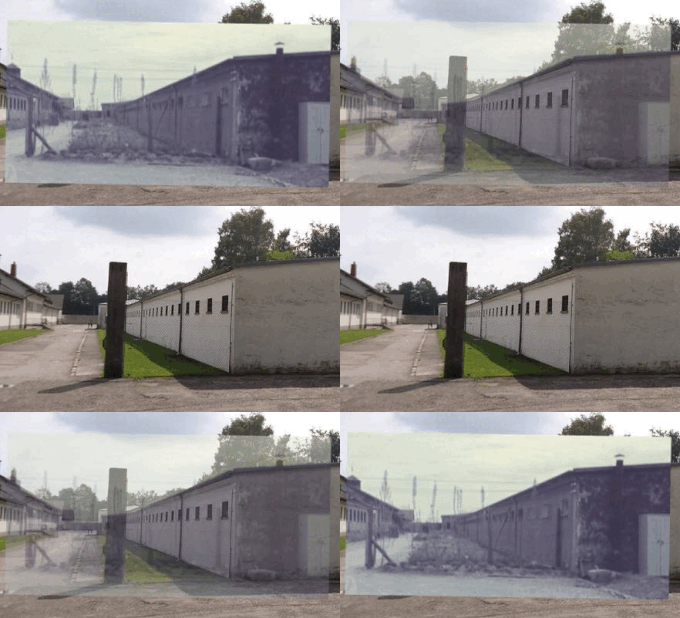 From 1941 special, prominent prisoners were locked up here whom the ϟϟ held as hostages in order to serve as negotiation tools. As a result, these special inmates had better living conditions than the other inmates such as Georg
Elser who'd been minutes away from blowing up Hitler. In addition, a punishment compound for ϟϟ men, police officers, and air defence personnel was set up in the east wing of the prison and an annex structure which no longer exists. According to a prisoner account by the former head orderly Heinrich Stohr, killing of the mentally disabled through phenol injections took place in the bunker. From 1943, prisoners suffering from tuberculosis were murdered by injection here in groups of twenty in a cell close to the guard room. The bunker is shown here in May 1945 and as it appears today. Today, the cells within provide first-hand accounts from bunker
prisoners through audio and visual terminals with biographical
information on some of the prisoners that were detained here.
From 1941 special, prominent prisoners were locked up here whom the ϟϟ held as hostages in order to serve as negotiation tools. As a result, these special inmates had better living conditions than the other inmates such as Georg
Elser who'd been minutes away from blowing up Hitler. In addition, a punishment compound for ϟϟ men, police officers, and air defence personnel was set up in the east wing of the prison and an annex structure which no longer exists. According to a prisoner account by the former head orderly Heinrich Stohr, killing of the mentally disabled through phenol injections took place in the bunker. From 1943, prisoners suffering from tuberculosis were murdered by injection here in groups of twenty in a cell close to the guard room. The bunker is shown here in May 1945 and as it appears today. Today, the cells within provide first-hand accounts from bunker
prisoners through audio and visual terminals with biographical
information on some of the prisoners that were detained here.
.gif)
From 1941 special, prominent prisoners were locked up here whom the ϟϟ held as hostages in order to serve as negotiation tools. As a result, these special inmates had better living conditions than the other inmates such as Georg
Elser who'd been minutes away from blowing up Hitler. In addition, a punishment compound for ϟϟ men, police officers, and air defence personnel was set up in the east wing of the prison and an annex structure which no longer exists. According to a prisoner account by the former head orderly Heinrich Stohr, killing of the mentally disabled through phenol injections took place in the bunker. From 1943, prisoners suffering from tuberculosis were murdered by injection here in groups of twenty in a cell close to the guard room. The bunker is shown here in May 1945 and as it appears today. Today, the cells within provide first-hand accounts from bunker
prisoners through audio and visual terminals with biographical
information on some of the prisoners that were detained here..gif)
On the left is a photograph of Franz Honig taken by the ϟϟ after committing suicide in his cell on December 6, 1941 and how the cell appears today.
By 1944 special cells were built in the camp prison in which individual cells were converted by being divided into four smaller cells, each of which measured only 80cm by 75cm giving them the name 'standing cells.' The prisoners often had to stay in the standing cells for many days receiving very little food and air. The brick chambers resembled chimneys in which was a ventilation opening at the top, and a narrow door with an iron bar locked the standing bunker. The intensified “punitive measure” saved space and increased the punishment ordeal. As a result, prisoners were exempt from forced labour in the camp for a shorter period of time. Polish prisoner Max Hoffmann spent days in the standing bunker describing it as
a terrible state when I thought that it was the end of me, when everything seemed so indifferent and so far away. I couldn't lie down, I couldn't squat, the best thing was standing, standing, for six days and six nights... With your elbows you touch the walls on both sides, with your back you touch the wall behind you, with your knees the wall in front of you... This is not punishment or pre-trial detention, this is torture, direct medieval torture. I had bloodshot eyes, was numb with bad air, and was just waiting for the end.
According to Johannes Neuhäusler, an inmate in the standing bunker only received a piece of bread for three days. On the fourth day, prisoners were taken out, given a normal ration of camp food, and allowed to sleep on a cot. The next day the three-day detention in the standing bunker began again. This break after the third day was not always observed however as Czech prisoner Radovan Drazan spent eight days without a break in the standing bunker. In some cases, prisoners weren't allowed out of the bunker for a short time, which resulted in chemical burns on their bodies from fæces and urine.
 Standing in front of the Bavarian Riot Police HQ (Bayerische Bereitschaftspolizei Abteilung VI. Dachau) and as it appeared as the main entrance to the ϟϟ training area during a personal tour of the entire compound. The area was occupied by the American army as the Eastman Barracks after after the war until 1973 when the Bavarian Riot Police (VI Department) moved in there. This was a result of the incompetence shown by the German authorities during the Olympic Games the year before in which eleven Israelis were massacred by terrorists, compelling the Americans to provide a site that would allow the Germans to train themselves to provide counter-terrorism, particularly today by training police officers and keeping hundreds of people ready for closed missions such as football games and demonstrations. The Bavarian Riot Police also provides the helicopter squadron of the Bavarian Police and the Bavarian Police Orchestra. I was advised not to take photos inside given the level of extremist terrorism from the extreme Left directed at those who work for the state in buildings built for and used by the ϟϟ.


.gif) The
Pocket Guide issued to troops stationed in Germany, a thoroughly
researched document containing in depth information about the culture,
customs and attitudes to expect in Nazi Germany, did not even mention
the existence of the camps, despite detailed military and political
knowledge of them. In fact, Eisenhower deliberately downplayed “a lot of
it [the conditions in the camps]” to avoid “men going nuts and reacting
like assassins” up to that point, although as we have seen his policy
drastically changed shortly after his own experiences. However, almost
simultaneously, Eisenhower had first-hand experience of the
concentration camp at Ohrduf; on April 12th, he toured the camp with General Patton and aides. Shortly thereafter, he ordered all the troops
in the vicinity to show them “what they were fighting for”. He also
organised an official delegation from the US to visit the camps, because
“all written statements up to now do not paint the full horrors.” The
events that occurred during the liberation of the Dachau concentration
camp have never been fully reconstructed or clarified. What's certain is
that as the 45th US Infantry Division Thunderbird advanced on the camp,
there were exchanges of fire with ϟϟ units and even executions of ϟϟ
members. The official documentation of the Dachau concentration camp
describes the executions as follows: "Some American soldiers were
so enraged by the sight of the death train that they began executing
captured ϟϟ men on their own initiative. When the battalion commander,
Felix L. Sparks, observed what was happening, he immediately stopped the
execution" shown here with him frantically shooting in the air.
The
Pocket Guide issued to troops stationed in Germany, a thoroughly
researched document containing in depth information about the culture,
customs and attitudes to expect in Nazi Germany, did not even mention
the existence of the camps, despite detailed military and political
knowledge of them. In fact, Eisenhower deliberately downplayed “a lot of
it [the conditions in the camps]” to avoid “men going nuts and reacting
like assassins” up to that point, although as we have seen his policy
drastically changed shortly after his own experiences. However, almost
simultaneously, Eisenhower had first-hand experience of the
concentration camp at Ohrduf; on April 12th, he toured the camp with General Patton and aides. Shortly thereafter, he ordered all the troops
in the vicinity to show them “what they were fighting for”. He also
organised an official delegation from the US to visit the camps, because
“all written statements up to now do not paint the full horrors.” The
events that occurred during the liberation of the Dachau concentration
camp have never been fully reconstructed or clarified. What's certain is
that as the 45th US Infantry Division Thunderbird advanced on the camp,
there were exchanges of fire with ϟϟ units and even executions of ϟϟ
members. The official documentation of the Dachau concentration camp
describes the executions as follows: "Some American soldiers were
so enraged by the sight of the death train that they began executing
captured ϟϟ men on their own initiative. When the battalion commander,
Felix L. Sparks, observed what was happening, he immediately stopped the
execution" shown here with him frantically shooting in the air.
Standing at the site and as it appeared in a photograph of the incident being interrupted by an irate Sparks, who ran from where he had
been stationed “about 100 to 200 meters on the other side of the wall”
To stop the shooting, Sparks shot his “.45 in the air whilst shouting
'Cease Fire!'”, before kicking the shooter away from the gun. The pink building to the right is an hospital. Sparks later described the area as enclosed by an “L-shaped masonry wall, about
eight feet high, which had been used as a coal bin. The ground was
covered with coal dust, and a narrow gauge railroad track, laid on top
of the ground, led into the area.” The prisoners were placed under the
command of Lt. William P. Walsh, the same man who had shot four ϟϟ guards on the
so-called Death Train. The number of men present varies enormously
between accounts, but according to the investigation carried out by the
Assistant Inspector General of the 7th Army, Joseph M. Whitaker (known
as the IG report), estimates were in the range of 50-125, with the
majority in the range of 50-75. From this point, the accounts of what
happened to these men diverge wildly. Walsh gave the order to the
machine gunner identified in the report as “C” and the other soldiers
present to shoot the PoWs if they moved. An eyewitness, Karl Mann,
remembered the I-Company officers deciding to shoot the ϟϟ men when
Sparks was no longer in sight, although this also conflicts with the IG
report which states that the ϟϟ men thought they were going
to be executed when the machine gunner loaded his weapon, and lurched
forward, triggering the shooting. However, other eyewitness reports,
including the gunman himself, indicate that the trigger had instead been
after someone shouted “fire”.

.gif)
On the right is the site looking the other direction. The walls are gone but the dying tree in the photograph taken today appears in the original photograph. In total, about fifty ϟϟ members were killed during the
liberation. The historian Jürgen Zarusky evaluated more recently
available sources, in particular copies of investigative documents from
the Assistant Inspector General of the 7th Army, Joseph M. Whitaker,
which were declassified in the summer of 1992, as well as further
documents from the estate of General Linden, which made it possible to
paint a more detailed picture of the events. According to these
documents, the shootings were various, rapid operations that took place
in a vast and confusing area. According to Zarusky, according to "fairly
reliable" findings, 39 ϟϟ men were killed by American soldiers in
violation of international law during the capture of the concentration
camp. The first incident occurred at the very beginning of the capture
of the concentration camp, directly on the death train. Shocked by the
sight of the train full of corpses, the commander of I Company of the
157th Infantry Regiment, Lieutenant Bill Walsh, along with another
soldier, shot four Sϟϟ men who had already surrendered. A major incident
occurred during the further penetration of I Company into the ϟϟ camp at
the Kohlenhof, where, also at the instigation of company commander
Walsh, another sixteen ϟϟ men were shot. Walsh's unit came across the ϟϟ
hospital at the entrance to the concentration camp , where they brought
at least an hundred Germans, including women, out onto the street. On Walsh's
orders, according to witnesses, between 50 and 75 ϟϟ men were separated
from the other prisoners and lined up against the wall of the Kohlenhof. In the nearby district
heating plant, an ϟϟ man was killed by prisoners in the presence of
American soldiers.
.gif) Numerous first-hand accounts from liberation portray the anger and
disbelief that the soldiers felt, coupled with the combat mindset they
still held, was expressed with violence. Letters home from soldiers also provide evidence to this effect; in one of Lt. Cowling’s letters home (written
three days earlier than his official report), he stated unequivocally that “I will never take another German prisoner armed or unarmed. How
can they expect to do what they have done and simply say 'I quit and go
scot free'? They are not fit to live.” This tendency had not gone
unnoticed by the Army brass present. It had become apparent to Sparks
early in the day that the emotions of the troops were running high,
and so he contacted headquarters for replacements to avoid an
“explosion.” Other accounts reference ϟϟ guards “shot in the legs so
they couldn’t move”, allowing the prisoners to take their revenge
against their captors. Shown here is a guard, named Weiss, who is being confronted by two Polish prisoners. Others handed over weapons to prisoners, or shoot
guards pointed out to them by their victims, or simply refused to
intervene on the behalf of the ϟϟ soldiers, who were under their
protection since the surrender of the camp. After the hospital shooting was stopped, some of the Americans allegedly gave a number of handguns to the now-liberated inmates. It has been claimed by eyewitnesses that the freed inmates tortured and killed a number of captured German troops, in retaliation for their treatment in the camp. The same witnesses claim that many of the German soldiers killed by the inmates were beaten to death with shovels and other tools supported by photographs of the event, a selection presented here. A number of Kapo prisoner-guards were also killed, torn apart by the inmates.
Numerous first-hand accounts from liberation portray the anger and
disbelief that the soldiers felt, coupled with the combat mindset they
still held, was expressed with violence. Letters home from soldiers also provide evidence to this effect; in one of Lt. Cowling’s letters home (written
three days earlier than his official report), he stated unequivocally that “I will never take another German prisoner armed or unarmed. How
can they expect to do what they have done and simply say 'I quit and go
scot free'? They are not fit to live.” This tendency had not gone
unnoticed by the Army brass present. It had become apparent to Sparks
early in the day that the emotions of the troops were running high,
and so he contacted headquarters for replacements to avoid an
“explosion.” Other accounts reference ϟϟ guards “shot in the legs so
they couldn’t move”, allowing the prisoners to take their revenge
against their captors. Shown here is a guard, named Weiss, who is being confronted by two Polish prisoners. Others handed over weapons to prisoners, or shoot
guards pointed out to them by their victims, or simply refused to
intervene on the behalf of the ϟϟ soldiers, who were under their
protection since the surrender of the camp. After the hospital shooting was stopped, some of the Americans allegedly gave a number of handguns to the now-liberated inmates. It has been claimed by eyewitnesses that the freed inmates tortured and killed a number of captured German troops, in retaliation for their treatment in the camp. The same witnesses claim that many of the German soldiers killed by the inmates were beaten to death with shovels and other tools supported by photographs of the event, a selection presented here. A number of Kapo prisoner-guards were also killed, torn apart by the inmates.At first the prisoners indulged in an innocent game of making the guards dance to their tune. They shouted ‘Mützen ab!’ and the ϟϟ men had to doff their caps. Then the Americans aided and abetted the prisoners in their revenge. One soldier lent an inmate a bayonet to behead a guard. A kapo was found lying naked with cuts all over his body and a gunshot wound to his head. They had rubbed salt into his wounds. Another was beaten to death with spades. Other guards were shot in the legs to immobilise them. Later reports drew a veil over what happened then, although it is clear that some of the Germans were ripped limb from limb. It seems that around forty more guards and kapos died this way.
MacDonogh (67) After the Reich
.gif) ϟϟ guards being fished out of the canal, and at the same site today. The soldier on the far right has been identified as 19-year-old Richard F. Dutro of 232 Infantry, E Company from Zanesville, Ohio. This was during the second major incident, during the advance of ϟϟ guards and prisoners along the camp fence, the entire crew of Watchtower B was killed in two actions in quick succession. This affected seventeen ϟϟ men who'd previously surrendered. Finally, in the area of the Jourhaus, another ϟϟ man who had surrendered was shot by a GI. Heinrich Wicker's whereabouts remain unknown to this day. He was last photographed on the death train with Victor Maurer after General Linden confronted him. After that, all trace of him disappeared. According to estimates by the 42nd Division, at least 25, perhaps fifty,ϟϟS men were killed by prisoners in the first 24 hours after the concentration camp's liberation. According to Whitaker's report, approximately 160 ϟϟ men were captured. He recommended the opening of court-martial proceedings for murder against Company Commander Walsh and four other soldiers, as well as proceedings for dereliction of duty against the military doctor Howard Buechner, who hadn't provided medical aid to the wounded men found. However, the Seventh Army headquarters under General Alexander Patch attempted to downplay the findings of Whitaker's report in a statement, according to Zarusky.
ϟϟ guards being fished out of the canal, and at the same site today. The soldier on the far right has been identified as 19-year-old Richard F. Dutro of 232 Infantry, E Company from Zanesville, Ohio. This was during the second major incident, during the advance of ϟϟ guards and prisoners along the camp fence, the entire crew of Watchtower B was killed in two actions in quick succession. This affected seventeen ϟϟ men who'd previously surrendered. Finally, in the area of the Jourhaus, another ϟϟ man who had surrendered was shot by a GI. Heinrich Wicker's whereabouts remain unknown to this day. He was last photographed on the death train with Victor Maurer after General Linden confronted him. After that, all trace of him disappeared. According to estimates by the 42nd Division, at least 25, perhaps fifty,ϟϟS men were killed by prisoners in the first 24 hours after the concentration camp's liberation. According to Whitaker's report, approximately 160 ϟϟ men were captured. He recommended the opening of court-martial proceedings for murder against Company Commander Walsh and four other soldiers, as well as proceedings for dereliction of duty against the military doctor Howard Buechner, who hadn't provided medical aid to the wounded men found. However, the Seventh Army headquarters under General Alexander Patch attempted to downplay the findings of Whitaker's report in a statement, according to Zarusky. .gif) On the right an American soldier stands beside the bodies of ϟϟ
personnel shot by American troops during the liberation and at the spot
today after managing to find a hole in the wire; the bodies wear the
camouflage coats used by the Waffen ϟϟ, and not worn by camp guards of the Allgemeine ϟϟ. Only the first incident directly at the death train was recognised whilst the events at the coal yard and at watchtower B were interpreted as preventing the prisoners from attempting to escape or as fighting. Whitaker was also accused of bias and a lack of understanding of the situation of the soldiers, who were confronted with disturbing horrors during the liberation. Ultimately, there was never an American trial for the killings during the liberation of the Dachau concentration camp.
On the right an American soldier stands beside the bodies of ϟϟ
personnel shot by American troops during the liberation and at the spot
today after managing to find a hole in the wire; the bodies wear the
camouflage coats used by the Waffen ϟϟ, and not worn by camp guards of the Allgemeine ϟϟ. Only the first incident directly at the death train was recognised whilst the events at the coal yard and at watchtower B were interpreted as preventing the prisoners from attempting to escape or as fighting. Whitaker was also accused of bias and a lack of understanding of the situation of the soldiers, who were confronted with disturbing horrors during the liberation. Ultimately, there was never an American trial for the killings during the liberation of the Dachau concentration camp.After entry into the camp, personnel of the 42nd Division discovered the presence of guards, presumed to be ϟϟ men, in a tower to the left of the main gate of the inmate stockade. This tower was attacked by Tec 3 Henry J. Wells 39271327, Headquarters Military Intelligence Service, ETO, covered and aided by a party under Lt. Col. Walter J. Fellenz, 0-23055, 222 Infantry. No fire was delivered against them by the guards in the tower. A number of Germans were taken prisoner; after they were taken, and within a few feet of the tower, from which they were taken, they were shot and killed.from the IG Report of the U.S. Seventh Army
.gif)
.gif)
In front of the Holländer Hall on the right. The building dates from 1915 when it was a gunpowder and munitions factory during the Great War and which was later used by the ϟϟ as a large garage and stables. Shown during the war and when I visited, this remains an important industrial monument with typical Art Nouveau features although today the building is in a state of disrepair and can't be entered.


Located within the grounds of the riot police compound is this sunken pool overgrown with vegetation topped by a Viking ship and Gothic script referring to the 'Führer'. No one I have spoken to, including those working at the memorial, has been able to identify its origins.

The Cold War shaped an American foreign policy that increasingly relied on the U.S.–Western German anticommunist alliance. The concentration camp disappeared from American propaganda in Germany, and Nazi atrocities receded to the distant background. The American efforts in Dachau in 1951 are emblematic. In order to “bridge the sea of misunderstanding,” the U.S. Army built a community centre in Dachau, and American officers invited local notables to a New Year’s party at the officers’ club.American officers organised a community-wide Christmas fund, encouraging civic cooperation between Catholics and “Evangelicalists” [sic], and tried to integrate the American military into the community. An ice rink in the U.S. Service Centre, previously reserved for American children, was opened to Germans. The centre’s new kindergarten likewise accepted German children to foster “a spirit of comradeship between children of the two nations.” “Prejudice has no place on Dachau’s playgrounds, where US and German kiddies show democracy in action,” boasted an article in the HICOG Monthly Bulletin. American official rhetoric no longer equated Dachau with its concentration camp.Cora Sol Goldstein (38-39) Capturing the German Eye
.gif)

Although scarcity was ubiquitous, the personnel used the workshops in Dachau, which already employed five hundred artisans in 1933, for its own private orders. This was the origin of the system of graft and corruption in which many members of the commandant office staffs were implicated later on. When the Dachau workshops were transferred from the supervision of the central Inspektion and placed under Pohl’s Administrative Office, that move met with fierce opposition from the clique of commandants. The shift to commercial principles curtailed their private power of control. This line of conflict between the economic administration echelon and the camp ϟϟ also resurfaced in differences over the later deployment of prisoners in arms manufacture.
Sofsky (174)

Release of roughly 600 prisoners from concentration camp at Christmas 1933 showing roughly fifty or sixty prisoners about to be released at the camp gate.

Himmler being driven through the main guard post of the camp in 1941; all that remains are the foundations recovered only since 2008. This is what is left of the former ϟϟ main guardhouse directly across from the ϟϟ Wirtschaftsbetriebe.
From 1935, this served as the entrance to the camp. Harassed and
beaten prisoners would pass through it from the railway station as well
as prisoner transport such as buses and lorries. The ϟϟ members used it
too when entering, and most lived further down this road to the ϟϟ
residences. This was the entrance through which the ϟϟ deployed in the camp reached the actual concentration camp area which was separated by a wall from the ϟϟ drill camp in 1936. The ϟϟ
deployed in the camp was divided into two units:– members of the
commandant’s staff were responsible for disciplining and controlling the
prisoners directly in the prisoner camp through fear through terror.
Reporting only to the commandant, they were the main culprits of the
torture, horrific punishment, and murders that took place. The ϟϟ
guard squads were responsible for watch on the towers and escorting
work details outside the camp grounds. These duties did not stop them
however from tormenting and murdering individual prisoners.

These buildings on what was the 'Strasse der ϟϟ', now within the Bavarian Riot Police HQ compound, served as residences for members of the ϟϟ. These villas were built as early as the time of the First World War and belonged to the former Muntions factory. Today only these eight houses remain of the former ϟϟ settlement and are used by the Bavarian riot police.
The centre of power was located in the administrative area. The offices of the camp commandant, the Political Department, and the administrative department were in close proximity to the prisoner camp, but just outside the barbed-wire perimeter. Every office of the KZ-Inspektion had its branch in this administrative zone. It served as the local representative of the central bureaucracy. A leafy, wooded area was set aside for the living quarters of the ϟϟ officers. In Dachau, these were located on the Straße der ϟϟ outside the camp.
Sofsky (49)

The Plantation (Kräutergarten)
.gif) The site in 1939 and today. In 1938 concentration camp prisoners were forced to build an herb garden (plantation) on the other side of the Alte Römerstrasse, east of the camp. Based on various ideologies, including Rudolf Steiner's principles of anthroposophy, the Nazis wanted to develop methods here to achieve war-related or ideologically desired agricultural production goals. Up to 1,600 prisoners from the neighbouring concentration camp were forced to perform sometimes extremely hard physical labour every day, of which up to 800 died. The cultivation of local herbs was the idea of the 'working group for medicinal plants studies' and Reichsführer ϟϟ Heinrich Himmler showed particular interest in the plan to ensure Germany should have no need to import foreign medicines and herbs. The economic importance of the work done by the prisoners in the herb garden increased as the war progressed.
The site in 1939 and today. In 1938 concentration camp prisoners were forced to build an herb garden (plantation) on the other side of the Alte Römerstrasse, east of the camp. Based on various ideologies, including Rudolf Steiner's principles of anthroposophy, the Nazis wanted to develop methods here to achieve war-related or ideologically desired agricultural production goals. Up to 1,600 prisoners from the neighbouring concentration camp were forced to perform sometimes extremely hard physical labour every day, of which up to 800 died. The cultivation of local herbs was the idea of the 'working group for medicinal plants studies' and Reichsführer ϟϟ Heinrich Himmler showed particular interest in the plan to ensure Germany should have no need to import foreign medicines and herbs. The economic importance of the work done by the prisoners in the herb garden increased as the war progressed. .gif) To that end from May 1938, concentration camp prisoners were forced to drain parts of the Dachauer Moos moorland east of the Alte Römerstraße and the Würm river and to build a large horticultural complex, including the associated commercial and administrative buildings. In addition to the cultivated areas, including greenhouses and an ornamental garden, it included commercial buildings, a watchtower, apartments, workshops, classrooms, a library, laboratories, a drying barn, a tool shed, a spice mill, a bee house, a composting facility, as well as a heating, transformer, and pump house. No expense was spared on the buildings, and what was then a state-of-the-art industrial horticultural operation was set up. Between 1939 and 1940, around 1 million Reichsmarks were spent. The cultivated area was continually expanded; when it was finally completed in 1942, it covered 148 hectares of open space, divided into "Freiland I" and "Freiland II". The area of "Freiland I" is now the Dachau East industrial park. The core of the complex consisted of two elongated, gabled-roof buildings with a courtyard and gateway. Four greenhouses, each six metres wide and 30 metres long, and two 3 metres wide and fifty metres long, were built. The ϟϟ assumed that an industrial horticultural operation of this size could not be run profitably by workers or the Labour Service. Therefore, plans were made to locate the operation near Dachau concentration camp, as slave labourers, officially referred to as "manual labourers," were available there. It was of no concern to those in charge of the ϟϟ whether these would be concentration camp inmates or prisoners of war. From 1942 onward, unskilled workers received a wage of sixty Reichspfennigs per day, and skilled workers up to three Reichsmarks. However, this was only on paper and for business documentation purposes, the money never being paid out. Inhumane exploitation and destruction through labour was the fundamental business model in Dachau. The Mehlhorn company from Saxony was responsible for the construction, and the glasshouses were designed according to their patents. Robust and moisture-resistant American redwood (Sequoia sempervirens) was used for the supporting structure of the glazing in order to thermally decouple the basic metal supporting structure from the glass and wood outer skin, thus preventing possible structural damage caused by temperature differences between the inside and outside air. The glasshouses had separating locks to divide them into different temperature zones. In addition, the concrete floor could be temperature-controlled, as could the water supplied to the plants. There was a living barracks and an air-raid shelter. Some of the buildings were expanded during the war, but some parts were left unfinished.
To that end from May 1938, concentration camp prisoners were forced to drain parts of the Dachauer Moos moorland east of the Alte Römerstraße and the Würm river and to build a large horticultural complex, including the associated commercial and administrative buildings. In addition to the cultivated areas, including greenhouses and an ornamental garden, it included commercial buildings, a watchtower, apartments, workshops, classrooms, a library, laboratories, a drying barn, a tool shed, a spice mill, a bee house, a composting facility, as well as a heating, transformer, and pump house. No expense was spared on the buildings, and what was then a state-of-the-art industrial horticultural operation was set up. Between 1939 and 1940, around 1 million Reichsmarks were spent. The cultivated area was continually expanded; when it was finally completed in 1942, it covered 148 hectares of open space, divided into "Freiland I" and "Freiland II". The area of "Freiland I" is now the Dachau East industrial park. The core of the complex consisted of two elongated, gabled-roof buildings with a courtyard and gateway. Four greenhouses, each six metres wide and 30 metres long, and two 3 metres wide and fifty metres long, were built. The ϟϟ assumed that an industrial horticultural operation of this size could not be run profitably by workers or the Labour Service. Therefore, plans were made to locate the operation near Dachau concentration camp, as slave labourers, officially referred to as "manual labourers," were available there. It was of no concern to those in charge of the ϟϟ whether these would be concentration camp inmates or prisoners of war. From 1942 onward, unskilled workers received a wage of sixty Reichspfennigs per day, and skilled workers up to three Reichsmarks. However, this was only on paper and for business documentation purposes, the money never being paid out. Inhumane exploitation and destruction through labour was the fundamental business model in Dachau. The Mehlhorn company from Saxony was responsible for the construction, and the glasshouses were designed according to their patents. Robust and moisture-resistant American redwood (Sequoia sempervirens) was used for the supporting structure of the glazing in order to thermally decouple the basic metal supporting structure from the glass and wood outer skin, thus preventing possible structural damage caused by temperature differences between the inside and outside air. The glasshouses had separating locks to divide them into different temperature zones. In addition, the concrete floor could be temperature-controlled, as could the water supplied to the plants. There was a living barracks and an air-raid shelter. Some of the buildings were expanded during the war, but some parts were left unfinished. .gif) The ϟϟ guards marched the prisoners to work on the large open-air site under abusive threats and blows, and prisoners were arbitrarily shot 'while attempting to escape'. The working conditions were atrocious. The choice of terrain was extremely unfavourable: the wet, heavy peat soil was unsuitable for growing herbs. It had to be re-layered, drained, and deacidified. When it rained, the prisoners sank into the mud; in the summer, they stood in the blazing sun, toiling on soil as hard as concrete. Originally, it was mainly Jews , Sinti and Roma who were forced to work here, but from 1942 onwards, on the personal orders of Himmler, it was mainly priests who were used. From 1940 onwards, around 1,500 prisoners were forced to work in the herb garden. Around 300 were deployed at one time, and it is estimated that up to 1,000 workers were employed on average throughout the day. For the summer of 1944, the ϟϟ counted 1,600 prisoners assigned to the herb garden. Around a third of these were employed in the buildings, two-thirds in the outdoor area. However, the numbers fluctuated considerably, as few workers were needed in the winter months, while significantly more were needed in the spring, with peak workloads occurring especially in the summer and autumn. Working in the outdoor area, especially in winter, was gruelling. The prisoners only had thin drill suits and coats. This offered little protection from the cold, and if they got wet, the prisoners had to go to bed in wet clothes because there was no change of clothes. The poor supply of food further increased the suffering of the forced labourers. In general, Stanislav Zámečník recalled the ineffective, inhumane organization of work by the ϟϟ in the outdoor area: From 1941, 400 to 500 prisoners were deployed on "Freiland II." The area could have been ploughed by two horses in a few days. Instead, the area was dug up by hand with a spade. In total, at least 800 prisoners died here between 1939 and 1945. Many who did not die of hunger and hardship were shot by ϟϟ men for crossing an invisible border line, coerced by their guards. The cause of death was cynically recorded as " suicide " in the files. Less brutal working conditions reigned only in the buildings and greenhouses. There a work detail of draughtsmen was supposed to produce a plant collection for Himmler. At the risk of losing their lives, some of the prisoners managed to depict the crimes committed by ϟϟ guards in secret notes. The ϟϟ set up a shop as part of the herb garden to sell produce from the 'plantation' to residents from Dachau and neighbouring communities. Some prisoners succeeded in establishing secret contact to the civilian population, notably with locals like Resi Huber who had secretly slipped the emaciated prisoners food and smuggled letters for them. However, ϟϟ guards were constantly present and violators were severely punished.
The ϟϟ guards marched the prisoners to work on the large open-air site under abusive threats and blows, and prisoners were arbitrarily shot 'while attempting to escape'. The working conditions were atrocious. The choice of terrain was extremely unfavourable: the wet, heavy peat soil was unsuitable for growing herbs. It had to be re-layered, drained, and deacidified. When it rained, the prisoners sank into the mud; in the summer, they stood in the blazing sun, toiling on soil as hard as concrete. Originally, it was mainly Jews , Sinti and Roma who were forced to work here, but from 1942 onwards, on the personal orders of Himmler, it was mainly priests who were used. From 1940 onwards, around 1,500 prisoners were forced to work in the herb garden. Around 300 were deployed at one time, and it is estimated that up to 1,000 workers were employed on average throughout the day. For the summer of 1944, the ϟϟ counted 1,600 prisoners assigned to the herb garden. Around a third of these were employed in the buildings, two-thirds in the outdoor area. However, the numbers fluctuated considerably, as few workers were needed in the winter months, while significantly more were needed in the spring, with peak workloads occurring especially in the summer and autumn. Working in the outdoor area, especially in winter, was gruelling. The prisoners only had thin drill suits and coats. This offered little protection from the cold, and if they got wet, the prisoners had to go to bed in wet clothes because there was no change of clothes. The poor supply of food further increased the suffering of the forced labourers. In general, Stanislav Zámečník recalled the ineffective, inhumane organization of work by the ϟϟ in the outdoor area: From 1941, 400 to 500 prisoners were deployed on "Freiland II." The area could have been ploughed by two horses in a few days. Instead, the area was dug up by hand with a spade. In total, at least 800 prisoners died here between 1939 and 1945. Many who did not die of hunger and hardship were shot by ϟϟ men for crossing an invisible border line, coerced by their guards. The cause of death was cynically recorded as " suicide " in the files. Less brutal working conditions reigned only in the buildings and greenhouses. There a work detail of draughtsmen was supposed to produce a plant collection for Himmler. At the risk of losing their lives, some of the prisoners managed to depict the crimes committed by ϟϟ guards in secret notes. The ϟϟ set up a shop as part of the herb garden to sell produce from the 'plantation' to residents from Dachau and neighbouring communities. Some prisoners succeeded in establishing secret contact to the civilian population, notably with locals like Resi Huber who had secretly slipped the emaciated prisoners food and smuggled letters for them. However, ϟϟ guards were constantly present and violators were severely punished.  Himmler visiting the site. The area served to supply the eastern front with vitamin C and active plant substances and was thus a building block for the planned war of aggression. Based on the poor supply situation during the First World War, the herb
garden had an important military task: The gladioli grown in Dachau were
pulverised and processed into vitamin C, and sent to the Eastern Front
as parcels for the soldiers of the Wehrmacht and the Waffen ϟϟ. A
mixture of ground basil, thyme, and savoury served as a German pepper
substitute. There was also the goal of developing "German drugs",
possibly with the motive of strengthening the soldiers' willingness to
fight.
Himmler visiting the site. The area served to supply the eastern front with vitamin C and active plant substances and was thus a building block for the planned war of aggression. Based on the poor supply situation during the First World War, the herb
garden had an important military task: The gladioli grown in Dachau were
pulverised and processed into vitamin C, and sent to the Eastern Front
as parcels for the soldiers of the Wehrmacht and the Waffen ϟϟ. A
mixture of ground basil, thyme, and savoury served as a German pepper
substitute. There was also the goal of developing "German drugs",
possibly with the motive of strengthening the soldiers' willingness to
fight.After the start of the war, the Dachau herb garden was also part of the planning of the ϟϟ settlement policy of the Race and Settlement Main Office (RuSHA), set out in the General Plan East in Eastern Europe in which after a victory over the Soviet
Union, the depopulated areas were to be settled by German farmers, whose
cultivation methods were to be developed in the Dachau herb
garden. When it was completed in 1942, it was 148 hectares, the open spaces of which the ϟϟ cynically divided into the field names " Freiland I" and " Freiland II".
 No savings were made for the various farm buildings, watchtower, apartments, workshops, classrooms, library, laboratories, drying barn and tool shed, greenhouses, spice mill, apiary, composting plant, ornamental garden and necessary facilities and installations (heating, transformer and pump house) and at that time a state-of-the-art, industrial horticultural company. The core of the complex were two elongated gable roof buildings with a courtyard and a gate seen with me in front on the left. Four 6 metre wide and 30 metre long greenhouses were built, as well as two 3 metre wide and fifty metre long greenhouses. The Mehlhorn company from Saxony was responsible for the construction, owning patents for the applied construction of the glass structures using resistant, moisture-resistant American redwood which enabled the metal base support structure to be thermally decoupled from the glass and wood outer skin in order to avoid structural damage that could occur as the outside temperature can differ significantly from the inside temperature of a greenhouse. There were separating locks in the glass houses to divide them into temperature zones. There was a living barracks and an air raid shelter. On the right is a drawing of the main building of the plantation from 1943 by Czech prisoner Karel Kašák. During the war, the buildings were partially expanded, but parts were not completed either. Between 1939 and 1940 around 1 million Reichsmarks were spent.
 .gif) The driving forces behind all this were Ernst Günther Schenck, who later became the "food inspector of the Waffen-ϟϟ", and Rudolf Lucaß, the master horticulturalist. According to the aims of the Deutschen Versuchsanstalt für Ernährung und Verpflegung GmbH (DVA) headed by ϟϟ-Obersturmbannführer Heinrich Vogel, Germany was to gain self-sufficiency in medicines, drugs, spices and medicinal plants whilst developing ways beyond the natural sciences that were suspected of being Jewish, and to develop models of how to improve German public health. In line with the Nazi ideology, the folk and natural history ideas were to be bundled in a "German folk medicine." Inspired by the esoteric teachings of Rudolf Steiner, a Nazi derivation of organic farming was practised.
The driving forces behind all this were Ernst Günther Schenck, who later became the "food inspector of the Waffen-ϟϟ", and Rudolf Lucaß, the master horticulturalist. According to the aims of the Deutschen Versuchsanstalt für Ernährung und Verpflegung GmbH (DVA) headed by ϟϟ-Obersturmbannführer Heinrich Vogel, Germany was to gain self-sufficiency in medicines, drugs, spices and medicinal plants whilst developing ways beyond the natural sciences that were suspected of being Jewish, and to develop models of how to improve German public health. In line with the Nazi ideology, the folk and natural history ideas were to be bundled in a "German folk medicine." Inspired by the esoteric teachings of Rudolf Steiner, a Nazi derivation of organic farming was practised.
.gif) The driving forces behind all this were Ernst Günther Schenck, who later became the "food inspector of the Waffen-ϟϟ", and Rudolf Lucaß, the master horticulturalist. According to the aims of the Deutschen Versuchsanstalt für Ernährung und Verpflegung GmbH (DVA) headed by ϟϟ-Obersturmbannführer Heinrich Vogel, Germany was to gain self-sufficiency in medicines, drugs, spices and medicinal plants whilst developing ways beyond the natural sciences that were suspected of being Jewish, and to develop models of how to improve German public health. In line with the Nazi ideology, the folk and natural history ideas were to be bundled in a "German folk medicine." Inspired by the esoteric teachings of Rudolf Steiner, a Nazi derivation of organic farming was practised.
The driving forces behind all this were Ernst Günther Schenck, who later became the "food inspector of the Waffen-ϟϟ", and Rudolf Lucaß, the master horticulturalist. According to the aims of the Deutschen Versuchsanstalt für Ernährung und Verpflegung GmbH (DVA) headed by ϟϟ-Obersturmbannführer Heinrich Vogel, Germany was to gain self-sufficiency in medicines, drugs, spices and medicinal plants whilst developing ways beyond the natural sciences that were suspected of being Jewish, and to develop models of how to improve German public health. In line with the Nazi ideology, the folk and natural history ideas were to be bundled in a "German folk medicine." Inspired by the esoteric teachings of Rudolf Steiner, a Nazi derivation of organic farming was practised. The site has been owned by the city of Dachau since 1957, but no appropriate use for the site as a place of remembrance has yet been found. The remains of the greenhouses today are now listed as historical monuments, as are some of the adjacent buildings. Karl Freller declared as early as 2012 that "[t]he sight of the dilapidated buildings is an impressive call for action." However, as of 2019, the city of Dachau and the state had not reached an agreement on sponsorship, ownership, and costs. In 2014, apartments were built in the research and laboratory building, thus partially losing the original structure. From 2015 onwards, the buildings were used by the city of Dachau primarily for social housing and to house the massive influx of refugees after Germany summarily opened is borders. They are structurally in poor condition and have been temporarily secured by the city of Dachau. By 2022, the greenhouses were rotting away, and the responsibility between the city of Dachau and the Free State of Bavaria remains unclear. A simple information panel points to the historical background of the facility.
.jpg)
Between
the plantation buildings of the former Dachau herb garden and the
entrance to the ϟϟ-Schießplatz Hebertshausen stand five single-family
houses erected in 1937–1938 for higher-ranking ϟϟ officers of the camp.
The houses, numbered Am Kräutergarten 1 to 5, were built according to
the standard pattern of the Deutsche Arbeitsfront settlement programme
using yellow clinker brick with hipped roofs and measured 142 square
metres of living space each. Construction was completed on October 15,
1938, and the keys were handed over on November 1, 1938. After listening to Adrian Weale's audiobook on the ϟϟ, where he suggests Adolf Eichmann lived in one at one point; indeed, from 1939 until
early 1942 the house at Am Kräutergarten 3 was occupied by
Eichmann, then head of Referat IV B 4
(Judenangelegenheiten) in the Reichssicherheitshauptamt. Eichmann moved
in with his wife Veronika and their sons Klaus and Dieter shortly after
his promotion to Hauptsturmführer on November 9, 1938. The allocation
order dated December 12, 1938, signed by ϟϟ-Gruppenführer Richard
Glücks, explicitly names Eichmann as tenant of house number 3. He
resided there until his transfer to Berlin in March 1942.The other four
houses were assigned to future Auschwitz Kommandant ϟϟ-Sturmbannführer Rudolf Höß (number 1,
1938–1940), ϟϟ-Hauptsturmführer Max Koegel (number 2, 1939–1943),
ϟϟ-Obersturmführer Franz Hofmann (number 4, 1940–1945), and
ϟϟ-Untersturmführer Johann Baptist Eichelsdörfer (number 5, 1938–1945).
All five buildings survived the war undamaged and were used by the American Army from May 1945 until 1972. Since 1973 they have been
private residential properties. They are shown here beside the Plantation
complex in the scale model of the camp in the memorial site. Today one
of the inhabitants chooses to fly the Confederate flag outside Höß's former house seen with me bottom right.
Meanwhile AMAZON nixes rebel flag, continues selling Nazi memorabilia...
Meanwhile AMAZON nixes rebel flag, continues selling Nazi memorabilia...
Hebertshausen ϟϟ Range
.gif)

.gif)
Standing
at the entrance to the shooting range April 30, 1945 and today; the
ϟϟ runes have been removed but their traces remain on the now
superfluous posts.
 In front of the coffin depot and shooting range in 1938 and today. The victims were killed as they were handcuffed to posts on the left side of the range shown on the right. Five of the prisoners brought in by truck had to step in front of the range undressed. They were handcuffed to waist-high stakes. Each of the twenty ϟϟ henchmen fired a shot on command in what they dubbed the "rifle festival". About 0.5 metres below the turf, to the right of the mound behind me in front of the opening of the bullet trap, is the place where thousands of Soviet prisoners of war died from 1941-42. After
analysing the witness reports and aerial photos, the Institute for
Prehistory and Early History and Provincial Roman Archaeology of the
Ludwig-Maximilians-University in Munich carried out archaeological excavations
in both shooting lanes of the former pistol shooting range in spring
and autumn 2001 which supplemented the understanding obtained from
historical research into the mass shootings of four to six thousand
Soviet prisoners of war there during the years 1941 and 1942 with
previously unknown aspects that were not mentioned in the witness
reports. Together with a detailed digital survey of the entire complex,
excavation areas were opened at various points in order to find the
former fence, the coffin storage and the remains of the posts mentioned
in witness reports, to which the victims were handcuffed. The western
shooting range was identified as the exclusive site of the executions of
1941-1942 and the place where the victims met their deaths were
precisely localised archaeologically. A considerable number of skull
fragments were found from the murdered. The results of the historical, archaeological and anthropological investigations confirmed that the mass
murder committed on the shooting range was particularly cruel, going
far beyond the standard of "normal executions".
In front of the coffin depot and shooting range in 1938 and today. The victims were killed as they were handcuffed to posts on the left side of the range shown on the right. Five of the prisoners brought in by truck had to step in front of the range undressed. They were handcuffed to waist-high stakes. Each of the twenty ϟϟ henchmen fired a shot on command in what they dubbed the "rifle festival". About 0.5 metres below the turf, to the right of the mound behind me in front of the opening of the bullet trap, is the place where thousands of Soviet prisoners of war died from 1941-42. After
analysing the witness reports and aerial photos, the Institute for
Prehistory and Early History and Provincial Roman Archaeology of the
Ludwig-Maximilians-University in Munich carried out archaeological excavations
in both shooting lanes of the former pistol shooting range in spring
and autumn 2001 which supplemented the understanding obtained from
historical research into the mass shootings of four to six thousand
Soviet prisoners of war there during the years 1941 and 1942 with
previously unknown aspects that were not mentioned in the witness
reports. Together with a detailed digital survey of the entire complex,
excavation areas were opened at various points in order to find the
former fence, the coffin storage and the remains of the posts mentioned
in witness reports, to which the victims were handcuffed. The western
shooting range was identified as the exclusive site of the executions of
1941-1942 and the place where the victims met their deaths were
precisely localised archaeologically. A considerable number of skull
fragments were found from the murdered. The results of the historical, archaeological and anthropological investigations confirmed that the mass
murder committed on the shooting range was particularly cruel, going
far beyond the standard of "normal executions"..gif)
 Next to the open left shed door, a room is seen leaning against the outer wall. The photographic reproduction of the wooden fence is important, given that it towered over the shed. The question arises whether it was specially built for the planned executions. Because on the already fenced and cordoned off area of the shooting range, its existence otherwise would make little sense given that on the one hand, the high wooden wall offered protection against unwanted glances, since the shooting range was not only visible from the heights outside the ϟϟ area and from the nearby railway embankment, but was also generally visible. On the other hand it prevented any attempts to escape. The area was all surrounded by a high deck fence to prevent any observation from the surrounding fields. The shootings must have been real bloodbaths, for which the ϟϟ involved had special overalls, aprons and gloves at their disposal. As the outside exhibition points out, the majority of perpetrators from the firing range were not directly confronted with either the dead behind the front or with dying in combat at the front. As evidenced by the testimony of Josef Thora, after work they were able to return to Munich or to the surrounding communities, which were still largely peaceful at the time.

Former Czech political prisoner Karel
Kasak's photo of the site immediately after the war, and a sketch of the
execution site by Lengfelder from April 29, 1954.
Lengfelder would receive a sentence of life imprisonment after the Anton
Stinglwagner trial of August 12-14, 1947. Within the entire area, the former pistol shooting range is more than just a place of remembrance; here in front of the bullet trap, at the site of the executions, rest scattered over an area of several metres - still under the protective turf today the only surviving remains of the corpses of the Soviet prisoners of war who were burned in the Munich and Dachau crematoria.
Given that thus far no more than a
quarter to a third of the expected fragments of precious metal have been
recovered, the majority must still lie in the ground. As a crime scene and as a cemetery/war grave, this site continues to suffer from illegal robbers and dogs running free.


Maria
Seidenberger took these photos from the second floor window of her
family's home whilst her mother stood outside and gave potatoes to the
prisoners. Karel Kasak is shown standing with his back to the camera in
the first photo, wearing a white shirt. According to Kasak's diary the
prisoners were coming from Nuremberg. Maria Seidenberger is the second
child of Georg and Katharina Seidenberger. In 1943 she made the
acquaintance of Karel Kasak, a Czech prisoner who was assigned to take
photographs of flowers in the gardens right outside the main entrance to
Dachau. He took advantage of his position to also photograph other
prisoners and needed a safe place to hide his photos. Having learned
that Maria worked in a photo lab, he asked if she would hide his
clandestine photos. She also secretly stored Dachau prisoner photos and
letters in her family's beehive and mailed them to the prisoner's
relatives back in Czechoslovakia. She even hid the personal
papers and human remains (a heart and death mask) of Masryk's personal
archivist, Jaroslav Simsov, who died of typhus in Dachau.


Maria explained how she and her mother heard the constant noise of the gun firing in her house during the day and stood frozen over the kitchen sink sobbing, knowing that each bullet meant the death of a person. On a Sunday Maria and Kasak, searched for the site where the Soviet PoWs were buried and found the mass grave. Maria went to the mass grave site to establish that mass murder had indeed happened and photographed the site. She gave her negatives to the Czech prisoner, Karel Kasak. During the final weeks of the war, Maria photographed the death march from Buchenwald to Dachau from inside her home in Hebertshausen. One photograph shows her mother distributing potatoes to the prisoners. After the war, Maria accompanied Kasak back to Czechoslovakia before returning to Hebertshausen in 1959.

.gif)


Nazi sites around Nuremberg town centre history then and now current state virtual tours 2025 can I visit today what happened during WWII preservation efforts drone footage 2025 Holocaust education ethical debates on touring Nazi sites augmented reality experiences contemporary significance guided tours digital archives underground structures memorial sites interactive timelines of Nazi events 1930s to now virtual reality reconstructions current excavations and restorations historical photos then and now augmented reality apps educational resources post-war changes modern exhibits at Nazi sites in Nuremberg city centre


.gif)
.gif)