

 One
of Hitler's first acts when he was appointed Chancellor was to order the
construction of two massive stone Temples of Honour on
Konigsplatz between the two main Nazi Party buildings. Now left in ruins, the city of Munich has long decided
to just cover the site up with vegetation and ignore its existence. The site had previously been occupied by two residential buildings, which Karl von Fischer, the architect who planned the Königsplatz building complex, had built to match the overall impression. However, even before the Nazis took power, there were plans by various architects to create a counterweight at the eastern end of Königsplatz to the Propylaea on the west side. In 1883, the architect Max von Heckel planned to replace the Fischer family's residential buildings with two temple-like buildings. In 1924, another design for the redesign of Königsplatz was submitted by O. O. Kurz who presented a plan for a "Patriotic Heroes' Square" for the Munich residents who fell in the Great War. His plans envisioned a Königsplatz with surrounding halls of honour and a gateway on the east side which would be visually comparable to the Brandenburg Gate in Berlin.
One
of Hitler's first acts when he was appointed Chancellor was to order the
construction of two massive stone Temples of Honour on
Konigsplatz between the two main Nazi Party buildings. Now left in ruins, the city of Munich has long decided
to just cover the site up with vegetation and ignore its existence. The site had previously been occupied by two residential buildings, which Karl von Fischer, the architect who planned the Königsplatz building complex, had built to match the overall impression. However, even before the Nazis took power, there were plans by various architects to create a counterweight at the eastern end of Königsplatz to the Propylaea on the west side. In 1883, the architect Max von Heckel planned to replace the Fischer family's residential buildings with two temple-like buildings. In 1924, another design for the redesign of Königsplatz was submitted by O. O. Kurz who presented a plan for a "Patriotic Heroes' Square" for the Munich residents who fell in the Great War. His plans envisioned a Königsplatz with surrounding halls of honour and a gateway on the east side which would be visually comparable to the Brandenburg Gate in Berlin.  In 1933, after the Nazis seized power, the transformation of Königsplatz (by now renamed Königlicher Platz) into the ideological and administrative centre of the Nazi Party began in earnest. Architect Paul Ludwig Troost was entrusted with this task, and, based on the plans of Max von Heckel, demolished the two residential buildings and replaced them with two "temples of honour."
Its construction lasted over two years, and the Celebration of November 9, 1935 was the event by which it was consecrated. Twenty fluted columns towering 23 feet above the ground were arranged on two 70-foot-wide limestone pedestals and which supported an open roof of steel and concrete with etched glass mosaics decorating the underside. In a two-day ceremony, Hitler brought the dead to their final resting place. On November 7, 1935, twelve years after the attempted putsch, the bodies of Ehrlich and others were exhumed and taken to the Feldherrnhalle, escorted by SA storm troops. After the pallbearers ceremoniously carried the caskets up the massive steps, the crowd sang the Horst Wessel song. Soon after, Hitler appeared and individually saluted the dead men before pausing in front of each casket.
 The
next morning began with a 16-gun salute. The old comrades assembled
around the “Bürgerbräukeller” and, commemorating the infamous march of
1923, silently retraced their steps to the Feldherrnhalle led by Julius Streicher behind whom were three men bearing the Blutfahne.
Hitler was flanked by veteran fighters followed by members of the
“Blutorden”, SA and ϟϟ troops, Hitler Youth, and paramilitary troops. A
crowd of tens of thousands stood along the parade route lined by a
cordon of SA soldiers. Accompanied by marching drummers, the Horst
Wessel song blared from gigantic loudspeakers. Black smoke wafted from
400 blazing pylons along the route, each bearing the name of one of the
“martyrs” of the movement in gold letters. Flag-bearing delegations from
the Nazi administrative districts stood nearby. As Hitler passed each
pylon, the immortalised name of each “martyr” was announced over the
loudspeakers. The
caskets were then taken on carriages to Königsplatz square. The moment
the first carriage arrived on the square, a shot was fired and the flags
of the movement and of the Wehrmacht were lowered. Veteran fighters
placed the caskets on the podium. Two large swastika banners were then
raised in unison. The Völkischer Beobachter reported
that Königsplatz had thus been transformed into “a mighty forum for the
movement.” The heroes were now resting in the Nazi Party’s “holy
sanctuary.” Hitler proclaimed: “Just as they marched fearlessly, so too
shall they lie in the wind and weather, in the storms and rain, in the
snow and ice, and in the sun, under the heavens. They will lie here in
open as an eternal symbol of the German nation. For us they are not
dead.”
The
next morning began with a 16-gun salute. The old comrades assembled
around the “Bürgerbräukeller” and, commemorating the infamous march of
1923, silently retraced their steps to the Feldherrnhalle led by Julius Streicher behind whom were three men bearing the Blutfahne.
Hitler was flanked by veteran fighters followed by members of the
“Blutorden”, SA and ϟϟ troops, Hitler Youth, and paramilitary troops. A
crowd of tens of thousands stood along the parade route lined by a
cordon of SA soldiers. Accompanied by marching drummers, the Horst
Wessel song blared from gigantic loudspeakers. Black smoke wafted from
400 blazing pylons along the route, each bearing the name of one of the
“martyrs” of the movement in gold letters. Flag-bearing delegations from
the Nazi administrative districts stood nearby. As Hitler passed each
pylon, the immortalised name of each “martyr” was announced over the
loudspeakers. The
caskets were then taken on carriages to Königsplatz square. The moment
the first carriage arrived on the square, a shot was fired and the flags
of the movement and of the Wehrmacht were lowered. Veteran fighters
placed the caskets on the podium. Two large swastika banners were then
raised in unison. The Völkischer Beobachter reported
that Königsplatz had thus been transformed into “a mighty forum for the
movement.” The heroes were now resting in the Nazi Party’s “holy
sanctuary.” Hitler proclaimed: “Just as they marched fearlessly, so too
shall they lie in the wind and weather, in the storms and rain, in the
snow and ice, and in the sun, under the heavens. They will lie here in
open as an eternal symbol of the German nation. For us they are not
dead.” All this had followed the purge of the SA during
the Night of the Long Knives the year before. The bodies were exhumed
from their graves and taken to the Feldherrnhalle where they were placed
beneath sixteen large pylons bearing their names. The next day, after
Hitler had solemnly walked from one to the next, they were taken down
the monument’s steps and taken on carts, draped in flags to Troost’s new Ehrentempel monuments
at the Konigsplatz, through streets lined with spectators bustling
between 400 columns with eternal flames atop. Flags were lowered as
veterans slowly and orderly placed the heavy sarcophagi into place. In
each of the structures eight of the martyrs were interred in a
sarcophagus bearing their name. In fact, it is believed that the
sixteenth person to be honoured at the celebrations was not a National
Socialist, but an uninvolved waiter from the nearby Café Annast, Karl Kulm, who was killed by a ricochet. Each temple held the sarcophagi of eight 'martyrs' with two ϟϟ honour guards keeping vigil.
All this had followed the purge of the SA during
the Night of the Long Knives the year before. The bodies were exhumed
from their graves and taken to the Feldherrnhalle where they were placed
beneath sixteen large pylons bearing their names. The next day, after
Hitler had solemnly walked from one to the next, they were taken down
the monument’s steps and taken on carts, draped in flags to Troost’s new Ehrentempel monuments
at the Konigsplatz, through streets lined with spectators bustling
between 400 columns with eternal flames atop. Flags were lowered as
veterans slowly and orderly placed the heavy sarcophagi into place. In
each of the structures eight of the martyrs were interred in a
sarcophagus bearing their name. In fact, it is believed that the
sixteenth person to be honoured at the celebrations was not a National
Socialist, but an uninvolved waiter from the nearby Café Annast, Karl Kulm, who was killed by a ricochet. Each temple held the sarcophagi of eight 'martyrs' with two ϟϟ honour guards keeping vigil. The
'martyrs of the movement' were placed within heavy black sarcophagi in
such a way as to be exposed to the elements from the open roof. Here
they're shown as they appeared and today with a school group from the time visiting. Designed by Professor Heinlein, the sarcophagi originally cast at the Wasseralfingen steel works in Baden-Württemberg and the eight columns weighing over 21 tonnes were recycled to make brake shoes for municipal buses. Weighing nearly 2,900 pounds, the metal caskets were converted to repair rail ties and electrical lines. Munich had discreetly rid itself of its former Nazi martyrs. The bronze eagles designed by party member Kurt Schmidt-Ehmen were removed and the former Nazi buildings on Königsplatz are now used by music students and cultural institutions. At the temples visitors were required to be silent, not wear hats and keep children from running over the centre of the temples. The Ehrentempel was made of limestone except for its roof which was made of steel and concrete with etched glass mosaics. The pedestals of the temples, which are the only parts remaining, are seventy feet wide. The columns of the structures each extended twenty-three feet. The combined weight of the sarcophagi was over 2,900 pounds.
The
'martyrs of the movement' were placed within heavy black sarcophagi in
such a way as to be exposed to the elements from the open roof. Here
they're shown as they appeared and today with a school group from the time visiting. Designed by Professor Heinlein, the sarcophagi originally cast at the Wasseralfingen steel works in Baden-Württemberg and the eight columns weighing over 21 tonnes were recycled to make brake shoes for municipal buses. Weighing nearly 2,900 pounds, the metal caskets were converted to repair rail ties and electrical lines. Munich had discreetly rid itself of its former Nazi martyrs. The bronze eagles designed by party member Kurt Schmidt-Ehmen were removed and the former Nazi buildings on Königsplatz are now used by music students and cultural institutions. At the temples visitors were required to be silent, not wear hats and keep children from running over the centre of the temples. The Ehrentempel was made of limestone except for its roof which was made of steel and concrete with etched glass mosaics. The pedestals of the temples, which are the only parts remaining, are seventy feet wide. The columns of the structures each extended twenty-three feet. The combined weight of the sarcophagi was over 2,900 pounds.  The
Führerbau behind one of the "temples of honour" with a soldier of
the ϟϟ-Verfügungstruppe Standarte 1 Deutschland in prewar helmet serving
as honour guard and looking at the same vantage point from the toilet
of its sister building Verwaltungsbau. The ϟϟVT 1 'Deutschland' assumed
formal responsibility for the permanent honour guard at the Ehrentempel
on March 1, 1936 which was the first formal public duty assigned to the
unit following its official establishment the previous month, taking
over from the Allgemeine ϟϟ. The standard posting consisted of sixteen
men on duty at any time, rotated on two hour shifts. Two armed sentries
were posted at each of the four corners of the two temple structures.
Standing orders authorised sentries to shoot any unauthorised person
attempting to cross the perimeter barrier onto the temple platform,
without requirement to give a warning shot first. Seven separate
shooting incidents were recorded between 1936 and 1945, five of which
resulted in fatalities. This duty was considered the most prestigious
non-combat posting in the entire ϟϟ. Selection was restricted
exclusively to men with five or more years continuous party membership,
full Aryan ancestry certification and an unblemished service record.
Unit rosters confirm that no man assigned to the detail ever failed to
complete a full tour of duty for the entire period the post existed. The
honour guard continued operating without interruption after the full
camouflage netting shown further below was installed on July 23, 1943. Sentries
remained at their posts underneath the netting, completely invisible to
members of the public in the square below. A further two fatal shootings
occurred in this period, when civilians climbed onto the structures
believing they had been abandoned. The detail was formally stood down at
23.17 on April 29, 1945, eleven hours prior to the formal surrender of
Munich and the remaining detachment withdrew from the square
immediately.
The
Führerbau behind one of the "temples of honour" with a soldier of
the ϟϟ-Verfügungstruppe Standarte 1 Deutschland in prewar helmet serving
as honour guard and looking at the same vantage point from the toilet
of its sister building Verwaltungsbau. The ϟϟVT 1 'Deutschland' assumed
formal responsibility for the permanent honour guard at the Ehrentempel
on March 1, 1936 which was the first formal public duty assigned to the
unit following its official establishment the previous month, taking
over from the Allgemeine ϟϟ. The standard posting consisted of sixteen
men on duty at any time, rotated on two hour shifts. Two armed sentries
were posted at each of the four corners of the two temple structures.
Standing orders authorised sentries to shoot any unauthorised person
attempting to cross the perimeter barrier onto the temple platform,
without requirement to give a warning shot first. Seven separate
shooting incidents were recorded between 1936 and 1945, five of which
resulted in fatalities. This duty was considered the most prestigious
non-combat posting in the entire ϟϟ. Selection was restricted
exclusively to men with five or more years continuous party membership,
full Aryan ancestry certification and an unblemished service record.
Unit rosters confirm that no man assigned to the detail ever failed to
complete a full tour of duty for the entire period the post existed. The
honour guard continued operating without interruption after the full
camouflage netting shown further below was installed on July 23, 1943. Sentries
remained at their posts underneath the netting, completely invisible to
members of the public in the square below. A further two fatal shootings
occurred in this period, when civilians climbed onto the structures
believing they had been abandoned. The detail was formally stood down at
23.17 on April 29, 1945, eleven hours prior to the formal surrender of
Munich and the remaining detachment withdrew from the square
immediately. Hitler and Mussolini
on the reviewing stand beside a temple of honour looking down Arcisstrasse with the Führerbau
behind during the latter's September 25, 1937 state visit which followed
the formation of the Rome-Berlin Axis the year before. The day began
with Mussolini’s arrival at Munich’s main railway station at 10.00 and
the procession to Königsplatz commenced shortly after, with Mussolini
and Hitler travelling in an open-topped Mercedes-Benz, escorted by
36,000 guards lining the route. The streets were adorned with red,
white, and black swastika flags alongside Italian red, white, and green
banners, complemented by Roman eagles and scarlet-gold festoons. The
parade at Königsplatz, which began around noon, was a focal point of the
visit, lasting approximately two hours.
Hitler and Mussolini
on the reviewing stand beside a temple of honour looking down Arcisstrasse with the Führerbau
behind during the latter's September 25, 1937 state visit which followed
the formation of the Rome-Berlin Axis the year before. The day began
with Mussolini’s arrival at Munich’s main railway station at 10.00 and
the procession to Königsplatz commenced shortly after, with Mussolini
and Hitler travelling in an open-topped Mercedes-Benz, escorted by
36,000 guards lining the route. The streets were adorned with red,
white, and black swastika flags alongside Italian red, white, and green
banners, complemented by Roman eagles and scarlet-gold festoons. The
parade at Königsplatz, which began around noon, was a focal point of the
visit, lasting approximately two hours.
An estimated 100,000 spectators, including Nazi Party members, Hitler Youth, ϟϟ units, and local citizens, gathered to witness the event including Himmler. Mussolini, visibly impressed, remarked to Hitler, “It was wonderful! It couldn’t have been better in Italy.” Approximately 10,000 troops participated, including 3,000 ϟϟ members under Himmler’s command and 5,000 SA members led by Lutze. Mussolini’s speech at Königsplatz which he delivered in German at 13.30 (but translated into German by Attolico for clarity), lasted ten minutes and addressed the crowd on the importance of Italo-German unity against common enemies declaring “[t]he future of Europe depends on the strength of our combined will,” a statement met with prolonged applause from the estimated 80,000 party-affiliated attendees. Hitler responded with a brief five-minute address, emphasising the “unbreakable bond” between their nations, which was broadcast via radio to possibly as many as 2 million listeners across Germany. The event was captured by 30 Italian and 50 German photographers, with footage later used in propaganda films directed by Leni Riefenstahl.
.gif)
Propaganda thus constructed and defined, but did not constrain, the relationship between Mussolini and Hitler. Therefore, the itinerary was packed with parades, banquets and tours, leaving almost no time for serious political discussions between the two leaders. This arrangement did not go unnoticed by the British. George Ogilvie-Forbes, a leading diplomat at the British embassy in Berlin, later reported to the foreign secretary, Anthony Eden: ‘Whatever the subordinate staffs may have done,it is doubtful whether Herr Hitler and Signor Mussolini can have had time to discuss their common problems in more than the most cursory manner.’Nonetheless, leading British diplomats viewed the Duce’s posing with Hitler as a threatening symbol.
Christian Goeschel (77) Mussolini and Hitler: The Forging of the Fascist Alliance


 My
GIF on the left captures Roberto Farinacci, one of the most radical
figures in Italian Fascism and former secretary general of the National
Fascist Party, during his official visit to München on September 27,
1940. Farinacci had come to Germany at the personal invitation of the
Nazi leadership to strengthen the political and ideological alliance
between Fascist Italy and the Nazis following the signing of the
Tripartite Pact earlier that month. He is seen walking with a high-level
Nazi escort including Staatssekretär Hermann Esser past the Ehrentempel
on the Königsplatz, the sacred site dedicated to the sixteen men killed
during the failed putsch of November 9, 1923. The location held immense
symbolic importance for the Nazis as the central forum of the
Hauptstadt der Bewegung, where annual commemorations of the putsch had
taken place since the mid 1930s and where the remains of the Blutzeugen
lay in the open colonnades of the two Ehrentempel. The presence of
uniformed Nazi Party and ϟϟ members alongside Farinacci, as well as
children observing from the temple platform, formed part of a carefully
staged propaganda event designed to demonstrate the unity of the Axis
powers and to impress upon the Italian delegation the scale of Nazi
architectural transformation and martyr cult. This visit occurred at a
moment when Italy had only recently entered the war as Germany’s ally,
and such tours served to reinforce the public image of a strong,
ideologically aligned partnership between the two dictatorships.
Farinacci, known for his extreme anti-Semitism and advocacy of closer
alignment with the Nazis, was particularly interested in these sites of
Nazi veneration.
My
GIF on the left captures Roberto Farinacci, one of the most radical
figures in Italian Fascism and former secretary general of the National
Fascist Party, during his official visit to München on September 27,
1940. Farinacci had come to Germany at the personal invitation of the
Nazi leadership to strengthen the political and ideological alliance
between Fascist Italy and the Nazis following the signing of the
Tripartite Pact earlier that month. He is seen walking with a high-level
Nazi escort including Staatssekretär Hermann Esser past the Ehrentempel
on the Königsplatz, the sacred site dedicated to the sixteen men killed
during the failed putsch of November 9, 1923. The location held immense
symbolic importance for the Nazis as the central forum of the
Hauptstadt der Bewegung, where annual commemorations of the putsch had
taken place since the mid 1930s and where the remains of the Blutzeugen
lay in the open colonnades of the two Ehrentempel. The presence of
uniformed Nazi Party and ϟϟ members alongside Farinacci, as well as
children observing from the temple platform, formed part of a carefully
staged propaganda event designed to demonstrate the unity of the Axis
powers and to impress upon the Italian delegation the scale of Nazi
architectural transformation and martyr cult. This visit occurred at a
moment when Italy had only recently entered the war as Germany’s ally,
and such tours served to reinforce the public image of a strong,
ideologically aligned partnership between the two dictatorships.
Farinacci, known for his extreme anti-Semitism and advocacy of closer
alignment with the Nazis, was particularly interested in these sites of
Nazi veneration.  During the state funeral of Munich Gauleiter Adolf Wagner on April 27, 1944. When Wagner
died from a stroke in 1944 he was interred metres away from the north
temple in the adjacent grass mound in between the two temples until after the war when it had been disinterred and reburied elsewhere. The funeral ceremony was shown in Die Deutsche Wochenschau 1944 № 713.
Gauleiter of München‑Oberbayern since 1929 and Bavarian Minister of the
Interior from March 9, 1933, he had suffered a severe stroke in January
1944 which left him permanently incapacitated and removed from active
office. Paul Giesler assumed executive authority in the Gau on January
2, 1944, initially as acting Gauleiter; in a solemn ceremony at the Führerbau, Hitler personally presented Giesler with his certificates of appointment. Wagner died on April 12, 1944 ,
his death officially announced on April 13, 1944 in the regional press,
which characterised him as one of the “oldest fighters of the movement
in Bavaria”. The state funeral on April 27, 1944 was conceived as a
major public demonstration at a moment when the military situation was
deteriorating for Germany. The arrangement of the coffin on a raised
catafalque aligned with the axial layout between the Führerbau and the
Ehrentempel. The swastika flag covering the coffin and the guard of
honour formed by ϟϟ and Wehrmacht units followed established patterns
used in earlier funerals of prominent party officials.
During the state funeral of Munich Gauleiter Adolf Wagner on April 27, 1944. When Wagner
died from a stroke in 1944 he was interred metres away from the north
temple in the adjacent grass mound in between the two temples until after the war when it had been disinterred and reburied elsewhere. The funeral ceremony was shown in Die Deutsche Wochenschau 1944 № 713.
Gauleiter of München‑Oberbayern since 1929 and Bavarian Minister of the
Interior from March 9, 1933, he had suffered a severe stroke in January
1944 which left him permanently incapacitated and removed from active
office. Paul Giesler assumed executive authority in the Gau on January
2, 1944, initially as acting Gauleiter; in a solemn ceremony at the Führerbau, Hitler personally presented Giesler with his certificates of appointment. Wagner died on April 12, 1944 ,
his death officially announced on April 13, 1944 in the regional press,
which characterised him as one of the “oldest fighters of the movement
in Bavaria”. The state funeral on April 27, 1944 was conceived as a
major public demonstration at a moment when the military situation was
deteriorating for Germany. The arrangement of the coffin on a raised
catafalque aligned with the axial layout between the Führerbau and the
Ehrentempel. The swastika flag covering the coffin and the guard of
honour formed by ϟϟ and Wehrmacht units followed established patterns
used in earlier funerals of prominent party officials.  Martin Bormann,
appearing in Hitler’s name, delivered the principal address, describing
Wagner as “one of the most faithful political soldiers of the Führer”
and as a man whmussoo had “stood unshakeably by the movement since its
earliest days”.
Martin Bormann,
appearing in Hitler’s name, delivered the principal address, describing
Wagner as “one of the most faithful political soldiers of the Führer”
and as a man whmussoo had “stood unshakeably by the movement since its
earliest days”.The ceremony included military music and formal wreath‑laying by party and state representatives.
The subsequent interment in the grass mound between the two Ehrentempel constituted an extension of the cultic topography created after November 9, 1935. That space, situated on the central north‑south axis of Königsplatz, had previously been reserved for the sarcophagi of the 16 killed in the November 9, 1923 putsch. By burying Wagner only metres from the northern temple, the regime incorporated him symbolically into the foundational narrative of sacrifice and loyalty. In his private will of May 2, 1938, Hitler himself stipulated that he be laid in state in the Feldherrnhalle and buried “in the right temple of the eternal guard (the temple next to the Führerbau )”. His coffin was to be the same as that of the others.
 A temple of honour covered in camouflage netting during the war and today. The
full camouflaging of the temples and surrounding buildings was ordered by the Munich Air Defence Command on July 12,
1943, and works were completed 11 days later. The operation utilised
42,000 square metres of standard military camouflage netting, and
employed 117 men drawn from the local labour service. The stated purpose of the camouflage wasn't to hide the buildings, but
rather to deliberately make them appear to be already heavily damaged
and destroyed ruins. Air defence analysts had concluded that allied
bomber crews actively preferred to aim at intact high profile landmark
structures, and would consistently ignore targets that already appeared
to be destroyed. Given that Königsplatz was the largest and most easily
recognisable open space in the centre of Munich and was being used
routinely by bomber crews as the primary navigation reference point for
all raids on the city, planners hoped that if the most prominent
structures in the square appeared to be already destroyed, bomber crews
would select alternative aim points further away from the most sensitive
party and government facilities. There was never any intention to
prevent the structures from being hit, and no additional structural
protection or blast shielding was installed at any point but rather it
was simply a decoy measure intended to redirect ordnance elsewhere.
A temple of honour covered in camouflage netting during the war and today. The
full camouflaging of the temples and surrounding buildings was ordered by the Munich Air Defence Command on July 12,
1943, and works were completed 11 days later. The operation utilised
42,000 square metres of standard military camouflage netting, and
employed 117 men drawn from the local labour service. The stated purpose of the camouflage wasn't to hide the buildings, but
rather to deliberately make them appear to be already heavily damaged
and destroyed ruins. Air defence analysts had concluded that allied
bomber crews actively preferred to aim at intact high profile landmark
structures, and would consistently ignore targets that already appeared
to be destroyed. Given that Königsplatz was the largest and most easily
recognisable open space in the centre of Munich and was being used
routinely by bomber crews as the primary navigation reference point for
all raids on the city, planners hoped that if the most prominent
structures in the square appeared to be already destroyed, bomber crews
would select alternative aim points further away from the most sensitive
party and government facilities. There was never any intention to
prevent the structures from being hit, and no additional structural
protection or blast shielding was installed at any point but rather it
was simply a decoy measure intended to redirect ordnance elsewhere. 

GrassThe sunken area for the sarcophagi became a pool of water after the war.
Pile the bodies high at Austerlitz and Waterloo.
Shovel them under and let me work—
I am the grass; I cover all.
And pile them high at Gettysburg
And pile them high at Ypres and Verdun.
Shovel them under and let me work.
Two years, ten years, and the passengers ask the conductor:
What place is this?
Where are we now?
I am the grass.
Let me work.
- Carl Sandburg
When I had revisited the site on March 11, 2011 I found a glass candle holder and a bone (!) placed on top a stone. In a thread on Axis History Forum, pionier44 provided several photos of the area around Konigsplatz, including a few on top the Ehrentempels. In a couple are shown small holes which he suggests could have been used for drainage; indeed, he later asks "the only visible thing up top is some open stand pipes. Were these for the eternal flames?"

 Left: As they appeared on May 17, 1945, still intact, and at the site today with the ruins of the Braune Haus now replaced by the NS-Dokuzentrum.
 After 1945, local officials did their best to erase the Third Reich’s presence from the Königsplatz. After the Ehrentempel were demolished in 1947, replanted with bushes and shrubs and gradually disappeared from public view. The Führerbau and the Verwaltungsbau der NSDAP, meanwhile, were given new postwar functions and slowly became accepted as normalised buildings in the local cityscape.The marching grounds of the Plattensee, by contrast, experienced a different fate. Having become degraded into a parking lot by the 1960s, the grounds gradually turned into an eyesore that the Bavarian state was eager to be rid of.As a result, plans for what came to be known as the “regreening” of the Königsplatz gathered momentum in the early 1980s, and in 1988, city and state officials finally completed the controversial plan, removing the Nazi Plattensee and restoring the square’s original grassy appearance. With this event, an important portion of the Königsplatz’s Nazi past was physically removed from view and essentially unmade. At the same time, in 1987, Bavarian state officials announced additional plans to demolish the remaining foundations of the Ehrentempel and replace them with a pair of new art museums. Against the backdrop of the demolition of the Bürgerbräukeller and the Plattensee, this new proposal seemed to confirm the accelerating elimination of the Nazi past from Munich’s built environment.
Paul B. Jaskot and Gavriel D. Rosenfeld (165-167) Beyond Berlin: Twelve German Cities Confront the Nazi Past


 Here an American soldier stands inside one of the Ehrentempel on Königsplatz in the days immediately after Munich’s capture at the end of April 1945. Several of the heavy iron sarcophagus lids have been forced open or displaced, leaving the interiors exposed. Whether this was the work of scavenging troops, earlier German personnel, or the effects of nearby explosions remains unclear from surviving accounts, but contemporary photographs consistently show multiple lids askew. Shell and small-arms damage is visible on several of the limestone columns, with chips and pockmarks indicating that the open structures had taken fire during the final fighting for the city centre. Strips of camouflage netting still hang from the upper edges of the colonnade, evidence that the Party complex had been partially screened against aerial observation in the last months of the war. The temples themselves had survived the heavy air raids on Munich largely intact; the visible damage was therefore almost entirely the product of the ground battle of April 29-30, 1945. American troops treated the site as a curiosity and a symbol of the collapsed regime, photographing the opened sarcophagi and the damaged architecture before the systematic clearance of the remains began several weeks later.

Verwaltungsbau der NSDAP
 On Meiserstrasse 10 (across from the offices of the Führer's deputy Rudolf Hess) was the Nazi Party's Central Office, now the Museum für Abgüsse Klassischer Bildwerke München (Haus
der Kulturinstitute); the remains of a 'temple of honour' now overgrown
with vegetation. The two large blue banners above the entrances
commemorate the building's 7oth anniversary. Identical to the Führerbau
to which it is linked by a 105 metre tunnel, this was the office of the
Reich treasurer and where filing cabinets held the information for 8.5
million party members which would later prove crucial for
the Americans' denazification process. It later held much of the stolen
art eventually recovered. The building is located on the former site of
the Palais Pringsheim, which belonged to the mathematician Alfred
Pringsheim and his wife Hedwig until November 1933. It had stood on the site of the House of Cultural Institutes and the Neo-Renaissance house was for many years the social centre of Munich. Pringsheim, who came from a Silesian Jewish mining and entrepreneurial family and
was the father-in-law of Thomas Mann, was forced to sell his property after
the Nazi seizure of power which then demolished his property to build
in its place this neoclassical building which serves as the architectural twin of the Führerbau, completing the eastern frame of the Königsplatz forum with respect to the axis of symmetry of Brienner Straße with the Führerbau, which today houses the University of Music and Performing Arts Munich.
On Meiserstrasse 10 (across from the offices of the Führer's deputy Rudolf Hess) was the Nazi Party's Central Office, now the Museum für Abgüsse Klassischer Bildwerke München (Haus
der Kulturinstitute); the remains of a 'temple of honour' now overgrown
with vegetation. The two large blue banners above the entrances
commemorate the building's 7oth anniversary. Identical to the Führerbau
to which it is linked by a 105 metre tunnel, this was the office of the
Reich treasurer and where filing cabinets held the information for 8.5
million party members which would later prove crucial for
the Americans' denazification process. It later held much of the stolen
art eventually recovered. The building is located on the former site of
the Palais Pringsheim, which belonged to the mathematician Alfred
Pringsheim and his wife Hedwig until November 1933. It had stood on the site of the House of Cultural Institutes and the Neo-Renaissance house was for many years the social centre of Munich. Pringsheim, who came from a Silesian Jewish mining and entrepreneurial family and
was the father-in-law of Thomas Mann, was forced to sell his property after
the Nazi seizure of power which then demolished his property to build
in its place this neoclassical building which serves as the architectural twin of the Führerbau, completing the eastern frame of the Königsplatz forum with respect to the axis of symmetry of Brienner Straße with the Führerbau, which today houses the University of Music and Performing Arts Munich.
 Standing in front looking towards the other direction towards the temples of honour and Führerbau. It served as a representative of the
Nazis' administration building. Located on three floors, the offices
were grouped around two courtyards. On the ground floor in the centre of
the building was a library extending to the second floor which still
serves its original purpose today. Whilst the exterior of the
Verwaltungsbau mirrored the severe, stripped Neoclassicism of the
Führerbau, characterised by its rusticated limestone façade and
monumental verticality, its internal function was fundamentally
different. It served not as a space for diplomatic representation or the
personal chancellery of the dictator, but as the bureaucratic engine of
the entire party apparatus. It housed the office of the Reich Treasurer
of the Nazi Party, Franz Xaver Schwarz, and, most significantly, the
central membership card index, or Zentralkartei, which contained the
personal data of over eight million party members.
Standing in front looking towards the other direction towards the temples of honour and Führerbau. It served as a representative of the
Nazis' administration building. Located on three floors, the offices
were grouped around two courtyards. On the ground floor in the centre of
the building was a library extending to the second floor which still
serves its original purpose today. Whilst the exterior of the
Verwaltungsbau mirrored the severe, stripped Neoclassicism of the
Führerbau, characterised by its rusticated limestone façade and
monumental verticality, its internal function was fundamentally
different. It served not as a space for diplomatic representation or the
personal chancellery of the dictator, but as the bureaucratic engine of
the entire party apparatus. It housed the office of the Reich Treasurer
of the Nazi Party, Franz Xaver Schwarz, and, most significantly, the
central membership card index, or Zentralkartei, which contained the
personal data of over eight million party members.


 The Karteisaal shown on the left in 1935 with cabinets containing the Nazi member card index in the basement and as it appears today. According to Geoff Walden
there was a Verbindungsgang (service tunnel) running between the Führerbau and Verwaltungsbau, several metres beneath the ground surface. There was also a parallel tunnel for heating pipes running beneath both buildings and on to the main heating system beneath the building just to the south of the Verwaltungsbau.Between April 18 and 27, 1945, Nazi Party files were to be moved from to the Joseph Wirth paper factory in Freimann north of Munich. Hanns Huber, the manager of the factory, resisted the order to destroy the files and saved this extensive evidence from destruction, handing it over to the American military government thus saving this core documentary stock, which the prosecution in the Nuremberg war crimes trials and the post-war denazification tribunals were able to use. Today the NSDAP file is part of the Federal Archives in Berlin. The structural design of the Verwaltungsbau was dictated by the immense physical weight of this paper archive. Troost utilised a steel skeleton frame reinforced with concrete, a modern construction technique masked by the traditional stone cladding. The central card index was located on the first and second floors in a specialized, climate-controlled vault system. To protect these records from fire and aerial bombardment, the filing rooms were equipped with heavy steel shutters that could be mechanically lowered over the windows, sealing the archive in an iron shell. The floor slabs were reinforced to bear the load of thousands of steel filing cabinets. This administrative fortress was the operational heart of the party's financial and organisational machinery, processing dues, issuing membership books, and managing the vast wealth accumulated by the organisation. The building also contained the offices of the Hilfskasse, the party's insurance fund, and the terrifyingly efficient bureaucratic staff who managed the exclusion and inclusion of individuals within the political community.
 Christmas 1937 and today- the building remains completely unchanged. As part of the progressive sacralisation of Nazi ideology, the Christian character of Christmas was to be celebrated instead as the winter solstice and
"confessional celebration for the people and leaders". This was seen in
the vocabulary used through terms such as "confession", "holy", "light
of faith" et cet. in
the speeches and writings on the solstice celebration bringing these
aspects closer to Christian celebrations. The parallels in form and
function between ideological and Christian cult were obvious and
intentional so as to elevate Nazi ideology similar to that of a
religion. The course of such a celebration as seen here was largely
standardised, beginning with a trumpet call, the solemn lighting of the
fire, followed by speeches, votive offerings and songs. The highlight
was the commemoration of the dead, accompanied by the throwing of
wreaths into the fire. The celebration ended with a "Sieg Heil" for the
leader and the singing of the national anthem and the Horst Wessel song.
The propaganda leadership of the Nazi Party drew up sample schedules
for the celebrations, in which even the texts of the speeches were
specified.
Christmas 1937 and today- the building remains completely unchanged. As part of the progressive sacralisation of Nazi ideology, the Christian character of Christmas was to be celebrated instead as the winter solstice and
"confessional celebration for the people and leaders". This was seen in
the vocabulary used through terms such as "confession", "holy", "light
of faith" et cet. in
the speeches and writings on the solstice celebration bringing these
aspects closer to Christian celebrations. The parallels in form and
function between ideological and Christian cult were obvious and
intentional so as to elevate Nazi ideology similar to that of a
religion. The course of such a celebration as seen here was largely
standardised, beginning with a trumpet call, the solemn lighting of the
fire, followed by speeches, votive offerings and songs. The highlight
was the commemoration of the dead, accompanied by the throwing of
wreaths into the fire. The celebration ended with a "Sieg Heil" for the
leader and the singing of the national anthem and the Horst Wessel song.
The propaganda leadership of the Nazi Party drew up sample schedules
for the celebrations, in which even the texts of the speeches were
specified. .gif "Verwaltungsbau library Franz Xaver Schwarz 1942 vs today") Showing the library during a speech by Reichsschatzmeister Franz
Xaver Schwarz on February 9, 1942, and as it appearstoday as the Bibliothekssaal des
Zentralinstituts für Kunstgeschichte. As “Reich Treasurer of the Nazi
Party” and ϟϟ-Oberst-Gruppenführer, Schwarz was one of the most
important functionaries of the party. Schwarz had met Hitler for the
first time in 1922, in whom he immediately claims to have recognised the
"man of destiny". That year he joined the Nazi Party for the first
time. On March 21, 1925, Hitler gave him the office of Reich Treasurer,
making him the chief administrator of party finances and party
membership. This full-time job, which had previously been held by Max
Amann, he practiced for almost twenty years despite his advanced age,
until the end of the Nazi regime in May 1945. Through this Schwarz had
full control of all matters related to Nazi Party finances and property.
In 1932, together with Paul Schulz, Schwarz founded a secret
Femeleitung party tribunal of the party. Captured by the
Americans after the war, Schwarz died in December 1947 as a prisoner in the Regensburg camp. He was posthumously classified as a Hauptschuldiger and his entire fortune, with the exception of 3,000
Reichsmarks which was left to his widow, was confiscated.
Showing the library during a speech by Reichsschatzmeister Franz
Xaver Schwarz on February 9, 1942, and as it appearstoday as the Bibliothekssaal des
Zentralinstituts für Kunstgeschichte. As “Reich Treasurer of the Nazi
Party” and ϟϟ-Oberst-Gruppenführer, Schwarz was one of the most
important functionaries of the party. Schwarz had met Hitler for the
first time in 1922, in whom he immediately claims to have recognised the
"man of destiny". That year he joined the Nazi Party for the first
time. On March 21, 1925, Hitler gave him the office of Reich Treasurer,
making him the chief administrator of party finances and party
membership. This full-time job, which had previously been held by Max
Amann, he practiced for almost twenty years despite his advanced age,
until the end of the Nazi regime in May 1945. Through this Schwarz had
full control of all matters related to Nazi Party finances and property.
In 1932, together with Paul Schulz, Schwarz founded a secret
Femeleitung party tribunal of the party. Captured by the
Americans after the war, Schwarz died in December 1947 as a prisoner in the Regensburg camp. He was posthumously classified as a Hauptschuldiger and his entire fortune, with the exception of 3,000
Reichsmarks which was left to his widow, was confiscated.
During the war, the Verwaltungsbau became a critical node in the logistical network of the regime. The deep, multi-level cellars were expanded to serve as air-raid shelters for the staff and to store the most sensitive financial reserves of the party. Unlike the surrounding residential areas of Maxvorstadt, which suffered catastrophic damage from Allied bombing raids between 1943 and 1945, the Verwaltungsbau survived the war with its structural integrity largely intact. Although the roof sustained damage and windows were blown out by blast waves from nearby impacts, the reinforced concrete core and the steel shutter system protected the interior from the firestorms that consumed much of the city.

Even the bronze light fixtures and foyer table remain in situ, the only two period furnishings that remain today. Unlike the Führerbau, the architectural fabric of the building
remains arguably the most authentic preservation of a Nazi
interior in Munich. The heavy iron doors that guarded the card index
are still in place, as are the limestone staircases and the heating
grilles designed by Troost. The distinct steel shutters that cover the
windows are a visible reminder of the building’s original defensive
purpose. The light-flooded atrium, once the
centre of the Nazi financial administration and later the sorting floor
for the greatest art theft in history, now serves as the reading room
and exhibition space for the Institute. The basement levels, which once
held the party’s gold and the air-raid shelters for the ϟϟ guards, now
house the extensive book stacks of the art history library and the
plaster cast collection.
Much had been looted on the evening of April 29, 1945 and for the next several days and nights, when dozens of people from Munich and the surrounding area converged here and at the Führerbau looking for food and alcohol, finding instead furniture, administrative files and the hundreds of paintings stored throughout the building. 262 paintings were still in the air raid shelters. Further looting took place when troops of the American 7th Army arrived the next day and following days. As Edgar Breitenbach, an Art Intelligence Officer from the CCP München, related in 1949:
Much had been looted on the evening of April 29, 1945 and for the next several days and nights, when dozens of people from Munich and the surrounding area converged here and at the Führerbau looking for food and alcohol, finding instead furniture, administrative files and the hundreds of paintings stored throughout the building. 262 paintings were still in the air raid shelters. Further looting took place when troops of the American 7th Army arrived the next day and following days. As Edgar Breitenbach, an Art Intelligence Officer from the CCP München, related in 1949:
During the night preceding the occupation of Munich, after the SS guards protecting the Party building had fled, the people from the neighbourhood, joined by DP’s [sic] began to loot the Nazi buildings around the Koenigsplatz. When all the food and liquor and much of the furniture had been carted off, the crowd stormed the air raid cellar of the Fuehrerbau, where about 500 paintings were stored, disregarding the piles of the Panzerfaust grenades over which they had to climb. By the end of the second day, when the looting was finally stopped, all the pictures were gone.
%20(1).gif) Showing the building immediately after the war when it served as the Central Collecting Point in Munich
as seen on the right, designated to primarily hold ERR loot, Hitler and
Goering’s collections, and other works found in the Altaussee salt mine.
It was now following
the seizure of the building by American forces on April 30, 1945 that
the Verwaltungsbau entered its second historical phase as the Munich
Central Collecting Point. In June 1945, the Monuments, Fine Arts, and
Archives programme of the US Military Government identified the building
as the only facility in Munich capable of housing the thousands of
artworks recovered from Nazi repositories. The selection of the
Verwaltungsbau was driven by the specific technical features installed
by Troost: the advanced heating and ventilation system, designed to
preserve paper files, was ideal for the preservation of fragile canvas
and wood panel paintings. The security features, including the perimeter
fencing and the steel shutters, allowed the Americans to transform the
building into a fortress for cultural heritage. Under the command of
Lieutenant Craig Hugh Smyth, a naval officer and art historian, the
former offices of the Reich Treasurer were cleared of bureaucratic
debris and converted into storage depots, photography studios, and
conservation laboratories.
Showing the building immediately after the war when it served as the Central Collecting Point in Munich
as seen on the right, designated to primarily hold ERR loot, Hitler and
Goering’s collections, and other works found in the Altaussee salt mine.
It was now following
the seizure of the building by American forces on April 30, 1945 that
the Verwaltungsbau entered its second historical phase as the Munich
Central Collecting Point. In June 1945, the Monuments, Fine Arts, and
Archives programme of the US Military Government identified the building
as the only facility in Munich capable of housing the thousands of
artworks recovered from Nazi repositories. The selection of the
Verwaltungsbau was driven by the specific technical features installed
by Troost: the advanced heating and ventilation system, designed to
preserve paper files, was ideal for the preservation of fragile canvas
and wood panel paintings. The security features, including the perimeter
fencing and the steel shutters, allowed the Americans to transform the
building into a fortress for cultural heritage. Under the command of
Lieutenant Craig Hugh Smyth, a naval officer and art historian, the
former offices of the Reich Treasurer were cleared of bureaucratic
debris and converted into storage depots, photography studios, and
conservation laboratories. Here Monuments Men are seen creating an inventory of looted art in the Central Collecting Point in Munich in 1945. The
distinct architectural features of the building facilitated this work;
the large, open-plan rooms on the upper floors, originally designed for
clerks, provided excellent natural light for the examination of
paintings. By early May that year Lt. Col. Geoffrey Webb, British
MFAA chief at Eisenhower’s headquarters, proposed that Allied forces
quickly prepare buildings in Germany in order to receive large shipments
of artworks and other cultural property found in the numerous
repositories in a
scale of the operation unprecedented in the history of art
conservation. Convoy after convoy of US Army trucks arrived at the
entrance, transporting the cultural plunder of Europe that had been
hidden by the Nazis in the salt mines of Altaussee, the copper mines of
Siegen, and the bunkers of the Obersalzberg. The inventory processed
within the walls of the Verwaltungsbau included the absolute apex of European art history-
The Ghent Altarpiece by the Van Eyck brothers, the Crown Jewels of the
Holy Roman Empire, the Hungarian Crown of Saint Stephen, Leonardo's Lady with an Ermine, stolen from the Czartoryski collection in Poland and
the vast collection intended for Hitler’s Führermuseum in Linz were all
stored and catalogued in the rooms previously used to manage Nazi Party
finances. The Anglo-Americans, searched
for some of the depots in a targeted manner and discovered them by
chance, and their contents were secured in so-called “central collecting
points,” primarily here, Wiesbaden, Marburg and Offenbach in what's been described as "the greatest treasure hunt
in history" according to Robert M. Edsel. The unit's
exemplary work was featured in the 2014 film Monuments Men and several portraits of British Monuments Men are in the permanent collection of National Portrait Gallery in London.
Here Monuments Men are seen creating an inventory of looted art in the Central Collecting Point in Munich in 1945. The
distinct architectural features of the building facilitated this work;
the large, open-plan rooms on the upper floors, originally designed for
clerks, provided excellent natural light for the examination of
paintings. By early May that year Lt. Col. Geoffrey Webb, British
MFAA chief at Eisenhower’s headquarters, proposed that Allied forces
quickly prepare buildings in Germany in order to receive large shipments
of artworks and other cultural property found in the numerous
repositories in a
scale of the operation unprecedented in the history of art
conservation. Convoy after convoy of US Army trucks arrived at the
entrance, transporting the cultural plunder of Europe that had been
hidden by the Nazis in the salt mines of Altaussee, the copper mines of
Siegen, and the bunkers of the Obersalzberg. The inventory processed
within the walls of the Verwaltungsbau included the absolute apex of European art history-
The Ghent Altarpiece by the Van Eyck brothers, the Crown Jewels of the
Holy Roman Empire, the Hungarian Crown of Saint Stephen, Leonardo's Lady with an Ermine, stolen from the Czartoryski collection in Poland and
the vast collection intended for Hitler’s Führermuseum in Linz were all
stored and catalogued in the rooms previously used to manage Nazi Party
finances. The Anglo-Americans, searched
for some of the depots in a targeted manner and discovered them by
chance, and their contents were secured in so-called “central collecting
points,” primarily here, Wiesbaden, Marburg and Offenbach in what's been described as "the greatest treasure hunt
in history" according to Robert M. Edsel. The unit's
exemplary work was featured in the 2014 film Monuments Men and several portraits of British Monuments Men are in the permanent collection of National Portrait Gallery in London. .gif) Here Rodin's Burghers of Calais shown at
the site after the war beside the building with the former Vatican
consulate- the Black House- now gone. The bronze sculpture had been abandoned by the Nazis in the snow-covered forest surrounding Neuschwanstein, apparently because it was too unwieldy to manœuver up the mountain. According to Charles Parkhurst,
who been involved in directing the transportation of 49 freight cars of
art from the key Nazi repository at Neuschwanstein Castle for the
Americans,
Here Rodin's Burghers of Calais shown at
the site after the war beside the building with the former Vatican
consulate- the Black House- now gone. The bronze sculpture had been abandoned by the Nazis in the snow-covered forest surrounding Neuschwanstein, apparently because it was too unwieldy to manœuver up the mountain. According to Charles Parkhurst,
who been involved in directing the transportation of 49 freight cars of
art from the key Nazi repository at Neuschwanstein Castle for the
Americans, I was heading for a remote castle in some woods, but I couldn’t get to it with the Jeep because it was perched high on a rock. So I got out and started walking through the forest. Soon I spotted some woodsmen who looked as though they were taking a break, standing around in a group talking. As I got nearer, it occurred to me they were standing quite close together and looked rather dejected … and they weren’t moving much. And if they were talking, they certainly were being quiet about it. Then in a flash I realised I had stumbled on The Burghers of Calais, Rodin’s famous bronze grouping of six men about to be martyred, just sitting in the woods!
 My then/now GIF on the right shows a delivery of works of art from the Nazi
collections at the Central Collecting Point. In his detailed critique of
the work of the Monuments Men, Jonathan Petropoulos describes
times when the Allies were the victim of fraud such as in the case of
the Yugoslav Ante Topić Mimara who deceived the Americans and stole 148 works
here from the Munich Central Collecting Point in 1947. Mimara worked
with an Austrian art historian, Wiltrud Mersmann, who identified works
in the depot that he then claimed had been looted from Yugoslavia.
Mimara forged a list and represented himself as a Yugoslav restitution
official, managing to drive off with the 147 objects from here. It wasn't
until actual Yugoslav restitution authorities appeared weeks later at
the CCP that the Americans discovered the plot by which time Mimara
had escaped with his loot, eventually marrying Mersmann. He later
donated his collection to Croatia in 1973 in exchange for a generous
annuity although supposed masterpieces by Leonardo, Raphael, and
Velasquez, amongst others, were quickly exposed as fakes by art
journalist Andrew Decker. Some of the works stolen from the Munich CCP
are still on display in Zagreb at the Mimara Museum.
My then/now GIF on the right shows a delivery of works of art from the Nazi
collections at the Central Collecting Point. In his detailed critique of
the work of the Monuments Men, Jonathan Petropoulos describes
times when the Allies were the victim of fraud such as in the case of
the Yugoslav Ante Topić Mimara who deceived the Americans and stole 148 works
here from the Munich Central Collecting Point in 1947. Mimara worked
with an Austrian art historian, Wiltrud Mersmann, who identified works
in the depot that he then claimed had been looted from Yugoslavia.
Mimara forged a list and represented himself as a Yugoslav restitution
official, managing to drive off with the 147 objects from here. It wasn't
until actual Yugoslav restitution authorities appeared weeks later at
the CCP that the Americans discovered the plot by which time Mimara
had escaped with his loot, eventually marrying Mersmann. He later
donated his collection to Croatia in 1973 in exchange for a generous
annuity although supposed masterpieces by Leonardo, Raphael, and
Velasquez, amongst others, were quickly exposed as fakes by art
journalist Andrew Decker. Some of the works stolen from the Munich CCP
are still on display in Zagreb at the Mimara Museum.
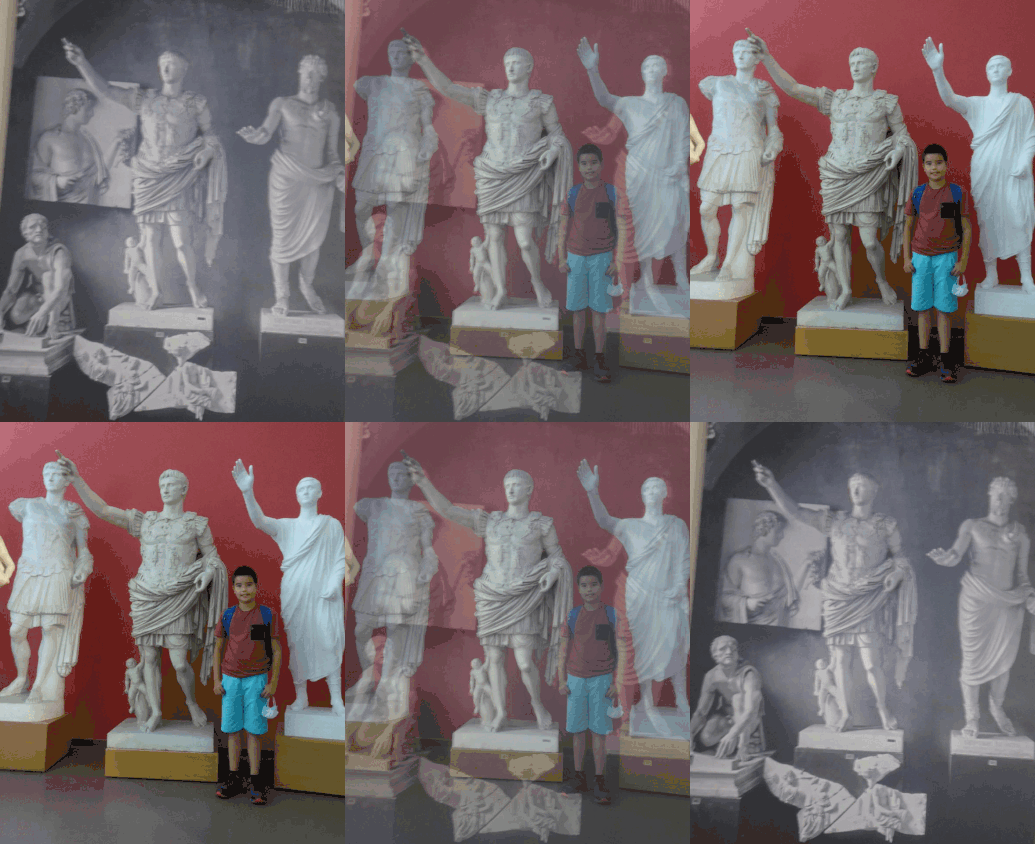
Fittingly the building today serves as a museum for classical replicas. The
collection shows casts from different eras and styles: Roman,
Hellenistic, Archaic and Classical. Drake Winston is shown inside the
so-called Gartensaal in front of a plaster cast of the
Augustus of Prima Porta which survived the war. Until 1877 the casts were housed in the coin
cabinet in the former Jesuit college. At that time, the collection
consisted of 379 pieces. Gradually, the collection moved to the northern
courtyard arcades of the Residenz, but it was not until 1932 that it
was given appropriate exhibition space to become one of the three
largest collections in Germany. The Munich Museum of Plaster Casts remained under the continuous directorship of Ernst Buschor for the full duration of the Nazi era, making it one of the only major cultural institutions in Germany which experienced no change of senior leadership. The most significant event during the early period of the Nazi regime was the requisition of the entire public gallery space for the Degenerate Art exhibition between July 19, 1937 and November 30, 1937. All the casts were simply concealed behind temporary partition walls, whilst the deliberately cramped and poorly lit spaces between the partitions were used to display the condemned modern art. Following the close of the exhibition Buschor assumed full operational control of the museum, dismissed all remaining pre-1933 senior conservation staff, and initiated the complete redesign and modification of the permanent display. Instead of organising the collection in chronological and geographical sequence, he reordered the entire gallery along explicitly racial typological lines. The main entrance gallery was reserved for works classified as pure Nordic type, with works arranged in sequence of declining racial purity progressing through the building. 39 separate casts were subject to permanent physical modification during this period, to adjust anatomical and facial features to bring them into alignment with Buschor's ideological framework. From March 1, 1938 onwards the museum was closed to the general public every Wednesday, exclusively for mandatory racial anthropology training for junior officer candidates of the ϟϟ. More than 2100 officers completed the course at the museum between 1938 and 1944. Buschor personally delivered the opening three hour lecture for every intake. The museum also functioned as the official reference collection for all racial morphology research conducted by the Ahnenerbe organisation, and was regularly used by researchers developing measurement standards for racial screening programmes in occupied eastern territories.
.gif) The cast of Harmodius and Aristogeiton was the single most heavily altered object in the entire museum. The original cast had been produced directly from the surviving marble original in Naples in 1886 which I'm standing beside here for comparison. Buschor ordered the complete resculpting of the facial structure of both figures. Jawlines were squared, brow ridges lowered, and nasal profiles straightened, to bring them into exact alignment with the standard Nordic racial phenotype defined by Hans Günther. Every feature Buschor had identified as semitic or anatolian was systematically removed. His reconstruction proposal was based essentially on a subjective aesthetic judgement and rightly did not remain unchallenged for long; the particular problem here is that Harmodius now stands in the way of every action by his companion. Rather, the tyrannicides presumably charged the imaginary enemy back to back at the same height (parallel to each other or even in a wedge shape) The modifications were executed so seamlessly that for 78 years all subsequent classical scholars accepted the altered version as an accurate reproduction of the ancient original. The changes were only definitively confirmed in October 2022, when the Munich cast was compared against a new high precision laser scan of the Naples marble.
The cast of Harmodius and Aristogeiton was the single most heavily altered object in the entire museum. The original cast had been produced directly from the surviving marble original in Naples in 1886 which I'm standing beside here for comparison. Buschor ordered the complete resculpting of the facial structure of both figures. Jawlines were squared, brow ridges lowered, and nasal profiles straightened, to bring them into exact alignment with the standard Nordic racial phenotype defined by Hans Günther. Every feature Buschor had identified as semitic or anatolian was systematically removed. His reconstruction proposal was based essentially on a subjective aesthetic judgement and rightly did not remain unchallenged for long; the particular problem here is that Harmodius now stands in the way of every action by his companion. Rather, the tyrannicides presumably charged the imaginary enemy back to back at the same height (parallel to each other or even in a wedge shape) The modifications were executed so seamlessly that for 78 years all subsequent classical scholars accepted the altered version as an accurate reproduction of the ancient original. The changes were only definitively confirmed in October 2022, when the Munich cast was compared against a new high precision laser scan of the Naples marble.
Buschor also rewrote the gallery label to present the tyrannicides as pure Nordic warriors who had liberated a racially degenerate population from eastern despotism. This label remained completely unchanged on public display until 1999. The sculpture was positioned as the centrepiece of the museum's entrance gallery, and was always the first object discussed during the weekly racial training courses for junior ϟϟ officer candidates. The original Greek significance of the group was tied to the Athenian democratic tradition, which celebrated Harmodios and Aristogeiton as liberators who had struck against tyranny, and the statues had functioned in antiquity as symbols of democratic civic virtue. Under the interpretive framework applied during the Nazi period, this democratic significance was suppressed and the group was instead presented in terms of masculine comradeship, physical courage, and the willingness to act decisively through violence for a political cause. The obvious contradiction between the group's original significance as a monument to tyrannicide and its display within an institution operating under a totalitarian regime was resolved by simply omitting the democratic dimension of the work's meaning and emphasising instead the physical and martial qualities of the figures themselves.
 Another example in regards the collection's copy is of the Laocoön group beside which Drake Winston is standing compard to the orgininal in the Vatican. It's been claimed that Buschor modified the angle of the arm such that contemporary observers noted a clear resemblance to the Hitler salute, and he was explicitly informed of this resemblance before the modified cast was placed on public display. Within 72 hours that post had been reposted to a number of far right history discussion forums, where it was immediately and deliberately exaggerated. The first altered version changed the claim to read: "Buschor remodelled the arm directly into a Hitler salute". That version spread across the German language internet over the following twelve months ending up, sure enough, posted to the Reddit forum r/UnresolvedMysteries. I've long heard about this story but haven't managed to find any verification for it.
In 1944, 2,398 casts fell victim to a bomb attack. Indeed, only fifteen casts survived the war undamaged and were transferred to a new inventory system when, after the war, a slow reconstruction began. Under Paul Zanker, the collection was systematically expanded with some objects left in their damaged state, whilst others were restored as they were. The restorations themselves are interesting in how they have been influenced by the period in which they took place; Laocoon's and his sons' missing arms restored suspiciously to look like Hitler salutes. Today six cultural institutions are now housed in the building. It is the Department of Egyptology, the Institute of Classical Archaeology, the Central Institute for Art History, the administrations of the National Print Room, the National Antiquities Collections & Glyptothek Munich and the State Museum of Egyptian Art..gif) Indeed, it's my favourite place to visit in Munich given the vast number of casts
and classical replicas throughout, the collection had originally stored
379 casts at the Münzkabinett in the former Jesuitenkolleg near St.
Michael before obtaining rooms in the northern court squares of the
Residenz. On the left is the museum in
1991 when it finally reopened with cleaned casts now displayed in
bright, light-flooded courtyards and the same view today. The casts are systematically arranged
by period: the North Lightwell (first encountered by visitors)
presented Hellenistic works, while the South Lightwell displayed casts
after Archaic and Classical originals. This proven arrangement has
remained unchanged. Yet Zanker’s achievements extended beyond a
representative collection meeting all scholarly demands: with over 1,400
objects and more than 100 long-term loans, the Museum of Casts
Classical Sculpture in Munich had grown into "one of the most
significant cast collections in the Federal Republic." Since then, it
has served to study and visualise the formal history, function, and
themes of ancient sculpture. I'm including some examples below.
Indeed, it's my favourite place to visit in Munich given the vast number of casts
and classical replicas throughout, the collection had originally stored
379 casts at the Münzkabinett in the former Jesuitenkolleg near St.
Michael before obtaining rooms in the northern court squares of the
Residenz. On the left is the museum in
1991 when it finally reopened with cleaned casts now displayed in
bright, light-flooded courtyards and the same view today. The casts are systematically arranged
by period: the North Lightwell (first encountered by visitors)
presented Hellenistic works, while the South Lightwell displayed casts
after Archaic and Classical originals. This proven arrangement has
remained unchanged. Yet Zanker’s achievements extended beyond a
representative collection meeting all scholarly demands: with over 1,400
objects and more than 100 long-term loans, the Museum of Casts
Classical Sculpture in Munich had grown into "one of the most
significant cast collections in the Federal Republic." Since then, it
has served to study and visualise the formal history, function, and
themes of ancient sculpture. I'm including some examples below.
.gif) The scientific and cultural investigation of the Geneleos group during the 1930s was primarily driven by the excavations conducted by the German Archaeological Institute on the island of Samos. Under the leadership of Ernst Buschor, a member of the Nazi Party since May 1, 1933, the Samos expedition sought to document the developmental stages of Archaic Greek sculpture. The Geneleos group, a family monument consisting of six figures dedicated to the goddess Hera around 560 BC, was a focal point of this research. Buschor described the group as a masterpiece of the Ionian spirit, highlighting the technical innovation of the sculptor Geneleos, whose name was inscribed on the seated figure of Phileia. The group includes the figures of Phileia, a boy, Philippe, Ornithe, an unidentified youth, and the reclining figure of the donor, often identified as the mother or a priestess. Nazi cultural policy emphasised the rhythmic order of the family group, which Buschor and other academics argued reflected a Nordic sense of hierarchy and a biological unity. The cast was produced using precise measurements from the original marble fragments discovered between 1925 and 1939, ensuring technical accuracy in the reconstruction of the drapery. The museum collection faced total destruction during the latter stages of the war. On the night of April 24, 1944, and continuing into April 25, 1944, the Alte Akademie was hit by incendiary bombs, destroying approximately 90% of the inventory including the Geneleos group, as the heat caused the material to crumble. The post-war reconstruction eventually utilised 1930s documentation to replace the lost figures, maintaining the academic continuity of the research initiated during the Nazi era.
The scientific and cultural investigation of the Geneleos group during the 1930s was primarily driven by the excavations conducted by the German Archaeological Institute on the island of Samos. Under the leadership of Ernst Buschor, a member of the Nazi Party since May 1, 1933, the Samos expedition sought to document the developmental stages of Archaic Greek sculpture. The Geneleos group, a family monument consisting of six figures dedicated to the goddess Hera around 560 BC, was a focal point of this research. Buschor described the group as a masterpiece of the Ionian spirit, highlighting the technical innovation of the sculptor Geneleos, whose name was inscribed on the seated figure of Phileia. The group includes the figures of Phileia, a boy, Philippe, Ornithe, an unidentified youth, and the reclining figure of the donor, often identified as the mother or a priestess. Nazi cultural policy emphasised the rhythmic order of the family group, which Buschor and other academics argued reflected a Nordic sense of hierarchy and a biological unity. The cast was produced using precise measurements from the original marble fragments discovered between 1925 and 1939, ensuring technical accuracy in the reconstruction of the drapery. The museum collection faced total destruction during the latter stages of the war. On the night of April 24, 1944, and continuing into April 25, 1944, the Alte Akademie was hit by incendiary bombs, destroying approximately 90% of the inventory including the Geneleos group, as the heat caused the material to crumble. The post-war reconstruction eventually utilised 1930s documentation to replace the lost figures, maintaining the academic continuity of the research initiated during the Nazi era.
.gif) The Two Wrestlers, known also as the Uffizi Wrestlers or the Pancrastinae, was created in the Hellenistic period around 300 BC as a marble sculpture group depicting two athletes engaged in the ancient Greek sport of pancration. The original is attributed to a Greek sculptor from the school of Rhodes and was discovered on January 15, 1583 during excavations in Rome near the Baths of Caracalla. This plaster cast copy was produced in 1812 and installed at the Gipsmuseum in Munich on November 3, 1815 where it is displayed today in the central gallery alongside other classical reproductions; the German
archaeologist Adolf Furtwängler examined the Munich cast in detail
during a study on October 22, 1895 and stated in his notes that the
dynamic tension between the figures illustrates the technical precision
of Hellenistic art at its peak. Here you can see the damage it has incurred and subsequent restoration, the first of which was completed on February 28, 1958 by conservator Karl Blümel who stabilised three fractured sections on the lower torso without modifying the original form.
The Two Wrestlers, known also as the Uffizi Wrestlers or the Pancrastinae, was created in the Hellenistic period around 300 BC as a marble sculpture group depicting two athletes engaged in the ancient Greek sport of pancration. The original is attributed to a Greek sculptor from the school of Rhodes and was discovered on January 15, 1583 during excavations in Rome near the Baths of Caracalla. This plaster cast copy was produced in 1812 and installed at the Gipsmuseum in Munich on November 3, 1815 where it is displayed today in the central gallery alongside other classical reproductions; the German
archaeologist Adolf Furtwängler examined the Munich cast in detail
during a study on October 22, 1895 and stated in his notes that the
dynamic tension between the figures illustrates the technical precision
of Hellenistic art at its peak. Here you can see the damage it has incurred and subsequent restoration, the first of which was completed on February 28, 1958 by conservator Karl Blümel who stabilised three fractured sections on the lower torso without modifying the original form.
.gif) On October 24, 2018, a visitor accidentally rammed this cast of the Fanciulla d'Anzio's offering tray, which resulted in the tray shattering into two large fragments and numerous small splinters. This event required an immediate and precise intervention by the museum's conservation department to restore the structural and aesthetic integrity of the work. The restoration process involved the use of modern materials and techniques whilst adhering to the historical standards of the original 1930s collection and was described by the museum as one of the most significant accidental damages to a major exhibit in recent years, necessitating a specialised restoration plan that lasted for several months. The larger pieces of the offering tray were reassembled and secured using specialised adhesives. To ensure long-term stability and to support the weight of the restored section, stainless steel pins were integrated into the plaster structure. The small splinters and the few areas that were completely pulverised during the impact on October 24, 2018, were meticulously remodelled. The final stage of the repair involved colour-matching the new plaster to the existing surface, a process that effectively concealed the points of fracture. The conservationists used pigments that would not discolour over time, ensuring that the visual unity of the statue was maintained for future generations of scholars and visitors. Today, the evidence of the 2018 damage is nearly invisible to the casual observer, with the cracks only discernible upon close inspection, allowing the statue to continue its role as a key object of study for the development of Hellenistic drapery and posture.
On October 24, 2018, a visitor accidentally rammed this cast of the Fanciulla d'Anzio's offering tray, which resulted in the tray shattering into two large fragments and numerous small splinters. This event required an immediate and precise intervention by the museum's conservation department to restore the structural and aesthetic integrity of the work. The restoration process involved the use of modern materials and techniques whilst adhering to the historical standards of the original 1930s collection and was described by the museum as one of the most significant accidental damages to a major exhibit in recent years, necessitating a specialised restoration plan that lasted for several months. The larger pieces of the offering tray were reassembled and secured using specialised adhesives. To ensure long-term stability and to support the weight of the restored section, stainless steel pins were integrated into the plaster structure. The small splinters and the few areas that were completely pulverised during the impact on October 24, 2018, were meticulously remodelled. The final stage of the repair involved colour-matching the new plaster to the existing surface, a process that effectively concealed the points of fracture. The conservationists used pigments that would not discolour over time, ensuring that the visual unity of the statue was maintained for future generations of scholars and visitors. Today, the evidence of the 2018 damage is nearly invisible to the casual observer, with the cracks only discernible upon close inspection, allowing the statue to continue its role as a key object of study for the development of Hellenistic drapery and posture.
.gif) Based on Roman copies and comparing the numerous replicas with each other, Adolf Furtwängler approached the mostly lost Greek originals by linking them to ancient written sources and attempted often successfully to reconstruct them, attempting to filter out everything period specific from the Roman copies in order to gain an idea of the Greek original. Here on the left is an example where I compare two casts of the Athena Lemnia from the Munich collection. Around her upper body the goddess wears the so-called aegis a scaly cloak with the head of the Gorgon Medusa mounted in the centre. On the two replicas the goddess always wears the aegis in the same way, running diagonally across the upper body whilst the gorgoneion is always slightly offset below the left breast. Nevertheless the two aegis representations differ greatly from one another. The arrangement of the scales their texture and materiality the rendering of the folds and the relationship between the scaled mantle and the garment are all to be evaluated and allow for classification of the pieces. The series of doryphoroi also demonstrates this. Looking at the hands of the two casts in the gif it becomes clear how different they are in the rendering of the skin veins and tendons with one version showing a dozen distinct veins and the other eighteen. The direct juxtaposition in the gif and above all the focus on details also shows that comparative observation is not only reserved for archaeologists. This approach allows for precise differentiation between replicas produced in different Roman workshops between 50 BC and 200 AD.
Based on Roman copies and comparing the numerous replicas with each other, Adolf Furtwängler approached the mostly lost Greek originals by linking them to ancient written sources and attempted often successfully to reconstruct them, attempting to filter out everything period specific from the Roman copies in order to gain an idea of the Greek original. Here on the left is an example where I compare two casts of the Athena Lemnia from the Munich collection. Around her upper body the goddess wears the so-called aegis a scaly cloak with the head of the Gorgon Medusa mounted in the centre. On the two replicas the goddess always wears the aegis in the same way, running diagonally across the upper body whilst the gorgoneion is always slightly offset below the left breast. Nevertheless the two aegis representations differ greatly from one another. The arrangement of the scales their texture and materiality the rendering of the folds and the relationship between the scaled mantle and the garment are all to be evaluated and allow for classification of the pieces. The series of doryphoroi also demonstrates this. Looking at the hands of the two casts in the gif it becomes clear how different they are in the rendering of the skin veins and tendons with one version showing a dozen distinct veins and the other eighteen. The direct juxtaposition in the gif and above all the focus on details also shows that comparative observation is not only reserved for archaeologists. This approach allows for precise differentiation between replicas produced in different Roman workshops between 50 BC and 200 AD.
.gif) Another example of juxtaposing two different casts- that in Berlin's collection superimposed over the one in Munich- to show how scholars established relative chronologies and filtered out Roman additions to identify Greek prototypes using the Doryphoros by Polykleitos. Whilst the form remains consistent, my GIF highlights discrepancies in the rendering of skin, the anatomical precision of veins, and the tension in tendons to show how one copyist might emphasise the elasticity of skin whilst another focuses on the rigidity of the bone structure. This comparison allows for a chronological order to be established when compared against dated inscriptions or discovery circumstances. The focus on anatomical details, such as veins on the back of the hand, served as a diagnostic tool to distinguish between various workshops.
Another example of juxtaposing two different casts- that in Berlin's collection superimposed over the one in Munich- to show how scholars established relative chronologies and filtered out Roman additions to identify Greek prototypes using the Doryphoros by Polykleitos. Whilst the form remains consistent, my GIF highlights discrepancies in the rendering of skin, the anatomical precision of veins, and the tension in tendons to show how one copyist might emphasise the elasticity of skin whilst another focuses on the rigidity of the bone structure. This comparison allows for a chronological order to be established when compared against dated inscriptions or discovery circumstances. The focus on anatomical details, such as veins on the back of the hand, served as a diagnostic tool to distinguish between various workshops.
.gif) In front of the cast of the Triumph relief from the Arch of Titus, originally acquired in the late 19th century under the direction of Heinrich Brunn and as it would have appeared in colour. It captures the triumphal procession of 71 AD, specifically the moment the spoils from the Temple of Jerusalem, including the Menorah, the golden table, and the silver trumpets, are carried through the Porta Triumphalis. The dimensions of the cast were established as 3.85 metres in width and 2.04 metres in height, matching the physical scale of the marble original in Rome as seen with me on the right below. When Hans Diepolder took over the museum’s administration on January 1, 1937, he worked to integrate the cast into a broader pædagogical framework which shifted away from viewing these objects as mere copies, instead treating them as essential scientific tools for the reconstruction of antiquity. Max Wegner’s 1936 publication on the Flavian style emphasised that the relief wasn't a static representation but a rhythmic composition designed to be viewed from below which led to the cast being repositioned to simulate the original viewing angle within the Arch of Titus passage.
In front of the cast of the Triumph relief from the Arch of Titus, originally acquired in the late 19th century under the direction of Heinrich Brunn and as it would have appeared in colour. It captures the triumphal procession of 71 AD, specifically the moment the spoils from the Temple of Jerusalem, including the Menorah, the golden table, and the silver trumpets, are carried through the Porta Triumphalis. The dimensions of the cast were established as 3.85 metres in width and 2.04 metres in height, matching the physical scale of the marble original in Rome as seen with me on the right below. When Hans Diepolder took over the museum’s administration on January 1, 1937, he worked to integrate the cast into a broader pædagogical framework which shifted away from viewing these objects as mere copies, instead treating them as essential scientific tools for the reconstruction of antiquity. Max Wegner’s 1936 publication on the Flavian style emphasised that the relief wasn't a static representation but a rhythmic composition designed to be viewed from below which led to the cast being repositioned to simulate the original viewing angle within the Arch of Titus passage. .gif)
On September 23, 1937, the museum participated in the documentation for the Mostra Augustea della Romanità in Rome, where the Munich cast served as a reference for creating additional reproductions for the exhibition. The ϟϟ-Ahnenerbe also expressed interest in the cast, as its researchers sought to identify the physical characteristics of the Roman soldiers depicted in the procession. In a report from July 15, 1938, the relief was described as a document of the heroic struggle of the legions, a narrative that the Nazis sought to incorporate into the national consciousness. This resulted in the cast becoming a focal point for official tours, where the historical defeat of the Jewish state was presented as a definitive moment in European history. By April 26, 1944, it was confirmed that the cast of the Arch of Titus triumph was entirely destroyed in the bombing. After the war the museum began a decades-long process of reconstruction. The replacement of the Arch of Titus cast was a high priority for the post-war administration, which utilised the archival records from the 1930s to ensure the accuracy of new acquisitions. In the 1970s, new moulds were obtained from the Vatican Museums and the French Academy in Rome to create a replacement for the lost 1944 object using the same technical standards that were championed in the 1930s. The relief’s surface is treated with a light wash to emphasise the contours of the figures, a technique that Diepolder had advocated for in his 1939 museum guide.
 In front of another cast and as it might have appeared in colour- that of the relief traditionally identified as Tellus, located on the eastern wall of the Ara Pacis Augustae, which was integrated into the Munich collection following the monument’s final reconstruction on September 23, 1938. In the 1930s, German scholars such as Hans Kähler and Johannes Sieveking engaged in significant debate regarding the identification of the central seated figure, with many academic publications referring to it as Tellus, Italia, or Pax. Drake Winston is standing in front of the actual relief, with Hitler and Mussolini in 1938 viewing the salvaged Tellus panel under the direction of Ranuccio Bianchi Bandinelli.
In the basement of the museum are numerous busts of emperors and various reliefs, many cast from those from the column of Marcus Aurelius. The column of Marcus Aurelius was erected between 176 and 193 in an area on the northern Campus Martius. Stands today in the centre of Piazza Colonna, it reaches a total height of nearly forty metres consisting of the base and the shaft with its relief. The reliefs depict campaigns that Marcus Aurelius led in the 170s in the north of the Roman Empire and the monument takes up the genre of Trajan's Column which had been created about 80 years earlier and which reported on the wars against the Dacians.
.gif) These casts are of immense value for historical conservation because
they preserve the state of the marble as it existed in August 1895.
Whilst the base of the column was heavily reworked in the 16th century,
the relief band itself is largely original. However, for nearly 2,000
years, the marble surface has been exposed to the elements, including
fires, earthquakes, and severe weathering. In recent decades, the impact
of air pollution and acid rain in central Rome has accelerated the
deterioration of the stone. By comparing the 1895 plaster casts with the
current condition of the original relief in Rome, it becomes evident
how much of the finer detail has been washed away or lost entirely due
to erosion. In many instances, the casts show fragments and surface
textures that are no longer discernible on the marble. This makes the
Munich collection an essential archive for the physical history of the
monument, acting as a time capsule that documents the state of the
reliefs before the onset of modern industrial pollution.
These casts are of immense value for historical conservation because
they preserve the state of the marble as it existed in August 1895.
Whilst the base of the column was heavily reworked in the 16th century,
the relief band itself is largely original. However, for nearly 2,000
years, the marble surface has been exposed to the elements, including
fires, earthquakes, and severe weathering. In recent decades, the impact
of air pollution and acid rain in central Rome has accelerated the
deterioration of the stone. By comparing the 1895 plaster casts with the
current condition of the original relief in Rome, it becomes evident
how much of the finer detail has been washed away or lost entirely due
to erosion. In many instances, the casts show fragments and surface
textures that are no longer discernible on the marble. This makes the
Munich collection an essential archive for the physical history of the
monument, acting as a time capsule that documents the state of the
reliefs before the onset of modern industrial pollution. .gif) The perception of the scenes depicted on the column has historically been hindered by the monument's height and the complexity of its narrative. In antiquity, the reliefs were brightly coloured, a technical detail that ensured the images remained comprehensible even at a distance.
The perception of the scenes depicted on the column has historically been hindered by the monument's height and the complexity of its narrative. In antiquity, the reliefs were brightly coloured, a technical detail that ensured the images remained comprehensible even at a distance.
Without this polychromy, the over 100 individual scenes are difficult to examine in detail from the ground. Consequently, reproductions in the form of drawings, prints, and plaster casts have been essential for scientific research since the 16th century, when European scholars began to systematically document Roman antiquities. Unlike Trajan's Column, which was fully cast in the 1860s under the patronage of Napoleon III, the Column of Marcus Aurelius was never reproduced in its entirety. Instead, only select portions of the spiral band were ever moulded with the most significant documentation effort occurring in the summer of 1895, when a team of German researchers conducted a large-scale scientific recording of the monument, which included both extensive photographic documentation and the creation of moulds for 68 relief sections. These moulds were then used by the Gipsformerei in Berlin to produce and distribute plaster casts to academic collections across Europe. The Museum fuer Abguesse Klassischer Bildwerke possesses 21 of these historical panels from the 1895 campaign which include complete narrative sequences, such as the famous Miracle of the Rain shown here and reproduced in colour, which extends over several metres, as well as partial depictions of the violent engagements between Roman legionaries and their northern opponents.
According to the epitome of Book LXXII of Cassius Dio, written decades later, the Roman army, led by Marcus Aurelius, found itself trapped in a mountainous valley. Surrounded by Quadi forces, exhausted by heat and thirst, and assailed by enemy assaults, the legions faced annihilation. As despair deepened, a sudden, violent tempest erupted. Torrential rain drenched the Romans, who collected the water in shields and helmets to quench their parched throats. Simultaneously, lightning bolts struck the Quadi lines, sowing chaos and enabling a Roman counterattack that secured an improbable victory.
 Somehow many of the Marcus Aurelius panels survived because they were integrated into the structural displays or held in protected areas of the facility. In 2019, the museum reorganised its display to allow these 21 panels to be viewed at eye level which is a sobering experience when one is confronted with the horrors inflicted through war. The systematic depiction of military violence marks a definitive shift in Roman imperial iconography, moving away from the idealised clemency of the Trajanic era toward a brutal realism that emphasises the total subjugation of the enemy. German researchers in the 1930s, such as Max Wegner, identified that the reliefs do not merely record events but serve as a visual manifesto of the restorative power of Roman justice through extreme force. The 174 AD rebellion, led by the Quadic king Ariogaesus who had replaced the Roman-appointed King Furtius and successfully mobilised a coalition of tribes to undermine the peace terms established in 172, led to a Roman response of total disarmament and execution intended to dismantle the social and political fabric of the rebelling tribes most evident in the sequence from scenes 58 to 61, where the formal surrender and disarmament of the barbarians are followed immediately by judicial slaughter.
 .gif) Here scene 61 on the left, showing the beheading of the rebellious barbarians, serves as a primary case study for the administrative nature of Roman state violence. The presence of the Praetorian guards and a standard-bearer at the bottom of the relief confirms that these executions weren't the result of heat-of-battle rage but were formal, state-sanctioned acts conducted under military law. At the execution site, two Germans are shown in the final moments before their deaths, whilst two others already lie decapitated on the ground, their severed heads positioned prominently beside their bodies. German archaeologists noted that the sculptor utilised the technique of deep-drilling to accentuate the void around the severed heads, ensuring that the finality of the act was visible to viewers looking up from the gound. The group of women at the top left of the scene are portrayed in sorrowful and resigned poses, an artistic trope known in German scholarship as the mourning woman motif, which serves to amplify the sense of total defeat. The 1930s interpretation of this scene argued that the execution was likely performed by fellow tribesmen who had remained loyal to Rome, a detail intended to illustrate the total breakdown of tribal solidarity under the pressure of imperial occupation.
Here scene 61 on the left, showing the beheading of the rebellious barbarians, serves as a primary case study for the administrative nature of Roman state violence. The presence of the Praetorian guards and a standard-bearer at the bottom of the relief confirms that these executions weren't the result of heat-of-battle rage but were formal, state-sanctioned acts conducted under military law. At the execution site, two Germans are shown in the final moments before their deaths, whilst two others already lie decapitated on the ground, their severed heads positioned prominently beside their bodies. German archaeologists noted that the sculptor utilised the technique of deep-drilling to accentuate the void around the severed heads, ensuring that the finality of the act was visible to viewers looking up from the gound. The group of women at the top left of the scene are portrayed in sorrowful and resigned poses, an artistic trope known in German scholarship as the mourning woman motif, which serves to amplify the sense of total defeat. The 1930s interpretation of this scene argued that the execution was likely performed by fellow tribesmen who had remained loyal to Rome, a detail intended to illustrate the total breakdown of tribal solidarity under the pressure of imperial occupation.  The logistical horror of civilian displacement is captured in Scene 85, which documents the transport of captive women and children into Roman territory. This scene represents the final stage of the 174 AD campaigns, where the survivors of the conflict were forcibly removed from their lands to be integrated into the Roman slave economy or resettled as coloni, a strategy the Nazis later formalised in their deportation of forced labourers known as Ostarbeiter; by 1944, statistics indicate that millions of foreign civilians were being herded in conditions that directly reflected the chaotic scenes of possession documented on the the Munich casts which provide a detailed record of the physical interaction between the legionaries and their captives. In the centre of the scene, a woman attempting to flee to the right is seized by a Roman soldier who grasps her shoulders to pull her back into the column of prisoners. Academic analysis of the 1895 plaster identifies this as the grasping gesture, a recurring element in Roman art that signifies the absolute possession of the defeated by the victor. The presence of children amongst the captives highlights the systematic nature of the displacement. Statistics derived from the 1930s surveys of the relief band indicate that female captives appear with significantly higher frequency in the Marcus Aurelius reliefs than in those of Trajan, reflecting a deliberate focus on the destruction of the barbarian family unit as a military objective.
.gif) The cast of Harmodius and Aristogeiton was the single most heavily altered object in the entire museum. The original cast had been produced directly from the surviving marble original in Naples in 1886 which I'm standing beside here for comparison. Buschor ordered the complete resculpting of the facial structure of both figures. Jawlines were squared, brow ridges lowered, and nasal profiles straightened, to bring them into exact alignment with the standard Nordic racial phenotype defined by Hans Günther. Every feature Buschor had identified as semitic or anatolian was systematically removed. His reconstruction proposal was based essentially on a subjective aesthetic judgement and rightly did not remain unchallenged for long; the particular problem here is that Harmodius now stands in the way of every action by his companion. Rather, the tyrannicides presumably charged the imaginary enemy back to back at the same height (parallel to each other or even in a wedge shape) The modifications were executed so seamlessly that for 78 years all subsequent classical scholars accepted the altered version as an accurate reproduction of the ancient original. The changes were only definitively confirmed in October 2022, when the Munich cast was compared against a new high precision laser scan of the Naples marble.
The cast of Harmodius and Aristogeiton was the single most heavily altered object in the entire museum. The original cast had been produced directly from the surviving marble original in Naples in 1886 which I'm standing beside here for comparison. Buschor ordered the complete resculpting of the facial structure of both figures. Jawlines were squared, brow ridges lowered, and nasal profiles straightened, to bring them into exact alignment with the standard Nordic racial phenotype defined by Hans Günther. Every feature Buschor had identified as semitic or anatolian was systematically removed. His reconstruction proposal was based essentially on a subjective aesthetic judgement and rightly did not remain unchallenged for long; the particular problem here is that Harmodius now stands in the way of every action by his companion. Rather, the tyrannicides presumably charged the imaginary enemy back to back at the same height (parallel to each other or even in a wedge shape) The modifications were executed so seamlessly that for 78 years all subsequent classical scholars accepted the altered version as an accurate reproduction of the ancient original. The changes were only definitively confirmed in October 2022, when the Munich cast was compared against a new high precision laser scan of the Naples marble.
Buschor also rewrote the gallery label to present the tyrannicides as pure Nordic warriors who had liberated a racially degenerate population from eastern despotism. This label remained completely unchanged on public display until 1999. The sculpture was positioned as the centrepiece of the museum's entrance gallery, and was always the first object discussed during the weekly racial training courses for junior ϟϟ officer candidates. The original Greek significance of the group was tied to the Athenian democratic tradition, which celebrated Harmodios and Aristogeiton as liberators who had struck against tyranny, and the statues had functioned in antiquity as symbols of democratic civic virtue. Under the interpretive framework applied during the Nazi period, this democratic significance was suppressed and the group was instead presented in terms of masculine comradeship, physical courage, and the willingness to act decisively through violence for a political cause. The obvious contradiction between the group's original significance as a monument to tyrannicide and its display within an institution operating under a totalitarian regime was resolved by simply omitting the democratic dimension of the work's meaning and emphasising instead the physical and martial qualities of the figures themselves.

In 1944, 2,398 casts fell victim to a bomb attack. Indeed, only fifteen casts survived the war undamaged and were transferred to a new inventory system when, after the war, a slow reconstruction began. Under Paul Zanker, the collection was systematically expanded with some objects left in their damaged state, whilst others were restored as they were. The restorations themselves are interesting in how they have been influenced by the period in which they took place; Laocoon's and his sons' missing arms restored suspiciously to look like Hitler salutes. Today six cultural institutions are now housed in the building. It is the Department of Egyptology, the Institute of Classical Archaeology, the Central Institute for Art History, the administrations of the National Print Room, the National Antiquities Collections & Glyptothek Munich and the State Museum of Egyptian Art.
.gif) Indeed, it's my favourite place to visit in Munich given the vast number of casts
and classical replicas throughout, the collection had originally stored
379 casts at the Münzkabinett in the former Jesuitenkolleg near St.
Michael before obtaining rooms in the northern court squares of the
Residenz. On the left is the museum in
1991 when it finally reopened with cleaned casts now displayed in
bright, light-flooded courtyards and the same view today. The casts are systematically arranged
by period: the North Lightwell (first encountered by visitors)
presented Hellenistic works, while the South Lightwell displayed casts
after Archaic and Classical originals. This proven arrangement has
remained unchanged. Yet Zanker’s achievements extended beyond a
representative collection meeting all scholarly demands: with over 1,400
objects and more than 100 long-term loans, the Museum of Casts
Classical Sculpture in Munich had grown into "one of the most
significant cast collections in the Federal Republic." Since then, it
has served to study and visualise the formal history, function, and
themes of ancient sculpture. I'm including some examples below.
Indeed, it's my favourite place to visit in Munich given the vast number of casts
and classical replicas throughout, the collection had originally stored
379 casts at the Münzkabinett in the former Jesuitenkolleg near St.
Michael before obtaining rooms in the northern court squares of the
Residenz. On the left is the museum in
1991 when it finally reopened with cleaned casts now displayed in
bright, light-flooded courtyards and the same view today. The casts are systematically arranged
by period: the North Lightwell (first encountered by visitors)
presented Hellenistic works, while the South Lightwell displayed casts
after Archaic and Classical originals. This proven arrangement has
remained unchanged. Yet Zanker’s achievements extended beyond a
representative collection meeting all scholarly demands: with over 1,400
objects and more than 100 long-term loans, the Museum of Casts
Classical Sculpture in Munich had grown into "one of the most
significant cast collections in the Federal Republic." Since then, it
has served to study and visualise the formal history, function, and
themes of ancient sculpture. I'm including some examples below..gif) The scientific and cultural investigation of the Geneleos group during the 1930s was primarily driven by the excavations conducted by the German Archaeological Institute on the island of Samos. Under the leadership of Ernst Buschor, a member of the Nazi Party since May 1, 1933, the Samos expedition sought to document the developmental stages of Archaic Greek sculpture. The Geneleos group, a family monument consisting of six figures dedicated to the goddess Hera around 560 BC, was a focal point of this research. Buschor described the group as a masterpiece of the Ionian spirit, highlighting the technical innovation of the sculptor Geneleos, whose name was inscribed on the seated figure of Phileia. The group includes the figures of Phileia, a boy, Philippe, Ornithe, an unidentified youth, and the reclining figure of the donor, often identified as the mother or a priestess. Nazi cultural policy emphasised the rhythmic order of the family group, which Buschor and other academics argued reflected a Nordic sense of hierarchy and a biological unity. The cast was produced using precise measurements from the original marble fragments discovered between 1925 and 1939, ensuring technical accuracy in the reconstruction of the drapery. The museum collection faced total destruction during the latter stages of the war. On the night of April 24, 1944, and continuing into April 25, 1944, the Alte Akademie was hit by incendiary bombs, destroying approximately 90% of the inventory including the Geneleos group, as the heat caused the material to crumble. The post-war reconstruction eventually utilised 1930s documentation to replace the lost figures, maintaining the academic continuity of the research initiated during the Nazi era.
The scientific and cultural investigation of the Geneleos group during the 1930s was primarily driven by the excavations conducted by the German Archaeological Institute on the island of Samos. Under the leadership of Ernst Buschor, a member of the Nazi Party since May 1, 1933, the Samos expedition sought to document the developmental stages of Archaic Greek sculpture. The Geneleos group, a family monument consisting of six figures dedicated to the goddess Hera around 560 BC, was a focal point of this research. Buschor described the group as a masterpiece of the Ionian spirit, highlighting the technical innovation of the sculptor Geneleos, whose name was inscribed on the seated figure of Phileia. The group includes the figures of Phileia, a boy, Philippe, Ornithe, an unidentified youth, and the reclining figure of the donor, often identified as the mother or a priestess. Nazi cultural policy emphasised the rhythmic order of the family group, which Buschor and other academics argued reflected a Nordic sense of hierarchy and a biological unity. The cast was produced using precise measurements from the original marble fragments discovered between 1925 and 1939, ensuring technical accuracy in the reconstruction of the drapery. The museum collection faced total destruction during the latter stages of the war. On the night of April 24, 1944, and continuing into April 25, 1944, the Alte Akademie was hit by incendiary bombs, destroying approximately 90% of the inventory including the Geneleos group, as the heat caused the material to crumble. The post-war reconstruction eventually utilised 1930s documentation to replace the lost figures, maintaining the academic continuity of the research initiated during the Nazi era. .gif) The Two Wrestlers, known also as the Uffizi Wrestlers or the Pancrastinae, was created in the Hellenistic period around 300 BC as a marble sculpture group depicting two athletes engaged in the ancient Greek sport of pancration. The original is attributed to a Greek sculptor from the school of Rhodes and was discovered on January 15, 1583 during excavations in Rome near the Baths of Caracalla. This plaster cast copy was produced in 1812 and installed at the Gipsmuseum in Munich on November 3, 1815 where it is displayed today in the central gallery alongside other classical reproductions; the German
archaeologist Adolf Furtwängler examined the Munich cast in detail
during a study on October 22, 1895 and stated in his notes that the
dynamic tension between the figures illustrates the technical precision
of Hellenistic art at its peak. Here you can see the damage it has incurred and subsequent restoration, the first of which was completed on February 28, 1958 by conservator Karl Blümel who stabilised three fractured sections on the lower torso without modifying the original form.
The Two Wrestlers, known also as the Uffizi Wrestlers or the Pancrastinae, was created in the Hellenistic period around 300 BC as a marble sculpture group depicting two athletes engaged in the ancient Greek sport of pancration. The original is attributed to a Greek sculptor from the school of Rhodes and was discovered on January 15, 1583 during excavations in Rome near the Baths of Caracalla. This plaster cast copy was produced in 1812 and installed at the Gipsmuseum in Munich on November 3, 1815 where it is displayed today in the central gallery alongside other classical reproductions; the German
archaeologist Adolf Furtwängler examined the Munich cast in detail
during a study on October 22, 1895 and stated in his notes that the
dynamic tension between the figures illustrates the technical precision
of Hellenistic art at its peak. Here you can see the damage it has incurred and subsequent restoration, the first of which was completed on February 28, 1958 by conservator Karl Blümel who stabilised three fractured sections on the lower torso without modifying the original form. .gif) On October 24, 2018, a visitor accidentally rammed this cast of the Fanciulla d'Anzio's offering tray, which resulted in the tray shattering into two large fragments and numerous small splinters. This event required an immediate and precise intervention by the museum's conservation department to restore the structural and aesthetic integrity of the work. The restoration process involved the use of modern materials and techniques whilst adhering to the historical standards of the original 1930s collection and was described by the museum as one of the most significant accidental damages to a major exhibit in recent years, necessitating a specialised restoration plan that lasted for several months. The larger pieces of the offering tray were reassembled and secured using specialised adhesives. To ensure long-term stability and to support the weight of the restored section, stainless steel pins were integrated into the plaster structure. The small splinters and the few areas that were completely pulverised during the impact on October 24, 2018, were meticulously remodelled. The final stage of the repair involved colour-matching the new plaster to the existing surface, a process that effectively concealed the points of fracture. The conservationists used pigments that would not discolour over time, ensuring that the visual unity of the statue was maintained for future generations of scholars and visitors. Today, the evidence of the 2018 damage is nearly invisible to the casual observer, with the cracks only discernible upon close inspection, allowing the statue to continue its role as a key object of study for the development of Hellenistic drapery and posture.
On October 24, 2018, a visitor accidentally rammed this cast of the Fanciulla d'Anzio's offering tray, which resulted in the tray shattering into two large fragments and numerous small splinters. This event required an immediate and precise intervention by the museum's conservation department to restore the structural and aesthetic integrity of the work. The restoration process involved the use of modern materials and techniques whilst adhering to the historical standards of the original 1930s collection and was described by the museum as one of the most significant accidental damages to a major exhibit in recent years, necessitating a specialised restoration plan that lasted for several months. The larger pieces of the offering tray were reassembled and secured using specialised adhesives. To ensure long-term stability and to support the weight of the restored section, stainless steel pins were integrated into the plaster structure. The small splinters and the few areas that were completely pulverised during the impact on October 24, 2018, were meticulously remodelled. The final stage of the repair involved colour-matching the new plaster to the existing surface, a process that effectively concealed the points of fracture. The conservationists used pigments that would not discolour over time, ensuring that the visual unity of the statue was maintained for future generations of scholars and visitors. Today, the evidence of the 2018 damage is nearly invisible to the casual observer, with the cracks only discernible upon close inspection, allowing the statue to continue its role as a key object of study for the development of Hellenistic drapery and posture. .gif) Based on Roman copies and comparing the numerous replicas with each other, Adolf Furtwängler approached the mostly lost Greek originals by linking them to ancient written sources and attempted often successfully to reconstruct them, attempting to filter out everything period specific from the Roman copies in order to gain an idea of the Greek original. Here on the left is an example where I compare two casts of the Athena Lemnia from the Munich collection. Around her upper body the goddess wears the so-called aegis a scaly cloak with the head of the Gorgon Medusa mounted in the centre. On the two replicas the goddess always wears the aegis in the same way, running diagonally across the upper body whilst the gorgoneion is always slightly offset below the left breast. Nevertheless the two aegis representations differ greatly from one another. The arrangement of the scales their texture and materiality the rendering of the folds and the relationship between the scaled mantle and the garment are all to be evaluated and allow for classification of the pieces. The series of doryphoroi also demonstrates this. Looking at the hands of the two casts in the gif it becomes clear how different they are in the rendering of the skin veins and tendons with one version showing a dozen distinct veins and the other eighteen. The direct juxtaposition in the gif and above all the focus on details also shows that comparative observation is not only reserved for archaeologists. This approach allows for precise differentiation between replicas produced in different Roman workshops between 50 BC and 200 AD.
Based on Roman copies and comparing the numerous replicas with each other, Adolf Furtwängler approached the mostly lost Greek originals by linking them to ancient written sources and attempted often successfully to reconstruct them, attempting to filter out everything period specific from the Roman copies in order to gain an idea of the Greek original. Here on the left is an example where I compare two casts of the Athena Lemnia from the Munich collection. Around her upper body the goddess wears the so-called aegis a scaly cloak with the head of the Gorgon Medusa mounted in the centre. On the two replicas the goddess always wears the aegis in the same way, running diagonally across the upper body whilst the gorgoneion is always slightly offset below the left breast. Nevertheless the two aegis representations differ greatly from one another. The arrangement of the scales their texture and materiality the rendering of the folds and the relationship between the scaled mantle and the garment are all to be evaluated and allow for classification of the pieces. The series of doryphoroi also demonstrates this. Looking at the hands of the two casts in the gif it becomes clear how different they are in the rendering of the skin veins and tendons with one version showing a dozen distinct veins and the other eighteen. The direct juxtaposition in the gif and above all the focus on details also shows that comparative observation is not only reserved for archaeologists. This approach allows for precise differentiation between replicas produced in different Roman workshops between 50 BC and 200 AD. .gif) Another example of juxtaposing two different casts- that in Berlin's collection superimposed over the one in Munich- to show how scholars established relative chronologies and filtered out Roman additions to identify Greek prototypes using the Doryphoros by Polykleitos. Whilst the form remains consistent, my GIF highlights discrepancies in the rendering of skin, the anatomical precision of veins, and the tension in tendons to show how one copyist might emphasise the elasticity of skin whilst another focuses on the rigidity of the bone structure. This comparison allows for a chronological order to be established when compared against dated inscriptions or discovery circumstances. The focus on anatomical details, such as veins on the back of the hand, served as a diagnostic tool to distinguish between various workshops.
Another example of juxtaposing two different casts- that in Berlin's collection superimposed over the one in Munich- to show how scholars established relative chronologies and filtered out Roman additions to identify Greek prototypes using the Doryphoros by Polykleitos. Whilst the form remains consistent, my GIF highlights discrepancies in the rendering of skin, the anatomical precision of veins, and the tension in tendons to show how one copyist might emphasise the elasticity of skin whilst another focuses on the rigidity of the bone structure. This comparison allows for a chronological order to be established when compared against dated inscriptions or discovery circumstances. The focus on anatomical details, such as veins on the back of the hand, served as a diagnostic tool to distinguish between various workshops. .gif) In front of the cast of the Triumph relief from the Arch of Titus, originally acquired in the late 19th century under the direction of Heinrich Brunn and as it would have appeared in colour. It captures the triumphal procession of 71 AD, specifically the moment the spoils from the Temple of Jerusalem, including the Menorah, the golden table, and the silver trumpets, are carried through the Porta Triumphalis. The dimensions of the cast were established as 3.85 metres in width and 2.04 metres in height, matching the physical scale of the marble original in Rome as seen with me on the right below. When Hans Diepolder took over the museum’s administration on January 1, 1937, he worked to integrate the cast into a broader pædagogical framework which shifted away from viewing these objects as mere copies, instead treating them as essential scientific tools for the reconstruction of antiquity. Max Wegner’s 1936 publication on the Flavian style emphasised that the relief wasn't a static representation but a rhythmic composition designed to be viewed from below which led to the cast being repositioned to simulate the original viewing angle within the Arch of Titus passage.
In front of the cast of the Triumph relief from the Arch of Titus, originally acquired in the late 19th century under the direction of Heinrich Brunn and as it would have appeared in colour. It captures the triumphal procession of 71 AD, specifically the moment the spoils from the Temple of Jerusalem, including the Menorah, the golden table, and the silver trumpets, are carried through the Porta Triumphalis. The dimensions of the cast were established as 3.85 metres in width and 2.04 metres in height, matching the physical scale of the marble original in Rome as seen with me on the right below. When Hans Diepolder took over the museum’s administration on January 1, 1937, he worked to integrate the cast into a broader pædagogical framework which shifted away from viewing these objects as mere copies, instead treating them as essential scientific tools for the reconstruction of antiquity. Max Wegner’s 1936 publication on the Flavian style emphasised that the relief wasn't a static representation but a rhythmic composition designed to be viewed from below which led to the cast being repositioned to simulate the original viewing angle within the Arch of Titus passage. .gif)
On September 23, 1937, the museum participated in the documentation for the Mostra Augustea della Romanità in Rome, where the Munich cast served as a reference for creating additional reproductions for the exhibition. The ϟϟ-Ahnenerbe also expressed interest in the cast, as its researchers sought to identify the physical characteristics of the Roman soldiers depicted in the procession. In a report from July 15, 1938, the relief was described as a document of the heroic struggle of the legions, a narrative that the Nazis sought to incorporate into the national consciousness. This resulted in the cast becoming a focal point for official tours, where the historical defeat of the Jewish state was presented as a definitive moment in European history. By April 26, 1944, it was confirmed that the cast of the Arch of Titus triumph was entirely destroyed in the bombing. After the war the museum began a decades-long process of reconstruction. The replacement of the Arch of Titus cast was a high priority for the post-war administration, which utilised the archival records from the 1930s to ensure the accuracy of new acquisitions. In the 1970s, new moulds were obtained from the Vatican Museums and the French Academy in Rome to create a replacement for the lost 1944 object using the same technical standards that were championed in the 1930s. The relief’s surface is treated with a light wash to emphasise the contours of the figures, a technique that Diepolder had advocated for in his 1939 museum guide.
 In front of another cast and as it might have appeared in colour- that of the relief traditionally identified as Tellus, located on the eastern wall of the Ara Pacis Augustae, which was integrated into the Munich collection following the monument’s final reconstruction on September 23, 1938. In the 1930s, German scholars such as Hans Kähler and Johannes Sieveking engaged in significant debate regarding the identification of the central seated figure, with many academic publications referring to it as Tellus, Italia, or Pax. Drake Winston is standing in front of the actual relief, with Hitler and Mussolini in 1938 viewing the salvaged Tellus panel under the direction of Ranuccio Bianchi Bandinelli.
 In the basement of the museum are numerous busts of emperors and various reliefs, many cast from those from the column of Marcus Aurelius. The column of Marcus Aurelius was erected between 176 and 193 in an area on the northern Campus Martius. Stands today in the centre of Piazza Colonna, it reaches a total height of nearly forty metres consisting of the base and the shaft with its relief. The reliefs depict campaigns that Marcus Aurelius led in the 170s in the north of the Roman Empire and the monument takes up the genre of Trajan's Column which had been created about 80 years earlier and which reported on the wars against the Dacians.
.gif) These casts are of immense value for historical conservation because
they preserve the state of the marble as it existed in August 1895.
Whilst the base of the column was heavily reworked in the 16th century,
the relief band itself is largely original. However, for nearly 2,000
years, the marble surface has been exposed to the elements, including
fires, earthquakes, and severe weathering. In recent decades, the impact
of air pollution and acid rain in central Rome has accelerated the
deterioration of the stone. By comparing the 1895 plaster casts with the
current condition of the original relief in Rome, it becomes evident
how much of the finer detail has been washed away or lost entirely due
to erosion. In many instances, the casts show fragments and surface
textures that are no longer discernible on the marble. This makes the
Munich collection an essential archive for the physical history of the
monument, acting as a time capsule that documents the state of the
reliefs before the onset of modern industrial pollution.
These casts are of immense value for historical conservation because
they preserve the state of the marble as it existed in August 1895.
Whilst the base of the column was heavily reworked in the 16th century,
the relief band itself is largely original. However, for nearly 2,000
years, the marble surface has been exposed to the elements, including
fires, earthquakes, and severe weathering. In recent decades, the impact
of air pollution and acid rain in central Rome has accelerated the
deterioration of the stone. By comparing the 1895 plaster casts with the
current condition of the original relief in Rome, it becomes evident
how much of the finer detail has been washed away or lost entirely due
to erosion. In many instances, the casts show fragments and surface
textures that are no longer discernible on the marble. This makes the
Munich collection an essential archive for the physical history of the
monument, acting as a time capsule that documents the state of the
reliefs before the onset of modern industrial pollution. .gif) The perception of the scenes depicted on the column has historically been hindered by the monument's height and the complexity of its narrative. In antiquity, the reliefs were brightly coloured, a technical detail that ensured the images remained comprehensible even at a distance.
The perception of the scenes depicted on the column has historically been hindered by the monument's height and the complexity of its narrative. In antiquity, the reliefs were brightly coloured, a technical detail that ensured the images remained comprehensible even at a distance. Without this polychromy, the over 100 individual scenes are difficult to examine in detail from the ground. Consequently, reproductions in the form of drawings, prints, and plaster casts have been essential for scientific research since the 16th century, when European scholars began to systematically document Roman antiquities. Unlike Trajan's Column, which was fully cast in the 1860s under the patronage of Napoleon III, the Column of Marcus Aurelius was never reproduced in its entirety. Instead, only select portions of the spiral band were ever moulded with the most significant documentation effort occurring in the summer of 1895, when a team of German researchers conducted a large-scale scientific recording of the monument, which included both extensive photographic documentation and the creation of moulds for 68 relief sections.
 These moulds were then used by the Gipsformerei in Berlin to produce and distribute plaster casts to academic collections across Europe. The Museum fuer Abguesse Klassischer Bildwerke possesses 21 of these historical panels from the 1895 campaign which include complete narrative sequences, such as the famous Miracle of the Rain shown here and reproduced in colour, which extends over several metres, as well as partial depictions of the violent engagements between Roman legionaries and their northern opponents.
According to the epitome of Book LXXII of Cassius Dio, written decades later, the Roman army, led by Marcus Aurelius, found itself trapped in a mountainous valley. Surrounded by Quadi forces, exhausted by heat and thirst, and assailed by enemy assaults, the legions faced annihilation. As despair deepened, a sudden, violent tempest erupted. Torrential rain drenched the Romans, who collected the water in shields and helmets to quench their parched throats. Simultaneously, lightning bolts struck the Quadi lines, sowing chaos and enabling a Roman counterattack that secured an improbable victory.
 Somehow many of the Marcus Aurelius panels survived because they were integrated into the structural displays or held in protected areas of the facility. In 2019, the museum reorganised its display to allow these 21 panels to be viewed at eye level which is a sobering experience when one is confronted with the horrors inflicted through war. The systematic depiction of military violence marks a definitive shift in Roman imperial iconography, moving away from the idealised clemency of the Trajanic era toward a brutal realism that emphasises the total subjugation of the enemy. German researchers in the 1930s, such as Max Wegner, identified that the reliefs do not merely record events but serve as a visual manifesto of the restorative power of Roman justice through extreme force. The 174 AD rebellion, led by the Quadic king Ariogaesus who had replaced the Roman-appointed King Furtius and successfully mobilised a coalition of tribes to undermine the peace terms established in 172, led to a Roman response of total disarmament and execution intended to dismantle the social and political fabric of the rebelling tribes most evident in the sequence from scenes 58 to 61, where the formal surrender and disarmament of the barbarians are followed immediately by judicial slaughter.
 .gif) Here scene 61 on the left, showing the beheading of the rebellious barbarians, serves as a primary case study for the administrative nature of Roman state violence. The presence of the Praetorian guards and a standard-bearer at the bottom of the relief confirms that these executions weren't the result of heat-of-battle rage but were formal, state-sanctioned acts conducted under military law. At the execution site, two Germans are shown in the final moments before their deaths, whilst two others already lie decapitated on the ground, their severed heads positioned prominently beside their bodies. German archaeologists noted that the sculptor utilised the technique of deep-drilling to accentuate the void around the severed heads, ensuring that the finality of the act was visible to viewers looking up from the gound. The group of women at the top left of the scene are portrayed in sorrowful and resigned poses, an artistic trope known in German scholarship as the mourning woman motif, which serves to amplify the sense of total defeat. The 1930s interpretation of this scene argued that the execution was likely performed by fellow tribesmen who had remained loyal to Rome, a detail intended to illustrate the total breakdown of tribal solidarity under the pressure of imperial occupation.
Here scene 61 on the left, showing the beheading of the rebellious barbarians, serves as a primary case study for the administrative nature of Roman state violence. The presence of the Praetorian guards and a standard-bearer at the bottom of the relief confirms that these executions weren't the result of heat-of-battle rage but were formal, state-sanctioned acts conducted under military law. At the execution site, two Germans are shown in the final moments before their deaths, whilst two others already lie decapitated on the ground, their severed heads positioned prominently beside their bodies. German archaeologists noted that the sculptor utilised the technique of deep-drilling to accentuate the void around the severed heads, ensuring that the finality of the act was visible to viewers looking up from the gound. The group of women at the top left of the scene are portrayed in sorrowful and resigned poses, an artistic trope known in German scholarship as the mourning woman motif, which serves to amplify the sense of total defeat. The 1930s interpretation of this scene argued that the execution was likely performed by fellow tribesmen who had remained loyal to Rome, a detail intended to illustrate the total breakdown of tribal solidarity under the pressure of imperial occupation.  The logistical horror of civilian displacement is captured in Scene 85, which documents the transport of captive women and children into Roman territory. This scene represents the final stage of the 174 AD campaigns, where the survivors of the conflict were forcibly removed from their lands to be integrated into the Roman slave economy or resettled as coloni, a strategy the Nazis later formalised in their deportation of forced labourers known as Ostarbeiter; by 1944, statistics indicate that millions of foreign civilians were being herded in conditions that directly reflected the chaotic scenes of possession documented on the the Munich casts which provide a detailed record of the physical interaction between the legionaries and their captives. In the centre of the scene, a woman attempting to flee to the right is seized by a Roman soldier who grasps her shoulders to pull her back into the column of prisoners. Academic analysis of the 1895 plaster identifies this as the grasping gesture, a recurring element in Roman art that signifies the absolute possession of the defeated by the victor. The presence of children amongst the captives highlights the systematic nature of the displacement. Statistics derived from the 1930s surveys of the relief band indicate that female captives appear with significantly higher frequency in the Marcus Aurelius reliefs than in those of Trajan, reflecting a deliberate focus on the destruction of the barbarian family unit as a military objective.
 The eagle on the right constitutes the Parteiadler adopted by the party
in 1920, here rendered in the static, heraldic profile style rather
than the dynamic spread-winged variant used on standards, clutching a
wreath that originally framed the swastika emblem. The bust represents
not a specific individual but the typological figure of German youth as
constructed in Nazi visual culture during the mid-1930s, embodying the
idealised physical and spiritual characteristics of the "new man"
without descending into portraiture, thus serving as architectural
propaganda that framed the mundane administrative function of mail
processing within a narrative of Germanic destiny and racial idealism.
These elements were carved during the construction phase of 1936–1937 by
sculptors from Munich workshops associated with the broader complex of
party buildings in the Königsplatz area, though documentation in the
Bavarian State Office for Monument Protection records attributes the
architectural sculpture to craftsmen working under Leonhard Gall’s
supervision rather than identifying a specific master sculptor such as
Josef Wackerle or Richard Knecht who executed comparable reliefs on
nearby structures.
The eagle on the right constitutes the Parteiadler adopted by the party
in 1920, here rendered in the static, heraldic profile style rather
than the dynamic spread-winged variant used on standards, clutching a
wreath that originally framed the swastika emblem. The bust represents
not a specific individual but the typological figure of German youth as
constructed in Nazi visual culture during the mid-1930s, embodying the
idealised physical and spiritual characteristics of the "new man"
without descending into portraiture, thus serving as architectural
propaganda that framed the mundane administrative function of mail
processing within a narrative of Germanic destiny and racial idealism.
These elements were carved during the construction phase of 1936–1937 by
sculptors from Munich workshops associated with the broader complex of
party buildings in the Königsplatz area, though documentation in the
Bavarian State Office for Monument Protection records attributes the
architectural sculpture to craftsmen working under Leonhard Gall’s
supervision rather than identifying a specific master sculptor such as
Josef Wackerle or Richard Knecht who executed comparable reliefs on
nearby structures.  I
still haven't been able to ascertain the meaning behind the relief on
the far left depicting what appears to be a lantern above a pyre.
I
still haven't been able to ascertain the meaning behind the relief on
the far left depicting what appears to be a lantern above a pyre. The
office was staffed by a corps of vetted civil servants and party
administrators who processed the paperwork of the dictatorship using the
most advanced office technology available in the 1930s. This included
the use of Hollerith punch-card systems for data management and
pneumatic tube networks to transport files between the mail room and the
upper administrative levels. During the war, the function of the office
expanded to manage the correspondence related to the Hilfskasse (Relief
Fund), processing claims for injured stormtroopers and the families of
the war dead, thereby integrating the welfare bureaucracy of the war
effort into the central party administration. The historical
significance of the Zentraleinlaufamt lies in its role as the
facilitator of the bureaucracy of terror. The processing of membership
expulsions, the management of Aryanisation assets, and the
administrative enforcement of racial laws were all tracked through the
correspondence that passed through Meiserstraße 10, with the final log on
April 28, 1945 recording 456 items, including Karl Dönitz's May 1, 1945
surrender instructions dispatched to Gauleiter by May 3, 1945, and 123
dissolution orders on April 25, 1945 using emergency seals from April
10, 1945. The
survival of this bureaucratic infrastructure proved fatal to the
leadership of the Nazi Party following the collapse of the regime. When
the American 7th Army seized the Verwaltungsbau in April 1945, the steel
shutters and reinforced vaults had successfully protected the archives
from the Allied bombing raids that destroyed much of Munich.
The
office was staffed by a corps of vetted civil servants and party
administrators who processed the paperwork of the dictatorship using the
most advanced office technology available in the 1930s. This included
the use of Hollerith punch-card systems for data management and
pneumatic tube networks to transport files between the mail room and the
upper administrative levels. During the war, the function of the office
expanded to manage the correspondence related to the Hilfskasse (Relief
Fund), processing claims for injured stormtroopers and the families of
the war dead, thereby integrating the welfare bureaucracy of the war
effort into the central party administration. The historical
significance of the Zentraleinlaufamt lies in its role as the
facilitator of the bureaucracy of terror. The processing of membership
expulsions, the management of Aryanisation assets, and the
administrative enforcement of racial laws were all tracked through the
correspondence that passed through Meiserstraße 10, with the final log on
April 28, 1945 recording 456 items, including Karl Dönitz's May 1, 1945
surrender instructions dispatched to Gauleiter by May 3, 1945, and 123
dissolution orders on April 25, 1945 using emergency seals from April
10, 1945. The
survival of this bureaucratic infrastructure proved fatal to the
leadership of the Nazi Party following the collapse of the regime. When
the American 7th Army seized the Verwaltungsbau in April 1945, the steel
shutters and reinforced vaults had successfully protected the archives
from the Allied bombing raids that destroyed much of Munich.  The
discovery of the intact files, which had been processed and filed by
the Zentraleinlaufamt, provided the Allied prosecutors with the
comprehensive membership lists and organisational charts necessary to
conduct the denazification proceedings and the Nuremberg Trials. The
department ultimately preserved the forensic evidence of the party’s
structure, allowing for the legal dismantling of the organisation it was
built to serve. Critically, the order for confidential document
destruction which encompassed party files, membership indices, and
operational records emerged between April 18 and 27, 1945, directing
their transfer to the Joseph Wirth paper mill in Freimann for pulping.
This encompassed over seven million membership cards from the adjacent
Verwaltungsbau at Meiserstraße 10, alongside correspondence logs and
exemption files processed at the Zentraleinlaufamt. Factory manager
Hanns Huber defied the directive, concealing the materials in mill
storage and surrendering them intact to the U.S. 7th Army upon their
arrival in Freimann on April 29, 1945. These archives, totalling 1.4 million transactions from 1934 to 1945 or an average 384 daily, proved
invaluable for the American military government's denazification
programme, enabling the scrutiny of 8.5 million Germans via the
Fragebogen questionnaire by 1946 and contributing evidence for the
Nuremberg trials.
The
discovery of the intact files, which had been processed and filed by
the Zentraleinlaufamt, provided the Allied prosecutors with the
comprehensive membership lists and organisational charts necessary to
conduct the denazification proceedings and the Nuremberg Trials. The
department ultimately preserved the forensic evidence of the party’s
structure, allowing for the legal dismantling of the organisation it was
built to serve. Critically, the order for confidential document
destruction which encompassed party files, membership indices, and
operational records emerged between April 18 and 27, 1945, directing
their transfer to the Joseph Wirth paper mill in Freimann for pulping.
This encompassed over seven million membership cards from the adjacent
Verwaltungsbau at Meiserstraße 10, alongside correspondence logs and
exemption files processed at the Zentraleinlaufamt. Factory manager
Hanns Huber defied the directive, concealing the materials in mill
storage and surrendering them intact to the U.S. 7th Army upon their
arrival in Freimann on April 29, 1945. These archives, totalling 1.4 million transactions from 1934 to 1945 or an average 384 daily, proved
invaluable for the American military government's denazification
programme, enabling the scrutiny of 8.5 million Germans via the
Fragebogen questionnaire by 1946 and contributing evidence for the
Nuremberg trials..gif "Bishop Hans Meiser Nazi salute 1934 vs today")


This was the former office of Ernst Hanfstaengl, Head of the International Press Office, at Karlstraße 18. In 1931 Hitler appointed Hanfstaengl, owner of the renowned Munich art publisher Franz Hanfstaengl, as head of the Nazis' foreign press. "Putzi" Hanfstaengl had been friends with Hitler for a long time, hiding him from the police at his home after the failed coup in November 1923. Hanfstaengl had studied in the United States before serving the Nazis in various functions before losing favour and emigrating to London in 1937. He became acquainted with Hitler on the occasion of a Nazi meeting in the Bürgerbräukeller. As its largest civil promoter he became part of Hitler's close circle of friends. From 1931-1937 he served as foreign press chief for the Nazi Party. After the elimination of the SA and Ernst Röhm on June 30, 1934 he dissociated himself increasingly from the party, which made him suspicious in the eyes of the Gestapo. He fled in 1937 and eventually arrived in the United States, where in 1942 he became German advisor to Roosevelt, the only man to have worked directly under Hitler and FDR.

 The headquarters of the Supreme Storm Troopers' Leadership (Oberste SA-Führung) was on Barerstraße 7-11; here SA
men in 1935 standing in front of the entrance door at Barer Strasse 11,
which was decorated with glass mosaics in the shape of the SA emblem. In
1932, the Oberste SA leadership left its offices in the Brown House and
moved into its own building at Brienner Strasse 43, whilst the hotels Union and Marienbad at Barer Strasse 7-11 moved into their new accommodations in 1934. Today the location has reverted to its original function as the Hotel Marienbad.
The headquarters of the Supreme Storm Troopers' Leadership (Oberste SA-Führung) was on Barerstraße 7-11; here SA
men in 1935 standing in front of the entrance door at Barer Strasse 11,
which was decorated with glass mosaics in the shape of the SA emblem. In
1932, the Oberste SA leadership left its offices in the Brown House and
moved into its own building at Brienner Strasse 43, whilst the hotels Union and Marienbad at Barer Strasse 7-11 moved into their new accommodations in 1934. Today the location has reverted to its original function as the Hotel Marienbad. The Sturmabteilung ("Storm detachment" or "Assault detachment" or "Assault section", usually translated as "stormtroop(er)s") was the paramilitary organisation of the Nazi Party and played a key role in Hitler's rise to power. SA men were often called "brownshirts" for the colour of their uniforms which distinguished them from the ϟϟ, who wore black and brown uniforms (in comparison to Mussolini's blackshirts). Brown-coloured shirts were chosen as the SA uniform because a large batch of them was cheaply available after the Great War, having originally been ordered for German troops serving in Africa. The SA was also the first Nazi paramilitary group to develop pseudo-military titles for bestowal upon its members later to be adopted by several other Nazi Party groups, chief among them the ϟϟ. The SA became largely irrelevant after he took control of Germany in 1933; it was effectively superseded by the ϟϟ after the Night of the Long Knives.


