Kelheim: Befreiungshalle Speeches, the 1933 Hitler Honorary Citizenship, and the SA March Past
Kelheim, decorated for Hitler's visit in 1933. Dr August Donderer assumed the role of mayor of Kelheim on January 30, 1933, coinciding precisely with Hitler's appointment as Reich chancellor. Donderer had co-founded the local branch of the Nazi Party and the Sturmabteilung in Kelheim during 1930 and 1931. As an early supporter, he embodied the authoritarian approach that characterised local administration thereafter. By March 1933, Donderer also became Kreisleiter for Kelheim, extending his influence to Riedenburg until 1935. No other Nazi figure in the Kelheim region amassed comparable authority until 1942, when his position as Kreisleiter ended due to revelations of morphine abuse reported to the Interior Ministry by Obermedizinalrat Heinrich Calligaro. Despite this, Donderer retained the mayoralty until May 1945.
 The Befreiungshalle ("Hall of Liberation") in a Nazi postcard. In
front is the Schleiferturm, also incorrectly called the Römerturm,
since ashlars were used in the construction that resemble ancient
stones, but come from the keep of the Wittelsbacher castle and date from
the late 15th century. Since 1931 it has served as a memorial for those
who fell in the First World War which explains its prominence in this
postcard. The Befreiungshalle is an historical classical monument upon
Mount Michelsberg above Kelheim upstream of Regensburg on
the Danube. It
was built through the initiative of King Ludwig I of Bavaria to
commemorate the liberation
war against Napoleon and the Volkerschlacht near
Leipzig on October 18, 1813, although cycling towards Kelheim takes one past a number of Napoleonic battlesites leading up to the Battle of Abensberg which are later shown below. Planned by Friedrich von Gärtner and after
its death 1847 by Leo von
Klenze with sculptures by Ludwig von Schwanthaler, the
foundation stone was lain on October 19, 1842, the solemn opening taking
place on October 18, 1863 in time for the 50th anniversary. With a
height of 45 metres and diametre of 29 metres, the domed hall
of the Befreiungshalle is larger than the Pantheon. Roughly
150 feet in height, the memorial focuses on the number eighteen
throughout given that the Battle of the Nations took place on October
18, 1813 and the Battle of Waterloo was fought on June 18, 1815.
The Befreiungshalle ("Hall of Liberation") in a Nazi postcard. In
front is the Schleiferturm, also incorrectly called the Römerturm,
since ashlars were used in the construction that resemble ancient
stones, but come from the keep of the Wittelsbacher castle and date from
the late 15th century. Since 1931 it has served as a memorial for those
who fell in the First World War which explains its prominence in this
postcard. The Befreiungshalle is an historical classical monument upon
Mount Michelsberg above Kelheim upstream of Regensburg on
the Danube. It
was built through the initiative of King Ludwig I of Bavaria to
commemorate the liberation
war against Napoleon and the Volkerschlacht near
Leipzig on October 18, 1813, although cycling towards Kelheim takes one past a number of Napoleonic battlesites leading up to the Battle of Abensberg which are later shown below. Planned by Friedrich von Gärtner and after
its death 1847 by Leo von
Klenze with sculptures by Ludwig von Schwanthaler, the
foundation stone was lain on October 19, 1842, the solemn opening taking
place on October 18, 1863 in time for the 50th anniversary. With a
height of 45 metres and diametre of 29 metres, the domed hall
of the Befreiungshalle is larger than the Pantheon. Roughly
150 feet in height, the memorial focuses on the number eighteen
throughout given that the Battle of the Nations took place on October
18, 1813 and the Battle of Waterloo was fought on June 18, 1815.  Thus
around the exterior are eighteen statues holding placards for each of
the historic Germanic tribes: Franconians, Bohemians, Tyroleans,
Bavarians, Austrians, Prussians, Hanoverians, Saxons, Silesians,
Brandenburgers, Pomeranians, Mecklenburgers, Westphalians, Moravians, Hessians, Thüringians, Rhinelanders, and Swabians.
Thus
around the exterior are eighteen statues holding placards for each of
the historic Germanic tribes: Franconians, Bohemians, Tyroleans,
Bavarians, Austrians, Prussians, Hanoverians, Saxons, Silesians,
Brandenburgers, Pomeranians, Mecklenburgers, Westphalians, Moravians, Hessians, Thüringians, Rhinelanders, and Swabians.The year 1913 marked the centenary of the Battle of Leipzig and, whilst the anniversary was celebrated throughout Germany, there was especial cause for celebrations in Kelheim as the building was fifty years old, and so the entire year saw the double anniversary celebrated in Kelheim with various festivals and events. The main highlight of the year was the visit of Kaiser Wilhelm II, Prince Regent Ludwig of Bavaria and all the princes of the empire on August 25, 1913, shown on the right and the site today.
 Twenty years after Kaiser Wilhelm II and the German princes had celebrated the centenary of the Battle of Nations in Leipzig, on
October 22, 1933 Hitler gave two speeches in front of
the Befreiungshalle on the occasion of a parade by the SA declaring
that "[t]his monument of unification is a symbol for us of that to
which we aspire in our struggle: ein Volk, ein Reich, ein Wille." This
"liberation ceremony" was accompanied by SA staff chief Ernst Rohm,
Reichsführer ϟϟ Heinrich Himmler and the Reichsstatthalter in Bavaria,
Franz Ritter von Epp.
Twenty years after Kaiser Wilhelm II and the German princes had celebrated the centenary of the Battle of Nations in Leipzig, on
October 22, 1933 Hitler gave two speeches in front of
the Befreiungshalle on the occasion of a parade by the SA declaring
that "[t]his monument of unification is a symbol for us of that to
which we aspire in our struggle: ein Volk, ein Reich, ein Wille." This
"liberation ceremony" was accompanied by SA staff chief Ernst Rohm,
Reichsführer ϟϟ Heinrich Himmler and the Reichsstatthalter in Bavaria,
Franz Ritter von Epp. Ernst
Röhm had made his way from Regensburg to Kelheim the following day at
9.00 with Hitler arriving shortly after in Gauleiter Wagner's black
Mercedes to be received by the SA chief of staff at around and hour
later. The "Liberation Celebration" began at 11 am with a "State Act in
front of the Hall" and the "Entry of the Gods", penned by Hitler's
favourite composer Richard Wagner. Following the firing of 21 gun
salutes to greet the Führer, Röhm then handed Hitler the bronze emblem, a
swastika, which was attached to the entrance above the hall, surrounded
by an oak leaf wreath with an imperial eagle, and the year 1933.
Hitler opened his speech referring to the building:
 My
chief of staff! My SA men! German national comrades! There is hardly a
building in Germany that more rightly bears the symbol of the German
uprising than the monument to the freedom fighters. For us, this
monument is a symbol of what we strive for in our struggle: one people,
one empire, one will. What was the aim of the striving of German men and
women many centuries ago seems to be nearing its final realisation
thanks to the struggle, the victims and the work of countless Germans
from all walks of life and walks of life. The new empire was born out of
the people themselves. And so in the future this temple should be a
sanctuary for the German people. The emblem of the new empire is
intended to symbolically express that it is not only consecrated to the
past, but also to the present and the German future. In this sense we
want to bring salvation to what was, what is and what will be because it
has to be: our German people, our German Empire! Sieg Heil!
My
chief of staff! My SA men! German national comrades! There is hardly a
building in Germany that more rightly bears the symbol of the German
uprising than the monument to the freedom fighters. For us, this
monument is a symbol of what we strive for in our struggle: one people,
one empire, one will. What was the aim of the striving of German men and
women many centuries ago seems to be nearing its final realisation
thanks to the struggle, the victims and the work of countless Germans
from all walks of life and walks of life. The new empire was born out of
the people themselves. And so in the future this temple should be a
sanctuary for the German people. The emblem of the new empire is
intended to symbolically express that it is not only consecrated to the
past, but also to the present and the German future. In this sense we
want to bring salvation to what was, what is and what will be because it
has to be: our German people, our German Empire! Sieg Heil!
After
the Deutschland-Lied, Hitler, accompanied by Reich Governor General
Ritter von Epp and Röhm, went alone into the interior of the Liberation
Hall, where he laid a huge laurel wreath for the fallen whilst the music
played the "Guten Kameraden".
Standing inside the large domed hall of the Befreiungshalle which emphasises the number eighteen motif-
supported by 54 columns (three times 18) and an equal number of pillars,
and 36 columns (two times 18) in the upper gallery. This focus on the number eighteen is due to the fact that both the Battle of the Nations near Leipzig and the Battle of Waterloo took place on the 18th day of the month. It can also be found in the number of 54 pillars (3 × 18) and in the inscriptions for 18 generals and recaptured fortresses each. Behind me
encircling the room are eleven-foot tall winged victories in a ringed
circle representing the members of the German Confederation,
alternatively holding hands and shields upon which are displayed the
battles in the liberation of Germany. Above on the upper gallery are
inscriptions for the main generals and recaptured strongholds. 
On the right is the interior from a Nazi-era postcard and today. In front of the niches that bear the names of the battles of the Wars of Liberation, there are two 3.30 metre high goddesses of victory, so that there is a total of 34 statues. The goddesses of victory shake hands in a solemn dance, with the exception of the two figures standing right next to the entrance which were made of white marble from Tyrol. Since this was very expensive and it soon became difficult to obtain the large marble blocks from Schlanders in Tyrol, the remaining Victorias were made of white Carrara marble designed by Ludwig Schwanthaler. In the niches there are 17 gold-plated bronze shields between two Victorias, which, like the seven metre high entrance gate of the hall, were cast from captured artillery. The multitude of goddesses of victory who shake hands here in a gesture of unity refers to the member states of the German Confederation which fluctuated between 35 and 39 in real terms. The monument thus also contained a commitment to the political status quo- in this case to princely federalism in Germany- which, in contrast to the establishment of an all-German nation-state demanded by the bourgeoisie, meant extensive independence of the individual German states.
During the lunch break that followed Hitler's wreath-laying, Donderer presented the certificate of honorary citizenship granted to Hitler by the town council. It reads:
The Kelheim town council has unanimously adopted on 21 October 1933
The Chancellor of the German Reich
Adolf Hitler
As the liberator of the German people
From night and turmoil in grateful fidelity
The right to honorary citizenship.
Kelheim, October 21, 1933
SA
chief of staff Ernst Röhm also became an honorary citizen of Kelheim
when he and Hitler visit the town before going on to the
Befreiungshalle. This award was revoked by the dictator by unanimous
decision of the city council on November 24, 2008. In advance, the city
councilor Christiane Lettow-Berger of the Green Party asked to clarify
whether "other Nazi greats are on the honorary citizens list". If so,
she urged that all be removed "in one wash". The city archivist at that
time, Erich
Hafner, obviously did not agree and so, on February 23, 2015, the Kelheim city council had to deal with the “denial of honorary citizenship of Kelheim citizens with a National Socialist past”. It
wasn't until November 24, 2008 that the Kelheim city council unanimously
revoked the award with the statement:
"The city of Kelheim distances itself from Adolf Hitler and notes that
the honorary citizenship was wrongly awarded. Honorary citizenship is
symbolically denied Adolf Hitler." 
After laying the wreath Hitler stepped onto the top platform of the Befreiungshalle and gave the following keynote speech on foreign policy, in which,
surprisingly, Hitler does not mention "Kelheim" at all. Nor does he even
mention the Befreiungshalle once, referring instead to a "temple" in a
nebulous manner.The focus on foreign policy does not seem surprising
given that Germany was in the process of withdrawing from the League of
Nations and the disarmament conference eight days earlier, because "we
cannot endure this eternal discrimination and dishonour of our people".
At the same time, however, reassuring declarations of peace were
essential: "The German people are not bellicose." Germany and the German
people had "no reason to want a war," emphasised Hitler:
 My
SA, German comrades! If we celebrate this festival of memories, then we
are aware of how much blood had to flow once, how much suffering was
endured in order to meet the requirements at that time to create for the
later unification of the German tribes and states. It is the memory of
very great sacrifices that makes us aware of a serious, worthy
celebration on such a day and must keep us away from superficial hurray
patriotism. We, in particular, who have witnessed the war for four and a
half years ourselves, who know ourselves how terrible and difficult the
demands it makes on a people, we are perhaps the most called, in German
history superficial hurray patriotism and real ones To keep a deep
connection with our own people apart, a deep connection with their
history, with their life, with their right to live. By staying away from
this superficial patriotism, on the other hand, we can claim all the
more for ourselves, for to defend the right to life of our people. As a
result of fifteen years of sad representation of German vital interests,
the world has got used to not seeing the German people properly. Weak
governments were mistaken for the German people. Insecurity,
half-heartedness and indecision seemed to be the characteristics of our
people. We are aware that it is not easy to take away this false image
and make it clear to the world that the German people themselves had
nothing in common with those who had no sense of honour, that the German
people have this feeling and that they themselves feels connected to
those who stood up for the honour of the nation in the past. The German
people are not bellicose; on the contrary, because they love peace, they
fight for their right to life and stand up for the prerequisites for
the existence of our 65 million people. Germany and the German people
have no reason to want a war to restore the honour of the nation, the
honour of its men and its soldiers. Our goal is to make our people happy
again by securing their daily bread. A tremendous job and the world
should leave us alone! We want nothing but our peace and quiet to be
able to work. And the world should know that for this work the whole
nation stands together, man for man and woman for woman down to the
youth.
My
SA, German comrades! If we celebrate this festival of memories, then we
are aware of how much blood had to flow once, how much suffering was
endured in order to meet the requirements at that time to create for the
later unification of the German tribes and states. It is the memory of
very great sacrifices that makes us aware of a serious, worthy
celebration on such a day and must keep us away from superficial hurray
patriotism. We, in particular, who have witnessed the war for four and a
half years ourselves, who know ourselves how terrible and difficult the
demands it makes on a people, we are perhaps the most called, in German
history superficial hurray patriotism and real ones To keep a deep
connection with our own people apart, a deep connection with their
history, with their life, with their right to live. By staying away from
this superficial patriotism, on the other hand, we can claim all the
more for ourselves, for to defend the right to life of our people. As a
result of fifteen years of sad representation of German vital interests,
the world has got used to not seeing the German people properly. Weak
governments were mistaken for the German people. Insecurity,
half-heartedness and indecision seemed to be the characteristics of our
people. We are aware that it is not easy to take away this false image
and make it clear to the world that the German people themselves had
nothing in common with those who had no sense of honour, that the German
people have this feeling and that they themselves feels connected to
those who stood up for the honour of the nation in the past. The German
people are not bellicose; on the contrary, because they love peace, they
fight for their right to life and stand up for the prerequisites for
the existence of our 65 million people. Germany and the German people
have no reason to want a war to restore the honour of the nation, the
honour of its men and its soldiers. Our goal is to make our people happy
again by securing their daily bread. A tremendous job and the world
should leave us alone! We want nothing but our peace and quiet to be
able to work. And the world should know that for this work the whole
nation stands together, man for man and woman for woman down to the
youth.
Domestically,
Hitler varied the subject of "people without space" in Kelheim. He
spoke of a "people of millions, squeezed together on a narrow base".
Therefore, "we National Socialists must adhere firmly to our foreign
policy goal, namely to secure the German people the land they deserve on
this earth. And this action is the only one that makes a blood effort
appear justified before God and our German posterity." What is striking
here is the use of the terms "loyal" and "disciplined" twice in
connection with the SA. Did Hitler, who had declared the revolution over
on July 6, 1933, fear resistance from Röhm's SA, even a "second
revolution" against the Reichswehr and big business? Whether a coup
attempt was actually planned, the so-called "Röhm Putsch", is
controversial among historians. In any case, Hitler took the side of the
Reichswehr and industry. He had Röhm - one of his few friends - and
other SA leaders arrested in Bad Wiessee on June 30, 1934, and murdered
the next day. In one point Hitler was undoubtedly right in his Kelheim
speech: "We are facing a difficult time and it is necessary that every
German is aware of it."
My
SA comrades! You are particularly lively witnesses for this will,
because your free will unites you to this community, in which the
national community finds its expression not theoretically but in
practice, a large community of mutual help and mutual support. You are
the guarantor not only for the present, but also for the German future,
and therefore nobody has more right to stand in front of this temple
than you. If the spirits of those slain from the German struggles for
freedom came back to life, they would not sway for a second, but instead
immediately take their place between us today. What they had in mind,
we also had in mind. We want to realise what they wanted: one people and
one German empire.
We are approaching a difficult time and it is
necessary that every German is aware of this. If we want to feed our
people, we have no other path than the one we have chosen. Someone had
to come to Germany who said: We want peace, but we reject dishonour. We
declare clearly to the world: if you want to see us in your
international conferences, if you want us in your League of Nations,
then only if you recognise us as a people. We are ready to sign
contracts at any time, when they are feasible for us and when they are
bearable for our sense of justice. We do not sign contracts that are
neither feasible nor honourable. We do not take part in dictations. This
place here is also a living testimony to the fact that we need not be
ashamed of our history. We want peace, but the world must also know that
we will not be able to endure this eternal discrimination and dishonour
of our people in the long run. For, just as in the will to peace, the
entire German people stands behind its government in the determination
to represent national honour. The world should not believe that there is
still any organisation or party in Germany today who are allies of
those who believe that they can simply ignore German rights to life and
German honour. She will see that the time when foreign countries
expected to be able to beat Germans with Germans is over and that it
will never return. This movement should be an eternal guarantee that
will last for centuries. This movement will for all time be the bearer
of the unity of spirit and will of the German nation, and in German
history it will never be repeated again what in the past has brought us
so deep suffering that unhappy deluded people face the enemy in the hour
of greatest need believed more than their own people..gif)
That
we are meeting here for the first time in front of this temple of
German unity is also symbolic of this. It was built with an inkling of
the future, and what was decades ahead of its time has now become a
reality. Today the German people unite to form a unity. It is our
mission in life to create an organisation that guarantees that this
unity will never be lost again. It is by working passionately for it
that we can best stand up for peace in the world.
There
is no better guarantor of peace than the fanatical unity of the German
nation. What can a people of millions, compressed on a narrow area, with
a destroyed economy, with millions of existences and millions of
unemployed, what can such a people want but to work in order to rise
again? Be tough and determined, loyal and at the same time disciplined
in the coming months and years, you have no other goal than to make
Germany happy again and thus free again, no other goal than to return
the honour to the millions of our national comrades!
If
you, the millions who stand by us, accept these thoughts as a sacred
commitment, this people will become a nation. And our hope will be
fulfilled. But this is clear to all of us: a life like it has been in
the last fifteen years is just as unendurable for our people in the long
run as it would be for another people. You have had to stick to a very
tough decision inside for many, many years. Despite persecution and
oppression, you persevered. If you follow me in the years to come, the
struggle for our right to live in the world will be successful. The
conviction will then increasingly prevail in the world that a people
lives here who want nothing other than peace and justice.
Reinhard
Kühnl, a German political scientist best known for his work on the
history and interpretation of fascism, commented on Hitler's speech by
first describing it as "incredible" that Hitler never mentioned either
"Kelheim", nor "Befreiungshalle," speaking twice only of a "temple".
Hitler's focus on foreign policy was understandable given that Germany
had just quit the League of Nations and the Disarmament Conference
eight days earlier because "we cannot endure this eternal discrimination
and dishonouring of our people." At the same time, however, he tried to
sound reassuring about his claims of peace: "The German people are not
belligerent;" "Germany and the German people have no reason to wish for
war" but want "nothing but our peace and quiet". In terms of domestic
politics, Hitler spoke of lebensraum, of "a million people, compressed
on a narrow footprint", which he had already outlined in Mein Kampf It is striking that the terms "faithful" and "disciplined" are used twice in connection with the SA. Did Hitler, Kühnl asked, who
had declared the revolution over on July 6, 1933, fear resistance from
Röhm's SA, or even a "second revolution" against the Reichswehr and
industry? Nevertheless, Kühnl concludes that Hitler
was undoubtedly right on one point: "We are facing a difficult time and
it is necessary that every German is aware of it." In
fact, there had been a real fear of assassination only weeks beforehand
when the security forces had sounded out the situation in order to
protect Hitler from assassinations. Above all, the Danube bridge heads,
which were each guarded by an hundred 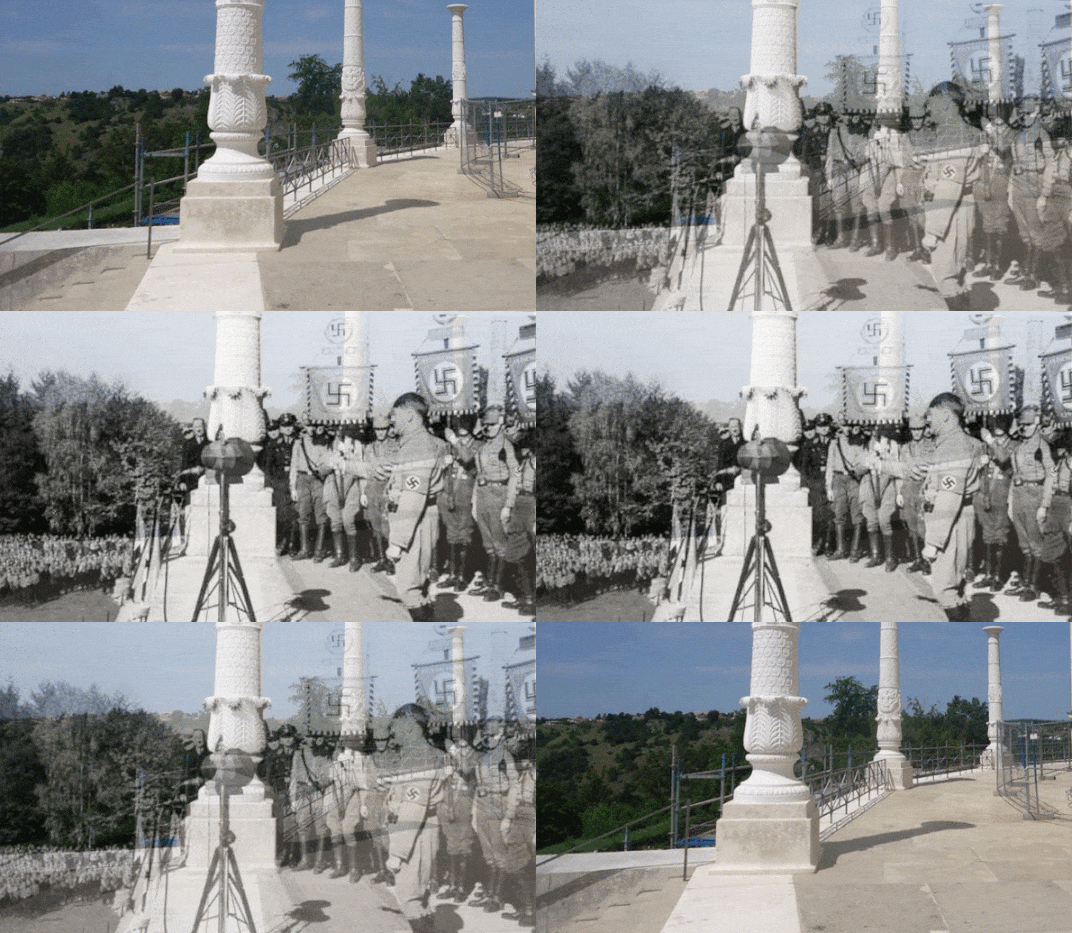 ϟϟ men, the Wöhrdplatz and the
Danube and Mittertor were rated as critical for vigilance. During the
march past the town square, around 700 people took care of Hitler's
protection. The SA people standing in line and members of the Hitler
Youth were also carefully scrutinised with cars and motorcycles only
able to enter into the city with special permission.
ϟϟ men, the Wöhrdplatz and the
Danube and Mittertor were rated as critical for vigilance. During the
march past the town square, around 700 people took care of Hitler's
protection. The SA people standing in line and members of the Hitler
Youth were also carefully scrutinised with cars and motorcycles only
able to enter into the city with special permission. Kelheim's
mayor August Donderer, who was also the Nazi district leader, had the
residents in the mood for the distinguished visit: "Our ancient city of
Kelheim is about to have a special day of special importance." The
celebration was intended to honour both "the internal liberation from
the struggle of the parties and the dissension of the masses" as well as
"the germ of the external liberation of our fatherland... Our
Befreiungshalle, this proud memorial of German unity, will be honoured
again and will then be known again throughout Germany as the meeting
place for all those people who want to build a consecrated site for
further work for the common good."
 Just
from a logistical point of view, it was a particular challenge for
those responsible to accommodate and feed the 20,000 participants who
had arrived the day before with 21 special trains. The town had provided
the guests, primarily the SA brigades in Amberg, Regensburg, Ingolstadt
and Landshut, with around an hundred private accommodation free of
charge in addition to the rooms in restaurants. The Protestant pastor
also offered a room and the parish hall. Most of them were housed in
tent bivouacs.
Just
from a logistical point of view, it was a particular challenge for
those responsible to accommodate and feed the 20,000 participants who
had arrived the day before with 21 special trains. The town had provided
the guests, primarily the SA brigades in Amberg, Regensburg, Ingolstadt
and Landshut, with around an hundred private accommodation free of
charge in addition to the rooms in restaurants. The Protestant pastor
also offered a room and the parish hall. Most of them were housed in
tent bivouacs. On
the evening of October 22 at 21.00 a tattoo of the SA took place and
music bands played on the town square and in the beer tents. The
Befreiungshalle and the town itself were illuminated. It wasn't until
midnight that the festivities in the overcrowded town ended.
 After, from 13.00 until the end of the event at 15.00, Hitler then took about 18,000 SA and ϟϟ
members to a march past on Kelheim's town square after the Reichswehr
fired another 21 gun salute. Coming from the Altmühltor they marched for
two hours in rows of six and in blocks of 500 men each "with their
hands raised" past Hitler. Five Reichsmarks had to be paid for a seat in
the stands. According to Rudibert Ettelt, the Kelheim city chronicler who died in early 2005, former Nazis fell into raptures even decades
later. Neutral observers, on the other hand, had come to the conclusion
that the number of spectators "and especially the cheers" had "kept
within limits". Other contemporary witnesses wanted to know that the
majority of the visitors to the event "came from outside". Nevertheless,
one could regard Hitler's visit as a "successful advertising campaign"
for Kelheim and the Liberation Hall, according to Ettelt. After all, the
name of the city appeared in all newspapers in the country, and the
Wochenschau produced a longer programme that was shown for a week in all
German cinemas.
After, from 13.00 until the end of the event at 15.00, Hitler then took about 18,000 SA and ϟϟ
members to a march past on Kelheim's town square after the Reichswehr
fired another 21 gun salute. Coming from the Altmühltor they marched for
two hours in rows of six and in blocks of 500 men each "with their
hands raised" past Hitler. Five Reichsmarks had to be paid for a seat in
the stands. According to Rudibert Ettelt, the Kelheim city chronicler who died in early 2005, former Nazis fell into raptures even decades
later. Neutral observers, on the other hand, had come to the conclusion
that the number of spectators "and especially the cheers" had "kept
within limits". Other contemporary witnesses wanted to know that the
majority of the visitors to the event "came from outside". Nevertheless,
one could regard Hitler's visit as a "successful advertising campaign"
for Kelheim and the Liberation Hall, according to Ettelt. After all, the
name of the city appeared in all newspapers in the country, and the
Wochenschau produced a longer programme that was shown for a week in all
German cinemas.

Himmler, Röhm and
Hitler in front of the Befreiungshalle with as it appears today. The Befreiungshalle would continue to function repeatedly as a Nazi congregation venue during the 1930s. A district rally occurred on June 15, 1934, drawing five thousand participants, where Donderer extolled the regime's fiscal recoveries. Refurbishments in 1935, subsidised by the Reich at one hundred thousand Reichsmarks, incorporated swastika emblems and eagle designs. From 1936, the location accommodated yearly observances associating Napoleonic setbacks with alleged Jewish machinations, although Kelheim lacked a resident Jewish populace after 1938. Absent synagogues since the nineteenth century precluded direct assaults, yet Aryanisation measures in proximate Regensburg disrupted Kelheim's commerce pathways.By the end of 1943, the entire building was covered under
a camouflage net and held within its walls the most valuable artifacts
from the Munich Residenz and the Nymphenburg Palace. In fact,
immediately before the outbreak of the war the Bavarian
Palace Department had outsourced the state's most valuable items within
the large vault of the Bavarian State Bank. Over time beginning in December 16, 1943 the Befreiungshalle contained 74
boxes of treasured artifacts including a large number of paintings from
the Munich Residenz followed later by an additional forty pictures
including fourteen battle scenes from the time of the Napoleonic Wars
previously hanging in the officer dining room of the Munich Residence,
a series of painted views of the palace and gardens by Franz Joachim Beich owned by the Elector
Max Emanuel from Nymphenburg schloß, Peter Jakob Horemans's paintings
from the hunting room of the Amalienburg and Peter Candids's Madonna
della Sedia after Raphael from the bedroom of King Ludwig II. After
October 1943 when the national theatre in Munich was hit by bombs, half
of its recovered work was stored in the basement of the Befreiungshalle.
Eventually the site was no longer considered safe so that on November
5, 1944, eleven of its 95 crates were relocated to Schloß Neuschwanstein.
 Between April 23 and 27 the
building came under the advance of the Americans under artillery fire.
Greater damage was caused to the surrounding masonry, to the galleries,
the staircase and the candelabra. Although part of the glass dome was
destroyed and the copper roof on the north and west side was perforated
and partially torn, the interior had no appreciable damage. One section
however had been damaged where the boxes containing the valuable art
goods were stored. Nevertheless, all but two Upper Rhine glass paintings
from 1520 from the vestibule of the rich chapel of the Munich Residence
remained intact. But as it had rained heavily these days, the humidity
increased considerably, resulting in the paintings stored there
suffering massive mould growth. To prevent further damage to the
building and the stored objects, the restoration of the glass and copper
roofs became a priority. On May 19, 1945, the Befreiungshalle
was illuminated again for the first time after repairing the damage. By
the end of August the camouflage mats and scaffolding were removed. The
last remaining works of art were returned during the course of August
1946. Soon after this evacuation, the building was reopened in 1946 for
visitors and Himmler’s touring show of ϟϟ art was stored in the Befreiungshalle.
Between April 23 and 27 the
building came under the advance of the Americans under artillery fire.
Greater damage was caused to the surrounding masonry, to the galleries,
the staircase and the candelabra. Although part of the glass dome was
destroyed and the copper roof on the north and west side was perforated
and partially torn, the interior had no appreciable damage. One section
however had been damaged where the boxes containing the valuable art
goods were stored. Nevertheless, all but two Upper Rhine glass paintings
from 1520 from the vestibule of the rich chapel of the Munich Residence
remained intact. But as it had rained heavily these days, the humidity
increased considerably, resulting in the paintings stored there
suffering massive mould growth. To prevent further damage to the
building and the stored objects, the restoration of the glass and copper
roofs became a priority. On May 19, 1945, the Befreiungshalle
was illuminated again for the first time after repairing the damage. By
the end of August the camouflage mats and scaffolding were removed. The
last remaining works of art were returned during the course of August
1946. Soon after this evacuation, the building was reopened in 1946 for
visitors and Himmler’s touring show of ϟϟ art was stored in the Befreiungshalle.
Wife
and son on the High Street in front of the town hall and how it
appeared in a Nazi postcard. Of early baroque style, it's inscribed
"1598", was renovated in the second half of the 17th century and
redesigned in 1912. Seven years after revoking Hitler's honorary
citizenship as detailed below, the town council decided to change the
name of Wilhelm-Schefbeck-Straße to Maria-Fels-Straße. Schefbeck had
been born in Straubing in 1863, studying pharmacy in Erlangen before
buying Kelheim's city pharmacy in 1893. Twenty years after in the
Befreiungshalle- seen in the background of the postcard- he signed a
contract for the "Corpsphilisterverband Regensburg" with the
"Kahnführerverein Kelheim-Weltenburg", student associations which stood
for exaggerated nationalism and anti-Semitism. Long before Hitler took
power on January 30, 1933, Schefbeck was a staunch Nazi. In his 1939
obituary in the "Altmühl-Bote," Nazi mayor Dr. August Donderer hailed
him as "one of the first to work actively within the National Socialist
movement".  |
Hitler with the town hall behind
|
Both
Dr. Donderer and Schefbeck violently disrupted a meeting of the
Bavarian People's Party in Kelheim in November 1930 with other Nazis.
This paid off for the city pharmacist who, until 1935, served as deputy
mayor of Kelheim and from 1934 a Nazi district judge. In spring 1933,
Schefbeck's employee Robert Häfner was arrested by the Bavarian Political Police, a predecessor of the Gestapo, and taken to the Dachau
concentration camp. Whilst Schefbeck would have had enough influence to
save Häfner, he did nothing for his employee. On February 9, 1933,
Schefbeck received Kelheim's honorary citizenship for "extraordinary
services to the city, in particular as chairman of the historical
association and as leader of the voluntary medical column". In 2010,
former city archivist Erich Hafner mentioned above for refusing to
revoke Hitler's honorary citizenship, celebrated his "active and
unselfish" commitment to the association, which he chaired from 1932
until his death in 1939, without saying a word about its Nazi past.
Under
Donderer's Kreisleitung, youth indoctrination progressed from 1933.
Catholic boys' organisations, encompassing two hundred members in
Kelheim by 1932, amalgamated into the Hitler Youth by December 1936,
pursuant to nationwide imperatives. Uniformed processions at the
Befreiungshalle on October 1, 1937, engaged eight hundred local
adolescents reciting allegiance oaths. Female divisions ensued in 1938,
attaining ninety per cent enrolment of qualified youths by 1939. As
mayor, Donderer supervised these, disbursing civic funds for encampments
instructing two thousand attendees yearly through 1941.
By 1939,
industrial augmentation intertwined with armament endeavours. The
Zellwolle facility redirected output to parachute silk and uniform
textiles, augmenting staff by one hundred by 1940, incorporating fifty
Italians enlisted after the Mussolini pact. Sulphuric acid production
doubled to aid explosive fabrication in Regensburg, with Kelheim
shipments via Danube vessels. By September 1941, post-Operation
Barbarossa, Ukrainian and Soviet captives supplemented labour
contingents, totalling seventy-five at the Cellulose installation. Logs
reflect fibre production at fifteen thousand tonnes in 1942, essential
for Luftwaffe necessities. The KZ-Aussenlager Saal, instituted in late
1944 near Kelheim, epitomised terminal wartime exigency. Functional from
November 1944 to April 1945, it detained seven hundred and fifty
inmates, chiefly Polish Jews such as eighteen-year-old Jakob Haiblum,
expatriated from Lodz ghetto. Under commandant Konrad Maier, prisoners
excavated tunnels into Ringberg for subterranean aeroplane part
manufactories, insulated from Allied assaults. Circumstances proved
deadly; undernourishment and floggings exacted manifold fatalities, with
approximations of one hundred deaths. Haiblum endured to narrate
fatigue treks, asserting that no graver concentration camp existed in
his ordeal. The encampment disbanded on April 25, 1945, with evacuations
to Dachau, where Maier subsequently obtained exoneration as a
subordinate. Donderer's morphine affliction emerged in early 1942,
precipitating his Kreisleiter downgrade on March 15, 1942. Heinrich
Calligaro alerted Berlin, citing addiction since 1938. Donderer
persisted as mayor, administering ration allotments amid scarcities;
coal distributions declined to sixty per cent of 1939 quantities by
1943, impacting three thousand domiciles. Agrarian tributes heightened,
with farms yielding forty per cent of crops to the regime by 1944.
Aerial defence protocols dominated routine existence from 1940. Kelheim
deployed twenty anti-aircraft emplacements by June 1941, staffed by four
hundred regional reservists. Weekly blackout exercises transpired, and
the Befreiungshalle sealed to non-combatants in 1943 for ordnance
stockpiling. Kelheim incurred no substantial bombardments, contrasting
Regensburg's March 17, 1943, incursion that slew ninety civilians, yet
fragments from remote strikes wounded twelve inhabitants on July 28,
1944. Displacements relocated two hundred juveniles to rustic Tyrol in
September 1943. Opposition manifested intermittently. Eduard Hamm, a
Kelheim denizen, withstood Dachau confinement from June 1934 for
disseminating anti-regime leaflets, subjected to torment and slain there
on June 30, 1934, amid the Night of the Long Knives. Subdued murmurs of
dissent arose in 1944, with five detentions for pessimistic utterances
on August 20, 1944. A Jehovah's Witness network,
encompassing Huber, circulated forty pamphlets in 1943, incurring
three-month imprisonments. Wartime economy taxed assets. The
Pappenfabrik Weck in Schellneck, a Kelheim outpost, functioned at halved
capability by 1942, generating cardboard for munitions containers with
twenty labourers. Revenues diminished to two hundred thousand
Reichsmarks yearly, mirroring resource deficits. Forestry barracks
furnished lumber for distant quarters erection, producing five thousand
cubic metres annually through 1944. As Allied progressions approached,
Donderer mandated fortifications on April 10, 1945, including Danube
span reinforcements garrisoned by Volkssturm cohorts of seniors and
youths averaging sixty years. American contingents infiltrated Kelheim
on April 29, 1945, unopposed, apprehending Donderer on May 1, 1945. The
Befreiungshalle, divested of Nazi symbols, lingered deserted, its
martial utility as a headquarters forsaken.
Adolescent labour mobilisation engaged from 1939. On July 1, 1940, two
hundred Kelheim lads aged sixteen to eighteen reported to
Reichsarbeitsdienst camps, erecting bulwarks near the Danube. Females
aided reaping, contributing thirty per cent of district harvests by
1942. Doctrine endured; scholastic syllabi integrated racial biology
from 1934, with manuals issued to nine hundred scholars. Industrial
subversion transpired sporadically. In March 1943, a Ukrainian operative
at Zellwolle impaired apparatus, meriting execution on April 5, 1943,
in Regensburg. Gestapo inquiries implicated no natives, yet oversight
intensified, with informants numbering fifty by 1944. The conflict's
burden accumulated. By January 1945, Kelheim tallied one hundred and
twenty martial casualties, including Lieutenant Karl Müller, perished on
the Eastern Front on December 15, 1944. Civilian adversities
encompassed ration vouchers capping bread at two hundred grams daily
from February 1945. Eastern refugee surges appended five hundred
displaced persons by March 1945, overburdening accommodations. Forced
labour at Saal amplified in January 1945, with tunnel advancement
attaining two hundred metres, fabricating propeller components for
Messerschmitt aeroplanes. Haiblum depicted daily stipulations of twelve
hours, with lashings for deficiencies. Emancipation on April 25, 1945,
released four hundred survivors, many attenuated below forty kilograms.
Donderer's ultimate measures as mayor entailed capitulation
arrangements. On April 28, 1945, he conferred with American emissaries,
relinquishing the municipality unscathed. Post-occupation, he
recommenced medical practice in 1951, attending one thousand patients
yearly until his demise on May 1, 1956.
Hitler
and Röhm leaving the rathaus which hasn't changed
after all these years as when Drake Winston and I first visited. By April 21, 1933, protective custody had ensnared one hundred and sixty-four men across the Kelheim district, predominantly communists, social democrats, and union activists. These detainees initially occupied provisional holding areas before relocation to Dachau concentration camp, which commenced operations in March 1933. Historian Helga Weigl compiled these statistics from archival materials, highlighting that the apprehensions resulted from orchestrated Sturmabteilung operations directed by Donderer. Such actions eradicated opposition rapidly, leading to the confiscation of local inns and assembly venues for Nazi purposes by May 1933.
Economic strategies conforming to Nazi autarky principles transformed Kelheim's industrial sector from mid-1933 onwards. The Simonius Cellulose Factory, which ceased production on December 31, 1932 due to the economic downturn, resumed on December 1, 1933, via Nazi intervention.  As Staatskommissar, Donderer advocated with Berlin authorities for the facility's revival, resulting in employment for roughly five hundred workers by 1934 and escalating cellulose output for paper and fabrics. Annual production increased by twenty per cent through 1936, facilitated by governmental subsidies to diminish reliance on imports. In late summer 1936, the Süddeutsche Zellwolle Aktiengesellschaft initiated activities on a plot south of the railway between Aifling and Saal along the Danube, designated as an exemplary Nazi venture producing synthetic fibres from cellulose in alignment with the Four-Year Plan for material independence. By 1938, the plant yielded ten thousand tonnes annually, staffing three hundred individuals, many conscripted from agrarian locales under compulsory labour directives. In 1937, Süd-Chemie Aktiengesellschaft erected a sulphuric acid plant adjacent to the Zellwolle site, commencing operations in January 1938. This installation furnished acids crucial for fertiliser and fibre manufacturing, enhancing the area's chemical industry. Military exigencies amplified production; by 1940, the complexes incorporated forced labourers from conquered regions, integrating fifty foreign workers by 1941. Factory records indicate the Cellulose plant evaded aerial bombardment, sustaining peak output until April 1945 as American forces neared, with annual revenues surpassing five million Reichsmarks by 1942, underscoring the regime's prioritisation of armaments-related commodities.
In front of a walled Jewish gravestone located on the façade of the town chesmist's at Donaustraße
16 and as it appeared from a Nazi-era photograph. Mentioned for the first time as a pharmacy in 1620, the two-story saddle roof building
with its corrugated gable and console bay window dates from the 17th
century and was modified in 1910. Translated from Hebrew, the gravestone
reads: This
is the grave stone of Mrs. Orgea, daughter of R. Yehuda, who died on
6th of the month of Tammuz on Friday in (5) 009 [July 9, 1249].
On
the Nazi-era photograph it shows a since-removed anti-Semitic bas
relief, "the Jewish Pig," placed above which a new plaque has been
erected. This 'Judensau' had been made in 1519 to commemorate the
expulsion of Jews from the town;' one remained resident in Kelheim.
Three such tombstones from the mediæval Jewish cemetery in Regensburg
ended up in Kelheim after the destruction of this cemetery and inserted
into numerous public and church buildings to demonstrate the eviction of
the Jews from Regensburg and the destruction of their religious
facilities and further emphasising the church's triumph over Judaism.
The other two found themselves in the Klösterl im Bruderloch, founded in
1450 by the hermit Antonius von Siegenburg. This monastery was owned by
the church until 1803 and inhabited by a few monks at which point it
was secularised and a little later came into private ownership, serving
for several decades as the site of an inn.

A pamphlet published during the Nazi period showing the relief and gravestone. Donderer's governance
enforced racial statutes stringently. By 1935, Jewish medics in
Regensburg confronted practice prohibitions, obliquely restricting
Kelheim patients' access. Devoid of synagogues, itinerant Jewish
merchants dissipated post-1938, with holdings appropriated under
November 12, 1938, ordinances. A solitary Jewish household, the Levys,
vacated Kelheim on October 1, 1938, emigrating to Palestine, their
patisserie Aryanised to a regime adherent for five thousand Reichsmarks.
Other religious minorities would encounter systematic repression in the Kelheim environs. Elisabeth Huber, born on October 19, 1890, in Mantelkirchen near Kelheim, suffered multiple incarcerations as a Jehovah's Witness. Denounced on September 14, 1937, for prohibited engagements, she endured two years and nine months across three detentions, including protective custody from 1939. Despite intermittent liberations, Huber's refusal to abjure her beliefs prompted re-arrest in 1941. Her ordeal illustrated the regime's clampdown on Bible Student associations, with over six thousand Jehovah's Witnesses imprisoned throughout Germany by 1940.


Between Weltenburg abbey and the parking lot along the Danube is this memorial
commemorating three American soldiers who drowned here in 1975 in a
training accident whilst attempting to cross the Danube in a rubber
dingy with twelve other soldiers in a manœuver using a rope by pulling
the boat across hand over hand. The current plunged the boat into the
rope, flipping it over. The surviving soldiers were rescued by fellow
soldiers and Kelheim citizens. The memorial reads:
In
Memory of Three Soldiers of the U.S. Army who Lost their Lives at this
spot in the Danube on September 16th, 1975 They met their Deaths on
Active Service for our Freedom. Dennis M. Reihan * 5.2.1940 Robert S.
Adams * 3.1.1954 Lucky J. Cordle * 16.8.1954
Siegenburg: 1937 Luftwaffe Bombing, the Wladyslaw Belcer Execution, and the Battle of Abensberg Memorial
%20(1).gif) Adolf-Hitler-Straße in a Nazi-era postcard and today. In November 1933 there had been a large demonstration in front of the property of the fire brigade commander Pickl because he had not voted despite repeated requests during the nationwide November 12 referendum on withdrawing from the League of Nations. The measure had been supposedly approved by 95.1% of voters with a turnout of 96.3%, the first of a series of referendums held by the German cabinet under Chancellor Hitler, after the cabinet conferred upon itself the ability to hold referendums on 14 July 1933. The referendum question was on a separate ballot from the one used for the elections. The question was: "Do you approve, German man, and you, German woman, this policy of your national government, and are you willing to declare as the expression of your own opinion and your own will and solemnly profess it?"
Adolf-Hitler-Straße in a Nazi-era postcard and today. In November 1933 there had been a large demonstration in front of the property of the fire brigade commander Pickl because he had not voted despite repeated requests during the nationwide November 12 referendum on withdrawing from the League of Nations. The measure had been supposedly approved by 95.1% of voters with a turnout of 96.3%, the first of a series of referendums held by the German cabinet under Chancellor Hitler, after the cabinet conferred upon itself the ability to hold referendums on 14 July 1933. The referendum question was on a separate ballot from the one used for the elections. The question was: "Do you approve, German man, and you, German woman, this policy of your national government, and are you willing to declare as the expression of your own opinion and your own will and solemnly profess it?" One report of November 7, 1937 to officials in Munich described how "[t]he population in the vicinity of the bombing site in Siegenburg near Kelheim was greatly upset by the faulty dropping of bombs in quick succession on 10/22/37 and 10/23/37. In the first case, a bomb weighing about 50 kg fell about 200 metres outside the village of Mühlhausen, 15 metres from the Mühlhausen-Geibenstetten municipal road. The wires in the hop garden belonging to farmer Johann Ferstl von Mühlhausen were damaged by the splinters. No one was injured, although several people were working in the fields about 50 metres from the impact site. In the second case, a bomb weighing about twelve kilogrammes was dropped about 80 metres from the above-mentioned community connection road and the Geibenstetten forester's lodge on the corn field of the farmer's widow Islinger von Geibenstetten. No personal injury or property damage was caused. The two impact sites are about two kilometres from the bomb site.”  Hitler-Straße is shown on the right during the Prangertag 1934 (Corpus Christi festival) bearing aloft Nazi flags down then-Hitlerstraße, now Herrenstraße.
In Siegenburg, five kilometres from Kelheim, racial policies enforced lethal consequences on November 13, 1942. Wladyslaw Belcer, a twenty-year-old Polish forced labourer in the Langhaider Forst, faced execution by hanging for a romantic liaison with a local farm girl. She
too was killed- when Belcer was hanged, she was pregnant with his
child. The Regensburg Gestapo sent her to the Ravensbrück women's
concentration camp, after which she was deported to the Majdanek
concentration camp near Lublin, and finally died on April 14, 1944 in
Auschwitz. A Nazi squad conducted the proceedings, witnessed by fellow labourers including Bruno Wilk, who later recalled the gallows erection and the sentence proclamation: whoever misuses German girls faces death by hanging. The girl, pregnant at the time, delivered the child with relatives in the Allgäu before her April 14, 1944, death in Auschwitz concentration camp, following transfers to Ravensbrück and Majdanek. Archival documents from Staatsarchiv Amberg record twenty-two similar executions across Niederbayern and Oberpfalz by 1943, underscoring the regimes racial hygiene decrees. In the nearby Langhaider forest a recent memorial has been erected to the memory of Belcer. Students at the Johann-Turmair-Realschule in Abensberg used their history class to remember the two, designing a park bench together with an information stele in Siegenburg which was financially supported by the European Leader funding program. The Kelheim District Administrator Martin Neumeyer named this form of history lesson as an example. "It should be a visible and accessible place," says the supervising teacher Maria Rauscher, with the park bench somehow symbolising a couple in love.
Site of the Battle of Teugn-Hausen which formed the opening major engagement of the 1809 campaign in Bavaria. Archduke Charles had crossed the Inn with the main Austrian army in an attempt to isolate and destroy Marshal Davout’s III Corps, which was then operating near Regensburg and still separated from the bulk of the French forces under Napoleon. On the morning of April 19, the Austrian III Corps advanced north from Rohr through Hausen, intending to cut Davout’s line of retreat and trap him against the Danube. Davout, warned by his patrols, deployed two of his divisions on the wooded ridge between Hausen and Teugn while the remainder of his corps and the baggage continued westward toward Abensberg. The resulting clash was a prolonged contest for control of the high ground with Austrian attacks repeatedly gaining temporary possession of parts of the ridge, only to be driven back by determined French counter-attacks. Fighting continued until a heavy thunderstorm in the late afternoon forced both sides to break off the action. Although neither army was destroyed, Davout succeeded in holding his position and extricating his corps. The Austrian failure to close the trap allowed the French III Corps to link up with Napoleon’s main body the following day. The battle therefore marked the first clear French success of the campaign and set in motion the sequence of victories that culminated at Eckmühl four days later, forcing the Austrians to abandon the south bank of the Danube and opening the road to Vienna.
Today the battlefield remains largely undeveloped agricultural and woodland landscape. The ridge itself is still wooded, and the valleys containing the modern villages of Teugn and Hausen retain their essential topography. In 2009 the municipalities of Hausen and Teugn erected this commemorative plaque marking the bicentenary which simply reads that "[h]ere on 19 April 1809
France fought against Austria.
Thousands of soldiers lost their lives.
The population experienced terrible times."
 Memorial to the Battle of Abensberg within another forest just outside the town which took place the following day on April 20, 1809 between a Franco-German force under the command of Napoleon and a reinforced Austrian corps led by Feldmarschall-Leutnant Archduke Louis of Austria. As the day wore on, Feldmarschall-Leutnant Johann von Hiller arrived with reinforcements to take command of the three corps that formed the Austrian left wing. The action ended in a complete Franco-German victory. The battlefield was southeast of Abensberg and included clashes at Offenstetten, Biburg-Siegenburg, Rohr in Niederbayern, and Rottenburg an der Laaber. On the same day, the French garrison of Regensburg capitulated. Despite being outnumbered, Napoleon's 113,000 troops had managed to split the 161,000 strung-out Austrians into two forces. Archduke Charles's five corps, including 48,000 additional troops of the I and II Armeekorps north of Regensburg, lay to the north whilst Feldmarschall-Leutnant Johann von Hiller, who had earlier arrived with reinforcements to take command of the three corps that formed the Austrian left wing, fell back to Landshut. Both Austrian forces had to fight a second major battle each with Hiller fighting the Battle of Landshut on April 21, whilst Charles engaged in the Battle of Eckmühl on the 22nd. These sites are covered by the Bavarian “Napoleon in Bayern” project.
 Standing at the Napoleonshöhe just outside Abensberg from where on the morning of April 20, 1809, Napoleon gave his famous speech to the Bavarians just before the battle from where he watched, which offered him a commanding view. Riding to the top of a small knoll just east of Abensberg, the emperor gathered the Bavarian officers and addressed them, his speech translated by Crown Prince Ludwig and transmitted to the men by their commanders:
Bavarian soldiers! I stand before you not as the Emperor of France but as the protector of your country and of the Confederation of the Rhine. Bavarians! Today you fight alone against the Austrians. Not a single Frenchman is in the first line, they are in reserve and the enemy is unaware of their presence. I have complete faith in your bravery. I have already expanded the borders of your land; I see now that I have not yet gone far enough. I will make you so great that you will not need my protection in any future war with Austria. For 200 years, the Bavarian flag, supported by France, has fought heroically against Austria. We march to Vienna, where we will punish it for all the evil it has caused your Fatherland. They want to divide your nation and enrol you in Austrian regiments! Bavarians! This war shall be the last you fight against your enemies. Attack them with the bayonet and destroy them!
‘A loud cheer rang out as he ended’ and the officers dispersed to convey Napoleon’s finely crafted message to their men. If some parts were lost in the process, the central themes were crystal clear: Austrian turpitude, Franco-Bavarian solidarity, certain triumph, and, most especially, the emperor’s personal faith in the loyalty and competence of the Bavarian army. ‘I only know this much,’ wrote artillery drummer Reichold, ‘that this great man assured us that he placed the same trust in us as in his Frenchmen and that we alone would therefore reap the honours of the day.’
Taken from John H. Gill's 1809 Thunder on the Danube: Napoleon’s Defeat of the Habsburgs
Schönberg: 1945 American Fighter-Bomber Attack, the RAD Teenage Casualties, and the Market Destruction

Towards the end of the war this parish church and large parts of the market suffered extensive destruction by an attack by American fighter-bombers. At least 21 German soldiers and ten civilians were killed in the fighting on April 25 between the 11th Armoured Division and a unit of the Reich Labour Service (RAD) according to Pastor Johann Baptist Bosser who described five civilians killed “in front of Schönberg”, the others as a result of the air raid on the market whilst extinguishing the fire and by heart attack by two men. According to the official history of the 11th Armoured Division, the fighting took place mainly in the forest south of Schönberg, where small groups armed with bazookas repeatedly attacked the Americans; a grenade launcher position a mile west of Schönberg was destroyed. The subsequent bombing in the late morning did not hit any military targets. Nineteen of the dead RAD men, almost all of whom were sixteen and seventeen year olds, were buried in the Schönberg cemetery; two more were found later in a state of decay and buried where they were found.
Simbach: Eva Braun’s 1928 School Year, the Marienhöhe Boarding School, and the Hitler Birthplace Proximity
 Across the Inn from Hitler's birthplace, Eva Braun spent a year at this boarding school.
In 1928 she spent a year at Marienhöhe in Simbach am Inn on the
German‑Austrian border, a Catholic institute rich in tradition. A Merian
copperplate engraving from around 1700 shows the view of Braunau from
Simbach across an old wooden bridge–the same Braunau where Adolf Hitler
had been born on April 20, 1889. The institute in Simbach had opened a
housekeeping school only a few years earlier. The facility itself had
been in existence since 1864, and was run by the Institute of the
Blessed Virgin Mary, an order of Roman Catholic nuns pledged to the
rules and spiritual exercises of St. Ignatius of Loyola. Founded by the
English nun Mary Ward, one of the most important woman of the
seventeenth century, and thus also known in Germany as the “Institute of
the English Maiden,” this order of women was active throughout Europe
and is considered even today a pioneer in women’s education. Along with
home economics, Eva Braun studied bookkeeping and typing at Marienhöhe
and was thereby trained for future office work–a path that was by no
means taken for granted for girls in the middle‑class environment of
that time. When Eva Braun, at the age of seventeen, returned from
Simbach to Munich, on July 22, 1929, she moved back in with her parents.
Only a few months later, in September, she answered an ad in a Munich
newspaper and found a trainee position: Heinrich Hoffmann, photographer,
was hiring.
Deggendorf: Alte Kaserne Swastika, the 1945 Displaced Persons Camp, and the 1337 Jewish Massacre
The alte kaserne sporting
a swastika during the war and today. Soldiers of the 3rd U.S. Army occupied the city of Deggendorf on April 27, 1945. Deggendorf was the site of a
displaced persons camp for Jewish refugees after the war, housing
approximately 2,000 refugees, who created a cultural centre that included two newspapers, the Deggendorf Centre Review and Cum Ojfboj, a theatre
group, synagogue, mikvah, kosher kitchen, and more. The camp even
issued its own currency known as the Deggendorf Dollar. Many of the
camp's residents were survivors of the concentration camp at
Theresienstadt. According to Giles MacDonogh (334), "locals accused the Jews who inhabited the old concentration camp in Deggendorf of carrying out armed robberies."
The displaced persons camp closed on June 15, 1949. This was ironic given that Deggendorf itself was the site of a notorious mediaeval massacre of
Jews, first mentioned in an official document by Duke Heinrich XIV
originating from 1338 in which the duke forgave the citizens of
Deggendorf for the murder of its Jews and spared them any kind of punishment, going so far as to grant
them the right to keep all the possessions they took from the Jews. The
inscription in the basilica of Deggendorf dates the events to 1337 in which it is claimed that Jews were
purported to have set fire to the town on Easter. It appears that the Jews
were massacred for economic reasons and the events were reworked later to
justify the act so that in the 15th century the myth
took on its own life. It was not until the 1960s that anti-Jewish
depictions showing them in the middle of the alleged host desecration
were increasingly attacked. Among these was a cycle of sixteen oil
paintings and the "Judenstein," an anvil with
daemonic Jewish figures around it. Even though the debate quickly became a heated topic in the press -abroad as well as domestic-
it wasn't until 1968 that the first four of the sixteen oil paintings were finally removed.
Ganacker: 1945 Flossenbürg Subcamp, the Me 262 Air Base Construction, and the 138 Prisoner Deaths

The Ganacker concentration camp in
Eger was a satellite camp of Flossenburg which existed from February
20, 1945 to April 24, 1945. In 1939 it was established for around 3,000
prisoners and expanded accordingly. Organisationally, around 100
subcamps were later subordinate to the main camp in Flossenbürg. In the
Ganacker satellite camp, north of Landau an der Isar, prisoners were
housed who were supposed to carry out war-important projects, mainly the
expansion and maintenance of an air base. It has not yet been finally
clarified whether, according to locals, the satellite camp was opened at
the end of 1944 or according to records on February 21, 1945. It was
initially housed on the grounds of the Landau-Ganacker airfield. A
fighter squadron was stationed there. A new concrete runway had to be
built to use the Me 262. When the air raids increased, the concentration
camp was moved to Erlau, near Wallersdorf , about a mile from the
airfield in front of a grove, the Pfarrerholz. There were around 500
male prisoners, mostly Jews, coming from all over Europe. The
concentration camp prisoners had to live there under miserable
conditions. They were forced to live in damp holes in the ground regardless of the rain and snow. It was one of the toughest and most
notorious camps in terms of living conditions and at least 138 prisoners
were killed. Israel Offmann, who narrowly survived, described the
conditions at central warehouse Ganacker in a radio interview this way:
"Auschwitz was a 5-star hotel and Ganacker was hell." Offmann had
experienced both camps and went on to describe how “Ganacker was
provisional compared to other camps. In makeshift dwellings, the
prisoners lay like marmots in excavated caves that were lined with
straw.” On April 23, 1945, the ϟϟ
began "clearing" the satellite camp in the Erlau with the Americans
expected daily. From March 2, 1945 to April 23, 1945, 138 prisoners died
in the satellite camp. The bodies were buried in a makeshift manner in
the small forest behind the camp and a nearby forest to the west.


Bayerisch Eisenstein: Bernhard Schmidt’s ϟϟ Career and the Jugendherberge Hitler Youth Flag
The Gasthof Neuwaldhaus flying the Nazi flag and its current incarnation
The Youth Hostel, also considerably changed including the Hitler Youth flag in front. Bayerisch Eisenstein is where Bernhard Schmidt would eventually die on September
6, 1960. Born in Pegnitz in 1890, in August 1919 he married and took
over the inn of his parents-in-law in Bayerisch Eisenstein. He joined
the Nazi Party as member 14,699 in 1925 and the ϟϟ,
number 2,069, in 1930. From late June 1934 to late March 1935, Schmidt
was camp commander in the Lichtenburg concentration camp, later serving
as camp commander in the Sachsenburg concentration camp until July 1937.
Thereafter Schmidt was the protective custody camp leader at both the
Sachsenhausen and Dachau concentration camps until June 1938.
Schmidt was dismissed by Theodor Eicke, leading him to work as a
district group leader at the Reich Air Protection Agency Weser/Elbe.
His request to return to the Waffen-ϟϟ was not granted on several occasions. Schmidt was never prosecuted after the war.
Osterhofen: Hindenburgplatz Nazi Era, the Osterhofen DP Camp, and the Stanislaw Stankievich War Criminal
 Hindenburgplatz during the Nazi regime and today.
Osterhofen was the site of a DP camp after the war; its camp leader at the end of 1946 would be Stanislaw Stankievich, “the arch-butcher” responsible for ordering the massacre of 6,000 Jews at Borissow in 1941. Stankievich had previously found
work as a teacher in the
Regensburg and Michelsdorf camps after the war. During his time at the
camp he continued his work as a propagandist, becoming the
editor-in-chief of the Byelorussian nationalist newspaper Backauseyna
(“Fatherland”). On October 31, 1947, the United Nations formally adopted
a resolution introduced by the delegate from the Byelorussian Soviet
Socialist Republic naming Stankievich “as a war criminal wrongfully
harboured by the United States,” which did nothing to remove Stankievich
from his position as the leader of the Osterhofen DP camp until May
1950.
 |
| The war memorial |
When
he left Osterhofen, he was neither arrested nor deported to the Soviet
Union, but instead became the “Language Training Supervisor” for the
International Refugee Organisation in Munich. Stankievich eventually
applied for a visa to the United States under his own name, and although
the US Displaced Persons Committee (DPC) was ignorant of his role in
the Borissow Massacre, the committee found that Stankievich had
“admitted to being the editor of a newspaper which was a German
propaganda organ. It was the opinion of the US DPC,” the report continued, “that Stankiewicz was an out-and-out opportunist who changed
his politics and allegiance without other thought than personal gain;”
his application was thus rejected. He unsuccessfully appealed this
decision, trying to explain that he had only supported the Nazis against the Soviet Union because it had been “the lesser of
the two evils.” A report was then sent to the American State Department
declaring him a good anti-Communist with no known connections with
Nazis, even though Stankievich was wanted for the Nuremberg trials as a
known war criminal. Nevertheless the American Army recruited Stankievich
and got him a job with the Institute of Russian Research, allowing him
to come to the United States briefly and then permanently in 1969.
Geisenfeld: Gregor Straßer’s 1932 Speech and the Night of the Long Knives
 On April 22, 1933 the market town council was formed from six Nazis and and May 1 was celebrated with a march on Hindenburgplatz shown on the left, the broadcast of a Hitler speech and a theatre performance. A week later Judenstrasse (today's Maximilianstrasse) was renamed Hitlerstrasse and a picture of Hitler was bought for the town hall hall. From June 12 when all BVP councillors resigned, only the Nazis had there. Four days later an "Adolf Hitler Oak" was consecrated in Geisenfeldzüge. The Nazi flag flew for the first time here on the market square on March 11, 1932, three days before the Reich presidential election- and yet only 290 voters vote for Hitler compared to the 744 for Hindenburg. Even in the second ballot on April 12, 1932, this voting ratio only changed slightly. In the following elections in 1932 - despite all the propaganda - the Nazis remained behind the Bavarian People's Party (BVP). It was not until the Reichstag elections on March 5, 1933, after the Nazis came to power on January 30, that the Nazis were able to conquer the "black stronghold" of Geisenfeld with 574 to 390 votes. On February 26, 1933, almost four weeks after Hitler came to power, the first SA and ϟϟ deployment took place in Geisenfeld, in which 200 people took part. On March 10th there is another big parade of the Nazis, for the first time the swastika flag is also blowing at the town hall. A few days later, several non-Nazi municipal councillors were temporarily taken into “protective custody” - to intimidate them.
Gregor Straßer was born in Geisenfeld in 1892. In 1914 he began studying pharmacy at Munich University. When the Great War broke out, he registered as a volunteer and became a lieutenant. After the war he continued his studies, which he completed in Erlangen in 1919. In early 1920 he took over a chemist's in Landshut, and in the same year he joined the National Association of German Soldiers. Thanks to Straßer's activity, the association became an important power factor in Lower Bavaria. In the spring of 1921 there was a meeting with Hitler in Straßer's Landshut apartment resulting in Straßer joining the Hitler movement with 1000 men from his battalion. When the SA associations of Lower Bavaria met in Landshut for the consecration of the standards, Straßer was appointed leader of the Lower Bavaria Storm Detachment. Later he was only referred to as the Gauleiter of Lower Bavaria. After the Beer Hall Putsch in which he was an active participant, Straßer was arrested, went to the remand prison, but was soon released- he had been put on the electoral list of the Völkisch bloc and no candidate could be hindered after being nominated.  Straßer was now the most important man in the Nazi movement. He was elected to the state parliament, where he was chairman of the “Völkischer Block”. In 1924 he entered the Reichstag. After Hitler was released from prison, it was agreed that Hitler would organise the movement in southern Germany, and Straßer that in northern Germany. Straßer subsequently built the Nazi Party there with tireless energy. In 1926 he became Reich Propaganda Leader, in 1928 Reich Organisational Leader. Straßer was now the second strongest man in the party and thus Hitler's most dangerous rival for power. And at the peak of his power, Straßer returned to his hometown where as head of the Reich Organisation of the Nazi party he gave a speech on June 25, 1932. “Around 800 people, mostly strangers, who had flown from all over Hallertau and filled the spacious Klosterbräu cellar room,” reported the Geisenfelder Wochenblatt. But that same year it came the break: Hitler was angry that Reich Chancellor Kurt Schleicher had offered Straßer the office of Vice Chancellor and accused Straßer of treason. In protest Straßer resigned bitterly from all offices and became managing director of a company. In the context of the Night of the Long Knives in June 1934, Hitler settled bloody accounts with many former companions - including Straßer. On June 30, 1934, five Gestapo officers broke into his Berlin apartment and took him away. In the basement of the Gestapo building, an ϟϟ-Hauptsturmführer killed him with several shots with the words: “Well, the pig is finished!” Whether Straßer was killed on Hitler's personal orders isn't known. He was shot once in the main artery from behind in his cell but did not die immediately. On the orders of Reinhard Heydrich, Straßer was left to bleed to death, which took almost an hour. His brother Otto had emigrated in 1933 whilst Himmler paid the widow a modest monthly pension. Lord Alan Bullock (171) judges the native Geisenfelder as follows:
 Strasser was undoubtedly the most powerful of Hitler's lieutenants, the only man in the Party who, if he had had more of Hitler's power of will and ambition, and less good-natured easy-going Bavarian indulgence in his nature, might have challenged Hitler's leadership. Strasser possessed the personality to be a leader in his own right if he bestirred himself; Goebbels, undersized, lame and much disliked for his malicious tongue, could rise only under the aegis of someone like Hitler, to whom he was useful for his abounding energy and fertility of ideas, apt at times to be too clever and to over-reach himself, but exploiting with brassy impudence every trick of propaganda.
Wolnzach: Georg Biederer’s Nazi Rise and 1932 Swastika Flag Hoisting
%20(1).gif) Wolnzach's town hall then and now.
Wolnzach's town hall then and now.
The
town's local Nazi Party branch was founded on February 14, 1932 under the sponsorship of Georg Biederer in the Klosterbräu cellar hall on
Regensburger Straße. The Geisenfeld members appointed the 43-year-old
Sebastian Daubenmerkl, who originated from Waldthurn in the Upper
Palatinate but based in Geisenfeld from 1919, as local group leader. On
March 11, 1932, the young Geisenfeld local group hoisted the swastika
flag for the first time on the market square, three days before the
presidential elections. In Geisenfeld, however, only 290 voters voted
for Hitler and 744 for Hindenburg. Even in the second round of voting on
April 12, 1932, this proportion of votes changed only slightly. In the
national elections that followed, despite all the propaganda efforts,
the Nazis continued to fall short behind the Bavarian People's Party
(BVP). It wasn't until the Reichstag elections on March 5, 1933, after
the Nazis took power on January 30, that the Nazis were able to conquer
the "black stronghold" of Geisenfeld with 574 to 390 votes. On February
26, 1933, almost four weeks after Hitler seized power and the day before
the Reichstag fire, the first SA and ϟϟ march took place in Geisenfeld,
in which 200 people took part. On March 10 there was another large Nazi
parade, and for the first time the swastika flag was flown from the
town hall. A
few days later, several non-National Socialist market town councillors
were temporarily taken into “protective custody” – for intimidation. On
March 24, Geisenfeld youth was called upon to join the Hitler Youth,
and just a few weeks later in April 65 boys from Geisenfeld took part in
a ""followers' roll call appeal" with the motto: "From now on everyone
must stand with Adolf Hitler." %20(1).gif) |
Bahnhofstraße then and now
|
Wolnzach's
war memorial being inaugurated on June 27, 1926. The head of the local
veteran's association, Josef Eibel, had suggested the erection of a
"worthy war memorial for the fallen Wolnzach". At 9.00 on June 17, 1926
the foundation stone for the war memorial was laid by Mayor Nefzger
before the memorial was formally inaugurated nearly ten days later.
Wolnzach was the hometown of Nazi functionary Georg Biederer who had described Geisenfeld as "a black nest"
given how difficult the Nazis had found it in the arch-conservative
town unlike other sites in the district. On February 14, 1932, he
sponsored a local branch of the Nazi Party in the basement of the
Klosterbräu on Regensburger Strasse in Geisenfeld. Biederer attended
elementary school here before working in agriculture. From June to
December 1918 he was a soldier, but did not serve at the front. After
the war he became a member of the Bund Oberland, a predecessor group of
the SA in Bavaria, while working as a hop farmer in his hometown. In
1928 he joined the Nazi Party and on August 15, 1933 he was promoted to
SA Standartenführer. In 1933 he was a member of the Bavarian State
Parliament and from November 1933 to 1945 he represented his
constituency in the Reichstag. Biederer was chairman of the supervisory
board of the German hop transport company. On January 30, 1937 he became
SA-Oberführer and on April 20, 1944 SA-Brigadführer. He completed his
military service during the war with the rank of first lieutenant in the
reserve. Cycling into town down Freisingerstraße, shown here and below from Nazi-era postcards and today.
Cycled past this memorial located in the corner of some woods heading towards Wolnzach for Martina Jarosova and Petra Trachtulcova who were murdered as they sought to hitchhike to southern France to earn money for their studies by helping with the grape harvest. They became the last victims of a then 49-year-old man who, although convicted, is in a Germany cautious about hurting the feelings of even serial killers, only identified as "N. N." and who had escaped pre-trial detention in Hamburg in June 1993. He drove through Germany in stolen luxury cars and murdered a woman near Geesthacht. Another woman he had taken along managed to save herself by jumping from the moving vehicle.
He's believed to have picked up the two Czech women on the A 93 autobahn near Regensburg. Martina was murdered in the Emmerams-Hölzl bei Nittenhausen in kreis Wolnzach; Petra in the forested Speck area near Ronnweg. He was captured a few weeks later and sentenced to life imprisonment.
In 1997, donations were raised for two stone memorials. The large monument with the central crack at Nittenhausen was donated by Margot Pöllmann and crafted by apprentices from the State Stonemasonry School in Wunsiedel. This one, a “Broken Book” at Ronnweg, is by sculptor Helmut Hofer from Geisenfeld. Its installation took place on September 12, 1998, five years after the murders, in the presence of the victims’ relatives.
Mainburg: Adolf-Hitler-Platz Town Hall, the 1937 Anti-Nazi Arrests, and the 1938 Anschluss Referendum
Crossing the Amper into the town
The town hall hanging out Nazi flags as it appears on the cover of local history teacher and headmaster Hanns Georg Seidl whose book Mainburg unterm Hakenkreuz focuses
on the Nazi era in Mainburg from 1928-1945. Drawing on extensive
archival research from the Stadtarchiv Mainburg and local sources, Seidl
traces the rise of the Nazis and examines how the Nazi Party
established itself in this predominantly rural Catholic area,
highlighting key figures such as NSDAP-Kreisleiter Alois Fellner, who
played a central role in local party activities, including rallies and
the 1938 Erntedankfest celebrations. Seidl documents the Gleichschaltung of
local institutions, including the town council, schools, and
associations, which were brought under Nazi control after 1933. He also
details the persecution of political opponents, Jews, and other groups,
as well as the impact of wartime measures on the civilian population.
Mainburg's economy, dominated by brewing and agriculture, was integrated
into the Nazi war effort, with local businesses contributing to
armament production. Seidl also covers the role of the Hitler Youth and
the experiences of forced labourers brought to the area. The book
includes numerous photographs and documents from the period, offering a
visual record of Nazi presence in the town, such as swastika flags and
party parades. Controversies surrounding local complicity and
denazification after 1945 are addressed, with Seidl noting the
challenges of confronting the past in a small community. As he himself says,
When
you find out that your own father or grandfather was a Nazi, you have
to be able to bear it if you want to learn something from it. But before
you start morally judging the descendants of Messrs. Brunner, Fellner,
Seidl, Hösl, Schnell, Hien, and Gerl- who's to say you don't also have a
Nazi grandfather lying in your basement? And he doesn't disappear if
you repress, forget, or deny him. I think it makes it more bearable if
you confront it, talk about what he did, wrote, or said.
 In
Am Graben, a small road in the town, is this remarkable building which
is betrayed by its surviving iron railings as the Nazi Party which
served as the administrative headquarters for the local Nazi Party
district leadership from the 1934 until 1945. The building housed the
office of Kreisleiter Alois Fellner, who directed party operations in
the Mainburg area from around 1933 onward. Construction and adaptation
of the Kreisleitung offices occurred primarily between 1934 and 1936 as
the party consolidated power following the Machtergreifung. The building
featured typical Nazi architectural elements, including a prominent
entrance with party symbols and flags. A notable detail is the survival
of original Wolfsangel iron railings which remain visible today
as does its opening date of 1934. Today the symbol is banned in Germany
for use by far-right organisations under Section 86 of the Criminal Code
(Dissemination of propaganda materials of unconstitutional and
terrorist organisations) and Section 86a of the Criminal Code (Use of
symbols of unconstitutional and terrorist organisations). Literally
translated as the wolf hook, it originated in mediæval Central Europe as
a practical animal trap designed to capture or kill wolves by ensnaring
them around the neck or limbs. Its distinctive angular shape,
resembling an open cross or a jagged letter Z, existed long before the
twentieth century and carried no inherent political meaning. During the
Nazi era though, the symbol was deliberately appropriated by elements of
the Wehrmacht and the ϟϟ as a unit insignia, primarily for
reconnaissance, paratrooper, and panzer formations.
In
Am Graben, a small road in the town, is this remarkable building which
is betrayed by its surviving iron railings as the Nazi Party which
served as the administrative headquarters for the local Nazi Party
district leadership from the 1934 until 1945. The building housed the
office of Kreisleiter Alois Fellner, who directed party operations in
the Mainburg area from around 1933 onward. Construction and adaptation
of the Kreisleitung offices occurred primarily between 1934 and 1936 as
the party consolidated power following the Machtergreifung. The building
featured typical Nazi architectural elements, including a prominent
entrance with party symbols and flags. A notable detail is the survival
of original Wolfsangel iron railings which remain visible today
as does its opening date of 1934. Today the symbol is banned in Germany
for use by far-right organisations under Section 86 of the Criminal Code
(Dissemination of propaganda materials of unconstitutional and
terrorist organisations) and Section 86a of the Criminal Code (Use of
symbols of unconstitutional and terrorist organisations). Literally
translated as the wolf hook, it originated in mediæval Central Europe as
a practical animal trap designed to capture or kill wolves by ensnaring
them around the neck or limbs. Its distinctive angular shape,
resembling an open cross or a jagged letter Z, existed long before the
twentieth century and carried no inherent political meaning. During the
Nazi era though, the symbol was deliberately appropriated by elements of
the Wehrmacht and the ϟϟ as a unit insignia, primarily for
reconnaissance, paratrooper, and panzer formations.  Military
commanders and ideological officers selected it because its historical
association with hunting and trapping resonated with Nazi propaganda
themes of martial cunning, predatory aggression, and the romanticised
imagery of Germanic wilderness. The hook was interpreted as a metaphor
for catching the enemy in a tactical snare, reinforcing the regime’s
emphasis on swift, decisive strikes and ruthless battlefield efficiency.
It was never an official emblem of the Nazi Party itself, nor did it
carry the same ideological weight as the swastika or the ϟϟ runes, but
appeared prominently on the uniforms, helmets, vehicles, and unit
patches of formations such as the Aufklärungsbataillon of the
Leibstandarte ϟϟ Adolf Hitler, several Fallschirmjäger regiments, and
certain Heer reconnaissance battalions. Hitler
Youth adjutants wore the Wolfsangel as a sleeve patch. Other
organisations that used it were the 2nd ϟϟ Panzer Division “Das Reich”,
infamous for the massacre at Oradour-sur-Glane. A Wolfsangel was also
used by the 34th ϟϟ Volunteer Grenadier Division “Landstorm Nederland”, a
Waffen-SS formation recruited largely from Dutch volunteers. Variants appeared in other ϟϟ-related contexts, including insignia connected with the 4th ϟϟPolizei Panzergrenadier Division and the 2nd ϟϟ Panzer Division. The SA
Standard
Feldherrnhalle, the National Socialist Students' League, and Panzer
Brigade 106 Feldherrnhalle also used it. In this context, the Wolfsangel
was meant to symbolise military preparedness. It's since been adopted
by far-right circles worldwide like serving as the identifying symbol of
the Young Front (JF), which was banned in 1982. Today, the Ukrainian
Azov Regiment uses the symbol more as a badge of elite status and operational identity rather than a broad political statement.
Military
commanders and ideological officers selected it because its historical
association with hunting and trapping resonated with Nazi propaganda
themes of martial cunning, predatory aggression, and the romanticised
imagery of Germanic wilderness. The hook was interpreted as a metaphor
for catching the enemy in a tactical snare, reinforcing the regime’s
emphasis on swift, decisive strikes and ruthless battlefield efficiency.
It was never an official emblem of the Nazi Party itself, nor did it
carry the same ideological weight as the swastika or the ϟϟ runes, but
appeared prominently on the uniforms, helmets, vehicles, and unit
patches of formations such as the Aufklärungsbataillon of the
Leibstandarte ϟϟ Adolf Hitler, several Fallschirmjäger regiments, and
certain Heer reconnaissance battalions. Hitler
Youth adjutants wore the Wolfsangel as a sleeve patch. Other
organisations that used it were the 2nd ϟϟ Panzer Division “Das Reich”,
infamous for the massacre at Oradour-sur-Glane. A Wolfsangel was also
used by the 34th ϟϟ Volunteer Grenadier Division “Landstorm Nederland”, a
Waffen-SS formation recruited largely from Dutch volunteers. Variants appeared in other ϟϟ-related contexts, including insignia connected with the 4th ϟϟPolizei Panzergrenadier Division and the 2nd ϟϟ Panzer Division. The SA
Standard
Feldherrnhalle, the National Socialist Students' League, and Panzer
Brigade 106 Feldherrnhalle also used it. In this context, the Wolfsangel
was meant to symbolise military preparedness. It's since been adopted
by far-right circles worldwide like serving as the identifying symbol of
the Young Front (JF), which was banned in 1982. Today, the Ukrainian
Azov Regiment uses the symbol more as a badge of elite status and operational identity rather than a broad political statement.
The
Kreisleitung itself coordinated local activities including propaganda,
recruitment, and enforcement of party policies. From Am Graben, Fellner
oversaw the Gleichschaltung of local associations, schools, and
businesses. The office managed membership records, organised rallies,
and distributed directives from the Gau leadership in Bayreuth. In 1938,
the Kreisleitung played a key role in the Erntedankfest celebrations
and the implementation of anti-Jewish measures following Kristallnacht.
During the war years the building became a centre for managing forced
labour assignments and air raid preparations. The building survived the
war largely intact and was later repurposed for civilian use. The
presence of the original Wolfschanz railings provides a rare physical
reminder of the Nazi period in the town centre. Historians note that the
Kreisleitung on Am Graben exemplified how the Nazi Party embedded
itself in everyday urban spaces, using prominent locations to project
authority.  Adolf-Hitler-Platz shown in Nazi era postcards with the town hall. On June 5, 1937 the district president from Lower Bavaria/Upper Palatinate reported to Munich how “[i]n the case of special political events, former members of the KPD [communist party] cannot hide their true views. For example, a mechanic in the district of Mainburg called the shelling of Almeria [during the Spanish civil war] cowardice and scorned the stupid Germans who held their heads up; he was arrested.” The following month "three complainers” from Kreis Mainburg were aprehended. One such example was Fischer Josef, a trader in Au, who responded in a local pub to the 'Heil Hitler' greeting with the words “Scheiss Hitler” and declared that"[w]e used to have a kingdom and an empire and now we have nothing. Even if the government is in agreement from above from below there are nothing but rascals and 'Bazi' [south German for 'crook'] who have never been any good. If someone gets their hands on five pfennigs, they embezzle the rest."
 The town hall in the right background is the only building that seems to have survived intact (or rebuilt as it was) since the war. The local newspapers “Hopfenbauer” and “Hollertauer Rapporteur” stopped appearing in Mainburg by the end of September 1937, having been replaced by the Nazi “Bavarian Ostmark”. In fact, the publisher of the "Hollerdauer Rapporteur" was taken into protective custody in Mainburg because the last number of the Hollerdauer Rapporteur contained an advertisement for the employees and workers of the company, in which they appealed to the community about work and earnings, allowing the regime to claim that the aim of the publication was to give the impression that employees and workers in the Third Reich were thrown out on the street without their maintenance or other accommodation having been provided.
In another report the district president made his own demands, such as being allowed to impose higher penalties, to Munich, citing as an example "[t]he general goods dealer Hällmayer in Mainburg [who] has been informed by the Neustadt a.d.D. tax office, fined around RM 11,000 for tax evasion. This way of doing things has caused outrage and bitterness among the population. The national comrades demand that such national pests also be punished with imprisonment.
The NSKK (Nationalsozialistisches Kraftfahrkorps) Motorsturm 7/M 80 conducting a Sturmheimweihe- a ceremonial consecration of their storm flag- in front of the Leiß post office on Himmlerstrasse in 1936. The NSKK, founded in 1931 as a paramilitary motorised unit of the Nazi Party, was responsible for transport, driver training, and supporting SA and ϟϟ operations. Motorsturm 7/M 80 was the local unit in the Mainburg area, part of the larger Motorstandarte in the Gau Bayerische Ostmark. The ceremony involved the unit parading in uniform, raising the Sturmflagge, and performing oaths of allegiance to Hitler and the party. Himmlerstrasse, now reverted back to Poststrasse, was a key street in Mainburg during the Nazi period, reflecting the regime's renaming of public spaces to honour party figures. The Leiß post office served as a central location for such events because of its visibility in the town centre. The Sturmheimweihe was part of a broader wave of flag consecrations across Germany in 1936, coinciding with the Olympic Games in Berlin and heightened propaganda efforts which usually included speeches emphasising motorised mobility as a symbol of modern Nazi power and readiness for war. In Mainburg, the event helped consolidate the NSKK's role in local society, recruiting members from the middle class and farmers who owned vehicles.  On May 6, 1938 the District President described the local response earlier April 10 referendum confirming the annexation of Austria as one of "sincere joy of all comrades over the return of the brother nation and the realisation that the actions of the Führer spared Austria a civil war, but eliminated an ever-threatening danger for Europe, the overwhelming result of the vote was right from the start in tight. The result of the vote in the administrative district was 98.23% yes votes with a turnout of 99.77%.” Apparently most of the 'no' votes were counted apart from those in former strongholds of communism or in constituencies that used to support parties like the Catholic Central Party. In working-class communities the vote was overwhelmingly “yes.” Nevertheless, it was admitted that “[n]othing has become known about violations of ballot secrecy during the election process itself. On the other hand, in Regensburg and above all in the Mainburg district, a broad public became aware of subsequent amendments to invalid and 'no' votes.
  The incidents are all the more regrettable as trust in the election process is considerably damaged by such cases that have become known to the public and which have virtually no influence on the overall result. The Lord Mayor of Regensburg- District Returning Officer for Lower Bavaria/Upper Palatinate- remarks that the election result was influenced by the short-sightedness of individual returning officers and political authorities, and as a result many people's belief in the correctness of the election was shaken. The 'no' votes that were wrongly converted into “'yes' or 'invalid' would now be multiplied by the constant naggers.”
Steinhöring: The First 1936 ϟϟ Lebensborn Home, and the Racial Purity Maternity Programme
 Site of the first Lebensborn home established by the ϟϟ for racially approved unmarried mothers, who otherwise might not receive the facilities Himmler thought they deserved: infant mortality rates amongst illegitimate children were notoriously far higher than the national average. Based in Berlin where it was founded on December 12, 1935 and from 1938 in Munich, between 1935 to 1945 over twenty homes were established for unmarried pregnant women, young mothers and their children throughout Europe. These had to meet the standards of the Nazi "heredity and race theory" and were considered "valuable". The founding members were ten ϟϟ leaders whose names were unknown, who carried out the founding at the instigation of Himmler. Organisationally, the association was initially integrated into the ϟϟ Race and Settlement Main Office (RuSHA) and managed as an independent main department in the "Sippenamt". Guntram Pflaum became the first managing director. At the beginning of 1938, Lebensborn was separated from the RuSHA and attached to Himmler's personal staff who now appointed the board members of the association directly. In March 1940, he replaced Pflaum due to poor management by the ϟϟ administrative officer Max Sollmann, who led the association as sole director until its dissolution. Himmler drove the ϟϟ to organise support programmes, particularly for unmarried mothers and their offspring, for two primary reasons:
  On the one hand, he had identified the declining birth rate as the most urgent demographic problem in the German Reich. He placed it in close connection with the increasing number of abortions since the turn of the century. This development was to be tackled by supporting and destigmatising unmarried mothers and their illegitimate children. Himmler was thus moving in the context of the general legal debate about a reform of the illegitimate policy in favour of unmarried women, which was mainly supported by the Nazi political desire for birth promotion. On the other hand, since the Nazis came to power, several Nazi organisations dedicated to the care of unmarried mothers and their offspring had come into being, above all the National Socialist People's Welfare Organization (NSV) with its "Mother and Child Aid" founded in 1934. By founding the association, Himmler signaled the ϟϟ's claim to want to actively participate in the Nazi state's population policy: With the Lebensborn, the ϟϟ ideal of a so-called Germanic elite was to be implemented in public welfare services.
The first purpose of the association was to “support large families with hereditary biological value” achieved by making allowance payments to families of ϟϟ members with five or more children from 1937 onwards. However, these grants were only actually paid out in a few cases. The welfare service primarily served the charitable appearance of Lebensborn, whose core mission lay in the racially based, selective birth promotion. The main purpose of the association was the establishment and maintenance of maternity homes and homes for mothers. Admission, childbirth and care in the homes were reserved for expectant mothers who met the racial-biological requirements of the ϟϟ. Club membership was obligatory for every full-time ϟϟ leader. The other ϟϟ members were expected to join, and every German could become a voluntary member.  The members had to pay contributions, which were graded according to the number of children, rank, income and age. At the end of 1938, the Lebensborn had almost 13,000 members, of whom around 8,000 belonged to the ϟϟ and around 4,000 to the protection police. Contrary to the requirements of the association's statutes, Lebensborn was never able to finance itself adequately from the contributions paid and was therefore dependent on additional resources. In addition to the billing of health insurance benefits for expectant mothers, these were primarily donations from state and party offices, from associations and businesses. In addition, the association benefited from the donation or transfer of real estate, which it used to set up homes or for its administration. Some of these properties were in favour of the Lebensborn "aryanised ” or withdrawn from previous owners who were persecuted for other reasons. At the instigation of Himmler, the association moved its headquarters from Berlin to Munich in early 1938, where it moved into the former villa of the writer Thomas Mann at what wa then Poschingerstraße 1. By
1939, six Lebensborn homes had been set up in the Greater German Reich,
the first here in 1936 in Steinhöring. The association maintained other
homes in countries occupied by the Wehrmacht during the war, above all
in Norway, and also in Belgium, France and the Netherlands. From 1942,
the association was also actively involved in the kidnapping of children
from the areas occupied and annexed by the German Reich. These were to
be "Germanised" and thus become part of the Nazis' "national
community".
The members had to pay contributions, which were graded according to the number of children, rank, income and age. At the end of 1938, the Lebensborn had almost 13,000 members, of whom around 8,000 belonged to the ϟϟ and around 4,000 to the protection police. Contrary to the requirements of the association's statutes, Lebensborn was never able to finance itself adequately from the contributions paid and was therefore dependent on additional resources. In addition to the billing of health insurance benefits for expectant mothers, these were primarily donations from state and party offices, from associations and businesses. In addition, the association benefited from the donation or transfer of real estate, which it used to set up homes or for its administration. Some of these properties were in favour of the Lebensborn "aryanised ” or withdrawn from previous owners who were persecuted for other reasons. At the instigation of Himmler, the association moved its headquarters from Berlin to Munich in early 1938, where it moved into the former villa of the writer Thomas Mann at what wa then Poschingerstraße 1. By
1939, six Lebensborn homes had been set up in the Greater German Reich,
the first here in 1936 in Steinhöring. The association maintained other
homes in countries occupied by the Wehrmacht during the war, above all
in Norway, and also in Belgium, France and the Netherlands. From 1942,
the association was also actively involved in the kidnapping of children
from the areas occupied and annexed by the German Reich. These were to
be "Germanised" and thus become part of the Nazis' "national
community". .jpg)
One reminder of the site's original purpose is this statue on its grounds named entitled (Breastfeeding Mother) on the former site of the Lebensborn-Heims Hochland in Steinhöring. The
Lebensborn programme ended up earning a mysterious and dubious
reputation. Rumours of "counselling homes" and breeding establishments
were based on diffuse knowledge about procreation calls and specific
practices in the homes, such as the so-called name consecration. At the
ceremony, which took place instead of a baptism, the mother had to
undertake to bring up the child in the spirit of National Socialism.  The
director of the home sealed this by "consecrating" the infant under an ϟϟ dagger and singing the ϟϟ "Loyalty Song". The
media dealing with the
Lebensborn in the immediate post-war period and beyond was characterised
by scandalising the homes as ϟϟ stud farms and brothels. Although the
eighth of the “Nuremberg "follow -up trials ” in 1947 and 1948 dealt
with its selection
and kidnapping measures the American judges failed to declare any
crimes were committed, judging the
Lebensborn as a pure welfare institution. The main protagonists of the
association were acquitted or given prison sentences of a few years
because of their ϟϟ membership.
The
director of the home sealed this by "consecrating" the infant under an ϟϟ dagger and singing the ϟϟ "Loyalty Song". The
media dealing with the
Lebensborn in the immediate post-war period and beyond was characterised
by scandalising the homes as ϟϟ stud farms and brothels. Although the
eighth of the “Nuremberg "follow -up trials ” in 1947 and 1948 dealt
with its selection
and kidnapping measures the American judges failed to declare any
crimes were committed, judging the
Lebensborn as a pure welfare institution. The main protagonists of the
association were acquitted or given prison sentences of a few years
because of their ϟϟ membership.But Himmler’s bizarre attempt to encourage his elite to breed a future master-race was not very successful: the homes were quickly used by prominent married couples in the ϟϟ and later in the Nazi Party more generally, because of their low charges, good facilities and (especially during the war) favourable rural locations. In peacetime, under half the mothers in the homes were unmarried, though this in itself was enough to attract criticism from Catholics and conservatives. Altogether, some 8,000 children were born in the homes, hardly sufficient to inaugurate a new master-race. Nor did he have much more luck with ϟϟ officers who actually were married. An investigation carried out in 1939 showed that the 115,690 married ϟϟ men had an average of only 1.1 children each.
Grafentraubach: Polish Forced Labourers, the 1945 Wehrmacht Reception Camp, and the Soviet PoW Deportations
The village war memorial.
After the invasion of Poland, the first Polish forced labourers came to the village. Later, isolated members of the Reich Labour Service were quartered there. A large number of French prisoners of war were housed in the hall of the Maierbräu inn before eventually obtaining their own barracks. Lithuanian workers were used to replace the copper wires from the overhead lines. In the last days of the war, American prisoners of war and their guards stayed in the courtyard of the Littich inn. Around this time, prisoners from the concentration camps were also taken through the town. Prisoners who were exhausted and could not go any further were simply shot by the guards; the other prisoners had to bury the dead in a makeshift manner on the spot. After the war, these victims were buried in the newly created Jewish cemetery west of Mallersdorf. After the heavy bombing raids, civilians came from Hamburg and were housed with their families. In 1945 the first refugees from East Germany arrived mainly with horse and carts. Here, too, the accommodation was in the families. Due to the expulsion of ethnic Germans from the former Eastern Germany, Sudetenland, etc. more people came to the village in 1945-1946 with the local school being used for accommodation. The Wehrmacht set up a reception camp for soldiers in the Maierhof. The Wehrmacht set up a supply depot on the premises of the A. & M. Maier company. The Americans moved in from Laberweinting. The day before they had already been sighted at the Graßlfinger Holz. Lithuanians fighting with the Germans were taken to Plattling before being handed over to the Soviets. German PoWs were loaded onto trucks by the Americans and taken to Mallersdorf prison before being transported to Landau/Isar, delivered to the mercy of the Russians where those who survived faced a decade in Siberia. Many of the expellees and refugees sought their new homes in areas that offered work. In 1950, factory owner Johann Maier was the last person to return from Russian captivity to his hometown of Grafentraubach.



 The Befreiungshalle ("Hall of Liberation") in a Nazi postcard. In
front is the Schleiferturm, also incorrectly called the Römerturm,
since ashlars were used in the construction that resemble ancient
stones, but come from the keep of the Wittelsbacher castle and date from
the late 15th century. Since 1931 it has served as a memorial for those
who fell in the First World War which explains its prominence in this
postcard. The Befreiungshalle is an historical classical monument upon
Mount Michelsberg above Kelheim upstream of Regensburg on
the Danube. It
was built through the initiative of King Ludwig I of Bavaria to
commemorate the liberation
war against Napoleon and the Volkerschlacht near
Leipzig on October 18, 1813, although cycling towards Kelheim takes one past a number of Napoleonic battlesites leading up to the Battle of Abensberg which are later shown below. Planned by Friedrich von Gärtner and after
its death 1847 by Leo von
Klenze with sculptures by Ludwig von Schwanthaler, the
foundation stone was lain on October 19, 1842, the solemn opening taking
place on October 18, 1863 in time for the 50th anniversary. With a
height of 45 metres and diametre of 29 metres, the domed hall
of the Befreiungshalle is larger than the Pantheon. Roughly
150 feet in height, the memorial focuses on the number eighteen
throughout given that the Battle of the Nations took place on October
18, 1813 and the Battle of Waterloo was fought on June 18, 1815.
The Befreiungshalle ("Hall of Liberation") in a Nazi postcard. In
front is the Schleiferturm, also incorrectly called the Römerturm,
since ashlars were used in the construction that resemble ancient
stones, but come from the keep of the Wittelsbacher castle and date from
the late 15th century. Since 1931 it has served as a memorial for those
who fell in the First World War which explains its prominence in this
postcard. The Befreiungshalle is an historical classical monument upon
Mount Michelsberg above Kelheim upstream of Regensburg on
the Danube. It
was built through the initiative of King Ludwig I of Bavaria to
commemorate the liberation
war against Napoleon and the Volkerschlacht near
Leipzig on October 18, 1813, although cycling towards Kelheim takes one past a number of Napoleonic battlesites leading up to the Battle of Abensberg which are later shown below. Planned by Friedrich von Gärtner and after
its death 1847 by Leo von
Klenze with sculptures by Ludwig von Schwanthaler, the
foundation stone was lain on October 19, 1842, the solemn opening taking
place on October 18, 1863 in time for the 50th anniversary. With a
height of 45 metres and diametre of 29 metres, the domed hall
of the Befreiungshalle is larger than the Pantheon. Roughly
150 feet in height, the memorial focuses on the number eighteen
throughout given that the Battle of the Nations took place on October
18, 1813 and the Battle of Waterloo was fought on June 18, 1815.  Thus
around the exterior are eighteen statues holding placards for each of
the historic Germanic tribes: Franconians, Bohemians, Tyroleans,
Bavarians, Austrians, Prussians, Hanoverians, Saxons, Silesians,
Brandenburgers, Pomeranians, Mecklenburgers, Westphalians, Moravians, Hessians, Thüringians, Rhinelanders, and Swabians.
Thus
around the exterior are eighteen statues holding placards for each of
the historic Germanic tribes: Franconians, Bohemians, Tyroleans,
Bavarians, Austrians, Prussians, Hanoverians, Saxons, Silesians,
Brandenburgers, Pomeranians, Mecklenburgers, Westphalians, Moravians, Hessians, Thüringians, Rhinelanders, and Swabians. Twenty years after Kaiser Wilhelm II and the German princes had celebrated the centenary of the Battle of Nations in Leipzig, on
October 22, 1933 Hitler gave two speeches in front of
the Befreiungshalle on the occasion of a parade by the SA declaring
that "[t]his monument of unification is a symbol for us of that to
which we aspire in our struggle: ein Volk, ein Reich, ein Wille." This
"liberation ceremony" was accompanied by SA staff chief Ernst Rohm,
Reichsführer ϟϟ Heinrich Himmler and the Reichsstatthalter in Bavaria,
Franz Ritter von Epp.
Twenty years after Kaiser Wilhelm II and the German princes had celebrated the centenary of the Battle of Nations in Leipzig, on
October 22, 1933 Hitler gave two speeches in front of
the Befreiungshalle on the occasion of a parade by the SA declaring
that "[t]his monument of unification is a symbol for us of that to
which we aspire in our struggle: ein Volk, ein Reich, ein Wille." This
"liberation ceremony" was accompanied by SA staff chief Ernst Rohm,
Reichsführer ϟϟ Heinrich Himmler and the Reichsstatthalter in Bavaria,
Franz Ritter von Epp. 


.gif)
.gif)
.gif)
 ϟϟ men, the Wöhrdplatz and the
Danube and Mittertor were rated as critical for vigilance. During the
march past the town square, around 700 people took care of Hitler's
protection. The SA people standing in line and members of the Hitler
Youth were also carefully scrutinised with cars and motorcycles only
able to enter into the city with special permission.
ϟϟ men, the Wöhrdplatz and the
Danube and Mittertor were rated as critical for vigilance. During the
march past the town square, around 700 people took care of Hitler's
protection. The SA people standing in line and members of the Hitler
Youth were also carefully scrutinised with cars and motorcycles only
able to enter into the city with special permission.  Just
from a logistical point of view, it was a particular challenge for
those responsible to accommodate and feed the 20,000 participants who
had arrived the day before with 21 special trains. The town had provided
the guests, primarily the SA brigades in Amberg, Regensburg, Ingolstadt
and Landshut, with around an hundred private accommodation free of
charge in addition to the rooms in restaurants. The Protestant pastor
also offered a room and the parish hall. Most of them were housed in
tent bivouacs.
Just
from a logistical point of view, it was a particular challenge for
those responsible to accommodate and feed the 20,000 participants who
had arrived the day before with 21 special trains. The town had provided
the guests, primarily the SA brigades in Amberg, Regensburg, Ingolstadt
and Landshut, with around an hundred private accommodation free of
charge in addition to the rooms in restaurants. The Protestant pastor
also offered a room and the parish hall. Most of them were housed in
tent bivouacs. 

.gif)
.gif)

 As Staatskommissar, Donderer advocated with Berlin authorities for the facility's revival, resulting in employment for roughly five hundred workers by 1934 and escalating cellulose output for paper and fabrics. Annual production increased by twenty per cent through 1936, facilitated by governmental subsidies to diminish reliance on imports. In late summer 1936, the Süddeutsche Zellwolle Aktiengesellschaft initiated activities on a plot south of the railway between Aifling and Saal along the Danube, designated as an exemplary Nazi venture producing synthetic fibres from cellulose in alignment with the Four-Year Plan for material independence. By 1938, the plant yielded ten thousand tonnes annually, staffing three hundred individuals, many conscripted from agrarian locales under compulsory labour directives. In 1937, Süd-Chemie Aktiengesellschaft erected a sulphuric acid plant adjacent to the Zellwolle site, commencing operations in January 1938. This installation furnished acids crucial for fertiliser and fibre manufacturing, enhancing the area's chemical industry. Military exigencies amplified production; by 1940, the complexes incorporated forced labourers from conquered regions, integrating fifty foreign workers by 1941. Factory records indicate the Cellulose plant evaded aerial bombardment, sustaining peak output until April 1945 as American forces neared, with annual revenues surpassing five million Reichsmarks by 1942, underscoring the regime's prioritisation of armaments-related commodities.

%20(1).gif) Adolf-Hitler-Straße in a Nazi-era postcard and today. In November 1933 there had been a large demonstration in front of the property of the fire brigade commander Pickl because he had not voted despite repeated requests during the nationwide November 12 referendum on withdrawing from the League of Nations. The measure had been supposedly approved by 95.1% of voters with a turnout of 96.3%, the first of a series of referendums held by the German cabinet under Chancellor Hitler, after the cabinet conferred upon itself the ability to hold referendums on 14 July 1933. The referendum question was on a separate ballot from the one used for the elections. The question was: "Do you approve, German man, and you, German woman, this policy of your national government, and are you willing to declare as the expression of your own opinion and your own will and solemnly profess it?"
Adolf-Hitler-Straße in a Nazi-era postcard and today. In November 1933 there had been a large demonstration in front of the property of the fire brigade commander Pickl because he had not voted despite repeated requests during the nationwide November 12 referendum on withdrawing from the League of Nations. The measure had been supposedly approved by 95.1% of voters with a turnout of 96.3%, the first of a series of referendums held by the German cabinet under Chancellor Hitler, after the cabinet conferred upon itself the ability to hold referendums on 14 July 1933. The referendum question was on a separate ballot from the one used for the elections. The question was: "Do you approve, German man, and you, German woman, this policy of your national government, and are you willing to declare as the expression of your own opinion and your own will and solemnly profess it?" 
 Memorial to the Battle of Abensberg within another forest just outside the town which took place the following day on April 20, 1809 between a Franco-German force under the command of Napoleon and a reinforced Austrian corps led by Feldmarschall-Leutnant Archduke Louis of Austria. As the day wore on, Feldmarschall-Leutnant Johann von Hiller arrived with reinforcements to take command of the three corps that formed the Austrian left wing. The action ended in a complete Franco-German victory. The battlefield was southeast of Abensberg and included clashes at Offenstetten, Biburg-Siegenburg, Rohr in Niederbayern, and Rottenburg an der Laaber. On the same day, the French garrison of Regensburg capitulated. Despite being outnumbered, Napoleon's 113,000 troops had managed to split the 161,000 strung-out Austrians into two forces. Archduke Charles's five corps, including 48,000 additional troops of the I and II Armeekorps north of Regensburg, lay to the north whilst Feldmarschall-Leutnant Johann von Hiller, who had earlier arrived with reinforcements to take command of the three corps that formed the Austrian left wing, fell back to Landshut. Both Austrian forces had to fight a second major battle each with Hiller fighting the Battle of Landshut on April 21, whilst Charles engaged in the Battle of Eckmühl on the 22nd. These sites are covered by the Bavarian “Napoleon in Bayern” project.
.gif)

 Across the Inn from Hitler's birthplace, Eva Braun spent a year at this boarding school.


 Hindenburgplatz during the Nazi regime and today.
 On April 22, 1933 the market town council was formed from six Nazis and and May 1 was celebrated with a march on Hindenburgplatz shown on the left, the broadcast of a Hitler speech and a theatre performance. A week later Judenstrasse (today's Maximilianstrasse) was renamed Hitlerstrasse and a picture of Hitler was bought for the town hall hall. From June 12 when all BVP councillors resigned, only the Nazis had there. Four days later an "Adolf Hitler Oak" was consecrated in Geisenfeldzüge. The Nazi flag flew for the first time here on the market square on March 11, 1932, three days before the Reich presidential election- and yet only 290 voters vote for Hitler compared to the 744 for Hindenburg. Even in the second ballot on April 12, 1932, this voting ratio only changed slightly. In the following elections in 1932 - despite all the propaganda - the Nazis remained behind the Bavarian People's Party (BVP). It was not until the Reichstag elections on March 5, 1933, after the Nazis came to power on January 30, that the Nazis were able to conquer the "black stronghold" of Geisenfeld with 574 to 390 votes. On February 26, 1933, almost four weeks after Hitler came to power, the first SA and ϟϟ deployment took place in Geisenfeld, in which 200 people took part. On March 10th there is another big parade of the Nazis, for the first time the swastika flag is also blowing at the town hall. A few days later, several non-Nazi municipal councillors were temporarily taken into “protective custody” - to intimidate them.
 Straßer was now the most important man in the Nazi movement. He was elected to the state parliament, where he was chairman of the “Völkischer Block”. In 1924 he entered the Reichstag. After Hitler was released from prison, it was agreed that Hitler would organise the movement in southern Germany, and Straßer that in northern Germany. Straßer subsequently built the Nazi Party there with tireless energy. In 1926 he became Reich Propaganda Leader, in 1928 Reich Organisational Leader. Straßer was now the second strongest man in the party and thus Hitler's most dangerous rival for power. And at the peak of his power, Straßer returned to his hometown where as head of the Reich Organisation of the Nazi party he gave a speech on June 25, 1932. “Around 800 people, mostly strangers, who had flown from all over Hallertau and filled the spacious Klosterbräu cellar room,” reported the Geisenfelder Wochenblatt. But that same year it came the break: Hitler was angry that Reich Chancellor Kurt Schleicher had offered Straßer the office of Vice Chancellor and accused Straßer of treason.
%20(1).gif) Wolnzach's town hall then and now.
Wolnzach's town hall then and now. %20(1).gif)


 Military
commanders and ideological officers selected it because its historical
association with hunting and trapping resonated with Nazi propaganda
themes of martial cunning, predatory aggression, and the romanticised
imagery of Germanic wilderness. The hook was interpreted as a metaphor
for catching the enemy in a tactical snare, reinforcing the regime’s
emphasis on swift, decisive strikes and ruthless battlefield efficiency.
It was never an official emblem of the Nazi Party itself, nor did it
carry the same ideological weight as the swastika or the ϟϟ runes, but
appeared prominently on the uniforms, helmets, vehicles, and unit
patches of formations such as the Aufklärungsbataillon of the
Leibstandarte ϟϟ Adolf Hitler, several Fallschirmjäger regiments, and
certain Heer reconnaissance battalions. Hitler
Youth adjutants wore the Wolfsangel as a sleeve patch. Other
organisations that used it were the 2nd ϟϟ Panzer Division “Das Reich”,
infamous for the massacre at Oradour-sur-Glane. A Wolfsangel was also
used by the 34th ϟϟ Volunteer Grenadier Division “Landstorm Nederland”, a
Waffen-SS formation recruited largely from Dutch volunteers. Variants appeared in other ϟϟ-related contexts, including insignia connected with the 4th ϟϟPolizei Panzergrenadier Division and the 2nd ϟϟ Panzer Division. The SA
Standard
Feldherrnhalle, the National Socialist Students' League, and Panzer
Brigade 106 Feldherrnhalle also used it. In this context, the Wolfsangel
was meant to symbolise military preparedness. It's since been adopted
by far-right circles worldwide like serving as the identifying symbol of
the Young Front (JF), which was banned in 1982. Today, the Ukrainian
Azov Regiment uses the symbol more as a badge of elite status and operational identity rather than a broad political statement.
Military
commanders and ideological officers selected it because its historical
association with hunting and trapping resonated with Nazi propaganda
themes of martial cunning, predatory aggression, and the romanticised
imagery of Germanic wilderness. The hook was interpreted as a metaphor
for catching the enemy in a tactical snare, reinforcing the regime’s
emphasis on swift, decisive strikes and ruthless battlefield efficiency.
It was never an official emblem of the Nazi Party itself, nor did it
carry the same ideological weight as the swastika or the ϟϟ runes, but
appeared prominently on the uniforms, helmets, vehicles, and unit
patches of formations such as the Aufklärungsbataillon of the
Leibstandarte ϟϟ Adolf Hitler, several Fallschirmjäger regiments, and
certain Heer reconnaissance battalions. Hitler
Youth adjutants wore the Wolfsangel as a sleeve patch. Other
organisations that used it were the 2nd ϟϟ Panzer Division “Das Reich”,
infamous for the massacre at Oradour-sur-Glane. A Wolfsangel was also
used by the 34th ϟϟ Volunteer Grenadier Division “Landstorm Nederland”, a
Waffen-SS formation recruited largely from Dutch volunteers. Variants appeared in other ϟϟ-related contexts, including insignia connected with the 4th ϟϟPolizei Panzergrenadier Division and the 2nd ϟϟ Panzer Division. The SA
Standard
Feldherrnhalle, the National Socialist Students' League, and Panzer
Brigade 106 Feldherrnhalle also used it. In this context, the Wolfsangel
was meant to symbolise military preparedness. It's since been adopted
by far-right circles worldwide like serving as the identifying symbol of
the Young Front (JF), which was banned in 1982. Today, the Ukrainian
Azov Regiment uses the symbol more as a badge of elite status and operational identity rather than a broad political statement. 
 Adolf-Hitler-Platz shown in Nazi era postcards with the town hall. On June 5, 1937 the district president from Lower Bavaria/Upper Palatinate reported to Munich how “[i]n the case of special political events, former members of the KPD [communist party] cannot hide their true views. For example, a mechanic in the district of Mainburg called the shelling of Almeria [during the Spanish civil war] cowardice and scorned the stupid Germans who held their heads up; he was arrested.” The following month "three complainers” from Kreis Mainburg were aprehended. One such example was Fischer Josef, a trader in Au, who responded in a local pub to the 'Heil Hitler' greeting with the words “Scheiss Hitler” and declared that"[w]e used to have a kingdom and an empire and now we have nothing. Even if the government is in agreement from above from below there are nothing but rascals and 'Bazi' [south German for 'crook'] who have never been any good. If someone gets their hands on five pfennigs, they embezzle the rest."
 The town hall in the right background is the only building that seems to have survived intact (or rebuilt as it was) since the war. The local newspapers “Hopfenbauer” and “Hollertauer Rapporteur” stopped appearing in Mainburg by the end of September 1937, having been replaced by the Nazi “Bavarian Ostmark”. In fact, the publisher of the "Hollerdauer Rapporteur" was taken into protective custody in Mainburg because the last number of the Hollerdauer Rapporteur contained an advertisement for the employees and workers of the company, in which they appealed to the community about work and earnings, allowing the regime to claim that the aim of the publication was to give the impression that employees and workers in the Third Reich were thrown out on the street without their maintenance or other accommodation having been provided.
 On May 6, 1938 the District President described the local response earlier April 10 referendum confirming the annexation of Austria as one of "sincere joy of all comrades over the return of the brother nation and the realisation that the actions of the Führer spared Austria a civil war, but eliminated an ever-threatening danger for Europe, the overwhelming result of the vote was right from the start in tight. The result of the vote in the administrative district was 98.23% yes votes with a turnout of 99.77%.” Apparently most of the 'no' votes were counted apart from those in former strongholds of communism or in constituencies that used to support parties like the Catholic Central Party. In working-class communities the vote was overwhelmingly “yes.” Nevertheless, it was admitted that “[n]othing has become known about violations of ballot secrecy during the election process itself. On the other hand, in Regensburg and above all in the Mainburg district, a broad public became aware of subsequent amendments to invalid and 'no' votes.
  The incidents are all the more regrettable as trust in the election process is considerably damaged by such cases that have become known to the public and which have virtually no influence on the overall result. The Lord Mayor of Regensburg- District Returning Officer for Lower Bavaria/Upper Palatinate- remarks that the election result was influenced by the short-sightedness of individual returning officers and political authorities, and as a result many people's belief in the correctness of the election was shaken. The 'no' votes that were wrongly converted into “'yes' or 'invalid' would now be multiplied by the constant naggers.”
  Site of the first Lebensborn home established by the ϟϟ for racially approved unmarried mothers, who otherwise might not receive the facilities Himmler thought they deserved: infant mortality rates amongst illegitimate children were notoriously far higher than the national average. Based in Berlin where it was founded on December 12, 1935 and from 1938 in Munich, between 1935 to 1945 over twenty homes were established for unmarried pregnant women, young mothers and their children throughout Europe. These had to meet the standards of the Nazi "heredity and race theory" and were considered "valuable". The founding members were ten ϟϟ leaders whose names were unknown, who carried out the founding at the instigation of Himmler. Organisationally, the association was initially integrated into the ϟϟ Race and Settlement Main Office (RuSHA) and managed as an independent main department in the "Sippenamt". Guntram Pflaum became the first managing director. At the beginning of 1938, Lebensborn was separated from the RuSHA and attached to Himmler's personal staff who now appointed the board members of the association directly. In March 1940, he replaced Pflaum due to poor management by the ϟϟ administrative officer Max Sollmann, who led the association as sole director until its dissolution. Himmler drove the ϟϟ to organise support programmes, particularly for unmarried mothers and their offspring, for two primary reasons:
  On the one hand, he had identified the declining birth rate as the most urgent demographic problem in the German Reich. He placed it in close connection with the increasing number of abortions since the turn of the century. This development was to be tackled by supporting and destigmatising unmarried mothers and their illegitimate children. Himmler was thus moving in the context of the general legal debate about a reform of the illegitimate policy in favour of unmarried women, which was mainly supported by the Nazi political desire for birth promotion. On the other hand, since the Nazis came to power, several Nazi organisations dedicated to the care of unmarried mothers and their offspring had come into being, above all the National Socialist People's Welfare Organization (NSV) with its "Mother and Child Aid" founded in 1934. By founding the association, Himmler signaled the ϟϟ's claim to want to actively participate in the Nazi state's population policy: With the Lebensborn, the ϟϟ ideal of a so-called Germanic elite was to be implemented in public welfare services.
  The members had to pay contributions, which were graded according to the number of children, rank, income and age. At the end of 1938, the Lebensborn had almost 13,000 members, of whom around 8,000 belonged to the ϟϟ and around 4,000 to the protection police. Contrary to the requirements of the association's statutes, Lebensborn was never able to finance itself adequately from the contributions paid and was therefore dependent on additional resources. In addition to the billing of health insurance benefits for expectant mothers, these were primarily donations from state and party offices, from associations and businesses. In addition, the association benefited from the donation or transfer of real estate, which it used to set up homes or for its administration. Some of these properties were in favour of the Lebensborn "aryanised ” or withdrawn from previous owners who were persecuted for other reasons. At the instigation of Himmler, the association moved its headquarters from Berlin to Munich in early 1938, where it moved into the former villa of the writer Thomas Mann at what wa then Poschingerstraße 1. By
1939, six Lebensborn homes had been set up in the Greater German Reich,
the first here in 1936 in Steinhöring. The association maintained other
homes in countries occupied by the Wehrmacht during the war, above all
in Norway, and also in Belgium, France and the Netherlands. From 1942,
the association was also actively involved in the kidnapping of children
from the areas occupied and annexed by the German Reich. These were to
be "Germanised" and thus become part of the Nazis' "national
community".
The members had to pay contributions, which were graded according to the number of children, rank, income and age. At the end of 1938, the Lebensborn had almost 13,000 members, of whom around 8,000 belonged to the ϟϟ and around 4,000 to the protection police. Contrary to the requirements of the association's statutes, Lebensborn was never able to finance itself adequately from the contributions paid and was therefore dependent on additional resources. In addition to the billing of health insurance benefits for expectant mothers, these were primarily donations from state and party offices, from associations and businesses. In addition, the association benefited from the donation or transfer of real estate, which it used to set up homes or for its administration. Some of these properties were in favour of the Lebensborn "aryanised ” or withdrawn from previous owners who were persecuted for other reasons. At the instigation of Himmler, the association moved its headquarters from Berlin to Munich in early 1938, where it moved into the former villa of the writer Thomas Mann at what wa then Poschingerstraße 1. By
1939, six Lebensborn homes had been set up in the Greater German Reich,
the first here in 1936 in Steinhöring. The association maintained other
homes in countries occupied by the Wehrmacht during the war, above all
in Norway, and also in Belgium, France and the Netherlands. From 1942,
the association was also actively involved in the kidnapping of children
from the areas occupied and annexed by the German Reich. These were to
be "Germanised" and thus become part of the Nazis' "national
community". .jpg)
 The
director of the home sealed this by "consecrating" the infant under an ϟϟ dagger and singing the ϟϟ "Loyalty Song". The
media dealing with the
Lebensborn in the immediate post-war period and beyond was characterised
by scandalising the homes as ϟϟ stud farms and brothels. Although the
eighth of the “Nuremberg "follow -up trials ” in 1947 and 1948 dealt
with its selection
and kidnapping measures the American judges failed to declare any
crimes were committed, judging the
Lebensborn as a pure welfare institution. The main protagonists of the
association were acquitted or given prison sentences of a few years
because of their ϟϟ membership.
The
director of the home sealed this by "consecrating" the infant under an ϟϟ dagger and singing the ϟϟ "Loyalty Song". The
media dealing with the
Lebensborn in the immediate post-war period and beyond was characterised
by scandalising the homes as ϟϟ stud farms and brothels. Although the
eighth of the “Nuremberg "follow -up trials ” in 1947 and 1948 dealt
with its selection
and kidnapping measures the American judges failed to declare any
crimes were committed, judging the
Lebensborn as a pure welfare institution. The main protagonists of the
association were acquitted or given prison sentences of a few years
because of their ϟϟ membership.
