

.gif)
Vienna
shown at the start of the film The Third Man and today, showing the
postwar development around the Hofburg Palace and St Stephen’s
Cathedral. An indispensable guide to Vienna then-and-now is as always Geoff Walden's Third Reich in Ruins.
 Hitler's
1912 paintings of St. Charles's church and the Vienna State Opera
House; his disinterest in people is pretty clear. This is confirmed as
Frederic Spotts relates in Hitler and the Power of Aesthetics
(172), when in 2002 an art critic was asked to review some of Hitler's
paintings without being told who painted them describing them as quite
good, but that the different style in which he drew human figures
represented a profound disinterest in people. Even back in 1936, after
seeing the paintings Hitler submitted to the Vienna art academy, John
Gunther wrote how they were all "prosaic, utterly devoid of rhythm,
colour, feeling, or spiritual imagination. They are architect's sketches
painful and precise draftsmanship; nothing more. No wonder the Vienna
professors told him to go to an architectural school and give up pure
art as hopeless." Nevertheless, far from 'proving' his paintings as
"grim" as the Wikipedia entry misquotes them, Collotti and Mariani
actually state that "his water colours show that as a painter Hitler was
anything but 'grim'", stating that it was in fact his "political
programme" that was in fact 'grim'. In discussing his paintings, they
write how Hitler's
Hitler's
1912 paintings of St. Charles's church and the Vienna State Opera
House; his disinterest in people is pretty clear. This is confirmed as
Frederic Spotts relates in Hitler and the Power of Aesthetics
(172), when in 2002 an art critic was asked to review some of Hitler's
paintings without being told who painted them describing them as quite
good, but that the different style in which he drew human figures
represented a profound disinterest in people. Even back in 1936, after
seeing the paintings Hitler submitted to the Vienna art academy, John
Gunther wrote how they were all "prosaic, utterly devoid of rhythm,
colour, feeling, or spiritual imagination. They are architect's sketches
painful and precise draftsmanship; nothing more. No wonder the Vienna
professors told him to go to an architectural school and give up pure
art as hopeless." Nevertheless, far from 'proving' his paintings as
"grim" as the Wikipedia entry misquotes them, Collotti and Mariani
actually state that "his water colours show that as a painter Hitler was
anything but 'grim'", stating that it was in fact his "political
programme" that was in fact 'grim'. In discussing his paintings, they
write how Hitler's From 1908 to 1913, Hitler tinted postcards and painted houses for a living painting his first self-portrait in 1910 at the age of 21. This painting, along with twelve other paintings by Hitler, was discovered by American Army Sergeant Major Willie J. Mc Kenna in 1945 in Essen. Samuel Morgenstern, an Austrian businessman and a business partner of the young Hitler in his Vienna period, bought many of the young Hitler's paintings. According to Morgenstern, Hitler came to him for the first time at the beginning of the 1910s, either in 1911 or in 1912. When Hitler came to Morgenstern's glazier store for the first time, he offered Morgenstern three of his paintings. Morgenstern kept a database of his clientèle, through which it was possible to locate the buyers of young Hitler's paintings. It was found that the majority of the buyers were Jewish. An important client of Morgenstern, a lawyer by the name of Josef Feingold, bought a series of paintings by Hitler depicting old Vienna.water colours have for their subject various urban environments of Vienna and Munich:cities with a strong cosmopolitan spirit,with nothing of the rural about them.They give the impression of having been copied from photographs rather than painted at the easel in front of the subject; the style and treatment are those of works edited at a writing desk. Some of the views are, in fact, repeated, maybe even falsified, maintaining the same optical axis but from a closer viewpoint. In these cases the close-up is an improvement, executed with a surer hand, The urban environment represented is almost always very complex: with a movement of volume, a multiplicity of planes, fragmentation of spaces, attempts at dynamic chiaroscuro etc. The attention to detail is considerable. The various building materials can be easily distinguished as can the condition of the buildings of their decorative details, objects and street furnishings, posters on the walls, even to the dressing of the shop windows.
(28) The Water Colours of Hitler: Recovered Art Works Homage to Rodolfo Siviero

“Vienna was and remained for me the hardest, though most thorough, school of my life,” Hitler would later claim in Mein Kampf. Hitler maintained that, in the “school” of Vienna, where he lived from roughly 1907 to 1913, he developed “a world picture and a philosophy which became the granite foundation of all [his] acts.” Of the lessons that formed this “granite foundation,” the most significant, considering the atrocities that he committed within two decades following Mein Kampf’s publication, was the vicious anti-Semitism that he claimed to have first encountered in Vienna. By the time he left the city, Hitler declared that he had “become an anti-Semite.”
.gif)
 Here it's shown two minutes into The Third Man and today. This prominent Beethoven monument by Caspar von Zumbusch, provided a fixed urban site where Beethoven could be encountered as a public emblem, not merely as a composer in programmes but as a permanent figure in the city’s representational landscape. The monument’s presence enabled Beethoven to be treated as part of Vienna’s civic iconography, readily compatible with official claims about 'German' cultural greatness, regardless of the complexity of Beethoven’s historical context. A second, more historically specific locus lay at the former grave site in Währing. Beethoven was buried in 1827 at the Währinger Ortsfriedhof, where his grave became an early focus of remembrance; his remains were exhumed in 1863, and he was later reinterred at the Zentralfriedhof in 1888, leaving Währing with a memorialised former grave location rather than the composer’s body beside which I'm standing on the left and as it appeared at the time. This Währing site, precisely because it marked an earlier layer of Viennese commemoration, anchored Beethoven memory in a tangible, local chronology of burial, exhumation, and reburial, and it connected the Nazi-era city to nineteenth-century practices of veneration.
  Taken together, Beethovenplatz and the Währing former grave location show how Beethoven in Nazi Vienna existed not only in concert halls and broadcasts but also in the city’s commemorative geography, where monuments and grave-markers could support an officially favoured image of Vienna as a guardian of “German” cultural heritage. Indeed, Nazi propaganda claimed that Beethoven’s deafness was a physical manifestation of his spiritual separation from Jewish influences, a narrative promoted by musicologists like Erich Schenk, who published biographies stripping the composer of his Enlightenment liberalism in favour of a proto-fascist persona. In 1941, the Reichsmusikkammer organised the Beethoven-Festwoche in Vienna, a massive propaganda event featuring performances by the Vienna Philharmonic under conductors like Hans Knappertsbusch, intended to showcase the cultural superiority of the Reich to international observers. Even as the war turned against Germany, the myth was maintained with desperate intensity. During the Battle of Vienna in April 1945, as Soviet troops encircled the city, loudspeakers in the city centre broadcast the Fifth Symphony’s fate motif to rally civilian morale. The final performance of Fidelio at the State Opera on April 12, 1945, just days before the Red Army entered, was framed by Goebbels’s propaganda machine as a symbol of heroic resistance, ironically staging a drama about liberation from tyranny whilst enforcing totalitarian rule.
The Anschluss also had significant strategic implications for the Reich. Shirer points out that the annexation of Austria provided Germany with a strategic advantage over Czechoslovakia, facilitating the subsequent occupation of the Sudetenland. The acquisition of Austria's resources, particularly the wealth of raw materials and the manufacturing capacity of the Wiener Neustadt's military factories, bolstered the Third Reich's war preparations. The economic integration of Austria, completed by the introduction of the Reichsmark and the absorption of the Austrian National Bank into the Reichsbank, further consolidated the Anschluss.
Ecstatic citizens of Vienna were waiting for Hitler until finally at around half past five in the afternoon on March 14, 1938, he entered the city that had once been the capital of the Holy Roman Empire of the German Nation, passing the Schönbrunn Palace. The church bells here also chimed for him, and “the demonstrations of enthusiasm that accompanied Hitler’s entry into the city defied description,” as the Neue Basler Zeitung wrote.
.gif)
.gif) Along with 154 ϟϟ men disguised
as Bundesheer soldiers and policemen who pushed into the Austrian
chancellery, they had entered this building and shot him in an attempted
coup d'état. Dollfuß was killed by two bullets fired by Nazi Otto
Planetta. In his dying moments he asked for Viaticum, the Eucharist
administered to a person who is dying, but his assassins refused to give
it to him. His death enraged Mussolini, whose wife Rachele was
entertaining the rest of Dollfuß's family, and led to his decision to
move troops to the Brenner pass on the Austrian border leading Hitler to
proclaim that he did not support the coup, which ultimately led to its
failure. Almost immediately Dollfuß's death was proclaimed as a “sacrificial death for Austria” and he became an “hero chancellor” and “martyr for Austria.” The Dollfuß monument was inaugurated, which consisted of a nearly life-sized head of the Chancellor, mounted on a base several metres high. Throughout Austria streets, squares, churches, chapels etc. were named in his honour. After the anschluss the focus was on the Nazis killed in the fighting and, above all, executed after the putsch was suppressed. Under the motto “And you have won!”, their deaths were stylised as an heroic “sacrifice of upright Germans” who had done nothing other than defend themselves against an unjust regime, which subsequently turned the failed coup into a meaningful undertaking, which helped bring about the Nazis' victory in Austria. Accordingly, immediately after the anschluss almost all of the “Dollfuß shrines” were demolished or destroyed and numerous streets and squares were renamed again, this time after the killed and executed Nazis.
Along with 154 ϟϟ men disguised
as Bundesheer soldiers and policemen who pushed into the Austrian
chancellery, they had entered this building and shot him in an attempted
coup d'état. Dollfuß was killed by two bullets fired by Nazi Otto
Planetta. In his dying moments he asked for Viaticum, the Eucharist
administered to a person who is dying, but his assassins refused to give
it to him. His death enraged Mussolini, whose wife Rachele was
entertaining the rest of Dollfuß's family, and led to his decision to
move troops to the Brenner pass on the Austrian border leading Hitler to
proclaim that he did not support the coup, which ultimately led to its
failure. Almost immediately Dollfuß's death was proclaimed as a “sacrificial death for Austria” and he became an “hero chancellor” and “martyr for Austria.” The Dollfuß monument was inaugurated, which consisted of a nearly life-sized head of the Chancellor, mounted on a base several metres high. Throughout Austria streets, squares, churches, chapels etc. were named in his honour. After the anschluss the focus was on the Nazis killed in the fighting and, above all, executed after the putsch was suppressed. Under the motto “And you have won!”, their deaths were stylised as an heroic “sacrifice of upright Germans” who had done nothing other than defend themselves against an unjust regime, which subsequently turned the failed coup into a meaningful undertaking, which helped bring about the Nazis' victory in Austria. Accordingly, immediately after the anschluss almost all of the “Dollfuß shrines” were demolished or destroyed and numerous streets and squares were renamed again, this time after the killed and executed Nazis.  The event itself is commemorated on the plaque just outside the rathaus shown here on the right. Dollfuß's successor Kurt von Schuschnigg gave his farewell speech
shortly before Austria was annexed with his
famous closing words "Gott schütze Österreich;" he
would be arrested by the Vienna Gestapo in the former Hotel Métropole
which was serving as the Vienna Gestapo headquarters before being taken
to Munich in the fall of 1938 by which time the 1.83 metre tall
Schuschnigg weighed no more than forty kilogrammes. Schuschnigg was
interrogated in the Reich Security Main Office on Prinz-Albrecht-Strasse
in Berlin and then imprisoned in several concentration camps starting
with Dachau, followed by Flossenbürg and finally in Sachsenhausen from
1941. In the spring of 1945, Schuschnigg was transferred from
Sachsenhausen to Dachau where over 130 other prominent special prisoners
from various concentration camps were being held hostage. Under the
command of ϟϟ Obersturmführer Stiller and ϟϟ Untersturmführer
Bader who were tasked with liquidating the prisoners in case of doubt,
they broke into three groups. On May 4, 1945, Schuschnigg, his wife Vera
and daughter Elisabeth, like the other hostages, were finally liberated
by the Americans. After 1945 and the restoration of independence the
offices of the Federal Chancellor were once again located here.
The event itself is commemorated on the plaque just outside the rathaus shown here on the right. Dollfuß's successor Kurt von Schuschnigg gave his farewell speech
shortly before Austria was annexed with his
famous closing words "Gott schütze Österreich;" he
would be arrested by the Vienna Gestapo in the former Hotel Métropole
which was serving as the Vienna Gestapo headquarters before being taken
to Munich in the fall of 1938 by which time the 1.83 metre tall
Schuschnigg weighed no more than forty kilogrammes. Schuschnigg was
interrogated in the Reich Security Main Office on Prinz-Albrecht-Strasse
in Berlin and then imprisoned in several concentration camps starting
with Dachau, followed by Flossenbürg and finally in Sachsenhausen from
1941. In the spring of 1945, Schuschnigg was transferred from
Sachsenhausen to Dachau where over 130 other prominent special prisoners
from various concentration camps were being held hostage. Under the
command of ϟϟ Obersturmführer Stiller and ϟϟ Untersturmführer
Bader who were tasked with liquidating the prisoners in case of doubt,
they broke into three groups. On May 4, 1945, Schuschnigg, his wife Vera
and daughter Elisabeth, like the other hostages, were finally liberated
by the Americans. After 1945 and the restoration of independence the
offices of the Federal Chancellor were once again located here. Standing
in front of the Hotel Imperial, located on the Ringstraße at Kärntner
Ring 16. Hitler stayed here when he finally arrived in Vienna at
around half past five in the afternoon on March 14, 1938. Hitler had
actually worked at the hotel as a day labourer during his youthful
period as a virtual tramp in Vienna, and now returned as an honoured
guest. Now amidst the jubilations and the chorus of the crowd outside of
the hotel, Hitler stepped onto the balcony around 19.00 together with
the aged Austrian General Krauss and delivered a short address:
Standing
in front of the Hotel Imperial, located on the Ringstraße at Kärntner
Ring 16. Hitler stayed here when he finally arrived in Vienna at
around half past five in the afternoon on March 14, 1938. Hitler had
actually worked at the hotel as a day labourer during his youthful
period as a virtual tramp in Vienna, and now returned as an honoured
guest. Now amidst the jubilations and the chorus of the crowd outside of
the hotel, Hitler stepped onto the balcony around 19.00 together with
the aged Austrian General Krauss and delivered a short address:My German Volksgenossen!What you are feeling now is something I myself have felt to the bottom of my heart in these five days. It is a great, historic change which our German Volk has undergone. What you are witnessing at this moment is something the whole German Volk is experiencing with you; not only two million people in this city, but seventy-five million members of our Volk, in one Reich. They are all deeply stirred and moved by this historic turning point, and they all consecrate themselves with the vow: no matter what may happen, the German Reich as it stands today is something no man will ever again break asunder and no man will ever again tear apart!
There is no crisis, no threat, and no force that might break this vow. Today these are the devout words of all German beings from Königsberg to Cologne, from Hamburg to Vienna!
Mussolini would also stay at the hotel during the war with
considerably less fanfare, being shepherded through the back door on
September 13, 1943, following his spectacular rescue out of detention by
German paratroopers in Unternehmen Eiche. Before the war, the Imperial
had partly been owned by Samuel Schallinger, who was forced to sell it
in 1938 due to the Nazi persecution of Jews. Schallinger died in 1942 at
the Theresienstadt concentration camp near Prague. Simon Wiesenthal
celebrated his 90th birthday here in 1998 with a kosher dinner party.
“Look, even the chandeliers are shaking,” said Wiesenthal at the dinner.
“Hitler is gone. The Nazis are no more. But we are still here, singing
and dancing."
 Hitler's
motorcade approaching the rathaus whilst, on March 15 at around 11.00,
200,000 cheering Austrians assembled on the Heldenplatz in front of the
Hofburg to hear a “proclamation of liberation.” This would be the climax
to Hitler's triumphal tour through Austria. The Heldenplatz
Hitler's
motorcade approaching the rathaus whilst, on March 15 at around 11.00,
200,000 cheering Austrians assembled on the Heldenplatz in front of the
Hofburg to hear a “proclamation of liberation.” This would be the climax
to Hitler's triumphal tour through Austria. The Heldenplatz served on 15 March 1938 as the setting for Hitler's theatrical appearance in Vienna, the last of the cities in Austria to embrace his leadership. On that day, more than a quarter of a million people converged on the square, where Hitler was saluted by large formations from the SA, ϟϟ, Hitlerjugend, and the Bund deutscher Madchen. Hitler captivated the cheering masses with a speech in which he compared the new mission of Austria to the commandment that had drawn the German settlers of the old Holy Roman Empire. One commentator makes the stunning claim that "Among the millions of photographs taken during the Anschluss, only a single snapshot of an unhappy face has come to light"—a reflection of the Austrians' hopes that the new union with the more prosperous Germany would benefit their country economically.Gail Finney (52-53) Performing Vienna
Two
little boys greeted Hitler upon his arrival carrying a banner between
them bearing the slogan “The Sudeten Germans greet the
Führer.” They had all gathered to hear Hitler say that "[t]he oldest
eastern province of the German people shall be, from this point on, the
newest bastion of the German Reich" followed by his "greatest
accomplishment" (the annexing of Austria to form a Greater
German Reich) by saying "As leader and chancellor of the German nation
and Reich I announce to German history now the entry of my homeland into
the German Reich." Hitler later commented: "Certain foreign newspapers
have said that we fell on Austria with brutal methods. I can only say:
even in death they cannot stop lying. I have in the course of my
political struggle won much love from my people, but when I crossed the
former frontier there met me such a stream of love as I
have never experienced. Not as tyrants have we come, but as liberators."
On
the balcony of the Hofburg with its commanding view of the Austrian
Parliament Building, the Rathaus, and the Burgtheater, Hitler gave the
following address:
Germans! Men and Women!
Within a few short days, a radical change has taken place in the German Volksgemeinschaft, whose dimensions we might see today, yet whose significance can only be fully appreciated by coming generations. In the past few years, the rulers of the regime which has now been banished often spoke of the special “mission” which, in their eyes, this country was destined to fulfil. A leader of the legitimists outlined it quite accurately in a memorandum. Accordingly, the so-called self-sufficiency of this Land of Austria, founded in the peace treaties and contingent upon the mercy of foreign countries, was to perform the function of preventing the formation of a genuinely great German Reich and hence block the path of the German Volk to the future.
I hereby declare for this Land its new mission. It corresponds to the precept which once summoned the German settlers of the Altreich to come here. The oldest Ostmark of the German Volk shall from now on constitute the youngest bulwark of the German nation and hence of the German Reich.For centuries, the storms of the East broke on the borders of the Old Mark in the turbulent times of the past. For centuries into the future, it shall now become an iron guarantor of the security and freedom of the German Reich, and hence a safeguard for the happiness and peace of our Great Volk. I know the old Ostmark of the German Reich will do justice to its new task just as it once performed and mastered the old.I am speaking on behalf of millions of people in this magnificent German Land, on behalf of those in Styria, in Upper and Lower Austria, in Carinthia, in Salzburg, in Tirol, and above all on behalf of the city of Vienna, when I assure the sixty-eight million other German Volksgenossen in our vast Reich listening this very minute: this Land is German; it has understood its mission, it will fulfil this mission, and it shall never be outdone by anyone as far as loyalty to the great German Volksgemeinschaft is concerned. It will now be our task to devote our labour, diligence, shared dedication, and joint strength to solving the great social, cultural and economic problems; yet first and foremost to make Austria ever grow and expand to become a fortress of National Socialist willpower.
I cannot conclude this address to you without calling to mind those men who, together with me, have made it possible to bring about this great change— with God’s help—in such a short time. I may thank the National Socialist members of the government, with the new Reichsstatthalter Seyss-Inquart at their fore. I may thank the innumerable party functionaries; I may thank above all the countless anonymous idealists, the fighters of our formations who have proven in the long years of persecution that the German, when put under pressure, only becomes tougher.
Cycling where Hitler drove
These years of suffering have served but to strengthen me in my conviction of the value of the German-Austrian being within the framework of our great Volksgemeinschaft. At the same time, however, the splendid order and discipline of this tremendous event is proof of the power of the idea inspiring these people. Hence in this hour, I can report to the German Volk that the greatest orders of my life have been carried out.As the Führer and Chancellor of the German nation and the Reich, I now report to history that my homeland has joined the German Reich.


The
entrance to the Neuen Burg wing of the Hofburg Palace on the left, from
which terrace Hitler had made his address. Originally he spoke from a
specially constructed wooden balcony erected in the centre of the
building’s neo-Gothic facade, but it was later replaced with a permanent
stone one to commemorate the event. Such is its impact that to this
day, it remains closed to the public with only one speech ever being
given since Hitler's- that of Holocaust survivor and Nobel Peace Prize
winner Elie Wiesel who gave a speech from it in 1992, calling on
Austrians to fight racism and confront the country's past. "The balcony
is nothing. It is a symbol, nothing more. The purification, the change
cannot come from the balcony. It must come from below." Now the usual
group of nutcases plaguing society is calling for the balcony to just be completely destroyed,
but not until some "speech for peace" is performed from it.
Nevertheless, Willi Mernyi, chair of Austria’s Mauthausen Committee
which seeks to preserve Holocaust memory in Austria, suggests that the
idea that the balcony only be opened to tours such that guides could
provide “context” and “clarification” for visitors although the
so-called 'Hitler-Balkon' “must not become a pilgrimage site for
neo-Nazis."
.gif) In front of Prinz
Eugen's statue at Heldenplatz. Eugen had been considered by Napoleon
for dubious reasons as one of the seven greatest commanders of history.
The wartime German cruiser Prinz Eugen was named in his honour, as was
the 7th ϟϟ Volunteer Mountain Division Prinz Eugen, a German mountain infantry division of the Waffen-ϟϟ.
It was formed in 1941 from Volksdeutsche volunteers and conscripts from
the Banat, Independent State of Croatia, Hungary and Romania initially
named ϟϟ-Freiwilligen-Division Prinz Eugen. In Churchill's second volume of Marlborough published in 1934, he focuses on political friendships and the creation of alliances, particularly the vital relationship between Marlborough and Prince Eugene of Savoy. For someone who has been accused of gratuitous Anglocentricity, Churchill was remarkably even-handed in allowing Eugene to share the glory with his ancestor.
In front of Prinz
Eugen's statue at Heldenplatz. Eugen had been considered by Napoleon
for dubious reasons as one of the seven greatest commanders of history.
The wartime German cruiser Prinz Eugen was named in his honour, as was
the 7th ϟϟ Volunteer Mountain Division Prinz Eugen, a German mountain infantry division of the Waffen-ϟϟ.
It was formed in 1941 from Volksdeutsche volunteers and conscripts from
the Banat, Independent State of Croatia, Hungary and Romania initially
named ϟϟ-Freiwilligen-Division Prinz Eugen. In Churchill's second volume of Marlborough published in 1934, he focuses on political friendships and the creation of alliances, particularly the vital relationship between Marlborough and Prince Eugene of Savoy. For someone who has been accused of gratuitous Anglocentricity, Churchill was remarkably even-handed in allowing Eugene to share the glory with his ancestor. 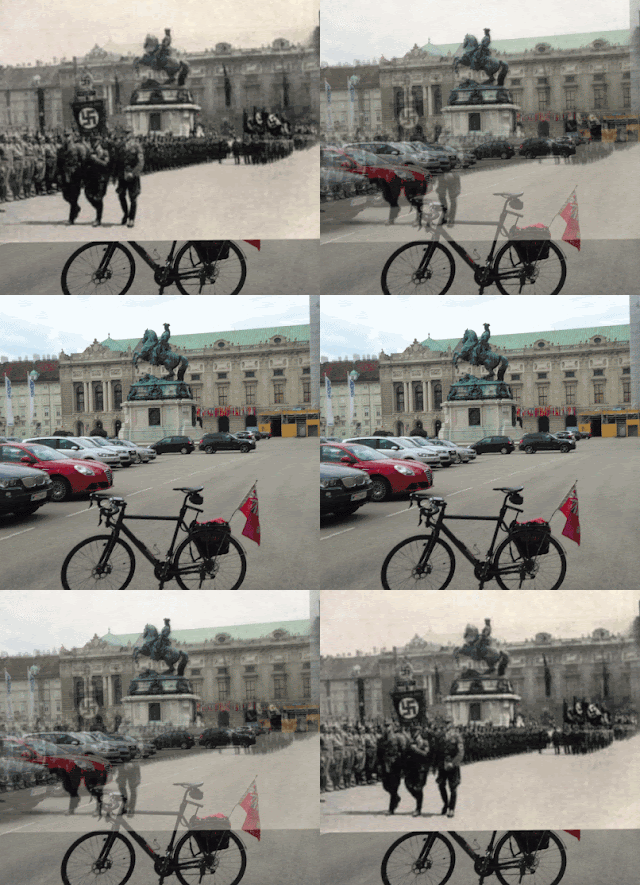.gif) They started with a purely epistolary friendship in 1701 and didn’t meet until 1704 but when they did, Churchill wrote, ‘[t]hen at once began that glorious brotherhood in arms that neither victory nor misfortune could disturb, before which jealousy and misunderstanding were powerless, and of which the history of war furnishes no equal example,’ at least until Churchill’s own equally vital affinity with President Roosevelt 240 years later. In his outstanding biography, Andrew Roberts writes of how Churchill's
They started with a purely epistolary friendship in 1701 and didn’t meet until 1704 but when they did, Churchill wrote, ‘[t]hen at once began that glorious brotherhood in arms that neither victory nor misfortune could disturb, before which jealousy and misunderstanding were powerless, and of which the history of war furnishes no equal example,’ at least until Churchill’s own equally vital affinity with President Roosevelt 240 years later. In his outstanding biography, Andrew Roberts writes of how Churchill's
.gif)
.gif) They started with a purely epistolary friendship in 1701 and didn’t meet until 1704 but when they did, Churchill wrote, ‘[t]hen at once began that glorious brotherhood in arms that neither victory nor misfortune could disturb, before which jealousy and misunderstanding were powerless, and of which the history of war furnishes no equal example,’ at least until Churchill’s own equally vital affinity with President Roosevelt 240 years later. In his outstanding biography, Andrew Roberts writes of how Churchill's
They started with a purely epistolary friendship in 1701 and didn’t meet until 1704 but when they did, Churchill wrote, ‘[t]hen at once began that glorious brotherhood in arms that neither victory nor misfortune could disturb, before which jealousy and misunderstanding were powerless, and of which the history of war furnishes no equal example,’ at least until Churchill’s own equally vital affinity with President Roosevelt 240 years later. In his outstanding biography, Andrew Roberts writes of how Churchill's living sense of history that encouraged him to try to replicate with Franklin Roosevelt the relationship that the Duke of Marlborough had enjoyed with Prince Eugene of Savoy during the War of Spanish Succession. It was argued in the War Office in 1942 that nothing like the pooling of sovereignty implicit in the concept of the Combined Chiefs of Staff had ever happened before. Churchill knew otherwise, and as he had written in 1934 in his biography of his great ancestor’s friendship with Eugene, ‘Without this new fact at the allied headquarters the extraordinary operations which these chapters describe, so intricate, so prolonged, and contrary on so many occasions to the accepted principles of war, could never have been achieved.'
.gif)
.gif)
The eagles are shown on the right behind the Heroes' Monument which was opened on September 9-10, 1934, as part of a patriotic celebration. On March 15, 1938, Hitler laid a wreath here and Göring visited the place of honour on March 27. During the time of the Hapsburgs the middle gate passage was mostly closed. According to a theory circulating in Nazi circles, this was reserved for the emperor. When Hitler laid a wreath in the crypt on which occasion he passed through the middle gate passage, he thereby incorporated the crypt into the Nazi war memorial culture. The SA later got its own memorial here, which was removed again after the end of the war. In 2012 it was announced that the name of Josef Vallaster, an Austrian Nazi who had been deployed, among other things, in the Nazi killing centre at Hartheim and in the Sobibór extermination camp, where he held an ϟϟ rank and was killed by revolting prisoners during the uprising, would be removed from the Books of the Dead in the Crypt of the Heroes' Gate. This was followed by an investigation by experts to determine whether there were other war criminals among the fallen soldiers listed in the death books.
In the 1930s, Heldenplatz began to be
used for mass events, with the speakers mostly speaking to the crowd
from the balcony of the Neue Burg, starting in 1932 with a rally during
Göring's visit, a 1934 rally for the Fatherland Front and of
course the 1938 Nazi rally for Hitler. All these events made made
Heldenplatz a synonym for the "Anschluss". During the war, open-air
exhibitions were held on Heldenplatz such as the 1940 Wehrmacht exhibition "Der Sieg im Westen," shown here on the right then and today with the rathaus behind.  On
March 13, 1938 Reich youth leader Baldur von Schirach gave a speech on
Heldenplatz in front of 40,000 children and young people, in which he
announced that instead of the “Austrian young people” there was only the
“Hitler Youth”. Preparations for the coordination of Austria with
the rest of Germany were started in the background by Josef Bürckel
based on the model of the Saarland. On March 15, 1938 so-called
“liberation rallies” took place here in front of around 200,000 people.
People had full pay off work, and children had been off school since
March 12th which ensured that enough people could greet Adolf Hitler on
his arrival in Vienna. The Austrian Nazi Karl Anton Prinz Rohan
described this event as a “festive, happy revolution”. When Hitler
arrived at Heldenplatz at noon on March 15, the square was also filled
with military, youth and other formations of the Nazi Party.
Seyss-Inquart reported to the Fiihrer that Austria had given up its
independence and consequently the "Ostmark" had "returned home". Hitler
delivered his speech, mentioning the word "Austria" only twice, and
spoke of the bulwark against past and coming storms in the East in order
to "announce before history the entry of my homeland into the German
Reich". Stormy shouts of victory and salvation and applause that lasted
for several minutes followed; the Germany and Horst Wessel songs were
sung and shouts of “We thank our Führer!” were repeated over and over
again. Then Hitler and Seyß-Inquart left Heldenplatz in a car, returning
at 14.00 to lay a wreath at the Hero's Gate. The next day Reichsführer ϟϟ Himmler and Austria representative
Josef Bürckel swore in 7,500 men of the Austrian police in the presence
of ϟϟ leader Ernst Kaltenbrunner on Heldenplatz, shown here.
On
March 13, 1938 Reich youth leader Baldur von Schirach gave a speech on
Heldenplatz in front of 40,000 children and young people, in which he
announced that instead of the “Austrian young people” there was only the
“Hitler Youth”. Preparations for the coordination of Austria with
the rest of Germany were started in the background by Josef Bürckel
based on the model of the Saarland. On March 15, 1938 so-called
“liberation rallies” took place here in front of around 200,000 people.
People had full pay off work, and children had been off school since
March 12th which ensured that enough people could greet Adolf Hitler on
his arrival in Vienna. The Austrian Nazi Karl Anton Prinz Rohan
described this event as a “festive, happy revolution”. When Hitler
arrived at Heldenplatz at noon on March 15, the square was also filled
with military, youth and other formations of the Nazi Party.
Seyss-Inquart reported to the Fiihrer that Austria had given up its
independence and consequently the "Ostmark" had "returned home". Hitler
delivered his speech, mentioning the word "Austria" only twice, and
spoke of the bulwark against past and coming storms in the East in order
to "announce before history the entry of my homeland into the German
Reich". Stormy shouts of victory and salvation and applause that lasted
for several minutes followed; the Germany and Horst Wessel songs were
sung and shouts of “We thank our Führer!” were repeated over and over
again. Then Hitler and Seyß-Inquart left Heldenplatz in a car, returning
at 14.00 to lay a wreath at the Hero's Gate. The next day Reichsführer ϟϟ Himmler and Austria representative
Josef Bürckel swore in 7,500 men of the Austrian police in the presence
of ϟϟ leader Ernst Kaltenbrunner on Heldenplatz, shown here.
 A fortnight later Göring gave his propaganda speech on Heldenplatz for
the referendum on the “Anschluss”. In April 1938 the “Day of the
Austrian Legion” and the “Day of the Greater German Reich” were held. A maypole from Garmisch-Partenkirchen was transported to Heldenplatz for May Day that year.
A fortnight later Göring gave his propaganda speech on Heldenplatz for
the referendum on the “Anschluss”. In April 1938 the “Day of the
Austrian Legion” and the “Day of the Greater German Reich” were held. A maypole from Garmisch-Partenkirchen was transported to Heldenplatz for May Day that year.
 On
March 13, 1938 Reich youth leader Baldur von Schirach gave a speech on
Heldenplatz in front of 40,000 children and young people, in which he
announced that instead of the “Austrian young people” there was only the
“Hitler Youth”. Preparations for the coordination of Austria with
the rest of Germany were started in the background by Josef Bürckel
based on the model of the Saarland. On March 15, 1938 so-called
“liberation rallies” took place here in front of around 200,000 people.
People had full pay off work, and children had been off school since
March 12th which ensured that enough people could greet Adolf Hitler on
his arrival in Vienna. The Austrian Nazi Karl Anton Prinz Rohan
described this event as a “festive, happy revolution”. When Hitler
arrived at Heldenplatz at noon on March 15, the square was also filled
with military, youth and other formations of the Nazi Party.
Seyss-Inquart reported to the Fiihrer that Austria had given up its
independence and consequently the "Ostmark" had "returned home". Hitler
delivered his speech, mentioning the word "Austria" only twice, and
spoke of the bulwark against past and coming storms in the East in order
to "announce before history the entry of my homeland into the German
Reich". Stormy shouts of victory and salvation and applause that lasted
for several minutes followed; the Germany and Horst Wessel songs were
sung and shouts of “We thank our Führer!” were repeated over and over
again. Then Hitler and Seyß-Inquart left Heldenplatz in a car, returning
at 14.00 to lay a wreath at the Hero's Gate. The next day Reichsführer ϟϟ Himmler and Austria representative
Josef Bürckel swore in 7,500 men of the Austrian police in the presence
of ϟϟ leader Ernst Kaltenbrunner on Heldenplatz, shown here.
On
March 13, 1938 Reich youth leader Baldur von Schirach gave a speech on
Heldenplatz in front of 40,000 children and young people, in which he
announced that instead of the “Austrian young people” there was only the
“Hitler Youth”. Preparations for the coordination of Austria with
the rest of Germany were started in the background by Josef Bürckel
based on the model of the Saarland. On March 15, 1938 so-called
“liberation rallies” took place here in front of around 200,000 people.
People had full pay off work, and children had been off school since
March 12th which ensured that enough people could greet Adolf Hitler on
his arrival in Vienna. The Austrian Nazi Karl Anton Prinz Rohan
described this event as a “festive, happy revolution”. When Hitler
arrived at Heldenplatz at noon on March 15, the square was also filled
with military, youth and other formations of the Nazi Party.
Seyss-Inquart reported to the Fiihrer that Austria had given up its
independence and consequently the "Ostmark" had "returned home". Hitler
delivered his speech, mentioning the word "Austria" only twice, and
spoke of the bulwark against past and coming storms in the East in order
to "announce before history the entry of my homeland into the German
Reich". Stormy shouts of victory and salvation and applause that lasted
for several minutes followed; the Germany and Horst Wessel songs were
sung and shouts of “We thank our Führer!” were repeated over and over
again. Then Hitler and Seyß-Inquart left Heldenplatz in a car, returning
at 14.00 to lay a wreath at the Hero's Gate. The next day Reichsführer ϟϟ Himmler and Austria representative
Josef Bürckel swore in 7,500 men of the Austrian police in the presence
of ϟϟ leader Ernst Kaltenbrunner on Heldenplatz, shown here. A fortnight later Göring gave his propaganda speech on Heldenplatz for
the referendum on the “Anschluss”. In April 1938 the “Day of the
Austrian Legion” and the “Day of the Greater German Reich” were held. A maypole from Garmisch-Partenkirchen was transported to Heldenplatz for May Day that year.
A fortnight later Göring gave his propaganda speech on Heldenplatz for
the referendum on the “Anschluss”. In April 1938 the “Day of the
Austrian Legion” and the “Day of the Greater German Reich” were held. A maypole from Garmisch-Partenkirchen was transported to Heldenplatz for May Day that year. The
Nazi rulers were well aware of the power of the unfinished square.
Despite their aversion to the Habsburg Monarchy, the Nazis were able to
stage and thus justify their own rule as a continuation of the old
imperial tradition with the help of the symbols of imperial power that
offered them the backdrop of the Heldenplatz. With this in mind, there
were considerations to resume the building project of the Kaiserforum
and to complete it with a Nazi ceremonial space. To that end a 'Haus des
Führers' intended for exhibition purposes as well as various memorials.
The fact that Heldenplatz was to be converted into a Nazi “cultural
district” is also indicated by its use as a venue for open-air
exhibitions, such as for the show “The Victory in the West” of 1940
mentioned above. During the war and postwar hardship however,
Heldenplatz was transformed from the centre of imposing power into an
agricultural land and by May 1946, the Allied troops celebrated their
liberation celebrations here. From 1951, the British, American and
Soviet units used the square as the changing of the guard.
 Hitler and his entourage walking through the Äußeres Burgtor, also known as the Heldentor or Hero Gate, on March 15, 1938 after having laid a wreath here. The gate was intended to replace the former Vienna city walls destroyed by Napoleon's troops during the Fifth Coalition War in 1809. The French also blew up other parts of the city's fortifications more as an act of humiliation given that by this time the city's fortifications had already largely lost their military value. The reconstruction was carried out by soldiers of the Imperial Austrian Army and the ceremonial laying of the foundation stone took place on September 22, 1821 in the presence of Kaiser Francis I. It was ceremoniously opened on October 16, 1824 - the eleventh anniversary of the Battle of the Nations near Leipzig.
 .gif) The inscription “FRANCISCUS I. IMPERATOR AUSTRIAE MDCCCXXIV” (Franz I. Emperor of Austria 1824) can be readin gold-plated writing on the side of the ring road and below the inscription: LAURUM. MILITIBUS. LAURO. DIGNIS. MDCCCCXVI (Lorbeer den des Lorbeers würdigen Soldaten 1916). On the front facing the Heroes' Square stands IUSTITIA REGNORUM FUNDAMENTUM (Justice is the foundation of rule ), the motto of Emperor Franz I. In 1934 the outer castle gate was converted into a war monument
dedicated to the fallen of the First World War, although the external
shape of the building was not allowed to be changed. Göring visited the place of honour on March 27. At
the time of Nazi rule in Austria, there were considerations to upgrade
the Heldenplatz architecturally. For this purpose, the main axis of the
square was to be rotated by 90 degrees so that the balcony of the
Hofburg, from which Hitler had announced the annexation of Austria,
would have become the main focal point for large marches. For this
purpose they wanted to relocate the equestrian monuments of Archduke
Karl and Prinz Eugen of Savoy. The SA later obtained its own memorial
here, which was removed again after the end of the war.
The inscription “FRANCISCUS I. IMPERATOR AUSTRIAE MDCCCXXIV” (Franz I. Emperor of Austria 1824) can be readin gold-plated writing on the side of the ring road and below the inscription: LAURUM. MILITIBUS. LAURO. DIGNIS. MDCCCCXVI (Lorbeer den des Lorbeers würdigen Soldaten 1916). On the front facing the Heroes' Square stands IUSTITIA REGNORUM FUNDAMENTUM (Justice is the foundation of rule ), the motto of Emperor Franz I. In 1934 the outer castle gate was converted into a war monument
dedicated to the fallen of the First World War, although the external
shape of the building was not allowed to be changed. Göring visited the place of honour on March 27. At
the time of Nazi rule in Austria, there were considerations to upgrade
the Heldenplatz architecturally. For this purpose, the main axis of the
square was to be rotated by 90 degrees so that the balcony of the
Hofburg, from which Hitler had announced the annexation of Austria,
would have become the main focal point for large marches. For this
purpose they wanted to relocate the equestrian monuments of Archduke
Karl and Prinz Eugen of Savoy. The SA later obtained its own memorial
here, which was removed again after the end of the war. 
Standing in the middle of the Ringstraße from where Hitler took his place in the reviewing stand. In Mein Kampf, Hitler recalled that “the whole Ring Boulevard seemed to [him] like an enchantment.” Now Vienna’s
transformation under his rule, would mark
a significant shift in the city’s ideological and physical landscape,
fundamentally altering its historical and cultural identity. The Nazis
embarked on a systematic campaign to reshape Vienna, a city once
celebrated for its rich intellectual and artistic heritage, into a
bastion of Nazi ideology.  The Nazis sought to create a
homogenised, ideologically pure narrative that glorified Aryan
contributions and minimised or erased the roles of others. Such an
ideological reconfiguration was accompanied by a physical transformation
of the city as the Nazis undertook extensive urban planning projects,
intending to remodel Vienna into a model German city. These projects
included the construction of monumental buildings and the redesign of
public spaces to reflect Nazi ideology. Streets and squares were
renamed, and statues and monuments that did not fit the Nazi worldview
were removed. The Heldenplatz, for example, became a central site for
Nazi rallies and parades, symbolising the city’s submission to Nazi
rule. The transformation of Vienna under Nazi rule was not just a change
in governance but a profound alteration of the city’s identity, erasing
much of its historical diversity and imposing a singular, oppressive
narrative that would leave lasting scars on the city’s cultural and
physical landscape.
The Nazis sought to create a
homogenised, ideologically pure narrative that glorified Aryan
contributions and minimised or erased the roles of others. Such an
ideological reconfiguration was accompanied by a physical transformation
of the city as the Nazis undertook extensive urban planning projects,
intending to remodel Vienna into a model German city. These projects
included the construction of monumental buildings and the redesign of
public spaces to reflect Nazi ideology. Streets and squares were
renamed, and statues and monuments that did not fit the Nazi worldview
were removed. The Heldenplatz, for example, became a central site for
Nazi rallies and parades, symbolising the city’s submission to Nazi
rule. The transformation of Vienna under Nazi rule was not just a change
in governance but a profound alteration of the city’s identity, erasing
much of its historical diversity and imposing a singular, oppressive
narrative that would leave lasting scars on the city’s cultural and
physical landscape.
The Nazis sought to create a
homogenised, ideologically pure narrative that glorified Aryan
contributions and minimised or erased the roles of others. Such an
ideological reconfiguration was accompanied by a physical transformation
of the city as the Nazis undertook extensive urban planning projects,
intending to remodel Vienna into a model German city. These projects
included the construction of monumental buildings and the redesign of
public spaces to reflect Nazi ideology. Streets and squares were
renamed, and statues and monuments that did not fit the Nazi worldview
were removed. The Heldenplatz, for example, became a central site for
Nazi rallies and parades, symbolising the city’s submission to Nazi
rule. The transformation of Vienna under Nazi rule was not just a change
in governance but a profound alteration of the city’s identity, erasing
much of its historical diversity and imposing a singular, oppressive
narrative that would leave lasting scars on the city’s cultural and
physical landscape. 
Standing
in front of the Loos Haus on Michaelerplatz and as it appeared during
the Anschluss. The sign reads "Gleiches Blut gehoert in ein gemeinsames
Reich"- "Shared blood belongs in a shared Reich." The right shows the
entrance with a shrine to Hitler, featuring his bust and an honour
guard. After
its completion in 1912, the building caused a scandal in the city with its “indecent nudity” on the upper facade. The Viennese called it House without
eyebrows because of the usual window roofs were completely missing and it was said that Emperor Franz Joseph not only avoided using the exit at
Michaelerplatz for the rest of his life, but also had the windows of the
Hofburg boarded up so that he no longer had to see the “horrible” building. The construction manager was Ernst Epstein, responsible for having built around an hundred buildings in Vienna and who was of Jewish origin. He ended up committing suicide in 1938, shortly after the anschluss, leaving behind a fortune of around 800,000 Reichsmarks, roughly 3 million euros today.
.gif "Loos Haus on Michaelerplatz hakenkreuz anschluss") According to Hermann Czech (14) concerning the decoration applied just prior to the
referendum of 1938 on Austria’s Anschluss with Nazi Germany, "[t]he 'beautification' of Loos’s portal, transforming it into a “contemporary
altar”, generates a mood in which intimidation prevails. The carpet in
the image on the right just does not fit, and it is not hard to see
why."
According to Hermann Czech (14) concerning the decoration applied just prior to the
referendum of 1938 on Austria’s Anschluss with Nazi Germany, "[t]he 'beautification' of Loos’s portal, transforming it into a “contemporary
altar”, generates a mood in which intimidation prevails. The carpet in
the image on the right just does not fit, and it is not hard to see
why."
.gif "Loos Haus on Michaelerplatz hakenkreuz anschluss") According to Hermann Czech (14) concerning the decoration applied just prior to the
referendum of 1938 on Austria’s Anschluss with Nazi Germany, "[t]he 'beautification' of Loos’s portal, transforming it into a “contemporary
altar”, generates a mood in which intimidation prevails. The carpet in
the image on the right just does not fit, and it is not hard to see
why."
According to Hermann Czech (14) concerning the decoration applied just prior to the
referendum of 1938 on Austria’s Anschluss with Nazi Germany, "[t]he 'beautification' of Loos’s portal, transforming it into a “contemporary
altar”, generates a mood in which intimidation prevails. The carpet in
the image on the right just does not fit, and it is not hard to see
why." Regarding the use of the building during the Nazi era, Czech and Mistelbauer go on to write how “[t]he vestibule to Michaelerplatz was briefly decorated into an 'altar of our time' before the 1938 referendum, where two ϟϟ guards stood in front of a bust of Hitler. Instead of the lighting fixtures, swastikas hung from the brass candelabra, but the actually 'representative' architectural parts were covered." Swastikas were also mounted in front of the company coats of arms. In 1944, a bomb hit the neighbouring high-rise building damaging the Looshaus. In 1947 the house was placed under listing protection.
 The supposed Hitler painting on the left of Michaelerplatz was recovered in Bolzano
in 1945, by an Italian governmental stolen art retrieval team under the
supervision of Rodolfo Siviero, now part of a collection of twenty
alleged Hitler watercolours held at the Uffizi Gallery in Florence since
1954.
The supposed Hitler painting on the left of Michaelerplatz was recovered in Bolzano
in 1945, by an Italian governmental stolen art retrieval team under the
supervision of Rodolfo Siviero, now part of a collection of twenty
alleged Hitler watercolours held at the Uffizi Gallery in Florence since
1954.
Apparently when painting Michaelerplatz, Hitler chose to ignore the building completely-

 Actors
and theatre employees who were classified as “ Jewish ” under the Reich
Citizenship Act of 1935 were soon banned from performing; they have
been given either leave, dismissed or arrested. Between 1938 and 1945
the Burgtheater ensemble did not offer any noteworthy resistance to Nazi
ideology- its programmes were heavily censored, and only a few actively
joined the resistance, such as Judith Holzmeister or the actor Fritz
Lehmann. Many Jewish ensemble members were helped to emigrate; one
actor, Fritz Strassny , was murdered in a concentration camp.
Actors
and theatre employees who were classified as “ Jewish ” under the Reich
Citizenship Act of 1935 were soon banned from performing; they have
been given either leave, dismissed or arrested. Between 1938 and 1945
the Burgtheater ensemble did not offer any noteworthy resistance to Nazi
ideology- its programmes were heavily censored, and only a few actively
joined the resistance, such as Judith Holzmeister or the actor Fritz
Lehmann. Many Jewish ensemble members were helped to emigrate; one
actor, Fritz Strassny , was murdered in a concentration camp. Immediately
after the German invasion of March 1938, the Viennese began to
threaten, torment, and deprive Jewish fellow citizens as the
ϟϟ began to throw them out of their homes. Of the
nearly 200,000 Jewish Viennese, around 120,000 were robbed and emigrated
(the most famous refugee was Sigmund Freud), about 60,000 were
murdered. The Viennese town administration was reorganised according to
the national socialist pattern. On the occasion of the 150th
anniversary of the death of the German composer, the Nazi administration
celebrated a Mozart year in the framework of the "Mozart Week of the
German Reich". From March 17, 1944, more than fifty air raids were
carried out on Vienna, which destroyed about one-fifth of the city. Not
by fighting, but by plunder, the St. Stephen's Cathedral, which had
previously surrendered the air war without a bomb hit, also set fire. In
April 1945 came the eight-day battle for Vienna, which ended with the
defeat of the Wehrmacht and the occupation by the Red Army, which had
advanced from Hungary. The effect of the capital function of Vienna in the monarchy, effective
until 1938, ended with the beginning of the Nazi era. The spiritual and
artistic life of Vienna suffered, above all, through the persecution of
the Jews, an enormous, not to be compensated, bloodletting. The
emergence of the Eastern bloc made Vienna a meeting point for the spies
from the East and the West, but slowed down the economic and scientific
reconstruction of Vienna. More than 20 per cent of the house stock was
completely or partly destroyed, almost 87,000 apartments were
uninhabitable. More than 3,000 bombs were counted in the city area,
numerous bridges lying in ruins, canals, gas and water pipes had
suffered serious damage.
Immediately
after the German invasion of March 1938, the Viennese began to
threaten, torment, and deprive Jewish fellow citizens as the
ϟϟ began to throw them out of their homes. Of the
nearly 200,000 Jewish Viennese, around 120,000 were robbed and emigrated
(the most famous refugee was Sigmund Freud), about 60,000 were
murdered. The Viennese town administration was reorganised according to
the national socialist pattern. On the occasion of the 150th
anniversary of the death of the German composer, the Nazi administration
celebrated a Mozart year in the framework of the "Mozart Week of the
German Reich". From March 17, 1944, more than fifty air raids were
carried out on Vienna, which destroyed about one-fifth of the city. Not
by fighting, but by plunder, the St. Stephen's Cathedral, which had
previously surrendered the air war without a bomb hit, also set fire. In
April 1945 came the eight-day battle for Vienna, which ended with the
defeat of the Wehrmacht and the occupation by the Red Army, which had
advanced from Hungary. The effect of the capital function of Vienna in the monarchy, effective
until 1938, ended with the beginning of the Nazi era. The spiritual and
artistic life of Vienna suffered, above all, through the persecution of
the Jews, an enormous, not to be compensated, bloodletting. The
emergence of the Eastern bloc made Vienna a meeting point for the spies
from the East and the West, but slowed down the economic and scientific
reconstruction of Vienna. More than 20 per cent of the house stock was
completely or partly destroyed, almost 87,000 apartments were
uninhabitable. More than 3,000 bombs were counted in the city area,
numerous bridges lying in ruins, canals, gas and water pipes had
suffered serious damage.
 The supposed Hitler painting on the left of Michaelerplatz was recovered in Bolzano
in 1945, by an Italian governmental stolen art retrieval team under the
supervision of Rodolfo Siviero, now part of a collection of twenty
alleged Hitler watercolours held at the Uffizi Gallery in Florence since
1954.
The supposed Hitler painting on the left of Michaelerplatz was recovered in Bolzano
in 1945, by an Italian governmental stolen art retrieval team under the
supervision of Rodolfo Siviero, now part of a collection of twenty
alleged Hitler watercolours held at the Uffizi Gallery in Florence since
1954.Apparently when painting Michaelerplatz, Hitler chose to ignore the building completely-
In 1910, opposite the pompous dome of the new courtcastle at the Michaelerplatz, he built the house of a men’s fashion parlour as a deliberate provocation that flustered the Viennese as “a monstrosity of a house” and as “a house without eyebrows.” For it made do without the usual ornaments above the windows and had a smooth surface. Loos was thoroughly delighted with all the excitement and on December 11, 1911, to an overcrowded audience, gave a lecture entitled “A Monstrosity of a House.” Hitler’s reaction to the house under dispute was idiosyncratic: when he drew the Michaelerplatz, he pretended the Loos House did not exist and copied a historic representation from the eighteenth century.
Hamann (71) Hitler's Vienna
Dutch investigative journalist Bart F.M. Droog nevertheless has expressed his doubts about the authenticity, stating that he "would not be surprised if the watercolour with the store of an 'E. Ramsauer' is a forgery by Reinhold Hanisch."

Hitler
driving through Vienna with the Burgtheater in the background and my
bike today in front. The Nazis would leave their mark on the history of
the Burgtheater. In 1939, the strongly anti-Semitic book by the theatre
scholar Heinz Kindermann, Das Burgtheater, in which he analysed
negatively, among other things, the “Jewish influence” on the
Burgtheater. On October 14, 1938, on the occasion of the 50th
anniversary of the opening of the Burgtheater, a Don Carlos production
by Karl-Heinz Stroux was shown, which served Hitler's ideology as the
role of Marquis Posa was played by the same Ewald Balser, who a year
earlier in another Don Carlos production at the Deutsches Theater in the
same role called out to Joseph Goebbels in the audience: "Give freedom
of thought!". The actor and director Lothar Müthel, who was director of
the Burgtheater between 1939 and 1945, staged the Merchant of Venice in
1943 , in which Werner Krauss portrayed the Jew Shylock as clearly
anti-Semitic. The same director staged Lessing's parable Nathan the Wise
after the war. Hitler himself only visited the Burgtheater once during
the Nazi regime in 1938, later refusing for fear of an assassination
attempt.
 Actors
and theatre employees who were classified as “ Jewish ” under the Reich
Citizenship Act of 1935 were soon banned from performing; they have
been given either leave, dismissed or arrested. Between 1938 and 1945
the Burgtheater ensemble did not offer any noteworthy resistance to Nazi
ideology- its programmes were heavily censored, and only a few actively
joined the resistance, such as Judith Holzmeister or the actor Fritz
Lehmann. Many Jewish ensemble members were helped to emigrate; one
actor, Fritz Strassny , was murdered in a concentration camp.
Actors
and theatre employees who were classified as “ Jewish ” under the Reich
Citizenship Act of 1935 were soon banned from performing; they have
been given either leave, dismissed or arrested. Between 1938 and 1945
the Burgtheater ensemble did not offer any noteworthy resistance to Nazi
ideology- its programmes were heavily censored, and only a few actively
joined the resistance, such as Judith Holzmeister or the actor Fritz
Lehmann. Many Jewish ensemble members were helped to emigrate; one
actor, Fritz Strassny , was murdered in a concentration camp.By
the summer of 1944 the Burgtheater had to be closed because of the
general closure of all theatres. From April 1, 1945, when the Red Army
approached Vienna, a military unit was encamped in the building, part of
which was used as an arsenal. It ended up being damaged in a bomb
attack on April 12, 1945 in which the auditorium and stage became
unusable with only the steel structure remaining. The ceiling paintings
and parts of the foyer were almost undamaged. In 1951 the Burgtheater
opened its doors for the first time, but only in the left wing, where
the celebrations for the 175th anniversary of the theatre took place.
 Immediately
after the German invasion of March 1938, the Viennese began to
threaten, torment, and deprive Jewish fellow citizens as the
ϟϟ began to throw them out of their homes. Of the
nearly 200,000 Jewish Viennese, around 120,000 were robbed and emigrated
(the most famous refugee was Sigmund Freud), about 60,000 were
murdered. The Viennese town administration was reorganised according to
the national socialist pattern. On the occasion of the 150th
anniversary of the death of the German composer, the Nazi administration
celebrated a Mozart year in the framework of the "Mozart Week of the
German Reich". From March 17, 1944, more than fifty air raids were
carried out on Vienna, which destroyed about one-fifth of the city. Not
by fighting, but by plunder, the St. Stephen's Cathedral, which had
previously surrendered the air war without a bomb hit, also set fire. In
April 1945 came the eight-day battle for Vienna, which ended with the
defeat of the Wehrmacht and the occupation by the Red Army, which had
advanced from Hungary. The effect of the capital function of Vienna in the monarchy, effective
until 1938, ended with the beginning of the Nazi era. The spiritual and
artistic life of Vienna suffered, above all, through the persecution of
the Jews, an enormous, not to be compensated, bloodletting. The
emergence of the Eastern bloc made Vienna a meeting point for the spies
from the East and the West, but slowed down the economic and scientific
reconstruction of Vienna. More than 20 per cent of the house stock was
completely or partly destroyed, almost 87,000 apartments were
uninhabitable. More than 3,000 bombs were counted in the city area,
numerous bridges lying in ruins, canals, gas and water pipes had
suffered serious damage.
Immediately
after the German invasion of March 1938, the Viennese began to
threaten, torment, and deprive Jewish fellow citizens as the
ϟϟ began to throw them out of their homes. Of the
nearly 200,000 Jewish Viennese, around 120,000 were robbed and emigrated
(the most famous refugee was Sigmund Freud), about 60,000 were
murdered. The Viennese town administration was reorganised according to
the national socialist pattern. On the occasion of the 150th
anniversary of the death of the German composer, the Nazi administration
celebrated a Mozart year in the framework of the "Mozart Week of the
German Reich". From March 17, 1944, more than fifty air raids were
carried out on Vienna, which destroyed about one-fifth of the city. Not
by fighting, but by plunder, the St. Stephen's Cathedral, which had
previously surrendered the air war without a bomb hit, also set fire. In
April 1945 came the eight-day battle for Vienna, which ended with the
defeat of the Wehrmacht and the occupation by the Red Army, which had
advanced from Hungary. The effect of the capital function of Vienna in the monarchy, effective
until 1938, ended with the beginning of the Nazi era. The spiritual and
artistic life of Vienna suffered, above all, through the persecution of
the Jews, an enormous, not to be compensated, bloodletting. The
emergence of the Eastern bloc made Vienna a meeting point for the spies
from the East and the West, but slowed down the economic and scientific
reconstruction of Vienna. More than 20 per cent of the house stock was
completely or partly destroyed, almost 87,000 apartments were
uninhabitable. More than 3,000 bombs were counted in the city area,
numerous bridges lying in ruins, canals, gas and water pipes had
suffered serious damage. 


The
Wehrmacht marching past the parliament building, renamed the Gauhaus
during Nazi rule, with me at the same spot today. It was during the
renovations that were taking place as seen behind me that workers came
across four paintings by Hitler, two busts and a relief in a cupboard in the cellars.
“It's not really a surprise when you clear out a building after 130
years,” a spokeswoman for the parliament told AFP. “We know that the
building was used as a 'Gauhaus' during World War II and we expected to
make discoveries like this.”
During
the war, the building was badly damaged by bombing. On February 7,
1945, one such strike destroyed two of the total of 24 monolithic
columns in the central hall , made of red-grey limestone from Adnet bear
Salzburg. The two destroyed pillars were replaced by two new ones,
broken from the same quarry, in 1950. The plenary hall itself was almost
completely destroyed.
According to Hamann (4),
He was not yet twenty years old, Hitler wrote in Mein Kampf, when he set foot for the first time in the magnificent building on the Franzensring, 1 in other words, the Parliament building in Vienna, and to be more precise: the House of Representatives of the Austrian Reichsrat. This time, however, he was not interested in the building by Theophil Hansen, the architect he so admired, but in Parliament as a political institution.
.gif)
I went to the Parliament whenever I had any time to spare and watched the spectacle silently but attentively. I listened to the debates, as far as they could be understood, and I studied the more or less intelligent features of those ‘elect’ representatives of the various nationalities which composed that motley State. Gradually I formed my own ideas about what I saw. A year of such quiet observation was sufficient to transform or completely destroy my former convictions as to the character of this parliamentary institution. I no longer opposed merely the perverted form which the principle of parliamentary representation had assumed in Austria. No. It had become impossible for me to accept the system in itself. Up to that time I had believed that the disastrous deficiencies of the Austrian Parliament were due to the lack of a German majority, but now I recognised that the institution itself was wrong in its very essence and form. A number of problems presented themselves before my mind. I studied more closely the democratic principle of ‘decision by the majority vote’, and I scrutinised no less carefully the intellectual and moral worth of the gentlemen who, as the chosen representatives of the nation, were entrusted with the task of making this institution function.

.gif)

The 1,441-room Rococo Schönbrunn
palace which had been the main summer residence of the Habsburg rulers,
located in Hietzing, Vienna. Here it is after the anschluss with its
sign forbidding entrance to Jews. Although once in power Hitler chose
not to stay here because he detested its "imperial pomp," as a young man
would not get out of bed until midday when, according to his best
friend at the time, August Kubizek, he
would go for a stroll in Schönbrunn Park before sitting up late at
night over grandiose and senseless projects in which practical
incompetence fought with impatient self-inflation. “We
often watched the old emperor [Franz Joseph] travelling from Shoenbrunn
to the Hofburg Palace in his coach” Kubizek would later relate. Waite
(41) records how "[d]uring his Vienna days he always saved a bit of
dried bread to feed the birds and squirrels in the Schönbrunn where he
went to read on summer evenings."
After the war during the Allied Occupation of Austria, Schönbrunn Palace was requisitioned to provide offices for both the British Delegation to the Allied Commission for Austria and for the Headquarters for the British Military Garrison present in Vienna as shown at the start of The Third Man. The British had begun by organising racing in the park here at Schönbrunn where commander General Sir Richard McCreery occupied the room that had served Napoleon before him, a fact that caused the French general de Lattre de Tassigny to get into a petulant huff. McCreery, who had served with the British army in Italy, endured strained relations with Koniev from the outset. Soon after he moved into a villa near the palace in Hietzing the Soviets kidnapped his gardener. He was never seen again.
After the war during the Allied Occupation of Austria, Schönbrunn Palace was requisitioned to provide offices for both the British Delegation to the Allied Commission for Austria and for the Headquarters for the British Military Garrison present in Vienna as shown at the start of The Third Man. The British had begun by organising racing in the park here at Schönbrunn where commander General Sir Richard McCreery occupied the room that had served Napoleon before him, a fact that caused the French general de Lattre de Tassigny to get into a petulant huff. McCreery, who had served with the British army in Italy, endured strained relations with Koniev from the outset. Soon after he moved into a villa near the palace in Hietzing the Soviets kidnapped his gardener. He was never seen again.
.gif)
Today, April 13, at 9 p.m., the capital of our homeland, Moscow, greets the brave troops of the 3rd Ukrainian Front in the name of the Fatherland, who captured the city of Vienna, with twenty-four artillery salvos from three hundred and twenty-four cannons. For the military actions, I express my gratitude to the troops led by you who took part in the battles for the liberation of Vienna. Eternal glory to the heroes who fell in the battles for the freedom and independence of our homeland! Death to the German invaders.Commander-in-Chief Marshal of the Soviet Union I. STALIN April 13, 1945
.gif)
.gif) It's a terrific source I use in my class when teaching the
Cold War given that Vienna was divided into four zones, each controlled
by one of the Allied powers: the United States, the United Kingdom,
France, and the Soviet Union already establishing the general atmosphere of
mistrust and paranoia which captures the essence of the Cold War
era, where allegiances were uncertain, and betrayal was a constant fear.
This division is clearly shown at the start, where the four powers are shown here in front of the Justizpalast on Schmerlingplatz. This division is crucial to understanding
the film's setting, as it creates a labyrinthine environment of intrigue
and ambiguity, mirroring the moral complexities of the characters. Vienna here serves as a striking representation of a divided city in post-war Europe, a condition that was emblematic of the Cold War's broader division of Europe. The film's depiction of Vienna, segmented into sectors controlled by the Allies and the Soviet Union, mirrors the real-world division of Berlin and, by extension, the division of Europe itself. This is akin to
the division of Berlin, where each sector reflected the culture and
policies of its occupying power.
It's a terrific source I use in my class when teaching the
Cold War given that Vienna was divided into four zones, each controlled
by one of the Allied powers: the United States, the United Kingdom,
France, and the Soviet Union already establishing the general atmosphere of
mistrust and paranoia which captures the essence of the Cold War
era, where allegiances were uncertain, and betrayal was a constant fear.
This division is clearly shown at the start, where the four powers are shown here in front of the Justizpalast on Schmerlingplatz. This division is crucial to understanding
the film's setting, as it creates a labyrinthine environment of intrigue
and ambiguity, mirroring the moral complexities of the characters. Vienna here serves as a striking representation of a divided city in post-war Europe, a condition that was emblematic of the Cold War's broader division of Europe. The film's depiction of Vienna, segmented into sectors controlled by the Allies and the Soviet Union, mirrors the real-world division of Berlin and, by extension, the division of Europe itself. This is akin to
the division of Berlin, where each sector reflected the culture and
policies of its occupying power. .gif) The portrayal of different sectors in the film further reflects the contrasting approaches of the Western Allies and the Soviet Union. The Western sectors are shown as relatively more open and liberal, whereas the Soviet sector is depicted as more oppressive and rigid. For instance, when Martins crosses into the Soviet sector, there’s a noticeable change in the
atmosphere, symbolising the ideological divide. This dichotomy mirrors the broader Cold War narrative where Western Europe, under the Marshall Plan, embarked on a path of democratic capitalism, while Eastern Europe, under Soviet influence, adopted a communist system. The film is steeped in an
atmosphere of espionage, black market activities, and general mistrust,
characteristics that were pervasive throughout the Cold War era. The shadowy and uncertain environment in
post-war Vienna is reflective of the espionage battles that were a core
part of the Cold War, where both sides were deeply engaged in gathering
intelligence and countering each other's moves. The film also highlights the prevalence of black market activities,
such as the illegal penicillin trade, underlining the economic hardships
and moral ambiguities in the immediate post-war period. These
activities can be seen as a consequence of the war's devastation and the
resulting scarcities, which were also common in many parts of Europe
during the Cold War. Tony Judt wrote how the presence of the
Allied forces had a significant impact on the city's social and
political environment. The film captures this through its depiction of
the interactions between the local population and the occupying forces,
highlighting the complexities of these relationships. The presence of
the Allied forces is not just a backdrop but a critical element of the
film's narrative, influencing the characters' actions and the overall
atmosphere of the city.
The portrayal of different sectors in the film further reflects the contrasting approaches of the Western Allies and the Soviet Union. The Western sectors are shown as relatively more open and liberal, whereas the Soviet sector is depicted as more oppressive and rigid. For instance, when Martins crosses into the Soviet sector, there’s a noticeable change in the
atmosphere, symbolising the ideological divide. This dichotomy mirrors the broader Cold War narrative where Western Europe, under the Marshall Plan, embarked on a path of democratic capitalism, while Eastern Europe, under Soviet influence, adopted a communist system. The film is steeped in an
atmosphere of espionage, black market activities, and general mistrust,
characteristics that were pervasive throughout the Cold War era. The shadowy and uncertain environment in
post-war Vienna is reflective of the espionage battles that were a core
part of the Cold War, where both sides were deeply engaged in gathering
intelligence and countering each other's moves. The film also highlights the prevalence of black market activities,
such as the illegal penicillin trade, underlining the economic hardships
and moral ambiguities in the immediate post-war period. These
activities can be seen as a consequence of the war's devastation and the
resulting scarcities, which were also common in many parts of Europe
during the Cold War. Tony Judt wrote how the presence of the
Allied forces had a significant impact on the city's social and
political environment. The film captures this through its depiction of
the interactions between the local population and the occupying forces,
highlighting the complexities of these relationships. The presence of
the Allied forces is not just a backdrop but a critical element of the
film's narrative, influencing the characters' actions and the overall
atmosphere of the city..gif)
The
interactions between characters from the different occupying forces
highlight the cultural and ideological clashes of the Cold War. Again,
the characters representing the Western Allies and the Soviet Union
often display conflicting ideologies and values. The Western characters
generally embody more liberal and capitalist ideals, while the Soviet
characters are depicted as adhering to strict, authoritarian principles.
The film offers more nuance as Major
Calloway, a British
officer, represents the Allied perspective, often at odds with Holly
Martins, an American. This is much as I lecture my students about the
serious disagreements that took place between Churchill and Roosevelt,
the latter who seemed to delight in antagonising his allies to curry
favour with the satanic Stalin. His
zone, as are the other three, shown on the right when it appears at
2:48 into the film with the entrance to schloss Belvedere. Schuschnigg lived in an official apartment here until 1938 before his
arrest by the Nazis after the anschluss. .gif) It
was also here that the signing of the State Treaty, which made Austria
free of occupying powers and other sovereignty restrictions, took place
on May 15, 1955 in its Marble Hall.
It
was also here that the signing of the State Treaty, which made Austria
free of occupying powers and other sovereignty restrictions, took place
on May 15, 1955 in its Marble Hall.
.gif) It
was also here that the signing of the State Treaty, which made Austria
free of occupying powers and other sovereignty restrictions, took place
on May 15, 1955 in its Marble Hall.
It
was also here that the signing of the State Treaty, which made Austria
free of occupying powers and other sovereignty restrictions, took place
on May 15, 1955 in its Marble Hall. These interactions, particularly in the
context of
Holly's investigation into Harry Lime’s activities, reflect the
differing attitudes and approaches of their respective countries. Lime
himself is a symbol of
moral ambiguity and the clash between capitalist opportunism and the
harsh realities of post-war life. His famous speech atop the Ferris
wheel, where he dismisses the value of individual human life, reflects a
cynical exploitation of the situation, a theme prevalent in the Cold
War's ideological battles: "Nobody thinks in terms of human beings.
Governments don't, so why should we? They talk about the people, and the
Proletariat; I talk about the suckers and the mugs. It's the same
thing. They have their five-year plan, and so have I." Meanwhile Anna, Lime's lover, is
caught between her loyalty to Lime and the reality of his criminal
activities. Her character embodies the personal and emotional conflicts
wrought by the political and ideological divide. These interactions reflect the broader ideological divide between the
West and the East during the Cold War allowing the film to explore how individuals from different cultural and
ideological backgrounds interact with each other, often resulting in misunderstandings and conflicts, symbolising the larger
cultural and political divides that characterised the Cold War era.
.gif)
.gif) Me standing in front of the site with the Karl-Borromäus-Kirche towering in the background and Holly departing with Major Calloway following behind. At first I was confused about the site given the considerable difference in the size of the dome until I learned that it had been destroyed during the war by an incendiary bomb with the repair work lasting until the 1950s. Even then, the renovation was deplorable and it wasn't until 2000 that the church was completely renovated on the initiative of city councillor Johann Hatzl at a cost of 183 million schillings and the dome itself restored true to the original. The reopening took place on October 27, 2000 by the Mayor of Vienna, Michael Häupl, and the re-inauguration four days later by the Archbishop of Vienna, Cardinal Christoph Schönborn. During the reopening, the new name Cemetery Church of Saint Charles Borromeo was chosen.
Me standing in front of the site with the Karl-Borromäus-Kirche towering in the background and Holly departing with Major Calloway following behind. At first I was confused about the site given the considerable difference in the size of the dome until I learned that it had been destroyed during the war by an incendiary bomb with the repair work lasting until the 1950s. Even then, the renovation was deplorable and it wasn't until 2000 that the church was completely renovated on the initiative of city councillor Johann Hatzl at a cost of 183 million schillings and the dome itself restored true to the original. The reopening took place on October 27, 2000 by the Mayor of Vienna, Michael Häupl, and the re-inauguration four days later by the Archbishop of Vienna, Cardinal Christoph Schönborn. During the reopening, the new name Cemetery Church of Saint Charles Borromeo was chosen..gif) Calloway confronting Holly as he invites him for a lift into town. The memorial to field marshal Heinrich Freiherr von Hess behind me serves as a point of reference.
Calloway confronting Holly as he invites him for a lift into town. The memorial to field marshal Heinrich Freiherr von Hess behind me serves as a point of reference..gif) Baron Kurtz meeting Holly at the (non-existent) Café Mozart on the Neuer Markt. As with many of the locations shown in the film, the square was badly damaged during the war a number of buildings disappeared and were replaced by modern buildings. Beyond
the physical and economic aspects, Vienna's cultural landscape in The
Third Man is also a critical element of its portrayal. The city's rich
cultural heritage, juxtaposed with the prevailing atmosphere of despair
and moral ambiguity, creates a stark contrast that enhances the film's
narrative. Musicologist Adorno notes the significance of the film's
score, composed by Anton Karas, which features the zither. This choice
of instrument and the style of music provide a distinctly Viennese sound
that contrasts with the dark, noir visuals of the film. The zither's
light, almost whimsical tone, set against the backdrop of a ruined city,
underscores the juxtaposition of Vienna's cultural richness with the
grim realities of post-war life.
Baron Kurtz meeting Holly at the (non-existent) Café Mozart on the Neuer Markt. As with many of the locations shown in the film, the square was badly damaged during the war a number of buildings disappeared and were replaced by modern buildings. Beyond
the physical and economic aspects, Vienna's cultural landscape in The
Third Man is also a critical element of its portrayal. The city's rich
cultural heritage, juxtaposed with the prevailing atmosphere of despair
and moral ambiguity, creates a stark contrast that enhances the film's
narrative. Musicologist Adorno notes the significance of the film's
score, composed by Anton Karas, which features the zither. This choice
of instrument and the style of music provide a distinctly Viennese sound
that contrasts with the dark, noir visuals of the film. The zither's
light, almost whimsical tone, set against the backdrop of a ruined city,
underscores the juxtaposition of Vienna's cultural richness with the
grim realities of post-war life. .gif)
Kurtz showing Holly the site of Lime's 'accident' on Josefsplatz, which is centred around a full-sized equestrian statue and monument of Emperor Joseph II at the base of which Kurtz and Harry’s friend “picked him up and laid him down just about here... and this is where he died”. This is directly in front of Lime's residence even though the film states that the address is at Stiftgasse 15.
.gif) Kurtz and Holly where Lime was supposedly fatally struck down by a truck with Kurtz stating "it was just about here". In the background is a section of the Hofburg Palace today containing the National Library. In addition to its function as a library, the building was also designed as a concert hall with superb acoustics. The library museum ended up suffering catastrophic damage in the 1848 battle for Vienna, with the zoological collection being completely destroyed by cannon fire. On the occasion of Austria's second EU presidency in 2006, the Austrian Mint minted a silver five euro coin on the reverse of which shows the building with the Emperor Joseph statue in the centre.
Kurtz and Holly where Lime was supposedly fatally struck down by a truck with Kurtz stating "it was just about here". In the background is a section of the Hofburg Palace today containing the National Library. In addition to its function as a library, the building was also designed as a concert hall with superb acoustics. The library museum ended up suffering catastrophic damage in the 1848 battle for Vienna, with the zoological collection being completely destroyed by cannon fire. On the occasion of Austria's second EU presidency in 2006, the Austrian Mint minted a silver five euro coin on the reverse of which shows the building with the Emperor Joseph statue in the centre. .gif) “Vienna doesn't really look any worse than a lot of other European cities; bombed about a bit”. Hoher Markt on the right with the Vermählungsbrunnen (Wedding fountain). Reed ended up being disappointed that much of the bombed out ruins he encountered during his initial recce of the sites had been cleared up. The film's use of language and
dialogue also reflects Vienna's complex cultural identity. Linguist
Crystal observes that the multilingual interactions among characters,
involving English, German, and Russian, are indicative of the city's
diverse cultural influences and the political tensions of the time. This
linguistic diversity adds to the film's realism and authenticity, as it
mirrors the actual linguistic landscape of post-war Vienna. The use of
different languages in the film not only serves as a plot device but
also symbolises the cultural and political fragmentation of the city.
“Vienna doesn't really look any worse than a lot of other European cities; bombed about a bit”. Hoher Markt on the right with the Vermählungsbrunnen (Wedding fountain). Reed ended up being disappointed that much of the bombed out ruins he encountered during his initial recce of the sites had been cleared up. The film's use of language and
dialogue also reflects Vienna's complex cultural identity. Linguist
Crystal observes that the multilingual interactions among characters,
involving English, German, and Russian, are indicative of the city's
diverse cultural influences and the political tensions of the time. This
linguistic diversity adds to the film's realism and authenticity, as it
mirrors the actual linguistic landscape of post-war Vienna. The use of
different languages in the film not only serves as a plot device but
also symbolises the cultural and political fragmentation of the city. .gif) Martins
coming to see Dr. Winkel at St. Ulrichsplatz 2. A medical practitioner within the film, Winkel symbolises the ethical dilemmas faced by individuals navigating a world in the aftermath of war. His profession as a healer becomes a metaphor for the attempt to mend the broken and wounded society left in the wake of conflict and yet Winkel
benefits from a racket that sold tubes of diluted penicillin for £70
per tube. Winkel was the one who came to the scene of the accident last and was supposedly only able to determine that Harry was dead. The furnishings of his apartment suggest that he is very wealthy despite the scarcity economy and shows an interest in antiques; there are many statues and icons on display and precious pictures and crucifixes hanging on the walls, which suggest that he has a very Christian outlook despite being an atheist. One of the most prominent crucifixes shown is a Jansenist portraying Christ's arms pointing almost directly upwards, making their embrace very narrow and thus representing the heretical belief that salvation was predestined and restricted to very few as Greene would have known.
Martins
coming to see Dr. Winkel at St. Ulrichsplatz 2. A medical practitioner within the film, Winkel symbolises the ethical dilemmas faced by individuals navigating a world in the aftermath of war. His profession as a healer becomes a metaphor for the attempt to mend the broken and wounded society left in the wake of conflict and yet Winkel
benefits from a racket that sold tubes of diluted penicillin for £70
per tube. Winkel was the one who came to the scene of the accident last and was supposedly only able to determine that Harry was dead. The furnishings of his apartment suggest that he is very wealthy despite the scarcity economy and shows an interest in antiques; there are many statues and icons on display and precious pictures and crucifixes hanging on the walls, which suggest that he has a very Christian outlook despite being an atheist. One of the most prominent crucifixes shown is a Jansenist portraying Christ's arms pointing almost directly upwards, making their embrace very narrow and thus representing the heretical belief that salvation was predestined and restricted to very few as Greene would have known. .gif)
.gif)
.gif)
.gif) Martins and Anna leaving the latter's apartment on Am Hof which had been part of the Roman military camp of Vindobona. In the background is the main portal of the Armoury which was built by the on the site of
the former Jewish meat yard to house a municipal weapons supply for the
defence of Vienna. A year before the filming of this scene, the Monument to the Firefighters Murdered by Fascism was attached to the building designed by the sculptor Mario Petrucci. It depicts a decapitated firefighter carrying his head in his right arm, and is dedicated to the resistance fighters Georg Weissel, Ludwig Ebhart, Josef Schwaiger, Rudolf Haider, Hermann Plackholm and formally dedicated to the memory of Johann Zak. More recently, as a result of a strong storm on June 21, 2007, a crane set up for renovation damaged the roof and several monuments, killing the crane operator. As Frederick Baker, who made the documentary Shadowing the Third Man relates, "in Austria they were desperate to have films done; they had a film industry left over and they were desperate to to get on with it and so for example all those wet streets... it was the local fire brigade. If your house had burnt down while The Third Man was being shot in Vienna at this time you probably would have not had the fire brigade there because they were all out helping Carol Reed hose down the street so he could get one more stop on his camera."
Martins and Anna leaving the latter's apartment on Am Hof which had been part of the Roman military camp of Vindobona. In the background is the main portal of the Armoury which was built by the on the site of
the former Jewish meat yard to house a municipal weapons supply for the
defence of Vienna. A year before the filming of this scene, the Monument to the Firefighters Murdered by Fascism was attached to the building designed by the sculptor Mario Petrucci. It depicts a decapitated firefighter carrying his head in his right arm, and is dedicated to the resistance fighters Georg Weissel, Ludwig Ebhart, Josef Schwaiger, Rudolf Haider, Hermann Plackholm and formally dedicated to the memory of Johann Zak. More recently, as a result of a strong storm on June 21, 2007, a crane set up for renovation damaged the roof and several monuments, killing the crane operator. As Frederick Baker, who made the documentary Shadowing the Third Man relates, "in Austria they were desperate to have films done; they had a film industry left over and they were desperate to to get on with it and so for example all those wet streets... it was the local fire brigade. If your house had burnt down while The Third Man was being shot in Vienna at this time you probably would have not had the fire brigade there because they were all out helping Carol Reed hose down the street so he could get one more stop on his camera." .gif)
.gif)
46:30- Returning that evening to the porter only to find him murdered, Holly is accused by Little Hansel (48:25) who initiates a chase through the streets of the town centre offering a series of remarkable shots of atmospheric locations.
.gif)
.gif)
At 48:33 Martins and Anna navigate the ruined steps past St. Ruprecht's church on Ruprechtsplatz. The location returns at 1:34:05 for another chase with Lime the target.
.gif)
.gif)
At 50:30 Martins finds himself an unwilling passenger in a taxi which careens through several evocative streets such as Ulrichtplatz on the left and Schoenlanterngasse on the right, the latter making a later appearance during the hunt for Lime. This scene on the right is fleeting but has the intriguing image of a man hauling around a double bass outside its case through the darkened streets of Vienna.
.gif) Martins at 50:43 driven to the entrance of the Salesianerinnenkirche, a monastery founded
in 1719 which has been continuously inhabited by Salesian sisters of
the Ordo Visitatio Mariae but repurposed in the film as the headquarters
for the 'Internationales Transportkontor' where he finds himself having
to address the British Council next door, now the site of an
Austrian-themed restaurant. Despite the numerous changes from Graham
Greene's novella, this event is for the most part intact with Colonel
Calloway (as opposed to Major Calloway in the film) beginning the tale
by describing it as "an ugly story if you leave out the girl: grim and
sad and unrelieved, if it were not for that absurd episode of the
British Council lecturer".
Martins at 50:43 driven to the entrance of the Salesianerinnenkirche, a monastery founded
in 1719 which has been continuously inhabited by Salesian sisters of
the Ordo Visitatio Mariae but repurposed in the film as the headquarters
for the 'Internationales Transportkontor' where he finds himself having
to address the British Council next door, now the site of an
Austrian-themed restaurant. Despite the numerous changes from Graham
Greene's novella, this event is for the most part intact with Colonel
Calloway (as opposed to Major Calloway in the film) beginning the tale
by describing it as "an ugly story if you leave out the girl: grim and
sad and unrelieved, if it were not for that absurd episode of the
British Council lecturer"..gif)
.gif) Standing at the doorway at Schreyvogelgasse 8 from where Lime makes his first appearance. After leaving Anna's flat, Martins walks around the streets, until he notices Anna's cat and realises someone is watching from this darkened doorway. In a momentary flash of light, it is revealed as Harry Lime. Martins calls out but Lime flees and vanishes. Martins at first notes someone lurking in the shadows, but it isn't until a light is suddenly turned on that the individual is revealed to be Harry Lime.
Standing at the doorway at Schreyvogelgasse 8 from where Lime makes his first appearance. After leaving Anna's flat, Martins walks around the streets, until he notices Anna's cat and realises someone is watching from this darkened doorway. In a momentary flash of light, it is revealed as Harry Lime. Martins calls out but Lime flees and vanishes. Martins at first notes someone lurking in the shadows, but it isn't until a light is suddenly turned on that the individual is revealed to be Harry Lime. .gif)
There is a fish head on each side of the base which serves as a
gargoyle. When designing the fountain, Schmidt used a story from a
Viennese folk tale of “The Hanake,” considered the best barber in Vienna
and whom, if anyone had a headache, it was said was the only one who
could magic away all diseases of the head by cutting his hair. He also
liked to make the inn's customers his own, especially if they suggested
he had richer wallets. When the victims left the tavern after dark, many
would stumble and hit the sharp stones of the steep alley. To make it
easier to cause such an accident, the barber had prepared a thick wooden
club, which he carefully chose to hide at the drunken man's feet with
great skill. The saying “throw a beating at someone’s feet” is said to
owe its origins to this fairy tale. When the injured man cried out, the
barber's assistant appeared quite by chance in the doorway, looked after
the poor man with compassion, helped him to his feet and led him into
her master's house. There
he was immediately treated leading to the reward until a colleague's
competitive jealousy over his successes ultimately led to his exposure.
.gif) As Harry starts to run up Mölker Steig, where the Vienna city wall ran in the Middle Ages, Martins gives chase. Scenes like this allows the film to use the unique architecture of Vienna to enhance its
narrative. Eisner points out that the baroque architecture of the city,
with its grand buildings and shadowy alleyways, contributes to the
film's noir aesthetic. The contrast between the grandeur of the
buildings and their current state of disrepair serves as a visual
metaphor for the fallen state of Europe. The use of Dutch angles and
shadowy lighting further emphasise the sense of disorientation and moral
ambiguity. Critic Eisner points out that the characters in The Third
Man are often depicted as being in a state of existential crisis,
reflecting the broader psychological trauma experienced by the people of
post-war Vienna. The city's fragmented landscape and the prevalence of
the black market serve as external manifestations of the characters'
internal turmoil. This psychological dimension adds depth to the film's
portrayal of Vienna, making it a complex and multi-layered
representation of a city and its people grappling with the aftermath of
war.
As Harry starts to run up Mölker Steig, where the Vienna city wall ran in the Middle Ages, Martins gives chase. Scenes like this allows the film to use the unique architecture of Vienna to enhance its
narrative. Eisner points out that the baroque architecture of the city,
with its grand buildings and shadowy alleyways, contributes to the
film's noir aesthetic. The contrast between the grandeur of the
buildings and their current state of disrepair serves as a visual
metaphor for the fallen state of Europe. The use of Dutch angles and
shadowy lighting further emphasise the sense of disorientation and moral
ambiguity. Critic Eisner points out that the characters in The Third
Man are often depicted as being in a state of existential crisis,
reflecting the broader psychological trauma experienced by the people of
post-war Vienna. The city's fragmented landscape and the prevalence of
the black market serve as external manifestations of the characters'
internal turmoil. This psychological dimension adds depth to the film's
portrayal of Vienna, making it a complex and multi-layered
representation of a city and its people grappling with the aftermath of
war. .gif) Lime's shadow seen at Shulhofplatz as he runs into Am Hof. In fact, the shadow on the wall is actually that of assistant director Guy Hamilton who would later direct a number of movies himself, including four Bond movies- Goldfinger, Diamonds Are Forever, Live and Let Die, and The Man with the Golden Gun. One movie would be filmed in Vienna- The Living Daylights. The original short story was set in Berlin, but given that Octopussy had already just been filmed there, director John Glen felt he needed to diversify and so he chose Vienna to both act as a setting and to stand in for Bratislava, then still behind the Iron Curtain. More recently Spectre was also filmed in Vienna by which time the Woke direction of Bond- as with movies in general- finally ended my enthusiasm for the films. Ian Fleming himself considered Vienna boring, describing it in his 1963 book Thrilling Cities as "clean, tidy, God-fearing."
Lime's shadow seen at Shulhofplatz as he runs into Am Hof. In fact, the shadow on the wall is actually that of assistant director Guy Hamilton who would later direct a number of movies himself, including four Bond movies- Goldfinger, Diamonds Are Forever, Live and Let Die, and The Man with the Golden Gun. One movie would be filmed in Vienna- The Living Daylights. The original short story was set in Berlin, but given that Octopussy had already just been filmed there, director John Glen felt he needed to diversify and so he chose Vienna to both act as a setting and to stand in for Bratislava, then still behind the Iron Curtain. More recently Spectre was also filmed in Vienna by which time the Woke direction of Bond- as with movies in general- finally ended my enthusiasm for the films. Ian Fleming himself considered Vienna boring, describing it in his 1963 book Thrilling Cities as "clean, tidy, God-fearing.".gif)
.gif)
The same arch seen from Am Hof as Holly enters. The cherub statue was simply a prop constructed for the scene.
.gif)
The kiosk covering the entrance to the sewers on Am Hof and the site today.
.gif)
.gif)
.gif)

After
the plan to build a memorial for the victims of the Nazis was
repeatedly delayed or failed, a memorial stone was erected and unveiled
on Morzinplatz without permission in 1951 as part of a political rally
by the concentration camp association which bore the inscription:
The Gestapo house was here. It was hell for the confessors of Austria ; for many of them it was the forecourt of death. It has fallen into ruins like the 1000 year Reich. But Austria has risen again and with it our dead, the immortal victims.
In 1985, this memorial stone was replaced by the city of Vienna with the memorial that exists today designed by Leopold Grausam.
It consists of a bronze figure surrounded by eight granite blocks. The
top block bears the inscription “Never Forget” and is flanked by a red
chevron and a Jewish star. Another block bears the inscription of the
first memorial stone.
.gif) 1:15:20- The start of the iconic scene at the Ferris Wheel between Martins and Lime which ends with the so-called cuckoo clock speech. In the original novella, Holly and Harry were both English but were, as is typical in Hollywood, appropriated as Americans.
1:15:20- The start of the iconic scene at the Ferris Wheel between Martins and Lime which ends with the so-called cuckoo clock speech. In the original novella, Holly and Harry were both English but were, as is typical in Hollywood, appropriated as Americans..gif)
.gif)
.gif) Schoenlanterngasse makes its reappearance at the same time as Lime enters the trap. Throughout this tour of Vienna using The Third Man, it becomes evident that the city is not
merely a setting but a central component of the film's narrative.
Vienna's physical ruins, its cultural heritage, linguistic diversity,
social dynamics, and the presence of the Allied forces all contribute to
the film's exploration of themes such as moral ambiguity, cultural
identity, and the psychological impact of war. The film's portrayal of
Vienna is a multifaceted and nuanced depiction of a city at a pivotal
moment in its history, reflecting the complexities and challenges of the
post-war period.
Schoenlanterngasse makes its reappearance at the same time as Lime enters the trap. Throughout this tour of Vienna using The Third Man, it becomes evident that the city is not
merely a setting but a central component of the film's narrative.
Vienna's physical ruins, its cultural heritage, linguistic diversity,
social dynamics, and the presence of the Allied forces all contribute to
the film's exploration of themes such as moral ambiguity, cultural
identity, and the psychological impact of war. The film's portrayal of
Vienna is a multifaceted and nuanced depiction of a city at a pivotal
moment in its history, reflecting the complexities and challenges of the
post-war period. .gif)
.gif)
