


 That morning of March 15 German troops entered the remaining Czech parts of Czechoslovakia, meeting practically no resistance with the only instance of organised resistance taking place in Místek where an infantry company commanded by Karel Pavlík fought invading German troops. The Hungarian invasion of Carpatho-Ukraine encountered resistance but the Hungarian army quickly crushed it. The next day Hitler himself arrived and from Prague Castle proclaimed the German protectorate of Bohemia and Moravia. The British historian Victor Rothwell wrote that the Czechoslovak reserves of gold and hard currency seized in March 1939 were "invaluable in staving off Germany's foreign exchange crisis". In addition, the Germans seized all of the factories for making weapons, mines that provided crucial raw materials for the armament program of the Four Year Plan and a "huge weapons haul, including nearly 500 tanks and nearly 1600 aircraft".

 The National Museum on the left after the Americans ceded Czechoslovakia to Stalin a decade after Munich. It was not until Soviet troops approached the city that, on the afternoon of May 4, there was armed uprising. On May 9, troops of General Vlasov, who had previously fought alongside the Wehrmacht, reached the city and were thus able to support the insurgents. The Red Army finally took over Prague after fierce resistance. By order of the Soviet dictator Stalin many members of the Prague units of the Vlasov army were imprisoned as well as Vlasov himself. Immediately after the end of the war in May 1945, most of the Germans were expelled. Many of them were interned whilst roughly five thousands were killed or died in the detention centres. In 1945, as part of the Beneš decrees, the Hungarians residing in Prague were expropriated and until 1947 partially driven out to Hungary or forcibly evicted. In February 1948, Prague fell under the communist regime of Klement Gottwald. During the Prague Spring of 1968, a peaceful attempt was made to replace the prevailing authoritarian socialism with liberal reforms into a "socialism with a human face". This was crushed by Warsaw Pact forces at gunpoint on August 21. In September 1989, refugees from East Germany, who had sought refuge in the German embassy, were allowed to leave for the West. In November 1989, Prague was the scene of the so-called Velvet Revolution , which meant the end of the socialist regime in Czechoslovakia .

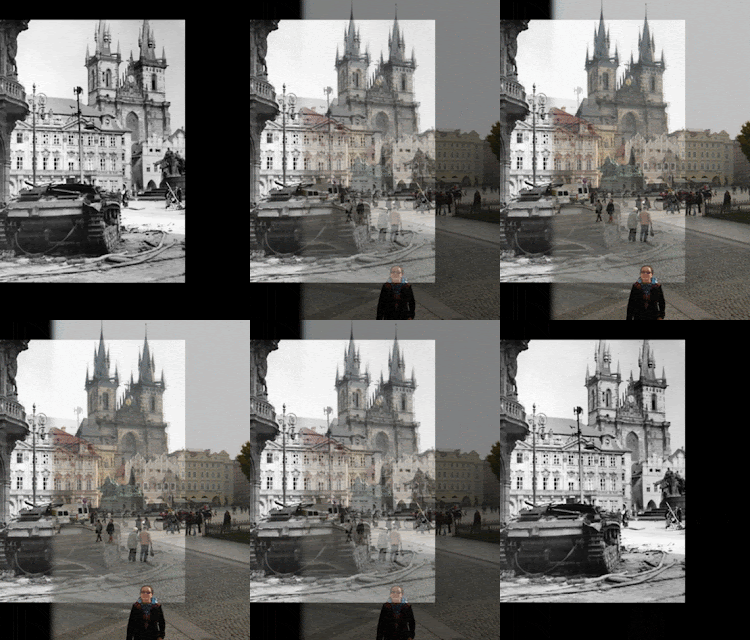 My GIFs on the left and below show Staromestske Namesti on that day and today with the wife. Mazower contends that the violence was as much about settling old scores and establishing a new political order as it was about liberation. Indeed, the Czech National Council was deeply divided along ideological lines, and the uprising served as a battleground for these internal disputes. The Germans responded to the uprising with brutal force, employing tanks and heavy artillery against the poorly armed resistance. The violence was not limited to military confrontations; civilians were caught in the crossfire, and summary executions were carried out. Judt notes that the German retaliation was driven not just by military objectives but also by a desire to make an example of Prague, to deter further uprisings in other occupied territories.
 The role of the Soviet Union in the violence is another point of contention among historians. Applebaum suggests that the Soviets had a vested interest in the outcome of the uprising, as they sought to establish a communist government in Czechoslovakia. According to her, the Soviets deliberately delayed their advance to allow the non-communist factions of the Czech resistance to be crushed by the Germans, thereby facilitating a communist takeover. Meanwhile Beneš had been advocating for a strong, independent Czechoslovakia post-war and was in talks with both Western Allies and the Soviet Union to secure this vision. Snyder suggests that Beneš was willing to make significant concessions to the Soviets to ensure their support, including the marginalisation of non-communist resistance groups. This political manoeuvring had a direct impact on the ground in Prague, as it emboldened communist factions within the resistance and sowed distrust among the various groups. The Czech resistance wasn't a monolithic entity but was fractured along ideological lines, much like the Czech National Council. The divisions weren't merely ideological but also tactical; different groups had different visions of how best to resist German occupation and what the post-war Czechoslovakia should look like. Tooze offers a nuanced view, suggesting that the resistance was a tapestry of local and national agendas, often working at cross-purposes. This internal discord was a significant factor in the violence that erupted during the Prague Uprising, as groups vied for control and influence, both over the German occupiers and over each other.
If hell on earth existed, than it existed in Prague after May the 5th, 1945. Old men, women and children were beaten to death and maimed. Rapes, barbaric cruelties, horror-scenarios of hellish proportions - here they had been let loose.

- We will never attempt to subjugate foreign peoples. speech of May 27, 1933.
- We have no territorial claims to make in Europe. speech of March 7, 1936
- The German Reich Government shall thus unconditionally abide by the other articles governing the coexistence of the nations, including territorial provisions, and put into effect solely by means of peaceful understanding those amendments which become inevitable by virtue of the changing times. speech of May 21, 1935.
- It is the last territorial demand I shall make in Europe... I repeat here before you, once this issue has been resolved; there will no longer be any further territorial problems for Germany in Europe! speech of September 26, 1938.
- We do not want any Czechs at all. ibid.

 |
The Old Town Square in the last days of the war and today with the wife.
|


Czech historians pointed to the Hussite period as proof that the nation, and national consciousness, predated the nineteenth century. In 1915 Masaryk, no doubt seeking to position himself as a successor to Hus, chose the five-hundredth anniversary of Hus’s death to declare his intention to create an independent Czechoslovakia. That same day, Czech leaders unveiled the Hus memorial in Prague. Habsburg leaders forbade any public celebration, but Prague citizens defied the ban and surreptitiously laid thousands of flowers at the base of the statue. Ten years later, in 1925, at an officially sanctioned rally centred around the monument, Czechoslovak leaders celebrated Hus’s death and the Czechs’ “resistance” to Austrian rule during World War I. In 1939, as in 1925, Czechs were commemorating many things: a medieval national hero, the nation’s long existence, and the creation of Czecho-slovakia. They were reenacting popular opposition to previous forms of“German” rule.”Chad Bryant (40) Prague in Black

 Here about sixty American Eighth Air Force Boeing B-17s dropped 152 tonnes of bombs on various residential areas of Prague. The carpet of bombs hit areas at Vyšehrad, Vinohrady and Pankrác, among others. A total of 700 people died in the attack with 68 buildings completely destroyed and around 250 buildings badly damaged. Among them were some historically valuable houses such as the most magnificent synagogue in the city in Vinohrady and the Emmaus Monastery in Prague's New Town. The extent of the bombing was significantly less than that of the air raids on most German cities. Although the Americans often expressed their regret and saw the causes of their error in unfavourable weather conditions and an alleged similarity of Prague and Dresden from the air, the suspicion is still sometimes expressed that it could have been a targeted attack. According to witnesses, a group of bombers from a larger formation clearly separated from the other bombers and flew to Prague. However, most historians believe that the air raids on Prague were in fact accidental. The last and largest air raid on Prague was on Palm Sunday, March 25, 1945, also by the USAAF. This time it was a planned operation involving 650 bombers launched from Italy and escort fighters. The attack was aimed at the industrial plants in eastern Prague and the Prague-Kbely military airfield. According to the USAAF, Sunday was chosen for the attack to minimise human casualties in the factories. The attack took place under ideal conditions in twelve waves of about fifty aircraft each between 11.48 and 13.02 hrs. One Me 262 was shot down by the P-38 escort fighters near the Prague Zoo crashed. As a result of the attack, 235 dead, 417 injured, 90 buildings destroyed and 1360 badly damaged objects were recorded.


 |
| Standing in front today |

Hradcany Castle

At 14.03 Hitler’s train reached the little Bohemian frontier station of Leipa, where Panzer Corps Commander General Erich Hoepner awaited him with Colonel Erwin Rommel (who was to command the ‘Führer HQ’). To the consternation of Himmler and the security staff, Hitler decided to drive right on to Prague. At 16.00 the frontier barrier was raised for him to cross into Czecho-Slovakia, and in a snowstorm his convoy headed on to the capital. He stood in his open car, saluting as he passed his regiments. It was dusk when he arrived in Prague. At first nobody knew where Hácha’s official residence, the Hradcany Castle, was. Hitler’s drivers finally entered it through a gate in the rear. A palace flunky was found to guide them to a wing where these unexpected visitors might sleep, but Hitler did not rest yet. He began dictating a law establishing a German ‘Protectorate’ over Bohemia and Moravia. At two in the morning a cold buffet arrived, provided by the local German Centre. There was Pilsen beer: Hitler was prevailed upon to sample a small glass but he grimaced, did not finish it, and went to bed. The first that the citizens of Prague knew of his presence in their midst was next morning, when they espied his personal swastika standard beating from a flagpole atop the snow-bedecked palace roofs.
Irving's Hitler's War and The War Path, 162

Hitler's invasion took place after having repeatedly pledging himself and his movement to respect the right to self-determination of other ethnic groups:
We have no territorial claims to make in Europe. speech of March 7, 1936
The German Reich Government shall thus unconditionally abide by the other articles governing the coexistence of the nations, including territorial provisions, and put into effect solely by means of peaceful understanding those amendments which become inevitable by virtue of the changing times. speech of May 21, 1935.
It is the last territorial demand I shall make in Europe... I repeat here before you, once this issue has been resolved; there will no longer be any further territorial problems for Germany in Europe! speech of September 26, 1938.
We do not want any Czechs at all. ibid.
 Heydrich taking up his position as 'protector' of Bohemia and Moravia. Earlier on September 27, 1941, the Czech Press Agency reported that his predecessor von Neurath “had fallen ill” and named Heydrich as his “substitute Reich Protector”. By then Hitler had become convinced that Neurath’s “good and peaceable nature now seemed more like weakness and stupidity”. Goebbels noted that the Protectorate required a “strong hand to maintain order” and that Neurath belonged to “an entirely different world” than the committed Nazis. In his inaugural speech at Černín Palace on October 2, 1941, Heydrich outlined his "unflinching hardness" and his racial vision for the region. In terms of the Czechs' allegiance to the Reich, he warned that “I must unambiguously and with unflinching hardness bring the citizens of this country, Czech or otherwise, to the understanding that there is no avoiding the fact they are members of the Reich and as such they owe allegiance to the Reich”. In regards to the war effort, he "must have peace of mind that every Czech worker works at his maximum for the German war effort… This includes feeding the Czech worker- to put it frankly- so that he can do his work”. He declared that the territory “must once and for all be settled by Germans” and demanded a “racial inventory” to determine who was “suited to be Germanised", reportedly telling his subordinates that for those who could not be assimilated or used “I’ll put them against the wall”.


Surprisingly, the ‘protectorate’ brought blessings for the Czechs as well. Their economy was stabilised and unemployment vanished. Their menfolk were not called upon to bear arms in Hitler’s coalition. Their armed forces were dissolved, and their officers were given state pensions on Hitler’s orders, to purchase their dependence and complicity. The industrious Czechs accepted rich contracts from the Reich and learned eventually to cherish the pax teutonica enforced by Reinhard Heydrich in 1941. It was the peace of the graveyard, but Heydrich won the affection of the Czech workers to such an extent – for instance, by introducing the first ever Bismarckian social security and pension schemes – that 30,000 Czechs thronged into Wenceslas Square in Prague to demonstrate against his murder in 1942. The Czechs had not been required to sell their souls, and this was what Hitler had promised Hácha in Berlin. Hácha himself never felt any grievance. He inquired of Morell about the prescription he had been injected with and thereafter obtained a regular supply from Morell’s pharmacy. He would die, forgotten, in an Allied prison in 1945; Tiso and Tuka were both hanged.
(163) Hitler's War

This passage is characteristic of Irving's method as Richard J. Evans testified during the libel trial Irving v. Penguin Books and Deborah Lipstadt, concluded on April 11, 2000, in
which Evans demonstrated that Irving systematically distorted and
manipulated documentary evidence to support a predetermined narrative of
Hitler as a rational and moderate statesman. Here Irving's framing that the Protectorate "brought blessings" and that Hitler "had not required the Czechs to sell their souls," isn't supported by record of deportations, executions, forced labour, and the total destruction of Czechoslovak sovereignty. His account of the post-Heydrich demonstration ignores the context of organised compulsion and subsequent mass reprisals that makes any reading of popular sentiment from that gathering unreliable. To say that Hácha “never felt any grievance” is hard to reconcile with the known circumstances of March 1939, when he was placed under intense pressure in Berlin before accepting the German takeover during which he had suffered a cardiac arrest. He may have remained head of the Protectorate state, but his personal position cannot be reduced to contentment. There is also a straightforward factual error in Irving’s final sentence: Hácha may not have died in an “Allied prison,” but he did on June 27, 1945 in Pankrác prison in Prague, in Czechoslovak custody. 

where his wounds were cleaned by a young Czech doctor, Vladimir Snajdr. He was conscious and had regained his icy self-control. As Snajdr later recalled: ‘I took forceps and a few swabs and tried to see whether the wound was deep. . . he did not flinch although it must have hurt him.’ The German Director of the hospital, one Doctor Dick, was summoned to the scene and made a more detailed examination. The prognosis seemed good. The shrapnel had missed the spine and kidneys and appeared to have inflicted only flesh wounds. He insisted, however, on an X-ray. This revealed a more serious situation. Heydrich had a broken rib, a ruptured diaphragm and splinters from either the bomb or the car in his spleen. They were injuries which could have been avoided by the installation of armour plate in the seat backs of the Mercedes. Dick recommended an immediate operation. Heydrich did not want to entrust his life to a provincial German doctor and demanded a surgeon from Berlin. After some argument, a compromise was reached. Heydrich agreed to surgery but only if the top Nazi consultant in Prague, Professor Hollbaum of the German Clinic, was called in. Shortly after midday, he was wheeled into the operating theatre.Callum MacDonald (208) The Assassination of Reinhard Heydrich
 After a week when his condition appeared to be improving, he collapsed whilst eating lunch and went into shock, dying the next morning. His physicians concluded that he had died from infection of his wounds. Here Heydrich's coffin is shown in Bulovka hospital, attended by an ϟϟ honour guard. A scanned copy of

In accordance with SS ritual, a death mask was made. A police official named Wehner, who had been summoned to Prague to investigate the circumstances of Heydrich’s murder, said that the mask showed “deceptive features of uncanny spirituality and entirely perverted beauty, like a cardinal of the Renaissance.”Graaber (220) The Life and Times of Reinhard Heydrich
 |
| Republic Square then and now |
Protectorate authorities promised, along with clemency, an increased award sum for anyone who knew of the assassins’ location, and they announced drastic measures if the assassins were not handed over by June 18. As the date approached, the tensions came to a crescendo. Rumours spread that the Nazis would execute every tenth Czech. Many Czechs gave serious thought to suicide.'' Two days before the deadline a Czechoslovak parachutist, Karel Curda, walked into Gestapo headquarters in Prague. He claimed to fear for his family and to have become disenchanted with the exile government. He did not know Gabčik and Kubis’s location, but he did betray those who had provided the safe houses. A wave of arrests followed. After withstanding hours of brutal interrogation, one of the men slipped that the assassins were hiding in an Orthodox church in Prague along with nine other parachutists.Bryant (171) Prague in Black

 The resistance of the paratroopers was broken only after two hours, when they ran out of ammunition. Opálka
and Bublík kept the last bullet for themselves. Jan Kubiš bled to death
as a result of numerous injuries. There was an attempt to save two of
the paratroopers in the hospital (the Gestapo wanted to capture the
paratroopers alive if possible), but their injuries were incompatible
with life. Overall, it is possible to evaluate the German intervention
as well executed, as it achieved a result with minimal losses. The
defence of the paratroopers was tenacious, but due to the number of
attackers and their weapons, they could not have had any chance of
success.


Pannwitz summoned the Prague fire brigade and ordered them to flood the crypt. A fireman climbed up a ladder and knocked out the iron grille over the vent. The hoses were connected and began to pump 660 gallons of water a minute into the catacombs. Trapped inside, the parachutists placed a short ladder against the wall and, ducking under the powerful jets of water roaring through the opening, cut the hoses or pushed them out. When the Czech firemen tried to replace them they were repulsed by gunfire and Molotov cocktails.According to the German report of the action: ‘The Waffen SS was then ordered to throw tear-gas grenades down the shaft. .. However, the criminals quite often managed to throw them back out. Hoses were again put into the shaft; a few hand grenades were used to stop the criminals pushing the hoses out again.’ Pannwitz hoped that the flooding and the gas would eventually persuade the parachutists to surrender. He reckoned without their grim determination and the interference of his political master, Karl Hermann Frank, who arrived on the scene shortly after dawn.Callum MacDonald (234) The Assassination of Reinhard Heydrich


The combination of terror generated by the massacre of entire families and the annihilation of Lidice, and the promise of pardons and huge financial rewards, eventually bore results. The paratrooper Karel Čurda from the OUT DISTANCE unit, who left Prague immediately after the assassination and hid out with his mother in Nová Hlína near Třeboň, finally gave in to his own fear and the reproaches of those closest to him. He betrayed. First, on June 13, 1942, he wrote a traitorous letter in which he identified Gabčík and Kubiš as the assassins. When the expected reaction did not materialize, he personally set out for Prague on 16 June 1942, and, shortly before noon, reported to the Gestapo administrative headquarters in Petschek Palace. There he caused a sensation with his all-encompassing testimony, because up to that point, all of the Nazis’ efforts to find the assassins had proved fruitless. Čurda betrayed to the Gestapo everyone he knew personally who had assisted the paratroopers, not only in Prague but in Pardubice, Lázně Bělohrad and Pilsen. Through his betrayal he caused the deaths of dozens of patriots and their families.Burian, Knížek, Rajlich, Stehlík (76) Assassination


 Across from the church/museum is the Restaurant Krčma u Parašutistů- Tavern of the Parachutists- that doubles as a shrine to the paratroopers. The restaurant's interior is designed as a themed tribute to the paratroopers and the broader Czechoslovak resistance during the war. Established during the post-Communist period, the venue occupies a vaulted cellar space that evokes the clandestine atmosphere of the wartime resistance, though the building itself dates to the nineteenth century and was not an actual historical site of the assassination plot. The walls are decorated with period photographs of the paratroopers, including individual portraits of Gabčík and Kubiš alongside group photographs of the various teams trained in Britain and deployed into the Protectorate. Reproductions of wartime documents are displayed, including identity papers, resistance pamphlets, and operational orders. The decor includes military equipment and memorabilia from the period, such as replica weapons, parachute harnesses, ammunition boxes, helmets, and uniforms representative of those worn by the Czechoslovak soldiers who trained with the British Special Operations Executive at various locations in England and Scotland, including Arisaig House in the Scottish Highlands and Cholmondeley Park in Cheshire.

Maps showing the locations of parachute drops into the Protectorate are displayed on the walls which later influenced my own classrooom decor, illustrating the various operations that were carried out alongside Anthropoid, including Operation Silver A, Operation Silver B, Operation Out Distance, Operation Bioscope, Operation Tin, and Operation Zinc. Framed newspaper clippings from both the Czech underground press and the official Protectorate press cover the aftermath of the assassination and the subsequent Nazi reprisals.
The restaurant's thematic focus extends to the reprisals that followed Heydrich's death, which are documented through photographs and text displayed on the walls. The destruction of Lidice on June 10, 1942, is referenced, when ϟϟ and Ordnungspolizei units surrounded the village, shot all 173 men over the age of fifteen, deported the women to Ravensbrück concentration camp, and sent the children to various locations, with many subsequently gassed at the Chełmno extermination camp. The village was then razed to the ground and its name removed from official maps. The parallel destruction of Ležáky on June 24, 1942, is also documented, where all thirty-three adult inhabitants were executed at Pardubice and the village was similarly destroyed. These reprisals resulted in the deaths of approximately five thousand Czech citizens in the weeks following the assassination. The restaurant's decor presents these events through documentary photographs, maps, and explanatory texts in Czech and English, allowing visitors to engage with the historical narrative whilst dining.


Hitler ordered the ϟϟ and Gestapo to “wade in blood” throughout Bohemia to find Heydrich’s killers. More than 13,000 people were ultimately arrested. The most notorious incident was in the village of Lidice, which was destroyed on June 9, 1942: 199 male residents were executed, 95 children taken, eight of whom were taken for adoption by German families, and 195 women arrested.

 Postwar restitution processes in the late 1940s addressed many of these seizures, though some properties remained in state hands or were subject to prolonged legal disputes as was the case with Celetná ulice on the right, one of the oldest thoroughfares in Staré Město running from Old Town Square toward the Powder Tower, was deeply affected by the German occupation through both administrative control and economic dispossession.
Commercial and residential properties, such as No. 3 (formerly belonging to Jewish merchant Leopold Pick) and No. 15, were Aryanised starting in 1940, with owners evicted and assets transferred to German entities or Wehrmacht personnel. The street formed part of the historic core used for propaganda displays and parades. In the broader Old Town, over 450 Jewish properties were seized by the end of 1941. Resistance activity occurred in the dense urban fabric around Celetná, though specific safe houses are less documented. Fierce street fighting took place here during the May 1945 Prague Uprising. Postwar, many buildings underwent restitution, though nationalisation under the communist regime complicated returns.


The mausoleum of Klement Gottwald, longtime leader of the Communist Party of Czechoslovakia (KSČ) and Prime Minister of Czechoslovakia from and later President, was established here in 1953. Gottwald had suffered from heart disease for several years. Shortly after attending Stalin's funeral on March 9, 1953, one of his arteries burst and he died five days. The original layout placed a sarcophagus in the Main Hall, as the place where founder Tomas Masaryk was to be buried. He eventually rejected the plan, and so did his family after his death. From 1953 to 1962 this area was rebuilt into the Klement Gottwald Mausoleum. The Minister of National Defence and Gottwald's son-in-law Alexej Čepička was in charge of preparatory works for the conversion. The examples came from Lenin's Mausoleum in Moscow and the Georgi Dimitrov Mausoleum in Sofia. Gottwald's body was exhibited in the centre of the mausoleum in a glazed sarcophagus. The lid had built-in lights with small mirrors. The body was moved in and out of the underground laboratory by a vibration-free telescopic device. The embalmed body was dressed in the blue general's uniform of the Head Commander of Czechoslovak armies. In 1958 it was changed to civilian attire. However, by 1962 the personality cult ended and it was no longer possible to show Gottwald's body. There are accounts that in 1962 Gottwald's body had blackened and was decomposing due to a botched embalming. His body was cremated, the ashes returned to the Žižka Monument and placed in a sarcophagus. After 1989, all of the remains buried here were taken away; his nondescript grave can be seen below in a common grave at Prague's Olšany Cemetery, together with the ashes of about 20 other communist leaders which had also originally been placed in the Žižka Monument. The Communist Party of Bohemia and Moravia now maintains that common grave.
 Standing in front of the
Maisel Synagogue where Hitler has been said to have intended to
establish his "Central Museum of the Extinguished Jewish Race." The synagogue in Prague's former Jewish ghetto served as one of the important religious buildings during the Nazi era. It was constructed in 1590 under the patronage of Mordecai Maisel, the financier and philanthropist who served as Prefect of the Prague Jewish Town, and later rebuilt in neo-Gothic style between 1893 and 1894 to designs by Max Fleischer. Under Nazi rule the synagogue was confiscated from the Jewish community and repurposed as a storage facility for confiscated Jewish property. Ritual objects, furniture, and household goods taken from Jewish households during the deportations were warehoused within its walls. The synagogue's function during the occupation was entirely administrative, serving as one of several depots in the Jewish Quarter where the possessions of deported Jews were sorted and catalogued before being distributed or transported elsewhere.
Two days after the establishment of the Protectorate the Czech government began drafting measures for the expropriation of Jewish property and, to the dismay of local Oberlandrate, began assigning Treuhdnder (literally, “trustees”) to Jewish firms.’ In June Neurath’s office issued a decree that claimed for the Reich Protector’ Office the sole authority to issue decrees relating to Aryanization. Bertsch’s office was responsible for the implementation of most of these measures. Neurath repeated Goring’s declaration that no Jewish property could be sold, transferred, or given away without permission. All valuables, such as gold and pearls, had to be registered with special offices created by the Reich Protectors Office. Only the Reich protector had the right to assign Treuhander, a responsibility that in practice fell to the Oberlandrate.” In 1940 Neurath’s office accelerated the process. Decrees that year required Jews to sell their valuables to a special public purchasing agency and to deposit stocks and other paper assets in a foreign currency bank. A second cascade of decrees declared a whole range of business ventures—film production, textile and shoe manufacturing, and then pubs, insurance companies, and banks—off limits to Jewish owners.’ Germans, with the help of “Aryanization loans” from German banks and subsidies from the German Reich, could purchase these businesses. More often, however, the regime simply liquidated the Jewish firms.
After Prague's liberation, the building remained in a state of disrepair for years. It was incorporated into the Jewish Museum in Prague's network of exhibition spaces and underwent extensive restoration in the 1990s, reopening to the public with a permanent exhibition devoted to the history of the Jews in Bohemia and Moravia from the eighteenth century to 1918.Chad Bryant (82-83) Prague in Black
 At the Klausen Synagogue on the right, the largest in the ghetto and the seat of Prague's Burial Society, which continued to function as a central institution for the Jewish community under Nazi occupation. It was erected in 1694 in the early Baroque style on the site of an earlier structure destroyed by fire in 1689. It served for centuries as the principal seat of the Prague Burial Society, the Chevra Kadisha, whose members were responsible for the ritual washing and preparation of the dead, the supervision of burials in the Old Jewish Cemetery, and the provision of charitable support to bereaved families. During the Nazi occupation, the synagogue was likewise confiscated. Its function as the centre of the Burial Society's operations ceased entirely once the Jewish population of Prague began to be deported in 1941 and 1942. he
commonly held view that the Nazis brought Jewish ritual objects from
the whole of occupied Europe to Prague so that after their victory they
could create a ‘museum of an extinct race’ in reality is more nuanced
and has become a self-perpetuating legend in which it was set up by Adolf Eichmann or his department as the
“Jewish Central Museum” during the German occupation and was opened by
the ϟϟ on April 6, 1943 as the “Museum of a Lost Race”. In fact, the Jewish Museum in
Prague wasn't created by the Nazis but was established August 1906.
The museum’s collection programme was clearly based along regional
lines, covering solely Jewish memorial objects from Prague and Bohemia.
At the time of the Nazi occupation, the museum’s
collection already contained approximately 760 items.The building was absorbed into the network of confiscated Jewish properties managed by the Nazi occupation authorities and used in connection with the administration of the Jewish Central Museum, the Jüdisches Zentralmuseum, which was reorganised in 1942 under the authority of Eichmann's Department IV B 4 of the Reich Security Main Office. The Klausen Synagogue served as one of the sites where confiscated Jewish artefacts were stored, sorted, and catalogued by Jewish prisoners from the Theresienstadt ghetto who were compelled to work under direct ϟϟ supervision. The building now houses a permanent exhibition on Jewish customs and traditions, part of the Jewish Museum in Prague's network of sites.


After the war, the synagogue was selected as the site for a memorial to the Czech and Moravian Jews murdered during the occupation. Between 1954 and 1959, the painters Václav Boštík and Jiří John inscribed the interior walls with the names of 77,297 victims, together with their dates of birth and dates of deportation. The inscriptions cover every available surface of the synagogue's interior. On the right is the exterior of the Pinkas Synagogue before reconstruction work began in the 1950s. In 1968, following the Warsaw Pact invasion of Czechoslovakia, the Communist authorities ordered the inscriptions painted over, a decision that has been attributed to the regime's desire to suppress public memory of the wartime period during a moment of political crisis. The inscriptions remained concealed until after 1989, when they were painstakingly restored. The synagogue now functions as a memorial and also houses on the first floor a permanent exhibition of drawings and paintings made by children interned at the Theresienstadt ghetto between 1942 and 1944, of whom the vast majority were subsequently deported to Auschwitz and murdered.


 Some of the men buried at Olšany may have been members of these Czechoslovak units serving under RAF command, though the majority of the burials are of British, Canadian, Australian, and New Zealand airmen whose aircraft came down over Czech territory. The cemetery also contains a small number of graves from the First World War, reflecting the presence of Commonwealth PoWs who died in captivity in Austro-Hungarian territory during that conflict when Czech lands formed part of the Austro-Hungarian Empire and housed PoW camps in which captured British and Imperial soldiers were held. The Commission's maintenance of these earlier graves alongside the Second World War burials ensures that the site serves as a continuous record of Commonwealth military losses on Czech soil across both world wars. The Olšany Cemetery itself dates from 1680, when it was established as a plague burial ground outside the city walls, and it has since expanded to become one of Prague's largest burial sites.
The stones differ in colour to those usually found in CWGCs as seen in my other site Echoes of war.


One day a Soviet official had arrived at Plattling and demanded the files on the prisoners. When the Russian POWs got wind of what was going to happen, they mutinied. A senior American officer had placated them by telling them that they would not be handed over, and that they would be resettled in southern Europe – the same lie the Welsh Guards used in Carinthia. Then the tanks rolled in. The American guards had been issued with rubber truncheons and went to the Russian huts in the middle of the night, beating them out of their bunks – ‘Mak snell, mak snell’ – and into waiting lorries. They were taken to Zwiesel near the border. American guards reported that corpses could be seen hanging from trees behind the Russian lines. The precise number of Russian soldiers killed is not known. Estimates range from 300 to 3,000.
MacDonogh (416) After the Reich
 Left: Paying my respects at Jan Palach's grave. Palach had initially been interred in Olšany Cemetery but given his gravesite was becoming a national shrine, the Czechoslovak secret police (StB) set out to destroy any memory of Palach and exhumed his remains during the night of October 25, 1973. They then cremated his body and sent the ashes to his mother whilst the body of an anonymous old woman from a rest home was laid in the vacated grave. Palach's mother wasn't allowed to deposit the urn in the local cemetery until 1974. It wasn't until October 25, 1990 that Palach's ashes were officially returned to his initial gravesite. On the 20th anniversary of Palach's death, protests ostensibly in memory of Palach but intended as criticism of the regime escalated into what would be known as "Palach Week". The series of anticommunist demonstrations in Prague between January 15 and 21, 1989 were suppressed by the police, who beat demonstrators and used water cannons, often catching passers-by in the fray. Palach Week is considered one of the catalyst demonstrations which preceded the fall of communism in Czechoslovakia ten months later. Right: Klement Gottwald's grave, a far cry from his previous resting place. The Communist Party of Bohemia and Moravia now maintains that common grave.
 The New Jewish Cemetery was established in 1890 as the primary burial ground for the city’s Jewish community after the Old Jewish Cemetery in Josefov reached capacity. Spanning approximately ten hectares, it contains over 25,000 graves and remains one of the largest and most important Jewish cemeteries in Europe. Unlike the overcrowded, atmospheric Old Cemetery, the New Cemetery, which is 10 times larger, follows a more orderly 19th-century layout with straight rows, family plots, and a mix of elaborate Art Nouveau and modest modernist tombstones. Many graves reflect the assimilated, bourgeois Prague Jewish families of the late Habsburg and First Republic periods. The cemetery survived the Nazi occupation relatively intact, though the community that filled it was decimated.
 Between 1941 and 1945, most of Prague’s Jews were deported to Theresienstadt and then to Auschwitz and other camps. Postwar, the site became a place of remembrance for Holocaust victims whose bodies were never recovered. Here on the left are a couple of the many such memorials found on the south wall of the cemetery. The new Jewish cemetery in Olšany was officially opened on July 6, 1890. The cemetery contains numerous Art Nouveau monuments by Czech artists, including Jan Kotěra, Jan Štursa and Josef Václav Myslbek, the creator of the statue of St. Wenceslas in Wenceslas Square. They provide an insight into the Jewish self-image conveyed by the grave inscriptions from the time before the German occupation in 1938, which was mainly kept in Hebrew.

 The site has required repeated conservation due to heavy foot traffic and weathering. In recent decades, the Prague Jewish Community and the Franz Kafka Society have maintained the plot, with occasional protective measures around the headstone. The surrounding cemetery, established in 1890, contains thousands of graves from the late 19th and early 20th centuries, many of prominent Prague Jewish families decimated during the Holocaust. The plaque below the grave commemorates his three younger sisters Elli, Valli and Ottla with an unknown date of death, who were murdered between 1942 and 1943 in the extermination camps Chelmno and Auschwitz-Birkenau respectively. Beside Kafka's grave to the east of the cemetery is this forlorn area on the right that should give even Holocaust-deniers pause for thought- a large area left unfilled by the generation that had been annihilated by the Nazis. If no Holocaust, where are the missing graves?
Cernínský Palác

 Across from the building (now serving the Czech Ministry of Foreign Affairs) is the statue of Beneš I'm standing beside above Both men received a state funeral, though under
very different circumstances. While resistance within Czechoslovakia was neither intense nor extensive, Edvard Beneš successfully established a very active Czech government in exile in London. In Great Britain, Beneš formed a Czech legion, a unit of brigade strength, consisting of 5,000 men equipped with tanks, which served in the Normandy landings and in subsequent engagements. Three Czech fighter squadrons and one Czech bomber squadron flew with the Royal Air Force, and Czech intelligence operatives served with the British throughout the war. In July 1941, the Beneš's government concluded a treaty with the Soviet Union by which the USSR recognised the legitimacy of the government in exile and, with the United States and Great Britain, upheld its status as an Allied power.
Bavaria's state premier Edmund Stoiber said at a meeting of the Sudeten German Landsmanschaft that the statue was a provocation given the so-called Beneš decrees which formed a legal basis for the expulsion of over 2.5 million Sudeten Germans from post-war Czechoslovakia.


 Swedish architectural historian Anders Åman described its impact as “overwhelming”:
In shape, it resembled a wedge pointing inward at the city. Stalin occupied the apex, the Soviet people one side, the Czech and Slovak peoples the other side. At the back, finally, was a relief of the hammer and sickle. It was colossal. It was built of meter-high blocks of granite. . . . Behind Stalin there was a slight gap—to make him stand out as an individual, even if the monument was viewed from the side—and then, on both sides, came the nations rallying in his footsteps...[four figures], representatives of the workers, the peasants, the intelligentsia, and the armed forces.
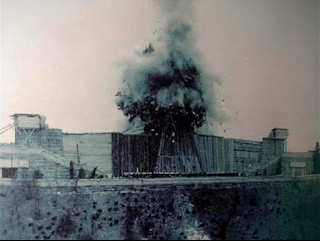 However, the monument's existence was short-lived. After Stalin's death in 1953, his successor, Nikita Khrushchev, initiated a period of "De-Stalinisation," which involved a critical reassessment of Stalin's policies and actions. This political shift had a direct impact on the monument's fate. The monument, therefore, became an increasing source of
embarrassment to the Czech Communist Party; in 1962, just seven years after its unveiling, the statue was demolished using 800 kilograms of explosives. The destruction was carried out in secrecy, under the cover of night, to avoid drawing attention. The remnants were buried at an undisclosed location, and the sculptor, Otakar Švec, who had already been grappling with the ethical implications of his work, committed suicide shortly before the statue's completion. The site where the monument stood remained vacant for many years, serving as a stark reminder of a controversial period in Czech history. It wasn't until 1991 that a new monument, the Prague Metronome, was erected on the same plinth. The Metronome is often interpreted as a symbol of the passage of time and the impermanence of political regimes, standing in stark contrast to the monumental permanence that the Stalin statue was intended to convey.


 Thatcher delivered a speech during the unveiling, emphasising Churchill's enduring impact on Czech history and culture. The event was also attended by local dignitaries, including the Mayor of Prague and other Czech officials. The ceremony was not merely a formality but a significant occasion that highlighted the deep respect and admiration that the Czech people have for Churchill. Thatcher's speech touched upon the shared values of democracy and freedom that both Churchill and the Czech people hold dear, further solidifying the deep-rooted admiration for Churchill in Prague. The date of the unveiling, 17th November, is also significant in the context of Czech history. It marks the anniversary of the Velvet Revolution, a peaceful revolution that led to the end of Communist rule in Czechoslovakia. The choice of this date for the unveiling of Churchill's statue underscores the alignment of Churchill's democratic ideals with the aspirations of the Czech people, further cementing his revered status in Prague. The statue of Churchill reminds us that the price of freedom can be high, that it may indeed require the sacrifice of “blood, toil, tears and sweat” and that liberty must never be allowed to perish from the earth; it must forever endure.
