

Click here for the Site of the Munich Agreement and other Nazi Party buildings across from Königsplatz
.gif)
Overlooking
Königsplatz from the top of the National Socialist Documentation
Centre, at the site of the former Brown House, and from exactly the same
spot in 1937 showing the granite square and the temples of honour now
just empty overgrown plots. Each
temple had a square central well, filled with the bronze sarcophagi of
the sixteen men killed in the failed 1923 Munich putsch, the first Nazi
attempt to seize power.
.gif) Below is Königlicher Platz by
Josef Eglseder (1938), showing the Führerbau where the Munich Agreement
was signed, Braunes Haus, Ehrentempel, and Verwaltungsbau der NSDAP
with Albert Speer's lampposts in
the foreground from the steps of the Glyptothek, and from the same
position in 2023. The
Nazi party's headquarters lay just behind the new huge buildings: the
Führerbau, which housed Hitler's Munich office and apartments, and the Verwaltungsbau der NSDAP which,
identical on the outside, are distinguished by their massive size,
their elongated proportions (275-foot façade length and sixty feet in
height, and their lack of elaborate ornament. The inner pair, comprising
the identical Ehrentempel, were square structures of the Doric order,
with a three-step podium and six square, fluted piers on each side.
These piers supported a simple, classicising architrave instead of a
full roof. In 1948 trees were planted along the Arcisstrasse to screen the Nazi buildings from Klenze's nineteenth-century Königsplatz
as can be seen here. In the mid 1930s the square was closed by a screen
of four buildings running along the east side of the Arcisstrasse.
Below is Königlicher Platz by
Josef Eglseder (1938), showing the Führerbau where the Munich Agreement
was signed, Braunes Haus, Ehrentempel, and Verwaltungsbau der NSDAP
with Albert Speer's lampposts in
the foreground from the steps of the Glyptothek, and from the same
position in 2023. The
Nazi party's headquarters lay just behind the new huge buildings: the
Führerbau, which housed Hitler's Munich office and apartments, and the Verwaltungsbau der NSDAP which,
identical on the outside, are distinguished by their massive size,
their elongated proportions (275-foot façade length and sixty feet in
height, and their lack of elaborate ornament. The inner pair, comprising
the identical Ehrentempel, were square structures of the Doric order,
with a three-step podium and six square, fluted piers on each side.
These piers supported a simple, classicising architrave instead of a
full roof. In 1948 trees were planted along the Arcisstrasse to screen the Nazi buildings from Klenze's nineteenth-century Königsplatz
as can be seen here. In the mid 1930s the square was closed by a screen
of four buildings running along the east side of the Arcisstrasse. 
.gif)
Fritz Gärtner's A Nazi Evening Ceremony in the Konigplatz (15 October 1933)
 Both the Verwaltungsbau and Führerbau were built according to plans by Hitler's favourite architect Paul
Ludwig Troost who never lived to see their completion in 1935 or of the
entire building complex at Königsplatz which was completed by 1937.
When he died his widow Gerdy, at only thirty years of age, continued his projects in cooperation with her late husband's long-time colleague Leonard Gall,
focussing especially on the interior finish of the Führerbau. Her
efforts were rewarded by Hitler with the title of Professor in 1937.
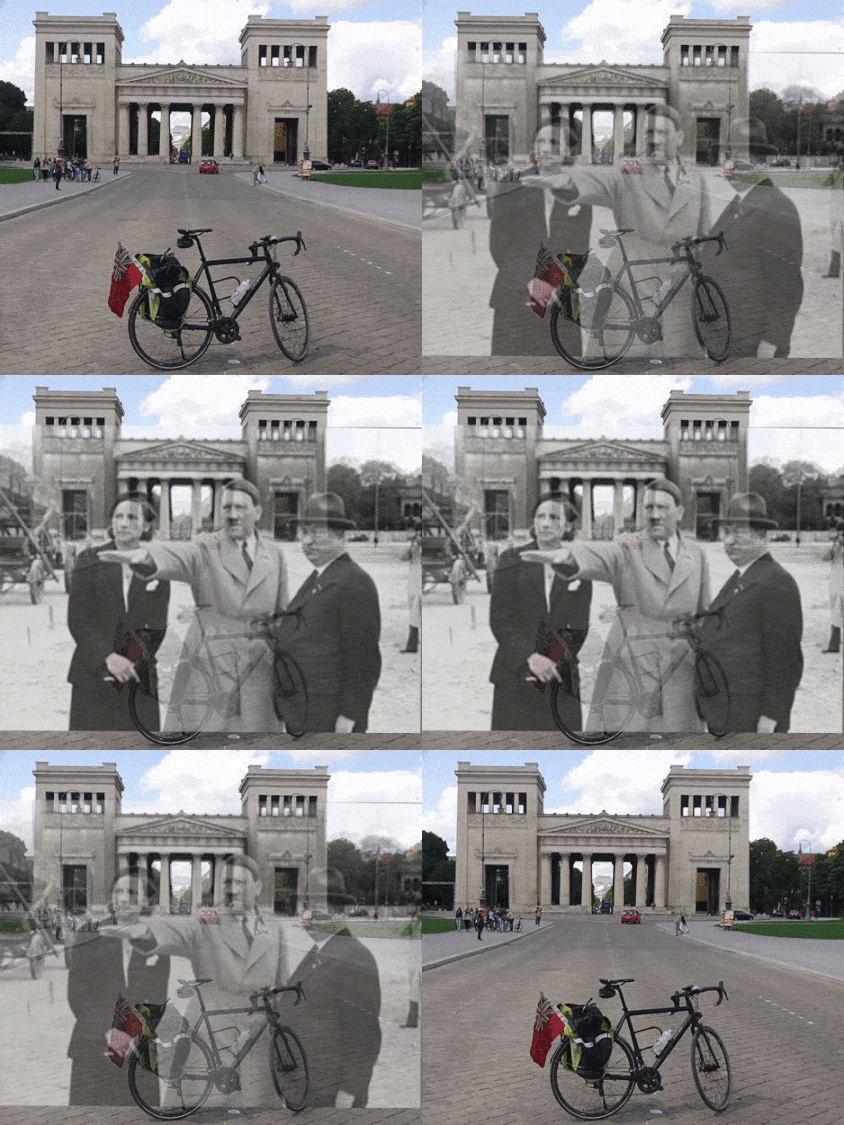
Above right in front of the Propyläen is
Hitler directing the construction of these buildings with both Troost and
Gall. Through them the place originally dedicated to the arts was
converted into the "Teatrum sacrum" of the movement. and served as a
stage for the pseudo-religious cult. Munich was officially designated by Hitler as the "Hauptstadt der Bewegung" (Capital of the Movement), and no spot in Munich was more central than the Konigsplatz. Hitler dedicated Mein Kampf to
those killed in the putsch (whom he termed "blood witnesses of our
movement") and noted that they had been denied common burial. In 1935 he
arranged for their bodies to be moved to the Temples of Honour.
According to a contemporary guidebook, this transformed the structures
into "the national shrine of the German people." The temples were also
known as the Ewige Wache, the dead serving as "eternal sentries" for the
Third Reich. Each sarcophagus was inscribed with Der letzte Appell (the
last roll call) and hier,
the imagined response of the dead to that call. Each year the November 9
anniversary of the putsch was commemorated. The march from the
Bürgerbräukeller to the Feldherrnhalle was reenacted and thence to the
Königsplatz, where a large crowd gathered. The names of the dead from
1923 were read; after each name the crowd shouted, "Hier."
Both the Verwaltungsbau and Führerbau were built according to plans by Hitler's favourite architect Paul
Ludwig Troost who never lived to see their completion in 1935 or of the
entire building complex at Königsplatz which was completed by 1937.
When he died his widow Gerdy, at only thirty years of age, continued his projects in cooperation with her late husband's long-time colleague Leonard Gall,
focussing especially on the interior finish of the Führerbau. Her
efforts were rewarded by Hitler with the title of Professor in 1937.
Above right in front of the Propyläen is
Hitler directing the construction of these buildings with both Troost and
Gall. Through them the place originally dedicated to the arts was
converted into the "Teatrum sacrum" of the movement. and served as a
stage for the pseudo-religious cult. Munich was officially designated by Hitler as the "Hauptstadt der Bewegung" (Capital of the Movement), and no spot in Munich was more central than the Konigsplatz. Hitler dedicated Mein Kampf to
those killed in the putsch (whom he termed "blood witnesses of our
movement") and noted that they had been denied common burial. In 1935 he
arranged for their bodies to be moved to the Temples of Honour.
According to a contemporary guidebook, this transformed the structures
into "the national shrine of the German people." The temples were also
known as the Ewige Wache, the dead serving as "eternal sentries" for the
Third Reich. Each sarcophagus was inscribed with Der letzte Appell (the
last roll call) and hier,
the imagined response of the dead to that call. Each year the November 9
anniversary of the putsch was commemorated. The march from the
Bürgerbräukeller to the Feldherrnhalle was reenacted and thence to the
Königsplatz, where a large crowd gathered. The names of the dead from
1923 were read; after each name the crowd shouted, "Hier."  Showing the Leibstandarte-ϟϟ Adolf Hitler marching
past the Propyläen. No other place in Munich is so closely connected
with the Nazi movement and its public shows of power as Königsplatz. Its
grand classicist ambience made the square the ideal backdrop for staging Nazi spectacles.
In 1935 the square’s appearance was altered considerably as it was
turned into a parade ground alongside two Temples of Honour built, along
with other new buildings, on its eastern perimeter. By virtue of its
size and central location, Königsplatz had already become a gathering
point for political meetings during the 1920s, and even before 1933 the
Nazis showed an interest in this public space sited so near its Brown
House; the Nazis had already bought the Palais Barlow building near Königsplatz in 1930 and subsequently had it refurbished as the party headquarters. The
distinctive neo-classical architecture of Königsplatz fitted perfectly
with the Nazi leadership’s need for a grand setting for its activities.
After 1933 a number of other key offices of the Nazi bureaucracy were
housed in the area around Königsplatz. Making society conform with Nazi
ideals and achieving the bureaucratic centralisation, documentation and
control of all areas of life by means of a powerful and all-pervasive
state and party apparatus – these were the goals of the Nazi
leadership’s domestic policy.
Showing the Leibstandarte-ϟϟ Adolf Hitler marching
past the Propyläen. No other place in Munich is so closely connected
with the Nazi movement and its public shows of power as Königsplatz. Its
grand classicist ambience made the square the ideal backdrop for staging Nazi spectacles.
In 1935 the square’s appearance was altered considerably as it was
turned into a parade ground alongside two Temples of Honour built, along
with other new buildings, on its eastern perimeter. By virtue of its
size and central location, Königsplatz had already become a gathering
point for political meetings during the 1920s, and even before 1933 the
Nazis showed an interest in this public space sited so near its Brown
House; the Nazis had already bought the Palais Barlow building near Königsplatz in 1930 and subsequently had it refurbished as the party headquarters. The
distinctive neo-classical architecture of Königsplatz fitted perfectly
with the Nazi leadership’s need for a grand setting for its activities.
After 1933 a number of other key offices of the Nazi bureaucracy were
housed in the area around Königsplatz. Making society conform with Nazi
ideals and achieving the bureaucratic centralisation, documentation and
control of all areas of life by means of a powerful and all-pervasive
state and party apparatus – these were the goals of the Nazi
leadership’s domestic policy.  Showing Captain Ernst Röhm, Hitler's chief of staff, after ceremonially handing over the flag of the Freicorps Rossbach to the SA on
November 8, 1933 at the Königsplatz. Although after 1933 the Nazi
centre of power was moved to Berlin, key offices of the Nazi Party and
its associated organisations remained in the area around Munich's
Königsplatz which became the central party quarter, where many Nazi
offices and organisations were housed in over fifty buildings – from
national offices responsible for the whole Reich down to regional
branches. Sometimes as many as six thousand people were employed here.
Showing Captain Ernst Röhm, Hitler's chief of staff, after ceremonially handing over the flag of the Freicorps Rossbach to the SA on
November 8, 1933 at the Königsplatz. Although after 1933 the Nazi
centre of power was moved to Berlin, key offices of the Nazi Party and
its associated organisations remained in the area around Munich's
Königsplatz which became the central party quarter, where many Nazi
offices and organisations were housed in over fifty buildings – from
national offices responsible for the whole Reich down to regional
branches. Sometimes as many as six thousand people were employed here.  Alongside the party administration itself – such as, for example,
the Reich Leadership of the NSDAP on Brienner Straße (the “Brown
House”) – the head offices of many Nazi organisations were located here,
including the Reich Youth Leadership, the Reich Treasury Department of
the National Socialist Women’s Organisation, the Reich Leadership of the
National Socialist German Students’ Association, the Reich Leadership
of the ϟϟ (administrative
offices and the ϟϟ court), the Supreme SA Leadership and central party
institutions, such as the Reich Central Propaganda Office or the Reich
Press Office. These institutions and authorities were tightly organised
and centrally controlled, generally structured along the same lines as
regional and district Nazi organisations which used them as highly
effective instruments for bringing people into line ideologically and
keeping them under surveillance and controlling their private lives.
Alongside the party administration itself – such as, for example,
the Reich Leadership of the NSDAP on Brienner Straße (the “Brown
House”) – the head offices of many Nazi organisations were located here,
including the Reich Youth Leadership, the Reich Treasury Department of
the National Socialist Women’s Organisation, the Reich Leadership of the
National Socialist German Students’ Association, the Reich Leadership
of the ϟϟ (administrative
offices and the ϟϟ court), the Supreme SA Leadership and central party
institutions, such as the Reich Central Propaganda Office or the Reich
Press Office. These institutions and authorities were tightly organised
and centrally controlled, generally structured along the same lines as
regional and district Nazi organisations which used them as highly
effective instruments for bringing people into line ideologically and
keeping them under surveillance and controlling their private lives.
 Schenk's son Walter
was a friend of Ernst Röhm's and held an important post in the
Organisation Escherich. The artwork itself is rendered in a conventional
style typical of his work, focusing on the classical structures of
Königsplatz, capturing the orderly layout of the square with its
neoclassical buildings. It employs a muted colour palette- earth
tones, pale blues for the sky, creams and browns for the stone, and
washed-out greens for the surrounding vegetation (before he later paved
the square)- and precise
lines, reflecting Hitler’s preference for architectural subjects over
human figures. The pieces lack significant artistic innovation, adhering
to traditional techniques observed in his other works from this period.
Besides the lack of interest in people- as is typical in his paintings the are tiny, stiff, and often anatomically incorrect; not characters in a scene but simply serve as "staffage"-objects placed merely to provide a sense of scale for the architecture and create no emotional resonance. Other aspects of his paintings indicate something of his psychology. In his paintings especially of the Königsplatz, trees and grass are also secondary or entirely absent. He focuses on the pavement and the stone, viewing the square as an urban stage, not a park. The skies too in these paintings are rarely dramatic but are rendered as flat, thin washes of blue or grey, ensuring that nothing distracts the viewer from the architecture. Art critics and historians often describe these works as sterile, looking less like artistic interpretations of a city and more like architectural renderings or postcards. There is no play of light or emotion but only the rigid structure of the building.
Schenk's son Walter
was a friend of Ernst Röhm's and held an important post in the
Organisation Escherich. The artwork itself is rendered in a conventional
style typical of his work, focusing on the classical structures of
Königsplatz, capturing the orderly layout of the square with its
neoclassical buildings. It employs a muted colour palette- earth
tones, pale blues for the sky, creams and browns for the stone, and
washed-out greens for the surrounding vegetation (before he later paved
the square)- and precise
lines, reflecting Hitler’s preference for architectural subjects over
human figures. The pieces lack significant artistic innovation, adhering
to traditional techniques observed in his other works from this period.
Besides the lack of interest in people- as is typical in his paintings the are tiny, stiff, and often anatomically incorrect; not characters in a scene but simply serve as "staffage"-objects placed merely to provide a sense of scale for the architecture and create no emotional resonance. Other aspects of his paintings indicate something of his psychology. In his paintings especially of the Königsplatz, trees and grass are also secondary or entirely absent. He focuses on the pavement and the stone, viewing the square as an urban stage, not a park. The skies too in these paintings are rarely dramatic but are rendered as flat, thin washes of blue or grey, ensuring that nothing distracts the viewer from the architecture. Art critics and historians often describe these works as sterile, looking less like artistic interpretations of a city and more like architectural renderings or postcards. There is no play of light or emotion but only the rigid structure of the building. 

Albert Speer designed bespoke twin-globe cast iron lamp posts that demarcated the boundaries of the granite square and provided the necessary illumination for night-time rituals shown in the foreground of these images. These lamps were strategically placed to support the hanging of massive vertical banners, which were draped across the façades of the Glyptothek and the State Gallery during ceremonies such as the Day of German Art.
 These banners, often featuring the national eagle and swastika on a red field, masked the original nineteenth-century reliefs and effectively rebranded the classical structures as party property. This decorative strategy was most visible during the state visit of Mussolini on September 25, 1937, when the square was filled with a forest of pylons and standards topped with gilded eagles creating a closed architectural circuit that functioned as a monumental void, capable of containing tens of thousands of participants. Every element, from the subterranean drainage systems beneath the granite slabs to the placement of the sarcophagi, was designed to facilitate the aestheticisation of politics so that the individual was meant to feel dwarfed by the scale of the architecture whilst simultaneously partaking in the collective power represented by the state. It wasn't until the
end of the 1980s that saw the start of efforts in Munich to further
neutralise or rather obliterate the architectural traces of the Nazis as
when, in 1987-88, the Nazis' granite slabs were removed from Königsplatz,
the largest Nazi construction element in terms of area in Munich, with
the declared aim of getting rid of the architectural reminder of the
Nazi era. Plans were also drawn up to build museums in the place of the
plinths of the Nazi ‘Temples of Honour’. However, these plans to dispose
of Nazi history were withdrawn after they met stiff resistance from
many residents and in the following decade the confrontation with the
city’s Nazi past shifted to the level of exhibitions, conferences, and
publications.
These banners, often featuring the national eagle and swastika on a red field, masked the original nineteenth-century reliefs and effectively rebranded the classical structures as party property. This decorative strategy was most visible during the state visit of Mussolini on September 25, 1937, when the square was filled with a forest of pylons and standards topped with gilded eagles creating a closed architectural circuit that functioned as a monumental void, capable of containing tens of thousands of participants. Every element, from the subterranean drainage systems beneath the granite slabs to the placement of the sarcophagi, was designed to facilitate the aestheticisation of politics so that the individual was meant to feel dwarfed by the scale of the architecture whilst simultaneously partaking in the collective power represented by the state. It wasn't until the
end of the 1980s that saw the start of efforts in Munich to further
neutralise or rather obliterate the architectural traces of the Nazis as
when, in 1987-88, the Nazis' granite slabs were removed from Königsplatz,
the largest Nazi construction element in terms of area in Munich, with
the declared aim of getting rid of the architectural reminder of the
Nazi era. Plans were also drawn up to build museums in the place of the
plinths of the Nazi ‘Temples of Honour’. However, these plans to dispose
of Nazi history were withdrawn after they met stiff resistance from
many residents and in the following decade the confrontation with the
city’s Nazi past shifted to the level of exhibitions, conferences, and
publications. 

 Simon Taylor identifies Königsplatz as the liturgical centre for a National Socialist Holy-History (Heiligengeschichte), arguing that ritualised celebration was a functional requirement for the Nazis because their ideology was supported by nebulous concepts like feeling and belief which resisted logical explication to "mystify real social, economic, and political contradictions" and instead required mechanisms of mass suggestion most evident during the November 9 Resurrection of the Dead ceremony. This resulted in Königsplatz's architectural layout concentrating attention on the leader, who "stood alone, high above the masses like a high priest on a temple wall," ensuring that followers were "spatially subjected to Hitler's person, the symbolism of his absolute power, and to its ideological prerequisite, the Fuhrer-principle". Günter Berghaus goes on to provide an anthropological analysis, arguing that these rituals functioned as an ill-advised cure for the crisis of modernity by inducing states of ecstatic possession. He contends that the architecture of the Königsplatz, such as the Führerbau and Administrative Building, acted as a temple wall where the leader delivered his message to a masses that were spatially subjected to the Führer-principle. This exposure to collective energy allowed individuals to regress to a collective psyche where they submitted to the strongest leader to overcome the fear of atomisation.
  This time the turn if the Yanks, as the American 45th Infantry Division marches through Königsplatz
on May 17, 1945. They marched past a reviewing stand occupied by senior American military officers, including the division's commanding general, Major General Robert T. Frederick, who had assumed command of the 45th Infantry Division on August 22, 1944, replacing Major General William W. Eagles. Frederick was one of the most decorated American officers of the war, having previously commanded the First Special Service Force, a joint American-Canadian commando unit, and his presence at the reviewing stand underscored the significance attached to the event by the American military leadership. The granite paving of Königsplatz, installed by the Nazis to facilitate mass formations, provided the surface over which the American soldiers now marched, an unintended irony in which the infrastructure built for Nazi spectacle was repurposed for the victory celebrations of the conquering army.
This time the turn if the Yanks, as the American 45th Infantry Division marches through Königsplatz
on May 17, 1945. They marched past a reviewing stand occupied by senior American military officers, including the division's commanding general, Major General Robert T. Frederick, who had assumed command of the 45th Infantry Division on August 22, 1944, replacing Major General William W. Eagles. Frederick was one of the most decorated American officers of the war, having previously commanded the First Special Service Force, a joint American-Canadian commando unit, and his presence at the reviewing stand underscored the significance attached to the event by the American military leadership. The granite paving of Königsplatz, installed by the Nazis to facilitate mass formations, provided the surface over which the American soldiers now marched, an unintended irony in which the infrastructure built for Nazi spectacle was repurposed for the victory celebrations of the conquering army.  Ironically enough,the division's original shoulder
sleeve insignia, approved in August 1924, featured a swastika, a common
Native American symbol, as a tribute to the Southwestern United States
region which had a large population of Native Americans. However, with
the rise of the Nazis in Germany with its infamous swastika symbol, the
45th Division stopped using the insignia. After a long process of
reviewing design submissions, a design by Woody Big Bow, a Kiowa artist
from Carnegie, Oklahoma, was chosen for the new shoulder sleeve insignia
which featured the Thunderbird, another Native American symbol, and was
approved in 1939. The division crossed the Danube River on April 27 and
liberated 32,000 captives of the Dachau concentration camp two days
later, accused of indiscriminately massacring surrendering German prisoners in
retaliation for the scenes of horror they encountered. The division
captured Munich during the next two days, occupying the city until V-E
Day and the surrender of Germany. During the next month, the division
remained in Munich and set up collection points and camps for the
massive numbers of surrendering troops of the German armies. The number
of PoWs taken by the 45th Division during its almost two years of
fighting totalled 124,840 men.
Ironically enough,the division's original shoulder
sleeve insignia, approved in August 1924, featured a swastika, a common
Native American symbol, as a tribute to the Southwestern United States
region which had a large population of Native Americans. However, with
the rise of the Nazis in Germany with its infamous swastika symbol, the
45th Division stopped using the insignia. After a long process of
reviewing design submissions, a design by Woody Big Bow, a Kiowa artist
from Carnegie, Oklahoma, was chosen for the new shoulder sleeve insignia
which featured the Thunderbird, another Native American symbol, and was
approved in 1939. The division crossed the Danube River on April 27 and
liberated 32,000 captives of the Dachau concentration camp two days
later, accused of indiscriminately massacring surrendering German prisoners in
retaliation for the scenes of horror they encountered. The division
captured Munich during the next two days, occupying the city until V-E
Day and the surrender of Germany. During the next month, the division
remained in Munich and set up collection points and camps for the
massive numbers of surrendering troops of the German armies. The number
of PoWs taken by the 45th Division during its almost two years of
fighting totalled 124,840 men.%20and%20the%20Party%20Admi%20n%20i%20-%20stration%20building%20(right)%20with%20the%20%E2%80%9CTemples%20of%20Honour%E2%80%9D.%20Behind%20the%20left%20Temple%20of%20Honour%20stands%20the%20Brown%20House.gif)

1936 and today taken from the top of the Propyläen.
 During the Tag des Kyffhäuser held on July 2, 1939 and me looking at the same site today. Organised by the Kyffhäuserbund, the national federation of German First World War veterans’ associations, the Kyffhäuserbund had been brought into line with the Nazis after 1933 and formally subordinated to state authority, though it retained its name and veteran identity. In 1938 the organisation counted approximately 3, 000, 000 members; by 1939 its structure had been fully integrated into the regime’s paramilitary and commemorative framework. The Munich event formed part of a nationwide veterans’ mobilisation campaign staged in the months preceding the outbreak of war. The day’s programme included a formal review by senior Nazi and state representatives. Speeches emphasised continuity between the First World War generation and the contemporary Wehrmacht. Public statements framed the veterans as “Träger der Frontgemeinschaft”, bearers of front‑line comradeship, and as political supporters of the regime’s foreign policy course in 1939. The Kyffhäuser Day in Munich therefore functioned as a mobilisation display reinforcing the connection between the First World War veteran generation and the regime’s current expansionist policy. The ceremony concluded with a mass assembly and oath‑like affirmations of unity, though it remained formally framed as a veterans’ commemoration rather than a military mobilisation, marking one of the last large‑scale veteran parades in Munich before the outbreak of the war.
  The ceremonial transfer of the bodies of the 'martyrs' who had died during the 1923 Hitler Putsch during the November 9, 1935 Beer Hall Putsch commemoration which culminated in the reburial of the deceased from the Feldherrnhalle to the newly erected 'Ehrentempel für die Gefallenen der Bewegung' on Königsplatz. This site was being progressively established as a primary ceremonial locus for the Nazi regime. Hitler led the procession, directly followed by a notable entourage that included, from the left, Streck, Kuhn, Friedrich Weber, Hermann Göring, Julius Streicher, Ulrich Graf, Hermann Kriebel, and Kolb. In the second row, positioned from the right, were Heinrich Himmler and Max Amann with the Staatliche Antikensammlungen behind. The re-interment within these dedicated 'Ehrentempel' was an act intended to sanctify the memory of these individuals, thereby integrating them into the regime's foundational mythology and providing specific physical sites for official commemoration.
 .gif)
 The geometric style of the 9th and 8th centuries BCE, which is
characterised by abstract linear patterns, meanders, and highly stylised
human and animal figures, was treated by Buschor as the purest
manifestation of this Nordic aesthetic because it preceded significant
contact with Near Eastern and Egyptian artistic traditions. He argued
that the disciplined, orderly, mathematically structured character of
geometric decoration was racially determined, reflecting the innate
disposition of a people he classified as belonging to the Nordic racial
type. The subsequent orientalising period, during which Greek potters
and painters adopted motifs such as sphinxes, griffins, and lotus
flowers from Assyrian, Phoenician, and Egyptian art, was framed by
Buschor as a period of racial contamination in which foreign influences
diluted the original Nordic purity of the art form. The return to
greater formal discipline and figural clarity in the black-figure and
red-figure techniques of the 6th and 5th centuries BCE was then
presented as a racial recovery, a reassertion of the Nordic aesthetic
will over alien elements. A
1940 Ahnenerbe report, archived in the Bundesarchiv, documents the loan
of a geometric-style amphora to support a study on the "Nordic origins
of Greek ornament," a project led by the racial theorist Hans F. K.
Günther. The report notes that the vase’s patterns were analysed to
demonstrate the "inherent order" of the "Indo-Germanic" mind, a
pseudoscientific claim that was later published in the Zeitschrift für
Rassenkunde.
The geometric style of the 9th and 8th centuries BCE, which is
characterised by abstract linear patterns, meanders, and highly stylised
human and animal figures, was treated by Buschor as the purest
manifestation of this Nordic aesthetic because it preceded significant
contact with Near Eastern and Egyptian artistic traditions. He argued
that the disciplined, orderly, mathematically structured character of
geometric decoration was racially determined, reflecting the innate
disposition of a people he classified as belonging to the Nordic racial
type. The subsequent orientalising period, during which Greek potters
and painters adopted motifs such as sphinxes, griffins, and lotus
flowers from Assyrian, Phoenician, and Egyptian art, was framed by
Buschor as a period of racial contamination in which foreign influences
diluted the original Nordic purity of the art form. The return to
greater formal discipline and figural clarity in the black-figure and
red-figure techniques of the 6th and 5th centuries BCE was then
presented as a racial recovery, a reassertion of the Nordic aesthetic
will over alien elements. A
1940 Ahnenerbe report, archived in the Bundesarchiv, documents the loan
of a geometric-style amphora to support a study on the "Nordic origins
of Greek ornament," a project led by the racial theorist Hans F. K.
Günther. The report notes that the vase’s patterns were analysed to
demonstrate the "inherent order" of the "Indo-Germanic" mind, a
pseudoscientific claim that was later published in the Zeitschrift für
Rassenkunde. Drake is here beside a couple of such examples Buschor uses in Griechische Vasenmalerei in a comprehensive attempt to reinterpret the entire trajectory of Greek vase painting through a racial lens- not merely a product of Greek civilisation but as the expression of a specifically "Nordic" creative impulse that Buschor claimed had migrated southward into the Mediterranean world.
 Here the kylix painted by Exekias depicting Dionysos
reclining in a sailing vessel surrounded by dolphins, dated to
approximately 530 BCE and held in the Antikensammlungen under inventory
number 2044, received particular attention in Buschor's interpretive
framework. Exekias was already recognised in mainstream classical
scholarship as one of the supreme masters of Attic black-figure
painting, and Buschor didn't dispute this assessment, but he reframed
the significance of Exekias's achievement in explicitly racial terms as evidence of a Nordic artist's capacity to
impose absolute formal order upon nature. The ship, vine, and dolphins are
arranged within the circular field as the expression of an innate Nordic drive toward
structural clarity and harmony. For Buschor, the stillness and
self-contained composure of Dionysos was simply the depiction of a Nordic ideal of
masculine sovereignty and calm authority over the natural world. The
dolphins were treated as
subordinate elements whose placement demonstrated the Nordic artist's
instinct for balance and domination of space. The vine growing from the
mast, which in the Homeric Hymn to Dionysos represents the god's
miraculous power to transform the ship after his capture by Tyrrhenian
pirates, was reinterpreted by Buschor as a symbol of organic connection
between the Nordic ruler-figure and the natural forces he commands. All this stripped the cultic and narrative context
within Greek religion to be reconstituted as a visual analogue for the
Führerprinzip whose
authority over his domain is natural, total, and aesthetically
self-evident.
Here the kylix painted by Exekias depicting Dionysos
reclining in a sailing vessel surrounded by dolphins, dated to
approximately 530 BCE and held in the Antikensammlungen under inventory
number 2044, received particular attention in Buschor's interpretive
framework. Exekias was already recognised in mainstream classical
scholarship as one of the supreme masters of Attic black-figure
painting, and Buschor didn't dispute this assessment, but he reframed
the significance of Exekias's achievement in explicitly racial terms as evidence of a Nordic artist's capacity to
impose absolute formal order upon nature. The ship, vine, and dolphins are
arranged within the circular field as the expression of an innate Nordic drive toward
structural clarity and harmony. For Buschor, the stillness and
self-contained composure of Dionysos was simply the depiction of a Nordic ideal of
masculine sovereignty and calm authority over the natural world. The
dolphins were treated as
subordinate elements whose placement demonstrated the Nordic artist's
instinct for balance and domination of space. The vine growing from the
mast, which in the Homeric Hymn to Dionysos represents the god's
miraculous power to transform the ship after his capture by Tyrrhenian
pirates, was reinterpreted by Buschor as a symbol of organic connection
between the Nordic ruler-figure and the natural forces he commands. All this stripped the cultic and narrative context
within Greek religion to be reconstituted as a visual analogue for the
Führerprinzip whose
authority over his domain is natural, total, and aesthetically
self-evident. On page 181 the
equally celebrated amphora by Exekias depicting the combat between Achilles and the Amazon
queen Penthesilea, also held in the Antikensammlungen under inventory
number 2044, was subjected to a parallel reinterpretation. This vase,
dated to approximately 530 BCE, shows the moment at which Achilles
drives his spear into Penthesilea whilst their eyes meet, a scene that
ancient literary sources and later art historical scholarship have
frequently associated with the tradition that Achilles fell in love with
Penthesilea at the instant of killing her. Buschor's reading of this
image departed from the erotic and tragic interpretation. He treated the
scene as a depiction of Nordic warrior supremacy, in which the male
combatant's physical dominance over the female adversary was presented
as the natural and inevitable outcome of racial superiority.
Penthesilea, as an Amazon and therefore a figure associated in Greek
myth with the margins of the civilised world and with peoples beyond the
Greek cultural sphere, was positioned by Buschor as a representative of
the non-Nordic other. Achilles's victory over her was thus recast as a
racial triumph rather than a personal or heroic one. The formal
qualities of Exekias's composition, particularly the concentrated
intensity of the figures' interlocking poses and the precise incision of
the anatomical detail, were attributed by Buschor to the Nordic racial
character of the artist, whose disciplined hand and eye were said to be
incapable of the looseness and decorative excess that Buschor associated
with racially mixed or non-Nordic peoples. The eye contact between the
two figures, which in the traditional literary reading introduces a note
of compassion, erotic desire, or tragic recognition, was reinterpreted
as the moment in which the defeated recognises the superiority of the
victor, a submission that Buschor framed in terms consistent with the
Nazi racial hierarchy. These interpretations were further integrated into the displays
of the Antikensammlungen during his directorship. Vases
depicting athletic competition, the departure of warriors, and the
symposium were arranged and labelled in ways that emphasised their
supposed connection to Nazi ideals of physical culture, military
readiness, and male communal bonding.
On page 181 the
equally celebrated amphora by Exekias depicting the combat between Achilles and the Amazon
queen Penthesilea, also held in the Antikensammlungen under inventory
number 2044, was subjected to a parallel reinterpretation. This vase,
dated to approximately 530 BCE, shows the moment at which Achilles
drives his spear into Penthesilea whilst their eyes meet, a scene that
ancient literary sources and later art historical scholarship have
frequently associated with the tradition that Achilles fell in love with
Penthesilea at the instant of killing her. Buschor's reading of this
image departed from the erotic and tragic interpretation. He treated the
scene as a depiction of Nordic warrior supremacy, in which the male
combatant's physical dominance over the female adversary was presented
as the natural and inevitable outcome of racial superiority.
Penthesilea, as an Amazon and therefore a figure associated in Greek
myth with the margins of the civilised world and with peoples beyond the
Greek cultural sphere, was positioned by Buschor as a representative of
the non-Nordic other. Achilles's victory over her was thus recast as a
racial triumph rather than a personal or heroic one. The formal
qualities of Exekias's composition, particularly the concentrated
intensity of the figures' interlocking poses and the precise incision of
the anatomical detail, were attributed by Buschor to the Nordic racial
character of the artist, whose disciplined hand and eye were said to be
incapable of the looseness and decorative excess that Buschor associated
with racially mixed or non-Nordic peoples. The eye contact between the
two figures, which in the traditional literary reading introduces a note
of compassion, erotic desire, or tragic recognition, was reinterpreted
as the moment in which the defeated recognises the superiority of the
victor, a submission that Buschor framed in terms consistent with the
Nazi racial hierarchy. These interpretations were further integrated into the displays
of the Antikensammlungen during his directorship. Vases
depicting athletic competition, the departure of warriors, and the
symposium were arranged and labelled in ways that emphasised their
supposed connection to Nazi ideals of physical culture, military
readiness, and male communal bonding.  The Antikensammlungen’s bronze collection was similarly repurposed in exhibitions like Waffen der Vorzeit which opened at the Antikensammlungen on November 12, 1941 and ran until March 22, 1942. It attracted 297,000 recorded visitors over the course of its run in Munich, a larger audience than any previous exhibition in the museum’s history. The exhibition was conceived and organised entirely by Buschor, and received direct funding and logistical support from the propaganda department of the Wehrmacht High Command. It was formally opened by Field Marshal Wilhelm List, who was at that time supreme commander of all German forces operating in Greece. Buschor had submitted the initial proposal for the exhibition less than three weeks after the surrender of Greek forces in April of 1941, and received full approval and funding of 112,000 Reichsmarks within a fortnight. From the outset the explicit purpose of the exhibition was to demonstrate an unbroken biological continuity of warrior spirit between the ancient Nordic populations of Greece and the soldiers of the contemporary German Wehrmacht. Buschor rejected all requests from party propaganda officials to add political slogans or overt commentary, arguing that the objects themselves were sufficiently self explanatory, and that any additional rhetoric would only weaken their impact.
  The undisputed centrepiece of the exhibition was this fully intact Corinthian helmet dating to 490 BC, inventory number Antikensammlungen 4365. Prior to 1933 this artefact had been universally attributed to an Athenian veteran of the battle of Marathon, and had been presented to the public as a symbol of pan-Hellenic resistance to foreign invasion. Buschor rejected this prior scholarly consensus in its entirety. He argued instead that the helmet had belonged to a Spartan officer, and that the formal characteristics of the object provided irrefutable physical evidence of the Nordic racial origin of the Spartan ruling class. He drew specific attention to the narrow unbroken line of the brow guard, the deep cut of the eye slits, and the complete absence of decorative ornamentation. Buschor maintained that none of these features were arbitrary stylistic choices, but rather direct outward expressions of an underlying racial disposition. The helmet was mounted on a plain black plinth at eye level. The only label attached to the plinth read, in full, “A warrior, then and now”. Positioned directly behind the helmet, at exactly the same height and at an identical angle, was a large unlabelled photograph of a Wehrmacht infantryman wearing a Stahlhelm. Buschor repeatedly refused requests to add any text explaining the connection between the two images, stating that the similarity was so obvious that any further comment would be redundant and unnecessary.
  During
the war, the Antikensammlungen’s holdings were partially evacuated to
avoid bombing damage. A transport log dated November 10, 1942, records
the relocation of 120 vases and 45 bronzes to the salt mine at
Altaussee, whilst the remaining collection was stored in the museum’s
basement. The building itself sustained minor damage during the air raid
of April 24, 1944, but the stored artefacts survived intact. Post-war,
the collection was restored to its original location, though the
Nazi-era interpretive frameworks were dismantled during denazification. Buschor
was temporarily removed from his position as museum director by
American occupation authorities on June 19, 1945, but was reinstated
less than three years later on December 11, 1947. None of the bronze
artefacts featured in the 1941 exhibition were removed from the
permanent display, and most remained in effectively identical positions
with only minor modifications to their labels for the next 75 years. The
famous Corinthian helmet remained on display in the same gallery
location until November 3, 2021, when it was finally moved and a new
label was installed acknowledging its use in Nazi era propaganda. A
formal internal audit of the collection completed on April 27, 2023
confirmed that 14 of the 19 bronze artefacts featured most prominently
in Waffen der Vorzeit remained on permanent public display, and that as
of that date none of their standard gallery labels contained any
reference to their prior ideological use. Visitor surveys conducted
during the same year found that less than 9% of museum guests had any
knowledge that the exhibition had ever taken place. There remains
ongoing disagreement within the field of classical archaeology regarding
the degree to which Buschor’s formal observations about the objects
themselves remain valid, separate from the ideological framework within
which they were originally constructed.
During
the war, the Antikensammlungen’s holdings were partially evacuated to
avoid bombing damage. A transport log dated November 10, 1942, records
the relocation of 120 vases and 45 bronzes to the salt mine at
Altaussee, whilst the remaining collection was stored in the museum’s
basement. The building itself sustained minor damage during the air raid
of April 24, 1944, but the stored artefacts survived intact. Post-war,
the collection was restored to its original location, though the
Nazi-era interpretive frameworks were dismantled during denazification. Buschor
was temporarily removed from his position as museum director by
American occupation authorities on June 19, 1945, but was reinstated
less than three years later on December 11, 1947. None of the bronze
artefacts featured in the 1941 exhibition were removed from the
permanent display, and most remained in effectively identical positions
with only minor modifications to their labels for the next 75 years. The
famous Corinthian helmet remained on display in the same gallery
location until November 3, 2021, when it was finally moved and a new
label was installed acknowledging its use in Nazi era propaganda. A
formal internal audit of the collection completed on April 27, 2023
confirmed that 14 of the 19 bronze artefacts featured most prominently
in Waffen der Vorzeit remained on permanent public display, and that as
of that date none of their standard gallery labels contained any
reference to their prior ideological use. Visitor surveys conducted
during the same year found that less than 9% of museum guests had any
knowledge that the exhibition had ever taken place. There remains
ongoing disagreement within the field of classical archaeology regarding
the degree to which Buschor’s formal observations about the objects
themselves remain valid, separate from the ideological framework within
which they were originally constructed.


 During the annual commemorative march on November 9, 1938 and me today with the Antikensammlungen behind. The ceremonies on the square blended 1923 with the present of the late 1930s,
implying that the men in the sarcophagi were still "here" and
suggesting that both the dead and those present in the square were
sentries answering the same roll call. But the Nazi Königsplatz went
further, not only blending 1923 with the 1930s and 1940s, but also
obscuring the line between the Nazi here and now and two other pasts
that are the stock in trade of the Glyptothek: classical antiquity and
Ludwig I's Munich.
During the annual commemorative march on November 9, 1938 and me today with the Antikensammlungen behind. The ceremonies on the square blended 1923 with the present of the late 1930s,
implying that the men in the sarcophagi were still "here" and
suggesting that both the dead and those present in the square were
sentries answering the same roll call. But the Nazi Königsplatz went
further, not only blending 1923 with the 1930s and 1940s, but also
obscuring the line between the Nazi here and now and two other pasts
that are the stock in trade of the Glyptothek: classical antiquity and
Ludwig I's Munich.  Instead
of Fischer's residential buildings, two so-called honorary temples were
built as a common burial site for those who died during the
Hitler-Ludendorff putsch. Their
bodies were transferred there and reburied in iron sarcophagi. A cult
was staged around these dead, referred to as “ martyrs of the movement ”
which was supposed to portray them as martyrs. At
the eastern end, the Führerbau was erected north of Brienner Strasse
and, symmetrically to the south, the Nazi Party's administration
building. The
conversion significantly increased the width of the Königsplatz. By
removing the green, the Königsplatz was able to expand in the direction
of the Troost buildings and focus on the temple of honour like a funnel.
This reversed the viewing direction by 180°.
Instead
of Fischer's residential buildings, two so-called honorary temples were
built as a common burial site for those who died during the
Hitler-Ludendorff putsch. Their
bodies were transferred there and reburied in iron sarcophagi. A cult
was staged around these dead, referred to as “ martyrs of the movement ”
which was supposed to portray them as martyrs. At
the eastern end, the Führerbau was erected north of Brienner Strasse
and, symmetrically to the south, the Nazi Party's administration
building. The
conversion significantly increased the width of the Königsplatz. By
removing the green, the Königsplatz was able to expand in the direction
of the Troost buildings and focus on the temple of honour like a funnel.
This reversed the viewing direction by 180°.  At the same time, the square was paved with 20,000 granite slabs deliberately sourced from all parts of Nazi Germany.
The completely level, one square metre slabs made both the museum
buildings and the Propylaea look very out of place. It was Troost's
intention that the historic buildings should no longer dominate the
square, but appear equal or subordinate to the new buildings. Through
this, Nazi Germany was to show in the monumentally reduced
architectural style developed by Troost in particular that it is derived
from the old order, architecturally from the classicist style of Ludwig
I, but represented its own new order that relativised everything. Since
then, Königsplatz had been used for Nazi parades and rallies. A 1936 guidebook to Munich went so far as to claim that the hardness of the granite paving stones
laid by the Nazis on the Königsplatz was a mirror of the spirit of the
dead buried there. Goebbels summed up the square's exceptional symbolic
importance in a lapidary 1935 diary entry: “Here
the Führer wrote his will in stone." Such hyperbolic claims meant that
the significance of the Königsplatz was overdetermined; not
surprisingly, then, the square kept its meaning long after the defeat of
the Nazis in 1945. According to Winfried Nerdinger, “[o]n the Königsplatz, old residents of Munich still hear thousands of voices shouting 'Here.'" After
the massive remodelling with granite slabs that did not allow rainwater
to drain well, others derisively dubbed Königsplatz 'Lake Plattensee' given the water that accumulated over the blocks given the lack of drainage.
At the same time, the square was paved with 20,000 granite slabs deliberately sourced from all parts of Nazi Germany.
The completely level, one square metre slabs made both the museum
buildings and the Propylaea look very out of place. It was Troost's
intention that the historic buildings should no longer dominate the
square, but appear equal or subordinate to the new buildings. Through
this, Nazi Germany was to show in the monumentally reduced
architectural style developed by Troost in particular that it is derived
from the old order, architecturally from the classicist style of Ludwig
I, but represented its own new order that relativised everything. Since
then, Königsplatz had been used for Nazi parades and rallies. A 1936 guidebook to Munich went so far as to claim that the hardness of the granite paving stones
laid by the Nazis on the Königsplatz was a mirror of the spirit of the
dead buried there. Goebbels summed up the square's exceptional symbolic
importance in a lapidary 1935 diary entry: “Here
the Führer wrote his will in stone." Such hyperbolic claims meant that
the significance of the Königsplatz was overdetermined; not
surprisingly, then, the square kept its meaning long after the defeat of
the Nazis in 1945. According to Winfried Nerdinger, “[o]n the Königsplatz, old residents of Munich still hear thousands of voices shouting 'Here.'" After
the massive remodelling with granite slabs that did not allow rainwater
to drain well, others derisively dubbed Königsplatz 'Lake Plattensee' given the water that accumulated over the blocks given the lack of drainage. 
 The iconography displayed on these banners and the surrounding facade was specific to the state rather than the party's paramilitary wings. The central motif was the Reichsadler, the Imperial Eagle, rendered in gold. In the context of the Day of German Art, which celebrated the opening of the Great German Art Exhibition, this symbol represented the state as the guardian of culture. The eagles were positioned within the aedicules of the Glyptothek, effectively replacing or overshadowing the classical statuary niches. This placement communicated the subordination of individual artistic expression to the collective will of the state.Furthermore, the scale of the decoration was calibrated to the monumental proportions of the site. The banners were sized to match the height of the portico, emphasising verticality and order. At the apex of the pediment, a singular swastika standard was often mounted, visually capping the classical triangle with the ultimate symbol of the regime. This arrangement created a hierarchy of visual command, where the classical foundation supported the National Socialist superstructure. The decoration of the Glyptothek for these events demonstrates how the regime utilised the existing urban fabric of Munich, treating the city not as a living organism but as a static backdrop for the performance of ideology.
Hitler at the Propylaeon during the November 9, 1938 Beer Hall Putsch commemoration, only weeks after the Munich Agreement had been signed at the other end of the square. Also shown are Goering and Rosenberg. For the first time, Keitel and Brauchitsch, occupied the places of the fired generals Blomberg and Fritsch with Raeder and Milch also participating in the march here from the Feldherrnhalle. These two images capture the moment during the ceremonial halt after the column had crossed the granite-paved Königsplatz. Hitler's brief remarks here at the Propyläen formed part of the ritual roll call of the sixteen dead as their names were read aloud and the assembled crowd and formations answered “Hier!” after each name. Hitler’s words at this point were short statements integrated into the roll call rather than a separate political address. The presence of Keitel and Brauchitsch at the Propyläen was a deliberate public demonstration of the new Wehrmacht command structure installed after the Blomberg-Fritsch affair earlier that year.
 In a few hours within a French hospital,
the legation counsellor Ernst Eduard vom Rath would die at 16.30 of the
various injuries he had sustained in an attack by Herschel Grynszpan, a
German Jewish emigré, who had apparently wanted to protest and draw
attention to the denial of rights to Jewish people in Germany as his
parents remained in no man's land on the border of Germany and Poland,
having been expelled from the former and denied entry into the latter. Later that evening, after the public ceremonies had concluded, Goebbels delivered a speech to the assembled party leaders and Gauleiters in the ballroom of the old town hall on Marienplatz. Goebbels announced that “spontaneous” demonstrations against Jews would be permitted, and so that night and into the early hours of November 10, 1938, coordinated violence erupted across Germany and Austria- the events later known as Kristallnacht. Synagogues were burned, Jewish businesses and homes were destroyed, and approximately 30,000 Jewish men were arrested and sent to concentration camps. The public commemoration at the Propyläen and Feldherrnhalle therefore occurred on the very day that the signal for the nationwide pogrom was given, although the violence itself began after the official ceremonies had ended.
In a few hours within a French hospital,
the legation counsellor Ernst Eduard vom Rath would die at 16.30 of the
various injuries he had sustained in an attack by Herschel Grynszpan, a
German Jewish emigré, who had apparently wanted to protest and draw
attention to the denial of rights to Jewish people in Germany as his
parents remained in no man's land on the border of Germany and Poland,
having been expelled from the former and denied entry into the latter. Later that evening, after the public ceremonies had concluded, Goebbels delivered a speech to the assembled party leaders and Gauleiters in the ballroom of the old town hall on Marienplatz. Goebbels announced that “spontaneous” demonstrations against Jews would be permitted, and so that night and into the early hours of November 10, 1938, coordinated violence erupted across Germany and Austria- the events later known as Kristallnacht. Synagogues were burned, Jewish businesses and homes were destroyed, and approximately 30,000 Jewish men were arrested and sent to concentration camps. The public commemoration at the Propyläen and Feldherrnhalle therefore occurred on the very day that the signal for the nationwide pogrom was given, although the violence itself began after the official ceremonies had ended.  On the right Generalfeldmarschall Wilhelm Keitel, Rudolf Hess and Gauleiter Adolf Wagner in two years later for the 1940 Beer Hall Putsch commemoration with Jakob Grimminger holding the Blutfahne behind.
 During the war, Königsplatz was a prominent orientation point for the approaching pilots during air raids because of its large and bright open space. For this reason, a dense development was simulated on the square by laying out large tarpaulins and directly painting the panels. During the air raids on Munich during the war, the classical buildings in particular were badly damaged. However, since the Nazi buildings on the Königsplatz were not damaged by the bombing that devastated Munich and which virtually destroyed the Glyptothek, the problem of how to de-Nazify the Königsplatz arose after the war. The slabs on the square, however, were preserved; the Nazis' "royal square" became the "royal parking lot," popularly dubbed "Lake Balaton". After initial proposals to remove the battered, broken and patched plates by the 1972 Olympic Games, the original condition wasn't reconstructed until 1988. The square is therefore representative of the reconstruction of Munich, in which most of the traces of Nazism and the war were erased through extensive reconstructions. As a result of the restoration, Königsplatz lost its role as a procurer of the old and a warning against new abuse.

Seen from the Propylaea in 1937 from where Hitler stood above, and with Drake Winston today. The building itself
was the brainchild of Ludwig, whose love of classical art had been stimulated by the Grand Tour. One of the great collectors of Europe, Ludwig commissioned his favourite architect, Leo von Klenze, to design a museum worthy of his collection. Both the museum and its holdings were shrines to neoclassical taste. The Munich Glyptothek was also the first public classical archaeology museum. The Aegina marbles were its centerpiece, but agents of Ludwig like Wagner and Friedrich Thiersch purchased widely on the international art market, and in 1841 Ludwig laid the foundations there of what became one of the great European vase collections by acquiring choice examples of Greek vases from Lucien Bonaparte, the prince of Canino, who owned the site of Etruscan Vulci and was actively mining it for artifacts.
Dyson (135) In Pursuit of Ancient Pasts

%20in%20Munich,%201936.gif)
 Reichsführer ϟϟ Himmler shown here in front of the Glyptothek in his full ceremonial Nazi Waffen ϟϟ uniform on September 25, 1937, during the opening day of Mussolini’s state visit to Germany. Himmler, as head of the ϟϟ and chief of German police, was responsible for the security arrangements for the entire visit and took his place among the inner circle that included Goebbels, Alfred Rosenberg, Baldur von Schirach, Robert Ley, Viktor Lutze, Franz Ritter von Epp and Adolf Wagner. Himmler remained in close proximity to Hitler and Mussolini throughout the afternoon review. After the march-past, the leaders moved to the balcony of the newly completed Führerbau overlooking the square, from where they acknowledged the assembled crowds. The event on the Königsplatz formed the central public demonstration of the first day of the four-day visit, which ran from September 25 to 29, 1937, and served to display the growing political and military alignment between the two regimes. Himmler’s visible presence in the leadership group underscored the ϟϟ’s central role in both the security apparatus and the public staging of Nazi power. No separate speech by Himmler is recorded for the day; his function was confined to participation in the official entourage and oversight of security.
The event formed part of the Nazi Party's early propaganda efforts to elevate Schlageter's death into a rallying point for völkisch movements, with approximately 30,000 attendees reported in contemporary accounts, including members of the Bund Oberland and other paramilitary organisations that had collaborated with Schlageter in the Ruhr, and the service included wreath-laying ceremonies at a temporary monument erected on the square to mark the occasion. Hitler in his speech highlighted Schlageter's actions as an example of individual heroism against the Versailles Treaty-imposed humiliations, declaring that such figures represented the true spirit of the German people in their struggle for freedom, and the memorial concluded with marches by SA formations past the Königsplatz, reinforcing the Nazi narrative of Schlageter as the first soldier of the Third Reich, a title later formalised in party literature.
 The Barberini Faun as it appeared in the opening sequence of Leni Riefenstahl's Olympia Part One: Festival of the Nations (Fest der Völker), released in April 1938 and with it today. Commissioned
by the Reich Ministry of Public Enlightenment and Propaganda, the film utilised
the Glyptothek as a key location to establish the aesthetic and
historical legitimacy of the Nazi state before the international
audience, including a
tracking shot moving through the Glyptothek’s rotunda, explicitly
focusing on the Barberini Faun. The camera lingers on the sculpture’s
muscular tension and the marble’s sheen, juxtaposing it with the
"Olympia" marble relief in the background, thereby visually equating the
ancient Greek athletic ideal with the Nazi concept of the Vir Novus as
documented in Riefenstahl’s production notes confirming that the
lighting was artificially enhanced to highlight the musculature of the
Faun for this specific scene to utilise the Faun as a symbol of the
"heroic body" that the
regime sought to cultivate through the Hitler Youth and the ϟϟ.
The Barberini Faun as it appeared in the opening sequence of Leni Riefenstahl's Olympia Part One: Festival of the Nations (Fest der Völker), released in April 1938 and with it today. Commissioned
by the Reich Ministry of Public Enlightenment and Propaganda, the film utilised
the Glyptothek as a key location to establish the aesthetic and
historical legitimacy of the Nazi state before the international
audience, including a
tracking shot moving through the Glyptothek’s rotunda, explicitly
focusing on the Barberini Faun. The camera lingers on the sculpture’s
muscular tension and the marble’s sheen, juxtaposing it with the
"Olympia" marble relief in the background, thereby visually equating the
ancient Greek athletic ideal with the Nazi concept of the Vir Novus as
documented in Riefenstahl’s production notes confirming that the
lighting was artificially enhanced to highlight the musculature of the
Faun for this specific scene to utilise the Faun as a symbol of the
"heroic body" that the
regime sought to cultivate through the Hitler Youth and the ϟϟ. 
 The
strategic bombing of Munich by the Royal Air Force beginning in 1942
posed a direct threat to the Faun’s existence. On April 24, 1944, a
high-explosive bomb struck the Glyptothek’s rotunda, causing the
collapse of the dome which would have pulverised the statue had it remained in situ. On the right showing it being removed for safety from the bombing to the Zentralministerium's Luftschutzkeller on Ludwigstrasse with Drake Winston and the Medusa Rondanini in the background.
Specialised heavy-lifting equipment was utilised to hoist the Barberini
Faun from its pedestal in the Glyptothek. The statue was encased in a
protective timber framework designed to shield the projecting limbs,
particularly the legs and the left arm, from vibration and impact. The
transport covered the short distance from the Königsplatz to
Ludwigstraße under the supervision of museum officials and state
conservationists. Upon arrival at the Zentralministerium, the crate was
manoeuvred into the deep cellar complex, which had been upgraded to
serve as a secure bunker for government personnel and critical state
assets. The decision to store the Faun within the city rather than
transport it to the countryside was dictated by the sheer mass of the
Parian marble and the structural risks associated with long-distance
vehicle transport. Hans Diepolder, the director of the Glyptothek,
oversaw this operation, prioritising a secure subterranean location in
the immediate vicinity of the museum district to avoid the vibrations
and shocks inherent in truck travel to locations like Schäftlarn.
The
strategic bombing of Munich by the Royal Air Force beginning in 1942
posed a direct threat to the Faun’s existence. On April 24, 1944, a
high-explosive bomb struck the Glyptothek’s rotunda, causing the
collapse of the dome which would have pulverised the statue had it remained in situ. On the right showing it being removed for safety from the bombing to the Zentralministerium's Luftschutzkeller on Ludwigstrasse with Drake Winston and the Medusa Rondanini in the background.
Specialised heavy-lifting equipment was utilised to hoist the Barberini
Faun from its pedestal in the Glyptothek. The statue was encased in a
protective timber framework designed to shield the projecting limbs,
particularly the legs and the left arm, from vibration and impact. The
transport covered the short distance from the Königsplatz to
Ludwigstraße under the supervision of museum officials and state
conservationists. Upon arrival at the Zentralministerium, the crate was
manoeuvred into the deep cellar complex, which had been upgraded to
serve as a secure bunker for government personnel and critical state
assets. The decision to store the Faun within the city rather than
transport it to the countryside was dictated by the sheer mass of the
Parian marble and the structural risks associated with long-distance
vehicle transport. Hans Diepolder, the director of the Glyptothek,
oversaw this operation, prioritising a secure subterranean location in
the immediate vicinity of the museum district to avoid the vibrations
and shocks inherent in truck travel to locations like Schäftlarn.  The
Zentralministerium possessed a reinforced concrete Luftschutzkeller
designed to withstand direct impacts, which was deemed safer for the
heavy statuary than the open roads. The Faun was lowered from its plinth
and transported on heavy-duty skids and rollers to the Ludwigstraße 2
facility. The statue remained in this specific cellar for the entirety
of the conflict, alongside other heavy sculptures such as the pedimental
figures from the Temple of Aphaia, the Aeginetes, which were also
deemed too fragile for rural evacuation. Following the cessation of
hostilities and the occupation of Munich by American forces in April
1945, the statue was retrieved from the shelter. Due to the destruction
of the Glyptothek, the Faun couldn't be returned to its original
location and was subsequently displayed in temporary exhibitions at the
Prinz-Carl-Palais and later the Haus der Kunst, serving as a testament
to the survival of Munich’s art collections amidst the city's physical
annihilation.
The
Zentralministerium possessed a reinforced concrete Luftschutzkeller
designed to withstand direct impacts, which was deemed safer for the
heavy statuary than the open roads. The Faun was lowered from its plinth
and transported on heavy-duty skids and rollers to the Ludwigstraße 2
facility. The statue remained in this specific cellar for the entirety
of the conflict, alongside other heavy sculptures such as the pedimental
figures from the Temple of Aphaia, the Aeginetes, which were also
deemed too fragile for rural evacuation. Following the cessation of
hostilities and the occupation of Munich by American forces in April
1945, the statue was retrieved from the shelter. Due to the destruction
of the Glyptothek, the Faun couldn't be returned to its original
location and was subsequently displayed in temporary exhibitions at the
Prinz-Carl-Palais and later the Haus der Kunst, serving as a testament
to the survival of Munich’s art collections amidst the city's physical
annihilation. 
The
remains of the Glyptothek after the war with Drake Winston in front
today. At the beginning of the war, the museum was closed and the
ancient sculptures outsourced which was fortunate given that, whilst the
neighbouring Nazi party buildings survived the war almost unscathed,
the museums on Königsplatz were badly damaged by air raids. The physical destruction of the Glyptothek building occurred during the heavy raid on Munich on the night of April 24-25, 1944, when a force of approximately 250 RAF bombers targeted the city centre and an high explosive bomb struck the southern wing of the building, penetrating the roof structure and exploding within the interior halls. The blast completely destroyed the timber and copper roof covering designed by Klenze, sending flaming debris into the galleries below. Subsequent incendiary bombs ignited the wooden flooring and display cases that remained, causing a fire that burned for several hours before firefighting units could extinguish the flames. The heat damage affected the stucco decoration of the ceilings and the wooden doors and frames throughout the southern section of the building.  Further damage was sustained during the raid of July 12, 1944, when additional high explosive ordnance landed in the vicinity of Königsplatz, shattering the remaining glass in the museum’s skylights and causing structural cracks in the load-bearing walls. The portico’s columns, constructed of solid stone, remained standing but suffered spalling and surface damage from blast pressure. The eastern wing, which housed the early Greek sculpture collection, lost its roof entirely, exposing the interior to the elements for the remainder of the war. Rainwater infiltration during the winter of 1944 to 1945 caused additional damage to the plaster walls and the parquet flooring of the galleries. A subsequent raid on January 7, 1945, caused further damage to the already compromised structure. This raid struck the western wing of the building, bringing down sections of the exterior wall and destroying several of the niched exterior sculptures that had adorned the facade since the building's completion. The eighteen original exterior sculptures, which depicted figures from Greek mythology and the history of art, were variously shattered, dislodged, or buried under rubble as seen in these GIFs featuring Drake. Some fragments were recovered after the war, but many were lost entirely. The Ionic columns of the portico sustained blast and shrapnel damage, with several columns showing deep gouges and surface fractures, though the portico itself remained structurally upright throughout the bombing campaign.
After the war, serious damage caused further damage. The destroyed roof of the Glyptothek wasn't restored, and the valuable wall and ceiling paintings that were preserved fell victim to the weather. Debates arose over whether the building should be restored to its original state, with its splendid neo-rococo decorations, or rebuilt in a more stark manner that reflected modernist sensibilities and the desire to highlight the original sculptures. The latter mode was selected in which
the decoration, some of which was still preserved, was removed and the
brick shell exposed, thus removing some problems. The conception of the
sculptures had changed significantly compared to the pre-war state: the
Egyptian and Assyrian monuments were now shown in the Residenz where the
Egyptians now had two rooms. However, since the building ornamentation
was based on the exhibited statues and reliefs, there would be no
connection between the reconstructed interior and the exhibition. In
the event of a reconstruction, the restoration of the Cornelius frescoes
would also be complicated: although there are sketches and
black-and-white photos, there were no coloured representations of the
frescoes. This is seen particularly here with the Trojanischer Saal as it appeared before the war and today with Drake Winston.
The latter mode was selected in which
the decoration, some of which was still preserved, was removed and the
brick shell exposed, thus removing some problems. The conception of the
sculptures had changed significantly compared to the pre-war state: the
Egyptian and Assyrian monuments were now shown in the Residenz where the
Egyptians now had two rooms. However, since the building ornamentation
was based on the exhibited statues and reliefs, there would be no
connection between the reconstructed interior and the exhibition. In
the event of a reconstruction, the restoration of the Cornelius frescoes
would also be complicated: although there are sketches and
black-and-white photos, there were no coloured representations of the
frescoes. This is seen particularly here with the Trojanischer Saal as it appeared before the war and today with Drake Winston. .gif "Trojanischer Saal then now") After the building's destruction during the air raids on Munich in the war reconstruction was finally begun in 1947 with the
reopening taking place in 1972. The frescoes executed by Peter Cornelius
between 1820 and 1830 such as Die Götter Griechenlands had
been destroyed and were not restored, but rather isolated fragments
were preserved and are held in the National Gallery in Berlin. Hitler
and his followers were fascinated with antiquity (hence the classical
style of Troost's party buildings). The Königsplatz was called Acropolis Germaniae in
a reminder of Ludwig's Athens on the Isar, and Hitler claimed, "[n]ever
has mankind been nearer to antiquity in appearance and sensibility than
today." This last point was made visually in Hans W. Fischer's 1935
book Menschenschönheit,
which juxtaposed works of art with photographs of contemporary people,
mainly athletes. In one two-page spread, a warrior from the east
pediment at Aegina was juxtaposed with a modern javelin thrower. These figures from the
Temple of Aegina had been originally 'restored' by the Danish sculptor Bertel Thorvaldsen in
the early 19th century. Thorvaldsen's restorations have been a subject
of considerable debate among scholars, with some praising his efforts to
revive the classical spirit, whilst others criticise his
interpretations as overly imaginative and lacking in historical
accuracy.
After the building's destruction during the air raids on Munich in the war reconstruction was finally begun in 1947 with the
reopening taking place in 1972. The frescoes executed by Peter Cornelius
between 1820 and 1830 such as Die Götter Griechenlands had
been destroyed and were not restored, but rather isolated fragments
were preserved and are held in the National Gallery in Berlin. Hitler
and his followers were fascinated with antiquity (hence the classical
style of Troost's party buildings). The Königsplatz was called Acropolis Germaniae in
a reminder of Ludwig's Athens on the Isar, and Hitler claimed, "[n]ever
has mankind been nearer to antiquity in appearance and sensibility than
today." This last point was made visually in Hans W. Fischer's 1935
book Menschenschönheit,
which juxtaposed works of art with photographs of contemporary people,
mainly athletes. In one two-page spread, a warrior from the east
pediment at Aegina was juxtaposed with a modern javelin thrower. These figures from the
Temple of Aegina had been originally 'restored' by the Danish sculptor Bertel Thorvaldsen in
the early 19th century. Thorvaldsen's restorations have been a subject
of considerable debate among scholars, with some praising his efforts to
revive the classical spirit, whilst others criticise his
interpretations as overly imaginative and lacking in historical
accuracy.
 Further damage was sustained during the raid of July 12, 1944, when additional high explosive ordnance landed in the vicinity of Königsplatz, shattering the remaining glass in the museum’s skylights and causing structural cracks in the load-bearing walls. The portico’s columns, constructed of solid stone, remained standing but suffered spalling and surface damage from blast pressure. The eastern wing, which housed the early Greek sculpture collection, lost its roof entirely, exposing the interior to the elements for the remainder of the war. Rainwater infiltration during the winter of 1944 to 1945 caused additional damage to the plaster walls and the parquet flooring of the galleries. A subsequent raid on January 7, 1945, caused further damage to the already compromised structure. This raid struck the western wing of the building, bringing down sections of the exterior wall and destroying several of the niched exterior sculptures that had adorned the facade since the building's completion. The eighteen original exterior sculptures, which depicted figures from Greek mythology and the history of art, were variously shattered, dislodged, or buried under rubble as seen in these GIFs featuring Drake. Some fragments were recovered after the war, but many were lost entirely. The Ionic columns of the portico sustained blast and shrapnel damage, with several columns showing deep gouges and surface fractures, though the portico itself remained structurally upright throughout the bombing campaign.
 After the war, serious damage caused further damage. The destroyed roof of the Glyptothek wasn't restored, and the valuable wall and ceiling paintings that were preserved fell victim to the weather. Debates arose over whether the building should be restored to its original state, with its splendid neo-rococo decorations, or rebuilt in a more stark manner that reflected modernist sensibilities and the desire to highlight the original sculptures.
 The latter mode was selected in which
the decoration, some of which was still preserved, was removed and the
brick shell exposed, thus removing some problems. The conception of the
sculptures had changed significantly compared to the pre-war state: the
Egyptian and Assyrian monuments were now shown in the Residenz where the
Egyptians now had two rooms. However, since the building ornamentation
was based on the exhibited statues and reliefs, there would be no
connection between the reconstructed interior and the exhibition. In
the event of a reconstruction, the restoration of the Cornelius frescoes
would also be complicated: although there are sketches and
black-and-white photos, there were no coloured representations of the
frescoes. This is seen particularly here with the Trojanischer Saal as it appeared before the war and today with Drake Winston.
The latter mode was selected in which
the decoration, some of which was still preserved, was removed and the
brick shell exposed, thus removing some problems. The conception of the
sculptures had changed significantly compared to the pre-war state: the
Egyptian and Assyrian monuments were now shown in the Residenz where the
Egyptians now had two rooms. However, since the building ornamentation
was based on the exhibited statues and reliefs, there would be no
connection between the reconstructed interior and the exhibition. In
the event of a reconstruction, the restoration of the Cornelius frescoes
would also be complicated: although there are sketches and
black-and-white photos, there were no coloured representations of the
frescoes. This is seen particularly here with the Trojanischer Saal as it appeared before the war and today with Drake Winston. .gif "Trojanischer Saal then now") After the building's destruction during the air raids on Munich in the war reconstruction was finally begun in 1947 with the
reopening taking place in 1972. The frescoes executed by Peter Cornelius
between 1820 and 1830 such as Die Götter Griechenlands had
been destroyed and were not restored, but rather isolated fragments
were preserved and are held in the National Gallery in Berlin. Hitler
and his followers were fascinated with antiquity (hence the classical
style of Troost's party buildings). The Königsplatz was called Acropolis Germaniae in
a reminder of Ludwig's Athens on the Isar, and Hitler claimed, "[n]ever
has mankind been nearer to antiquity in appearance and sensibility than
today." This last point was made visually in Hans W. Fischer's 1935
book Menschenschönheit,
which juxtaposed works of art with photographs of contemporary people,
mainly athletes. In one two-page spread, a warrior from the east
pediment at Aegina was juxtaposed with a modern javelin thrower. These figures from the
Temple of Aegina had been originally 'restored' by the Danish sculptor Bertel Thorvaldsen in
the early 19th century. Thorvaldsen's restorations have been a subject
of considerable debate among scholars, with some praising his efforts to
revive the classical spirit, whilst others criticise his
interpretations as overly imaginative and lacking in historical
accuracy.
After the building's destruction during the air raids on Munich in the war reconstruction was finally begun in 1947 with the
reopening taking place in 1972. The frescoes executed by Peter Cornelius
between 1820 and 1830 such as Die Götter Griechenlands had
been destroyed and were not restored, but rather isolated fragments
were preserved and are held in the National Gallery in Berlin. Hitler
and his followers were fascinated with antiquity (hence the classical
style of Troost's party buildings). The Königsplatz was called Acropolis Germaniae in
a reminder of Ludwig's Athens on the Isar, and Hitler claimed, "[n]ever
has mankind been nearer to antiquity in appearance and sensibility than
today." This last point was made visually in Hans W. Fischer's 1935
book Menschenschönheit,
which juxtaposed works of art with photographs of contemporary people,
mainly athletes. In one two-page spread, a warrior from the east
pediment at Aegina was juxtaposed with a modern javelin thrower. These figures from the
Temple of Aegina had been originally 'restored' by the Danish sculptor Bertel Thorvaldsen in
the early 19th century. Thorvaldsen's restorations have been a subject
of considerable debate among scholars, with some praising his efforts to
revive the classical spirit, whilst others criticise his
interpretations as overly imaginative and lacking in historical
accuracy. 
King Laomedon, also known as the "Dying Hoplite", in its restored and current 'de-restored' version.
 Showing how much the marbles have been altered as seen today. The preservation of Thorvaldsen's restorations by Bertel was a calculated political decision documented in the correspondence between Museum Director Hans Diepolder and the Bavarian Ministry of Education. By the 1920s, the archaeological consensus, led by scholars such as Adolf Furtwängler, favoured the removal of Thorvaldsen’s additions shown here in my GIFs which included heads, arms, and legs to reveal the original Greek fragments. However, on January 14, 1937, a formal proposal to de-restore the figures was rejected by the Ministry on the basis that the heroic integrity of the figures was essential for the edification of the German people. The Nazi aesthetic, which fetishised the whole, capable body of the soldier, viewed the fragment as a symbol of weakness and defeat; a warrior without limbs couldn't serve as a model for the Wehrmacht or the ϟϟ. Consequently, the Thorvaldsen restorations were protected by decree to ensure that the visual narrative of an invincible, unbroken ancestry remained intact. This policy froze the Aeginetes in their 19th-century state throughout the Nazi era, prioritising ideological coherence over archaeological accuracy.
  Under Buschor's directorship, the Aegina warriors were reinterpreted as physical evidence of Nordic racial characteristics in the ancient Greek population. The muscular, idealised male bodies depicted here were presented as expressions of an innate Nordic physicality, and their martial subject matter was treated as confirmation that the ancient Greeks possessed the same warrior nature that the regime attributed to the Germanic peoples. The falling and fighting figures, shown in disciplined combat poses with shields and spears, were framed as precursors to the regime's cult of the soldier, and their display on Königsplatz placed them in direct spatial relationship with the Ehrentempel and the Führerbau, creating an ideological circuit in which ancient Greek martial sculpture and Nazi ceremonial architecture reinforced one another. Thorvaldsen's 19th-century restorations, which had given the figures a more complete and idealised appearance than the damaged originals warranted, inadvertently facilitated this appropriation by making the warriors appear more physically perfect and heroic than the archaeological evidence supported. The propagandistic exploitation of the Aeginetes can be judged by the visitor statistics we have. In 1932, the Glyptothek recorded 38,000 visitors. Following the integration of the museum into the Strength Through Joy leisure programme and the intensified promotion of the Greek-Nordic link during the 1936 Berlin Olympics, attendance figures rose to 112,400 by the end of 1936. The exhibition Sport der Hellenen, organised in conjunction with the Olympics, featured casts of these dying warriors, explicitly juxtaposing them with photographs of modern German athletes. The catalogue for this exhibition, supervised by the Amt Rosenberg, described the calm expression of the fallen warriors not as a stylistic convention of the Archaic period but as a manifestation of heroic racial character. This narrative was enforced in the museum’s 1935 guidebook, Führer durch die Glyptothek König Ludwig's I, which was revised to align with Nazi terminology. The text expunged previous art-historical references to Near Eastern influences on Archaic Greek art, positioning the sculptures instead as a purely autochthonous Northern creation.
Hitler himself inspected the Glyptothek on October 3, 1933, accompanied by architect Paul Ludwig Troost, Gauleiter Wagner, and Bavarian Minister of Education and Culture Hans Schemm. Apprently the delegation bypassed the Roman portraiture collections, which Hitler derided as symptomatic of racial decline, to focus exclusively on the Hall of the Aeginetes. The specific ideological utility of the Aeginetes was rooted in the racial theories propounded by Hans F. K. Günther in Rassenkunde des griechischen Volkes, published in 1929. Günther argued that the geometric structure and the so-called archaic smile of the Aeginetan figures were physiognomic evidence of a Nordic migration into the Peloponnese, distinct from the later, racially diluted Hellenistic art. During the twenty-minute observation of the pedimental figures, Hitler explicitly validated this theory, instructing Troost that these forms represented the artistic archetype for the New Germany. This directive resulted in the immediate prioritisation of the Aeginetes over other collections, as confirmed by the budgetary reallocations for 1934, which diverted funds from the maintenance of the Roman halls to the enhancement of the lighting and presentation of the Aegina pediments.  Drake with the figures from the Eastern pediment, as as they would have appeared in colour. As with the Barberini Faun, the construction firm Gebrüder Rank was contracted to dismantle the figures and place the figures under protection from wartime bombing at the Zentralministerium about 800 metres away. The sculptures were encased in double-walled timber crates, with the void between the walls filled with shock-absorbing sand to dampen ground vibrations from bombing. The crates were lowered from their plinths using hydraulic jacks and transported on heavy-duty sleds towed by tractors to the Ludwigstraße bunker and eventually deposited in the deepest level of the shelter, designated Keller 3. The climatic conditions within the bunker were strictly monitored given the struggle to maintain humidity levels at 60% to prevent the dissolution of the gypsum plaster used in the Thorvaldsen restorations. On November 8, 1940, additional protective measures were implemented, including the stacking of sandbags around the crates to mitigate the shockwaves from high-explosive impacts.
 The Glyptothek was eventually destroyed during a concentrated aerial bombardment on July 13, 1944, executed by the US Eighth Air Force during a daylight raid targeting the railway and administrative infrastructure of Munich. The museum suffered three direct hits from high-explosive ordnance which penetrated the copper-sheathed roof and detonated within the gallery spaces, shattering the internal vaulting and compromised the structural stability of the northern and eastern wings. The initial blast damage was compounded by the subsequent firestorm, fed by the dry timber of the attic spaces and the parquet flooring. The intensity of the thermal load within the building was sufficient to melt the lead caming of the windows and calcify the limestone surfaces of the interior walls. Whilst the exterior façade designed by von Klenze remained largely standing due to its massive masonry construction, the interior was gutted. This isn't always evident as seen on the right showing Drake with the so-called “Apollo Barberini” within its rebuilt room and as it appeared before the war. The most significant cultural loss during this event was the total destruction of the monumental fresco cycle by Peter von Cornelius. These frescoes, which had depicted scenes from Greek mythology including the Hall of the Gods and the Hall of Heroes, were obliterated by the heat and the collapse of the plaster substrate. The destruction of the Cornelius frescoes was absolute, leaving only blackened brickwork and charred debris where the celebrated 19th-century polychromy had once dominated the visitor experience.
 Drake with the figures from the Eastern pediment, as as they would have appeared in colour. As with the Barberini Faun, the construction firm Gebrüder Rank was contracted to dismantle the figures and place the figures under protection from wartime bombing at the Zentralministerium about 800 metres away. The sculptures were encased in double-walled timber crates, with the void between the walls filled with shock-absorbing sand to dampen ground vibrations from bombing. The crates were lowered from their plinths using hydraulic jacks and transported on heavy-duty sleds towed by tractors to the Ludwigstraße bunker and eventually deposited in the deepest level of the shelter, designated Keller 3. The climatic conditions within the bunker were strictly monitored given the struggle to maintain humidity levels at 60% to prevent the dissolution of the gypsum plaster used in the Thorvaldsen restorations. On November 8, 1940, additional protective measures were implemented, including the stacking of sandbags around the crates to mitigate the shockwaves from high-explosive impacts.
  The Glyptothek was eventually destroyed during a concentrated aerial bombardment on July 13, 1944, executed by the US Eighth Air Force during a daylight raid targeting the railway and administrative infrastructure of Munich. The museum suffered three direct hits from high-explosive ordnance which penetrated the copper-sheathed roof and detonated within the gallery spaces, shattering the internal vaulting and compromised the structural stability of the northern and eastern wings. The initial blast damage was compounded by the subsequent firestorm, fed by the dry timber of the attic spaces and the parquet flooring. The intensity of the thermal load within the building was sufficient to melt the lead caming of the windows and calcify the limestone surfaces of the interior walls. Whilst the exterior façade designed by von Klenze remained largely standing due to its massive masonry construction, the interior was gutted. This isn't always evident as seen on the right showing Drake with the so-called “Apollo Barberini” within its rebuilt room and as it appeared before the war. The most significant cultural loss during this event was the total destruction of the monumental fresco cycle by Peter von Cornelius. These frescoes, which had depicted scenes from Greek mythology including the Hall of the Gods and the Hall of Heroes, were obliterated by the heat and the collapse of the plaster substrate. The destruction of the Cornelius frescoes was absolute, leaving only blackened brickwork and charred debris where the celebrated 19th-century polychromy had once dominated the visitor experience.

.gif "Site of the Munich Agreement today")


