

Continued from Remaining Nazi Structures in Westphalia (1)
Wewelsburg: Himmler’s ϟϟ Cult Castle, Ritual Architecture, the Totenkopfring Vault, and the Wewelsburg Concentration Camp

Wewelsburg
castle holds a significant place in the annals of the Second World War.
Its importance is primarily linked to Heinrich Himmler, the
Reichsführer-ϟϟ, who transformed the castle
into a pseudo-religious and ideological centre for the ϟϟ. The castle's
role in the ϟϟ's mystic and racial doctrines, its function as a training
centre, and its symbolic representation of the ϟϟ's future aspirations,
underscore its significance to Himmler and the ϟϟ. On the left are the
original plans of the ϟϟ-project of August 5, 1940, signed by Himmler
and architect Hermann Bartels. As a leading architect for the
reconstruction of the Wewelsburg Castle for the ϟϟ, Bartels had already
been appointed by the Reichsführer ϟϟ Heinrich Himmler in 1933. From
1934 the Wewelsburg was rented to the ϟϟ. According to Karl Hüser,
Wewelsburg is the "cult and terrorist site of the ϟϟ"
where ϟϟ ideologues assumed that a Saxon Wallburg was the first
predecessor building at the time of the defensive battles of King Henry I
around 930 against the Hungarians or 'Huns'. Himmler had been drawn to
Henry I in 1935, when Hermann Reischle, who represented him as a deputy
curator in the "Ahnenerbe", informed him
on October 24, 1935 that the city of Quedlinburg was to support the
organisation of the festivities for the thousandth anniversary of the
death of Henry I on July 2, 1936. He called this celebration
"propagandistically [...] a gift of heaven" and wrote: "By their
appropriate design, we can achieve with a great blow what otherwise
would be difficult to fight through in a propagandistic way in years.
For this very reason the decisive participation of the ϟϟ and thus our
influence on the preparation and organisation of the celebration must be
urgently advocated." Shortly thereafter, on November 6, 1935, Himmler
took over Wewelsburg and in the next month stated "that the ϟϟ with the
city of Quedlinburg should be the sole bearer of the celebrations on 2
July 1936."

Himmler
had been made aware of Wewelsburg by leading Nazis from the region, in
particular Adolf von Oeynhausen. Himmler initially planned a training
ground for ϟϟ leaders. A small staff of ϟϟ scientists was hired. From
the beginning of the war, new plans were directed to make a meeting
place for ϟϟ group leaders, especially on special occasions.In 1934
Himmler signed a 100-mark hundred-year lease with the Paderborn
district, intending to renovate and redesign the castle as a
Reichsführerschule ϟϟ after Karl Maria Wiligut advised him
based on the Westphalian legend of the "Battle at the birch tree". It
was to be enlarged to a ϟϟ-Führerschule. Besides physical training, a
uniform ideological orientation of the leading cadre of the ϟϟ was to be
realised. Courses for ϟϟ-officers in pre- and early history, mythology,
archaeology, astronomy and art were intended and, from 1939, the castle
was also furnished with miscellaneous objects of art, including
prehistoric objects, objects of past historical eras, and works of
contemporary sculptors and painters (mainly works by such artists as
Karl Diebitsch, Wolfgang Willrich, and Hans Lohbeck—that is, art
comporting with the aesthetics of National Socialism). In 1938 Himmler
ordered the return of all Death's head rings (Totenkopfringe) of dead
ϟϟ-men and officers to be stored in a chest in the castle as a symbol of
the ongoing membership of the decedent in the ϟϟ-Order. The whereabouts
of the approximately 11,500 rings is still unknown. Although academic
instructors were appointed who began a "research enterprise" there and
set up a large library, the "ϟϟ-Schule Haus Wewelsburg" never saw any
training take place. Himmler and Bartels transformed Wewelsburg into a
shielded central meeting place for ϟϟ generals which saw the castle
obtain a more defensive appearance, for which the white plaster was cut
off and the ditch was deepened. Inside Nordic-Germanic ornaments and
symbols on stairs, furniture, floors, ceilings, crockery, cutlery and
other everyday objects soon formed the picture.

Himmler's
had group leaders' coats of arms suspended as ornaments in 1937,
organised an annual group leadership involving a ritual swearing-in from
1938, and the storage of the ceremonial ϟϟ-Ehrenring ("ϟϟ Honour
Ring"), unofficially called Totenkopfring ("Death's Head Ring"). These
were not official state decorations, but rather a personal gift bestowed
by Himmler. The ring was initially presented to senior officers of the
Old Guard (of which there were fewer than 5,000). Each ring had the
recipient's name, the award date, and Himmler's signature engraved on
the interior and came with a standard letter from Himmler and citation
stating that the ring was a "reminder at all times to be willing to risk
the life of ourselves for the life of the whole".. It was to be worn
only on the left hand, on the "ring finger". If an ϟϟ member was
dismissed or retired from the service, his ring had to be returned. The
name of the recipient and the conferment date was added on the letter.
In 1938 Himmler ordered the return of all rings of dead ϟϟ-men and
officers to be stored in a chest in Wewelsburg Castle as a memorial to
symbolise the ongoing membership of the deceased in the ϟϟ-order. In
October 1944, Himmler ordered that further manufacture and awards of the
ring were to be halted and then ordered all remaining rings,
approximately 11,500, blast-sealed inside a hill near Wewelsburg. By
January 1945, 64% of the 14,500 rings made had been returned to Himmler
after the deaths of the "holders". In addition, 10% had been lost on the
battlefield and 26% were either kept by the holder or their whereabouts
were unknown. As for regular meetings of group leaders, only in June
1941 Himmler summoned a group of ϟϟ officials to explain to them the war
aims of the Russian campaign. According to local residents, American
GIs took the rings in 1945.
 In
the early years, the Wewelsburg received a completely new interior,
partly decorated with ϟϟ ornamentation. The exterior of Wewelsburg was
designed "by the removal of the plaster, deepening of the trenches and
the erection of a new bridge" to appear more like a mediævel castle. In
1936-1937 and 1939-1941, two large ϟϟ administrative buildings were
built on the forecourt. In the village, a villa was built for the chief
architect and dwelling-houses for ϟϟ staff. From 1940 on, the plans
under the influence of the architect Himmler commissioned architect
Hermann Bartels assumed gigantic proportions. On the territory of the
village of Wewelsburg, a new burial site was to be built in a
three-circle circle with a radius of 635 metres around the old building.
The inhabitants were to be resettled. In order to be able to realise
the ongoing and planned construction work in the war, the ϟϟ established
a concentration camp in Wewelsburg. From May 1939 onwards, the camp
consisted of a detainee commando, which belonged to the Sachsenhausen
main camp. From 1941, the concentration camp was linked to the main
state camp at Niederrhein which operated until April 1943. The remaining
prisoners were subordinated organisationally to the Buchenwald
concentration camp . Of the altogether 3,900 documented prisoners from
almost all the countries occupied by the Wehrmacht, 1,855 did not
survive this camp. In March 1945, Himmler ordered the blasting of the
Burganlage and the adjoining administrative buildings. Wewelsburg was
burnt out completely, as was the guard-house; the adjacent buildings
were completely destroyed. On April 2, 1945 the destroyed castle was
taken by Americans.
In
the early years, the Wewelsburg received a completely new interior,
partly decorated with ϟϟ ornamentation. The exterior of Wewelsburg was
designed "by the removal of the plaster, deepening of the trenches and
the erection of a new bridge" to appear more like a mediævel castle. In
1936-1937 and 1939-1941, two large ϟϟ administrative buildings were
built on the forecourt. In the village, a villa was built for the chief
architect and dwelling-houses for ϟϟ staff. From 1940 on, the plans
under the influence of the architect Himmler commissioned architect
Hermann Bartels assumed gigantic proportions. On the territory of the
village of Wewelsburg, a new burial site was to be built in a
three-circle circle with a radius of 635 metres around the old building.
The inhabitants were to be resettled. In order to be able to realise
the ongoing and planned construction work in the war, the ϟϟ established
a concentration camp in Wewelsburg. From May 1939 onwards, the camp
consisted of a detainee commando, which belonged to the Sachsenhausen
main camp. From 1941, the concentration camp was linked to the main
state camp at Niederrhein which operated until April 1943. The remaining
prisoners were subordinated organisationally to the Buchenwald
concentration camp . Of the altogether 3,900 documented prisoners from
almost all the countries occupied by the Wehrmacht, 1,855 did not
survive this camp. In March 1945, Himmler ordered the blasting of the
Burganlage and the adjoining administrative buildings. Wewelsburg was
burnt out completely, as was the guard-house; the adjacent buildings
were completely destroyed. On April 2, 1945 the destroyed castle was
taken by Americans.


After
the war and today. Himmler's fascination with the occult and
pseudo-scientific racial theories led to the transformation of
Wewelsburg Castle into a mystical and ideological hub for the ϟϟ.
Himmler, who was deeply influenced by the works of Chamberlain and
Rosenberg, believed in the superiority of the Aryan race and the need
for its preservation. Wewelsburg Castle, in his view, was to become the
'centre of the world', a spiritual home for the ϟϟ, where the racial
purity of the Aryan race could be preserved and propagated. Historian
Longerich argues that Himmler's interest in the occult was not merely a
personal fascination but a strategic tool to foster a distinct identity
for the ϟϟ. According to Longerich, Himmler used the castle as a
platform to instil a sense of racial superiority and a shared destiny
among the ϟϟ members. The castle's North Tower, known as the
ϟϟ-Ordenburg, was the focal point of this ideological indoctrination. It
housed the 'Obergruppenführersaal' (Hall of the Supreme Group Leaders),
where twelve ϟϟ leaders would gather around a massive oak table,
engaging in rituals and discussions aimed at reinforcing their
commitment to the ϟϟ's racial and ideological doctrines.


Wewelsburg
is apparently the only triangular-shaped castle in Germany, built at
the beginning of the 17th century in the village of Wewelsburg. After 1934, it was used by the ϟϟ under Himmler and was to be expanded into the central ϟϟ-cult-site.
After 1941, plans were developed to enlarge it to be the so-called
"Centre of the World". In 1950, the castle was reopened as a museum and
youth hostel, now one of the largest in Germany. The castle today hosts
the Historical Museum of the Prince Bishopric of Paderborn and the
Wewelsburg 1933-1945 Memorial Museum.

Himmler with NSDAP-Reichsorganisationsleiter Robert Ley in 1937 and with his architect Bartels
While travelling through Westphalia during the Nazi electoral campaign of January 1933, Himmler was profoundly affected by the atmosphere of the region, with its romantic castles and the mist- (and myth-) shrouded Teutoburger Forest. After deciding to take over a castle for ϟϟ use, he returned to Westphalia in November and viewed the Wewelsburg castle, which he appropriated in August 1934 with the intention of turning it into an ideological-education college forϟϟ officers. Although at first belonging to the Race and Settlement Main Office, the Wewelsburg castle was placed under the control of Himmler's Personal Staff in February 1935.

Himmler's
plans included making it the "centre of the new world" ("Zentrum der
neuen Welt") following the "final victory" but only detailed plans and
models exist. It was to be finished within twenty years. The complex was
to be a centre of the "kind accordant" religion (artgemäße Religion)
and a representative estate for the ϟϟ-Führerkorps ( ϟϟ leader corps) If
the plans had been realised, the entire village of Wewelsburg and
adjacent villages would have disappeared. The population was to be
resettled and the valley flooded.


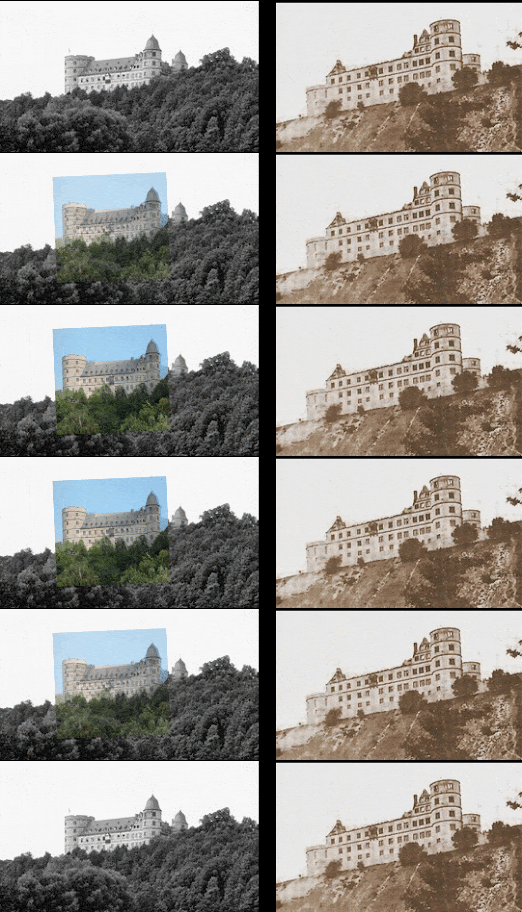
.gif) The north tower then and now on the left. Richard J. Evans argues that the castle's function as a training centre was integral to Himmler's vision of the ϟϟ. According to Evans, Himmler saw the ϟϟ not
merely as a military organisation, but as a racial and ideological
vanguard. The training provided at the castle was intended to equip ϟϟ members
with the intellectual tools necessary to fulfil this role. The castle's
function as a training centre, therefore, was not merely a practical
consideration, but a crucial component of Himmler's vision of the ϟϟ's role in the Third Reich. The castle's symbolic representation of the ϟϟ's future aspirations further underscores its significance to Himmler and the ϟϟ. Himmler envisaged the castle as the future 'centre of the world', a spiritual and ideological hub from which the ϟϟ would
govern a post-war Aryan utopia. The castle's architecture and decor,
heavily influenced by Germanic mythology and the occult, were intended
to reflect this future vision. The castle's North Tower, for instance,
was designed to align with the North Star, a symbol of the ϟϟ's destined path to racial supremacy. Snyder argues that the castle's symbolic representation of the ϟϟ's future aspirations was a key element of Himmler's strategy to foster a sense of shared destiny among the ϟϟ. According to Snyder, the castle served as a tangible manifestation of the ϟϟ's future vision, a constant reminder of the ϟϟ's
destined role as the racial and ideological vanguard of the Third
Reich. The castle, therefore, was not merely a physical structure, but a
symbolic representation of the ϟϟ's future aspirations.
The north tower then and now on the left. Richard J. Evans argues that the castle's function as a training centre was integral to Himmler's vision of the ϟϟ. According to Evans, Himmler saw the ϟϟ not
merely as a military organisation, but as a racial and ideological
vanguard. The training provided at the castle was intended to equip ϟϟ members
with the intellectual tools necessary to fulfil this role. The castle's
function as a training centre, therefore, was not merely a practical
consideration, but a crucial component of Himmler's vision of the ϟϟ's role in the Third Reich. The castle's symbolic representation of the ϟϟ's future aspirations further underscores its significance to Himmler and the ϟϟ. Himmler envisaged the castle as the future 'centre of the world', a spiritual and ideological hub from which the ϟϟ would
govern a post-war Aryan utopia. The castle's architecture and decor,
heavily influenced by Germanic mythology and the occult, were intended
to reflect this future vision. The castle's North Tower, for instance,
was designed to align with the North Star, a symbol of the ϟϟ's destined path to racial supremacy. Snyder argues that the castle's symbolic representation of the ϟϟ's future aspirations was a key element of Himmler's strategy to foster a sense of shared destiny among the ϟϟ. According to Snyder, the castle served as a tangible manifestation of the ϟϟ's future vision, a constant reminder of the ϟϟ's
destined role as the racial and ideological vanguard of the Third
Reich. The castle, therefore, was not merely a physical structure, but a
symbolic representation of the ϟϟ's future aspirations.



The guardhouse has had its ϟϟ runes chipped out, but in a way that makes them easily recognisable 

Hitler Youth leaving the castle in 1935
The
Obergruppenführersaal and mausoleum beneath the Obergruppenführer hall
then and now. In addition to the exhibition rooms in the historic rooms
of the former guard building, these two rooms from the ϟϟ era
have been preserved in the north tower of the Wewelsburg, which can be
visited during the opening hours of the memorial. The dark green
ornament on the marble floor of the Obergruppenfuhrersaal has in recent
years developed under the name Schwarze Sonne into a symbol of
identification among right-wing extremists and a supposed "sign of
power" among esotericists. Since 1991 it has been associated with the
esoteric neo-Nazi concept of the Black Sun, which has been discussed
since the 1950s.
.gif)

Inside
the vault at the very top of the roof, a swastika remains. This
"vault, built after the model of Mycenaean domed tombs was hewn into
the rock which possibly was to serve for some kind of commemoration of
the dead. The floor was lowered 4.80 metres although the room itself
remains unfinished. In
the middle of the vault a bowl with an eternal flame was probably
planned. In the middle of the floor a gas pipe is embedded and around
the
presumed place for the eternal flame at the wall twelve pedestals are
placed. Their meaning is unknown. Above the pedestals wall niches
existed. In the zenith of the vault a swastika is walled in. The
vault has special acoustics and illumination. The castle's crypt, with
its twelve pedestals, each bearing the name of an ϟϟ officer,
further exemplified the mystical aura Himmler sought to create. The
crypt was intended to serve as a sacred space for the commemoration of
fallen ϟϟ officers, reinforcing the notion of the ϟϟ as a knightly
order. Kershaw posits that these rituals were instrumental in fostering a
sense of unity and purpose among the ϟϟ, creating a bond that
transcended the traditional military hierarchy. The castle, thus, served
as a physical manifestation of Himmler's vision of the ϟϟ as a racial
elite, a new aristocracy that would lead the Aryan race to its destined
supremacy. The castle's role in the ϟϟ's racial and ideological
indoctrination was further amplified by its function as a training
centre. Himmler envisaged the castle as an 'ϟϟ school', where members of
the ϟϟ could be educated in the racial and ideological doctrines of
the ϟϟ. The castle housed a library with a vast collection of books on
Germanic mythology, racial theory, and the occult, reflecting Himmler's
belief in the importance of intellectual training in shaping the ϟϟ's
racial elite. The castle also hosted conferences and seminars on racial
theory, providing a platform for the dissemination of the ϟϟ's racial
and ideological doctrines.

Before
and after the war. In addition to serving as a repository for stolen
artefacts, Wewelsburg Castle was also the site of a concentration camp.
The camp, which was established in 1939, was used primarily as a source
of forced labour for the castle's renovation and expansion. The
prisoners, most of whom were Soviet PoWs, were subjected to brutal
conditions, with many dying from malnutrition, disease, and overwork.
Evans argues that the existence of the camp underscores the brutal
reality of the ϟϟ's racial and ideological doctrines, which were often
masked by the castle's mystical and ideological facade. The castle's
role as a site of brutality and oppression was further highlighted by
its use as a detention centre for high-ranking ϟϟ officers accused of
disloyalty or incompetence. Snyder suggests that the castle's function
as a detention centre was part of Himmler's strategy to maintain
discipline and loyalty within the ϟϟ. The threat of detention at the
castle served as a constant reminder of the consequences of disloyalty,
reinforcing Himmler's authority over the ϟϟ.
Düsseldorf: Nazi Gleichschaltung, Reichsausstellung Schaffendes Volk, Kristallnacht Destruction, Forced Labour, and Postwar Reconstruction
 Düsseldorf's market square during an induction ceremony for 10-14 year old boys into
the “Deutsche Jungvolk“ of the Hitler-Jugend in either April 1937 or
1939. After the Nazi takeover of power, the first
book burning involving "unwanted literature" by the Deutsche
Studentenschaft, including books by Heinrich Heines, took place in
Düsseldorf on April 11, 1933. The NSDAP Gauleiter Friedrich Karl Florian
supported the mass-bearing remembrance of Albert Leo Schlageter at the
Schlagter National Monument, which had already been built in 1931, as
well as the personnel restructuring of city administration and
authorities. Hans Langels (Centre Party), who had previously been hired,
was dismissed and replaced by the ϟϟ Group leader Fritz Weitzel
(mentioned below). Many regime adversaries were arrested, abused, or
killed. Dusseldorf,
Düsseldorf's market square during an induction ceremony for 10-14 year old boys into
the “Deutsche Jungvolk“ of the Hitler-Jugend in either April 1937 or
1939. After the Nazi takeover of power, the first
book burning involving "unwanted literature" by the Deutsche
Studentenschaft, including books by Heinrich Heines, took place in
Düsseldorf on April 11, 1933. The NSDAP Gauleiter Friedrich Karl Florian
supported the mass-bearing remembrance of Albert Leo Schlageter at the
Schlagter National Monument, which had already been built in 1931, as
well as the personnel restructuring of city administration and
authorities. Hans Langels (Centre Party), who had previously been hired,
was dismissed and replaced by the ϟϟ Group leader Fritz Weitzel
(mentioned below). Many regime adversaries were arrested, abused, or
killed. Dusseldorf,  |
| The main railway station flying Nazi flags and today, unchanged. |


.gif)


Four of the sculptures were put up again on the water basin in 1941, and flower baskets were placed on the empty plinths. "The Fisherman" was handed over to the city in 2006 from private ownership, and "The Shepherdess" was set up in front of a children's playground in Benrath. Both came back to their old place in the Nordpark in 2006, the remaining six sculptures are considered missing. On the other hand, the sculpture "Die Sitzende" by Johannes Knubel, which is not part of the "Ständische", remained, which is still in the Nordpark.

Spencer Tunick took advantage of Aurora for his latest nude group portrait photograph in Düsseldorf when he invited over eight hundred volunteers to strip down near the nude. Tunick had openly shied away from any connections with the Nazi regime Breker served, declaring that for him at least, “bodies are about freedom and beauty.”
In the summer of 2015 the Aurora was restored on the roof from which the "goddess of the dawn" had sat continuously for ninety years. Breker, who never expressed any regret for his work on behalf of the Nazis, was classified a "fellow traveller" by an Allied de-Nazification tribunal and moved to Dusseldorf where he eventually died and is buried in the city's Nordfriedhof.


Düsseldorf's Adolf Hitler Platz with its Kugelspielerin has now reverted back to Graf-Adolf-Platz


Die Kugelspielerin, seen in the postcard above, shown here in the 1930s and today.


Hitler’s
two-and-a-half hour speech
to the Industry Club took place here at the Parkhotel on January
27, 1932, probably
the most important speech Hitler gave before becoming chancellor a year
later, helping overcome the skepticism of many in the business community
about the putative socialism of the Nazi Party. The speech,
later published
as a pamphlet, was carefully constructed to appeal to the economic and
political interests of his affluent and influential audience. Hitler
emphasised the importance of
personality, the distinction of the German nation, and the beneficence
of struggle. His
critique of democracy and praise of racial and political hierarchy
struck a responsive
chord. Study of this speech my help to understand why so many of
Germany’s conservative economic elite were prepared to accept Hitler’s
leadership
despite his record and reputation as Jew-baiting rabble-rouser.
Hitler’s
major argument was that only the Nazis could prevent the eventual
triumph of Bolshevism in Germany. Only the Nazis could provide the Weltanschauung to
overcome the debilitating class conflict Marxism had supposedly
created, the Weimar multi-party “system” had fostered, and the
depression had exacerbated. Only they could restore unity to the nation,
and the nation to
its former greatness. Only they could hold democracy and its discontents
in check.
Hitler projected an optimistic attitude of self-reliance that closely
corresponded to the entrepreneurial mindset of successful businessmen.
They would readily have agreed with
him that it was inconsistent and counterproductive to adhere to the
“leadership principle,” individual achievement and competition, and
private property in the economy,
but to favour democracy, the egalitarian principle, pacifism, and
internationalism in politics. What democracy is to politics, Hitler
warned, communism is to the economy.
The
talk has an inspirational quality that enabled Hitler to evoke
enthusiasm even
among serious and level-headed people. Hitler took the line that
Germany, with its
inherent racial value, could solve the problems of the depression
without depending
on outside help. He portrayed the Nazi Party as motivated by idealism
and faith, qualities that alone could save the nation from
distributional conflicts and left-wing subversion. He also made frequent
use of historical references, invoking the Thirty Years’ War
as an example of the perils of national disunity, and the outbreak of
the First World War
in August 1914 as an example of the unified national purpose that
Germany would have
to recapture if it wished to regain the power and prosperity it once
had. His refusal,
however, to blame Germany’s troubles solely on the Versailles Treaty or
the world
economic crisis was directed against the government of Chancellor
Brüning, who
contended that German revival could be brought about simply by ending or
reducing
German reparations payments.
 Parkhotel was located on what was then named Albert Leo Schlageter Platz after the adopted Nazi martyr, now Corneliusplatz. The fountain remains in situ. Hitler’s speech was also noteworthy for what it did not contain. In deference to his
hosts, a business group that included some Jews and persons of mixed ancestry, Hitler
avoided any explicit denunciation of Jews. He knew that the anti-capitalist implications
of rabble-rousing anti-Semitism would not endear him to “respectable” conservatives.
He did not exercise similar restraint, however, in asserting the superiority of the “white
race” and its right to colonial dominance. He apparently assumed that this was an
uncontroversial point of view that most of his audience shared. Anti-Semitism was
implied, on the other hand, in his reference to the “ferment of decomposition,” a
phrase first applied to the Jewish influence in the ancient Roman Empire by the great
classical historian Theodor Mommsen.
Parkhotel was located on what was then named Albert Leo Schlageter Platz after the adopted Nazi martyr, now Corneliusplatz. The fountain remains in situ. Hitler’s speech was also noteworthy for what it did not contain. In deference to his
hosts, a business group that included some Jews and persons of mixed ancestry, Hitler
avoided any explicit denunciation of Jews. He knew that the anti-capitalist implications
of rabble-rousing anti-Semitism would not endear him to “respectable” conservatives.
He did not exercise similar restraint, however, in asserting the superiority of the “white
race” and its right to colonial dominance. He apparently assumed that this was an
uncontroversial point of view that most of his audience shared. Anti-Semitism was
implied, on the other hand, in his reference to the “ferment of decomposition,” a
phrase first applied to the Jewish influence in the ancient Roman Empire by the great
classical historian Theodor Mommsen.


Another place name that has reverted Albert-Leo-Schlageter-Allee to Königsallee. Still noted for both the landscaped canal that
runs along its centre as well as for the fashion showrooms and luxury
retail stores located along its sides, it remains by far Germany's
busiest, upscale shopping street.
.gif)
The
town centre immediately after the war and today with the Wilhelm Marx
House shown to the right. Started in 1922, it was one of the first
skyscrapers in Düsseldorf and one of the earliest in Germany when it was
completed in 1924 with a height of 57 metres and storeys, together with
the Industriehaus Düsseldorf. Until the completion of the Hansahigh
House in Cologne in 1925, which still towers four storeys above the
Düsseldorf office building, this was described as "the tallest
reinforced concrete structure in Europe" at the time. During the air
raids of the Second World War, the top floors of the building were badly
damaged in June 1943, but were able to be used again after the end of
the war. Nothing of the original furnishings has been preserved except
for the entrance hall with the tiger sculpture by Carl Moritz Schreiner
and the main staircase.

The war memorial at the Reeserplatz by the architects Klophaus and Tachill, commissioned in 1932 by the Monuments Committee of the Fusilierregiment and inaugurated in July 1939. It shows armed soldiers emerging from
the crypt with unbroken struggle. The monument is typical language of
the time in which war is glorified and its participants followers are
heroised in death.
The inscription on the monument still reads "For the German People's
Honour and Freedom" as well as the names of the conquered cities, later
engraved on the side of the monument, as a positive expression of the aggressive war policy of Nazi Germany. After the war, the monument was set to be demolished but was
preserved on the grounds that it was dedicated to the fallen soldiers
and would be "artistically and architecturally" significant.

Schloss
Jägerhof in 1935 with the swastika above and today. In 1795 during the
Napoleonic Wars the Jägerhof was almost blown up by the French
revolutionary troops. During this time however, the Jägerhof served as a
military hospital for the French and remained so until the visit of
Napoleon in 1811. It was hastily renovated and equipped so that the
Emperor and his wife Marie Louise could feel at home during their
four-day visit.
During
the French occupation in 1925, the building was confiscated and used as
the seat of its headquarters. Due to the considerable pressure of the
Nazi Gauleiter Friedrich Karl Florian, its lease had been illegally
dissolved so that on January 30, 1937 the building could serve the
Gauleitung which had been sitting here during the heavy air raid of June
12, 1943 in which the castle was severely damaged. It was eventually
rebuilt in 1950 by Helmut Hentrich as can be seen in the then-and-now
comparison.

In June 1933, the ϟϟ-group leader Fritz Weitzel was appointed to President-Polizeiprä. Weitzel had became a member of the Nazi Party in 1925, joining the ϟϟ the following year at the age of 22, and was only 29 years old when he was police chief although he was considered in Nazi circles as incompetent. In 1930 he was promoted leader of the ϟϟ in the Rheinland and Ruhr. He became Polizeipräsident in Düsseldorf in 1933, and Höherer ϟϟ- und Polizeiführer West in 1938. During 1939 Weitzel wrote the book Celebrations of the ϟϟ Family which described the holidays to be celebrated and how married ϟϟ men and their families should celebrate them. This book, written by Weitzel, described how the Julleuchter, a Yuletide gift by Himmler to the ϟϟ, should be used. After the Germans invaded Norway on April 9, 1940 Weitzel was sent to Norway on April 21 to become Höherer ϟϟ- und Polizeiführer in the country's capital, Oslo. However, he was killed two months later by shrapnel in an aerial attack on his home town, Düsseldorf, during a visit on 19 June 1940. He is buried in the cemetery at Düsseldorf.

St. Benediktus behind the ruins of the Hitlereiche guesthouse
and now. During the war the first bombs fell to Düsseldorf in 1940.
Allied air raids demanded more than 5,000 civilian casualties by 1945.
About half of the buildings were destroyed, about 90 percent were
damaged. All Rhine bridges, most of the roads, floodplains, underpasses
and overpasses, as well as the urban drainage network, were largely
destroyed. The amount of debris was estimated to be about ten million
cubic meters. From February 28, 1945, Düsseldorf was encircled for a
period of seven weeks to the front town, with American permanent
bombardment from the left bank of the Rhine, and in March more and
more. The city was a target of strategic bombing, particularly during
the RAF bombing campaign in 1943 when over 700 bombers were used in a
single night. Raids continued late into the war. As part of the campaign
against German oil facilities, the RAF raid of 20–21 February on the
Rhenania Ossag refinery in the Reisholz district of the city halted oil
production there. In April, several Düsseldorf residents of the
resistance to lawyer Karl August Wiedenhofen tried to convince police
police commander Franz Jiirgens to appoint police officer August Korren
to hand over the city without a fight to the Allies. The coup attempt
succeeded, but was then betrayed. After the liberation of Korreng by the
loyal forces of Gauleiter Friedrich Karl Florian, who shot five of the
resistance members (including Jürgens), the two last members of the
lawmaker Wiedenhofen and architect Aloys Odenthal managed to escape the
American forces arriving in the east of the city and the final
destruction of the city by an already prepared large air attack. The
Allied ground advance into Germany reached Düsseldorf in mid-April 1945.
The United States 97th Infantry Division easily captured the city on
April 18, 1945.

The
grave in Nordfriedhof cemetery of Ernst Eduard vom Rath, a German
diplomat remembered for his assassination in Paris in 1938 by a Jewish
young man, Herschel Grynszpan, which touched off Reichskristallnacht-
the so-called Night of Broken Glass.
Vom Rath was given a state funeral on November 17 in Düsseldorf, with Hitler and Foreign Minister Joachim von Ribbentrop among those in attendance. Germany used the incident to publicise the idea that the Jews had "fired the first shot" in a war on Germany; in his funeral oration, Ribbentrop declared, "[w]e understand the challenge, and we accept it." Much to the fury of Grynszpan who wanted to use the defence that he had killed Rath because he was a Jew, Grynszpan's French lawyer Vincent de Moro-Giafferi wanted to use as the defence the allegation that Rath was a homosexual who had seduced Grynszpan, and that Grynszpan had killed Rath as a part of a lover's quarrel. The allegations that Rath was gay started with Moro-Giafferi.
 These
homosexuality accusations threatened to humiliate the Nazis with
Goebbels writing that "Grynszpan has invented the insolent argument that
he had a homosexual relationship with... vom Rath. That is, of course, a
shameless lie; however, it is thought out very cleverly and would, if
brought out in the course of a public trial, certainly become the main
argument of enemy propaganda." In fact, in
the indictment of the Chief Reich Prosecutor of October 16, 1941, the
following note can be found under the heading “Statement of the
accused”:
These
homosexuality accusations threatened to humiliate the Nazis with
Goebbels writing that "Grynszpan has invented the insolent argument that
he had a homosexual relationship with... vom Rath. That is, of course, a
shameless lie; however, it is thought out very cleverly and would, if
brought out in the course of a public trial, certainly become the main
argument of enemy propaganda." In fact, in
the indictment of the Chief Reich Prosecutor of October 16, 1941, the
following note can be found under the heading “Statement of the
accused”:
Vom Rath was given a state funeral on November 17 in Düsseldorf, with Hitler and Foreign Minister Joachim von Ribbentrop among those in attendance. Germany used the incident to publicise the idea that the Jews had "fired the first shot" in a war on Germany; in his funeral oration, Ribbentrop declared, "[w]e understand the challenge, and we accept it." Much to the fury of Grynszpan who wanted to use the defence that he had killed Rath because he was a Jew, Grynszpan's French lawyer Vincent de Moro-Giafferi wanted to use as the defence the allegation that Rath was a homosexual who had seduced Grynszpan, and that Grynszpan had killed Rath as a part of a lover's quarrel. The allegations that Rath was gay started with Moro-Giafferi.
These
homosexuality accusations threatened to humiliate the Nazis with
Goebbels writing that "Grynszpan has invented the insolent argument that
he had a homosexual relationship with... vom Rath. That is, of course, a
shameless lie; however, it is thought out very cleverly and would, if
brought out in the course of a public trial, certainly become the main
argument of enemy propaganda." In fact, in
the indictment of the Chief Reich Prosecutor of October 16, 1941, the
following note can be found under the heading “Statement of the
accused”:In the course of further investigations, he even went so far as to make the bold, lying claim that he had already known the ambassador, vom Rath, some time before and that he had been homosexually abused by him several times.
In
addition, Grynszpan claimed at times that he had worked as a pimp for
vom Rath, that he had been cheated out of his commission and that he had
homosexual relations with the diplomat – he later retracted this claim,
but only in the form of an encrypted note. As early as 1941, the
Ministry of Justice and the Reich Security Main Office knew from various
sources that vom Rath was apparently actually active in the homosexual
scene in Paris and had also met Grynszpan there, which is why internal
reservations about opening the trial were increasingly expressed. According
to Hans-Jürgen Döscher, Germany's foremost authority on Kristallnacht,
vom Rath was indeed an homosexual and had met Grynszpan in Le Boeuf sur le Toit,
a popular haunt for gay men in 1938. The gay French writer André Gide
testified in his personal diaries that vom Rath was well known in the
Parisian homosexual community. There were rumours that occasionally he
was called "Madame Ambassador" and "Notre Dame de Paris." His brother,
Gustav, was convicted of "fornication with men"
on June 6, 1941 under § 175 of the German Criminal Code and there were allegations that vom Rath was treated
for rectal gonorrhoea at the Berlin Institute of Radiology.  On
the right is the gravestone of Ernst and his brother First Lieutenant
Gustav vom Rath in the Nordfriedhof. All this torpedoed Goebbels's plans
for a show trial in order to expose Grynszpan as an accomplice of the
"international Jewish world conspiracy". A parallel to that
assassination attempt in Sarajevo in 1914 was to be constructed.
However, the overzealous public prosecutor made what Goebbels considered
to be a fatal mistake of adding the accusation of homosexuality to the
indictment which, according to Goebbels, was based only on an anonymous
letter "from some Jewish emigrant who left open the possibility of
homosexual intercourse between Grünspan and vom Rath"; he dismissed the
allegation as an "absurd, typically Jewish allegation". Nevertheless,
the "depoliticisation of the crime" and the reference to the homosexual
milieu led to the trial being postponed and ultimately never taking
place. According to the official records of the envoy Ewald
Krümmer,Goebbels abandoned the trial plan on April 16, 1942 for these
reasons, and Foreign Minister Ribbentrop followed suit on May 13, 1942
due to Hitler's reticence on the issue and because of the war. There was
therefore never a judicial investigation into the murder of von Rath.
On
the right is the gravestone of Ernst and his brother First Lieutenant
Gustav vom Rath in the Nordfriedhof. All this torpedoed Goebbels's plans
for a show trial in order to expose Grynszpan as an accomplice of the
"international Jewish world conspiracy". A parallel to that
assassination attempt in Sarajevo in 1914 was to be constructed.
However, the overzealous public prosecutor made what Goebbels considered
to be a fatal mistake of adding the accusation of homosexuality to the
indictment which, according to Goebbels, was based only on an anonymous
letter "from some Jewish emigrant who left open the possibility of
homosexual intercourse between Grünspan and vom Rath"; he dismissed the
allegation as an "absurd, typically Jewish allegation". Nevertheless,
the "depoliticisation of the crime" and the reference to the homosexual
milieu led to the trial being postponed and ultimately never taking
place. According to the official records of the envoy Ewald
Krümmer,Goebbels abandoned the trial plan on April 16, 1942 for these
reasons, and Foreign Minister Ribbentrop followed suit on May 13, 1942
due to Hitler's reticence on the issue and because of the war. There was
therefore never a judicial investigation into the murder of von Rath.

The former Gauschulungsburg, now Haus Welchenberg. It was built in 1925-26 on the occasion of the thousandth anniversary of the Rhineland, with the membership of the region was celebrated to the German Empire and Prussia. Already in 1927-28 it was extended by cultivation at a hostel. The global economic crisis and the resulting political changes complicated the financing of the house; 1932 lived only 20 orphans. After the seizure of power by the Nazis it became a Gauführerschule. During the war forced labourers were housed here. When the Americans occupied Neuenhausen on March 3, 1945 they took over Welchenberg as the last bastion of the Nazis after considerable damage and was subsequently sacked by the population. Once there Polish civilian workers and homeless families were provisionally housed. By 1949 it was converted into a tuberculosis hospital until the mid-1980s with the establishment of the new Grevenbroicher district hospital.
 The Königlichen Hof then and, below, now. After
the Reichstag fire on February 27, 1933, members of the communist party
were arrested and on March 28, 1933, 137 people were imprisoned in the
Moers district. Among the 43 known fatalities as a result of resistance
and persecution from Moers includes Johann Esser who wrote the Liedes
der Moorsoldaten whilst in the Börgermoor concentration camp and which
became a symbol of resistance to fascism.
The Königlichen Hof then and, below, now. After
the Reichstag fire on February 27, 1933, members of the communist party
were arrested and on March 28, 1933, 137 people were imprisoned in the
Moers district. Among the 43 known fatalities as a result of resistance
and persecution from Moers includes Johann Esser who wrote the Liedes
der Moorsoldaten whilst in the Börgermoor concentration camp and which
became a symbol of resistance to fascism.
 In 1940 there were around a thousand prisoners of war and the forced labourers from Russia, Poland and Ukraine ;
in early 1942, 3,000 prisoners of war were counted in 23 foreigners'
camps in the Moers district. In addition to mining recruitment, many
were employed on farms, in industries and construction companies. Many
died of malnutrition and debilitation; foreigners were not allowed into
the bunkers during bombing raids. A
target of the Oil Campaign during the war, the Steinkohlenbergwerke
(coal mine) Rheinpreussen synthetic oil plant in Moers was partially
dismantled post-war. There are 141 graves in the
Lohmansheide cemetery near the Rheinpreussen 5/9 shaft alone. The number
of deaths in Moers is estimated at over 200 whilst 558 Russian forced
labourers are documented as having been killed. No corresponding figures
are available for the other nationalities, including French, Belgian
and Dutch. Of the five thousand Wehrmacht soldiers from Moers, 975 were
killed or missing. There were also 150 civil war casualties. In
Meerbeck, where the bombing was particularly strong because of the fuel
plants, almost all of the 3,000 settlement houses were damaged and a
thousand almost completely destroyed. On May 27, 2013, eleven stumbling
blocks to commemorate Moers citizens who had been killed by the Nazis
were laid in the town centre by the Cologne artist Gunter Demnig.
In 1940 there were around a thousand prisoners of war and the forced labourers from Russia, Poland and Ukraine ;
in early 1942, 3,000 prisoners of war were counted in 23 foreigners'
camps in the Moers district. In addition to mining recruitment, many
were employed on farms, in industries and construction companies. Many
died of malnutrition and debilitation; foreigners were not allowed into
the bunkers during bombing raids. A
target of the Oil Campaign during the war, the Steinkohlenbergwerke
(coal mine) Rheinpreussen synthetic oil plant in Moers was partially
dismantled post-war. There are 141 graves in the
Lohmansheide cemetery near the Rheinpreussen 5/9 shaft alone. The number
of deaths in Moers is estimated at over 200 whilst 558 Russian forced
labourers are documented as having been killed. No corresponding figures
are available for the other nationalities, including French, Belgian
and Dutch. Of the five thousand Wehrmacht soldiers from Moers, 975 were
killed or missing. There were also 150 civil war casualties. In
Meerbeck, where the bombing was particularly strong because of the fuel
plants, almost all of the 3,000 settlement houses were damaged and a
thousand almost completely destroyed. On May 27, 2013, eleven stumbling
blocks to commemorate Moers citizens who had been killed by the Nazis
were laid in the town centre by the Cologne artist Gunter Demnig.
 On
the right is the gravestone of Ernst and his brother First Lieutenant
Gustav vom Rath in the Nordfriedhof. All this torpedoed Goebbels's plans
for a show trial in order to expose Grynszpan as an accomplice of the
"international Jewish world conspiracy". A parallel to that
assassination attempt in Sarajevo in 1914 was to be constructed.
However, the overzealous public prosecutor made what Goebbels considered
to be a fatal mistake of adding the accusation of homosexuality to the
indictment which, according to Goebbels, was based only on an anonymous
letter "from some Jewish emigrant who left open the possibility of
homosexual intercourse between Grünspan and vom Rath"; he dismissed the
allegation as an "absurd, typically Jewish allegation". Nevertheless,
the "depoliticisation of the crime" and the reference to the homosexual
milieu led to the trial being postponed and ultimately never taking
place. According to the official records of the envoy Ewald
Krümmer,Goebbels abandoned the trial plan on April 16, 1942 for these
reasons, and Foreign Minister Ribbentrop followed suit on May 13, 1942
due to Hitler's reticence on the issue and because of the war. There was
therefore never a judicial investigation into the murder of von Rath.
On
the right is the gravestone of Ernst and his brother First Lieutenant
Gustav vom Rath in the Nordfriedhof. All this torpedoed Goebbels's plans
for a show trial in order to expose Grynszpan as an accomplice of the
"international Jewish world conspiracy". A parallel to that
assassination attempt in Sarajevo in 1914 was to be constructed.
However, the overzealous public prosecutor made what Goebbels considered
to be a fatal mistake of adding the accusation of homosexuality to the
indictment which, according to Goebbels, was based only on an anonymous
letter "from some Jewish emigrant who left open the possibility of
homosexual intercourse between Grünspan and vom Rath"; he dismissed the
allegation as an "absurd, typically Jewish allegation". Nevertheless,
the "depoliticisation of the crime" and the reference to the homosexual
milieu led to the trial being postponed and ultimately never taking
place. According to the official records of the envoy Ewald
Krümmer,Goebbels abandoned the trial plan on April 16, 1942 for these
reasons, and Foreign Minister Ribbentrop followed suit on May 13, 1942
due to Hitler's reticence on the issue and because of the war. There was
therefore never a judicial investigation into the murder of von Rath.Grevenbroich: The Gauschulungsburg Nazi Training Centre

The former Gauschulungsburg, now Haus Welchenberg. It was built in 1925-26 on the occasion of the thousandth anniversary of the Rhineland, with the membership of the region was celebrated to the German Empire and Prussia. Already in 1927-28 it was extended by cultivation at a hostel. The global economic crisis and the resulting political changes complicated the financing of the house; 1932 lived only 20 orphans. After the seizure of power by the Nazis it became a Gauführerschule. During the war forced labourers were housed here. When the Americans occupied Neuenhausen on March 3, 1945 they took over Welchenberg as the last bastion of the Nazis after considerable damage and was subsequently sacked by the population. Once there Polish civilian workers and homeless families were provisionally housed. By 1949 it was converted into a tuberculosis hospital until the mid-1980s with the establishment of the new Grevenbroicher district hospital.
Moers am Niederrhein: The Königlichen Hof, the Börgermoor Concentration Camp Song, and the Rheinpreussen Synthetic Oil Plant
 The Königlichen Hof then and, below, now. After
the Reichstag fire on February 27, 1933, members of the communist party
were arrested and on March 28, 1933, 137 people were imprisoned in the
Moers district. Among the 43 known fatalities as a result of resistance
and persecution from Moers includes Johann Esser who wrote the Liedes
der Moorsoldaten whilst in the Börgermoor concentration camp and which
became a symbol of resistance to fascism.
The Königlichen Hof then and, below, now. After
the Reichstag fire on February 27, 1933, members of the communist party
were arrested and on March 28, 1933, 137 people were imprisoned in the
Moers district. Among the 43 known fatalities as a result of resistance
and persecution from Moers includes Johann Esser who wrote the Liedes
der Moorsoldaten whilst in the Börgermoor concentration camp and which
became a symbol of resistance to fascism.
In
1928, about 230 Jews lived in Moers, making up about a percent of the
population. The long-standing council member Issak Kaufmann was
congratulated by Reich President Hindenburg on his 85th birthday in 1931
and was publicly praised in the press. But with the seizure of power
Jewish businesses were boycotted from March 28, 1933, enforced by the SA
and ϟϟ
in Moers. As a result, many Jews left Moers. The Jewish school was
finally closed in 1939. The synagogue was destroyed during the
Reichspogromnacht but, because of the proximity of neighbouring
buildings, it was not set on fire. When Jewish emigration was formally
prohibited on October 1, 1941, sixty Jews still lived in Moers, crowded
into five so-called Jewish houses. The first transport of forty people
to Riga and Theresienstadt took place on December 13, 1941. After two
more transports in April and July 1942, the Nazis found that Moers was
"Judenfrei," overlooking a family in Matthek who were protected by a
courageous city worker from Moers.
In 1940 there were around a thousand prisoners of war and the forced labourers from Russia, Poland and Ukraine ;
in early 1942, 3,000 prisoners of war were counted in 23 foreigners'
camps in the Moers district. In addition to mining recruitment, many
were employed on farms, in industries and construction companies. Many
died of malnutrition and debilitation; foreigners were not allowed into
the bunkers during bombing raids. A
target of the Oil Campaign during the war, the Steinkohlenbergwerke
(coal mine) Rheinpreussen synthetic oil plant in Moers was partially
dismantled post-war. There are 141 graves in the
Lohmansheide cemetery near the Rheinpreussen 5/9 shaft alone. The number
of deaths in Moers is estimated at over 200 whilst 558 Russian forced
labourers are documented as having been killed. No corresponding figures
are available for the other nationalities, including French, Belgian
and Dutch. Of the five thousand Wehrmacht soldiers from Moers, 975 were
killed or missing. There were also 150 civil war casualties. In
Meerbeck, where the bombing was particularly strong because of the fuel
plants, almost all of the 3,000 settlement houses were damaged and a
thousand almost completely destroyed. On May 27, 2013, eleven stumbling
blocks to commemorate Moers citizens who had been killed by the Nazis
were laid in the town centre by the Cologne artist Gunter Demnig.Mülheim an der Ruhr: The Nazi Party Rise in the Ruhr, the Synagogue Destruction, and the Wartime Bombing devastation


Military parade at Viktoriaplatz before General Klutman to mark Hitler's birthday in 1939.
In the last free parliamentary elections on November 6, 1932, the Nazi
Party received 28.3% of the vote in Mülheim and thus was the strongest
party. In comparison, National Socialism in Germany, overall, received
33.1% of the vote. As in other cities of the Ruhr, the Nazi Party was indeed
the strongest party, but the Communist Party had 24.27% and the SPD had
13.53%, which means that these two parties of the left, together, had
37.81%, a larger share of the vote. Nevertheless, Mülheim was
enthusiastic over the appointment of Hitler as Chancellor, and
celebrated this with a torchlight procession.
Beginning in mid-February 1933, the first houses were searched,
especially in the Dümpten neighbourhood, for suspected Communists. At the
end of February, 200 ϟϟ, SA, and Stahlhelm members officially became
auxiliary policemen of the city, and they arrested many political
opponents. In the first local elections after seizing power, the Nazi
Party took 45.1% of votes. In the first council decision, Hitler and
Hindenburg were awarded honorary citizenship of the city.
 |
| Wehrmacht marching down Schloßstraße, now pedestrianised |
In June 1941, an Arbeitserziehungslager (Nazi labour camp) was
established at the Essen-Mülheim airport. It was administered by the
Cologne Gestapo. The guards were 26 policemen from the Essen police
department, and the work of setting up the camp was carried out by the
airport company. By March 1945, an estimated 6,000 to 8,000 people were
in the camp, and 130 of the prisoners died.
 |
| First day at school, 1939; note hakenkreuz in the background |
 |
| Wallstraße before the war and today |
The end of the war came to the city on 11 April 1945. To defend
against the advancing troops, there were 200 soldiers of the 183rd
People's Grenadier Regiment in the Mülheim area who were theoretically
supported by approximately 3,000 members of the Volkssturm. In the
morning, the first soldiers of the 17th American Airborne Division advanced
from Essen to the neighbourhood of Hot in the city centre. In the urban
area, only along Kämpchenstraße was there any fighting. A short fight
there between some Volkssturm and the Americans resulted in the deaths
of two Volkssturm and three GIs. Mayor Hasenjäger handed the city over
to the Americans at 9:40. A few months later, America was superseded
by Britain as the occupying power.

The Nazi eagle that adorns the Kolpinghaus on Steinkopfstraße which, from 1936, served as the Nazi Party headquarters.

The synagogue before (during an SA demonstration in 1934), during and after Reichskristallnacht November 8-9, 1939. When Hitler was appointed chancellor in 1933, Mühlheim counted
71 Jewish inhabitants, roughly 1.0% of its 6,757 citizens. Increasingly
Jews emigrated because of the state-sponsored terrorism against them.
During the Kristallnacht,
the interior of the synagogue was completely destroyed and Jewish men
were imprisoned in the guardhouse at the Catholic Church and beaten by
SA. Some were taken to the Buchenwald concentration camp the next day.
In 1939, there were still 36 Jewish people remaining- 0.3% of the local
population. As of December 31, 1939 this was reduced to 28, and on
February 5, 1942 sixteen were recorded as continuing to live in the
town. However, on September 19, 1942, the last Jewish inhabitants were
forced to meet at the Old Town Hall, from where they were deported to
the extermination camps. The last four Jewish inhabitants lived in
so-called "mixed marriages"; three of them were arrested and deported in
the spring of 1943.
As
of today, anti-Semitism has made a reappearance, especially with the
huge
influx of Muslims by the Merkel government with the Mülheim town
council choosing to cancel its official 2017 Hanukkah festivities,
citing ‘security concerns.’ All outdoor Hanukkah events due to take
place in Mülheim and the adjoining region had also been cancelled, with
Berlin branch of the American Jewish Committee blaming the “widespread
antisemitism among Arab refugees in Germany.”

Bombentreffer at a Flak station on Wiener Platz in May 1944 and the site today

The city under intense bombing October 29, 1944. In
his postwar memoir, Hajo Herrmann, flying with the so-called 'Wild
Boars' to intercept the enemy bombers, described the situation:
We were not flying above General Hintz's flak but over Cologne-Mulheim, in the area of the 7th Flakdivision, which was illuminating bombers and fighters indiscriminately. They fired on us without paying any heed to our flashing belly and navigation lights. Searchlight beams were concentrated around us, and ahead of us we heard the thunder of our artillery. In the intoxication of that summer night's battle we forgot the countless flak splinters and other dangers that faced us, and we tore into the witch's cauldron hot with anger and spurred with enthusiasm. This was Wilde Sau pure and simple.However, even without the assistance of the flak, Herrmann still owed a large part of his unit's success to ground-based air defences. In fact, the wild boar procedure relied completely on either searchlights or flak to provide illumination for the initial intercept, thereby allowing the fighters to press home their attacks. Admittedly, it was the fighters that finished off the bombers, but ground-based air defenses provided the necessary conditions for ensuring this outcome.Westermann (142) Flak German Anti-aircraft Defences 1914-1945

An example of a single building transformed through war- Freiheit 54 in 1930, 1945, 1995 and today

The current 'Kulturbunker' today and in use during the war in 1943
Siegen: The Brown House Torture Chamber, the SA Interrogations, and the American Liberation Battle
 The Siegener Krönchen einst und jetzt.
On the evening of July 25, 1933, ϟϟ
units swarmed out in into the town and picked up their victims where
they were taken to the Nazi Party office, the so-called Brown House,
located within the old Oberförserei in Hindenburgstrasse. There they
were subject to brutal interrogations and torture. One of the first
victims was communist Willi Henrich, suspected by the Gestapo as a
sub-district leader of the illegal KPD. He was arrested during the day
by order of the police commissioner Härter who released Harter from gaol
at around 20.00 only to meet with the SA already waiting in the hall
who then attacked Henrich with rubber truncheons in the basement for ten
minutes. With a bucket of cold water, he was brought back to
consciousness until Wilhelm Odendahl finally pointed his pistol at
Henrich. Henrich by then had been so worn out now that he told him to
"pull the trigger, but stop beating me" before succumbing to exhaustion
and waking up at 14.00 in his police cell the next day. The first person
he saw was the Siegen doctor Dr. Stiebeling, who described him as
having the "constitution of an ox;" a weaker nature would not have
survived the abuse, he later explained. After the war, Kehl, then a
doctor in the Marienkrankenhaus, declared that Henrich had so many
hæmatomas that he looked as if he was “wearing a blue suit”. | ||||||||||
|

During
the war Siegen was repeatedly bombed by the Allies owing to a crucial
railroad that crossed through the town. On April 1, 1945, the American
8th Infantry Division began the Allied ground assault against Siegen and
the dominating military-significant high ground north of the river. The
battle against determined German forces at Siegen continued through 2
April 1945, until organised resistance was finally overwhelmed by the
division on April 3, 1945.
Bochum: The Bochumer Verein Steel Works, the Forced Labour Exploitation, and the Allied Bombing Destruction

Apart from its industrial significance, Bochum played an equally disturbing role in the oppressive measures enacted by the Nazi state. As a medium-sized city with a mixed population, Bochum became a site where various Nazi ideologies and policies, from anti-Semitic legislation to Aryanisation, were vigorously implemented. Bochum’s Jewish community faced extreme persecution, beginning with social ostracisation and progressing to confiscation of property and deportation. Numerous synagogues were destroyed during Kristallnacht, marking a grim escalation of anti-Jewish measures. Friedlander, a historian focusing on the Holocaust, elaborates on how mid-sized cities like Bochum were essential cogs in the bureaucratic machinery of the Final Solution. On November 9, 1938 during Kristallnacht, the Jewish citizens of Bochum were attacked with the synagogue set on fire and rioting against Jewish citizens. The first Jews from Bochum were deported to Nazi concentration camps and many Jewish institutions and homes were destroyed. Some 500 Jewish citizens are known by name to have been killed in the Holocaust, including nineteen who were younger than 16 years old. Joseph Klirsfeld was Bochum's rabbi at this time. He and his wife fled to Palestine. In December 1938, the Jewish elementary school teacher Else Hirsch began organising groups of children and adolescents to be sent to the Netherlands and England, sending ten groups in all.
 Many Jewish children and those from other
persecuted groups were taken in by Dutch families and thereby saved
from abduction or deportation and death. Additionally, the city was
involved in the more extensive persecution machinery of the Third Reich.
Political dissidents, Communists, and other "undesirables" were often
arrested and sent to concentration camps. Local law enforcement
cooperated with Gestapo agents in surveillance and policing activities,
underscoring how deeply the tentacles of Nazi repression had penetrated
into everyday life in Bochum. Friedlander contends that this integration
of local administration into state repression represents one of the
many insidious ways the Nazi regime managed to involve ordinary Germans
in its broader criminal activities. Peukert, in Die KPD im Widerstand (88)
reports that in the city of Bochum leading Communists were brutally
beaten by the SA, pummelled through the streets and left lying at a
street corner. This event led to an "atmosphere of paralysis" among the
workers.
Many Jewish children and those from other
persecuted groups were taken in by Dutch families and thereby saved
from abduction or deportation and death. Additionally, the city was
involved in the more extensive persecution machinery of the Third Reich.
Political dissidents, Communists, and other "undesirables" were often
arrested and sent to concentration camps. Local law enforcement
cooperated with Gestapo agents in surveillance and policing activities,
underscoring how deeply the tentacles of Nazi repression had penetrated
into everyday life in Bochum. Friedlander contends that this integration
of local administration into state repression represents one of the
many insidious ways the Nazi regime managed to involve ordinary Germans
in its broader criminal activities. Peukert, in Die KPD im Widerstand (88)
reports that in the city of Bochum leading Communists were brutally
beaten by the SA, pummelled through the streets and left lying at a
street corner. This event led to an "atmosphere of paralysis" among the
workers.  The
Nazi eagle over the entrance to the former air raid shelter at
Boltestraße 38, dated 1941-1942, remains, denuded of its swastika.
Because the Ruhr region was an area of high residential density and a
centre for the manufacture of weapons, it was a major target in the war.
Given its industrial and ideological importance, it was inevitably
targeted by Allied bombing campaigns. The devastation wrought by these
air raids served multiple purposes: disrupting Germany's war machinery
and demoralising the population. However, paradoxically, the wartime
experiences also led to a different kind of mobilisation in Bochum.
Despite the destruction, many in the city viewed the air raids as an
impetus for increased loyalty to the regime, as suffering was framed as
collective and noble sacrifice for the Fatherland. Tooze argues that
this 'rallying effect' of wartime hardship was not unique to Bochum but
constituted a broader trend across Nazi Germany, revealing the complex
psychological interplay between the regime and its populace. The
bombings also had a more direct impact on Bochum’s role in the war
effort. With factories damaged or destroyed, the city’s productivity
plummeted, affecting the overall German war economy. Here, the city’s
previously celebrated industrial prowess turned into a liability, as it
drew the destructive attention of the Allies. Despite its
vulnerabilities, Bochum was never entirely subdued; even in the latter
stages of the war, makeshift production continued, albeit at reduced
capacity. Overy emphasises the resilience of Nazi Germany's industrial
cities, including Bochum, as they adapted to the constraints imposed by
wartime conditions. This section has reached the 400-word limit. May I
continue with the next section of this paragraph?Women with young
children, school children and the homeless fled or were evacuated to
safer areas, leaving cities largely deserted to the arms industry, coal
mines and steel plants and those unable to leave. Bochum was first
bombed heavily in May and June 1943. On May 13, 1943, the city hall was
hit, destroying the top floor, and leaving the next two floors in
flames. On November 4, 1944, in an attack involving seven hundred
British bombers, the steel plant, Bochumer Verein, was hit. This
included one of the largest steel plants in Germany which had more than
ten thousand high-explosive and 130,000 incendiary bombs stored there,
setting off a conflagration that destroyed the surrounding
neighbourhoods.
The
Nazi eagle over the entrance to the former air raid shelter at
Boltestraße 38, dated 1941-1942, remains, denuded of its swastika.
Because the Ruhr region was an area of high residential density and a
centre for the manufacture of weapons, it was a major target in the war.
Given its industrial and ideological importance, it was inevitably
targeted by Allied bombing campaigns. The devastation wrought by these
air raids served multiple purposes: disrupting Germany's war machinery
and demoralising the population. However, paradoxically, the wartime
experiences also led to a different kind of mobilisation in Bochum.
Despite the destruction, many in the city viewed the air raids as an
impetus for increased loyalty to the regime, as suffering was framed as
collective and noble sacrifice for the Fatherland. Tooze argues that
this 'rallying effect' of wartime hardship was not unique to Bochum but
constituted a broader trend across Nazi Germany, revealing the complex
psychological interplay between the regime and its populace. The
bombings also had a more direct impact on Bochum’s role in the war
effort. With factories damaged or destroyed, the city’s productivity
plummeted, affecting the overall German war economy. Here, the city’s
previously celebrated industrial prowess turned into a liability, as it
drew the destructive attention of the Allies. Despite its
vulnerabilities, Bochum was never entirely subdued; even in the latter
stages of the war, makeshift production continued, albeit at reduced
capacity. Overy emphasises the resilience of Nazi Germany's industrial
cities, including Bochum, as they adapted to the constraints imposed by
wartime conditions. This section has reached the 400-word limit. May I
continue with the next section of this paragraph?Women with young
children, school children and the homeless fled or were evacuated to
safer areas, leaving cities largely deserted to the arms industry, coal
mines and steel plants and those unable to leave. Bochum was first
bombed heavily in May and June 1943. On May 13, 1943, the city hall was
hit, destroying the top floor, and leaving the next two floors in
flames. On November 4, 1944, in an attack involving seven hundred
British bombers, the steel plant, Bochumer Verein, was hit. This
included one of the largest steel plants in Germany which had more than
ten thousand high-explosive and 130,000 incendiary bombs stored there,
setting off a conflagration that destroyed the surrounding
neighbourhoods. 


Much
of Bochum has been lost, but the rathaus has remained all but intact.
It was in Bochum on January 8, 1942 that the state funeral ordered by
Hitler for the leader of the war economy and chairman of the Bochum
Association, Dr. Walter Borber, took place with Reich Economics Minister
Frick conveying the “Führer’s last greetings.”
The town centre of Bochum was a strategic target during the Oil Campaign. In 150 air raids on Bochum, over 1,300 bombs were dropped on Bochum and Gelsenkirchen. By the end of the war, 38% of Bochum had been destroyed. 70,000 citizens were homeless and at least 4,095 dead. Of Bochum's more than 90,000 homes, only 25,000 remained for the 170,000 citizens who survived the war, many by fleeing to other areas. Most of the remaining buildings were damaged, many with only one usable room. Only 1,000 houses in Bochum remained undamaged after the war. Only two of 122 schools remained unscathed; others were totally destroyed. Hunger was rampant. A resident of neighbouring Essen was quoted on April 23, 1945 as saying, "[t]oday, I used up my last potato... it will be a difficult time till the new [autumn] potatoes are ready to be picked – if they're not stolen." The Allied ground advance into Germany reached Bochum in April 1945. Encountering desultory resistance, the American 79th Infantry Division captured the city on April 10, 1945. After the war, Bochum was occupied by the British, who established two camps to house people displaced by the war. The majority of them were former Polish Zwangsarbeiter, forced labourers, many of them from the Bochumer Verein. More than sixty years after the war, bombs continue to be found in the region, usually by construction workers. One found in October 2008 in Bochum town centre led to the evacuation of 400 and involved hundreds of emergency workers. A month earlier, a buried bomb exploded in neighbouring Hattingen, injuring 17 people.
The town centre of Bochum was a strategic target during the Oil Campaign. In 150 air raids on Bochum, over 1,300 bombs were dropped on Bochum and Gelsenkirchen. By the end of the war, 38% of Bochum had been destroyed. 70,000 citizens were homeless and at least 4,095 dead. Of Bochum's more than 90,000 homes, only 25,000 remained for the 170,000 citizens who survived the war, many by fleeing to other areas. Most of the remaining buildings were damaged, many with only one usable room. Only 1,000 houses in Bochum remained undamaged after the war. Only two of 122 schools remained unscathed; others were totally destroyed. Hunger was rampant. A resident of neighbouring Essen was quoted on April 23, 1945 as saying, "[t]oday, I used up my last potato... it will be a difficult time till the new [autumn] potatoes are ready to be picked – if they're not stolen." The Allied ground advance into Germany reached Bochum in April 1945. Encountering desultory resistance, the American 79th Infantry Division captured the city on April 10, 1945. After the war, Bochum was occupied by the British, who established two camps to house people displaced by the war. The majority of them were former Polish Zwangsarbeiter, forced labourers, many of them from the Bochumer Verein. More than sixty years after the war, bombs continue to be found in the region, usually by construction workers. One found in October 2008 in Bochum town centre led to the evacuation of 400 and involved hundreds of emergency workers. A month earlier, a buried bomb exploded in neighbouring Hattingen, injuring 17 people.

The
Neues Rathaus and war memorial. The city's resilience revealed the
extent to which the Nazi regime had succeeded in integrating Bochum into
its war machine. Local efforts to maintain production, even under
adverse conditions, showcased the effectiveness of the regime’s
ideological and organisational penetration into everyday life. Mason
contends that this dogged perseverance of German industrial cities,
often against immense odds, questions the traditional narrative of a
Germany uniformly collapsing under the weight of its internal
contradictions and external pressures. In Bochum's case, the city's
wartime experience serves as a microcosm of Nazi Germany's broader
complexities, revealing a populace that, whether due to ideological
commitment or fear of reprisal, continued to contribute to the regime’s
war efforts until the very end.
Hermannsdenkmal: Hitler's Arminius Pilgrimage Site, the Teutoburg Forest Nazi Celebrations, and Germanic Mythology
 This
monument in North Rhine-Westphalia commemorates the Cherusci war chief
Hermann (Arminius) at the Battle of the Teutoburg Forest in which the
Germanic tribes under Arminius recorded a decisive victory in 9 AD over
three Roman legions under Varus. Of Arminius, Hitler remarked in
rejecting "Czech aspirations for the creation of a national army" that
This
monument in North Rhine-Westphalia commemorates the Cherusci war chief
Hermann (Arminius) at the Battle of the Teutoburg Forest in which the
Germanic tribes under Arminius recorded a decisive victory in 9 AD over
three Roman legions under Varus. Of Arminius, Hitler remarked in
rejecting "Czech aspirations for the creation of a national army" thatThe postcard's caption roughly translates asTo teach a nation the handling of arms is to give it a virile education. If the Romans had not recruited Germans in their armies, the latter would never have had the opportunity of becoming soldiers and, eventually, of annihilating their former instructors. The most striking example is that of Arminius, who became Commander of the Third Roman Legion. The Romans instructed the Third in the arts of war, and Arminius afterwards used it to defeat his instructors. At the time of the revolt against Rome, the most daring of Arminius's brothers-in-arms were all Germanics who had served some time or other in the Roman legions.
Where once the leader of the Germans released the German land from the enemy
Blow Hitler´s victory flags, powerfully into the new age.
 During
the Great War the monument became an instrument of military propaganda,
which implied that the current war would end with a German victory like
the battle fought by Arminius or the war of 1870/71. In 1915, the
number of annual visitors exceeded 50,000 for the first time. In the
Weimar Republic the monument became a popular meeting point for
associations and societies of the nationalist, monarchist and
reactionary right whilst the government kept its distance. The 50th
anniversary of the statue's inauguration from August 1 to 19, 1925
thus was an event dominated by the political right. On August 8-9,
around fifty thousands of visitors attended a procession. Hitler, whom
James Holland in The Rise of Germany describes as having been
"obsessed with the stories of Arminius's defeat if Varus's legions"
visited the monument in 1926 and after 1930 the Nazi Party in Lippe used
the location for a number of assemblies- "[t]he
myths of Arminius as a freedom fighter who had liberated the pure Aryan
German peoples from the yoke of Rome became a source for Nazi ideology"
(393-394). After the Machtergreifung of 1933, the Detmold government
tried to have the Hermannsdenkmal declared the official Wallfahrtstätte
der deutschen Nation (pilgrimage site of the German nation) but was
turned down by the Nazi government in Berlin. The Nazi leadership
preferred to organise events at locations of its own choosing, with
better transport facilities. The monument featured as a symbol in Nazi
propaganda material, but as a place for assemblies it was mostly used
only by the Hitlerjugend and local branches of the various Nazi
organisations. In 1936, the monument had 191,000 visitors. Events in
1935 (the monument's 60th anniversary) and 1941 (on the centenary when
the foundation stone was laid) were smaller than the 1909 and 1925
celebrations and focused on glorifying Hitler and glamorising him as the
successor of Arminius.
During
the Great War the monument became an instrument of military propaganda,
which implied that the current war would end with a German victory like
the battle fought by Arminius or the war of 1870/71. In 1915, the
number of annual visitors exceeded 50,000 for the first time. In the
Weimar Republic the monument became a popular meeting point for
associations and societies of the nationalist, monarchist and
reactionary right whilst the government kept its distance. The 50th
anniversary of the statue's inauguration from August 1 to 19, 1925
thus was an event dominated by the political right. On August 8-9,
around fifty thousands of visitors attended a procession. Hitler, whom
James Holland in The Rise of Germany describes as having been
"obsessed with the stories of Arminius's defeat if Varus's legions"
visited the monument in 1926 and after 1930 the Nazi Party in Lippe used
the location for a number of assemblies- "[t]he
myths of Arminius as a freedom fighter who had liberated the pure Aryan
German peoples from the yoke of Rome became a source for Nazi ideology"
(393-394). After the Machtergreifung of 1933, the Detmold government
tried to have the Hermannsdenkmal declared the official Wallfahrtstätte
der deutschen Nation (pilgrimage site of the German nation) but was
turned down by the Nazi government in Berlin. The Nazi leadership
preferred to organise events at locations of its own choosing, with
better transport facilities. The monument featured as a symbol in Nazi
propaganda material, but as a place for assemblies it was mostly used
only by the Hitlerjugend and local branches of the various Nazi
organisations. In 1936, the monument had 191,000 visitors. Events in
1935 (the monument's 60th anniversary) and 1941 (on the centenary when
the foundation stone was laid) were smaller than the 1909 and 1925
celebrations and focused on glorifying Hitler and glamorising him as the
successor of Arminius. Herford: The Nazi Grave and its Swastika Controversy

In the end, the matter appears to have been resolved when persons unknown took it upon themselves to partially chip the offending symbol away.

The town's railway station was once located on Horst-Wessel-Platz as shown in the period postcard.
Bielefeld: The Horst Wessel Martyrdom Site, the Rudolf-Oetker-Halle Hitler Park, and the Dürkopp Forced Labour Camps

Reichsminister Dr. Robert Ley unveiling a statue produced by the Berlin sculptor Ernst Paul Hinckeldey to "Bielefelds bestem Sohn" June 14 1939.
 Horst
Wessel was born in Bielefeld on September 9, 1907 here on August Bebel
Strasse (formerly Horst-Wessel-Strasse) and became the Nazis' most
famous 'martyrs' after his murder on February 23, 1930. As a teenager
Horst Wessel was a leader among the youth group of the German National
People’s Party, a conservative nationalist party. He would
often lead the group into brawls against Communists. But when the
organization began viewing him as too extreme he became more involved
with the Nazis and their Stormtroopers. Eventually
in 1926, he abandoned his studies of law at Berlin’s Friedrich Wilhelm
University to become a full-time Stormtrooper; as a leader of the SA, he
often made speeches and led marches and fights against Communists in
the streets. Whilst Berlin was a mainly Liberal and Communist city, with
his charisma Horst Wessel began winning over the support and votes of
many Berliners for the National Socialists. He was the author of the
lyrics to the song "Die Fahne hoch", usually known as Horst-Wessel-Lied,
which became the Nazi Party anthem and, de facto, Germany's co-national
anthem from 1933 to 1945. His death also resulted in his becoming the
"patron" for the Luftwaffe's 26th Destroyer Wing and the 18th ϟϟ
Volunteer Panzergrenadier Division during the war.After his murder
by the German Communist Party in 1930 he became the subject of a major
Nazi feature film (Hans Westmar, 1933), becoming the archetypal Nazi
hero; much of his legend, a major plank of Nazi mythology, began on the
pages of Der Angriff. More about this site at Bill's Bunker and a good overview about The Death, Burial and Ressurection of Horst Wessel from Berlin Wartourist.
Horst
Wessel was born in Bielefeld on September 9, 1907 here on August Bebel
Strasse (formerly Horst-Wessel-Strasse) and became the Nazis' most
famous 'martyrs' after his murder on February 23, 1930. As a teenager
Horst Wessel was a leader among the youth group of the German National
People’s Party, a conservative nationalist party. He would
often lead the group into brawls against Communists. But when the
organization began viewing him as too extreme he became more involved
with the Nazis and their Stormtroopers. Eventually
in 1926, he abandoned his studies of law at Berlin’s Friedrich Wilhelm
University to become a full-time Stormtrooper; as a leader of the SA, he
often made speeches and led marches and fights against Communists in
the streets. Whilst Berlin was a mainly Liberal and Communist city, with
his charisma Horst Wessel began winning over the support and votes of
many Berliners for the National Socialists. He was the author of the
lyrics to the song "Die Fahne hoch", usually known as Horst-Wessel-Lied,
which became the Nazi Party anthem and, de facto, Germany's co-national
anthem from 1933 to 1945. His death also resulted in his becoming the
"patron" for the Luftwaffe's 26th Destroyer Wing and the 18th ϟϟ
Volunteer Panzergrenadier Division during the war.After his murder
by the German Communist Party in 1930 he became the subject of a major
Nazi feature film (Hans Westmar, 1933), becoming the archetypal Nazi
hero; much of his legend, a major plank of Nazi mythology, began on the
pages of Der Angriff. More about this site at Bill's Bunker and a good overview about The Death, Burial and Ressurection of Horst Wessel from Berlin Wartourist. The
swastika being raised at the rathaus on March 6, 1933. At 14.30, eight
SA men and steel helmsmen raised the black and white and red flag of the
German Reich, which had been defeated in the First World War in 1918,
and the Hakenkreuzfahne from the windows of the meeting hall of the town
council assembly. This action was well organised so that by the early
afternoon many people went to Schillerplatz in front of the town hall,
because a rumour went around saying something was going on. A short time
later three SA trains, half a train of steel helmets and members of the
German National Campaign met. They had two flags, wrapped with flags,
which were carried to the town hall. This was designed to celebrate with
this action the results of the Reichstag and Landtag elections on March
5, which the NSDAP had won as the strongest party. Whilst the Nazis
accounted for 43.9 per cent of the national vote, the SPD 18.3% and the
KPD %, here in Bielefeld the Nazis won 37.3 per cent. Compared to the
elections in November 1932 it could increase its share of votes by a
good 10 per cent. The SPD reached 34.4 percent and the KPD 10.3 percent.
Whilst the flags were being hoisted with the right arms raised,
Councilor Clara Delius of the DVP protested at the magistrate's meeting
before the twelve-person panel and left the meeting. Seven city councils
of the SPD and the Zentrum party followed. Clara Delius made no secret
of the fact that she was behind the symbolism of the old imperial flag.
If only these had been hoisted by steel guards, it would have remained.
However, after the Reichstag election Reichsminister Hermann Göring
sent a radio speech to the Prussian presidents, referring to "the
hoisting of the Hakenkreuzfahne on state and municipal service
buildings". "This intelligible national vote" should be recognised by
the police and tolerated. So it was in Bielefeld.
The
swastika being raised at the rathaus on March 6, 1933. At 14.30, eight
SA men and steel helmsmen raised the black and white and red flag of the
German Reich, which had been defeated in the First World War in 1918,
and the Hakenkreuzfahne from the windows of the meeting hall of the town
council assembly. This action was well organised so that by the early
afternoon many people went to Schillerplatz in front of the town hall,
because a rumour went around saying something was going on. A short time
later three SA trains, half a train of steel helmets and members of the
German National Campaign met. They had two flags, wrapped with flags,
which were carried to the town hall. This was designed to celebrate with
this action the results of the Reichstag and Landtag elections on March
5, which the NSDAP had won as the strongest party. Whilst the Nazis
accounted for 43.9 per cent of the national vote, the SPD 18.3% and the
KPD %, here in Bielefeld the Nazis won 37.3 per cent. Compared to the
elections in November 1932 it could increase its share of votes by a
good 10 per cent. The SPD reached 34.4 percent and the KPD 10.3 percent.
Whilst the flags were being hoisted with the right arms raised,
Councilor Clara Delius of the DVP protested at the magistrate's meeting
before the twelve-person panel and left the meeting. Seven city councils
of the SPD and the Zentrum party followed. Clara Delius made no secret
of the fact that she was behind the symbolism of the old imperial flag.
If only these had been hoisted by steel guards, it would have remained.
However, after the Reichstag election Reichsminister Hermann Göring
sent a radio speech to the Prussian presidents, referring to "the
hoisting of the Hakenkreuzfahne on state and municipal service
buildings". "This intelligible national vote" should be recognised by
the police and tolerated. So it was in Bielefeld. On March 7, SA, Stahlhelm and Deutschnationaler Kampfring raised the
Nazi flag over the police headquarters, the Kreishaus, the main station
and the Haus der Technik. They burned a black-red-gold flag, the symbol
of democratic Germany. The same was repeated on March 9th. This time,
the already active "national associations" tried to flag the Eisenhütte,
the trade union building on Marktstraße, with black and white red and
Hakenkreuz, but came upon a "large crowd of SPD people and trade
unionists" and fled. In the early evening hours there was a large crowd
again at Schillerplatz. The latest news from the Westphalian newspaper
reported: "At about 19.20, the ϟϟ and
SA came, bringing along black-and-red, gold, and three-arrow flags,
which had been fetched from schools and other public and other
buildings. On Schillerplatz the flags were filled with gasoline and lit.
A great multitude pursued the process, and ended the demonstration with
the singing of the German and Horst-Wessel songs."
On March 7, SA, Stahlhelm and Deutschnationaler Kampfring raised the
Nazi flag over the police headquarters, the Kreishaus, the main station
and the Haus der Technik. They burned a black-red-gold flag, the symbol
of democratic Germany. The same was repeated on March 9th. This time,
the already active "national associations" tried to flag the Eisenhütte,
the trade union building on Marktstraße, with black and white red and
Hakenkreuz, but came upon a "large crowd of SPD people and trade
unionists" and fled. In the early evening hours there was a large crowd
again at Schillerplatz. The latest news from the Westphalian newspaper
reported: "At about 19.20, the ϟϟ and
SA came, bringing along black-and-red, gold, and three-arrow flags,
which had been fetched from schools and other public and other
buildings. On Schillerplatz the flags were filled with gasoline and lit.
A great multitude pursued the process, and ended the demonstration with
the singing of the German and Horst-Wessel songs." Klosterplatz
at the start of the war when "Fall weiß" started - the attack on
Poland. At 4.45 am, the "Schleswig - Holstein" line ship opened fire on
Polish fortifications on the Westerplatte near Gdansk, accompanied by
the invasion of fictitious raids on German facilities (including the
transmitter Gliwitz), which the ϟϟ had prepared and which was the
propagandistic pretext for a German "counter-attack." Two German army
groups with more than 1.5 million soldiers advanced in a pincer movement
against the strategically unfavourably
postponed Polish army on September 17, 1939. The Soviets invaded
Eastern Poland, and on September 27, 1939, Warsaw capitulated
unconditionally Poland had no longer existed, the crimes of the armed
forces and the police units gave a foreboding of the brutal occupying
forces, which had now begun: about 3,000 Polish soldiers had been
killed, some 12,000 civilians were killed and an unknown number of
Polish Jews murdered. The German Reich had not proved itself as the
expected civilized opponent, but as an enemy with the will to destroy.
Klosterplatz
at the start of the war when "Fall weiß" started - the attack on
Poland. At 4.45 am, the "Schleswig - Holstein" line ship opened fire on
Polish fortifications on the Westerplatte near Gdansk, accompanied by
the invasion of fictitious raids on German facilities (including the
transmitter Gliwitz), which the ϟϟ had prepared and which was the
propagandistic pretext for a German "counter-attack." Two German army
groups with more than 1.5 million soldiers advanced in a pincer movement
against the strategically unfavourably
postponed Polish army on September 17, 1939. The Soviets invaded
Eastern Poland, and on September 27, 1939, Warsaw capitulated
unconditionally Poland had no longer existed, the crimes of the armed
forces and the police units gave a foreboding of the brutal occupying
forces, which had now begun: about 3,000 Polish soldiers had been
killed, some 12,000 civilians were killed and an unknown number of
Polish Jews murdered. The German Reich had not proved itself as the
expected civilized opponent, but as an enemy with the will to destroy.
The
Naturfreundehaus when used by Hitlerjugend and today, the swastika
replaced with a different device. Kershaw records how the Social
Democrats in Bielefeld reported that in August 1941
strong feeling about the ‘provocative behaviour of Jews’ had brought a ban on Jews attending the weekly markets ‘in order to avoid acts of violence’. In addition, there had been general approval, so it was alleged, for an announcement in the local newspapers that Jews would receive no compensation for damage suffered as a result of the war. It was also keenly felt, it was asserted, that Jews should only be served in shops once German customers had had their turn. The threat of resort to self-help and use of force against Jews if nothing was done hung in the air. Ominously, it was nonetheless claimed that these measures would not be enough to satisfy the population. Demands were growing for the introduction of some compulsory mark of identification such as had been worn by Jews in the General Government since the start of the war, in order to prevent Jews from avoiding the restrictions imposed on them.

The
Ausstellungshalle after the war, with the roof having fallen through,
and its current incarnation. Hitler had spoken here on November 16,
1930.
Whilst after the Nazi takeover SPD and KPD supporters frequently distributed illegal leaflets and newspapers, in the early years of the war resistance groups withdrew completely. It wasn't until the winter of 1942 and 1943 with the fall of Stalingrad that provoked a marked change of sentiment in the population and shook the faith in any victory of the German Wehrmacht profoundly, through which resistance fighters again stepped into action. Attempts were made to keep track of the news via the illegal interception of foreign broadcasters and to discuss the political situation together. Such resistance groups existed at the Benteler and Dürkopp machine factories. If they were uncovered, members would face severe penalties; between 1942 and 1944 at least nineteen Bielefelders were sentenced to death, most of them for high treason. In total, over fifty Bielefelders died for their political beliefs. For three weeks in August 1944, fthe People's Court conducted trials chaired by its Vice-President Dr. Crone in the district court of Bielefeld. To increase the propaganda and deterrent function held Crone in full judge's vote at the Dürkopp company a speech to the workers, which was also published in the press. Given that Bielefeld was an important industrial location, more than 14,000 mostly young people, mainly from Belarus, Ukraine and Poland, were employed as forced labourers. They lived mostly in camps and worked for the defence industry. Whilst the press hardly ever dealt with the foreign workers, the camp was visited by the high Nazis and a detailed report in the "Westfälische Neueste Nachrichten" concerns the visit of Gauleiter Dr. Meyer to such camps. In a situation in which the blitzkrieg strategy was shelved, the press attempted to encourage the stay of foreign workers, who were problematic for the National Socialists from a racial ideological point of view, in order to raise awareness of the Ukrainian forced labourers helped secure the war economy.
 |
| The town hall then and now |
Whilst after the Nazi takeover SPD and KPD supporters frequently distributed illegal leaflets and newspapers, in the early years of the war resistance groups withdrew completely. It wasn't until the winter of 1942 and 1943 with the fall of Stalingrad that provoked a marked change of sentiment in the population and shook the faith in any victory of the German Wehrmacht profoundly, through which resistance fighters again stepped into action. Attempts were made to keep track of the news via the illegal interception of foreign broadcasters and to discuss the political situation together. Such resistance groups existed at the Benteler and Dürkopp machine factories. If they were uncovered, members would face severe penalties; between 1942 and 1944 at least nineteen Bielefelders were sentenced to death, most of them for high treason. In total, over fifty Bielefelders died for their political beliefs. For three weeks in August 1944, fthe People's Court conducted trials chaired by its Vice-President Dr. Crone in the district court of Bielefeld. To increase the propaganda and deterrent function held Crone in full judge's vote at the Dürkopp company a speech to the workers, which was also published in the press. Given that Bielefeld was an important industrial location, more than 14,000 mostly young people, mainly from Belarus, Ukraine and Poland, were employed as forced labourers. They lived mostly in camps and worked for the defence industry. Whilst the press hardly ever dealt with the foreign workers, the camp was visited by the high Nazis and a detailed report in the "Westfälische Neueste Nachrichten" concerns the visit of Gauleiter Dr. Meyer to such camps. In a situation in which the blitzkrieg strategy was shelved, the press attempted to encourage the stay of foreign workers, who were problematic for the National Socialists from a racial ideological point of view, in order to raise awareness of the Ukrainian forced labourers helped secure the war economy.

Rudolf-Oetker-Halle
in the former Hitlerpark, now Bürgerpark, located in the west of the
city. The park itself had been established in the years 1919-1921
according to the planning of the Bielefeld gardening director Paul
Meyerkamp in which an abandoned clay pit was redesigned as a job-
creation measure to be transformed into a town centre recreational
facility. The plan- promoted by the mayor Rudolf Stapenhorst at that
time -was controversial given the economic turmoil. From 1933 to 1945
the park was officially called Adolf Hitler Park. The renaming took
place amidst a fireworks display to mark the birthday of Adolf Hitler on
April 20, 1933. On this day there was a big event in the park; in front
of the Oetkerhalle a huge screen was set up, onto which the image of
Hitler was projected.
Torchlight
trains in the darkness, crowds, and the use of modern imaging
techniques were all designed to create a strong emotional reaction.
 |
| Hitler's picture projected onto it in honour of his birthday, April 20, 1933 |
Another
big event took place on May Day 1933. From 1933, a well-organised mass
march whose purpose was to strengthen the sense of community among the
population and also to win over the workers for the regime State
celebration was alienated from what had originally been an international
orientation, and the organisation's extensive efforts to make the day
run smoothly were made clear in advance by the company's extensive staff
and their operators marching to the central rally in the Heeper Spruce
through the quarter inhabited by the working class, the "5th Canton".
The participation went far beyond the companies: SA, ϟϟ,
school classes, police, railwaymen, choirs and YMCA marched with. On
the next day, the free trade unions were banned and their buildings
confiscated.

Nazi flags and eagles covering the Theatre in 1936, the year Nazi party member Alfred Kruchen took over the directorship.

 The Dessauer shoeshop on Niedernstraße 18 was, among other Jewish-owned shops, targeted
between October 11-13 1938 by Nazis. Here the letters of Dessauer have
been crossed out to leave the word "sau"- pig along with ant-Semitic
slogans written over the windows.
The Dessauer shoeshop on Niedernstraße 18 was, among other Jewish-owned shops, targeted
between October 11-13 1938 by Nazis. Here the letters of Dessauer have
been crossed out to leave the word "sau"- pig along with ant-Semitic
slogans written over the windows.

The Bielefeld Central Station bedecked in Nazi flags in June 1939. From 1941 Jews were deported via the freight yard behind. Beginning on December 13, 1941, 400 Jews from the region of Minden-Ravensberg and Lippe were deported from Bielefeld train station to Riga. A few days before, they had been asked to be ready with the baggage, which had been compiled according to strict regulations. Police officers took the people into the hall of the Kyffhäuser restaurant on Kesselbrink, a busy square in the middle of the city. Even if the press did not report on the transit camp or the imminent deportation, the people knew what was going on. On a clear day, people were transported by bus to the freight yard and had to board a train from Münster there. This reached the ghetto in Riga, Latvia, four days later. Only 47 people survived this deportation, among them six Jews from Bielefeld. On July 10, 1942, at least 78 men, women and children were probably deported and murdered at Auschwitz. By far the largest deportation took place on July 31, 1942 when 590 Jews were sent from Bielefeld to the Theresienstadt concentration camp.
In
1944, B-17 Flying Fortresses bombed Bielefeld on September 20 (the gas
works) & October 7, and the RAF bombed on December 4/5. In 1945,
B-17s bombed the nearby Paderborn marshalling yard, the "Schildesche
Railway Viaduct" was bombed on January 17, 1945, and on March 14 the
Grand Slam bomb was used for the very first time against the viaduct.
American troops entered the city in April 1945. Founded in 1867 as a
Bielefeld sewing machine repair company, AG Dürkoppwerke employed 1,665
people in 1892; it used Waffenamt code "WaA547" from 1938 to 1939 as the
Dürkopp-Werke, and merged with other Bielefeld companies to form
Dürkopp Adler AG in 1990. Due to the presence of a number of barracks
built during the 1930s and its location next to the main East-West
Autobahn in northern Germany, after the war Bielefeld became a
headquarters town for the fighting command of the British Army of the
Rhine - BAOR (the administrative and strategic headquarters were at
Rheindahlen near the Dutch border). Until the 1980s there was a large
British presence in the barracks housing the headquarters of the British
First Corps and support units, as well as schools, NAAFI shops,
officers' and sergeants' messes and several estates of married quarters.
The British presence was heavily scaled back after the reunification of
Germany and most of the infrastructure has disappeared.

The Bielefeld Central Station bedecked in Nazi flags in June 1939. From 1941 Jews were deported via the freight yard behind. Beginning on December 13, 1941, 400 Jews from the region of Minden-Ravensberg and Lippe were deported from Bielefeld train station to Riga. A few days before, they had been asked to be ready with the baggage, which had been compiled according to strict regulations. Police officers took the people into the hall of the Kyffhäuser restaurant on Kesselbrink, a busy square in the middle of the city. Even if the press did not report on the transit camp or the imminent deportation, the people knew what was going on. On a clear day, people were transported by bus to the freight yard and had to board a train from Münster there. This reached the ghetto in Riga, Latvia, four days later. Only 47 people survived this deportation, among them six Jews from Bielefeld. On July 10, 1942, at least 78 men, women and children were probably deported and murdered at Auschwitz. By far the largest deportation took place on July 31, 1942 when 590 Jews were sent from Bielefeld to the Theresienstadt concentration camp.
 |
| The Alte Hauptpost |
Münster: Bishop von Galen's Nazi Resistance, the Ordnungspolizei Homicide Command Centre, and the Prinzipalmarkt Swastika Flags


Prinzipalmarkt festooned with swastikas and today.
 Catholic
Münster had been largely antipathic towards the Nazis and the local
group of the NSDAP was not particularly large. The slow rise of the
Nazis began in 1931 with a variety of events, including sixteen major
events. Benefiting from external speakers, they experienced a steady
influx, in particular after the speeches by Göring and August Wilhelm
von Prussia on August 25, 1931 which caused a turning point. The Nazis
were able to improve their reputation among the population from “brown
Marxists” to a “decent” party. Propaganda further intensified in 1932
when nearly the entire party leadership paid a visit to Münster
including Goebbels, Robert Ley, Gregor Strasser and Wilhelm Frick as
well as Hitler himself for whom it would be his second and last visit to
Münster, after he had formerly been the Freikorpsführer. He spoke at a
campaign event on the election of the Reich President on April 8, 1932
to a total of about 10,000 people. Around 7,000 people listened to his
speech inside Halle Münsterland whilst another 3,000 listened from the
neighbouring Halle Kiffe.
Catholic
Münster had been largely antipathic towards the Nazis and the local
group of the NSDAP was not particularly large. The slow rise of the
Nazis began in 1931 with a variety of events, including sixteen major
events. Benefiting from external speakers, they experienced a steady
influx, in particular after the speeches by Göring and August Wilhelm
von Prussia on August 25, 1931 which caused a turning point. The Nazis
were able to improve their reputation among the population from “brown
Marxists” to a “decent” party. Propaganda further intensified in 1932
when nearly the entire party leadership paid a visit to Münster
including Goebbels, Robert Ley, Gregor Strasser and Wilhelm Frick as
well as Hitler himself for whom it would be his second and last visit to
Münster, after he had formerly been the Freikorpsführer. He spoke at a
campaign event on the election of the Reich President on April 8, 1932
to a total of about 10,000 people. Around 7,000 people listened to his
speech inside Halle Münsterland whilst another 3,000 listened from the
neighbouring Halle Kiffe.  The
year before the city council had refused to allow the Nazis to hold
events in the hall. Due to their increasing influence on politics and
the police this ban was no longer possible. The success of this
continuing propaganda was evident in the spring of 1933: in the 1933
Reichstag election , the Nazis increased their share of the vote from
16,246 (24.3%) to 26,490 (36.1%), but was still behind the Zentrum party
with 41.6%. A few days later, at the municipal election on March 12,
1933, this ratio had been reversed: the Nazi Party was now the strongest
party with 40.2% with the Zentrum at 39.7%. In the election on March 5,
the Nazis nationwide had managed 43.9%. The initial reaction to the
Nazi seizure of power in 1933 was met with significant ambivalence in
Münster. A stronghold of the Catholic Zentrum Party, the city initially
appeared somewhat resistant to National Socialist ideology. However,
this facade of resistance crumbled rapidly under the pressures of
Gleichschaltung, the process of Nazification. By 1934, key institutions
in Münster, such as the university and local government, were under Nazi
control. Bishop Clemens August Graf von Galen, an authoritative figure
in the city, initially attempted to reconcile Catholicism with Nazi
ideology but later became an outspoken critic. Kershaw identifies von
Galen's sermons against euthanasia and other Nazi practices as one of
the isolated instances of high-profile resistance within Germany, which
had a resounding effect on the Münster populace. Still, von Galen's
impact was limited in scope and did not translate into widespread active
resistance.
The
year before the city council had refused to allow the Nazis to hold
events in the hall. Due to their increasing influence on politics and
the police this ban was no longer possible. The success of this
continuing propaganda was evident in the spring of 1933: in the 1933
Reichstag election , the Nazis increased their share of the vote from
16,246 (24.3%) to 26,490 (36.1%), but was still behind the Zentrum party
with 41.6%. A few days later, at the municipal election on March 12,
1933, this ratio had been reversed: the Nazi Party was now the strongest
party with 40.2% with the Zentrum at 39.7%. In the election on March 5,
the Nazis nationwide had managed 43.9%. The initial reaction to the
Nazi seizure of power in 1933 was met with significant ambivalence in
Münster. A stronghold of the Catholic Zentrum Party, the city initially
appeared somewhat resistant to National Socialist ideology. However,
this facade of resistance crumbled rapidly under the pressures of
Gleichschaltung, the process of Nazification. By 1934, key institutions
in Münster, such as the university and local government, were under Nazi
control. Bishop Clemens August Graf von Galen, an authoritative figure
in the city, initially attempted to reconcile Catholicism with Nazi
ideology but later became an outspoken critic. Kershaw identifies von
Galen's sermons against euthanasia and other Nazi practices as one of
the isolated instances of high-profile resistance within Germany, which
had a resounding effect on the Münster populace. Still, von Galen's
impact was limited in scope and did not translate into widespread active
resistance. .gif)
.gif)
Under the Nazis, Münster was the administrative seat of the Nazi district "Westphalia North". Gauleiter Meyer was appointed Upper President of Westphalia. The Gau capital of Münster became the seat of SA Brigade 66, SA Standarte 13, ϟϟ Section XVII, ϟϟ Fußstandarte 19, HJ Area Management 9, BDM Top Performance 9 and other party authorities. The Wehrmacht offices were also expanded. The number of inhabitants increased from 123,000 in 1933 to 145,000 in 1944; although a total of 5,818 apartments were built between 1933 and 1940, the town's housing shortage was not removed. 30% of the new buildings were funded with public funds; before 1933 it was 60%.The problem of unemployment was initially covered by many celebrations and later tackled through job creation measures. Between 1933 and 1937, the city of Münster spent around 9.7 million Reichsmarks for this purpose, and in 1937 reached practically full employment with only 616 unemployed.

 Atop the city's Hauptklinik at 56-58 Esmarchstrasse is a Nazi eagle with the caduceus replacing the swastika. The
relief itself dates from 1937-8 and the warriors on the Tympanonrelief
created by Hermann Kissenkötter are now lacking their weapons. In
the 1940s the Bishop of Münster, Cardinal Clemens August Graf von
Galen, was one of the most prominent critics of the Nazi government. In
retaliation for his success (The New York Times described Bishop von
Galen as "the most obstinate opponent of the National Socialist
anti-Christian program"), Münster was heavily garrisoned during the war
and five large complexes of barracks are still a feature of the city,
still sporting their Nazi eagles as shown
here. Münster was the headquarters (Hauptsitz) for the 6th Military
District (Wehrkreis) of the German Wehrmacht, under the command of
Infantry General (General der Infanterie) Gerhard Glokke. Originally
made up of Westphalia and the Rhineland, after the Battle of France it
was expanded to include the Eupen - Malmedy district of Belgium. The
headquarters controlled military operations in Münster, Essen,
Düsseldorf, Wuppertal, Bielefeld, Coesfeld, Paderborn, Herford, Minden,
Detmold, Lingen, Osnabrück, Recklinghausen, Gelsenkirchen, and Cologne.
Münster was the home station for the VI and XXIII Infantry Corps
(Armeekorps), as well as the XXXIII and LVI Panzerkorps. Münster
was also the home of the 6th, 16th and 25th Panzer Division; the 16th
Panzergrenadier Division; and the 6th, 26th, 69th, 86th, 106th, 126th,
196th, 199th, 211th, 227th, 253rd, 254th, 264th, 306th, 326th, 329th,
336th, 371st, 385th, and 716th Infantry Divisions
(Infanterie-division).
Atop the city's Hauptklinik at 56-58 Esmarchstrasse is a Nazi eagle with the caduceus replacing the swastika. The
relief itself dates from 1937-8 and the warriors on the Tympanonrelief
created by Hermann Kissenkötter are now lacking their weapons. In
the 1940s the Bishop of Münster, Cardinal Clemens August Graf von
Galen, was one of the most prominent critics of the Nazi government. In
retaliation for his success (The New York Times described Bishop von
Galen as "the most obstinate opponent of the National Socialist
anti-Christian program"), Münster was heavily garrisoned during the war
and five large complexes of barracks are still a feature of the city,
still sporting their Nazi eagles as shown
here. Münster was the headquarters (Hauptsitz) for the 6th Military
District (Wehrkreis) of the German Wehrmacht, under the command of
Infantry General (General der Infanterie) Gerhard Glokke. Originally
made up of Westphalia and the Rhineland, after the Battle of France it
was expanded to include the Eupen - Malmedy district of Belgium. The
headquarters controlled military operations in Münster, Essen,
Düsseldorf, Wuppertal, Bielefeld, Coesfeld, Paderborn, Herford, Minden,
Detmold, Lingen, Osnabrück, Recklinghausen, Gelsenkirchen, and Cologne.
Münster was the home station for the VI and XXIII Infantry Corps
(Armeekorps), as well as the XXXIII and LVI Panzerkorps. Münster
was also the home of the 6th, 16th and 25th Panzer Division; the 16th
Panzergrenadier Division; and the 6th, 26th, 69th, 86th, 106th, 126th,
196th, 199th, 211th, 227th, 253rd, 254th, 264th, 306th, 326th, 329th,
336th, 371st, 385th, and 716th Infantry Divisions
(Infanterie-division). .gif) The
schloss after the war and today, reconstructed. The original
construction was probably started before 1200 and was expanded several
times over the centuries. The building was largely destroyed in the war.
The foundation stone for the reconstruction took place in 1950 and was
completed in 1958. Since then it has once again been considered one of
the most important secular Gothic monuments and is one of the main
attractions for tourists in Münster. A
secondary target of the Oil Campaign of the war, Münster was bombed on
October 25, 1944 by 34 diverted B-24 Liberator bombers, during a mission
to a nearby primary target, the Scholven/Buer synthetic oil plant at
Gelsenkirchen. During the war, Münster suffered significantly from
Allied bombing, being a crucial railway and industrial hub. The city
experienced severe destruction, particularly in 1943 and 1944, affecting
both its architectural heritage and its populace. The damage inflicted
by these bombings added another layer of suffering, but also offered an
avenue for the regime to fortify ideological commitment through shared
hardship. Ziemann provides an analysis of how the experience of air
raids led to complex reactions among citizens, from further alienation
to a deepening of commitment to the regime's war efforts.About 91% of
the Old City and 63% of the entire city was destroyed by Allied air
raids. The American 17th Airborne Division, employed in a standard
infantry role and not in a parachute capacity, attacked Münster with the
British 6th Guards Tank Brigade on April 2, 1945 in a ground assault
and fought its way into the contested city centre, which was cleared in
urban combat on the following day.
The
schloss after the war and today, reconstructed. The original
construction was probably started before 1200 and was expanded several
times over the centuries. The building was largely destroyed in the war.
The foundation stone for the reconstruction took place in 1950 and was
completed in 1958. Since then it has once again been considered one of
the most important secular Gothic monuments and is one of the main
attractions for tourists in Münster. A
secondary target of the Oil Campaign of the war, Münster was bombed on
October 25, 1944 by 34 diverted B-24 Liberator bombers, during a mission
to a nearby primary target, the Scholven/Buer synthetic oil plant at
Gelsenkirchen. During the war, Münster suffered significantly from
Allied bombing, being a crucial railway and industrial hub. The city
experienced severe destruction, particularly in 1943 and 1944, affecting
both its architectural heritage and its populace. The damage inflicted
by these bombings added another layer of suffering, but also offered an
avenue for the regime to fortify ideological commitment through shared
hardship. Ziemann provides an analysis of how the experience of air
raids led to complex reactions among citizens, from further alienation
to a deepening of commitment to the regime's war efforts.About 91% of
the Old City and 63% of the entire city was destroyed by Allied air
raids. The American 17th Airborne Division, employed in a standard
infantry role and not in a parachute capacity, attacked Münster with the
British 6th Guards Tank Brigade on April 2, 1945 in a ground assault
and fought its way into the contested city centre, which was cleared in
urban combat on the following day. .gif)
Gremmendorf's Nazi Eagle
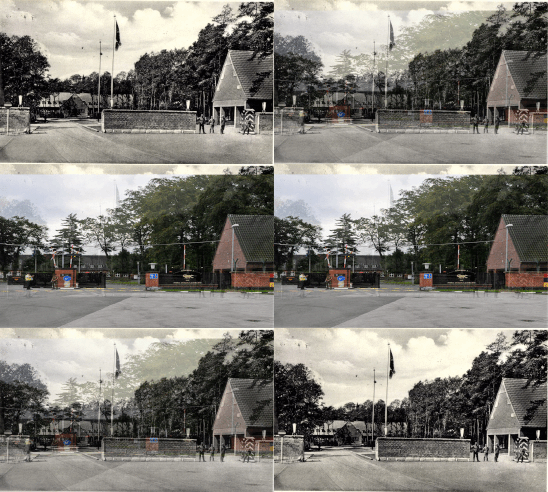

The
Fliegernachrichtenkaserne, later taken over by the British who renamed
it the York barracks, replacing the hakenkreuz with the holy Union flag.
The reichsadler remains however, albeit in a dilapidated state
Bad Hamm: The Kurhaus Nazi Events Venue, the Schützenhof Political Gatherings, and the Wartime Destruction

The
front of the Kurhauses Bad Hamm, the swastika- bedecked Badehaus now
gone. The Schützenhof, acquired in 1931 by the town, served as a venue
for political events during the Nazi era. On March 13, 1933,
ϟϟ-Sturmbann II / 30 organised Towards the end of the Second World War,
the bathhouse was misused, and finally the whole bathing business was
shut down. The bathhouse and the lodge house were used to accommodate
homeless people, especially children. At the time, the community centre
provided for the homeless in the Badehaus and the Sylverberg. The
northern transverse wing of the Kurhaus, located at the brine bath, was
affected by war damage by about 25%. During the war 55 air raids
destroyed nearly 60% of the old city and left only a few historical
buildings. The suburbs of Hamm "had been almost razed to the ground.
People who had fled from collapsing bunkers and had got stuck in huge
crowds in the streets had burning phosphorus poured over them, rushed
into the next air raid shelter and were shot in order not to spread the
flames."
Übach-Palenberg: The Forced Brothel System

The town hall
in September 1938 adorned with the face of Hitler and flanked by
swastikas and today. In 1935, the municipality of Übach-Palenberg was
founded by the municipalities of Frelenberg, Scherpenseel and Übach. In
1936, the municipal administration took over 14 Übach-Palenberger Jews,
whose traces were lost in the following years. Two women married to
non-Jews survived the Holocaust, whilst the Jew Baruch Dellman was expelled to Poland in 1938 and was murdered
in Sachsenhausen concentration camp in 1940. During the war on
September 9, 1940, Heinrich Himmler ordered the regional arrangement of
brothels for municipalities in which more than a hundred foreign workers
were placed. The Übach-Palenberger mayor Carl as well as the collier
Carolus Magnus tried to prevent this but their
efforts were unsuccessful. In 1941 a brothel was set up in a wooden
barrack with three Polish prostitutes. The use of the brothel, which was
subsequently dissolved, also declined with the withdrawal of coal. The
liberated barracks were then occupied with Soviet prisoners of war.
After the American invasion, the population was initially relieved. The
end of the fighting was dated to the church on October 5, 1944. When an
American infantry unit was preparing for an invasion of the Cologne area
for the following day, an Austrian attack on Antwerp was made into a
double house In the hill road. The damage in the largely spared
settlement until this time by war effects was devastating. The number of
deaths was never known.
Werne: The War Memorial

The
war memorial during the Third Reich and what's left of it today. During
the war, 471 citizens of Werne died and five hundred more disappeared
without trace. The town was forced to accommodate nearly four thousand
refugees.
Remaining Nazi sites in Westphalia Bochum Herford Werne
Übach-Palenberg Münster Teutoburg Grevenbroich Wewelsburg
Hermannsdenkmal Bielefeld Düsseldorf Moers Siegen Mülheim Hamm
Gremmendorf history then and now current state virtual tours 2025 can I
visit today what happened during WWII preservation efforts drone footage
2025 Holocaust education ethical debates on touring Nazi sites
augmented reality experiences contemporary significance guided tours
digital archives underground structures memorial sites interactive
timelines of Nazi events 1930s to now virtual reality reconstructions
current excavations and restorations historical photos then and now
augmented reality apps educational resources post-war changes modern
exhibits at Nazi sites in Westphalia
