


Alzey – Finanzamt (Tax Office)
A Reichsadler continues to grace the entrance of the local financial administration building.
View full page →
Augsburg – Landratsamt (District Office)
Monumental stone Reichsadler above the entrance; swastika chiseled out and protected by mesh.
View full page →
Augsburg – Reinöhlstrasse Relief
Large architectural eagle sculpture on a former industrial building, recently repainted.
View full page →
Augsburg – Theodor Wiedemann Strasse 35
Facade relief depicting an eagle directing its gaze towards France alongside other military motifs.
View full page →
Bad Reichenhall – Hochstaufen Barracks
Former Wehrmacht barracks; the swastika was replaced by an edelweiss symbol.
View full page →
Berchtesgaden – Railway Station
Facade preserves an iron eagle motif and a swastika-removed wreath above a private door.
View full page →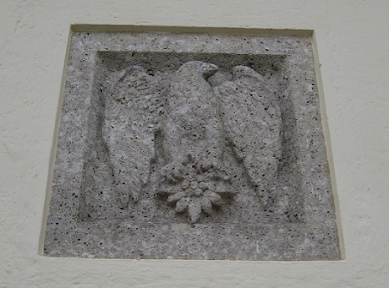
Berchtesgaden – Jägerkaserne
The eagle remains above the entrance; its swastika has been replaced with an edelweiss.
View full page →
Berchtesgaden – Railway Tunnel (1940)
The Nazi eagle has been removed from the tunnel's stone inscription.
View full page →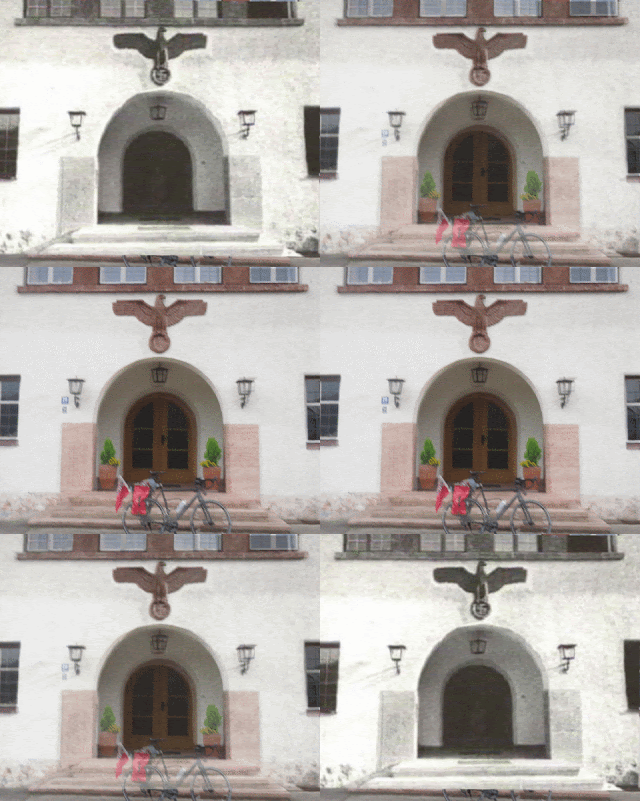
Berchtesgaden (Stanggaß) – Kleine Reichskanzlei
Reichsadler relief survives on the facade of the administrative branch.
View full page →
Berlin – Amtsgericht Wedding
A prominent Reichsadler remains on the front façade of the district court building.
View full page →
Berlin – Olympic Bell (Maifeld)
Survivor of the fire; features an eagle and a half-heartedly smashed swastika.
View full page →
Berlin – House of German Sports
In addition to column-top eagles, a Nazi-era eagle relief remains on a nearby stone pillar.
View full page →
Berlin – Reichspostministerium
Fritz Kölle's 1937 eight-metre wide 'Adler' remains on the facade on Leipziger Straße.
View full page →
Berlin – Zehlendorf Adler Apotheke
1936 terracotta relief; the swastika was chiseled out, leaving a blank depression.
View full page →
Berlin – Reichpost TV Studios
A dated Nazi eagle remains above the entrance of the world's first regular TV studio.
View full page →
Berlin – Siemens Ehrenmal
Joseph Wackerle's 1935 Reichsadler remains in situ at the memorial site.
View full page →
Berlin – Post Office (Lichterfelde)
Surviving Nazi eagle at the post office on Hindenburgdamm.
View full page →
Berlin – State Labour Department
1940 building; the eagle remains "unmolested," overlooking the capital.
View full page →
Berlin – Post Office (Knesebeckstraße)
A Reichsadler survives above the doorway of the post office at number 95.
View full page →
Berlin – Finanzamt Charlottenburg
Designed by Kurt Schmid-Ehmen; the swastika is currently covered by the building address.
View full page →
Berlin – Tempelhof Airport
Surviving eagles shorn of swastikas remain on the building; a "decapitated" Reichsadler sits in the square.
View full page →
Bochum – Boltestraße Shelter
Nazi eagle dated 1941-1942 above the entrance, denuded of its swastika.
View full page →
Bremen – Allianz-Haus
A Nazi eagle remains visible on the façade of Allianz-Haus at Sögestraße 59.
View full page →
Cologne – Rodenkirchen Bridge
Reichsadler relief found on the infrastructure of the southern Cologne motorway bridge.
View full page →
Darmstadt – Psychologiegebäude (TH)
Nazi eagle on the façade; the swastika has been smoothed away.
View full page →.gif)
Dresden – Hospital Friedrichstadt
The Nazi Reichsadler dominating the entrance of the palais-based hospital.
View full page →
Düsseldorf – Police Headquarters
Nazi eagle above the Jürgensplatz entrance; now covered by a plaque.
View full page →
Erlangen – Primary School Doorway
A surviving Nazi eagle above the door, albeit with the swastika missing.
View full page →.gif)
Erwitte – Horst-Wessel-Halle
Nazi eagle sculpture by Willy Meller remains in situ at the former Reichsschulungsburg.
View full page →
Flensburg – Naval Academy Mürwik
The Nazi eagle is allowed to remain over the portal, unchanged apart from flags.
View full page →
Freiburg – University Campus
The Reichsadler has been scrubbed away completely from the entrance corner.
View full page →
Freising – Adler Apotheke
The Nazi-era eagle giving its name to the pharmacy dates from 1937.
View full page →
Freising – Vimy Kaserne Base
The eagle was removed in 1945; only the round base with roughly chiseled swastika marks remains.
View full page →
Garmisch-Partenkirchen – Artillerie Kaserne
Nazi eagle remains in situ at the former "Krafft-von-Dellmensingen-Kaserne".
View full page →
Hammelburg – Military Barracks
Nazi eagle remains clearly visible on the façade of the historic Adolf Hitler military barracks.
View full page →.jpg)
Heidelberg – Großdeutschlandkaserne
Two Nazi eagles still perch above the gate on the main road, with excised swastikas.
View full page →
Heilbronn – Rosenberg Bridge
A Nazi eagle with the date 1938-1939 remains on the bridge structure.
View full page →
Herrsching – Reichsfinanzschule
Described as the largest remaining Nazi eagle in Germany, located on the Feierhalle facade.
View full page →
Kiel – U-boat Memorial (Möltenort)
The Reichsadler sits atop a 15.3m pillar; swastika replaced by a nondescript device.
View full page →.jpg)
Lohr am Main – Forstverwaltung
A Nazi eagle remains in situ above the door of this 1937 forestry building.
View full page →
London – Imperial War Museum
Bronze Nazi Party eagle by Schmid-Ehmen, originally loomed over a Reich Chancellery doorway.
View full page →
Mülheim – Kolpinghaus
A Nazi eagle continues to adorn the building that served as local party headquarters.
View full page →.gif)
Munich – Luftgaukommando VII Entrance
Main entrance flanked by two stone eagles by Wackerle (1938); swastikas chiseled out.
View full page →
Munich – Luftgaukommando VII Portal
Monumetal predatory Reichsadler sculpture above the vehicular entrance; swastika excised.
View full page →
Munich – Nationalmuseum Wing
Preserved Reichsadler relief on the Bestelmeyer side entrance with swastika removed.
View full page →
Munich – Schellingstraße 50
The Reichsadler remains above the door of the former Nazi Party offices (1925-1931).
View full page →
Munich – Schellingstraße Coat of Arms
Legacy of the 1936 coat of arms; the eagle and swastika were excised post-war.
View full page →
Munich – Bavarian State Tax Office
Large imperial eagle remains on the façade of Sophienstraße 6, swastika chiseled out.
View full page →
Munich – Deutsches Museum
The Nazi-era eagle and arms of Munich remain on the façade below the astronomical clock.
View full page →
Münster – Shopping Centre
A Nazi eagle actually commandeered to decorate a local shopping facility.
View full page →
Murnau am Staffelsee – Railway Bridge
Rare surviving intact 1935 Nazi Reichsadler relief on German Reichsbahn infrastructure.
View full page →
Nuremberg – Transformatorenstation
Faint ghost outline of the Nazi eagle on this Albert Speer building, now a Burger King.
View full page →
Nuremberg – Reichsbahndirektion
The Nazi eagle still adorns the main administrative building for the railway.
View full page →
Offenbach – Luftschutzbunker Eagle
1941 Reichsadler by Ernst Unger above the entrance, protecting a mother and child.
View full page →
Pelzerhaken – Baltic Lighthouse
The Nazi eagle installation has remained since its establishment on the lighthouse in 1936.
View full page →
Rothenburg – Main Hall Door
Surviving Nazi eagle above the door to the main hall of the former district leadership building.
View full page →
Schweinfurt – former HJ School
The entrance of the former Hitlerjugend school still has its Nazi eagle above the door.
View full page →
Schweinfurt – Willy-Sachs-Stadion
Nazi eagle sculpture remains intact on the stonework arch of the stadium entrance.
View full page →
Straubing – Pumping Station Bastion
Seven-tonne limestone Reichsadler carved in 1941; re-erected in 1954 with the swastika excised.
View full page →
Ulm – Office Building Doorway
A Reichsadler still remains above the doorway of an office building.
View full page →
Villingen – Burenhaus (former Party HQ)
The 'Fuhrer balcony' created by the Nazis remains, with the eagle still present in the grill.
View full page →.gif)
Vogelsang – Eagle Courtyard
Willy Meller's 'Adler' sculpture remains partially damaged but preserved at the former Ordensburg.
View full page →
Worms – Worms Cathedral
A surviving iron Sea Level benchmark featuring the Nazi eagle remains affixed to the exterior.
View full page →