

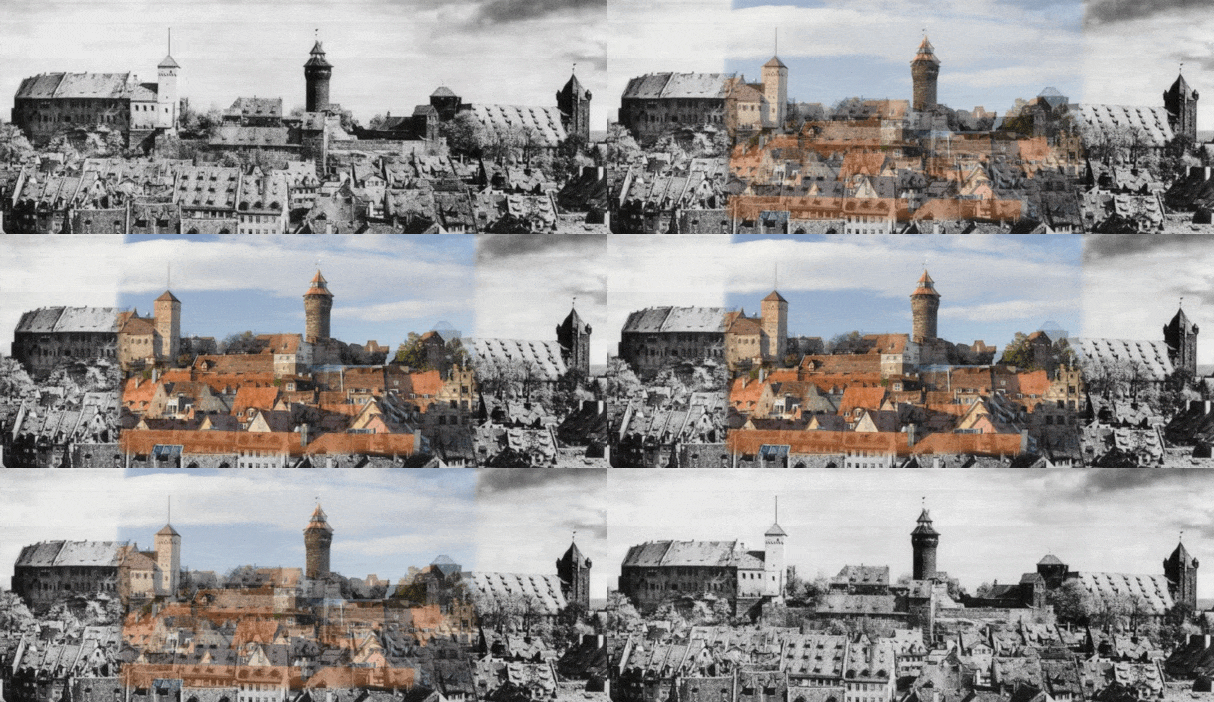
Nuremberg Castle then and now with Sinwell Tower in the middle left and Luginsland Tower in the far right. During the war, the castle was damaged in 1944-45, with only the Roman
double chapel and the Sinwell Tower remaining entirely intact. After the
war, the castle was restored under the direction of Rudolf Esterer and
Julius Lincke to its historical form, including the Luginsland tower
which had been completely destroyed.
 Nazi postcard and how the site appears today. Nuremberg’s town centre, encompassing the medieval Altstadt with its historic walls, churches, and market squares, was systematically transformed by the Nazi regime from 1933 to 1945 to serve as a propaganda hub. The city’s historical role as a Holy Roman Empire capital was exploited to project an image of Germanic continuity. Hitler, speaking at the Deutscher Hof hotel on September 1, 1933, described Nuremberg as “the soul of German heritage,” a claim used in Nazi propaganda to justify its centrality. The Reichsparteitage rallies, held annually from 1933 to 1938, attracted 520,000 attendees by 1937, per Reich Ministry reports, with the Hauptmarkt as the primary stage. Swastika banners adorned the Frauenkirche, and the Schöner Brunnen fountain was lit with 200 spotlights costing 60,000 Reichsmarks in 1936. Albert Speer, appointed in 1934 to design rally grounds, wrote in his 1970 memoirs that the Altstadt’s “medieval aesthetic amplified the regime’s narrative.” Restoration of the 3.7-kilometre city walls, completed by 1937 with 2.8 million Reichsmarks, reinforced this image, with 80% of turrets rebuilt. Local businesses, including 18 Lebkuchen bakeries, produced 15,000 swastika-themed goods in 1937, increasing sales by 25%. The Hauptbahnhof’s 1936 expansion added twelve platforms, handling 1.5 million rally visitors yearly. The Germanisches Nationalmuseum on Kornmarkt, repurposed for Nazi art exhibitions, drew 140,000 visitors in 1938. The synagogue on Hans-Sachs-Platz, demolished on 10 August 1938, displaced 1,800 Jewish residents by December. Leni Riefenstahl’s Triumph des Willens, filmed in the Hauptmarkt in 1934, was viewed by 21 million Germans by 1942, per Reichsfilmkammer data. Public executions of eighteen communists in the Lorenzkirche plaza in 1933 drew 5,000 spectators. Königstrasse, renamed Adolf-Hitler-Strasse in 1933, saw 85% of shop signs replaced with Nazi symbols by 1936. The town centre’s population rose to 435,000 by 1939, a 13% increase from 1933, driven by rally-related commerce. Analysis of Nazi records suggests the regime prioritised Nuremberg’s town centre for its symbolic weight, though local resistance, including 200 anti-Nazi leaflets distributed in the Hauptmarkt in 1935, indicates limited opposition persisted. The regime’s investment in infrastructure and propaganda reshaped the Altstadt’s identity.

 The economic and administrative restructuring of Nuremberg’s town centre under Nazi control was extensive. The Nuremberg Laws, finalised at the Deutscher Hof hotel on September 15, 1935, revoked citizenship for 2,400 Jewish residents by January 1936, per city archives. Jewish businesses on Karolinenstrasse, numbering 160 in 1933, were “Aryanised” by 1939, with 90% transferred to non-Jewish owners. The Hauptmarkt’s weekly market, dating to 1349, banned Jewish vendors by 1936, reducing stalls from 200 to 120. The Gestapo, headquartered in the Rathaus since 1934, detained 2,200 individuals by 1941, with 400 informants monitoring the Altstadt by 1939. The MAN factory, two miles from the town centre, employed 14,000 workers by 1942, producing 1,200 tank engines monthly. The Kongresshalle, begun in 1935, used 320,000 cubic metres of concrete by 1941, employing 4,500 workers annually. Hotels like the Goldener Adler saw a 70% occupancy rise during rallies, earning 1.8 million Reichsmarks in 1939. The tram network added 70 vehicles in 1938, carrying 17 million passengers yearly. The Meistersingerhalle’s Wagner performances, attended by 13,000 in 1940, reinforced Nazi cultural ideals. Schools like the Melanchthon-Gymnasium adopted Nazi curricula by 1935, with 97% of teachers in the Nazi Party by 1938. The Hitlerjugend, with 10,000 Nuremberg members by 1941, paraded weekly through the Hauptmarkt. Speer’s unbuilt Deutsches Stadion required 480,000 cubic metres of granite by 1942. Analysis of municipal data reveals the regime’s economic policies boosted local industry but prioritised ideological control, as evidenced by the exclusion of Jewish vendors. However, economic gains were uneven, with 15% of Altstadt businesses reporting losses by 1939 due to forced compliance costs. The town centre’s transformation thus reflected a calculated blend of coercion and economic stimulus.
Hitler's D-2600 above Nuremberg on the left from Triumph of the Will, taken from page 17 of Bilder aus dem Leben des Führers.
Clearly, Riefenstahl is deifying Hitler: the ‘plane in which Hitler is flying cuts through dark clouds; the clouds part, and sunlight streams through, silhouetting the crucifix-like shape of the ‘plane upon the ancient churches and houses of Nuremberg. Hitler descends, as a god from the sky, pushing aside the storm clouds of Germany’s problems, ready to give salvation, and enable Germans to inherit the earth.

More screen shots of the town from the start of Triumph of the Will
William L. Shirer describes the 1934 Reichsparteitag des deutschen Volkes in Nüremberg as a pseudo-pentecostal event in which the masses viewed Adolf Hitler “as if he were Messiah, their faces transformed into something positively inhuman” . Despite the official purpose of strengthening the liaison between the Nazi Party and the German people and exemplifying the “unfolding glory and power” of the Third Reich, the annual Nüremberg Rallies, as eminent historian Richard J. Overy claims, mainly served to foster Hitler’s cult of personality. Hitler desired the Nüremberg Rally of 1934 to be immortalised in recording and assigned his protégée, prominent filmmaker Leni Riefenstahl, the duty. The result was the groundbreaking masterpiece, Triumph des Willens, a motion picture that, despite its close association with Nazism, is still considered a keystone and “breathtaking” role model of modern cinema. Up to her death in 2003, Riefenstahl has consistently denied her alleged sympathy with the Nazi Party and has insisted that “Triumph of the Will” be regarded as a work of art rather than propaganda. Every party rally was orchestrated thematically, yet the September 1934 Nüremberg Rally was the exception; only later, after Riefenstahl’s film, was it declared to be the “Rally of Power”. However, this Rally posed a challenge for the dictator : just three months earlier, Hitler had taken action against the Sturmabteilung (SA) and its leader, Ernst Röhm, in the infamous Night of the Long Knives, an operation involving at least 85 extra-judicial killings, spanning the 30th of June until the 2nd of July. Now, facing the entire Party, including the SA, as well as a crowd of several thousand civilians at the Nüremberg Rally, Hitler encountered the task of publicly rationalising Operation Hummingbird. This would suggest that his position as leader in 1934 was not as solid as commonly assumed.

.gif)
Pankraz Labenwolf's Gänsemännchenbrunnen, or Goose Man fountain, makes an appearance in Triumph of the Will and as it appears today. It was created around 1550 and is one of Nuremberg’s oldest fountains featuring a bronze figure of a farmer holding a goose under each arm with water coming out of their beaks. Often mistaken for a simple farmer, the figure may actually represent a more affluent figure, possibly Philip Melanchthon, based on contemporary portraits and the figure’s fine attire. The fountain is briefly visible in scenes showcasing Nuremberg’s historic architecture, used to evoke a sense of German cultural heritage and continuity. Its inclusion aligns with the film’s aim to connect Nazi ideology to Germany’s past, although the fountain itself has no political connotations and is a celebrated piece of Renaissance art. The film’s use of Nuremberg’s landmarks, including the Gänsemännchenbrunnen, helped craft an image of the city as a symbolic centre of German tradition. Before 1945 the fountain was located at the Gänsemarkt near the Frauenkirche but now is located in a courtyard behind the town hall at Rathausplatz. It remains one of Nuremberg’s oldest and most replicated fountains, with copies in cities like Meiningen, Weimar, and Lucerne. .gif) In reality it's much smaller than its appearance in Triumph of the Will would suggest as Drake Winston shows on the right. This brings to mind the complaint made by Nuremberg’s Head of Tourism and Marketing, Michael Weber, that three linkages – laws, rallies and trials – define the city for many foreigners in particular: ‘They always want to know, show me the place of the trials, where the laws were announced and where Hitler used to stand.’
In reality it's much smaller than its appearance in Triumph of the Will would suggest as Drake Winston shows on the right. This brings to mind the complaint made by Nuremberg’s Head of Tourism and Marketing, Michael Weber, that three linkages – laws, rallies and trials – define the city for many foreigners in particular: ‘They always want to know, show me the place of the trials, where the laws were announced and where Hitler used to stand.’
.gif) In reality it's much smaller than its appearance in Triumph of the Will would suggest as Drake Winston shows on the right. This brings to mind the complaint made by Nuremberg’s Head of Tourism and Marketing, Michael Weber, that three linkages – laws, rallies and trials – define the city for many foreigners in particular: ‘They always want to know, show me the place of the trials, where the laws were announced and where Hitler used to stand.’
In reality it's much smaller than its appearance in Triumph of the Will would suggest as Drake Winston shows on the right. This brings to mind the complaint made by Nuremberg’s Head of Tourism and Marketing, Michael Weber, that three linkages – laws, rallies and trials – define the city for many foreigners in particular: ‘They always want to know, show me the place of the trials, where the laws were announced and where Hitler used to stand.’
As he was also keen to point out, however, these were not the only Nurembergs. Long dubbed ‘Germany’s treasure chest’ (Deutschlands Schatzkästlein), the city has been a significant tourist destination since the mid-nineteenth century, visitors coming to see its beautiful churches, fountains, walled Old Town, medieval castle and the important collections in the Germanic national museum. Although much of the Old Town was destroyed during the War, many of the notable buildings have since been painstakingly reconstructed as part of Germany’s postwar heritage movement. Nuremberg is also famous for its Christmas market, its toy-making, gingerbread, and sausages. Indeed, a visitor survey from the 1980s that Michael Weber gave to me showed clearly that for most German visitors these were more significant associations than the Nazi heritage. In response to the question ‘What comes into your mind when you hear the name Nuremberg?’, while foreign tourists (of whom the majority were Americans) almost all mentioned trials, laws and rallies as the primary associations, fewer than 5 per cent of German visitors mentioned anything to do with the Nazi period. Instead, their associations were Butzenscheiben (little bull’s eye glass window- panes), Bratwürste (sausages), Lebküchen (gingerbread) and the Christkindlesmarkt (Christmas market). In other words, all things which Michael Weber described as ‘small and cute’ (klein und niedlich), an image that he also thought problematic for a modern dynamic city.
Nuremberg old town as seen in Triumph of the Will during the 1934 Party Rally, left, and amateur colour footage filmed at the 1938 Nazi Party Congress in Nuremberg.
Although the city had been practically obliterated during the war, many of the landmarks scene in this clip can still be identified as shown below.

 90% of the city had been bombed to nothing after the war, as these photos before and after the war show. What is seen now by the visitor is a marvel of reconstruction. Nuremberg was one of the frequent targets of Allied air raids during the war, severely damaging the city. On January 2, 1945, the Nuremberg Old Town was almost completely destroyed. Also in the five-day battle of Nuremberg in April 1945, most historic buildings were destroyed. After the war, there were actually considerations to completely abandon the ruined city and rebuild it elsewhere as food shortages and a lack of housing prevailed in the city. Of the 134,000 homes before the war, only 14,500 remained undamaged. Martin Treu and Hans Ziegler were appointed by the American military government in July 1945 to serve as the new Lord Mayors of the city. At the beginning of 1948 an architectural competition was decided to rebuild the largely destroyed city according to development plans by Heinz Schmeißner and Wilhelm Schlegtendal. In 1949, the German Building Exhibition took place in Nuremberg under the motto "Wir müssen bauen"- "We must build". During the reconstruction, most people oriented themselves on the historical city structures, so that they are still legible in many places despite the predominantly destroyed building fabric. As seen in the GIF at the top of this page, the roofscape has again been formed similar to the pre-war state. Many important church buildings were also largely reconstructed, as well as buildings along the later historic mile as the Reichsburg. Important townhouses such as the Toplerhaus and the Pellerhaus or the buildings on the Hauptmarkt were either not or only partially rebuilt as will be seen below.


Links to archival footage:
1933 - Der Deutsche Reichstag zu Nürnberg
1933 - The Nuremberg Reichsparteitage der NSDAP of 1927, 1929 and 1933
1933 - The Nuremberg Reichsparteitage der NSDAP of 1927, 1929 and 1933
 90% of the city had been bombed to nothing after the war, as these photos before and after the war show. What is seen now by the visitor is a marvel of reconstruction. Nuremberg was one of the frequent targets of Allied air raids during the war, severely damaging the city. On January 2, 1945, the Nuremberg Old Town was almost completely destroyed. Also in the five-day battle of Nuremberg in April 1945, most historic buildings were destroyed. After the war, there were actually considerations to completely abandon the ruined city and rebuild it elsewhere as food shortages and a lack of housing prevailed in the city. Of the 134,000 homes before the war, only 14,500 remained undamaged. Martin Treu and Hans Ziegler were appointed by the American military government in July 1945 to serve as the new Lord Mayors of the city. At the beginning of 1948 an architectural competition was decided to rebuild the largely destroyed city according to development plans by Heinz Schmeißner and Wilhelm Schlegtendal. In 1949, the German Building Exhibition took place in Nuremberg under the motto "Wir müssen bauen"- "We must build". During the reconstruction, most people oriented themselves on the historical city structures, so that they are still legible in many places despite the predominantly destroyed building fabric. As seen in the GIF at the top of this page, the roofscape has again been formed similar to the pre-war state. Many important church buildings were also largely reconstructed, as well as buildings along the later historic mile as the Reichsburg. Important townhouses such as the Toplerhaus and the Pellerhaus or the buildings on the Hauptmarkt were either not or only partially rebuilt as will be seen below.
 Bergstraße on the left and the Reichsparteitag of 1937 and Ludwigstor bedecked in swastikas and today. The Ludwigstor was a gate through the Nuremberg city wall and is today one of the main entrances to the south-west of Nuremberg's old town.
.gif)

By the time of the Reichsparteitag der Ehre, the Hauptbahnhof processed even larger volumes, with records indicating 1,200 trains in total for the event, carrying close to 700,000 people, including foreign diplomats who arrived on dedicated expresses from Berlin. Platform announcements echoed with directives for organised disembarkation, and party officials coordinated transfers to avoid congestion. In September 1937, at the Reichsparteitag der Arbeit, the station saw the arrival of 800,000 participants via rail, with specific trains reserved for high-ranking figures like Göring, who disembarked on September 6 amidst the usual honour guards. The following year during the Reichsparteitag Großdeutschland, over 1 million individuals travelled by train, straining the Hauptbahnhof's capacity to its limits, with platforms extended temporarily to accommodate longer trains consisting of up to 20 carriages each. These operations underscored the station's integration into the regime's propaganda machinery, as arrivals were often filmed for newsreels showing disciplined masses pouring out of carriages adorned with swastika banners. This pareticular rally,
in which the theme was the celebration of that year's anschluss, in
some cases took intervals of 80 seconds to clear the platforms
during which time between arrival and departure, special trains were
parked in parking lots that were up to 400 kilometres away from
Nuremberg, such as in Dresden.
.gif)
 Further transports originated directly from the Hauptbahnhof. On September 10, 1942, 1,000 deportees, including 533 from Nuremberg, primarily elderly persons, were gathered at Jewish old-age homes on Johannisstraße 17, Knauerstraße 27, and Wielandstraße 6. They were moved by buses and furniture vans to the cattle yard at Finkenstraße 33, then loaded onto a train of six freight wagons, one shunting wagon, and twenty passenger carriages, departing from the adjacent Rangierbahnhof at 6:14 PM, bound for Theresienstadt in Czechoslovakia, 250 kilometres away, arriving at Bauschowitz station. Of these, 26 survived. On June 18, 1943, two separate deportations left the Hauptbahnhof: one at 5:12 AM with 16 people from Nuremberg and Fürth in two passenger wagons attached to freight train number 7183, destined for Auschwitz in Poland, 587 kilometres distant, arriving at 6:17 AM the next day, with no survivors; the other at 7:05 AM with 18 participants, 14 from Nuremberg, to Theresienstadt, arriving at 9:27 PM, yielding 4 survivors. Loading occurred the previous evening at Zirndorf goods station, with wagons shunted overnight to the Hauptbahnhof. On January 17, 1944, 10 deportees from Nuremberg and Fürth boarded a passenger wagon at the Hauptbahnhof for Theresienstadt, with 5 surviving. In late August 1944, four youths classified as Mischlinge were deported from the station in a previously undocumented transport, their fate unrecorded in detail. These actions involved coordination with the Reichsbahn, which charged fares equivalent to third-class tickets, profiting 4 Reichsmarks per adult and 2 per child, whilst providing sealed wagons without sanitation.
.gif) As the war intensified, the Hauptbahnhof's strategic importance made it a target for Allied bombings. On January 2, 1945, a raid by 514 British Lancaster bombers dropped 6,000 high-explosive and incendiary bombs over 25 minutes, destroying 95 percent of the old town and severely damaging the station's roof and platforms, killing 1,800 civilians in the vicinity. Fires raged for days, halting rail traffic for 48 hours. Further attacks on February 20 and 21, 1945, claimed 1,356 lives, with bombs striking the Hauptbahnhof's tracks, derailing military supply trains and collapsing parts of the entrance hall. By March 16, 1945, another assault disrupted operations, with repair crews, including 2,000 forced labourers, working under duress to restore service for troop movements. The station's destruction symbolised the collapse of the regime's infrastructure, with American forces capturing the ruined facility on April 20, 1945, after street fighting that left 200 German soldiers dead nearby. Throughout the era, the Hauptbahnhof facilitated the transport of over 10,000 forced labourers to local factories like MAN and Siemens, with daily shipments from 1940 onwards averaging 500 workers per train, many from Eastern Europe, under guard by ϟϟ personnel when directly involved in security details. Statistical records from the Reichsbahn indicate that between 1939 and 1945, the station handled 15 million passenger movements annually, a 30 percent increase from pre-1933 levels, driven by military and regime priorities.
As the war intensified, the Hauptbahnhof's strategic importance made it a target for Allied bombings. On January 2, 1945, a raid by 514 British Lancaster bombers dropped 6,000 high-explosive and incendiary bombs over 25 minutes, destroying 95 percent of the old town and severely damaging the station's roof and platforms, killing 1,800 civilians in the vicinity. Fires raged for days, halting rail traffic for 48 hours. Further attacks on February 20 and 21, 1945, claimed 1,356 lives, with bombs striking the Hauptbahnhof's tracks, derailing military supply trains and collapsing parts of the entrance hall. By March 16, 1945, another assault disrupted operations, with repair crews, including 2,000 forced labourers, working under duress to restore service for troop movements. The station's destruction symbolised the collapse of the regime's infrastructure, with American forces capturing the ruined facility on April 20, 1945, after street fighting that left 200 German soldiers dead nearby. Throughout the era, the Hauptbahnhof facilitated the transport of over 10,000 forced labourers to local factories like MAN and Siemens, with daily shipments from 1940 onwards averaging 500 workers per train, many from Eastern Europe, under guard by ϟϟ personnel when directly involved in security details. Statistical records from the Reichsbahn indicate that between 1939 and 1945, the station handled 15 million passenger movements annually, a 30 percent increase from pre-1933 levels, driven by military and regime priorities..gif)
.gif)
Another Nazi-era building on the Bahnhofplatz- the post office, with the Nazi eagle on the corner long removed. In fact, since I last visited the entire building had been demolished in spring 2018. It had been located next to Nuremberg's main train station and was originally built as a senior post office; here the western, so-called "head building" of the main post office is seen. The first post office building on the site was built in 1861 and located on the site of the current property at Bahnhofsplatz 1. This building was completed by 1931, designed by Oberpostbaurat Johann Kohl who had designed the building consistently in the New Objectivity style, as advocated by the Munich Postbauschule. The eight-story high-rise was to have a strictly cubic silhouette with a basic, modern steel skeleton. According to the original planning, simple curtain walls with large transverse rectangular windows were to be superimposed on this. A closed bridge was planned as a direct connection to the neighbouring main station. 

When the Nazis took power in 1933, the steel frame of the front building was largely complete. Since the building was located in an important urban location - the station square - the newly appointed Gauleiter Julius Streicher, a declared enemy of the New Building, had Kohl's plans summarily changed leading to architect Max Kälberer adding high arched arcades to the ground floor, provided the facades with a cladding made of sandstone slabs that matched the environment and put a steep, hipped roof on the building. Reliefs related to the history of Deutsche Post and the sculpture of a seated Nazi eagle at the corner of the building towards the station square completed the ideologically-motivated revision of the original plan. In 1935 the construction work was completed. Up until 1994, the mail for Nuremberg was sorted here and then delivered. During the Second World War, the head building was damaged by aerial bombing. Reconstruction under the direction of Anton Ebner began in 1947 through which the supporting steel structure was partially renewed. The external appearance of the front building was a combination of the original plan by Johann Kohl with the changes made by Max Kälberer in 1933: the arcades on the ground floor and the sandstone cladding of the facades were restored without reliefs and eagle figures.  The roof was rebuilt but with a lesser slope as seen in my GIF. Ebner adopted the division of windows from Johann Kohl's design of 1931. The front building of the Nuremberg main post office was therefore an interesting example of how the reconstruction combined the architecture of National Socialism with the New Objectivity of the Weimar Republic. As a symbol of democracy, the latter shaped the style of post-war German architecture for decades.
 The roof was rebuilt but with a lesser slope as seen in my GIF. Ebner adopted the division of windows from Johann Kohl's design of 1931. The front building of the Nuremberg main post office was therefore an interesting example of how the reconstruction combined the architecture of National Socialism with the New Objectivity of the Weimar Republic. As a symbol of democracy, the latter shaped the style of post-war German architecture for decades.
 However, in the course of the privatisation of the post office in the 1990s, the main post office was largely abandoned. In the years that followed, techno parties were held in the rotunda as an interim use whilst he branch in the head building, where Deutsche Post AG and Postbank offered their services, remained in place. In 2013, the owner, Aurelis Real Estate, announced that new users were being sought for the largely vacant building and the next year Munich investor Hubert Haupt Immobilien acquired the post office premises. The company intended to renovate the circular building, which is a listed building, but in the end only the façades and the historic stairwells ended up being preserved despite the resistance provided by the Altstadtfreunde Nürnberg and other groups. Despite such activism, the completion of the new ensemble, the atrocious so-called Tafelhof Palais, was completed in 2021.
Deutscher Hof
.gif) The Deutscher Hof at the junction of Lessingstraße and Frauentorgraben decked out in Nazi banners and today. This
is the hotel at Frauentorgraben 29 where Hitler always stayed whilst in
Nuremberg, in suite 105. It was whilst he was about to leave after one
such stay on September 18, 1931 that Hitler received a phone call from
Rudolf Hess telling him that his niece Geli, his constant companion for
the past six years, had killed herself in her room at his new Munich
apartment in Munich. He then rushed back to Munich during which time he
had been stopped by the police for speeding. Later when in power Hitler
would use the site for meetings and receptions during the rallies. Indeed, the hotel played a significant role during the Nazi era, serving as a key accommodation and ceremonial site for Hitler and other high-ranking party members during the Reichsparteitage as seen in the opening of Triumph of the Will. Constructed between June 22, 1912, and December 1913, by the Verein Lehrerheim under architect Hans Müller, the building initially functioned as a clubhouse for Nuremberg’s teachers, featuring a library, social rooms, and two grand halls, the Lessingsäle and Renaissance Saal. Its 56-room hotel section, opened in December 1913, became a focal point for Nazi activities due to its proximity to the Hauptbahnhof and its luxurious amenities, which included marble staircases, stucco ceilings, and wood-panelled interiors. The hotel’s opulence, with 1,500 square metres of space, made it a natural choice for the regime’s elite.
The Deutscher Hof at the junction of Lessingstraße and Frauentorgraben decked out in Nazi banners and today. This
is the hotel at Frauentorgraben 29 where Hitler always stayed whilst in
Nuremberg, in suite 105. It was whilst he was about to leave after one
such stay on September 18, 1931 that Hitler received a phone call from
Rudolf Hess telling him that his niece Geli, his constant companion for
the past six years, had killed herself in her room at his new Munich
apartment in Munich. He then rushed back to Munich during which time he
had been stopped by the police for speeding. Later when in power Hitler
would use the site for meetings and receptions during the rallies. Indeed, the hotel played a significant role during the Nazi era, serving as a key accommodation and ceremonial site for Hitler and other high-ranking party members during the Reichsparteitage as seen in the opening of Triumph of the Will. Constructed between June 22, 1912, and December 1913, by the Verein Lehrerheim under architect Hans Müller, the building initially functioned as a clubhouse for Nuremberg’s teachers, featuring a library, social rooms, and two grand halls, the Lessingsäle and Renaissance Saal. Its 56-room hotel section, opened in December 1913, became a focal point for Nazi activities due to its proximity to the Hauptbahnhof and its luxurious amenities, which included marble staircases, stucco ceilings, and wood-panelled interiors. The hotel’s opulence, with 1,500 square metres of space, made it a natural choice for the regime’s elite.
.gif) Standing in front whilst cycling past and Hitler making an appearance from his suite's window. Hitler first stayed at the Deutscher Hof on September 2, 1923, during the Deutscher Tag, delivering a speech to a select group in the hotel’s main hall. He returned on March 22, 1929, addressing privileged Nazi Party members, and from August 1 to August 4, 1929, for the fourth Party Congress, occupying room 55. During this visit, Winifred Wagner, daughter-in-law of Richard Wagner, stayed in room 57, highlighting the hotel’s appeal to prominent figures. Hitler’s consistent use of the Deutscher Hof began in March 1920, facilitated by the hotel’s lessee, Johannes Klein, a former U-boat officer with far-right leanings who forged early ties with the Nazis. By September 1933, during the Reichsparteitag des Sieges, the hotel was designated as Hitler’s official Standquartier, housing him, Reichsminister Robert Ley, and Gauleiter Julius Streicher, with 80 rooms reserved for party leadership. Parades and roll calls, involving up to 10,000 SA and Hitler Youth members, took place outside, with crowds of 50,000 spectators lining Frauentorgraben.
Standing in front whilst cycling past and Hitler making an appearance from his suite's window. Hitler first stayed at the Deutscher Hof on September 2, 1923, during the Deutscher Tag, delivering a speech to a select group in the hotel’s main hall. He returned on March 22, 1929, addressing privileged Nazi Party members, and from August 1 to August 4, 1929, for the fourth Party Congress, occupying room 55. During this visit, Winifred Wagner, daughter-in-law of Richard Wagner, stayed in room 57, highlighting the hotel’s appeal to prominent figures. Hitler’s consistent use of the Deutscher Hof began in March 1920, facilitated by the hotel’s lessee, Johannes Klein, a former U-boat officer with far-right leanings who forged early ties with the Nazis. By September 1933, during the Reichsparteitag des Sieges, the hotel was designated as Hitler’s official Standquartier, housing him, Reichsminister Robert Ley, and Gauleiter Julius Streicher, with 80 rooms reserved for party leadership. Parades and roll calls, involving up to 10,000 SA and Hitler Youth members, took place outside, with crowds of 50,000 spectators lining Frauentorgraben.

.gif) Post-war, from May 1945, the Deutscher Hof fell under Bavarian state control as former Nazi property. Reconstruction, led by architect Hans Albert Wilhelm and interior designer Friedrich Feuerlein, began in June 1946, restoring the façade to its pre-1936 design by December 1948, though the roof was simplified, omitting 10 dormers for cost savings of 300,000 Deutschmarks. The Lessingsäle briefly housed the Lessingtheater from October 1946 to June 1949, staging 150 performances, including Goethe’s Faust, attended by 25,000 patrons. Financial struggles led to the city assuming its debts of 200,000 Deutschmarks on June 1, 1949. The hotel resumed operations under lessee Karl Schöller from July 1949, with 40 rooms available, hosting 10,000 guests annually by 1950. Heinz Rübsamen took over in April 1953, managing the Carlton Hotelgesellschaft, and by 1976, the Bocksbeutelkeller, redesigned by Feuerlein with vaulted ceilings, served 1,500 customers monthly.
Post-war, from May 1945, the Deutscher Hof fell under Bavarian state control as former Nazi property. Reconstruction, led by architect Hans Albert Wilhelm and interior designer Friedrich Feuerlein, began in June 1946, restoring the façade to its pre-1936 design by December 1948, though the roof was simplified, omitting 10 dormers for cost savings of 300,000 Deutschmarks. The Lessingsäle briefly housed the Lessingtheater from October 1946 to June 1949, staging 150 performances, including Goethe’s Faust, attended by 25,000 patrons. Financial struggles led to the city assuming its debts of 200,000 Deutschmarks on June 1, 1949. The hotel resumed operations under lessee Karl Schöller from July 1949, with 40 rooms available, hosting 10,000 guests annually by 1950. Heinz Rübsamen took over in April 1953, managing the Carlton Hotelgesellschaft, and by 1976, the Bocksbeutelkeller, redesigned by Feuerlein with vaulted ceilings, served 1,500 customers monthly.
The Deutscher Hof’s role extended beyond accommodation. It hosted fifty Nazi Party planning meetings annually from 1933 to 1938, each attended by 200 to 300 officials, including Martin Bormann and Albert Speer, who inspected renovations on September 10, 1936. The hotel’s staff, numbering 120 during rallies, managed 1,000 meals daily, with menus featuring local dishes like Schäufele, costing 3 Reichsmarks per plate. Silverware embossed with the hotel’s name, produced by Bruckmann & Söhne, later surfaced as war relics, with 50 pieces documented in 1945 by American soldiers. The building’s prominence waned after 1959 when the Lessingtheater closed, and by 1978, architect Ernst Hürlimann modernised the interiors, removing 30 percent of original fixtures, including 20 wall paintings, to meet contemporary standards. By 2012, the hotel stood vacant, with 80 percent of its furniture, including 200 photographs from the 1950s to 1990s, left behind, as documented by historian Sebastian Gulden. Restoration efforts, completed by March 2016, converted the Deutscher Hof into an office building, preserving its façade under heritage protection, with renovation costs reaching 15 million euros.
.gif) The Deutscher Hof at the junction of Lessingstraße and Frauentorgraben decked out in Nazi banners and today. This
is the hotel at Frauentorgraben 29 where Hitler always stayed whilst in
Nuremberg, in suite 105. It was whilst he was about to leave after one
such stay on September 18, 1931 that Hitler received a phone call from
Rudolf Hess telling him that his niece Geli, his constant companion for
the past six years, had killed herself in her room at his new Munich
apartment in Munich. He then rushed back to Munich during which time he
had been stopped by the police for speeding. Later when in power Hitler
would use the site for meetings and receptions during the rallies. Indeed, the hotel played a significant role during the Nazi era, serving as a key accommodation and ceremonial site for Hitler and other high-ranking party members during the Reichsparteitage as seen in the opening of Triumph of the Will. Constructed between June 22, 1912, and December 1913, by the Verein Lehrerheim under architect Hans Müller, the building initially functioned as a clubhouse for Nuremberg’s teachers, featuring a library, social rooms, and two grand halls, the Lessingsäle and Renaissance Saal. Its 56-room hotel section, opened in December 1913, became a focal point for Nazi activities due to its proximity to the Hauptbahnhof and its luxurious amenities, which included marble staircases, stucco ceilings, and wood-panelled interiors. The hotel’s opulence, with 1,500 square metres of space, made it a natural choice for the regime’s elite.
The Deutscher Hof at the junction of Lessingstraße and Frauentorgraben decked out in Nazi banners and today. This
is the hotel at Frauentorgraben 29 where Hitler always stayed whilst in
Nuremberg, in suite 105. It was whilst he was about to leave after one
such stay on September 18, 1931 that Hitler received a phone call from
Rudolf Hess telling him that his niece Geli, his constant companion for
the past six years, had killed herself in her room at his new Munich
apartment in Munich. He then rushed back to Munich during which time he
had been stopped by the police for speeding. Later when in power Hitler
would use the site for meetings and receptions during the rallies. Indeed, the hotel played a significant role during the Nazi era, serving as a key accommodation and ceremonial site for Hitler and other high-ranking party members during the Reichsparteitage as seen in the opening of Triumph of the Will. Constructed between June 22, 1912, and December 1913, by the Verein Lehrerheim under architect Hans Müller, the building initially functioned as a clubhouse for Nuremberg’s teachers, featuring a library, social rooms, and two grand halls, the Lessingsäle and Renaissance Saal. Its 56-room hotel section, opened in December 1913, became a focal point for Nazi activities due to its proximity to the Hauptbahnhof and its luxurious amenities, which included marble staircases, stucco ceilings, and wood-panelled interiors. The hotel’s opulence, with 1,500 square metres of space, made it a natural choice for the regime’s elite. .gif)
In September 1934, the Deutscher Hof featured prominently in Leni Riefenstahl’s propaganda film Triumph des Willens, capturing Hitler reviewing paramilitary formations from the hotel’s balcony. The film, premièred on March 28, 1935, showcased the building adorned with swastika banners, cementing its image as the Führer’s residence. On September 15, 1935, during the Reichsparteitag der Freiheit, the Nuremberg Laws were finalised in the hotel’s main hall, with Wilhelm Frick and Hans Frank drafting the legislation that stripped 2,400 Jewish residents of citizenship by January 1936. The Nazis, under pressure from Gauleiter Julius Streicher, acquired the property from the Verein Lehrerheim in 1935 for 1.2 million Reichsmarks, though whether this sale was coerced remains unclear. The teachers retained tenancy of the Lessingsäle, which hosted 120 events annually, including Nazi gatherings attended by up to 800 party members.Like a Roman emperor Hitler rode into this medieval town at sundown today past solid phalanxes of wildly cheering Nazis who packed the narrow streets that once saw Hans Sachs and the Meistersinger. Tens of thousands of Swastika flags blot out the Gothic beauties of the place, the faces of the old houses, the gabled roofs. The streets, hardly wider than alleys, are a sea of brown and black uniforms. I got my first glimpse of Hitler as he drove by our hotel, the Württemberger Hof, to his headquarters down the street at the Deutscher Hof, a favourite old hotel of his, which has been remodelled for him... Later I pushed my way into the lobby of the Deutscher Hof. I recognized Julius Streicher, whom they call here the Uncrowned Czar of Franconia. In Berlin he is known more as the number-one Jew-baiter and editor of the vulgar and pornographic anti-Semitic sheet the Stürmer. His head was shaved and this seemed to augment the sadism of his face. As he walked about, he brandished a short whip.William L. Shirer, Berlin Diary, September 4 1934 entry

On
February 11, 1935 Hitler delivered an address in the Deutscher Hof on
the occasion of Gauleiter Julius Streicher’s birthday. For Streicher,
the Hitler explained, it certainly must be an uplifting feeling that his
50th birthday marked not only the turning point of a century but also
of a millennium of German history. In Streicher he felt confident of
having a man in Nuremberg who never wavered for a second and stood
behind him unerringly in every situation. Three days later in the
evening, Robert Ley presented the working masses to Hitler in their new
blue uniforms in front of the building.
As with the other organisation leaders, Ley wanted his own private guard and had not rested until the German Labour Front could don its uniforms and march in formation—much to the irritation of the militant party units.
As with the other organisation leaders, Ley wanted his own private guard and had not rested until the German Labour Front could don its uniforms and march in formation—much to the irritation of the militant party units.
Hitler
held a diplomatic reception in the Deutscher Hof on September 10, 1937
when, for the first time, ambassadors from France and Great Britain were
among the guests. In
his address, Hitler stressed “that the Reich Party Congress was not a
political Party event, but a national celebration of the entire German
Volk and to be seen as such.” The next day he invited his foreign guests
for tea at the hotel, among whom included a delegation of Turkish
businessmen, led by State Secretary Kurtoglu, as well as several Iranian
and Afghan economists. The following year on September 6 in the
afternoon Hitler held a reception for the diplomatic corps; even the
representative of Czechoslovakia attended. The only states that were
still missing were the Vatican and the Soviet Union. Hitler gave a
welcoming address in which he pointed out that increasing numbers of
heads of diplomatic missions were now participating in the Nazi Party
Congresses. In response, the French Ambassador François-Poncet expressed
the gratitude of the diplomatic corps. 
On the right a troop of Hitler Youth marches past Hitler and from the same vantage point today; this part of the hotel had been considerably remodelled as seen below where I stand in front of both entrances. The hotel underwent significant alterations in 1936 and 1937, directed by architect Franz Ruff, who removed neo-baroque façade ornaments and added a Führerbalkon for Hitler to review parades, such as those of 15,000 Hitler Youth members on September 8, 1936. The adjacent Siemenshaus, acquired in 1935 for 800,000 Reichsmarks, was integrated into the complex, creating a unified NSDAP hub. The Lessingsäle’s domed roof turret, used for ventilation, was dismantled in 1942 for wartime metal collection, yielding 200 kilograms of copper. The hotel’s Bocksbeutelkeller, a wine cellar opened in 1920, served 500 litres of Franconian wine weekly during rallies, hosting receptions for figures like Heinrich Himmler and Baldur von Schirach.
On October 3, 1944, an Allied air raid damaged the Deutscher Hof, with incendiary bombs igniting the roof and collapsing interior walls, though 60 percent of the structure remained intact. A more devastating attack on January 2, 1945, involving 6,000 bombs dropped by 514 Lancaster bombers, killed 1,800 civilians citywide and destroyed the hotel’s north wing, tearing away the corner at Lessingstraße and Frauentorgraben down to the basement. The blast, which occurred at 7:15 PM, left 40 percent of the building in ruins, with repair costs later estimated at 2 million Reichsmarks. By April 20, 1945, American forces captured the site after skirmishes that killed 150 German defenders nearby, finding the hotel abandoned except for a dozen looters detained on April 21.On the right a troop of Hitler Youth marches past Hitler and from the same vantage point today; this part of the hotel had been considerably remodelled as seen below where I stand in front of both entrances. The hotel underwent significant alterations in 1936 and 1937, directed by architect Franz Ruff, who removed neo-baroque façade ornaments and added a Führerbalkon for Hitler to review parades, such as those of 15,000 Hitler Youth members on September 8, 1936. The adjacent Siemenshaus, acquired in 1935 for 800,000 Reichsmarks, was integrated into the complex, creating a unified NSDAP hub. The Lessingsäle’s domed roof turret, used for ventilation, was dismantled in 1942 for wartime metal collection, yielding 200 kilograms of copper. The hotel’s Bocksbeutelkeller, a wine cellar opened in 1920, served 500 litres of Franconian wine weekly during rallies, hosting receptions for figures like Heinrich Himmler and Baldur von Schirach.
.gif)
The Deutscher Hof’s role extended beyond accommodation. It hosted fifty Nazi Party planning meetings annually from 1933 to 1938, each attended by 200 to 300 officials, including Martin Bormann and Albert Speer, who inspected renovations on September 10, 1936. The hotel’s staff, numbering 120 during rallies, managed 1,000 meals daily, with menus featuring local dishes like Schäufele, costing 3 Reichsmarks per plate. Silverware embossed with the hotel’s name, produced by Bruckmann & Söhne, later surfaced as war relics, with 50 pieces documented in 1945 by American soldiers. The building’s prominence waned after 1959 when the Lessingtheater closed, and by 1978, architect Ernst Hürlimann modernised the interiors, removing 30 percent of original fixtures, including 20 wall paintings, to meet contemporary standards. By 2012, the hotel stood vacant, with 80 percent of its furniture, including 200 photographs from the 1950s to 1990s, left behind, as documented by historian Sebastian Gulden. Restoration efforts, completed by March 2016, converted the Deutscher Hof into an office building, preserving its façade under heritage protection, with renovation costs reaching 15 million euros.

At what had been the Adolf Hitler Youth Hostel. The tower behind me, built in 1377, is said to have been the gaol for Kaspar Hauser. The youth hostel, which is now housed in the imperial stables of Nuremberg Castle, was set up during the Nazi era. The idea of setting up youth hostels actually comes from Germany and goes back to the beginning of the 20th century. During the Third Reich, the "German Youth Hostel Association" (DJH) was incorporated into the Hitler Youth (HJ). It is therefore in keeping with the idea that youth hostels were to be built
using regional and traditional materials and forms to prevent them from becoming architecturally foreign bodies, but blend in
with the respective landscape ("Heimatstil"). Unlike before 1933,
however, youth hostels were now built primarily for mass use.During the the 1930s Hitler requested that this site be used for accommodation for as many as 450 'young hikers.' This led to portions of the castle complex into an immense youth hostel with facilities for Hitler Youth leaders. The local administration hoped that the newly renovated hostel would immerse youths in the experience of the party rallies, optimistically proclaiming that 'thousands of German boys and girls will pass through it [the hostel] and take something of the spirit of greatness that prevails in it into their future life'.
Gästehaus der NSDAP

The Party Guest House was completed in time for the 1936 Nuremberg Party Rally. Hermann Göring stayed here for this and subsequent rallies. Standing directly across from the train station in 2007, it is little changed.

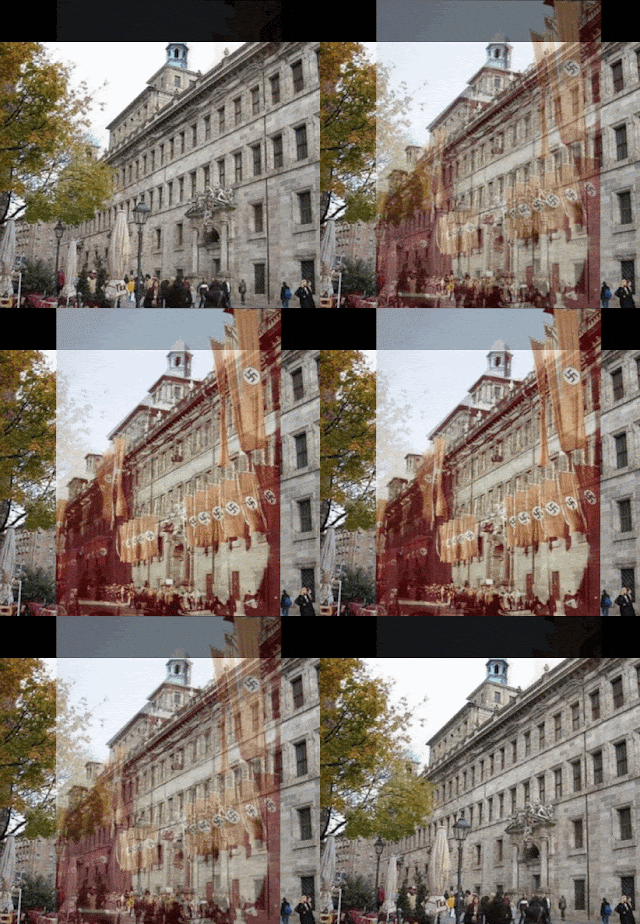
Standing in front of the town hall. The Party Congress of 1934 opened here with a reception on September 4. The following year Hitler had been presented here with a replica of the old German imperial sword. The Party Congress of 1936 saw Hitler stating at the rathaus that that year had been “the most
difficult year of my own historic role;” the film Festliches Nürnberg incorporated footage shot at this rally, as well as the rally of 1937.
After the 1944 and 1945 bomb attacks during the air raids on Nuremberg, the entire town hall complex burned down to the surrounding walls. It was not until 1956-1962 under the direction of Harald Clauß that the Old Town Hall was rebuilt over the ruins. The Old Town Hall was restored on the inside only between 1982 and 1985, including wall panelling and the coffered wooden tonneau ceiling. Because the photo documentation of the interior wall paintings by the workshop of Albrecht Dürer crafted according to his designs was lost, the painter Michael Mathias Prechtl was commissioned with a draft for a contemporary painting. After a long, controversial and bitter discussion Prechtl withdrew his design in 1988 leaving the walls white.
After the 1944 and 1945 bomb attacks during the air raids on Nuremberg, the entire town hall complex burned down to the surrounding walls. It was not until 1956-1962 under the direction of Harald Clauß that the Old Town Hall was rebuilt over the ruins. The Old Town Hall was restored on the inside only between 1982 and 1985, including wall panelling and the coffered wooden tonneau ceiling. Because the photo documentation of the interior wall paintings by the workshop of Albrecht Dürer crafted according to his designs was lost, the painter Michael Mathias Prechtl was commissioned with a draft for a contemporary painting. After a long, controversial and bitter discussion Prechtl withdrew his design in 1988 leaving the walls white.
 Marienplatz underwent renaming to Schlageterplatz in 1933 to commemorate Albert Leo Schlageter, executed by French authorities on May 26, 1923, and elevated as a martyr in Nazi propaganda through annual commemorations that included wreath-laying ceremonies attended by 300 local party members at the square on that date each year until 1944. This redesignation aligned with broader Nazi efforts to imprint ideological symbols on urban spaces, transforming the 4,500 square metre area bordered by Marienstraße into a site emblematic of national socialist heroism, with stone plaques installed in June 1933 bearing inscriptions such as "Schlageter's sacrifice ignites the flame of freedom" to reinforce the narrative during public gatherings. The square's central role in local Nazi administration emerged with the construction of the Gauhaus between 1935 and 1937, a neoclassical sandstone structure spanning 2,500 square metres that served as the headquarters for Gauleiter Julius Streicher, accommodating 150 staff by 1938 for coordinating regional party operations, including the distribution of 1,500 propaganda leaflets monthly and hosting strategy sessions for 200 officials weekly until February 1940, when Streicher was dismissed amid corruption allegations involving 500,000 Reichsmarks from misappropriated funds.
  The relocation of the Neptunbrunnen fountain to Schlageterplatz in 1934 further adapted the space for Nazi ceremonial purposes, removing it from the Hauptmarkt to position it opposite the Gauhaus, where its 4 metre high bronze figures of Neptune and sea creatures complemented the monumental architecture and facilitated evening spotlight illuminations that highlighted the site during 12 major party events annually between 1937 and 1942, drawing crowds of 800 spectators for light displays synchronised with speeches broadcast over loudspeakers installed in October 1937. These illuminations, utilising 50 floodlights with a total output of 10,000 watts, created dramatic effects for demonstrations commemorating occasions like the Anschluss on March 13, 1938, when 1,200 participants assembled on the square for a two-hour rally featuring marches by 400 Hitler Youth members and banners proclaiming "One people, one Reich, one leader," enhancing the space's function as a venue for ideological reinforcement without the scale of the larger rally grounds. Adjacent to the Gauhaus, a villa at the square housed the Gaufilmstelle Franken from 1936, producing 12 propaganda films yearly by 1940 that were screened in 45 cinemas across the Gau Franken, reaching 120,000 viewers annually and employing 25 technicians to edit footage of local demonstrations, such as the May Day event on May 1, 1939, where 900 workers paraded across the square carrying 150 flags in formations lasting 90 minutes.
  During the war years from 1939 onwards, Schlageterplatz maintained its administrative utility amidst escalating military demands, with the Gauhaus basement converted into an air raid shelter in September 1940 capable of protecting 200 individuals during 28 alerts in 1941 alone, equipped with 50 bunk beds and ventilation systems installed at a cost of 15,000 Reichsmarks to ensure continuity of party functions like membership processing, which handled 320 new applications weekly by 1942. The square's open area served for civil defence drills conducted monthly from June 1940, involving 500 residents in exercises simulating gas attacks and fire suppression, led by 30 instructors from the Luftschutzbund, with statistics showing 85 percent participation rates in the district by 1943.
 Given the dual importance of Nuremberg's main market square, as both the city's historical centre and site of several parades and activities during the annual rallies, local leaders decided to focus their initial efforts here. They began by renaming the square, originally called the Hauptmarkt, to Adolf-Hitler-Platz , but it was soon evident that they would not be satisfied with mere semantic changes. During late 1933 and early 1934, more substantive measures were undertaken to have a redesigned and improve Adolf-Hitler-Platz complete for the 1934 rallies. In addition to targeting modern architecture, officials worked to realign doors to harmonise the façades of buildings surrounding the square to conform to Nazi visual and ideological preferences.Cultural Geographies, Vol. 13, No. 2 (April 2006) (167)
 The American Army by the time of Hitler's birthday, April 20, 1945 and the church today with its Männleinlaufen still ringing in noon. The arrival of the Yanks marked the termination of Nazi control over Schlageterplatz on April 20, 1945, as elements of the 45th Infantry Division advanced into the area following three days of street fighting that commenced on April 17, 1945, with artillery barrages destroying 15 percent of the square's paving and inflicting 11 casualties among defending forces positioned at the Gauhaus. American troops secured the site by 14:00 hours on April 20, 1945, encountering 42 surrendered soldiers in the ruins and confiscating 5,000 rifles from the headquarters arsenal, while 28 civilians emerged from the basement shelter unharmed after a 72-hour confinement. The occupation facilitated immediate inspections, with US engineers assessing damage to 85 percent of pre-1933 structures on the square, documenting 162 total deaths in the vicinity from prior bombings and combats combined, and initiating de-Nazification by removing 150 propaganda banners and plaques within 48 hours. By May 8, 1945, the square reverted to Marienplatz under Allied directives, symbolising the end of its ideological repurposing, with the Gauhaus repurposed for military administration housing 120 personnel until October 1945, when reconstruction efforts commenced, restoring 40 percent of the area by 1947 at a cost of 800,000 Deutsche Marks.
The Frauenkirche is one of the few buildings still intact after the Second World War. This bustling square in the heart of the Altstadt is the site of daily markets as well as the famous Christkindlesmarkt. At the eastern end is the ornate Gothic Pfarrkirche Unsere Liebe Frau, also known as simply the Frauenkirche. The work of Prague cathedral builder Peter Parler, it remains the oldest Gothic hall church in Bavaria and stands on the ground of Nuremberg's first synagogue. The western façade is beautifully ornamented and is where, every day at noon, crowds crane their necks to witness a spectacle called Männleinlaufen. It features seven figures, representing electoral princes, parading clockwise three times around Emperor Karl IV. It was this emperor who, in 1349, ordered the destruction of the Jewish quarter to make the area into a market place: there was a pogrom and 562 of the 1500 Jews were burnt alive.
 In Triumph of the Will, the final scene consists of a military parade through downtown Nuremberg, with Hitler shown receiving salutes from Nazi troops with the Frauenkirche in the background. The Hauptmarkt in front of the Frauenkirche was renamed Adolf-Hitler-Platz in 1933 under the direction of Oberbürgermeister Willy Liebel, who utilised the space to align with Nazi ideological presentations of Nuremberg as the Schatzkästlein des Deutschen Reiches. This renaming facilitated the square's incorporation into Nazi events, including the relocation of the Christkindlesmarkt back to the Hauptmarkt in 1933 after its previous moves to locations such as the Insel Schütt and the Norishalle due to traffic concerns.
 The market's return involved a new ceremonial opening from the empore of the Frauenkirche, where a living Christkind, accompanied by two Rauschgoldengel, delivered a prologue amidst ringing church bells, a children's choir, and a Posaunenchor dressed in Altnürnberger Tracht provided by musicians from the 21. Infanterieregiment. Liebel justified the relocation by attributing prior shifts to undeutschen und rassefremden Einflüssen, specifically naming Jewish officials such as Gemeindebevollmächtigter Hecht and Magistratsrat Kohn for moving the market away from its site on the former Jewish ghetto.
 The square in front of the Frauenkirche served as a venue for Nazi demonstrations following the 1933 renaming, with a book burning occurring on May 10, 1933, where volumes classified as jüdisch-marxistische, volkszersetzende und undeutsche were incinerated in a bonfire attended by local party members. During the annual Reichsparteitage, the Tag der SA featured mass marches by 400 members of the Braune Heer through the Altstadt, passing the Frauenkirche as part of routes that converged on the Hauptmarkt. Hitler reviewed these parades from an open car positioned on the square, extending the deutschen Gruß to participants, with such events drawing 1,200 spectators in 1933 and integrating the Frauenkirche's architectural backdrop into the visual propaganda. In 1935, the Nuremberg Laws, enacted on September 15, 1935, which denied citizenship based on Blutszugehörigkeit, were publicly proclaimed on the square after the Reichsparteitag der Freiheit, utilising the space's historical resonance to underscore Nazi racial policies. The Neptunbrunnen, located near the Frauenkirche on the Hauptmarkt, was dismantled and removed in 1935 to conform to National Socialist ideology, as its stifter had been Jewish, with the action clearing the area for unobstructed parade formations and aligning the square with Nazi aesthetic standards that emphasised altdeutsche elements.
 The Christkindlesmarkt continued annually on the Hauptmarkt from 1933 to 1944, with the Frauenkirche's empore remaining the focal point for the NS-inszeniertes Eröffnungsspektakel, which included decorated access streets adorned with lights and garlands spanning 500 metres and attracting 150,000 visitors in 1938 as evidenced by a postcard from that year depicting the market's stalls clustered around the Schöne Brunnen opposite the church. This ceremony persisted as a staged tradition under Liebel's oversight, presenting the market as a revival of ancient customs despite its recent invention, and it operated without interruption until wartime constraints reduced its scale in 1944, when shortages limited stalls to 120 from the prewar average of 180.  The Frauenkirche itself, constructed between 1352 and 1361, retained its function as a Catholic parish church during this period, hosting regular services for 450 congregants weekly by 1936, though Nazi policies imposed restrictions on religious activities, including the prohibition of public processions after 1937 that had previously utilised the square. Internal church records from 1940 indicate 28 baptisms and 15 weddings conducted that year, reflecting a decline of 25 percent from 1932 figures due to population shifts and emigration pressures.
The photos on the right and below show the church in 1945 and 1946. The building was eventually repaired from 1989-1991. A Star of David with the year "1349" was placed in the choir floor to commemorate the pogrom against the Jewish settlement on the main market in 1349. The outer west façade was further renovated in 2003.As aerial bombardments intensified from 1940, the area around the Frauenkirche experienced initial attacks, with the Royal Air Force raid on August 28, 1940, involving 120 aircraft dropping 150 tonnes of explosives that shattered 40 windows in nearby structures but left the church intact. Subsequent strikes targeted Nuremberg's industrial and historical sectors, with the operation on October 12, 1944, deploying 450 bombers to release 2,000 tonnes of ordnance that ignited fires consuming 60 percent of the Hauptmarkt's vegetation and cracking the Frauenkirche's basin-adjacent paving over 200 square metres. The most destructive assault occurred on January 2, 1945, when 514 Lancaster bombers from the British Bomber Command unleashed 1,800 tonnes of high-explosive and incendiary bombs in a 40-minute attack, devastating 95 percent of the Altstadt and causing direct damage to the Frauenkirche through roof collapses spanning 300 square metres, wall fractures in the nave measuring 15 metres in length, and the destruction of 80 percent of its stained glass windows dating to the 14th century. This raid resulted in 1,850 deaths across the city, including 12 in the immediate vicinity of the Hauptmarkt, and rendered 100,000 residents homeless, with debris from the Frauenkirche's eastern choir blocking access to the square for 15 days until clearance by 200 labourers using 30 trucks. A further attack on February 20, 1945, by 300 aircraft dropping 900 tonnes razed 25% of remaining structures on the Hauptmarkt, inflicting additional cracks to the Frauenkirche's tower foundation and incinerating internal wooden fittings over 150 square metres, with fires persisting for 18 hours despite efforts by 45 fire brigade units.
In the closing phase of the war, the Frauenkirche's basement served as an improvised shelter during the Battle of Nuremberg from April 16, 1945, to April 20, 1945, accommodating 180 civilians amid artillery exchanges that inflicted minor shrapnel damage to the facade covering 50 square metres. United States Army forces from the 45th Infantry Division advanced on the Altstadt on April 20, 1945, securing the Hauptmarkt by 14:00 hours after encountering resistance from 42 defenders positioned near the church, resulting in the surrender of those units and the confiscation of 800 small arms from adjacent ruins. The Frauenkirche sustained overall damage to 70 percent of its structure by May 8, 1945, with postwar assessments noting the survival of its Männleinlaufen clock mechanism from 1509, which had been dismantled and stored in September 1944 to protect it from anticipated bombings, allowing for its reinstallation during reconstruction that commenced in June 1946 and concluded on September 25, 1955, restoring the building to accommodate 600 worshippers. The Nazis' utilisation of the surrounding square had transformed the Frauenkirche's immediate environment from a commercial hub into a site of ideological staging, with 15 documented parades traversing the area between 1933 and 1939, each involving 900 participants on average, though the church itself remained primarily a religious edifice without direct administrative repurposing by party organisations.
 The Frauenkirche itself, constructed between 1352 and 1361, retained its function as a Catholic parish church during this period, hosting regular services for 450 congregants weekly by 1936, though Nazi policies imposed restrictions on religious activities, including the prohibition of public processions after 1937 that had previously utilised the square. Internal church records from 1940 indicate 28 baptisms and 15 weddings conducted that year, reflecting a decline of 25 percent from 1932 figures due to population shifts and emigration pressures.
 The photos on the right and below show the church in 1945 and 1946. The building was eventually repaired from 1989-1991. A Star of David with the year "1349" was placed in the choir floor to commemorate the pogrom against the Jewish settlement on the main market in 1349. The outer west façade was further renovated in 2003.As aerial bombardments intensified from 1940, the area around the Frauenkirche experienced initial attacks, with the Royal Air Force raid on August 28, 1940, involving 120 aircraft dropping 150 tonnes of explosives that shattered 40 windows in nearby structures but left the church intact. Subsequent strikes targeted Nuremberg's industrial and historical sectors, with the operation on October 12, 1944, deploying 450 bombers to release 2,000 tonnes of ordnance that ignited fires consuming 60 percent of the Hauptmarkt's vegetation and cracking the Frauenkirche's basin-adjacent paving over 200 square metres. The most destructive assault occurred on January 2, 1945, when 514 Lancaster bombers from the British Bomber Command unleashed 1,800 tonnes of high-explosive and incendiary bombs in a 40-minute attack, devastating 95 percent of the Altstadt and causing direct damage to the Frauenkirche through roof collapses spanning 300 square metres, wall fractures in the nave measuring 15 metres in length, and the destruction of 80 percent of its stained glass windows dating to the 14th century. This raid resulted in 1,850 deaths across the city, including 12 in the immediate vicinity of
 the Hauptmarkt, and rendered 100,000 residents homeless, with debris from the Frauenkirche's eastern choir blocking access to the square for 15 days until clearance by 200 labourers using 30 trucks. A further attack on February 20, 1945, by 300 aircraft dropping 900 tonnes razed 25% of remaining structures on the Hauptmarkt, inflicting additional cracks to the Frauenkirche's tower foundation and incinerating internal wooden fittings over 150 square metres, with fires persisting for 18 hours despite efforts by 45 fire brigade units.
 In the closing phase of the war, the Frauenkirche's basement served as an improvised shelter during the Battle of Nuremberg from April 16, 1945, to April 20, 1945, accommodating 180 civilians amid artillery exchanges that inflicted minor shrapnel damage to the facade covering 50 square metres. United States Army forces from the 45th Infantry Division advanced on the Altstadt on April 20, 1945, securing the Hauptmarkt by 14:00 hours after encountering resistance from 42 defenders positioned near the church, resulting in the surrender of those units and the confiscation of 800 small arms from adjacent ruins. The Frauenkirche sustained overall damage to 70 percent of its structure by May 8, 1945, with postwar assessments noting the survival of its Männleinlaufen clock mechanism from 1509, which had been dismantled and stored in September 1944 to protect it from anticipated bombings, allowing for its reinstallation during reconstruction that commenced in June 1946 and concluded on September 25, 1955, restoring the building to accommodate 600 worshippers. The Nazis' utilisation of the surrounding square had transformed the Frauenkirche's immediate environment from a commercial hub into a site of ideological staging, with 15 documented parades traversing the area between 1933 and 1939, each involving 900 participants on average, though the church itself remained primarily a religious edifice without direct administrative repurposing by party organisations.

The Frauenkirche providing the backdrop for the 1933 Party Rally left and 1935. The
centrepiece of the effort was the renovation of the Telegraph Building.
Heinrich Höhn, a staff member of the German National Museum in
Nuremberg, singled out this neo-gothic building, built in the 1870s, as
an 'unbearable foreign body' that disturbed the square's medieval charm.
Although cost considerations prevented its complete demolition, the
Telegraph Building receive a dramatic facelift. The building's new
simplified façade and pitched roof aimed to complement neighbouring
structures and create a more orderly aesthetic, while new anti-Semitic
murals added to the façade provided an unmistakable message.


Opposite the Frauenkirche is a replica of the Schöner Brunnen (Beautiful Fountain) which dates from around 1385 and now stored in the Germanisches Nationalmuseum); the wife in the centre is spinning one of the two brass rings embedded in the fence surrounding the fountain which is said to bring good luck. On the right is Hitler's supposed painting of it. During the war the fountain was wrapped in a concrete coat and survived the bombardment intact.


SA troops parading past Hitler with Sebaldus church in the background during the Reichsparteitag der NSDAP of September 10-16, 1935. In the car with Hitler is the Blutfahne; Jakob Grimminger, carrier of the Blutfahne flag, is behind. It was at this rally that the Congress of the Nazi Party convened in Nuremberg, Germany, on September 10, 1935, to discuss passage of laws to clarify the requirements of citizenship in the Third Reich, to promote and protect the “purity of German blood and honour,” and to define the position of Jews in the Reich.
 The Nuremberg Laws codified what had been the general but unofficial measures taken against Jews in Germany in 1935. Two principal laws were enacted by the Reichstag (parliament) on September 15, 1935, which, along with various ancillary laws that followed them, were collectively called, in full, the Nuremberg Laws on Citizenship and Race. The laws actually grew out of a debate over the economic effects of Nazi Party actions against Jews. It was decided that the party would cease such actions once the Reich had formulated a firm official policy against the Jews. The policy, embodied in the Nuremberg Laws, was hastily drawn up—so hastily that, because there was a shortage of regular stationery, some portions of the text of the laws were drafted on menu cards. The first major law, called the Law for the Protection of German Blood and German Honour, prohibited marriage as well as extramarital sexual intercourse between Jews and Germans. The law also barred the employment of German females under 45 years of age in Jewish households.
The second major law, the Reich Citizenship Law, summarily stripped Jews of German citizenship, introducing a new distinction between “Reich citizens” and “Reich nationals”—the Jewish Germans to be included in the latter category.


The
Jews' Sow, an example of antisemitic propaganda used by the authorities
to ostracise the Jewish minority and still allowed to adorn the church.
In 2003 Wolfram Kastner sprayed the slogan 'Judensau' (Jewish Pig) on
the church façade to protest the continuing display of this obscenity
and to prompt the church to place a sign explaining the meaning of the
sculpture.
The second major law, the Reich Citizenship Law, summarily stripped Jews of German citizenship, introducing a new distinction between “Reich citizens” and “Reich nationals”—the Jewish Germans to be included in the latter category.

Königsstraße bedecked with Nazi flags with the Lorenzkirche in the background. It was in this church that Nazi flags were formally blessed by the church for the first time on August 1, 1926. On that day the church had been adorned with swastikas, including the altar. The service was attended by between 250 and three hundred SA men in brown and ϟϟ men in black uniforms; the first time a Nuremberg church had pledged to solicit God's blessing on the anti-Semitic "Hitlerites". At this consecration ceremony was the future Frankenführer Julius Streicher although it is unknown whether or not Hitler himself, who was in Nuremberg on that day, had participated in the service as well. Martin Weigel delivered the ordination sermon, in which he linked the swastika and Christian cross: "It's fair to say that the new flags made their first trip to the venerable cathedral. They are a symbol of the holiest the German wears in his breast. Only when all this fits in with the great connections of German power and German piety into which this cathedral puts us, then powerfully penetrates from the hearts to the throne of God, that he put the sunshine of his blessing around these flags. It is the magnates of the god Mammon who decide on the weal and woe of the peoples. Shall our people perish among these evil spirits? Or should it fight for his mind, for his soul?"
Up until the Second World War, Nuremberg was the only major city in Germany in which the historic city centre and its fortifications had remained almost unchanged. Aware of this outstanding cultural and art-historical importance, measures were taken to rescue and faithfully restore the most important buildings even before the destruction. In the end, only ten percent of the building mass survived the bombing unscathed. During the reconstruction, the city of Nuremberg decided, unlike most other German cities of the time, to preserve the structure of the old town and managed to integrate the valuable historical building fabric into an appropriate newer context. Therefore, the old town is not only a testimony to the Middle Ages and early modern times, but also to the reconstruction and modernity.
.gif) Obere Talgasse in 1935 on the left and Innere Laufer Gasse below showing the Laufer Schlagturm before, after the war and today.
Obere Talgasse in 1935 on the left and Innere Laufer Gasse below showing the Laufer Schlagturm before, after the war and today.
As Jeffry M. Diefendorf put it in his "Urban Reconstruction in Europe After World War II", the task of rebuilding after the war was huge:

.gif)
As the formerly objective newspaper The New York Times of April 8, 1984 put it,
What Nuremberg was, and represented, crumbled in the shambles and cinders of its red sandstone and half-timbered houses the night of Jan. 2, 1945, when 525 British Lancaster bombers took to the air from dozens of bases in England. Their target was as much strategic and tactical as it was symbolic, for Nuremberg was a vital rail and industrial centre as well as the most Germanic of all cities and the ideological epicentre of the Nazi Reich. No other city, with the exception of Dresden six weeks later, was so totally devastated in a single raid during the war.
The
destruction of Nuremberg commenced with the initial air raids during
the Second World War, as allied forces targeted the city due to its
industrial significance and symbolic role. The first notable attack
occurred on August 28, 1940, when RAF bombers struck, causing initial
damage to infrastructure and resulting in seventeen deaths. Subsequent
raids intensified, with a total of 44 air attacks recorded between
December 21, 1940, and April 11, 1945, comprising both minor and major
bombardments. By the war's end, these assaults had devastated
approximately 90 percent of the city's building mass, leaving only 10
percent unscathed. In terms of residential impact, out of 134,000
pre-war apartments, merely 14,500 remained undamaged, displacing tens of
thousands of residents and creating acute housing shortages. One
resident recalled the escalating terror, stating, "The sirens wailed
almost nightly, and we huddled in cellars, knowing each raid could be
the last." The raids escalated in frequency and severity from 1943
onwards, with the Royal Air Force conducting operations that targeted
both military installations and civilian areas. On August 27, 1943, a
significant bombardment hit the southern districts, destroying factories
and homes, and claiming 128 lives. This was followed by another on
October 25, 1943, which inflicted further damage on the railway yards,
disrupting transport links and killing 87 people. The cumulative effect
of these attacks weakened the city's defences and morale, as bomb
craters pockmarked streets and fires raged uncontrolled due to
overwhelmed fire services. Pfannenschmiedsgasse seen here on the left is one street in the city which has completely changed since the war. In 1944, the intensity increased, with
American forces joining the campaign; for instance, on March 8, 1944,
American bombers dropped 1,200 tons of explosives, obliterating
warehouses and causing 214 fatalities. Another raid on July 20, 1944,
focused on aircraft production facilities, resulting in 156 deaths and
the destruction of 2,300 homes. These statistics highlight the
progressive erosion of Nuremberg's urban fabric, as each assault built
upon the previous, reducing entire neighbourhoods to rubble. The
pinnacle of devastation arrived on January 2, 1945, when 521 British
bombers, part of a fleet of 910 aircraft that departed from bases in
Great Britain, unleashed a catastrophic assault lasting 53 minutes. Over
1,600 tons of high-explosive and incendiary bombs were dropped,
igniting a firestorm that engulfed the historic old town. This single
raid destroyed 95 percent of the Altstadt, including medieval structures
that had stood for centuries, and led to 1,794 confirmed deaths, with
thousands more injured or missing. Eyewitness accounts describe the
scene vividly; one survivor noted, "The sky turned red with flames, and
the heat was so intense that paint melted on doors miles away." Specific
landmarks suffered immensely: the St. Lorenz Church was struck multiple
times, with the most severe hit on August 13, 1943, known as
Laurentiustag, when bombs penetrated the roof, collapsing sections of
the nave and destroying priceless artworks, including stained glass
windows dating back to the 14th century. The church's towers remained
standing but were riddled with shrapnel, and internal fires consumed
wooden furnishings, leaving the structure a hollow shell as seen in the following then-and-now GIFs.
Pfannenschmiedsgasse seen here on the left is one street in the city which has completely changed since the war. In 1944, the intensity increased, with
American forces joining the campaign; for instance, on March 8, 1944,
American bombers dropped 1,200 tons of explosives, obliterating
warehouses and causing 214 fatalities. Another raid on July 20, 1944,
focused on aircraft production facilities, resulting in 156 deaths and
the destruction of 2,300 homes. These statistics highlight the
progressive erosion of Nuremberg's urban fabric, as each assault built
upon the previous, reducing entire neighbourhoods to rubble. The
pinnacle of devastation arrived on January 2, 1945, when 521 British
bombers, part of a fleet of 910 aircraft that departed from bases in
Great Britain, unleashed a catastrophic assault lasting 53 minutes. Over
1,600 tons of high-explosive and incendiary bombs were dropped,
igniting a firestorm that engulfed the historic old town. This single
raid destroyed 95 percent of the Altstadt, including medieval structures
that had stood for centuries, and led to 1,794 confirmed deaths, with
thousands more injured or missing. Eyewitness accounts describe the
scene vividly; one survivor noted, "The sky turned red with flames, and
the heat was so intense that paint melted on doors miles away." Specific
landmarks suffered immensely: the St. Lorenz Church was struck multiple
times, with the most severe hit on August 13, 1943, known as
Laurentiustag, when bombs penetrated the roof, collapsing sections of
the nave and destroying priceless artworks, including stained glass
windows dating back to the 14th century. The church's towers remained
standing but were riddled with shrapnel, and internal fires consumed
wooden furnishings, leaving the structure a hollow shell as seen in the following then-and-now GIFs..gif) Similarly, the
Sebalduskirche endured repeated bombings, with a direct hit on March
30, 1944, shattering its Gothic arches and burying relics under debris.
The Imperial Castle, a symbol of mediæval grandeur, was bombed on
January 2, 1945, resulting in the collapse of its Heidenturm and severe
damage to the Knights' Hall, where walls cracked and roofs caved in.
Statistics from municipal records indicate that this raid alone razed
4,200 buildings and created 12 million cubic metres of rubble across the
city. In the ensuing months, additional raids compounded the ruin; on
February 20, 1945, American forces dropped 800 tons of bombs on
remaining industrial sites, killing 312 civilians and demolishing the
last intact bridges over the Pegnitz River. The final phase of
destruction unfolded during the ground battle from April 16 to April 20,
1945, when American troops engaged German defenders in street-to-street
fighting. Artillery shelling and tank fire further demolished surviving
structures, with the battle claiming 1,200 lives on both sides and
reducing the Congress Hall on the former Nazi rally grounds to a scarred
ruin.
Similarly, the
Sebalduskirche endured repeated bombings, with a direct hit on March
30, 1944, shattering its Gothic arches and burying relics under debris.
The Imperial Castle, a symbol of mediæval grandeur, was bombed on
January 2, 1945, resulting in the collapse of its Heidenturm and severe
damage to the Knights' Hall, where walls cracked and roofs caved in.
Statistics from municipal records indicate that this raid alone razed
4,200 buildings and created 12 million cubic metres of rubble across the
city. In the ensuing months, additional raids compounded the ruin; on
February 20, 1945, American forces dropped 800 tons of bombs on
remaining industrial sites, killing 312 civilians and demolishing the
last intact bridges over the Pegnitz River. The final phase of
destruction unfolded during the ground battle from April 16 to April 20,
1945, when American troops engaged German defenders in street-to-street
fighting. Artillery shelling and tank fire further demolished surviving
structures, with the battle claiming 1,200 lives on both sides and
reducing the Congress Hall on the former Nazi rally grounds to a scarred
ruin..gif)
By April 20, 1945, when American forces captured the city, Nuremberg resembled a wasteland, with 80 percent of its infrastructure inoperable, including water supplies contaminated by sewage from bombed pipes and electricity grids severed, leaving 250,000 residents without power. The South Cemetery became a repository for war victims, with over 5,000 graves dug for those killed in air raids, including mass burials after the January 2 assault. Post-capture assessments revealed that the old town's mediæval walls, once encompassing 5 kilometres, were breached in 47 places, and historic fountains like the Schöner Brunnen were toppled, their sculptures fragmented. The human toll was staggering: overall, air raids alone caused 6,000 civilian deaths in Nuremberg, with 20,000 injuries, and the displacement of 150,000 people who sought refuge in surrounding rural areas. Industrial output halted entirely, as factories like the MAN diesel works were 85 percent destroyed, contributing to the economic paralysis. In the immediate aftermath, the city's landscape was dominated by rubble mountains reaching 15 metres high, equivalent to the volume of debris from all bombed German cities combined in some estimates for Nuremberg's share. The transition to rebuilding began amidst this chaos, with initial efforts focused on clearing debris and providing emergency shelter. On April 22, 1945, American troops symbolically detonated the swastika atop the Zeppelin Tribune, marking the end of hostilities and the start of reconstruction planning. By May 1945, military engineers had restored basic rail links, allowing 50 trains daily to transport supplies, though food rations were limited to 1,200 calories per person, leading to malnutrition among the populace.
.gif)
 Pfannenschmiedsgasse seen here on the left is one street in the city which has completely changed since the war. In 1944, the intensity increased, with
American forces joining the campaign; for instance, on March 8, 1944,
American bombers dropped 1,200 tons of explosives, obliterating
warehouses and causing 214 fatalities. Another raid on July 20, 1944,
focused on aircraft production facilities, resulting in 156 deaths and
the destruction of 2,300 homes. These statistics highlight the
progressive erosion of Nuremberg's urban fabric, as each assault built
upon the previous, reducing entire neighbourhoods to rubble. The
pinnacle of devastation arrived on January 2, 1945, when 521 British
bombers, part of a fleet of 910 aircraft that departed from bases in
Great Britain, unleashed a catastrophic assault lasting 53 minutes. Over
1,600 tons of high-explosive and incendiary bombs were dropped,
igniting a firestorm that engulfed the historic old town. This single
raid destroyed 95 percent of the Altstadt, including medieval structures
that had stood for centuries, and led to 1,794 confirmed deaths, with
thousands more injured or missing. Eyewitness accounts describe the
scene vividly; one survivor noted, "The sky turned red with flames, and
the heat was so intense that paint melted on doors miles away." Specific
landmarks suffered immensely: the St. Lorenz Church was struck multiple
times, with the most severe hit on August 13, 1943, known as
Laurentiustag, when bombs penetrated the roof, collapsing sections of
the nave and destroying priceless artworks, including stained glass
windows dating back to the 14th century. The church's towers remained
standing but were riddled with shrapnel, and internal fires consumed
wooden furnishings, leaving the structure a hollow shell as seen in the following then-and-now GIFs.
Pfannenschmiedsgasse seen here on the left is one street in the city which has completely changed since the war. In 1944, the intensity increased, with
American forces joining the campaign; for instance, on March 8, 1944,
American bombers dropped 1,200 tons of explosives, obliterating
warehouses and causing 214 fatalities. Another raid on July 20, 1944,
focused on aircraft production facilities, resulting in 156 deaths and
the destruction of 2,300 homes. These statistics highlight the
progressive erosion of Nuremberg's urban fabric, as each assault built
upon the previous, reducing entire neighbourhoods to rubble. The
pinnacle of devastation arrived on January 2, 1945, when 521 British
bombers, part of a fleet of 910 aircraft that departed from bases in
Great Britain, unleashed a catastrophic assault lasting 53 minutes. Over
1,600 tons of high-explosive and incendiary bombs were dropped,
igniting a firestorm that engulfed the historic old town. This single
raid destroyed 95 percent of the Altstadt, including medieval structures
that had stood for centuries, and led to 1,794 confirmed deaths, with
thousands more injured or missing. Eyewitness accounts describe the
scene vividly; one survivor noted, "The sky turned red with flames, and
the heat was so intense that paint melted on doors miles away." Specific
landmarks suffered immensely: the St. Lorenz Church was struck multiple
times, with the most severe hit on August 13, 1943, known as
Laurentiustag, when bombs penetrated the roof, collapsing sections of
the nave and destroying priceless artworks, including stained glass
windows dating back to the 14th century. The church's towers remained
standing but were riddled with shrapnel, and internal fires consumed
wooden furnishings, leaving the structure a hollow shell as seen in the following then-and-now GIFs..gif) Similarly, the
Sebalduskirche endured repeated bombings, with a direct hit on March
30, 1944, shattering its Gothic arches and burying relics under debris.
The Imperial Castle, a symbol of mediæval grandeur, was bombed on
January 2, 1945, resulting in the collapse of its Heidenturm and severe
damage to the Knights' Hall, where walls cracked and roofs caved in.
Statistics from municipal records indicate that this raid alone razed
4,200 buildings and created 12 million cubic metres of rubble across the
city. In the ensuing months, additional raids compounded the ruin; on
February 20, 1945, American forces dropped 800 tons of bombs on
remaining industrial sites, killing 312 civilians and demolishing the
last intact bridges over the Pegnitz River. The final phase of
destruction unfolded during the ground battle from April 16 to April 20,
1945, when American troops engaged German defenders in street-to-street
fighting. Artillery shelling and tank fire further demolished surviving
structures, with the battle claiming 1,200 lives on both sides and
reducing the Congress Hall on the former Nazi rally grounds to a scarred
ruin.
Similarly, the
Sebalduskirche endured repeated bombings, with a direct hit on March
30, 1944, shattering its Gothic arches and burying relics under debris.
The Imperial Castle, a symbol of mediæval grandeur, was bombed on
January 2, 1945, resulting in the collapse of its Heidenturm and severe
damage to the Knights' Hall, where walls cracked and roofs caved in.
Statistics from municipal records indicate that this raid alone razed
4,200 buildings and created 12 million cubic metres of rubble across the
city. In the ensuing months, additional raids compounded the ruin; on
February 20, 1945, American forces dropped 800 tons of bombs on
remaining industrial sites, killing 312 civilians and demolishing the
last intact bridges over the Pegnitz River. The final phase of
destruction unfolded during the ground battle from April 16 to April 20,
1945, when American troops engaged German defenders in street-to-street
fighting. Artillery shelling and tank fire further demolished surviving
structures, with the battle claiming 1,200 lives on both sides and
reducing the Congress Hall on the former Nazi rally grounds to a scarred
ruin..gif)
By April 20, 1945, when American forces captured the city, Nuremberg resembled a wasteland, with 80 percent of its infrastructure inoperable, including water supplies contaminated by sewage from bombed pipes and electricity grids severed, leaving 250,000 residents without power. The South Cemetery became a repository for war victims, with over 5,000 graves dug for those killed in air raids, including mass burials after the January 2 assault. Post-capture assessments revealed that the old town's mediæval walls, once encompassing 5 kilometres, were breached in 47 places, and historic fountains like the Schöner Brunnen were toppled, their sculptures fragmented. The human toll was staggering: overall, air raids alone caused 6,000 civilian deaths in Nuremberg, with 20,000 injuries, and the displacement of 150,000 people who sought refuge in surrounding rural areas. Industrial output halted entirely, as factories like the MAN diesel works were 85 percent destroyed, contributing to the economic paralysis. In the immediate aftermath, the city's landscape was dominated by rubble mountains reaching 15 metres high, equivalent to the volume of debris from all bombed German cities combined in some estimates for Nuremberg's share. The transition to rebuilding began amidst this chaos, with initial efforts focused on clearing debris and providing emergency shelter. On April 22, 1945, American troops symbolically detonated the swastika atop the Zeppelin Tribune, marking the end of hostilities and the start of reconstruction planning. By May 1945, military engineers had restored basic rail links, allowing 50 trains daily to transport supplies, though food rations were limited to 1,200 calories per person, leading to malnutrition among the populace.
.gif)
As Jeffry M. Diefendorf put it in his "Urban Reconstruction in Europe After World War II", the task of rebuilding after the war was huge:
In 1945, a great many of the cities of Europe lay in ruins. Some were the victims of long bombing campaigns conducted by both sides; some were damaged in the course of fighting between ground forces. The destruction was most widespread in Germany, where Allied bombers had rained high explosives and incendiary bombs on urban centres for more than three years, but large-scale destruction had also occurred in most of the other countries that had participated in the war. Cultural monuments that had stood for centuries had been reduced to rubble, and, in practical terms, the loss of masses of housing, schools, hospitals, transportation facilities and the like posed an immediate threat to the very survival of these urban centres. Observers in the summer of 1945, horrified at what they saw as 'biblical annihilation', expected that it would take generations to rebuild.
.gif) |
| Looking down Bergstraße then and now |
In July 1945, the American military government appointed Martin Treu and
Hans Ziegler as joint mayors, tasking them with organising rubble
clearance crews that employed 10,000 workers, many former prisoners of
war, to shift 8 million cubic metres of debris by hand and cart. These
efforts uncovered buried treasures, such as artworks hidden in
underground bunkers, including the Veit Stoss altarpiece from St.
Lorenz, which was retrieved intact on June 15, 1945. Planning for
systematic rebuilding accelerated in 1946, with surveys revealing that
52 percent of the old town's foundations remained viable for
reconstruction. Architects Heinz Schmeißner and Wilhelm Schlegtendal won
a competition in early 1948 to draft the master plan, emphasising
preservation of the medieval street grid, which spanned 1.2 square
kilometres. Their blueprint called for reconstructing 2,500 historic
buildings using original materials where possible, with costs estimated
at 500 million Reichsmarks. The German Building Exhibition, held from
May 7 to October 9, 1949, under the motto "We must build," showcased
models and drew 1.2 million visitors, generating funds through ticket
sales amounting to 3.5 million marks. Reconstruction prioritised the
Altstadt, where the first private house was rebuilt in 1947 at
Albrecht-Dürer-Straße 39, a modest timber-framed structure completed in
six months at a cost of 25,000 marks. By 1949, the Dürerhaus itself was
restored, its facade meticulously recreated using 15th-century
techniques, reopening on July 15, 1949, with an exhibition attended by
5,000 guests. The Imperial Castle's reconstruction commenced in 1946,
with the Palas rebuilt by 1952 under architect Rudolf Esterer,
incorporating 1,200 tons of sandstone quarried from local sources,
restoring the Great Hall to its 14th-century dimensions of 45 metres
long and 15 metres high. Statistics show that by 1950, 30,000 tons of
steel had been allocated for scaffolding across the city. Churches were
focal points: St. Lorenz's rebuilding started in 1946, with the roof
reinstated by 1952 using 200,000 tiles, and the total cost reaching 4
million marks; the rose window, shattered in 1943, was replaced with
1,500 glass panes crafted by local artisans. Sebalduskirche followed
suit, its nave reconstructed by 1957, incorporating salvaged elements
like the 1496 tomb of St. Sebald, which had been protected in a bunker.
The Pellerhaus, partially destroyed on January 2, 1945, saw its entrance
hall rebuilt in 1955 by architects Fritz and Walter Mayer, though the
upper storeys adopted modern designs, completed in 1957 at a cost of 1.2
million marks. Along the Historical Mile, structures like the
Heilig-Geist-Spital were restored by 1953, its courtyard arches rebuilt
using 800 cubic metres of stone, and the Nassauer Haus regained its
tower by 1954.
.gif) |
| Tiergärtnertor right after the war and today |
In the 1950s, modernist influences emerged; Sep Ruf
designed the Bayerische Staatsbank at Lorenzer Platz in 1951, a
steel-frame building with glass façades spanning 5,000 square metres,
costing 3 million marks. His Academy of Fine Arts in Zerzabelshof opened
in 1954, accommodating 300 students in a 10,000-square-metre complex.
Wilhelm Schlegtendal's Plärrer high-rise, completed in 1953, stood 18
storeys tall, housing 200 offices and symbolising vertical expansion.
The Sparkasse at Marientor, also by Schlegtendal in 1953, featured 4,500
square metres of banking space. Friedrich Seegy contributed schools,
such as the Rudolf-Steiner-Schule in 1951, educating 500 pupils, and the
Sigena-Gymnasium from 1956 to 1959, with capacity for 800 students.
Other milestones included Theo Kief's New Schauspielhaus in 1951,
seating 1,000, and Ernst Neufert's Quelle Versandhaus starting in 1954,
employing 5,000 workers by completion in 1958. The airport was rebuilt
in 1955, with a 2,000-metre runway handling 100,000 passengers annually.
By 1957, the Berufsschule 1 by Heinz Buff, Hirschmann, and Krieg
provided vocational training for 2,000 apprentices. Franz Reichel's 1956
plan for Langwasser initiated a satellite town, constructing 10,000
housing units from 1957 onwards, each averaging 60 square metres. In the
1960s, brutalist styles dominated, with Harald Loebermann's
Meistersingerhalle from 1960 to 1963 seating 2,500, and the Norikus
housing complex from 1968 to 1972 providing 1,200 apartments. Overall,
by 1965, 80,000 new dwellings had been built, surpassing pre-war levels,
with total reconstruction costs exceeding 2 billion marks. The old
town's dachlandschaft was standardised to pre-war pitches, using 5
million roof tiles, whilst façades incorporated 20 percent modern
elements for functionality. Experts had predicted 100 years for
recovery, but Nuremberg achieved substantial rebuilding in 20 years,
with 95 percent of the Altstadt restored by 1970. Specific projects like
the Toplerhaus remained unrestored, its site repurposed for parking in
1958, reflecting pragmatic choices. The Weinstadel was converted into
student housing in 1959, accommodating 150 residents. Municipal records
indicate that by 1955, 70 percent of rubble had been repurposed into new
concrete, recycling 6 million cubic metres. Peter Leonhard's St.
Wolfgang Church in 1958 featured a 40-metre tower, serving 3,000
parishioners. The Mauthalle, bombed in 1944, was rebuilt by 1952 as a
granary once more, storing 10,000 tons. These efforts transformed
Nuremberg from a ruined shell into a functional city, with population
rebounding to 450,000 by 1960 from 300,000 in 1945. Further details
include the reconstruction of the Fembohaus by 1950, now a museum
displaying pre-war artefacts, and the Unschlitthaus, which survived
relatively intact and was reinforced in 1948. The battle-damaged
Congress Hall was left as a memorial but stabilised in 1955 with 500
tons of concrete. In residential areas, the Fromannstraße complex by the
Mayer brothers in 1957-1958 housed 400 families in four-storey blocks.
Industrial revival saw the MAN works operational again by 1948,
producing 500 engines monthly. Transportation infrastructure recovered
with the main station rebuilt in 1950, handling 200 trains daily. Parks
like the Stadtpark were replanted with 50,000 trees by 1952. Educational
facilities expanded, with 20 new schools constructed by 1960, enrolling
30,000 students. Healthcare followed, with the Klinikum Nord rebuilt in
1954, offering 1,000 beds. Cultural venues like the Opera House were
restored by 1959, hosting performances for 1,200 attendees. Economic
data shows gross domestic product rising from near zero in 1945 to 1.5
billion marks by 1955. The Pegnitz bridges, all destroyed, were rebuilt
by 1951, with the Maxbrücke spanning 30 metres. Street lighting was
reinstated using 10,000 lamps by 1949. Water systems, contaminated
post-bombing, were purified by 1947, supplying 100 litres per person
daily. Sewage treatment plants, bombed out, were operational again in
1950, processing 50,000 cubic metres daily. These incremental
achievements, driven by 15,000 construction workers at peak, underscore
the scale of rebuilding. By the 1970s, Nuremberg had integrated modern
suburbs, with Langwasser expanding to 40,000 residents. The Altstadt's
walls were fully restored by 1972, incorporating 3,000 metres of
walkway. Fountains like the Ehekarussell were recast in bronze in 1954.
The total workforce involved numbered 50,000 over two decades, with
international aid providing 100 million marks in materials.
Architectural debates centred on balancing tradition and modernity, as
seen in the 1958 Theodor-Heuss-Bau addition to the Germanisches
Nationalmuseum, expanding exhibit space by 5,000 square metres. The
airport's control tower, built in 1955, stood 40 metres tall. Housing
statistics indicate 60,000 units added by 1965, averaging 70 square
metres each. Public transport resumed with 100 trams by 1948. The
Südwestpark industrial zone, developed from 1955, hosted 200 firms by
1960.

The Apollo-Theater and Zeughaus on Pfannenschmiedsgasse before and after the war and today. The Apollo Theatre was opened on July 11, 1896. It was located at Pfannenschmiedsgasse 22 and was known as a variety show far beyond Nuremberg's borders. It was founded by Johann Baptist Zetlmeier, who had it built next to his Hotel Wittelsbach. The Apollo was destroyed during the war as seen in the photo below, but its name lived on until 1996 in the form of a cinema in the Vorderen Sterngasse. In the afternoon of September 5, 1934 Hitler delivered his customary speech at the Culture Convention in the Apollo Theatre during the party rallies, commenting above all on the nature of artistic genius. The next year on September 13 he spoke to the Foreign Organisation of the Nazi Party again at the Nuremberg Apollo Theatre, giving another speech before the NS Frauenschaft in which he offered glowing words of praise for the female party members who had actually demonstrated an unparalleled devotion to their Führer in the early years following the collapse of 1923. Hitler also assured his audience that he would never send “but a single woman to the front” in the event of war and that he would be ashamed to be German, were such a thing ever to come to pass. He concluded how marvellous it was to live in such a great age and voiced some thoughts on his own inevitable demise:
 |
| The site after the war |
Thus I believe that it is a marvellous thing after all to live in such an age and to lend a helping hand at one point or another. When I am one day forced to finish this life, my final conviction will be: it was not in vain. It was good, because it was a life of fighting, a life of struggle; because it was a life of work towards an ideal which often seemed so distant and which many a man believed would never be attained. We have reached our goal! That applies to all of you who are fighting with us here. No German generation will be happier in the end than ours. We have experienced infinite hardships. And the fact that we have succeeded in overcoming them and that we will succeed ever better in overcoming them—that is such a wonderful thing that all of us, men and women alike, can be proud and happy and will also be proud and happy one day. The time will come when you will all think back with proud joy on these years of struggling and fighting for this new Germany. Then it will be your most treasured memory that, as German women, you helped wage the battle for our German Volk in this great age of the German renascence and uprising.

The Heilig-Geist-Spital seen from the Museumsbrücke spanning the river Pegnitz to connect the Marktplatz with the Church of St. Lawrence.
Albrecht Dürer Haus


During the Nazi era and today
Postcards of the Albrecht Dürer House in Nuremberg regularly portrayed the structure festooned in swastika flags, but the postcards of the Goethe House presented a building seemingly untouched by the passage of time. All in all, the Goethe sites conveyed an image of Goethe and an interpretation of his life and work that was not overtly Nazified. The visitors who arrived by the thousands thus experienced the house and the museum just as visitors had done for decades.Semmens (75) Seeing Hitler's Germany: Tourism in the Third Reich
Heinrich Mann in Ein Zeitalter wird besichtigt would write how "Nuremberg - Albrecht Dürer was never great there, all the fame of the city was stolen by a party unknown to the muses, until explosives from the air disrupted their customs."Despite severe damage, the Dürer House survived the almost complete destruction of Nuremberg's old town at the end of the war surprisingly well. It was made accessible to the public again in 1949, before the large town churches, the town hall and the town library. The house received a modern extension on the west side in 1971 for the large anniversary exhibition on the occasion of Albrecht Dürer's 500th birthday. Its core is a large exhibition room, which was used as a cinema in 1996.

A tour to the Second World War bunkers starts here at Dürerplatz. There is a four storey passageway under the Albrecht Dürer Platz called “Felsengänge” and was burrowed into the sandstone in the 14th century. The passageway was used as a shelter during the war. Here on February 9, 2019 there was a special Adolf Hitler auction scheduled in the Weidler auction house in Dürerplatz. According to its catalogue, thirty-one drawings and watercolour paintings which are either signed "A. Hitler" or "Adolf Hitler" were offered there. The minimum bids are between 130 euros for the charcoal drawing “monastery in the vineyard” to 45,000 euros for the watercolour painting “Village on a Foothill lake”. The problem of course is that the number of paintings attributed to Hitler runs into the hundreds; between 1909 to 1918 he is supposed to have created 2000 to 3000 works, requiring someone known to be lazy to have painted at least a picture a day since becoming a self-described ‘painter’ in the 56 months between 1909 and August 1914, when he joined the Bavarian army. During the war, even though he was rarely present on the battlefront, he had other things to do and certainly didn’t have the necessary amounts of paper to make a lot of drawings and watercolour paintings.


Luftschutzschule Hermann Göring

During its inauguration and today, derelict

Another Nazi-era school at Regenbogenstraße 73 with façade dating from 1935
Julius Streicher's Gauhaus


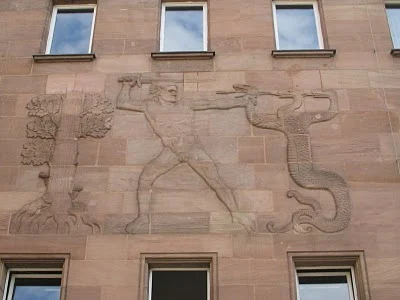

Compare with Der Racher (The Avenger) from Hitler's favourite sculptor, Arno Breker.
Standing at the former headquarters at Marienplatz 5 of the Nazi Party in Nuremberg, and of Gauleiter Julius Streicher, Nazi leader of Franconia. Julius Streicher had received the property from the city on his fiftieth birthday on which the building was later built. Streicher was the founder and publisher of the extremely crude and vulgar Der Stürmer 'newspaper', and his publishing firm also produced three anti-Semitic books for children, including one of the most widespread pieces of propaganda, the 1938 Der Giftpilz (The
Poison Mushroom), which purported to warn about insidious dangers Jews
posed by using the metaphor of an attractive yet deadly mushroom.
After the war, he was convicted of crimes against humanity and
executed. Controversially so, for his execution went against the idea
of freedom of speech, Streicher not having been involved in waging or
planning war.

The Gauhaus in flames in this American Army Signal Corps photograph on the left taken on April 27, 1945. The Reich eagle is visible through the smoke.
The name of a newspaper, the Nürnberger Nachrichten, replaces the eagle and swastika on the façade whilst the
back of the building is one of the only remaining examples of original
Nazi relief, depicting National Socialism fighting the Weimar Republic
and Jews- Wilhelm Nida-Rümelin's Drachentöter (Dragon Slayer). During the Nazi era Nida-Rümelin received public commissions and was one of "Hitler's artists" which included Arno Breker, Josef Thorak and others. After his retirement on October 1, 1941, he worked again in Munich, where he rented the large studio in the Hildebrandhaus on Maria-Theresia-Strasse 23 (now Siebertstraße 2) in Bogenhausen to work on the famous Hildebrand until his suicide on May 14, 1945. According to Joe F. Bodenstein, this was deliberately kept secret by his descendants: "Wilhelm Nida-Rümelin fell into oblivion after 1945 because his descendants obviously deliberately suppressed and kept silent about the artist's work during the Nazi era."
Near where I live the war memorial in Ismaning is acknowledged as an early work by Nida-Rümelin. It was erected in the Weimar Republic on May 24, 1924 on the occasion of the fiftieth anniversary of the local veterans 'and warriors' association. At that time, the memorial commemorated an hundred men from the community who lost their lives in the Great War. After the war, Mayor Erich Zeitler ensured that memorial plaques were installed for a total of 181 killed and 89 missing from the war.
Compare with Der Racher (The Avenger) from Hitler's favourite sculptor, Arno Breker.
Nuremberg trials court building

Standing in front of the site of the Nuremberg war crimes trials. It is still a working court building, so tourist hours are limited to weekends. In parallel with denazification at the municipal level, the Nuremberg trials against leading war criminals of the National Socialist dictatorship took place in the Justizpalast on Fürtherstrasse from November 1945 onwards. Since the Palace of Justice with the adjoining prison had survived the war largely unscathed, Nuremberg was chosen instead of Berlin as a place of trial, especially since Nuremberg as a city of the Nazi rallies had a similar symbolic importance as the capital or Munich.

The tribunal was made up of a member (and an alternate) selected by each of the four principal signatory countries. The first session was convened under the presidency of General I. T. Nikitchenko on October 18, 1945, in Berlin when 24 former Nazi leaders were charged with war crimes, and various groups (including the Gestapo) were charged as being criminal in character. After this first session, all others, beginning on November 20, 1945, were held in Nuremberg under the presidency of Lord Justice Geoffrey Lawrence, the British member.

On the left is the bench where the accused sat. It was expanded during the trial, so it looks a bit smaller now.
The video shows the October 17, 1946 U.S. Newsreel of the Nuremberg
Trials Sentencing when, at the conclusion of 216 court sessions, the
verdicts on 22 of the original 24 defendants were handed down. One
defendant, Robert Ley, had committed suicide whilst in gaol, and the
aged Gustav Krupp von Bohlen und Halbach, the great German arms
manufacturer, was judged mentally and physically unfit to stand trial.
Of the 22 tried, three, Hjalmar Schacht, Franz von Papen, and Hans
Fritzsche, were acquitted; four, Karl Dönitz, Baldur von Schirach,
Albert Speer, and Konstantin von Neurath, were sentenced to 10 to 20
years in prison; three, Rudolf Hess, Walther Funk, and Erich Raeder,
were sentenced to life imprisonment; and 12 were sentenced to be
hanged. Of these, ten—Hans Frank, Wilhelm Frick, Julius Streicher,
Alfred Rosenberg, Ernst Kaltenbrunner, Joachim von Ribbentrop, Fritz
Sauckel, Alfred Jodl, Wilhelm Keitel, and Arthur Seyss-Inquart—were
executed on October 16, 1946. Martin Bormann was tried and condemned to
death in absentia, and Hermann Göring committed suicide before
sentence could be carried out.


The judges and the accused; the seats the latter sat on today. Defendants had the right to receive a copy of the indictment, to offer an explanation or defence, to be represented by legal counsel, and to confront and cross-examine all witnesses brought against them.
The tribunal established certain enduring principles of international law, including those embodied in the rejection of the chief defences offered by the defendants. The tribunal rejected the contention that only a state, and not individuals, could be found guilty of war crimes. The court concluded that only by holding individuals to account for committing such crimes could international law be enforced. The tribunal also rejected the defence that the trial as well as its adjudication were ex post facto. All acts of which the defendants were found guilty, the tribunal held, had been universally regarded as criminal prior to the war which created a precedent for subsequent war crimes trials relating to the war as well as subsequent conflicts.

Standing in front of the Arabella Sheraton Hotel on Eilgutstraße 15, formerly the Fränkischer Hof, which had originally mostly accommodated the press during Party Rallies. The building's proximity to other key sites, such as the Deutscher Hof hotel where Adolf Hitler resided during his visits for the rallies, positioned it conveniently for press operations, allowing quick access to the main venues like the Luitpoldarena and the Zeppelinfeld. In a description from June 23, 2007, recalling the era, the hotel is noted for housing the gleichgeschaltete NS-Presse, meaning the press that had been brought into line with Nazi ideology through coordination and control measures implemented after the Nazi Party's seizure of power on January 30, 1933.
The facade of the Fränkischer Hof featured four stone coats of arms, one of which depicted a powerful eagle clutching a swastika, installed as a symbol of Nazi authority during the regime's tenure.  This emblem, dominating the architectural detail, reflected the widespread incorporation of party iconography into public and private structures in Nuremberg, designated as the Stadt der Reichsparteitage by a decree from Hitler on September 16, 1935. The swastika element was later chiselled away after the war's end on May 8, 1945, leaving the eagle partially obscured but still visible on the building that stood until its demolition in 2001. No specific statistics on the number of press members housed there are recorded in available accounts, but the hotel's role supported the dissemination of rally proceedings, with events such as the 1937 Reichsparteitag des Arbeit, held from September 6 to September 13, 1937, involving extensive media coordination that likely utilised such accommodations for 1,200 accredited journalists from domestic and foreign outlets, as documented in party organisational reports from that period.
 This emblem, dominating the architectural detail, reflected the widespread incorporation of party iconography into public and private structures in Nuremberg, designated as the Stadt der Reichsparteitage by a decree from Hitler on September 16, 1935. The swastika element was later chiselled away after the war's end on May 8, 1945, leaving the eagle partially obscured but still visible on the building that stood until its demolition in 2001. No specific statistics on the number of press members housed there are recorded in available accounts, but the hotel's role supported the dissemination of rally proceedings, with events such as the 1937 Reichsparteitag des Arbeit, held from September 6 to September 13, 1937, involving extensive media coordination that likely utilised such accommodations for 1,200 accredited journalists from domestic and foreign outlets, as documented in party organisational reports from that period.
During the war years following the cancellation of the 1939 rally due to the invasion of Poland on September 1, 1939, the Fränkischer Hof continued to operate under Nazi administration, though its primary association remains with the pre-war propaganda functions. The building escaped major damage from Allied bombings, unlike many structures in Nuremberg that suffered destruction in raids such as the one on January 2, 1945, which devastated 95 percent of the Altstadt and killed 1,850 residents citywide. By April 20, 1945, when United States forces secured Nuremberg after five days of fighting, the hotel stood intact amidst the ruins, with no recorded instances of it serving as a defensive position or shelter for ϟϟ units, unlike nearby administrative buildings. Postwar, the site transitioned to civilian use, but its Nazi-era facade elements persisted as remnants until the reconstruction into the modern hotel.

One of the largest air raid shelters during the war, High Bunker Worhd held 678 people; part of it is now used by the organisation to simulate blindness. The photo on the extreme right shows an example of an air-tight door used in Nuremberg air raid shelters.
Reichsbahndirektion

The Nazi eagle still adorns the main administrative building for the railway.

Nearby is the Monument at Essenweinstrasse, serving as a reminder of the destruction of another synagogue during Reichkristallnacht. Images of the destruction.
Although local officials used strong rhetoric when describing all preservation projects, their criticisms of Nuremberg's Jewish synagogue were especially virulent. Like other structures targeted for removal, the synagogue was built in a late nineteenth century historicist style, making it doubly objectionable to Nazi ideologues. Walter Brugmann, a local architectural consultant, had already identified this 'Moorish-style' synagogue as a 'building sin' in 1934.46 The building's perceived 'foreign' architectural style was compounded by its seemingly disproportionate size. Brugmann suggested a new porch as a partial remedy, but officials chose a more radical solution. In Mayor Liebel's view the synagogue was 'the worst building sin of past decades. ... A settlement can only be reached through the complete removal of the synagogue.' This 'foreign' building simply could not be reconciled with the 'Old German' image that local authorities endeavoured to create. Armed with" additional authority under the German Urban Renewal Law of 1937, Liebel completed the quasi-legal demolition of the synagogue shortly before the 1938 rallies began.Cultural Geographies, Vol. 13, No. 2 (April 2006) (169-170)

The Synagogue on Hans-Sachs-Platz was the main synagogue and was inaugurated on September 8, 1874 with a speech by the mayor Otto Stromer von Reichenbach. The
building was often admired as the "pearl in the silhouette and
adornment of the city". In the 1920s however, hostile voices were formed
and attacks on Nuremberg Jews took place. After the seizure of power of Hitler in 1933, numerous Jews emigrated and Nuremberg's Jewish population decreased by 5,638 between 1934 and 1940. On the other hand, police
officers still protected the building in 1934, when SA men tried to
storm the synagogue after the Nazi Party Day. On June 15, 1938, the Jewish community in Nuremberg held an extraordinary meeting of the members, in which it was announced that the synagogue was to be demolished "in the course of the law on the reorganisation of German cities." On August 10, 1938 Julius Streicher gave the signal to demolish the synagogue. Shortly before the demolition of the synagogue, the Jews secretly removed from the synagogue a 5-Z-heavy stone with an inscription in memory of the first synagogue burnt down 500 years ago in Nuremberg. The removal of the stone was procured by the Nuremberg master builder Fritz Frisch, who had been admitted to the Nazi Party only in 1937. Frisch was immediately expelled from the party.
Mostly on the night of October 29, 1938, Jews were taken from their
apartments as part of the so-called “Polenaktion” and transported to the German-Polish border in guarded trains and trucks and
chased over. A total of 1,631 Jews from Nuremberg were killed by the Nazis.

Another memorial stone is at Spital Bridge commemorating the destruction of Nuremberg's main synagogue located on Hans Sachs Platz. The main synagogue, which has been erased is
only remembered by this memorial stone which dates from 1988.
It was demolished on August 10, 1938 on the instructions of Julius Streicher because they "seriously disrupt the beautiful German cityscape." In a report by the "District President of Upper and Middle Franconia" of July 7, 1938, “[o]n June 15, 1938, the Israelite religious community held an extraordinary meeting of the members of their general administration in Nuremberg, in which it was announced that the main synagogue in Nuremberg would have to be demolished in order to enforce the law on the redesign of German cities. This news had a devastating effect on the Jews present there; However, it was generally clear that objections to this measure were pointless. " Another document taken from the same source dated September 7, 1938 states that “Nuremberg's party rallies experienced a memorable day on August 10, 1938: Julius Streicher gave the signal to demolish the main synagogue on Hans-Sachs-Platz, which had to be removed in order to carry out urban planning measures. Tens of thousands of national comrades attended the historical hour. […] Shortly before the synagogue was demolished, the Jews secretly had a 5-centimeter stone with an inscription in memory of the first synagogue in Nuremberg that burned down 500 years ago removed from the synagogue and taken to the Jewish cemetery. The Nuremberg builder Fritz Frisch, who had only been admitted to the Nazi Party in 1937, took care of the removal of the stone. Frisch was immediately expelled from the party and his lack of character was appropriately denounced in public. "  When asked during the Nuremberg trial if the synagogue had been destroyed on his orders, Streicher replied: “Yes. There were an estimated fifteen synagogues in my Gau , one main synagogue in Nuremberg and a somewhat smaller one and, I believe, a few more prayer rooms. The main synagogue stood in the soft image of the medieval imperial city. Even before 1933, the so-called time of struggle , when we still had another government, I declared publicly in a meeting that it was a shame that such an oriental, immensely large building was placed in the old city. After the takeover , I told the mayor to have the synagogue demolished ... I cannot help that in November of that year the order was given to set fire to the synagogues."
 When asked during the Nuremberg trial if the synagogue had been destroyed on his orders, Streicher replied: “Yes. There were an estimated fifteen synagogues in my Gau , one main synagogue in Nuremberg and a somewhat smaller one and, I believe, a few more prayer rooms. The main synagogue stood in the soft image of the medieval imperial city. Even before 1933, the so-called time of struggle , when we still had another government, I declared publicly in a meeting that it was a shame that such an oriental, immensely large building was placed in the old city. After the takeover , I told the mayor to have the synagogue demolished ... I cannot help that in November of that year the order was given to set fire to the synagogues."
A
reconstruction of the synagogue never took place, although the
property would have been available after 1945. The winning design of the
architects' competition for the reconstruction of Nuremberg in 1947 did not foresee that. In the award-winning work of Heinz Schmeißner and William Schlegtendal the plot of
the demolished nine years earlier synagogue was otherwise over-planned,
the city plan was at this point overmoulded. A partial area was
later acquired by Eduard Kappler (an architect of the reconstruction
period) and built with an office and residential building. On the
southern part of the plot (to Pegnitz), a new riverside path was
created. In
the entrance hall of the Jewish Community of Nuremberg is the model of
the main synagogue of Nuremberg, which was destroyed in 1938. Through
the windows one can look at finely crafted interior with lighting.
Nazi sites around Nuremberg town centre history then and now current state virtual tours 2025 can I visit today what happened during WWII preservation efforts drone footage 2025 Holocaust education ethical debates on touring Nazi sites augmented reality experiences contemporary significance guided tours digital archives underground structures memorial sites interactive timelines of Nazi events 1930s to now virtual reality reconstructions current excavations and restorations historical photos then and now augmented reality apps educational resources post-war changes modern exhibits at Nazi sites in Nuremberg city centre
