


During a 1944 ceremony for bombing victims and today. Within the cemetery is a mass grave for 2,099 victims of aerial bombardment during the war has been converted to form a "grove of
honour for air raid victims" (Ehrenhain für Luftkriegsopfer), with a
monument by Hans Wimmer.

he noticed a figure in the portico above the two apocalyptic beasts guarding the staircase, and something slightly out of the ordinary in the figure’s appearance gave his thoughts an entirely new turn.
Two sphinxes had flanked the portal of the cemetery designed by Hans Grässel and opened in 1899 but by the mid-1950s they were suddenly gone leaving it a riddle as to how they left the city and where they are today. It is very likely that they were damaged during the war and dismantled after although this is disputed by the literary scholar a,nd chairman of the Thomas Mann Forum in Munich, Dirk Heisserer whose own research finds that the figures survived the war unscathed, but a Munich building inspector "unintentionally" sold them to a stonemason from Lower Bavaria in the late 1960s, referring to a letter in which the deputy head of the Munich City Archives gave information about the whereabouts of the sphinxes to a Thomas Mann researcher in August 1997. "These shitty creatures have to go," Heiserer quotes the supposedly traditional reasoning of the long-deceased building officer.
After considerable research the replicas were based on the only surviving archive image of the original as seen by Thomas Mann and presented to his contemporaries in 1905 at the main portal of the North Cemetery. Unfortunately the photo presents an oblique view making the perspective difficult to figure out the exact proportions.

After being bombed in 1944 and today

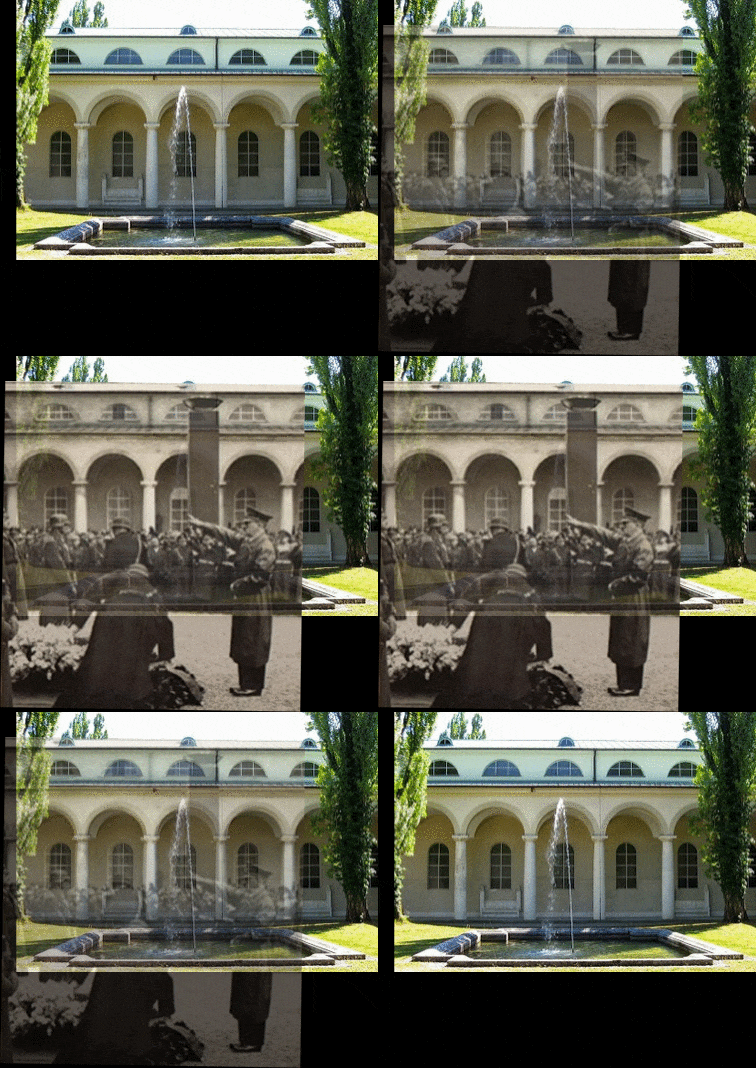
The grave of Hitler's favourite architect, shown on the left with Hitler paying his respects during the ceremonies "marking the opening of the Haus der Deutschen Kunst in July 1937" again from Third Reich Ruins. "In Munich Hitler spent many hours in the studio of Professor Troost, his favourite architect" (Bullock, 387) who had designed the Haus Deutschen Kunst. According to Albert Speer,
The Führer found in the irreplaceable artist Paul Ludwig Troost, his architect. Troost understood how to utilise Hitler's intentions and how to provide the correct architectural form. The Führer during his great speech at the cultural meeting of the Reich Party in 1935, delivered a memorial to Professor Troost which could not have been a more beautiful tribute to an architect of our times, Hitler said: We should be filled with happy pride that through a strange fate Germany possessed the greatest architect since Schinkel, in the new Reich and for the movement. He erected his first and unfortunately his only tremendous works in stone as monuments of true Germanic and Teutonic purity.

Upon her death in 2003 Troost's widow joined him and would later be a significant figure during the Third Reich. Through her husband she became acquainted with Adolf Hitler in 1930 and became a member of the Nazi Party in 1932. After her husband's death in 1934, Troost ran his architectural business together with his former partner Leonhard Gall. She supervised the construction of the Haus der Kunst, the remodelling of the Königsplatz, and the construction of the Ehrentempels. She remained an architectural adviser to Hitler's circle up to the end of the war. In 1943 she received from Hitler an endowment of 100,000 Reichsmarks. During denazification she was classified as "less responsible" (Minderbelastete) by the Hauptspruchkammer and sentenced to a fine of 500 DM and a 10-year Berufsverbot. At the end of the period Troost resumed work and resided in Schützing (Haiming) in Upper Bavaria.

Andreas Bauriedl was an early member of the Nazi Party who participated in the Beer Hall Putsch on November 9, 1923. When the Munich Police opened fire on the on the marchers, Bauriedl was hit in the abdomen, killing him and causing him to fall on the Nazi flag, which had fallen to the ground when its flagbearer, Heinrich Trambauer, was severely wounded. Bauriedl's blood soaked the flag. The flag later became known as the Blutfahne, a sacred relic to the Nazis, and Andreas Bauriedl and the other killed participants of the putsch were regarded as the first martyrs to the Nazi Party. His name, as well as those of two others killed- Anton Hechenberger and Lorenz Ritter von Stransky-Griffenfeld- were embroidered into the flag in silver thread. His body was interred in a crypt in the an Ehrentempel as part of a memorial to the putsch. The memorial was demolished by the Allied occupation forces at the end of the Second World War.


Andreas Bauriedl, relocated after the war from his sarcophagus in an ehrentempel on Königsplatz. Note the date of death- apparently it was his blood that had 'consecrated' the blutfahne.
The Nazis invested the concept of the "blood flag" with a decidedly emotional colouration. "Blood flag" was their name for the swastika flag that had allegedly been drenched with the blood of Andreas Bauriedl who had carried it on 9 November 1923 during the legendary march to the Feldherrnhalle, at the time of the Hitler Putsch. At the second Nazi Party congress in Weimar on 4 July 1926, Hitler "bestowed" the flag of this "blood witness" on the then Reichsführer of the ϟϟ, Berchtold.
 |
| Hitler "blessing" new party banners by touching them with the Blutfahne. |

At the grave of Hitler's official photographer, Heinrich Hoffmann, pointing at the stone's reference to him as "Professor", the title given him by Hitler in 1938. Located at the very back wall of the cemetery, it was Hoffmann and his second wife Erna who introduced Hitler to Eva Braun, his studio assistant at the time.
Also named on the grave is his daughter Henriette who had married Reichsjugendführer Baldur von Schirach. Irving in Hitler's War records the following exchange between her and Hitler at the Berghof:
Also named on the grave is his daughter Henriette who had married Reichsjugendführer Baldur von Schirach. Irving in Hitler's War records the following exchange between her and Hitler at the Berghof:
A few days after Himmler’s visit, Baldur von Schirach and his pretty wife Henriette were in Hitler’s house party. They joined the fireside circle, slumped in the deep armchairs in the semi-darkness. While Hitler sipped his special tea and the others their wine or cognac, Henriette exclaimed that she had just witnessed at Amsterdam the loading of Jews into open trucks for deportation.Fest in The Face Of The Third Reich writes that it was
‘Do you know about it?’ she asked. ‘Do you permit it?’
Hitler retorted, ‘They are being driven off to work, so you needn’t pity them. Meantime our soldiers are fighting and dying on the battlefields!’ Later he added, ‘Let me tell you something. This is a set of scales’ – and he put up a hand on each side like the pans. – ‘Germany has lost half a million of her finest manhood on the battlefield. Am I to preserve and minister to these others? I want something of our race to survive a thousand years from now.’ He reproached her: ‘You must learn how to hate!’
The Schirachs were still there the next evening, June 24, when Goebbels wickedly brought the fireside conversation around to Vienna. Until after four a.m. Hitler drew savage comparisons between Schirach’s Viennese and Goebbels’s Berliners until tears welled up in Henriette’s eyes: the Berliners, he said, were hard-working, intelligent, and politically shrewd. Goebbels wrote, ‘Frau von Schirach in particular acted like a silly cow . . . and later summed up her unhappiness by saying that she wanted to go back to Munich with her husband and would the Führer send [Gauleiter] Giesler to Vienna instead.’‘Tell me,’ Hitler challenged her,‘is your husband our Reich representative in Vienna – or is he Vienna’s man in the Reich?’ The Schirachs departed in a huff the same night, and never saw Hitler again.
[f]rom this point on he found himself isolated, and if his subsequent statement that he had expected to be arrested and charged before the People’s Court was probably simply self-dramatisation, it is nevertheless true, as he claimed, that after the controversy at the Berghof he was ‘politically a dead man’. He retired into the background, partly out of personal fear and also no doubt out of the embarrassment of a man who saw his romantic ideals and fantasies of self-sacrifice, heroism and marble monuments contradicted by the reality of the war, even if he refrained from putting it into words, ‘in order to maintain a foolish dream a little while longer’

The grave of ϟϟ-Obersturmbannführer Max Wünsche, the legendary German Waffen-ϟϟ Obersturmbannführer who was awarded the Knight's Cross with Oak Leaves. He held the position of ϟϟ Standartenführer and served as Hitler’s adjutant. Irving acknowledged the importance of his diary entries to his research from June 16 to Nov 20, 1938 listing the Hitler’s appointments and decisions.
Wünsche joined the Hitler Youth Movement in November 1932 and in July 1933 joined the ϟϟ. He was deemed to have officer qualities and Wünsche graduated from officer training in 1936. He took part in the attack on the Netherlands and France in 1940. In December 1940, Wünsche was made adjutant to Sepp Dietrich and took part in ‘Operation Barbarossa’ – the attack on the Soviet Union in 1941. In June 1942, Wünsche returned to Germany to study at the Staff College. He successfully completed this course and was promoted to Sturmbannführer. In February 1943 Wünsche was awarded the German Cross in Gold and the Knight’s Cross, for bravery shown during the Russian campaign. In June 1943, Wünsche transferred to France to take command of the 12th ϟϟ Panzer Regiment. This regiment played an active part in trying to repel the Allied landings in Normandy on D-Day and in the weeks after June 6, 1944. For his work Wünsche was awarded oak leaves to his Knight’s Cross. The 12th ϟϟ Panzer Regiment was trapped in the Falaise Pocket in August 1944. Wünsche tried to escape on foot but was wounded in the calf and captured. Wünsche was held as a PoW at Camp 165 in Caithness which was the most northerly PoW camp on mainland Britain. Compound O within Camp 165 was where hard line Nazis were kept – away from other PoWs – and Wünsche was considered to be a hard line Nazi. He was released in 1948 and returned to Germany. He worked at an industrial plant until his retirement in 1980.

Wünsche joined the Hitler Youth Movement in November 1932 and in July 1933 joined the ϟϟ. He was deemed to have officer qualities and Wünsche graduated from officer training in 1936. He took part in the attack on the Netherlands and France in 1940. In December 1940, Wünsche was made adjutant to Sepp Dietrich and took part in ‘Operation Barbarossa’ – the attack on the Soviet Union in 1941. In June 1942, Wünsche returned to Germany to study at the Staff College. He successfully completed this course and was promoted to Sturmbannführer. In February 1943 Wünsche was awarded the German Cross in Gold and the Knight’s Cross, for bravery shown during the Russian campaign. In June 1943, Wünsche transferred to France to take command of the 12th ϟϟ Panzer Regiment. This regiment played an active part in trying to repel the Allied landings in Normandy on D-Day and in the weeks after June 6, 1944. For his work Wünsche was awarded oak leaves to his Knight’s Cross. The 12th ϟϟ Panzer Regiment was trapped in the Falaise Pocket in August 1944. Wünsche tried to escape on foot but was wounded in the calf and captured. Wünsche was held as a PoW at Camp 165 in Caithness which was the most northerly PoW camp on mainland Britain. Compound O within Camp 165 was where hard line Nazis were kept – away from other PoWs – and Wünsche was considered to be a hard line Nazi. He was released in 1948 and returned to Germany. He worked at an industrial plant until his retirement in 1980.

Wünsche is the subject of a figure produced in China.
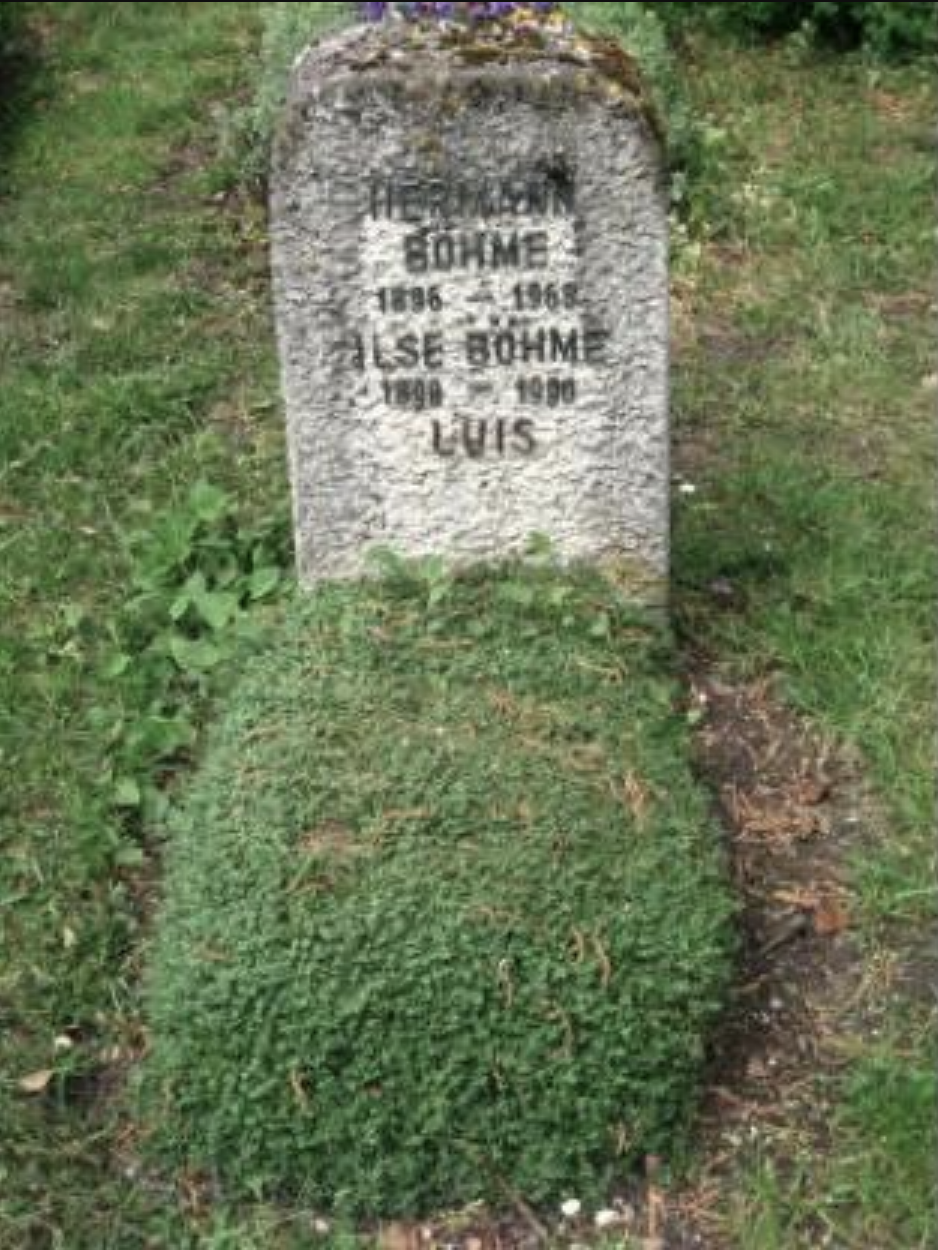 The grave of General Hermann Böhme. He had first joined the 177th Infantry Regiment on August 10, 1914 as a cadet. On February 20, 1915 he was deployed to the 177th Infantry Regiment and was promoted to ensign on April 1, 1915. Promoted to lieutenant on April 16, 1915, he became a platoon commander in the 243rd Reserve Infantry Regiment. On December 1, 1916, he became an orderly and intelligence officer on the staff of the 177th Infantry Regiment and on April 28, 1917, he became a company commander. In July and August 1917 he attended a machine gun training course. On November 7, 1917 he became adjutant of the III. Battalion of the 177th Infantry Regiment. On January 31, 1919 he was commissioned as an inspection officer to the Ministry of War of the Republic of Lithuania. On March 31, 1919 he became adjutant of the 1st Battalion of the 56th Volunteer Infantry Regiment and on 10 December 1919 Regimental Adjutant in the 20th Volunteer Infantry Regiment. On March 1, 1920 he finally became Adjutant of the III. Battalions of the 37th Infantry Regiment. On September 27, 1920, he was appointed company officer in the 11th Infantry Regiment.
 .jpg) From October 1921 he was transferred to the 11th Cavalry Regiment and was commanded there for assistant leader training at the 3rd Division staff. On October 1, 1923 he returned to the 11th Infantry Regiment and was promoted to Oberleutnant on July 31, 1925. On March 15, 1928 he became adjutant of the II Battalion in his regiment. On September 12, 1930, he was then transferred to the commandant's office in Berlin and assigned to the Reinhardt course, the secret war academy. On June 1, 1931 he came to the Reichswehr Ministry and was promoted to Rittmeister on February 1, 1931. on the 15th On October 1, 1935 he was promoted to company commander in the 10th Infantry Regiment and on January 1, 1936 to Major.
From October 1921 he was transferred to the 11th Cavalry Regiment and was commanded there for assistant leader training at the 3rd Division staff. On October 1, 1923 he returned to the 11th Infantry Regiment and was promoted to Oberleutnant on July 31, 1925. On March 15, 1928 he became adjutant of the II Battalion in his regiment. On September 12, 1930, he was then transferred to the commandant's office in Berlin and assigned to the Reinhardt course, the secret war academy. On June 1, 1931 he came to the Reichswehr Ministry and was promoted to Rittmeister on February 1, 1931. on the 15th On October 1, 1935 he was promoted to company commander in the 10th Infantry Regiment and on January 1, 1936 to Major. On January 18, 1936 he became Ia in the General Staff of the 8th Division and on March 25, 1938 Ia in the General Staff of the II Army Corps. Promoted to lieutenant colonel on January 1, 1939, he became group leader on November 1, 1939 in the military command staff, national defence department of the OKW. On June 27, 1940, he became Chief of Staff of the German Armistice Commission. On November 1, 1940, he was promoted to colonel. .gif) Transferred to the Führerreserve on March 15, 1943, he was appointed on May 1, 1943 to lead the Promoted to lieutenant colonel on January 1, 1939, he became group leader on November 1, 1939 in the military command staff, national defence department of the OKW. On June 27, 1940, he became Chief of Staff of the German Armistice Commission. On November 1, 1940, he was promoted to colonel. After
the Serbian uprising of July 1941, General Hermann Böhme was given
emergency powers to govern the country. He was transferred to the Führerreserve on March 15, 1943, being appointed on May 1, 1943 to lead the 370th Infantry Division. Promoted to major general on September 7, 1943, he became commander of the 73rd Infantry Division on the same day. On April 1, 1944 he was promoted to Generalleutnant. On May 13, 1944, near Sevastopol, he was taken prisoner by the Russians, finally being released on October 6, 1955. He has given his name to the Hermann-Boehme-Schule in Altenburg, Thuringia shown above.
Transferred to the Führerreserve on March 15, 1943, he was appointed on May 1, 1943 to lead the Promoted to lieutenant colonel on January 1, 1939, he became group leader on November 1, 1939 in the military command staff, national defence department of the OKW. On June 27, 1940, he became Chief of Staff of the German Armistice Commission. On November 1, 1940, he was promoted to colonel. After
the Serbian uprising of July 1941, General Hermann Böhme was given
emergency powers to govern the country. He was transferred to the Führerreserve on March 15, 1943, being appointed on May 1, 1943 to lead the 370th Infantry Division. Promoted to major general on September 7, 1943, he became commander of the 73rd Infantry Division on the same day. On April 1, 1944 he was promoted to Generalleutnant. On May 13, 1944, near Sevastopol, he was taken prisoner by the Russians, finally being released on October 6, 1955. He has given his name to the Hermann-Boehme-Schule in Altenburg, Thuringia shown above.
.gif) Transferred to the Führerreserve on March 15, 1943, he was appointed on May 1, 1943 to lead the Promoted to lieutenant colonel on January 1, 1939, he became group leader on November 1, 1939 in the military command staff, national defence department of the OKW. On June 27, 1940, he became Chief of Staff of the German Armistice Commission. On November 1, 1940, he was promoted to colonel. After
the Serbian uprising of July 1941, General Hermann Böhme was given
emergency powers to govern the country. He was transferred to the Führerreserve on March 15, 1943, being appointed on May 1, 1943 to lead the 370th Infantry Division. Promoted to major general on September 7, 1943, he became commander of the 73rd Infantry Division on the same day. On April 1, 1944 he was promoted to Generalleutnant. On May 13, 1944, near Sevastopol, he was taken prisoner by the Russians, finally being released on October 6, 1955. He has given his name to the Hermann-Boehme-Schule in Altenburg, Thuringia shown above.
Transferred to the Führerreserve on March 15, 1943, he was appointed on May 1, 1943 to lead the Promoted to lieutenant colonel on January 1, 1939, he became group leader on November 1, 1939 in the military command staff, national defence department of the OKW. On June 27, 1940, he became Chief of Staff of the German Armistice Commission. On November 1, 1940, he was promoted to colonel. After
the Serbian uprising of July 1941, General Hermann Böhme was given
emergency powers to govern the country. He was transferred to the Führerreserve on March 15, 1943, being appointed on May 1, 1943 to lead the 370th Infantry Division. Promoted to major general on September 7, 1943, he became commander of the 73rd Infantry Division on the same day. On April 1, 1944 he was promoted to Generalleutnant. On May 13, 1944, near Sevastopol, he was taken prisoner by the Russians, finally being released on October 6, 1955. He has given his name to the Hermann-Boehme-Schule in Altenburg, Thuringia shown above. 
At the grave of an important figure for the extreme right, Gustav von Kahr, who was elected Bavarian prime minister as the candidate of the Bavarian People’s Party in 1920 after the bloody end of the Räterepublik when Munich became a centre of opposition to the young democratic state. His aim was to make Bavaria an authoritarian cell of order and an antithesis to Berlin. This provided an ideal operating environment for a broad spectrum of nationalist, anti-democratic and reactionary forces. Kahr met Hitler just before relinquishing office. With like-minded contemporaries, he deemed Hitler the drummer for Germany’s national revival and hoped that Bavaria’s many Wehrverbaende might unite behind the Nazi leader. On September 26, 1923, with Berlin enmeshed in crisis, Bavarian Prime Minister Eugen von Knilling appointed Kahr to the semi-dictatorial post of General State Commissioner. In succeeding weeks Kahr, who desired an authoritarian state, toyed with the idea of a march on Berlin. But by the evening of November 8, the occasion of Hitler’s putsch, he had abandoned his plan as unworkable (he may have intended proposing a Wittelsbach restoration).
 As he was delivering a speech on November 8, 1923 to roughly three thousand guests at the completely overcrowded hall of the Bürgerbräukeller, the meeting was stormed by Hitler, Erich Ludendorff, Hermann Göring and other Nazis. Hitler fired a revolver shot into the ceiling to grab the attention of the audience, proclaimed the"national revolution" and called for Kahr, Lieutenant General Otto Hermann von Lossow and police colonel Hans Ritter von Seisser for a meeting. In a back room he urged Kahr and the others with the weapon in his hand to join the proclaimed national uprising. When they returned to the hall, they called on those present to support Hitler's coup d'état , which was scheduled for the next day. In view of their given word of honour that they would do nothing to counter Hitler's plan, Ludendorff ridiculously released them. Lossow and Seisser then immediately introduced countermeasures to put down the coup d'état. After a few hours of inner strife, Kahr also turned against Hitler and at 14.55 broadcast a ban on the Nazi party, Freikorps Oberland and Bund Reichskriegsflagge. The next day the Hitler-Ludendorff Putsch escalated into a scuffle as the ranks of the rioting group advanced in front of twelve ranks - armed in front, behind them flags, in third row the leaders - at the end of the residential street at the height of the Feldherrnhalle a shot was fired (whether fired by a putsch or by a state policeman , could never be resolved). In the subsequent firefight, sixteen putschists, four policemen and one bystander were killed. Hitler blamed for the failure of the coup Kahr. Hitler’s
unexpected action split Bavaria’s nationalists and doomed Kahr’s
political future. His ambivalence to the putsch made him a scapegoat. At the high treason trial against Hitler and the other putschists Kahr participated as a witness, whereby he testified on February 26, 1924. Over a week earlier he had already resigned from the post of General-State Commissioner. From October 16, 1924 to December 31, 1930 Kahr officiated as President of the Bavarian Administrative Court, retiring on January 1, 1931.
As he was delivering a speech on November 8, 1923 to roughly three thousand guests at the completely overcrowded hall of the Bürgerbräukeller, the meeting was stormed by Hitler, Erich Ludendorff, Hermann Göring and other Nazis. Hitler fired a revolver shot into the ceiling to grab the attention of the audience, proclaimed the"national revolution" and called for Kahr, Lieutenant General Otto Hermann von Lossow and police colonel Hans Ritter von Seisser for a meeting. In a back room he urged Kahr and the others with the weapon in his hand to join the proclaimed national uprising. When they returned to the hall, they called on those present to support Hitler's coup d'état , which was scheduled for the next day. In view of their given word of honour that they would do nothing to counter Hitler's plan, Ludendorff ridiculously released them. Lossow and Seisser then immediately introduced countermeasures to put down the coup d'état. After a few hours of inner strife, Kahr also turned against Hitler and at 14.55 broadcast a ban on the Nazi party, Freikorps Oberland and Bund Reichskriegsflagge. The next day the Hitler-Ludendorff Putsch escalated into a scuffle as the ranks of the rioting group advanced in front of twelve ranks - armed in front, behind them flags, in third row the leaders - at the end of the residential street at the height of the Feldherrnhalle a shot was fired (whether fired by a putsch or by a state policeman , could never be resolved). In the subsequent firefight, sixteen putschists, four policemen and one bystander were killed. Hitler blamed for the failure of the coup Kahr. Hitler’s
unexpected action split Bavaria’s nationalists and doomed Kahr’s
political future. His ambivalence to the putsch made him a scapegoat. At the high treason trial against Hitler and the other putschists Kahr participated as a witness, whereby he testified on February 26, 1924. Over a week earlier he had already resigned from the post of General-State Commissioner. From October 16, 1924 to December 31, 1930 Kahr officiated as President of the Bavarian Administrative Court, retiring on January 1, 1931.


On June 30, 1934, during what became known as the Night of the Long Knives, Kahr was killed by Nazis for his "treason" during the Beer Hall Putsch. He was abducted from his Munich apartment and tortured by two ϟϟ members en route to the Dachau concentration camp. After his arrival there, Kahr was shot on orders of Theodor Eicke, the camp commandant. Historian Thomas Childers reports that Kahr was taken to a nearby swamp and hacked to death with axes. Whether he was shot first is unknown, but his mutilated corpse was found outside the camp a few days later. The murder was likely committed by Johann Kantschuster.
Gustav von Kahr, long in retirement, had moved far from the political arena in his native state. He lived in Munich, maintaining a low political profile, and was no longer in any position to do any damage to Hitler or his movement. But over a decade earlier he had caused, with help, the failure of the Hitler putsch. Although the Hitlerian coup of 1923 might well have fallen short without Kahr’s intervention, he was dragged from his home under arrest by the ϟϟ. His body was found later, hacked to pieces, in the hills near Dachau.
 |
| The bunker then and now |

The grave of Emil Maurice, Hitler's chauffeur and first Supreme SA Leader before becoming ϟϟ Oberführer.

One of the often made and inaccurate generalisations about this early Nazi Party was that what was to become the stormtroopers was built out of men drawn from war veterans like those found in many of the Free Corps. In fact, the Nazis would have preferred men from the trenches, but most of these became involved in earlier developing paramilitary groups. Instead, the initial defence formations of the Nazi Party appear to have been constructed of “loud young students” and elements drawn from other radicalised youth. It was out of material like this that Emil Maurice, former member of the paramilitary Bund Oberland, built the initial normal groups of monitor troops. In November of 1920, a “Sport Section” or SA was built out of hall guards. It is difficult to tell when the term “Sturmabteilung” (“Storm Detachment”) was first used to describe the organisation formed in late 1920. “Stormtrooper” was clearly in common use by mid–1921. The Nazi SA was at some point renamed (from “Sport Detachment” to “Storm Detachment”) after the party leaders had become assured that the authorities would not respond negatively to a more aggressive sounding name. Perhaps it was because the initials “SA” for “Security Section” were already in common use on the Left. The SPD had established SAs in Munich and Coburg by 1921.
Otis C. Mitchell (52)

According to Bullock (393) Hitler "was beside himself with fury when he discovered that she had allowed Emil Maurice, his chauffeur, to make love to her, and forbade her to have anything to do with any" other man." Goebbels’s diary for Oct 19, 1928 records: ‘Kaufmann . . . tells me crazy things about the Chief, his niece Geli, and Maurice . . . I understand everything, true and untrue.’ Heiden claims that the murder gang that killed Father Bernhard Stempfle of the Hieronymite Order who, "helped edit Mein Kampf and later talked too much, perhaps, about his knowledge of why Hitler’s love, Geli Raubal, committed suicide" and was found in the forest of Harlaching near Munich with his neck broken and three shots to the hear was led by Maurice during the Night of the Long Knives.
Incredibly given his supposed affair with Hitler's niece Hitler stood by and protected him even after his Jewish ancestry had been discovered by Himmler. All ϟϟ officers had to prove racial purity back to 1750, and it turned out that Maurice had Jewish ancestry. Himmler, who had always been jealous of Hitler's close friends from the early days of the Party, and especially of the lack of control he had over Hitler's inner bodyguards, was delighted and recommended that Maurice be expelled from the ϟϟ, along with other members of his family. To Himmler's annoyance however, the Führer stood by his old friend. In a secret letter written on August 31, 1935, Hitler compelled Himmler to make an exception for Maurice and his brothers, who were allowed to stay in the ϟϟ.
Incredibly given his supposed affair with Hitler's niece Hitler stood by and protected him even after his Jewish ancestry had been discovered by Himmler. All ϟϟ officers had to prove racial purity back to 1750, and it turned out that Maurice had Jewish ancestry. Himmler, who had always been jealous of Hitler's close friends from the early days of the Party, and especially of the lack of control he had over Hitler's inner bodyguards, was delighted and recommended that Maurice be expelled from the ϟϟ, along with other members of his family. To Himmler's annoyance however, the Führer stood by his old friend. In a secret letter written on August 31, 1935, Hitler compelled Himmler to make an exception for Maurice and his brothers, who were allowed to stay in the ϟϟ.

Hitler's youngest personal private secretary (December 1942 to April 1945) and subject of the film Der Untergang, Traudl Junge. It was she who had typed Hitler's last private and political will and testament in the Führerbunker a day and a half before his suicide and was one of the last to have seen him alive.
 Her interview (with English subtitles) for the 2002 documentary film Blind Spot: Hitler's Secretary which drew much attention and how she appeared in Der Untergang as portrayed by Alexandra Maria Lara.
According to Antony Beevor,
 The grave of Oswald Spengler (section 125, grave site 2) best known for his book Der Untergang des Abendlandes (The Decline of the West), published in 1918 and 1922, where he proposed a new theory, according to which the lifespan of civilisations is limited and ultimately they decay. Some Nazis such as Goebbels held Spengler as an intellectual precursor, whose Der Untergang des Abendlandes and Preussentum und Sozialismus were considered useful stepping stones for Hitler’s climb to power, but he was ostracised after 1933 for his pessimism about Germany's and Europe's future, his refusal to support Nazi ideas of racial superiority, and his critical work Jahre der Entscheidung (The Hour of Decision) when he dared to articulate his skepticism about the future of Nazism.
 He fell out of Hitler’s favour and the second part this work was not allowed to be published. Hitler referred to him directly in a May 1, 1935 speech:
In spite of this, Alfred Rosenberg wrote a lengthy obituary in the Volkiscber Beobachter at Spengler’s death in 1936.


Junge later wrote that while she was playing with the Goebbels children on April 30 thatWith the concrete membranes reverberating under the blast of Russian shells, he sent for his youngest secretary – the widowed Traudl Junge. For a while he stood at his usual mid-table place, leaning on the now bare map-room table with both hands and staring at her shorthand pad. Suddenly he barked out: ‘My Political Testament’ and began dictating it, without notes – part pièce justificative, part pæan of praise for his brave troops’ accomplishments. ‘From the sacrifice of our soldiers and my own comradeship with them unto death, we have sown a seed which one day in Germany’s history will blossom forth into a glorious rebirth of the National Socialist movement and thus bring about a truly united nation.’Irving (834) Hitler's War
Suddenly... there is the sound of a shot, so loud, so close, that we all fall silent. It echoes on through all the rooms. 'That was a direct hit,' cried Helmut [Goebbels] with no idea how right he is. The Führer is dead now.
According to Antony Beevor,
Traudl Junge and Gerda Christian disguised themselves as men. But the striking Tyrolean Constanze Manzialy became separated from them almost immediately. One account claims that she was seized by a huge Russian infantryman and assaulted by him and his comrades. Nobody knows whether she resorted to the cyanide ampoule which Hitler had presented in a brass container to each of his staff as going-away presents. In any case, she was never seen again. Both Traudl Junge and Gerda Christian, despite alarming adventures, managed to reach the other side of the Elbe. (388) The Fall of Berlin 1945

”It is no victory, for the enemies were lacking,” observed Oswald Spengler in commenting on how easily Hitler had conquered and Nazified Germany in 1933. ”This seizure of power – ” the author of The Decline of the West wrote early in the year, ”it is with misgiving that I see it celebrated each day with so much noise. It would be better to save that for a day of real and definitive successes, that is, in the foreign field. There are no others.”
Shirer (185)
 He fell out of Hitler’s favour and the second part this work was not allowed to be published. Hitler referred to him directly in a May 1, 1935 speech:
A great age has thus dawned once again for Germany. We say this knowing that the greatness of an age lies in the greatness of the tasks assigned to it and thereby to us. Great tasks, such as those vested in only few generations in history.
Yesterday we were still a powerless Volk, for we were strife-torn, falling out and apart in internal discord, fragmented into hundreds of parties and groups, leagues and associations, Weltanschauungen and confessions—a Reich built upon this fragmented Volk, equally weak and powerless, a mere plaything at the mercy of alien despotism! Normal states deride it, normal states deprive it of its rights and gag the people of this Volk. The economy was in the throes of death. Disintegration and ruin at every turn. Every principle had been abandoned. What had once seemed good became bad; what had been detestable was suddenly venerable. What was once meant to and able to give life more meaning was now passed off and perceived to be merely a burden to mankind. One author summed up the impressions of this age in a book which he entitled, The Decline of the West.
Is this then really the end of our history and hence of our peoples? No! We cannot believe or accept it! It must be called not the ‘Decline of the West,’ but the ‘Resurrection of the Peoples of the Western World’!

At the grave of Otto von Rauchenberger. During the Great War he had commanded the 6th and 14th Bavarian Infantry Divisions. After the spring battle at Arras in April 1917 Rauchenberger, now Lieutenant General January 1917, moved with his division to the Eastern Front where it was used at Riga, leading his attack on the Little Jägels to the Livonian Aa . The division was able to bring in two thousand prisoners and twenty guns in addition to the land seized. For this achievement, which led shortly afterwards to the fall of Riga, Rauchenberger was awarded on September 6, 1916 the Order Pour le Mérite. The day before Bavarian king Ludwig III had awarded him the Knight's Cross of the Max Joseph Order which had connected his service to the personal nobility. This allowed him the title Ritter von Rauchenberger. After the conquest of Riga his troops also participated in the capture of Jakobstadt before the division was relocated in mid-December 1917 back to the West, fighting alongside the 1st Army in the fighting for Reims. Rauchenberger was involved in the spring offensive where he was used at the Avre and the Ancre, being appointed Commander of the 6th Infantry Division at the end of May 1918. He managed, in the following heavy defensive battles before the Siegfriedstellung and the defensive battle between Cambrai and Saint Quentin, to repeatedly defeat enemy attacks. For this purpose, Rauchberger was awarded the Oak Leaves to the Pour le Mérite on October 19, 1918, on the proposal of the Commanding General of the 18th Army, Oskar von Hutier .
After the War, he took over command of II. Bavarian Army Corps until June 1919. Twenty years later he was given by the Nazis the honorary title of General of Infantry for Tannenberg Remembrance Day.

The 1944 state funeral and grave today at plot 114, row 1, grave 34 of General Eduard Dietl, recipient of the Knight's Cross of the Iron Cross with Oak Leaves and Swords, awarded to recognise extreme battlefield bravery or successful military leadership. Eduard Dietl was the first recipient, in June 1941, following his exploits in Norway at Narvik. Approximately 880 Oak Leaves distinctions were awarded during the war. Dietl commanded the German 3rd Mountain Division that participated in the German invasion of Norway on April 9-10, 1940. Most of this division was landed at Narvik by a German naval force of ten destroyers, commanded by Commodore Friedrich Bonte; subsequently all ten destroyers that had ferried Dietl's troops to Narvik were sunk in the First and Second Battles of Narvik. Dietl's mountaineers withdrew into the hills and later retook the town when Britain abandoned her efforts to evict the Germans from Norway due to German success on the Western Front (the Franco-German border, Luxembourg, Belgium and the Netherlands).
The battle for Narvik was a close- run thing. On the naval side it was a disaster, with the bulk of the German destroyer fleet lost in action with the Royal Navy. On land, Ludwig Stautner's battalion of Gebirgsjager (mountain troops) from Regiment 139 hung on tenaciously under considerable pressure from the Allied units that surrounded them. The German perimeter was gradually reduced, so much so that General Dietl was forced to consider the prospect of defeat and capture: the Allies had even landed and retaken the town of Narvik itself. However, the Germans put up a steadfast defence of the rapidly shrinking perimeter, and the Allies decided to pull back from the town: both Dietl and Stautner's mountain troops were the heroes of the hour. Dietl himself commented, however: "They call me the Hero of Narvik, but if the battle had lasted one more day, I would have surrendered." For his part in the dogged defence, Stautner was awarded the Knight's Cross.
Williamson (63) Knight's Cross and Oak-Leaves Recipients 1939-40

Dietl was sent to Finland designated to be the "Hero in the snow" as a counterpart to Rommel's "Hero in the sun", and to leave the main theatre of operations to Hitler). Dietl eventually commanded German forces in Norway and northern Finland and in Eastern Europe and rose to the rank of Generaloberst, commanding the 20th Mountain Army on the northern Eastern Front, where the results of the German Arctic campaign were disappointing. Dietl initially turned down his promotion, but was convinced to accept the appointment by Generaloberst Alfred Jodl.
On June 23, 1944, a Junkers Ju 52 aircraft carrying Dietl, General der Infanterie Thomas-Emil von Wickede, General der Gebirgstruppe Karl Eglseer, Generalleutnant Franz Rossi and three other passengers crashed in the vicinity of the normal village of Rettenegg, Styria; there were no survivors.
On June 23, 1944, a Junkers Ju 52 aircraft carrying Dietl, General der Infanterie Thomas-Emil von Wickede, General der Gebirgstruppe Karl Eglseer, Generalleutnant Franz Rossi and three other passengers crashed in the vicinity of the normal village of Rettenegg, Styria; there were no survivors.
Just outside Freising in Dürneck where I cycle past everyday to get to work, is where Ferdinand Marian died in a road accident in 1946. Described by David Stewart Hull as "a rather oily matinee idol with a marked resemblance to the late American comic Ernie Kovacs. Marian had a normal following, but was no major star, although he was later to prove his genuine talents in several remarkable performances," he had been the star of history’s most incendiary film, Jud Süß despite having had an half-Jewish daughter from his first marriage and whose second wife had been married to a Jew, whom Marian hid in his house.
 The Hochbunker on the corner of Domagkstrasse across from the cemetery is now being redeveloped as shown in these two photos taken a year apart.
"I can't play that kind of role, I'm a bon vivant." Goebbels: "Who gives you your parts-the public or me? I know you want to go to Hollywood, but here you get more money than scientists, and yet you refuse to play the part the Fuhrer wants you to play. Don't tell me you won't play it, tell my aide."With this, Goebbels stomped out of the room. Marian, cowed, then cried after the departing Goebbels, "I'll do it!" (This scene was recorded for posterity by a secretary, according to Harlan, who said that it was revealed after the war. I have not been able to locate the document.) Marian, said Harlan, was so miserable that he went home, got drunk, and wrecked his apartment with an axe.
Film in the Third Reich: A Study of the German Cinema 1933-1945 (165-166)
His losing fight to not appear in the film was the subject of the German-Austrian movie Jud Süss - Film ohne Gewissen of 2010.
Apparently he had been driving to Munich drunk with a borrowed car to collect denazification papers that with the permission by US film officer Eric Pleskow that would have allowed him to work again, having celebrated this news just beforehand. Other sources suggest that the accident was suicide:
Apparently he had been driving to Munich drunk with a borrowed car to collect denazification papers that with the permission by US film officer Eric Pleskow that would have allowed him to work again, having celebrated this news just beforehand. Other sources suggest that the accident was suicide:
Ferdinand Marian, who had taken the title role in Jud Suss, committed suicide in a car crash due to feelings of guilt.
Hull (269)

Waldfriedhof

Perhaps the most (in)famous name in Nazi cinema is that of Leni Riefenstahl whose grave in the Waldfriedhof is located at 509-W-4. Probably the most famous major film-maker in the Third Reich, she records in her memoirs an example of how exactly Hitler got people on his side. The only difficulty in using her evidence is that it has to be assumed accurate and not a distortion of reality which is attempting to show her relationship to the Nazis in as favourable a light as possible. We have to be prepared to believe she participated in Hitler’s Germany with reluctance rather than enthusiasm. This filmmaker visited Hitler at the Reich Chancellery in August 1933. She says she entered the room determined not to undertake any project on behalf of the Nazis. But the meeting went as follows:
‘I invited you here today in order to find out how far you’ve got with your preparations for the film on the Party rally, and whether you’re getting enough support from the Ministry of Propaganda.’
I stared at him [Hitler] in amazement – what was he talking about? Surprised at my reaction, he said: ‘Didn’t the Propaganda Ministry inform you that I want you to make a film about the Party rally in Nuremberg?’
I shook my head and Hitler was clearly perplexed. ‘You know nothing about it?’ he asked angrily. ‘Why, that’s impossible. Brückner transmitted my request to Dr Goebbels weeks ago. Haven’t you been notified?’ Once again I had to say no and Hitler grew even more upset. He summoned Brückner and angrily asked him, ‘Didn’t you pass my request on to the doctor? Why wasn’t Fräulein Riefenstahl informed?’ As he spoke he clenched his fists, glaring with anger. Before his terrified aide could reply, Hitler jeered, ‘I can imagine how the gentlemen at the Propaganda Ministry must envy this gifted young artist. They can’t stand the fact that such an honour has been awarded to a woman – and, indeed, an artist who isn’t even a member of the party.’ Neither Brückner nor I dared to respond. ‘It’s outrageous of them to boycott my request’, Hitler ranted. He snapped at Brückner to telephone Dr Goebbels and tell him to order the people in his cinema department to support me and my work in Nuremberg in every possible way.
I myself was by now very agitated, and I interrupted Hitler. ‘My Führer, I cannot accept this – I have never seen a Party rally, I know nothing about what goes on there, and I have no experience in making documentaries. It would be better if such films were made by Party members who know the material and are happy to be given such assignments.’ I talked to Hitler almost beseechingly, and slowly he relaxed and calmed down.
Looking at me, he said, ‘Fräulein Riefenstahl, don’t let me down. You would only have to take a few days off. I am convinced that you alone have the artistic ability to turn real-life events into more than ordinary newsreel footage – certainly the officials at the cinema department of the Propaganda Ministry do not.’ I stood before him, eyes lowered, as he went on urging me more and more insistently. ‘The party rally will begin in three days. Naturally you won’t be able to make a really great film this year. But you can go to Nuremberg in order to gain some experience and try to film whatever can be filmed without preparations.’ He took a few steps, then resumed. ‘My wishes were probably never communicated to the doctor. I will personally ask him to support you.’
L. Riefenstahl, The Sieve of Time, 1992, pp. 143–4


Objectively, Leni Riefenstahl's films helped the Nazi cause. This does not mean that she was a personal monster, nor that every "moral" aspect of her films is deplorable. For her achievements on this level she has been widely and no doubt justly condemned-if not always for the reasons stated by her critics-and it seems unlikely that history will reverse the verdict. But it is also necessary to assess her as an artist, accountable only to another kind of history, and it seems possible that on this level, film history will preserve the honours which have been given her.Hull (139-140)

Admiral Tirpitz secured major augmentations of the fleet in the famous naval laws of 1898 and 1900 in part through a masterly use of the ideology of Weltpolitik as it had been developed after 1890. Tirpitz wanted to construct, not a multitude of long-distance cruisers, but a new fleet of heavily armoured battleships that could counter the British battle fleet in the North Sea. One of the reasons that Tirpitz got what he wanted (besides the fact that he organised the most effective public relations campaign in pre-Nazi German history) was that he translated his aim into the terms of Weltpolitik and thus managed to rally the support of Weltpolitiker in business and politics. The new German battle fleet would confront Britain with a choice between attempting to maintain her naval superiority in the face of a determined German naval expansion program, thus heightening the risk of war with Germany, or seeking accommodation and partnership with Germany on a worldwide basis. According to Tirpitz and his propagandists, fleet building would force Britain to take the second option—to recognise Germany as a coequal power in the world and to enter into a comprehensive diplomatic arrangement with the Reich. There is good evidence that Tirpitz himself never wholly believed all of this. Even if he did, he could hardly have been more disastrously wrong about the consequences of the policies that he advocated.
Tirpitz and his supporters hit on a highly significant feature of Weltpolitik as an extended aggregate ideology: a particular view of Britain's role in Germany's future as a great power, and a characteristic (and wholly incorrect) set of predictions about British reactions to the emergence of Germany as an imperialistic state. In the general scheme of Weltpolitik, the attitude of Great Britain was absolutely crucial to Germany's success. Britain, as the preeminent imperial power and as the major source of the world's investment capital, was the only European country presently in a position to interfere seriously with the Weltpolitikers' plans outside of Europe. Most Weltpolitiker envisioned Germany's eventual imperial "periphery" as Germany's share after a division of much of the underdeveloped world's economic resources and marketing areas with Britain. Both countries would benefit in the long run from thus cooperating to protect themselves against the competition of the great continental economic powers of the future: the United States and Russia. The only problem was in getting the British to understand their own best interests.
Smith, Woodruff D. (72-73) The Ideological Origins of Nazi Imperialism

 Bandera was imprisoned at Sachsenhausen. In November 1943 Bandera was confident enough to stage a Conference of the Enslaved Nations of Eastern Europe and Asia, which brought together Tatars, Georgians, Azerbaijanis, Poles, Slovaks, Czechs and Cossacks to draw up a common programme for the struggle against Germany and the Soviet Union. The struggle continued well after the end of the war against the Communist successors to the retreating German army but not before Bandera was first arrested and imprisoned by
the Nazis until September 1944. Bandera was assassinated in 1959 by the
KGB. He was named Hero of Ukraine (posthumously) for "defending national
ideas and battling for an independent Ukrainian state." When I visited his grave there were flags of the Ukrainian Insurgent Army which has been formed by the OUN and had been engaged in guerrilla warfare against the Soviet Union, the Polish Underground State, Communist Poland, and Nazi Germany. The black flag is that of the Kholodny Yar Republic, Cold Ravine Republic or Kholodnoyarsk Republic of 1919–1922, the village of Melnyky serving as its capital. It had a 15,000-strong army composed of peasants and soldiers of the Ukrainian National Republic army, which was defeated by the White Army in Podolia earlier. Kholodny Yar Republic was the last territory in which Ukrainians continued to fight for an independent Ukrainian state before the incorporation of Ukraine into the Soviet Union as the Ukrainian SSR. Thus it was an important part of the Ukrainian War of Independence.
Bandera was imprisoned at Sachsenhausen. In November 1943 Bandera was confident enough to stage a Conference of the Enslaved Nations of Eastern Europe and Asia, which brought together Tatars, Georgians, Azerbaijanis, Poles, Slovaks, Czechs and Cossacks to draw up a common programme for the struggle against Germany and the Soviet Union. The struggle continued well after the end of the war against the Communist successors to the retreating German army but not before Bandera was first arrested and imprisoned by
the Nazis until September 1944. Bandera was assassinated in 1959 by the
KGB. He was named Hero of Ukraine (posthumously) for "defending national
ideas and battling for an independent Ukrainian state." When I visited his grave there were flags of the Ukrainian Insurgent Army which has been formed by the OUN and had been engaged in guerrilla warfare against the Soviet Union, the Polish Underground State, Communist Poland, and Nazi Germany. The black flag is that of the Kholodny Yar Republic, Cold Ravine Republic or Kholodnoyarsk Republic of 1919–1922, the village of Melnyky serving as its capital. It had a 15,000-strong army composed of peasants and soldiers of the Ukrainian National Republic army, which was defeated by the White Army in Podolia earlier. Kholodny Yar Republic was the last territory in which Ukrainians continued to fight for an independent Ukrainian state before the incorporation of Ukraine into the Soviet Union as the Ukrainian SSR. Thus it was an important part of the Ukrainian War of Independence.The notorious ‘Bandera boys’ punished Ukrainians who helped either side. This nationalist militia was, by 1943, strong enough to turn back attempts by the Soviet partisans to penetrate the Ukraine and inflict damage on German communications. Soviet partisans found almost no support among the Ukrainian villagers, whose memories were long enough to recall the famine and the terror. In 1943 the German authorities calculated that 60 per cent of the area of north‐western Ukraine was under the control of nationalist partisans. The Ukrainian nationalist force was too large for the Germans to defeat, but they held on to the main lines of communication, after abandoning the forests and mountains. In November 1943 Bandera was confident enough to stage a Conference of the Enslaved Nations of Eastern Europe and Asia, which brought together Tatars, Georgians, Azerbaijanis, Poles, Slovaks, Czechs and Cossacks to draw up a common programme for the struggle against Germany and the Soviet Union. The struggle continued well after the end of the war against the Communist successors to the retreating German army.


Bandera
lived here at Kreittmayrstrasse 7 where, in the entrance, KGB agent
Bohdan Stashinsky assassinated him on October 15, 1959. A medical
examination established that the cause of his death was poison (cyanide
gas). Christopher Othen has written a compelling account of the assassination:
He had been tracking Bandera for weeks. He first spotted the short, bald, blue-eyed Ukrainian at a funeral. A pseudonym listed in the phone book got him to one of the six apartments Bandera and his family used around Munich for security.An attempt to break into the block resulted in snapping the end of a pick deep in the lock. So he waited, observing the apartment. On Thursday 15 October he saw Bandera approaching his home. The OUN leader had just dismissed his bodyguard and was carrying a bag of shopping. Stashynsky got to the block first and got the front door open with a new lockpick.
Then he headed up the stairs and waited.He planned to ambush Bandera on the stairs but was rattled by the arrival of an elevator and a woman walking past him. Stashynsky walked back to the entrance hall where Bandera had just entered the building but was having trouble with his key. ‘Is it not working?‘ asked Stashynsky. ‘No, it’s okay,’ said Bandera. He held the door open for the KGB man. Stashynsky sprayed him in the face with liquid cyanide and walked out into the street.It was a hell of a story. But American intelligence and the West Berlin police had the same question. Why had Stashynsky defected? The KGB assassin explained. He was in love.The German GirlStashynsky met hairdresser Inge Pohl in East Berlin when he was first posted there in 1956. They fell for each other hard despite Stashynsky having to pretend he was a businessman called Joseph Leman. He kept his KGB life secret. After Bandera’s murder he was recalled to Moscow to receive the Order of the Red Banner, one of the USSR’s highest awards. Stashynsky took the opportunity to ask permission to marry Inge. His bosses refused.


Hausser joined the ϟϟ in November 1934 and was immediately made a commander of an ϟϟ Junker school in Braunschweig and inspector of the ϟϟ Junker schools in Braunschweig and Tölz. He was responsible for the military training of all armed ϟϟ units (with the exception of the ϟϟ Totenkopfverbande), namely the ϟϟ standards "Deutschland", "Germania" and "Der Führer" as motorised units. He rose rapidly in the ϟϟ hierarchy- in 1935 he became ϟϟ-Oberführer, in May 1936 ϟϟ-Brigadefuhrer and in June 1939 ϟϟ-Gruppenfuhrer. As the head of training for the ϟϟ disposal troops, Hausser introduced camouflage uniforms for their soldiers.

 Four weeks later the city was reoccupied by German troops led by Field Marshal von Manstein, in which the ϟϟ Panzer Corps under Hausser was significantly involved. His ϟϟ units committed numerous war crimes and serious assaults against both Red Army soldiers and the Soviet civilian population. After taking part in Operation Zitadelle, Hausser's corps was transferred to northern Italy in the summer of 1943 with the ϟϟ "Leibstandarte" division. Hausser had the task of disarming the Italian armed forces which involved crimes against the Italian civilian population in the context of combating Italian resistance to the occupation, which have not yet been adequately investigated. What is certain is that units under Jochen Peiper burned down the Piedmontese towns of Boves and Castellar on September 19, 1943, committing massacres among the inhabitants. At the time of the massacre, Hausser held the responsible general command of the II ϟϟ Panzer Corps; he never gave an explanatory reaction to the massacre either at the time or after the war but, on the contrary, always denied that these and other crimes committed by his ϟϟ members. For his actions against the Anglo-Americans after D-Day, Hitler awarded him the Knight's Cross of the Iron Cross with Swords on August 26 1944. By the beginning of April 1945 however, Hitler relieved Hausser of his post as Commander-in-Chief of Army Group G and Hausser fled to Austria.post war period where, in May 1945, he surrendered to the US troops in Zell am See and then went through various camps, such as Dachau. In 1949 he was released from prison. Despite his high rank in the ϟϟ, no charges were brought against him. At the Nuremberg trials in 1946, Hausser was “the most important defence witness for the Waffen-ϟϟ,” going to great lengths to present the Waffen-ϟϟ as an apolitical force, like the Wehrmacht. He denied the significance of the Fuehrer decree of August 17, 1938, with which the General ϟϟ, the disposal troops (VT) and the Totenkopf units were separated from each other and from the police and Wehrmacht.
According to information from the British secret service, he made contact with the “ Brotherhood ” founded in 1949, an association of old Nazis headed by ex-gau leader Karl Kaufmann who wanted to infiltrate the young Federal Republic of Germany. Hausser ended up being involved in a variety of lobbying activities on behalf of the Waffen-ϟϟ veterans.

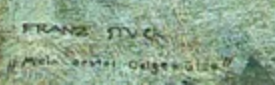
One day in Munich during the summer of 1967, one of our sons burst into our apartment, asking excitedly, “Do you know that there is a portrait of Hitler in the Municipal Gallery at the Lenbach House?” I replied with paternal condescension that that was not possible. He asked if I would just come and take a look. Together we saw what indeed appeared to be a portrait of the Führer under the title Die wilde Jagd (Wild Chase). In this terrifying picture, von Stuck has caught the spirit of the Teutonic legend of Wotan the mad hunter, the personification of death and destruction,who rides forth at night leaving horror in his wake. The huntsman in von Stuck’s picture bears an uncanny likeness to Adolf Hitler. There is the dark brown hair with the famous forelock over the left temple, the brooding eyes, the large nose, the memorable little mustache. A blood-red cape swirls in the wind, and he brandishes a bloody sword. Hitler’s favourite images are also pictured: decapitation, wolves, and death. At the tip of the sword there seems to dangle a human head; wolflike animals howl at the horse; hollow-eyed little creatures yell soundlessly; and ravished women and corpses are left in the path ofthe galloping horseman.To the student of Hitler, however, the most arresting thing about this portrait of rampaging destruction is the inscription in the lower left-hand corner. It reads: “Franz Stuck, Mein erstes Ölgemälde, 1889.” That was the year in which Adolf Hitler was born.How shall one interpret these historical facts? What is their meaning? It is known that the picture was acquired (inventory #61405) in 1929 and exhibited in the Public Gallery in Munich at the old Glass Palace until the fire of 1931. It was later transferred to the Lenbach House. It is also known that Hitler was a habitué of art galleries, that he was in Munich during this period, and that he was an avid admirer of Stuck. He was also a person who took coincidence of dates as more than coincidental, seeing in them some secret meaning. Is it not possible that Hitler, sometime in the 1920s, saw the pic ture and was immensely excited by it; that he pictured himself, very literally, as the Wild Huntsman, and adopted von Stuck’s figure as his own self-image? It seems likely that he adjusted his personal appearance—forelock, mustache, and the red cape he affected at Nuremberg party rallies—to conform to this image of the hard-riding apotheosis of brutality, power, and destruction.

Hitler himself often observed that his eyes were very like those of his mother. Her eyes, in turn, reminded him of the Medusa—whose glance, it will be recalled, turned men to stone or impotence. Hitler was absolutely enthralled with Franz von Stuck’s striking portrait of a Medusa of terrifying eye. On seeing it for the first time in Hanfstaengl’s home, he exclaimed, “Those eyes, Hanfstaengl! Those eyes! They are the eyes of my mother!”
Waite does risk going overboard when he writes how Hitler "played games with his eyes. He would slowly cross them in looking at people, or he would stare them down. In effect, he may have been saying to themand to himself, See, I do have two powerful (potent) testicles, and I can penetrate and dominate others.' He was infatuated with the Medusa of the piercing eyes that could render others impotent. One might also consider Hitler’s use of the extended, stiff-arm salute as a substitute for flawed genitalia."

Westfriedhof

At Ernst Röhm's grave located at plot 59, row 3, grave 1 without any LGBTQ+ etc. flags. Ernst Julius Günther Röhm was a German officer in the Bavarian Army and later an early Nazi leader. He was a co-founder of the Sturmabteilung (SA), the Nazi Party militia, and later was its commander. In 1934, as part of the Night of the Long Knives, he was executed on Adolf Hitler's orders as a potential rival. Röhm was the only senior Nazi who expressed anti-Hitler views in public and was the Führer’s only threat (Fest, 1973, p. 476). By March 1934 Röhm was demanding that several thousand SA men be taken in the army at once. Within a few months, during early Summer 1934, reports began circulating around government circles that Röhm was planning an armed revolt.
‘Adolf is a swine’, he swore. ‘He will give us all away. He only associates with reactionaries now. His old friends aren’t good enough for him. Getting matey with the East Prussian generals. They’re his cronies now.’
He was jealous and hurt.
‘Adolf is turning into a gentleman. He’s got himself a tail-coat now!’ he mocked.
He drank a glass of water and grew calmer.
‘Adolf knows exactly what I want. I’ve told him often enough. Not a second edition of the old imperial army. Are we revolutionaries or aren’t we? Allons, enfants de la patrie! If we are, then something new must arise out of our élan, like the mass armies of the French Revolution. If we’re not, then we’ll go to the dogs. We’ve got to produce something new, don’t you see? A new discipline. A new principle of organisation. The generals are a lot of old fogeys. They never had a new idea.’
Behind Hitler on Widenmayerstraße
‘Adolf has learnt from me. Everything he knows about military matters, I’ve taught him. War is something more than armed clashes. You won’t make a revolutionary army out of the old Prussia NCOs. But Adolf is and remains a civilian, an “artist”, an idler. “Don’t bother me”, that’s all he thinks. What he wants is to sit on the hilltop and pretend he’s God. And the rest of us have to sit around doing nothing.’
He filled his glass, with wine this time, and went on:
‘They expect me to hang about with a lot of old pensioners, a herd of sheep. I’m the nucleus of the new army, don’t you see that? Don’t you understand that what’s coming must be new, fresh and unused? The basis must be revolutionary. You can’t inflate it afterwards. You only get the opportunity once to make something new and big that will help us lift the world off its hinges. But Hitler puts me off with fair words. He wants to let things run their course. He expects a miracle. Just like Adolf!..."


Kershaw records Hitler's reluctance to kill his closest confidante:
Hitler arrived back in Berlin around ten o’clock on the evening of 30 June, tired, drawn, and unshaven, to be met by Göring, Himmler, and a guard of honour. He hesitated until late the following morning about the fate of the former SA Chief of Staff. He was, it seems, put under pressure by Himmler and Göring to have Röhm liquidated. In the early afternoon of Sunday 1 July, during a garden party at the Reich Chancellery for cabinet members and their wives, Hitler finally agreed. Even now, however, he was keen that Röhm take his own life rather than be ‘executed’. Theodor Eicke, Commandant of Dachau Concentration Camp, was ordered to go to Stadelheim and offer Röhm the chance to recognise the enormity of his actions by killing himself. If not, he was to be shot.Along with his deputy, ϟϟ-Sturmbannführer Michael Lippert, and a third ϟϟ man from the camp, Eicke drove to Stadelheim. Röhm was left with a pistol. After ten minutes, no shot had been heard, and the pistol was untouched on the normal table near the door of the cell, where it had been left. Eicke and Lippert returned to the cell, each with pistol drawn, signalled to Röhm, standing and bare-chested, and trying to speak, that they would wait no longer, took careful aim, and shot him dead. Hitler’s published announcement was terse: ‘The former Chief of Staff Röhm was given the opportunity to draw the consequences of his treacherous behaviour. He did not do so and was thereupon shot.’
On 2 July, Hitler formally announced the end of the ‘cleansing action’. Some estimates put the total number killed at 150–200 persons.
With the SA still in a state of shock and uncertainty, the purge of its mass membership began under the new leader, the Hitler loyalist Viktor Lutze. Within a year, the SA had been reduced in size by over 40 per cent. Many subordinate leaders were dismissed in disciplinary hearings. The structures built up by Röhm as the foundation of his power within the organisation were meanwhile systematically dismantled. The SA was turned into little more than a military sports and training body. For anyone still harbouring alternative ideas, the ruthlessness shown by Hitler had left its own unmistakable message.


At the end of this third “Flight over Germany” campaign, Hitler presented a signed portrait to Baur with the following dedication:
To the magnificent pilot of D 1720, Captain Baur, in grateful memory of the three “Flights over Germany.”
With kindest regards, Adolf Hitler
He later became Hitler's personal pilot and leader of the Reichsregierung squadron. Captured by the Soviets at the end of the war, he endured ten years of imprisonment in the USSR before being released on October 10, 1955 to the French, who then imprisoned him until 1957.
 The grave of Anton Drexler. In 1918, he, Karl Harrer (a sports journalist and member of the Thule Society), and Dietrich Eckart, founded the German Workers' Party (DAP) January 5, 1919. It was during one its meetings at the Sterneckerbrau on September 1919 that Hitler encountered the group. Drexler approached Hitler and thrust his booklet My Political Awakening into his handand invited him to join the DAP. Hitler accepted on 12 September 1919, becoming the party's 55th member. In less than a week, Hitler received a postcard from Drexler stating he had officially been accepted as a DAP member and he should come to a "committee" meeting to discuss it. Hitler attended the "committee" meeting held at the run-down Alte Rosenbad beer-house.


Hitler's membership card (signed by Drexler and given the number 555 to make it appear the tiny organisation had a much larger membership). On the right is Drexler's former home at Burghausener Straße 6 as it appears today north of Munich's main rail station.
 Rudolf Trauch had been promoted to lieutenant on October 25, 1913 at the 1st Royal Bavarian Train Battalion. During the First World War he had been awarded both iron crosses and other awards. In early December 1918, he came to the settlement office of the 1st Royal Bavarian Train Battalion. After the war with the German army limited to 100,000 men, he was then taken to the 7th (Bayer) driving section where he was employed as a squadron officer. On February 1, 1923, he was promoted to Captain. Ten years later he was promoted on May 1, 1933 to major. At the beginning of the Second World War, he was appointed on September 3, 1939 head of the driving force department in the OKH which he held for almost three and a half years during which time he commanded supply troops to Oberquartiermeister Belgium during the Western campaign from May 22, 1940 to July 8, 1940. His service earned him the clasp for the Iron Cross 2nd class. On December 24, 1941, he was promoted to Major General. On May 1, 1943 he was then appointed inspector of the driving troops at the chief of the army armour and commander of the replacement army. As such, he was promoted on December 1, 1943 to Lieutenant General. He then served as Inspector until shortly before the end of the war. In early May 1945, he came into Western Allied captivity and finally released in March 1947.
Also located in Westfriedhof at the fifth grave in Quarter Nr. 143 in front of the Quarter Nr. 149 is that of the former Empress of Iran, Soraya Esfandiary-Bakhtiar:


Ostfriedhof
Ostfriedhof was built in 1821 and is still used today, covering over 30 hectares of land and some 34,700 graves. In 1929 a crematorium was opened. The bodies of thousands of opponents of the Nazi regime were cremated here in the years between 1933 and 1945, and their ashes mostly disposed of without memorial. These included people executed in Stadelheim Prison, victims of the concentration camps Dachau, Birkenau and Auschwitz, and of the Aktion T4 campaign. Kurt Eisner, who was murdered on February 21, 1919, was buried at the Ostfriedhof.


Hitler’s possible support for the Majority Social Democrats in the revolutionary upheaval is less unlikely than it might at first sight appear. The political situation was extremely confused and uncertain. A number of strange bedfellows, including several who later came to belong to Hitler’s entourage, initially found themselves on the Left during the revolution. Esser, who became the first propaganda chief of the NSDAP, had been for a while a journalist on a Social Democratic newspaper. Sepp Dietrich, later a general in the Waffen-ϟϟ and head of Hitler’s ϟϟ-Leibstandarte, was elected chairman of a soldiers’ council in November 1918. Hitler’s long-time chauffeur Julius Schreck had served in the ‘Red Army’ at the end of April 1919. Gottfried Feder, whose views on ‘interest slavery’ so gripped Hitler’s imagination in summer 1919, had sent a statement of his position to the socialist government headed by Kurt Eisner the previous November. And Balthasar Brandmayer, one of Hitler’s closest wartime comrades and a later fervent supporter, recounted how he at first welcomed the end of the monarchies, the establishment of a republic, and the onset of a new era. Ideological muddle-headedness, political confusion, and opportunism, combined frequently to produce fickle and shifting allegiances.
That, as has been implied, Hitler was inwardly sympathetic to Social Democracy and formed his own characteristic racist-nationalist Weltanschauung only following an ideological volte-face under the influence of his ‘schooling’ in the Reichswehr after the collapse of the Räterepublik is, however, harder to believe. If Hitler felt compelled to lean outwardly towards the Majority Social Democrats during the revolutionary months, it was not prompted by conviction but by sheer opportunism aimed at avoiding for as long as possible demobilisation from the army.
On May Day 1922, the Munich Free Trade Unions unveiled a monument devoted to "The Dead of the Revolution". In its base, Kurt Eisner's urn was installed. Shortly after the Nazi takeover on June 22, 1933 it was destroyed. Eisner's urn was taken to the New Israelite Cemetery, where his grave is still standing today seen below. The monument was modelled after the war by the artist Konstantin Frick.
The corpses of thousands of opponents and victims of the Third Reich were burned in the Crematorium of the East Cemetery. At the beginning of July 1934 the mortal remains of seventeen Nazis who had been murdered during the so-called 'Night of the Long Knives' and other enemies were transported to the crematorium via a furniture cart (to avoid spectators) and burned there. The ashes of the dead were indiscriminately filled into various urns to obliterate the traces of the victims forever. Among them was journalist Fritz Gerlich, one of the most far-sighted and intrepid opponents of the Nazis. An unknown number of people who were murdered in Stadelheim prison for political reasons, as well as the corpses of 3,996 prisoners from the Dachau, Auschwitz and Buchenwald concentration camps, as well as the killing facilities of the so-called Aktion T4, were cremated here. In 1946 the bodies of several of those condemned to death at the Nuremberg War Crimes trials and also of Hermann Göring were cremated here, and the ashes scattered into the Isar.
 The grave of Julius Schaub, described by Kershaw as formerly the head of Hitler's bodyguard,
 Near the end of the war, on April 23, 1945, Hitler ordered Schaub to burn all his personal belongings and papers from the Reichskanzlei and the Führerbunker in the garden of the Reichskanzlei, on the left are the last photographs of Hitler alive as he inspects the damage made to the Chancellery with Schaub. The photograph was taken by the same photographer who took the one of Hitler inspecting the Hitlerjugend in the Reichschancellery garden on April 20, 1945. Schaub then flew to Munich and did the same in Hitler's private apartment at Prinzregentenplatz and at the Berghof in Obersalzberg. Finally he went to Zell am See and Mallnitz and destroyed Hitler's personal Train, the "Fuehrerzug". Possessing false ID papers with the name "Josef Huber", he was arrested on May 8, 1945 in Kitzbuehl by American troops (36th CIC Det.), and remained in custody until February 17, 1949. Since both American military and German denazification authorities didn't see any participation in war crimes in the period of 1933-1945, Schaub was classified by the denazification only as a "fellow traveller". An indictment for war crimes did not come accordingly. His final rank, from 1944, was as an ϟϟ-Obergruppenführer. Schaub died here in Munich in 1967.

.gif) Had the privilege of being given a personal tour of the grounds by the caretaker of the past twenty years. After the Old Israelite Cemetery had become too small, the new cemetery on Garchinger Strasse in Munich-Freimann was built in 1904, laid out in the style of a park cemetery and consecrated in 1908. The cemetery contains around 8,000 graves. A memorial designed by the architect Fritz Landauer was dedicated to the fallen of the First World War. A memorial stone erected in 1946 commemorates the victims of the Holocaust. The cemetery was renovated at the end of the 1980s. Buried close to one another in a kind of row of honour are Munich rabbis and their wives, as well as the doctor Julius Spanier , who headed the Israelite Sick and Nurses Home and was camp doctor in the assembly camp in Berg am Laim. He was deported to the Theresienstadt ghetto and concentration camp in June 1942, survived, and returned to Munich. As a symbol of his profession, the Rod of Asclepius adorns his gravestone. The Nazis' destructive rage did not even stop at the cemeteries. In 1933, the Munich City Council decreed the "destruction of the gravestones of Marxist revolutionaries," which led to the forced reburial of the remains of Kurt Eisner and Gustav Landauer.
Had the privilege of being given a personal tour of the grounds by the caretaker of the past twenty years. After the Old Israelite Cemetery had become too small, the new cemetery on Garchinger Strasse in Munich-Freimann was built in 1904, laid out in the style of a park cemetery and consecrated in 1908. The cemetery contains around 8,000 graves. A memorial designed by the architect Fritz Landauer was dedicated to the fallen of the First World War. A memorial stone erected in 1946 commemorates the victims of the Holocaust. The cemetery was renovated at the end of the 1980s. Buried close to one another in a kind of row of honour are Munich rabbis and their wives, as well as the doctor Julius Spanier , who headed the Israelite Sick and Nurses Home and was camp doctor in the assembly camp in Berg am Laim. He was deported to the Theresienstadt ghetto and concentration camp in June 1942, survived, and returned to Munich. As a symbol of his profession, the Rod of Asclepius adorns his gravestone. The Nazis' destructive rage did not even stop at the cemeteries. In 1933, the Munich City Council decreed the "destruction of the gravestones of Marxist revolutionaries," which led to the forced reburial of the remains of Kurt Eisner and Gustav Landauer.  The urn of Kurt Eisner, the first Minister-President of the Free State of Bavaria, who was murdered in 1919, was located in the Ostfriedhof, as well as the urn of Gustav Landauer, a member of the Bavarian Soviet government who was also murdered in 1919, buried under an obelisk in the Forest Cemetery. Both were exhumed and sent to the Jewish community for burial here where I'm standing beside on the right in the New Israelite Cemetery, along with an invoice. During the Nazi era, Jews were increasingly excluded from German society and denied access to public sports facilities or swimming pools, so that Jewish cemeteries often represented the last remaining open spaces for children, young people, and sports enthusiasts. The New Israelite Cemetery also served for a time as a sports field and for sports lessons at the Jewish elementary school. Likewise, some Jews in hiding managed to find refuge there with the help of the cemetery caretaker, Karl Schörghofer.to survive in hiding for over a year. With the deportation of the Jewish community , the cemetery fell victim to desecration; metal collections by the National Socialist People's Welfare led to the removal of grave markers, and gravestones were stolen.

Hitler at the burial of Dr. Gerhard Wagner on March 27, 1938. It had been Wagner who had been
pressing for radical measures to bring about the ‘destruction of life not worth living’. Hitler reportedly told him that he would ‘take up and carry out the questions of euthanasia’ in the event of a war. He was ‘of the opinion that such a problem could be more smoothly and easily carried out in war’, and that resistance, as was to be expected from the Churches, would then have less of an impact than in peacetime. He intended, therefore, ‘in the event of a war radically to solve the problem of the mental asylums’.
For the next three years, Hitler had little involvement with the ‘euthanasia’ issue. Others were more active. Evidently encouraged by Hitler’s remarks that he did intend, once the opportunity presented itself through the war for which the regime was preparing, to introduce a ‘euthanasia programme’, Reich Doctors’ Leader Wagner pushed forward discussions on how the population should be prepared for such action. Calculations were published on the cost of upkeep of the mentally sick and hereditarily ill, instilling the impression of what could be done for the good of the people with vast resources now being ‘wasted’ on ‘useless’ lives. Cameras were sent into the asylums to produce scenes to horrify the German public and convince them of the need to eliminate those portrayed as the dregs of society for the good of the whole population. The National Socialist Racial and Political Office produced five silent films of this kind between 1935 and 1937.
Kershaw (319) Hitler
a putsch veteran who had been in prison in Landsberg with Hitler and in his close attendance ever since, looking after his confidential papers, carrying money for the ‘Chief ’s’ use, acting as his personal secretary, general factotum, and ‘notebook.’Hitler hired Schaub on January 1, 1925 to serve as his personal assistant, and was one of Hitler's personal adjutants until 1945 and in constant close contact with Hitler. The good relationship with his boss appeared among others in the participation of Hitler as a witness at Schaub's second wedding. He was identified as "Hitler's personal Adjutant" in the 1935 film Triumph of the Will. In the aftermath of the July 20 Plot to kill Hitler in 1944, Hitler had a badge struck to honour all those injured or killed in the blast. Hitler's aides later said that Schaub, who was in a building some distance from the explosion, falsely tried to claim he was injured so as to be able to wear the badge.
 Near the end of the war, on April 23, 1945, Hitler ordered Schaub to burn all his personal belongings and papers from the Reichskanzlei and the Führerbunker in the garden of the Reichskanzlei, on the left are the last photographs of Hitler alive as he inspects the damage made to the Chancellery with Schaub. The photograph was taken by the same photographer who took the one of Hitler inspecting the Hitlerjugend in the Reichschancellery garden on April 20, 1945. Schaub then flew to Munich and did the same in Hitler's private apartment at Prinzregentenplatz and at the Berghof in Obersalzberg. Finally he went to Zell am See and Mallnitz and destroyed Hitler's personal Train, the "Fuehrerzug". Possessing false ID papers with the name "Josef Huber", he was arrested on May 8, 1945 in Kitzbuehl by American troops (36th CIC Det.), and remained in custody until February 17, 1949. Since both American military and German denazification authorities didn't see any participation in war crimes in the period of 1933-1945, Schaub was classified by the denazification only as a "fellow traveller". An indictment for war crimes did not come accordingly. His final rank, from 1944, was as an ϟϟ-Obergruppenführer. Schaub died here in Munich in 1967.
 The grave of Hjalmar Horace Greeley Schacht on the right. A German economist, banker, liberal politician, and co-founder in 1918 of the German Democratic Party, he served as the Currency Commissioner and President of the Reichsbank under the Weimar Republic. He was a fierce critic of his country's post-Great War reparation obligations. He became a supporter of Hitler and the Nazi Party, and served in Hitler's government as President of the Reichsbank and Minister of Economics. As such, Schacht played a key role in implementing the policies attributed to Hitler. Since he opposed the policy of German re-armament spearheaded by Hitler and other prominent Nazis, Schacht was first sidelined and then forced out of the Third Reich government beginning in December 1937, therefore he had no role during the war itself. He became a fringe member of the German Resistance to Hitler and was imprisoned by the Nazis after the July plot. After the war, he was tried at Nuremberg and acquitted.
 Rudolf Christoph Freiherr von Gersdorff was an officer in the German Army who had attempted to assassinate Adolf Hitler by suicide bombing in March 1943; the plan failed but he was undetected. On March 21, 1943, Hitler visited the Zeughaus Berlin, the old armoury on Unter den Linden, to inspect captured Soviet weapons. A group of top Nazi and leading military officials—among them Hermann Göring, Heinrich Himmler, Field Marshal Wilhelm Keitel, and Grand Admiral Karl Dönitz—were present as well. As an expert, von Gersdorff was to guide Hitler on a tour of the exhibition. Moments after Hitler entered the museum, von Gersdorff set off two ten-minute delayed fuses on explosive devices hidden in his coat pockets. His plan was to throw himself around Hitler in a death embrace that would blow them both up. A detailed plan for a coup d'état had been worked out and was ready to go; but, contrary to expectations, Hitler raced through the museum in less than ten minutes. After he had left the building, von Gersdorff was able to defuse the devices in a public bathroom “at the last second.” After the attempt, von Gersdorff was immediately transferred back to the Eastern Front where he managed to evade suspicion. Prior to the July 20 plot, von Gersdorff also had hidden the explosives and fuses that another conspirator, Wessel von Freytag-Loringhoven, managed to procure from the Abwehr’s cache of captured British weapons and which Claus Schenk Graf von Stauffenberg was to use in his attempt to kill Hitler. Miraculously, and thanks to the silence of his imprisoned and tortured co-conspirators, von Gersdorff was able to escape arrest and certain execution. As a result, he was one of the few German military anti-Hitler plotters to survive the war (others included Axel Freiherr von dem Bussche-Streithorst and Eberhard von Breitenbuch). In April 1943 he discovered the mass graves of the Soviet-perpetrated Katyn massacre. In 1979 he was awarded West Germany's Bundesverdienstkreuz (Federal Cross of Merit).
 The cemetery itself has shown considerable signs of neglect over time as the ruins of this fountain by noted architect Hans Grässel shows.
.gif) The funeral of Hitler's long-time driver Julius Schreck in Gräfelfing, who died on May 16, 1936. Schreck, born on July 13, 1898, was an early member of the Nazi Party, joining in 1920, and served as Hitler’s personal driver and bodyguard. He co-founded the Sturmabteilung in 1921 and later became a member of the ϟϟ, achieving the rank of ϟϟ-Standartenführer. His funeral in Gräfelfing was marked by a wreath from Hitler inscribed with the words, "To my old fighting companion and dear comrade." Schreck’s grave is located in the cemetery’s older section, though it hasn't been maintained as a site of veneration and shows signs of neglect, consistent with the cemetery’s overall condition by the late 20th century.
The funeral of Hitler's long-time driver Julius Schreck in Gräfelfing, who died on May 16, 1936. Schreck, born on July 13, 1898, was an early member of the Nazi Party, joining in 1920, and served as Hitler’s personal driver and bodyguard. He co-founded the Sturmabteilung in 1921 and later became a member of the ϟϟ, achieving the rank of ϟϟ-Standartenführer. His funeral in Gräfelfing was marked by a wreath from Hitler inscribed with the words, "To my old fighting companion and dear comrade." Schreck’s grave is located in the cemetery’s older section, though it hasn't been maintained as a site of veneration and shows signs of neglect, consistent with the cemetery’s overall condition by the late 20th century.
Another notable burial is that of Karl Fiehler, who died on December 8, 1969. Fiehler was the Nazi mayor of Munich from May 20, 1933, until the city’s capitulation by Allied forces. As a key figure in the Nazi administration, Fiehler oversaw the implementation of Nazi policies in Munich, including the exclusion of Jews from public life and the Aryanisation of property. His grave is marked by a simple headstone, reflecting the post-war trend of avoiding ostentatious memorials for Nazi officials to prevent neo-Nazi pilgrimages. The cemetery also contains the grave of Otto von Lossow, born on January 15, 1868, and died on November 25, 1938. Lossow, a general during the Weimar Republic, played a role in the failed Beer Hall Putsch of November 8, 1923, initially supporting.gif) Hitler before withdrawing his support, which led to the putsch’s collapse.
Hitler before withdrawing his support, which led to the putsch’s collapse.
The grave of Paul Giesler is located in the newer section of the cemetery. Gauleiter of Munich-Upper Bavaria from November 2, 1942, until April 28, 1945, he was a fervent Nazi who enforced brutal policies, including the suppression of resistance movements. He committed suicide as Munich fell to the Allies.
The cemetery also holds the remains of lesser-known Nazi Party members, such as Franz Xaver Schwarz, the Reichsschatzmeister of the Nazi Party who managed its finances and was instrumental in funding the party’s operations. in addition, the bodies of several executed resistance members, including those from the White Rose group, were briefly buried in Gräfelfing before being relocated to Perlach cemetery. For example, Hans Scholl, Sophie Scholl, and Christoph Probst, executed on February 22, 1943, were initially interred in Gräfelfing, with their graves later moved to ensure proper memorialisation.

Gräfelfing cemetery
.gif)
Another notable burial is that of Karl Fiehler, who died on December 8, 1969. Fiehler was the Nazi mayor of Munich from May 20, 1933, until the city’s capitulation by Allied forces. As a key figure in the Nazi administration, Fiehler oversaw the implementation of Nazi policies in Munich, including the exclusion of Jews from public life and the Aryanisation of property. His grave is marked by a simple headstone, reflecting the post-war trend of avoiding ostentatious memorials for Nazi officials to prevent neo-Nazi pilgrimages. The cemetery also contains the grave of Otto von Lossow, born on January 15, 1868, and died on November 25, 1938. Lossow, a general during the Weimar Republic, played a role in the failed Beer Hall Putsch of November 8, 1923, initially supporting
.gif) Hitler before withdrawing his support, which led to the putsch’s collapse.
Hitler before withdrawing his support, which led to the putsch’s collapse. The grave of Paul Giesler is located in the newer section of the cemetery. Gauleiter of Munich-Upper Bavaria from November 2, 1942, until April 28, 1945, he was a fervent Nazi who enforced brutal policies, including the suppression of resistance movements. He committed suicide as Munich fell to the Allies.
The cemetery also holds the remains of lesser-known Nazi Party members, such as Franz Xaver Schwarz, the Reichsschatzmeister of the Nazi Party who managed its finances and was instrumental in funding the party’s operations. in addition, the bodies of several executed resistance members, including those from the White Rose group, were briefly buried in Gräfelfing before being relocated to Perlach cemetery. For example, Hans Scholl, Sophie Scholl, and Christoph Probst, executed on February 22, 1943, were initially interred in Gräfelfing, with their graves later moved to ensure proper memorialisation.
Near the cemetery, a bronze sculpture commemorates the death march of 6,887 concentration camp prisoners that led through the Würmtal and Graefelfing on April 26, 1945. Eight identical monuments were erected at the other stations of the route.
Neuer Israelitischer Friedhof
.gif)
 The urn of Kurt Eisner, the first Minister-President of the Free State of Bavaria, who was murdered in 1919, was located in the Ostfriedhof, as well as the urn of Gustav Landauer, a member of the Bavarian Soviet government who was also murdered in 1919, buried under an obelisk in the Forest Cemetery. Both were exhumed and sent to the Jewish community for burial here where I'm standing beside on the right in the New Israelite Cemetery, along with an invoice. During the Nazi era, Jews were increasingly excluded from German society and denied access to public sports facilities or swimming pools, so that Jewish cemeteries often represented the last remaining open spaces for children, young people, and sports enthusiasts. The New Israelite Cemetery also served for a time as a sports field and for sports lessons at the Jewish elementary school. Likewise, some Jews in hiding managed to find refuge there with the help of the cemetery caretaker, Karl Schörghofer.to survive in hiding for over a year. With the deportation of the Jewish community , the cemetery fell victim to desecration; metal collections by the National Socialist People's Welfare led to the removal of grave markers, and gravestones were stolen.
