


Moreover, the Nazis made strategic use of the Brandenburg Gate during their annual Labour Day parades. The diary entries of Joseph Goebbels, the Propaganda Minister, reveal that the location of these parades was deliberately chosen. Goebbels noted in his diary entry dated May 2, 1937, "[t]he parade was a grand display of the strength of our movement... the choice of the Gate helped to elevate it." By staging these parades at the Gate, the Nazis visually aligned their ideologies with the spirit of German labour and manufacturing prowess, reinforcing their populist narrative. These parades were covered widely in Nazi-controlled media outlets like the "Völkischer Beobachter", maximising their propaganda impact. As part of the transformation of Berlin into the so-called "world capital Germania", the gate was to be located on the east-west axis and a seven-kilometre section between the Brandenburg Gate and Adolf-Hitler-Platz (Theodor-Heuss-Platz today) was expanded and put into operation in 1939. In the further expansion of the East-West axis the side pillared halls were to have been removed from the Brandenburg Gate and the traffic then would not only have passed through, but also around the gate.
.gif)
During the time of two totalitarian dictatorships. The depiction of the Quadriga, the statue atop the Brandenburg Gate, in Nazi-controlled media was another aspect of their propaganda strategy. The Quadriga, depicting the goddess of victory driving a chariot, held immense symbolic value. When the Nazis controversially remilitarised the Rhineland in March 1936, a move that directly violated the Treaty of Versailles, they employed the Quadriga's imagery as a tool of propaganda. Photos of the Quadriga were widely circulated in newspapers such as the "Berliner Illustrirte Zeitung," implying that the remilitarisation was a 'victory' for Germany. This manoeuvre sought to depict the Nazis as the torchbearers of German pride and resilience. Bachrach, in her book The Nazi Olympics: Berlin 1936, posits that the dissemination of the Quadriga's images was a deliberate tactic to align the provocative foreign policies of the Nazis with the nationalistic spirit of victory embodied in the Quadriga. To reinforce her argument, Bachrach refers to various editions of "Berliner Illustrirte Zeitung" from 1936, showing how the Quadriga's images were prominently featured following major policy. During the war in 1942 a plaster cast was taken from the Quadriga, a chariot drawn by four horses sculpted by Johann Gottfried Schadow; through bombing and the battle for Berlin the Quadriga was severely damaged several times. In fact, of Schadow's original work only a horse's head was preserved which is on display today in the Märkisches Museum. The building itself was damaged with a pillar shot up. The state of the Brandenburg Gate at the end of the war also played a role in Nazi propaganda, albeit from a defensive standpoint. After the Gate's destruction, especially the missing Quadriga, it served as a symbol of German devastation in Allied propaganda. Yet, Hitler's last propaganda minister, Werner Naumann, attempted to use this destruction for a final act of Nazi propaganda. Naumann compared the subsequent restoration of the Quadriga to the prospective resurgence of National Socialism. This narrative is documented in Naumann's post-war letters, now preserved in the German Federal Archives. His correspondences, particularly a letter dated February 3, 1951, underline his efforts to galvanise remaining Nazi sympathisers by drawing parallels between the restoration of the Quadriga and the potential resurrection of the Nazi ideology.

From the first British cover of the bestselling 1992 thriller by Robert Harris set in a world in which Germany won the war to providing the inspiration for the entrance to a millionaire's estate on Xiaoyun Road here in the capital of 'communist' China.
Before the war Pariser Platz was the grandest square in Berlin, flanked by the American and French embassies, the finest hotel (the Adlon Hotel), the Academy of the Arts, and several blocks of apartments and offices. During the last years of the Second World War all of the buildings around the square were turned to rubble by air raids and heavy artillery bombardment. The only structure left standing in the ruins of Pariser Platz was the Brandenburg Gate, which was restored by the East Berlin and West Berlin governments. After the war and especially with the construction of the Berlin Wall, the square was laid waste and became part of the death zone dividing the city. When the city was reunited in 1990, there was broad consensus that the Pariser Platz should be made into a fine urban space again. The embassies would move back, the hotel and arts academy would be reinstated, and prestigious firms would be encouraged to build round the square. Under the rules of reconstruction, eaves heights had to be twenty two metres, and buildings had to have a proper termination against the sky. Stone cladding was to be used as far as possible. Interpretations of these constraints, however, have varied to a great extent.
 During my Bavarian International School 2018 class trip and Provisional President Friedrich Ebert saluting returning troops from the war exactly a century earlier on November 10, contributing to the so-called stab-in-the-back myth (Dolchstoßlegende) with the declaration that "no enemy has vanquished you" (kein Feind hat euch überwunden!) and "they returned undefeated from the battlefield" (sie sind vom Schlachtfeld unbesiegt zurückgekehrt). The latter quote was shortened to im Felde unbesiegt ("undefeated on the battlefield") as a semi-official slogan of the Reichswehr. Ebert had meant these sayings as a tribute to the German soldier, but it only contributed to the prevailing feeling that Germany had been betrayed at home, widely believed and promulgated in right-wing circles that the German Army did not lose the Great War on the battlefield but was instead betrayed by the civilians on the home front, especially the republicans who overthrew the monarchy in the German Revolution of 1918–19. Advocates denounced the German government leaders who signed the Armistice on November 11, 1918, as the "November Criminals" (Novemberverbrecher).


Before the war Pariser Platz was the grandest square in Berlin, flanked by the American and French embassies, the finest hotel (the Adlon Hotel), the Academy of the Arts, and several blocks of apartments and offices. During the last years of the Second World War all of the buildings around the square were turned to rubble by air raids and heavy artillery bombardment. The only structure left standing in the ruins of Pariser Platz was the Brandenburg Gate, which was restored by the East Berlin and West Berlin governments. After the war and especially with the construction of the Berlin Wall, the square was laid waste and became part of the death zone dividing the city. When the city was reunited in 1990, there was broad consensus that the Pariser Platz should be made into a fine urban space again. The embassies would move back, the hotel and arts academy would be reinstated, and prestigious firms would be encouraged to build round the square. Under the rules of reconstruction, eaves heights had to be twenty two metres, and buildings had to have a proper termination against the sky. Stone cladding was to be used as far as possible. Interpretations of these constraints, however, have varied to a great extent.

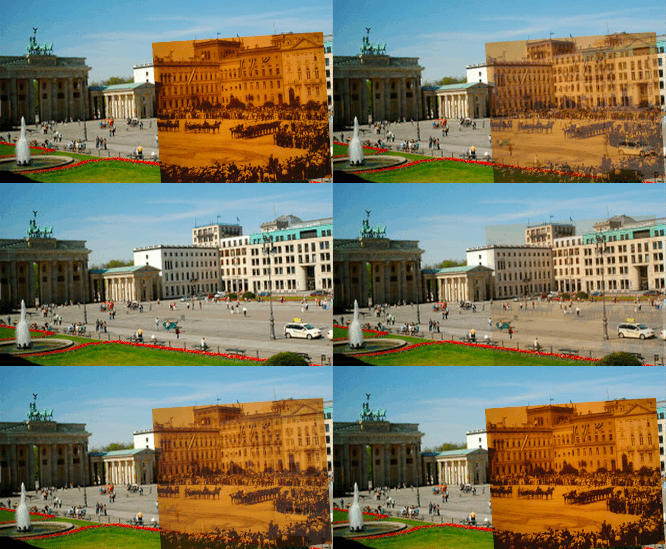
Pariser Platz during the official reception of Queen Wilhelmina of the Netherlands in May 1901; within two decades she would provide sanctuary for Kaiser Wilhelm II after his abdication. The square was named after the French defeat at the hands of the Anglo-Prussians in 1815 and now is again the main square in Berlin, after having fallen within the so-called 'Death Strip' during the time of the Berlin Wall. It had suffered severe damage during the war, especially during its last days during the Battle of Berlin. The East German regime had the remaining buildings demolished before the Berlin Wall was built with only the rear part of the Palais Arnim preserved. After the fall of the Wall in 1993, the reconstruction of the square was a matter of controversy leading to it being rebuilt according to the design specifications of Bruno Flierl and Hans Stimmann, supplemented by the specifications of the Berlin Senate which required that the height of the buildings not exceed 22 metres and that only vertical windows be used in the new buildings and that a maximum of fifty percent of the façade area be made of glass in order to tie in with the “golden days” of the square.
 During my Bavarian International School 2018 class trip and Provisional President Friedrich Ebert saluting returning troops from the war exactly a century earlier on November 10, contributing to the so-called stab-in-the-back myth (Dolchstoßlegende) with the declaration that "no enemy has vanquished you" (kein Feind hat euch überwunden!) and "they returned undefeated from the battlefield" (sie sind vom Schlachtfeld unbesiegt zurückgekehrt). The latter quote was shortened to im Felde unbesiegt ("undefeated on the battlefield") as a semi-official slogan of the Reichswehr. Ebert had meant these sayings as a tribute to the German soldier, but it only contributed to the prevailing feeling that Germany had been betrayed at home, widely believed and promulgated in right-wing circles that the German Army did not lose the Great War on the battlefield but was instead betrayed by the civilians on the home front, especially the republicans who overthrew the monarchy in the German Revolution of 1918–19. Advocates denounced the German government leaders who signed the Armistice on November 11, 1918, as the "November Criminals" (Novemberverbrecher).
During the March 1920 Kapp putsch and the same site today, looking towards Unter der Linden. On March 13, 1920 Walther von Luettwitz personally activated a putsch, ordered Freikorps units into Berlin, and designated New York-born Dr. Wolfgang Kapp the new Chancellor. Kapp had been a member of the right-wing DNVP and, with like-minded individuals such as Erich Ludendorff, Colonel Max Bauer, and Waldemar Pabst, formed the Nationale Vereinigung (National Union) in October 1919. He was dedicated to the removal of the Republic and creation of a conservative dictatorship. At the start of the putsch, the legal government fled to Stuttgart. Because of insufficient preparations, the putschists failed to secure the support of Berlin’s bureaucracy, including the Reichsbank, and were greeted on March 14 by a general strike that doomed the action. Kapp resigned on March 17 and, with imprisonment threatening, fled to Sweden. When the 1922 trial of Traugott von Jagow, Kapp’s Interior Minister, fostered the view that the putschists had acted only as patriotic Germans, Kapp came home. Seriously ill with cancer, he surrendered to the Supreme Court and died before his case was decided. As aftermath to the foiled putsch, Germany’s internal politics were polarised: the Right became more adamant in its disapproval of the Republic, while the Left demanded resumption of the November Revolution. The uprising in the Ruhr of a so-called Red Army, a by-product of the putsch, compelled the hapless government to rely on the same Freikorps units that had just tried to displace it. German voters discerned the impairment of purpose. When elections were held in June 1920, the Weimar Coalition lost its majority; it would never regain it.
The site during the last stage of the Battle of Berlin. The "Altbau" from the IG-Farben building behind the T34/85 is now a Starbucks; it can be seen on the right when Goebbels had spoken in front only months earlier on the Tag des Deutschen Volkssturm of November 12, 1944.
 From the same spot at the other direction towards the Adlon with the Volkssturm marching and my students from our 2016 Bavarian International School trip. It was here at the Pariserplatz that

the wounded were laid in the street wrapped in blankets. German Red Cross nurses and BdM girls continued to treat them. Just to the north, Soviet guns blasted into submission a group of doomed ϟϟ still holding out in a building on the Spree. In all directions, smoke from ruins continued to deform the sky. Red Army soldiers flushed out Wehrmacht, ϟϟ, Hitler Youth and Volkssturm. They emerged from houses, cellars and subway tunnels, their faces almost black with grime and stubble. Soviet soldiers shouted, `Hande hoch!' and their prisoners dumped their weapons and held their hands as high as possible. A number of German civilians sidled up to Soviet officers to denounce soldiers who continued to hide. Vasily Grossman accompanied General Berzarin to the centre of the city. He was staggered by the scale of destruction all around, wondering how much had been wrought by American and British bombers. A Jewish woman and her elderly husband approached him. They asked about the fate of Jews who had been deported. When he confirmed their worst fears, the old man burst into tears. Grossman was apparently accosted a little later by a smart German lady wearing an astrakhan coat. They conversed pleasantly. `But surely you aren't a Jewish commissar?' she suddenly said to him.
Beevor (393) The Fall of Berlin 1945
Colour footage of the Nazis' triumphal procession January 30, 1933 upon Hitler's appointment as Chancellor. From dusk to midnight that day, tens of thousands of jack- booted, brown-shirted storm troopers, flaming torches held high, drums beating, bands playing, paraded through Berlin. The “river of fire,” as one observer described it, passed thunderously through the Brandenburg Gate, turning down Wilhelmstrasse, past the Presidential Palace and the Reich Chancellery. From a window in the Presidential Palace, the aged Reich president, Field Marshal Paul von Hindenburg, watched the seemingly endless procession in bewilderment as farther along, in front of the Reich Chancellery, the massed storm troopers raised their right arms and voices in salute to the slight figure in formal dress standing at a Chancellery window—their leader, newly appointed chancellor of Germany, Adolf Hitler.
On 30 January 1933, the night of Hitler’s appointment to the chancellorship, massed Nazi marchers, mostly stormtroopers, poured through Berlin streets to the Brandenburg gate, waving torches and singing. They moved on past the Reich Chancellery where Hitler and Hindenburg stood on a balcony. Now the exodus began in earnest. Playwright Bertold Brecht left quickly for Vienna. Kurt Weill and Lotte Lenya, of “Three-Penny Opera” fame, fled to Paris. A number of conductors and composers fled to Switzerland or America. The unique, feverish, turbulent, and recklessly hedonistic Berlin of the twenties was gone.
Otis C. Mitchell (116): Hitler's Stormtroopers and the Attack on the German Republic

When Hitler had been appointed Chancellor January 30, 1933, SA troops marched through. This painting by Arthur Kampf depicting this march makes a number of appearances in the video game Return to Castle Wolfenstein.

From a 1938 postcard and exactly 80 years later

On August 1st 1936 Hitler opened the Summer Olympic Games held in Berlin (and my students during my 2013 Bavarian International School tour)
which afforded the Nazis a golden opportunity to impress the world with the achievements of the Third Reich, and they made the most of it. The signs ”Juden unerwuenscht” (Jews Not Welcome) were quietly hauled down from the shops, hotels, beer gardens and places of public entertainment, the persecution of the Jews and of the two Christian churches temporarily halted, and the country put on its best behaviour. No previous games had seen such a spectacular organisation nor such a lavish display of entertainment. Goering, Ribbentrop and Goebbels gave dazzling parties for the foreign visitors – the Propaganda Minister’s ”Italian Night” on the Pfaueninsel near Wannsee gathered more than a thousand guests at dinner in a scene that resembled the Arabian Nights. The visitors, especially those from England and America, were greatly impressed by what they saw: apparently a happy, healthy, friendly people united under Hitler – a far different picture, they said, than they had got from reading the newspaper dispatches from Berlin. And yet underneath the surface, hidden from the tourists during those splendid late-summer Olympic days in Berlin and indeed overlooked by most Germans or accepted by them with a startling passivity, there seemed to be – to a foreigner at least – a degrading transformation of German life.

The Brandenburg Regiment, so-named as it had initially been based in the town of Brandenburg an der Havel. The Brandenburgers were members of the Brandenburg German Special forces unit during the war. Originally the unit was formed by and operated as an extension of the military's intelligence organ, the Abwehr. Members took part in seizing operationally important targets by way of sabotage and infiltration and, being foreign German nationals who were convinced Nazi volunteers, constituent members, had lived abroad and were proficient in foreign languages as well as being familiar with the way of life in the area of operations where they were deployed. The Brandenburg Division was generally subordinated to the army groups in individual commands and operated throughout Eastern Europe, in southern Africa, Afghanistan, the Middle East and in the Caucasus. In the later course of the war, parts of the special unit were used in the fight against partisans in Yugoslavia before the Division, in the last months of the war, was reclassified and merged into one of the Panzergrenadier Divisions. They committed various atrocities in the course of their operations including the Lviv massacre s well as other mass shootings. Shortly after German reunification a newly established reserve formation of the Bundeswehr was named the Heimatschutzbrigade Brandenburg which led in June 1991 to a debate in the Brandenburg parliament, calling on the state government to distance itself from this designation and to advocate a renaming, as it is "politically instinctive and human tasteless" to use the name of a Wehrmacht division of "fascist content and criminal character." The motion was finally rejected by 38 votes in favour agaonst ten with sixteen abstentions.


The and My 2012 and 2018 Bavarian International School cohorts with the Aufziehen der Wache on the left and Hitlerjugend right.
 During Hitler's 50th Birthday celebrations. On April 18, 1939, the German government declared Hitler's birthday, April 20, a national holiday. Kershaw describes the events that Goebbels organised in Berlin as "an astonishing and extravagant cult of the Führer. The effusiveness of adulation surpassed that of any previous anniversary." The festivities began the evening before the birthday. Hitler led a motorcade of fifty white limousines along the newly completed East-West Axis, designed by Speer to serve as the central boulevard of Welthauptstadt Germania , the proposed new capital. Hitler, who'd anticipated that Speer would make a speech, was amused when Speer briefly announced that the piece spoke volumes. The next act was a torchlight procession from all over Germany, which Hitler watched from a balcony of the Reich Chancellery. Speer gave Hitler a scale model of the gigantic triumphal arch he had sketched for the rebuilding of Berlin. Of all the events that made up the celebrations, the great military parade that the Nazis deployed to show their military capacity was one of the most important. One of its objectives was to send a warning to the Allied forces and the parade, which lasted about five hours, was carried out by twelve companies of the Luftwaffe, twelve from the Army and another twelve from the Navy, as well as units of the ϟϟ. In total, between 40,000 and 50,000 soldiers participated as 162 warplanes flew over Berlin. Twenty thousand invited officers and several hundred thousand spectators witnessed the parade. The long-range air artillery pieces stood out, and special attention was paid to motorised artillery and the development of air defence units. Other invited officers, representing a total of twenty-three countries, also took part in the celebrations. The papal envoy Cesare Orsenigo, the President of the Slovak Republic Jozef Tiso, the leaders of the different branches of the German armed forces, and the mayors of German cities sent their gifts to the chancellery. The British and American ambassadors weren't present at the parade, having withdrawn from the country following Hitler's march into Bohemia and Moravia in 1938 and chargé d'affaires Raymond H. Geist represented the United States at the troop parade. King George VI sent a message of congratulations to Hitler; however, given the tense relations between the two countries, his advisors had advised the king to skip his birthday.
 During Hitler's 50th Birthday celebrations. On April 18, 1939, the German government declared Hitler's birthday, April 20, a national holiday. Kershaw describes the events that Goebbels organised in Berlin as "an astonishing and extravagant cult of the Führer. The effusiveness of adulation surpassed that of any previous anniversary." The festivities began the evening before the birthday. Hitler led a motorcade of fifty white limousines along the newly completed East-West Axis, designed by Speer to serve as the central boulevard of Welthauptstadt Germania , the proposed new capital. Hitler, who'd anticipated that Speer would make a speech, was amused when Speer briefly announced that the piece spoke volumes. The next act was a torchlight procession from all over Germany, which Hitler watched from a balcony of the Reich Chancellery. Speer gave Hitler a scale model of the gigantic triumphal arch he had sketched for the rebuilding of Berlin. Of all the events that made up the celebrations, the great military parade that the Nazis deployed to show their military capacity was one of the most important. One of its objectives was to send a warning to the Allied forces and the parade, which lasted about five hours, was carried out by twelve companies of the Luftwaffe, twelve from the Army and another twelve from the Navy, as well as units of the ϟϟ. In total, between 40,000 and 50,000 soldiers participated as 162 warplanes flew over Berlin. Twenty thousand invited officers and several hundred thousand spectators witnessed the parade. The long-range air artillery pieces stood out, and special attention was paid to motorised artillery and the development of air defence units. Other invited officers, representing a total of twenty-three countries, also took part in the celebrations. The papal envoy Cesare Orsenigo, the President of the Slovak Republic Jozef Tiso, the leaders of the different branches of the German armed forces, and the mayors of German cities sent their gifts to the chancellery. The British and American ambassadors weren't present at the parade, having withdrawn from the country following Hitler's march into Bohemia and Moravia in 1938 and chargé d'affaires Raymond H. Geist represented the United States at the troop parade. King George VI sent a message of congratulations to Hitler; however, given the tense relations between the two countries, his advisors had advised the king to skip his birthday.
July 6, 1940 as German troops return home victorious after quickly dispatching France.

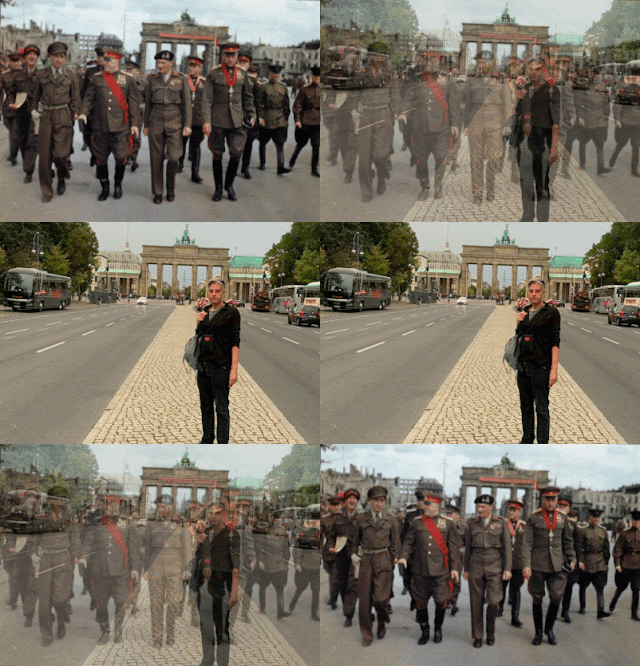
Field Marshal Sir Bernard Montgomery joining Deputy Supreme Commander in Chief of the Red Army, Marshal Zhukov, the Commander of the 21st Army Group, Marshal Sokolovsky and General Rokossovsky of the Red Army as they leave the Brandenburg Gate after decorating them at the July 12, 1945 ceremony.

The Brandenburg Gate as seen from the British Zone and during my 2013 Bavarian International School class trip.
The two guardhouses flanking the Brandenburg Gate were piles of rubble. Soldiers from the four powers walked around adding a living aspect to the landscape of ruin. Around the Reichstag building a black market had grown up. There were Russian graves on the Ranke Platz and abandoned tanks on the pavements. The latter served as kiosks, announcing dance schools, new theatres and newspapers and toys for urchins reminiscent of the pictures by Heinrich Zille. The Franziskus Hospital was the only undamaged building, and the nuns looked timeless in their habits, as if they had emerged from somewhere on the Castilian Meseta. Near by, the Tiergarten was a blackened shambles, looking more like a battlefield than a landscaped garden.MacDonogh (120-121) After the Reich

From my 2018 Bavarian International School trip and from the same spot amidst the destruction in June, 1945. The truck in the foreground appears to be an American Chevrolet AFWX-354. The French ordered 150 of them by the fall of 1939 which the British inherited, later delivering most to Russia via lend-lease. The Germans ended up capturing them and deploying them in several fronts. A month earlier on May 2nd, at 6.55 a.m. Moscow time, the white and red Polish flag was hoisted atop the Brandenburg Gate above the ruins of the city, alongside the Soviet flag.
Few areas of the capital were untouched by the ravages of war. Entire districts had been rendered uninhabitable; buildings standing like so many broken teeth, with empty, gaping window frames opening into blackened voids where once had been apartments, homes and businesses. The streets in between were pitted with craters and covered by vast fields of rubble, through which makeshift footpaths snaked. Over it all, a pall of smoke and dust hung in the air, covering everything, choking the survivors and twisting and eddying in the cool spring breeze.Moorhouse (382) Berlin at War

Taken from the other side of the Gate

The Brandenburg Gate had become the main focus for barter and the black market at the beginning of May, when liberated prisoners of war and forced labourers traded their loot. Ursula von Kardorff found all sorts of women prostituting themselves for food or the alternative currency of cigarettes. `Willkommen in Shanghai,' remarked one cynic. Young women of thirty looked years older, she noticed.
Beever (414) The Fall of Berlin: 1945

Dazed civilians receiving care from Red Cross personnel in front of the Brandenburg Gate and my 2016 cohort.
Once it had been decided that all Germans were guilty, the next job was to punish them. Despite the propaganda rations meted out by the Russians in Berlin, the Potsdam Conference decided that the Germans were not to be over-fed. Requests by the Red Cross to bring in provisions were waved aside, and in the winter of 1945 donations were returned with the recommendation that they be used in other war-torn parts of Europe – although the Irish and Swiss contributions had been specifically raised with Germany in mind. The first donations to be permitted reached the American Zone in March 1946, to some degree thanks to the intervention of British intellectuals such as Bertrand Russell and Victor Gollancz.
... Despite the great wrong perpetrated against his people, Gollancz could not sanction another crime: ‘The plain fact is . . . we are starving the Germans. And we are starving them, not deliberately in the sense that we definitely want them to die, but wilfully in the sense that we prefer their death to our own inconvenience.’ Over and over again in his letters to his wife, he is struck by the fact that these suffering infants might have been his own children.
 Russian poet Yevgeny Dolmatowski reading poetry to Red Army troops before the Brandenburg Gate on May 2, 1945 in a photo by Yevgeny Khaldei, and my 2021 class cohort. Dolmatowski is shown on the tank first from right, after the signing of the order to cease hostilities by General Weidling. During the war, he'd worked as a correspondent for the Red Army until August 1941 when he was wounded and taken prisoner by the Germans. He managed to escape and return to service, holding the rank of major. Another well-known picture by Khaldei shows the young poet on the same day with a bust of Hitler under his arm as a trophy, near the Reichstag building. His experiences found literary resonance even during the war years and in 1950 he received the Stalin Prize for Slovo о завтрашнем дне.
  It is still possible to honour the Red Army's victory today (although an American tourist found reason to be offended in the contempt shown for her flag) provided one doesn't dwell on its "excesses"...
Does Djilas, who is himself a writer, not know what human suffering and the human heart are? Can't he understand it if a soldier who has crossed thousands of kilometres through blood and fire and death has fun with a woman or takes some trifle?Stalin responding to complaints about the rapes and looting committed by the Red Army during the Second World War. Milovan Djilas, Conversations with Stalin, p. 95. Stalin would also suggest that "We lecture our soldiers too much; let them have their initiative."
Conservative estimates place the number of Berlin women raped at 20,000. It began in Neukölln at 18.00 on April 27. The worst cases involved very young children or elderly ladies, and the victims were often killed afterwards. It was rumoured that the severity of the rapine was caused by the fact the Russians had sent in units made up of criminals – such as the Nazis had used at the time of the Warsaw Uprising – but this was later revealed to have been untrue. Rapists were threatened with gruesome punishments, but the prospect of satisfying their lust proved stronger than the fear of chastisement. One officer reprimanded a soldier with the words ‘ukas Stalina’ (Stalin’s orders), but the man answered back, saying the Germans had raped his sister.
 Showing little has changed when it comes to Russians currently raping and torturing women and children in a Hitleresque war of extermination in Ukraine, a kind of gallows humour grew up that was encapsulated in the expression ‘Besser ein Iwan auf dem Bauch als ein Ami auf dem Kopf!’ (Better a Russki on the belly than a Yank on the head!), meaning that rape was preferable to being blown up by a bomb. In a frightful twist in the gallows humour of the time, Berlin children used to play the ‘Frau komm mit!’ game, with the boys taking the part of the soldiers and the girls their victims. There was a trade in stars of David, which sold for up to 500 reichsmarks, but in the end the Russians couldn’t care less if the woman was Jewish or the house they plundered had a Jewish owner, not having gone to war to protect the Jews after all. The rapes continued throughout the time the Russians had Berlin to themselves, but they slackened off markedly after May 4. Even when Berlin women were not driven so far as to take their own lives, the rapes had inevitable consequences in the form of disease and babies. Some of these unwanted babies were placed in a home in Wilmersdorf. In 1946 it was estimated that one in six of the children born out of wedlock had been fathered by Russians. Coping with syphilis and gonorrhoea without antibiotics was part of a woman’s life at the time. Ten percent of those raped were infected, and antibiotics cost the equivalent of two pounds of coffee. Most of the unwanted Russian children were aborted, although there was the usual rumour that Stalin had forbidden the women to dispose of their children because he wanted to see an alteration in the racial mix. Abortion was a crude business, normally carried out without anaesthetic and costing about 1,000 reichsmarks. Many women performed the act on themselves, with inevitable consequences. Despite the massive incidence of abortion, it is estimated that between 150,000 and 200,000 ‘Russian babies’ survived infancy. The daily threat of rape petered out only when the Western Allies arrived in July, and when the Soviet authorities realised that it was damaging their chances of political success among the civilian population.
After Germany's surrender and the end of the war, the governments of East Berlin and West Berlin restored it in a joint effort. The holes were patched, but were visible for many years. The gate was located in the Soviet occupation zone, directly next to the border to the British occupation zone, which later became the border between East and West Berlin. Vehicles and pedestrians could travel freely through the gate until the day after construction began on the Berlin Wall on Barbed Wire Sunday, August 13, 1961. West Berliners gathered on the western side of the gate to demonstrate against the Berlin Wall, among them West Berlin's mayor, Willy Brandt, who had returned from a federal election campaign tour in West Germany earlier the same day. The wall passed directly by the western side of the gate, which was closed throughout the Berlin Wall period, which ended on December 22, 1989. Today the Gate is again closed to vehicles and much of Pariser Platz has been turned into a cobblestone pedestrian zone.


The site before and after the fall of the wall from the British zone from my 2018 Bavarian International School history class trip
Tourists
posing in front of the Berlin Wall at the Brandenburg gate in the
British sector on June 6, 1989 and my Bavarian International School students in 2013.


Soviet IS-2 heavy tanks going past the gate and the site during the Cold War and today, wall gone.
.gif)
The American embassy after the war and after its official opening July 4, 2008.The night before he was murdered Rathenau spent at a dinner here given by Ambassador Alanson Houghton followed by a talk "that lasted until four o'clock in the morning with Hugo Stinnes, who disagreed often enough with him but at the same time admired many things he stood for." The Making of Adolf Hitler
Since 1924 the Americans had been interested in having its own embassy building in Berlin and in 1930 signed a preliminary contract to buy Palais Blücher at Pariser Platz 2. On April 15, 1931, before the final purchase of the property, a fire destroyed the palace - but the contract was signed a short time later for $1.8 million. The reconstruction of the building was delayed by several years due to the onset of the Great Depression and, more importantly, the Nazi seizure of power and Roosevelt's antipathy towards them. In Ambassador William Edward Dodd, who'd studied at the University of Leipzig, Roosevelt chose an expert on Germany. Dodd didn't like Hitler, avoided dinners with him, and even refused to repair Palais Blücher, which was in such a prominent location, during the 1936 Olympic Games in order just to annoy Hitler. After Speer presented his plans to transform Berlin into the world capital Germania in 1938 and it became apparent that the embassy location on Bendlerstrasse would have to be abandoned, Dodd's successor Hugh Robert Wilson had the building renovated. From April 1, 1939, it was used as an embassy but without an official ambassador, since on November 16, 1938, Wilson was recalled by Roosevelt in protest against Kristallnacht. In addition to the two charges d'affaires who succeeded Wilson, the important historian and diplomat George F. Kennan also worked as legation secretary in the embassy. With the beginning of the war in 1939, diplomatic relations between the United States and Germany remained as the Americans left it to Britain to fight on alone. The letters
'USA' were printed on the roof in an attempt to minimise damage from
accidental aerial bombings which was impossible given its proximity to
the Reichschancellery. This lasted until December 11, 1941, four days after the Japanese attack on Pearl Harbour when Germany declared war on the United States. The embassy was closed and the embassy staff was interned for five and a half months in a former hotel in Bad Nauheim. During the war, the embassy of neutral Switzerland administered the embassy building.

Standing in front of Berlin's most famous hotel before the war, opened in 1907 when families of the high nobility sold their winter palaces in Berlin to reside in the suites of the hotel. Wilhelm II fled from the draughty rooms of his castle to its luxurious and well-heated rooms. The German Foreign Office also used the hotel as an "unofficial guest house" because there were no suitable accommodations for high visitors from abroad. Not only Europe's kings and emperors such as the Russian Czar and the Maharajah of Patiala, but also industrialists and politicians such as Thomas Edison, Henry Ford, John D. Rockefeller, Walther Rathenau, Gustav Stresemann and Aristide Briand were famous guests in the early years. However, where the emperor used to spend the night, after the Great War rich Americans arrived who were on vacation in Europe and soon took the name of the hotel across the Atlantic. In 1919, the American occupiers had their headquarters in the Adlon. Above the hotel, however, was not the American flag, but that of the Red Cross. The "Golden Twenties" also brought golden times for the Adlon. Charlie Chaplin lost his trouser's buttons on the way to the hotel in Berlin and Marlene Dietrich was discovered here. Between 1925 and 1930, the hotel had almost two million visitors making it a veritable Berlin landmark.
 A parade of the newly founded Volkssturm marches through Berlin on November 12, 1944 with the Hotel Adlon in the background, and during my 2016 class trip. Immediately after the Nazi seizure of power in April 1933, their foreign policy office was set up by Alfred Rosenberg for a short time in a wing of the building. The steady upswing of the hotel gradually came to an end with the beginning of the Nazi regime in the German Reich, mainly due to the declining number of American tourists. However, there were highlights, such as the 1936 Olympic Games when Louis Adlon, who had since taken over the management of the hotel with his wife Hedda, hoped that his house would become the new meeting place of ϟϟ generals and leading politicians and that the hotel could emerge as the main venue for festivities. Instead, the Nazis themselves preferred the Hotel Kaiserhof a few blocks
south and directly across from the Propaganda Ministry and Hitler's
Chancellery on Wilhelmplatz. Kaiserhof in Wilhelmstraße, possibly because the atmosphere of the Adlon was probably too conservative, too cosmopolitan, too international and so did not fit into the "fanaticism of Germanism." The Adlon continued to operate normally throughout the war, even constructing a luxurious bomb shelter for its guests and a huge brick wall around the lobby level to protect the function rooms from flying debris. Parts of the hotel were converted to a military field hospital during the final days of the Battle of Berlin. The hotel survived the war without any major damage, having avoided the bombs and shelling that had levelled the city. However, on the night of May 2, 1945 a fire, started in the hotel's wine cellar by drunken Russians, left the main building in ruins.
A parade of the newly founded Volkssturm marches through Berlin on November 12, 1944 with the Hotel Adlon in the background, and during my 2016 class trip. Immediately after the Nazi seizure of power in April 1933, their foreign policy office was set up by Alfred Rosenberg for a short time in a wing of the building. The steady upswing of the hotel gradually came to an end with the beginning of the Nazi regime in the German Reich, mainly due to the declining number of American tourists. However, there were highlights, such as the 1936 Olympic Games when Louis Adlon, who had since taken over the management of the hotel with his wife Hedda, hoped that his house would become the new meeting place of ϟϟ generals and leading politicians and that the hotel could emerge as the main venue for festivities. Instead, the Nazis themselves preferred the Hotel Kaiserhof a few blocks
south and directly across from the Propaganda Ministry and Hitler's
Chancellery on Wilhelmplatz. Kaiserhof in Wilhelmstraße, possibly because the atmosphere of the Adlon was probably too conservative, too cosmopolitan, too international and so did not fit into the "fanaticism of Germanism." The Adlon continued to operate normally throughout the war, even constructing a luxurious bomb shelter for its guests and a huge brick wall around the lobby level to protect the function rooms from flying debris. Parts of the hotel were converted to a military field hospital during the final days of the Battle of Berlin. The hotel survived the war without any major damage, having avoided the bombs and shelling that had levelled the city. However, on the night of May 2, 1945 a fire, started in the hotel's wine cellar by drunken Russians, left the main building in ruins.
 A parade of the newly founded Volkssturm marches through Berlin on November 12, 1944 with the Hotel Adlon in the background, and during my 2016 class trip. Immediately after the Nazi seizure of power in April 1933, their foreign policy office was set up by Alfred Rosenberg for a short time in a wing of the building. The steady upswing of the hotel gradually came to an end with the beginning of the Nazi regime in the German Reich, mainly due to the declining number of American tourists. However, there were highlights, such as the 1936 Olympic Games when Louis Adlon, who had since taken over the management of the hotel with his wife Hedda, hoped that his house would become the new meeting place of ϟϟ generals and leading politicians and that the hotel could emerge as the main venue for festivities. Instead, the Nazis themselves preferred the Hotel Kaiserhof a few blocks
south and directly across from the Propaganda Ministry and Hitler's
Chancellery on Wilhelmplatz. Kaiserhof in Wilhelmstraße, possibly because the atmosphere of the Adlon was probably too conservative, too cosmopolitan, too international and so did not fit into the "fanaticism of Germanism." The Adlon continued to operate normally throughout the war, even constructing a luxurious bomb shelter for its guests and a huge brick wall around the lobby level to protect the function rooms from flying debris. Parts of the hotel were converted to a military field hospital during the final days of the Battle of Berlin. The hotel survived the war without any major damage, having avoided the bombs and shelling that had levelled the city. However, on the night of May 2, 1945 a fire, started in the hotel's wine cellar by drunken Russians, left the main building in ruins.
A parade of the newly founded Volkssturm marches through Berlin on November 12, 1944 with the Hotel Adlon in the background, and during my 2016 class trip. Immediately after the Nazi seizure of power in April 1933, their foreign policy office was set up by Alfred Rosenberg for a short time in a wing of the building. The steady upswing of the hotel gradually came to an end with the beginning of the Nazi regime in the German Reich, mainly due to the declining number of American tourists. However, there were highlights, such as the 1936 Olympic Games when Louis Adlon, who had since taken over the management of the hotel with his wife Hedda, hoped that his house would become the new meeting place of ϟϟ generals and leading politicians and that the hotel could emerge as the main venue for festivities. Instead, the Nazis themselves preferred the Hotel Kaiserhof a few blocks
south and directly across from the Propaganda Ministry and Hitler's
Chancellery on Wilhelmplatz. Kaiserhof in Wilhelmstraße, possibly because the atmosphere of the Adlon was probably too conservative, too cosmopolitan, too international and so did not fit into the "fanaticism of Germanism." The Adlon continued to operate normally throughout the war, even constructing a luxurious bomb shelter for its guests and a huge brick wall around the lobby level to protect the function rooms from flying debris. Parts of the hotel were converted to a military field hospital during the final days of the Battle of Berlin. The hotel survived the war without any major damage, having avoided the bombs and shelling that had levelled the city. However, on the night of May 2, 1945 a fire, started in the hotel's wine cellar by drunken Russians, left the main building in ruins. The Stalin portrait beside the Adlon and the view today down Unter den Linden- completely rebuilt. After
Keitel had handed over document signed by Dönitz confirming the unconditional surrender arranged in Rheims the day before ending the
war,
The Stalin portrait beside the Adlon and the view today down Unter den Linden- completely rebuilt. After
Keitel had handed over document signed by Dönitz confirming the unconditional surrender arranged in Rheims the day before ending the
war, [t]here were four full hours of toasts and many of the soldiers were literally under the table. When the festivities came to an end there was a massive cannonade, which some Berliners misinterpreted, imagining the war had started up all over again. The Soviets had known where to find the wine: 65,000 bottles of claret had been located to this end, and others beside. They had taken it from a walled-up section of the cellars of Berlin’s best hotel, the Adlon. The fate of the hotel was sealed by the discovery of the wine cellar. Russian lorries came to take away the contents, and very soon a fire broke out that was to destroy one of the few buildings in the street that had survived the conflict.

The Adlon was the hotel where Michael Jackson infamously dangled his baby out of the window of his room on the third floor, holding it with one arm under its shoulders in November, 2002:


Standing in front of the site of the former Central Office of the Inspector General for Construction in the Reich Capital at Pariser Platz 4. Originally Palais Arnim, from 1907 to 1938 it was the seat of the Prussian Academy of Arts. After the July 1937 campaign against the Degenerate Art had led to the closure of the New Department of the National Gallery, Albert Speer used these premises as a workplace in his capacity as general construction inspector for the imperial capital given him by Hitler on January 30, 1937. In February 1937, Speer described its use as allowing for "the Führer to come through the ministerial gardens into the rooms of the new office, the only building in the immediate vicinity of the Reich Chancellery, whose corporation no longer fulfils any worthwhile purpose." Speer divided the rooms of the Arnim Palace into offices and studios, taking up quarters in the great hall. In his exhibition building, he had a large model of Berlin set up in the middle hall escape, which only partially retained its skylight. All eight remaining halls were replaced by skylights, rebuilt into studios and workshops, and overbuilt by two storeys with new stairwells. Often Hitler visited the building to visit the models and plans for the planned rebuilding of Berlin and to discuss it with Speer and his coworkers. Speer moved into the building in 1942 after Hitler had appointed him to succeed Fritz Todt in the Office of the Minister of Armaments and Munitions. From 1943 Speer and his staff, headed by Rudolf Wolters, used the site and working staff for the reconstruction of bombed cities.

Standing beside the original model of the proposed Great Hall of the People (Große Halle, Halle des Volkes) designed by Albert
Speer, who enjoyed a meteoric rise to power and prominence as Hitler's favourite architect. In 1925, Speer began to study architecture in
Berlin. In 1931, after hearing Hitler speak, he joined the Nazi Party.
When the Nazis came to power, Speer was given the job of redesigning the
ministerial residence of Joseph Goebbels, Hitler's chief of
propaganda. The work Speer did on this job brought him to the attention
of Hitler, who gave Speer the commission for the new Chancellery
building. Together Hitler and Speer then began work on monumental plans
to reconstruct Berlin and make it the capital (now to be called
Germania) of the new Nazi Empire, with enormous public buildings that
would dwarf all existing structures. The Great Hall was intended to be
several times the size of St. Peter's Cathedral in Rome, which was then
the largest single building in Europe. Speer managed to complete part of
his plan before the war. Part of Berlin was torn down and to house Aryan Berliners living in this neighbourhood, Speer forcibly evicted
Jews from almost six thousand apartments. As armaments minister during
the war, Speer worked slave labourers to death to keep the German war
machine going. When Germany was defeated, Speer did not think the
victorious Allies would prosecute him for war crimes because he had,
after all, been only an architect for Hitler. The Allies disagreed, putting Speer on trial in 1945 and sentencing him to twenty years in prison whilst his subordinate was hanged. For Speer's knowledge of the Holocaust despite his denials, see examples of my students' research projects for the IBDP History course.

Focusing on the time period between 1932 and 1940, the historic buildings of Voss Street were digitally recreated for this film. Aside from the architectural highlights on the street, such as the Ministry of Justice, the Bavarian legation and Palais Mosse, the film also discusses the building where Albert Speer executed his first contract for the Nazi Party in 1932. The way in which the construction of the New Reich's Chancellery influenced the character of the street is demonstrated, as well as the expansion of Voss Street that would have taken place by 1950. This expansion was never carried out, and formed part of the plans for the new Reich's Capital -- "Germania".
According to Hitler, Berlin could now finally become a 'truly’ German capital city: it was to be totally rebuilt and renamed Germania. Historians have devoted considerable attention to Hitler’s plans for the rebuilding of Berlin, but they have rarely acknowledged their effect on both the face of tourist Berlin and the meaning of a visit to the capital between 1933 and 1945. Yet it is impossible to overestimate the degree to which Berlin’s new buildings – among them, the Reich Chancellery, the Reich Sport Field, the Reich Ministry of Transportation and the Reich Aviation Ministry – became key sights for visitors to the city.

After a 56 million Euro restoration, Berlin's Academy of the Arts re-opened at its historic location at Pariser Platz 4 between the Adlon Hotel and Brandenburg Gate. Founded in 1696, the Academy of the Arts offers a look back at a turbulent history that includes Nazi domination, destruction during the war, and the takeover by the East German Border Patrol after the division of Berlin. Designed by architects Behnisch & Partner and Werner Durth, the new glass and steel building is meant to reflect the dimensions of its original structure. Remnants of the former Academy have also been incorporated in the design, mirroring the building's history and destruction.
The Reichstag


 Three seminal photographs of 20th century Germany with the Reichstag as a backdrop all have one other thing in common- they have all been manipulated. The first photo shows Philipp Scheidemann proclaiming the end of the monarchy and birth of the Republic on November 9, 1918 by a window of the Reichstag. In reality, no-one would have been in a position to have heard anything he said. Later that afternoon Karl Liebknecht from the communist Spartakusbund called out the socialist Soviet republic from the palace. The centre photo of the Reichstag fire was manipulated to appear that the fire had been more widespread and devastating than it actually was, limited mainly to the central council chamber. The third shows the iconic raising of the Soviet flag which had been altered to remove the extra watch worn by the soldier as it appeared to confirm the systematic stealing of watches from Berliners. The original photo (top) was altered (bottom) by editing the watch on the soldier's right wrist.
 My 2016 class in front of the Reichstag, Germany's parliament in Berlin. The name together with its monumental size make most people associate Germany's neoclassical parliamentary building with the Nazis, but Hitler and his party have little history here. After hosting parliamentary sessions since 1894, one month after Hitler was appointed chancellor in January 1933, it was set on fire by Dutch communist Marinus van der Lubbe. In the years during which it abutted the Wall as a conference centre, West Berliners played football on its lawn, whilst later artist Christo famously wrapped it in cloth. It did not serve as parliament again until a reunited German government returned to Berlin in 1999. Renovated by Sir Norman Foster, this building is perhaps the most public federal building in the world through its glass-dome tourist attraction. On the rooftop, photographs documenting the building's history circle the rim above the parliament chamber. Two ramps spiral up the side of the dome, an engineering feat even more fascinating than the panoramic view from the top.
.gif)

 The burning of the Reichstag led to the so-called Reichstag Fire Decree, the
Enabling Act and ultimately Hitler’s rise to power, giving rise to the
question of who was responsible for this crime. On
March 23, 1933, the German Reichstag passed the Enabling Bill banning the German Communist Party and the Social Democratic Party from
taking part in future election campaigns. This was followed by Nazi
officials being put in charge of all local government in the provinces
(7th April), trades unions being abolished, their funds taken and their
leaders put in prison (2nd May), and a law passed making the Nazi Party
the only legal political party in Germany (14th July). There are three main
arguments, which are debated until today; these include the involvement
of the Nazis, the sole guilt of Marinus van der Lubbe and whether or
whether not the crime had been a communist plot.
The burning of the Reichstag led to the so-called Reichstag Fire Decree, the
Enabling Act and ultimately Hitler’s rise to power, giving rise to the
question of who was responsible for this crime. On
March 23, 1933, the German Reichstag passed the Enabling Bill banning the German Communist Party and the Social Democratic Party from
taking part in future election campaigns. This was followed by Nazi
officials being put in charge of all local government in the provinces
(7th April), trades unions being abolished, their funds taken and their
leaders put in prison (2nd May), and a law passed making the Nazi Party
the only legal political party in Germany (14th July). There are three main
arguments, which are debated until today; these include the involvement
of the Nazis, the sole guilt of Marinus van der Lubbe and whether or
whether not the crime had been a communist plot. Nazi involvement in the Reichstag Fire is supported by the fact that the Nazis built an underground passage to the Reichstag in which storm troopers dispersed “gasoline and self-igniting chemicals” on the night of the arson under the order of the S.A leader Karl Ernst. Even though the locksmith Wingurth declared that the tunnel into the Reichstag had many locked doors, which where found to be closed after the fire, one must know that the Nazis have asked him to advocate their innocence at the Nuremberg Trials. Even the official of the Prussian Ministry testified at the Nuremberg trials that Goebbels had the initial idea of burning down the Reichstag. Additionally General Franz Halder witnessed Goering shouting "The only one who really knows about the Reichstag is I, because I set it on fire!" However Goering denied his participation in the Fire at the Nuremberg Trials. It seems most reasonable blaming the Nazis for the burning of the Reichstag as according to Seftan Delmer “the fire was started by the Nazis, who used the incident as a pretext to outlaw political opposition and impose dictatorship.”

From Goering’s Reichstag President’s Palace an underground passage, built to carry the central heating system, ran to the Reichstag building. Through this tunnel Karl Ernst, a former hotel bellhop who had become the Berlin S.A. leader, led a small detachment of storm troopers on the night of February 27 to the Reichstag, where they scattered gasoline and self-igniting chemicals and then made their way quickly back to the palace the way they had come. At the same time a half-witted Dutch Communist with a passion for arson, Marinus van der Lubbe, had made his way into the huge, darkened and to him unfamiliar building and set some small fires of his own.At the trial at Leipzig enough evidence suggested that van der Lubbe “did not possess the means to set so vast a building on fire so quickly.” The testimony of experts at the trial shows that more than one person must have set the fire, as such a widespread fire would have required large quantities of chemicals and gasoline. It was therefore obvious “that one man could not have carried them into the building alone.” However van der Lubbe, who already had a criminal record, had attempted several times earlier to arson different buildings in order to protest against the German government. These failures could have encouraged the 24-year old Communist to aim other sites such as in this case the Reichstag. Additionally van der Lubbe was caught with “flammable materials”, “sweating” and “breathing heavily” during his interrogation as if he just came from the crime scene. Lubbe’s behaviour during his interrogation and his items he was carrying with him clearly show that he had to do something with the fire. Why otherwise would he have carried around flammable materials on that particular day? Furthermore Kellerhof supports the theory of van der Lubbe being solely responsible for the fire as an own initiative to protest against the German system. He claims that a few flammable materials would have been enough to conduct the fire in the Reichstag alone, as the breaking of the glass of the dome of the Reichstag encouraged the contact between fire and oxygen, spreading the fire even more. This is also supported by Dr. Walter Zirpnis claiming at the Nuremberg trials that van der Lubbe acted by himself, even though Ernst Togler, Dimitroff, Popov and Tanev gave themselves up to the police. They only did this as a trigger to the police’s announcement to hang Marinus van der Lubbe.
(171) Rise And Fall Of The Third Reich
 Standing within the Reichstag with Göring's former office shown behind across the street; the view would have been blocked by the Berlin wall during the Cold War. In his book published 1963 Tobias described the use of the famous tunnel from this building to the Reichstag was just an “ingenious communist speculation”. However, Tobias has been accused of dismissing “forensic evidence such as the testimony of fire experts who claimed the necessity of multiple arsonists to set the fire” whilst Richard Evans writes how “numerous forgeries and falsifications have been found among the documentary evidence purporting to prove Nazi involvement”. Indeed, Benjamin Carter claims that Tobias was a "senior official of Germany’s domestic intelligence services” who benefited from his personal ties to Gestapo officers. Nevertheless, in the so-called Brown Book published by the Communist activist Willi Münzenberg, there was enough evidence presented arguing that SA officers had accessed the Reichstag via the tunnel connected to Göering’s basement and started the fire. On the night of the fire Göering and Hitler were having dinner together at Göering’s apartment. In his book, Carter states ‘[t]he following day, a new draft now called Decree for the protection of the German people was set. This draft allowed the banning (..) of political meetings and political associations if they posed a threat to public security. But here again, Hitler demonstrated his sense of timing and political calculations”. For Hett, the fire happened so near the federal election that it could not have been just a mere coincidence; it was clearly done by the Nazis, who wanted to benefit politically from the event by pointing their fingers to both the Communists and Social Democrats. “Now the Red pest is being thoroughly rooted out.” (Goebbels) after communists were arrested by the SA. However, as Tobias explains in his book, the Nazis could not have been involved in the fire as by allowing Van der Lubbe to stand trial the Nazis already proved their innocence; if the Dutch communist had been in fact associated with them, the Nazis would have gotten rid of him before the police could have had the chance to question the suspect.
 .gif)
Nazis entering the Reichstag and the council chamber on August 30, 1932, the day Hermann Göring was elected President of the Reichstag. On that day KPD member Clara Zetkin, socialist-communist politician, peace activist and women's rights activist, had travelled to Berlin especially for this purpose, opened the inaugural session as the oldest member of the Reichstag. She had recently recovered from a severe bout of malaria and was still very weak but devoted her opening speech to the fight against fascism. She accused the SPD of having been the pacesetter of the presidential cabinets, which she described as reactionary and pro-fascist. In accordance with the duties of a senior member of the Reichstag, she presided over the election of Göring as President of the Reichstag and then handed over the chair of the session to him. The Nazis had listened to Zetkin's speech without heckling or other disruptions, and this session is the only surviving audio recording from the Reichstag in which Zetkin can be heard. As a result of the Reichstag Fire Decree, Zetkin moved to the Soviet Union dying shortly after on June 20, 1933 at the age of almost 76. Stalin himself carried the urn to the burial where she is one of the few Germans to be buried at the Kremlin wall. Her brain, like that of Lenin and Mayakovsky, was kept in the Moscow Institute for Brain Research.
 Inside the chamber during my 2013 Bavarian International School trip and as it appeared during the era of the Weimar Republic. Hitler would utilise the Reichstag Fire to set the tone of his political trajectory. His speech on March 23, 1933, aimed at securing approval for the Enabling Act, underscores this. He declared, "The Reichstag fire was the work of the enemies of the German people. It was a terrorist act aimed at our new government's efforts to restore order." The narrative that the Nazi Party was Germany's guardian against threats of communism and internal chaos emerged through his words, leveraging the Reichstag fire as a political instrument. The 1935 Nuremberg Rally, officially known as the "Rally of Freedom", commemorated the Enabling Act. Goebbels, delivering the opening speech, underlined the Reichstag Fire's significance, stating, "Two years ago, Germany was still under the crushing yoke of the Treaty of Versailles... The Reichstag fire was a signal to rise up and fight this oppression." The fire was metaphorically represented as the impetus that propelled their struggle against the oppressive Versailles Treaty. Speer's ambitious architectural project also demonstrated the Reichstag's symbolic role. His memoirs reveal Hitler's vision for the new Reichstag: "It was to be crowned with a huge dome, inside of which there would be an assembly room for party leaders, a symbol of their dominance over the Reichstag, which Hitler regarded as synonymous with the weak and despised Weimar democracy."
Dieter Appett's memorial directly in front of the Reichstag commemorating the 96 Social Democratic and Communist Reichstag delegates murdered under the Third Reich.

Memorial room inside the Reichstag dedicated to those members killed or victimised during the Nazi regime.


 A total of 89 heavy artillery guns and Katyusha rocket launchers were trained on the Reichstag for a thunderous barrage before the infantry stormed it, turning the structure into a ruin. I'm sitting on the steps on the right, providing a comparison to its ruined state immediately after the war.
The GIF on the left shows the area around the Reichstag being cleared of rubble and the site today soon after my class of 2023 detrained and began their walk to our hostel. Immediately after the end of the war, the Reichstag building, which had been heavily contested for the last time, stood as a partial ruin in an environment characterised by rubble. The surrounding open spaces were used by the starving population to grow potatoes and vegetables. The city encouraged participation in clearing the rubble and helping rebuild by making the second-highest category of food ration cards available to the so-called 'Rubble Women', or Trümmerfrauen. The myth is one of smiling women cheerfully lugging stones and bricks which has now become ingrained in the German collective consciousness; her statue now erected all over the country in her honour. However, this campaign originally only worked in the eastern sector where the Trümmerfrau ideal became the role model for women seeking traditional male work and not in the area here within the British sector which maintained the traditional view of a woman’s role. In fact, Leonie Treber calls the story of the Trümmerfrau a myth given that not only was there not a particularly large number of women involved in the clearing of the rubble, those who did help did so involuntarily. Treber's doctorate at Duisburg-Essen University about them. Before that, the subject had not been studied academically. She has recently published a book based on her research called “The Myth of the Trümmerfrauen.” According to Treber, the role that women played in clearing out all of that rubble was minor; whilst in Berlin 60,000 women are documented as having worked to clear rubble, this constituted but 5% of the female population of the city.

Memorial room inside the Reichstag dedicated to those members killed or victimised during the Nazi regime.
From our 2011 and 2013 class trips, showing on the right the site on May 15, 1919, amidst a protest against the Versailles treaty.

The GIF on the left shows the area around the Reichstag being cleared of rubble and the site today soon after my class of 2023 detrained and began their walk to our hostel. Immediately after the end of the war, the Reichstag building, which had been heavily contested for the last time, stood as a partial ruin in an environment characterised by rubble. The surrounding open spaces were used by the starving population to grow potatoes and vegetables. The city encouraged participation in clearing the rubble and helping rebuild by making the second-highest category of food ration cards available to the so-called 'Rubble Women', or Trümmerfrauen. The myth is one of smiling women cheerfully lugging stones and bricks which has now become ingrained in the German collective consciousness; her statue now erected all over the country in her honour. However, this campaign originally only worked in the eastern sector where the Trümmerfrau ideal became the role model for women seeking traditional male work and not in the area here within the British sector which maintained the traditional view of a woman’s role. In fact, Leonie Treber calls the story of the Trümmerfrau a myth given that not only was there not a particularly large number of women involved in the clearing of the rubble, those who did help did so involuntarily. Treber's doctorate at Duisburg-Essen University about them. Before that, the subject had not been studied academically. She has recently published a book based on her research called “The Myth of the Trümmerfrauen.” According to Treber, the role that women played in clearing out all of that rubble was minor; whilst in Berlin 60,000 women are documented as having worked to clear rubble, this constituted but 5% of the female population of the city.

.gif) Me sitting on the steps leading to the entrance of the Reichstag and the original iconic image of a demoralised German soldier amidst the ruins. The remains disappeared behind covering panels; new mezzanines increased the useful area and largely changed the original spatial structure. The Chamber was now twice as large and could have accommodated all the members of a reunited Germany although ever since the four-power agreement of 1971, no plenary sessions of the Bundestag were allowed to be held in Berlin. Instead, only committee or group meetings were possible in the newly established rooms. Baumgarten's interventions (which cost 110 million marks reflect the lack of taste and sensitivity seen in postwar architechture everywhere. Thus and decorative design was taboo and straight lines and smooth surfaces dominated. Historic preservation aspects had little weight. In addition, in the case of the Reichstag building, there was a special motif, beyond aesthetic considerations: the building was originally, despite its parliamentary destiny, the symbol of a pre-democratic form of state. This was followed by a weak democracy and a brutal dictatorship. The Germans had just found their way back to a still young democracy and so it therefore only seemed logical to distance themselves from the past with clear cuts, and with a strictly contemporary aesthetic. During the partition of Berlin, the Reichstag building was located in the British sector, but the Berlin Wall ran directly on the east side of the building. The “lonely, shot up Reichstag” became a symbol – as “sandstone cutolos in no-man’s-to-hearland between the enemy world systems.” In the building was a museum about the Bundestag and the history of the Reichstag building. For foreign state guests, the visit to the outdoor terraces with a view of the Berlin Wall was part of the usual programme.
Me sitting on the steps leading to the entrance of the Reichstag and the original iconic image of a demoralised German soldier amidst the ruins. The remains disappeared behind covering panels; new mezzanines increased the useful area and largely changed the original spatial structure. The Chamber was now twice as large and could have accommodated all the members of a reunited Germany although ever since the four-power agreement of 1971, no plenary sessions of the Bundestag were allowed to be held in Berlin. Instead, only committee or group meetings were possible in the newly established rooms. Baumgarten's interventions (which cost 110 million marks reflect the lack of taste and sensitivity seen in postwar architechture everywhere. Thus and decorative design was taboo and straight lines and smooth surfaces dominated. Historic preservation aspects had little weight. In addition, in the case of the Reichstag building, there was a special motif, beyond aesthetic considerations: the building was originally, despite its parliamentary destiny, the symbol of a pre-democratic form of state. This was followed by a weak democracy and a brutal dictatorship. The Germans had just found their way back to a still young democracy and so it therefore only seemed logical to distance themselves from the past with clear cuts, and with a strictly contemporary aesthetic. During the partition of Berlin, the Reichstag building was located in the British sector, but the Berlin Wall ran directly on the east side of the building. The “lonely, shot up Reichstag” became a symbol – as “sandstone cutolos in no-man’s-to-hearland between the enemy world systems.” In the building was a museum about the Bundestag and the history of the Reichstag building. For foreign state guests, the visit to the outdoor terraces with a view of the Berlin Wall was part of the usual programme.  Here on the left is the scene the day after the breaching of the wall and today. Since 1971, the building has shown the exhibition “Questions to German History” and visited by several million interested parties. On the initiative of Federal Chancellor Helmut Kohl and his Federal Minister of State, Oscar Schneider, an expert report was obtained from Gottfried Böhm from RWTH Aachen in 1985 on how the building could be used in the future – especially in the case of reunification – and what modifications would be required. The report was treated confidentially. Until 1988, Böhm designed a glass dome that went to visitors and should symbolise openness and democratic participation. After German reunification the first session of the Bundestag in the reunified Germany took place in the Reichstag; for the first time with the 144 members, who were sent to the Bundestag by the freely elected Volkskammer for the period until the first all-German election. The meeting was sworn in to the meeting and Federal Chancellor Helmut Kohl made his government statement. Nevertheless the use of the Reichstag building was only determined by the Bundestag after an intensive and controversial debate in the Capital Decree on June 20, 1991 in Bonn by a narrow majority of 338 to 320 votes.
  On the left
Soviet soldier private Mikhail Makarov looks at the destroyed Reichstag and my 2017 cohort. A competition was announced for the conversion of the Reichstag building in 1993, its main planning criteria being transparency, clarity and exemplary energy technology. Norman Foster had planned a freestanding, transparent roof over the actual building and parts of the surrounding area – a proposal that was not subject to sufficient public approval for aesthetic reasons (it was dubbed “Germany’s largest petrol station”), but also because of the expected costs of 1.3 billion marks. In a completely new draft, Foster had not planned a dome for the roof of the Reichstag, expressly distancing himself from any elevation on the roof that would be built "for purely symbolic reasons". On May 8, 1995, Foster's final design for a glass, walk-in dome was presented which architect Calatrava claimed was a plagiarism of his own competition entry, which provided for a transparent dome of similar form. Regardless, the order to Foster for the reconstruction of the parliament seat was subject to the strict requirement that the total costs were not allowed to exceed 600 million marks, including all expenses for the dome, as well as the incidental costs and fees. Foster today has now been appointed to redesign Old Trafford for Manchester United. Meanwhile numerous original components were recovered and later included within the finished interior. Respect for the historic building fabric was one of the demands made to the architects in which traces of history should remain visible even after the renovation.
On the left
Soviet soldier private Mikhail Makarov looks at the destroyed Reichstag and my 2017 cohort. A competition was announced for the conversion of the Reichstag building in 1993, its main planning criteria being transparency, clarity and exemplary energy technology. Norman Foster had planned a freestanding, transparent roof over the actual building and parts of the surrounding area – a proposal that was not subject to sufficient public approval for aesthetic reasons (it was dubbed “Germany’s largest petrol station”), but also because of the expected costs of 1.3 billion marks. In a completely new draft, Foster had not planned a dome for the roof of the Reichstag, expressly distancing himself from any elevation on the roof that would be built "for purely symbolic reasons". On May 8, 1995, Foster's final design for a glass, walk-in dome was presented which architect Calatrava claimed was a plagiarism of his own competition entry, which provided for a transparent dome of similar form. Regardless, the order to Foster for the reconstruction of the parliament seat was subject to the strict requirement that the total costs were not allowed to exceed 600 million marks, including all expenses for the dome, as well as the incidental costs and fees. Foster today has now been appointed to redesign Old Trafford for Manchester United. Meanwhile numerous original components were recovered and later included within the finished interior. Respect for the historic building fabric was one of the demands made to the architects in which traces of history should remain visible even after the renovation.  This includes graffiti of Soviet soldiers in Cyrillic script from the May days of 1945. Initially, the surroundings and installations of Baumgarten from the 1960s were removed; 45,000 tonnes of debris had to be removed. In order to guarantee the stability of the modified building, ninety new ones were added to the 2300 support piles that Paul Wallot had once sunk underground of the building. The shell was started in June 1996 as within the centre of the building, a new building in the old building was built. It mainly includes the Chamber, which extends over all three main floors and was changed so that the Presidium is now placed on the east side, as in the early days of the building. The plenary hall is also illuminated by a mirror system that didicates daylight from the dome to the hall. On the second floor are offices and reception rooms of the parliament president and the meeting room of the council of elders; on the third floor, the offices of the members of parliament and the parliamentary groups as well as the central press lobby are housed. A roof terrace with a restaurant for MEPs is also open to the public after prior security check. The north and south wing, about two thirds of the building, remained as a historic existence and were merely renovated. Contemporary materials such as exposed concrete, glass and steel were used in the new building, predominantly limestone and sandstone in bright, warm colours in the old building sector. A newly developed colour concept is to contribute to the clarity in the building. A total of nine, sometimes very strong colours characterise different areas. The rooms were given round-coloured wooden panels – some of which was perceived as problematic in relation to the works of art shown there.
More Soviet soldiers died getting from where my Bavarian International School cohort of 2023 is standing to get the picture of the Soviet standard on the roof for Stalin than the British, Canadians and Americans who died storming the beaches at Normandy. The
Reichstag had been seen as symbolic of, and at the heart of, the "fascist
beast." It was arguably the most symbolic target in Berlin. On April 30 there had been tremendous pressure from Stalin to
take the building in time for the International Workers' Day, May 1.

At 1300 hours, a thundering barrage from 152mm and 203mm howitzers, tank guns, SPGs, and Katyusha rocket launchers - in all, 89 guns - was loosed against the Reichstag. A number of infantrymen joined in with captured Panzerfausts. Smoke and debris almost completely obscured the bright, sunny day. Captain Neustroyev's battalion was the first to move. Crouching next to the captain, Sergeant Ishchanov requested and was granted permission to be the first to break into the building with his section. Slipping out of a window on the first floor of the Interior Ministry building, Ishchanov's men began crawling across the open, broken ground towards the Reichstag, and rapidly secured entrances at several doorways and holes in the outer wall.Captain Neustroyev took the rest of the forward company, with their Red Banner, and raced across the space, bounding up the central staircase and through the doors and breaches in the wall. The company cleared the first floor easily, but quickly discovered that the massive building's upper floors and extensive underground labyrinth were occupied by a substantial garrison of German soldiers. One floor at a time, they began attempting to reduce the German force. The task uppermost in everyone's mind was to make their way to the top and raise the banner; the soldiers who succeeded in this symbolic act, it had been promised, would be made Heroes of the Soviet Union. Fighting their way up the staircase to the second floor with grenades, Sergeants Yegorov and Kantariya managed to hang their battalion's banner from a second-floor window, but their efforts to take the third floor were repeatedly thrown back. It was 1425 hours.
Bahm (155-156) Berlin 1945: The Final Reckoning

While the loose scrum fought in chaos, two men of the banner group tried to slip past to race for the roof with their red flag. They managed to reach the second floor before they were pinned down by machine-gun fire. The regiment claimed that a second attempt at 10.50 p.m. succeeded and the red flag flew from the cupola of the Reichstag. This version must be treated with extreme caution, since Soviet propaganda was fixated with the idea of the Reichstag being captured by 1 May. Whatever the exact time, the `hoisting of the Red Flag of Victory' was a superficial gesture at that stage, since even the official accounts acknowledge the ferocity of the fighting, which continued all night. As the Soviet troops fought their way upstairs, the Germans from the cellars attacked them from behind. At one point Lieutenant Klochkov saw a group of his soldiers crouched in a circle as if examining something on the floor. They all suddenly leaped back together and he saw that it was a hole. The group had just dropped grenades in unison on to the heads of unsuspecting Germans on the floor below.
Beevor (365-6) Berlin: The Downfall 1945

My 2017 cohort surreptitiously holding the Bavarian International School banner above the Reichstag. When the fighting was over, Marshal Zhukov found over twenty reports and recommendations for the title of Hero of the Soviet Union on his desk. The documents showed different and contradictory accounts of the time and location of hoisting the Banner of Victor)'. Zhukov announced that no one was to receive the HSU title until the confusion was sorted out. For the time being, the men would receive the lesser award of the Order of the Red Banner. Col. Fyodor Zinchenko, commander of the 756th Rifle Regiment, which stormed the Reichstag, was awarded the title of HSU on May 31, 1945, as was Lt. Col. Naum Peysakhovski of the 164th. However, the other men connected with the banner raising did not receive the HSU title until a year later, on the first anniversary of the end of the Great Patriotic War. On May 8, 1946, Capt. Stepan Neustroyev, Sgt. Mikhail Yegorov, and Jr. Sgt. Meliton Kantaria became Heroes of the Soviet Union, followed by Sgt. Maj. Ilya Syanov a week later. Lt. Alexei Berest, who surely deserved the award, was ignored. In 2002, veterans of Rostov sent a petition to President Putin to recognise Berest with the title of Hero of Russia. Berest had died long before, killed in 1970 whilst saving a girl from under the wheels of a train.
 Inside the dome, which is has now developed into a much-visited attraction and a landmark of Berlin. Registered visitors can enter the building through the west portal. After a security check, one can first access the 24-metre-high accessible roof by means of an elevator; one of my students had been detained after attempting to bring a crude Chinese star into the building with unfortunate results. The dome has the shape of a half rotational ellipsoid with a diameter of 38 metres and a height of 23.5 metres, and its steel skeleton consists of 24 vertical ribs at intervals of 15°. The peak height of the dome is 47 m above the ground – significantly lower than that of Paul Wallot. By November 2010, as long as the dome was freely accessible, an average of 8,000 visitors were counted every day. The number fell sharply when access was limited for security reasons, and today about three million visitors per year are admitted. Due to the threat of Islamist terror attacks, the dome was briefly closed in November and December 2010 but today has reopened for individuals and groups, but only after previous online registration. In
the first week of March, 2011, a 30-year old Canadian tourist was
arrested on Saturday for posing for a photograph whilst giving the Nazi
salute outside the Reichstag according to the Telegraph.
Berlin police arrived on the scene within seconds, handcuffed him and
took his camera's memory card. The pose is a chargeable offence of up
to six months in prison, yet the man was freed after being held in
custody for several hours.
Inside the dome, which is has now developed into a much-visited attraction and a landmark of Berlin. Registered visitors can enter the building through the west portal. After a security check, one can first access the 24-metre-high accessible roof by means of an elevator; one of my students had been detained after attempting to bring a crude Chinese star into the building with unfortunate results. The dome has the shape of a half rotational ellipsoid with a diameter of 38 metres and a height of 23.5 metres, and its steel skeleton consists of 24 vertical ribs at intervals of 15°. The peak height of the dome is 47 m above the ground – significantly lower than that of Paul Wallot. By November 2010, as long as the dome was freely accessible, an average of 8,000 visitors were counted every day. The number fell sharply when access was limited for security reasons, and today about three million visitors per year are admitted. Due to the threat of Islamist terror attacks, the dome was briefly closed in November and December 2010 but today has reopened for individuals and groups, but only after previous online registration. In
the first week of March, 2011, a 30-year old Canadian tourist was
arrested on Saturday for posing for a photograph whilst giving the Nazi
salute outside the Reichstag according to the Telegraph.
Berlin police arrived on the scene within seconds, handcuffed him and
took his camera's memory card. The pose is a chargeable offence of up
to six months in prison, yet the man was freed after being held in
custody for several hours.

 Standing in one of the rooms that keeps the preserved graffiti displayed. In 1999, there was still discussion about the preservation of Russian graffiti given it recorded a triumph of the victors over defeated Germany with an appeal to remove the writings completely. Although their appeal fell on deaf ears, it is important to note that with the interference and the request of the Russian Embassy, some graffiti messages due to their vulgarity were removed, mostly those which contained abuse or politically motivated remarks, and the surviving graffiti cleaned and preserved under the supervision of Berlin’s Head of Conservation. This censorship is a real shame which prevents one fom being able to form a comprehensive picture of the Soviet liberators, with all the simplicity and pure, rough emotional expression of Soviet-subjected peoples, a somewhat sanitised version of history is oresented, further alienating us from the events. That said, the vast majority of the graffiti consisted of the formula ‘... was here’ (‘здесь был’), followed by the date or the name of the soldier’s hometown or region, his rank, the route taken by his troops or the military unit to which he belonged. A few contained abuse or such innocuous politically-motivated remarks, such as "Gornin was here and spat" and "They’ve paid the price for Leningrad".
  Others indicate that the writers had confused the Reichstag building with the Reich Chancellery such as that which reads "[w]e were in the Reichstag, in Hitler’s den! Captain Koklyushkin, Senior Lieutenant Krasnikov, J. 15/V 45". Some soldiers recorded pride in their military prowess: ‘Glory to the pontoon builders, who conquered the Spree and its canals. We were in the Reichstag 6.5.45 , Ivanov and Tchikhlin’. One graffito shows an heart pierced by an arrow accompanied by the words ‘Anatoli and Galina’. The hometowns and regions reflect the ethnic and political diversity of the peoples from the Soviet Union who made up the Red Army. ‘Todorov V.I.’ and ‘Todovrov V.’, for example, state that they came from the Donbass, whilst ‘Shevchenko’ is ‘from Ukraine’. Others reveal ‘Marched Teheran – Baku – Berlin’ or name their home as the Caucasus, Yerevan or Novosibirsk. In view of the large number of graffiti it's hardly surprising that some of their originators can still be identified decades later. Anar Nayafov, a student from Azerbaijan on an internship with a member of the Bundestag, discovered a graffito written by his grandfather Mamed Nayafov. Veterans Pavel Zolotaryov and Professor Boris Sapunov, both from St Petersburg, actually found the graffiti they had written over half a century earlier. One tour guide spoke of how "[a] group of veterans’ wives from what was then Stalingrad examined the graffiti. After the tour an elderly woman from the group came up to me and told me that her deceased husband said he’d been here and had also immortalised himself. Tears flowed when the old woman eventually stood in front of her husband’s written testimony." The Cyrillic graffiti are thus more than pieces of historical evidence but serve to bring history to life and deliver the recording of major events into the hands of those who experienced them at first hand and who often enough were forced to suffer from them. One remaining bit of vulgarity has been allowed to remain however, barely legible in the building’s southeastern corner: “I fuck Hitler in the arse.”
The Nazis' enemies had first been able to visualise their moment of vengeance just over two years before. On 1 February 1943, an angry Soviet colonel collared a group of emaciated German prisoners in the rubble of Stalingrad. "That's how Berlin is going to look!" he yelled, pointing to the ruined buildings all around. When I read those words some six years ago, I sensed immediately what my next book had to be. Among the graffiti preserved on the Reichstag's walls in Berlin, one can still see the two cities linked by Russians exulting in their revenge, forcing the invaders from their furthest point of eastward advance right back to the heart of the Reich.
.gif)
Marija Filippowna Limanskaja directing
traffic by the Brandenburg Gate with the Reichstag behind on May 5, 1945 and students
from my 2024 cohort at the site today. Known as Masha, she'd voluntarily joined the Red Army as a military policewoman in 1942. Not much is known about her early days in the military other than that she'd served as a soldier in places such as Sevastopol and Rostov-on-Don and narrowly escaped with her life several times. It so happened that shortly after she left a shelter, the house was destroyed by an aerial bomb. She was just as lucky when she was almost run over by a passing truck. She became famous when she was filmed and photographed by the Soviet photographer and war correspondent Yevgeny Khaldei whose photos he took were published in numerous newspapers around the world. After her time in front of the Brandenburg Gate, she was deployed as a traffic police officer at the Potsdam Conferences in July 1945 where she had the great honour of meeting Churchill himself who asked her whether the English soldiers had kept their manners towards her and her colleagues, to which she replied "[i]f they don't, our soldiers will defend us." Churchill walked away smiling. Limanskaya later recalled that "[he] looked precisely the way I imagined him, puffing on a cigar". After the war, Limanskaya married and had two daughters, but they separated relatively quickly. After a long period alone, she married the war veteran Viktor and was married to him for 23 years until his death. Limanskaya turned 100 on April 12, 2024.
.gif)
The Red Army marching past the Reichstag on the left on what is now Friedrich-Ebert-Platz. This
square, separated from the northern section of Ebertstraße, lies
between Reichstagufer and Dorotheenstraße on the border of the district
of Tiergarten. The rear of the Reichstag building and the listed
Reichstag President's Palace, completed in 1904, with a garden and
tunnel to the Reichstag building are located here. In the area of the
square is the White Crosses memorial site, which symbolically
commemorates the victims of the Wall. Only the building in the background survives from the time. Behind me can be seen, across the Spree, the Library of the German Bundestag. Completed in 2024, as a library it leaves much to be desired; its five levels make the routes long and time-consuming and the noise pollution between the open levels is exacerbated by the concrete surfaces. The facade, which is completely glazed to the south and west has the disadvantage that light and sunlight have a negative effect on the lighting and air conditioning of the room.
 The
Swiss Embassy near the Reichstag during the Battle for Berlin and my 2022 cohort in front. The building was used as the Soviet Red Army headquarters
during the battle for Berlin. This building is in fact the only one
to emerge intact after the war. It was completed by the architect Friedrich Hitzig in 1871 as a private city palace. The Swiss Confederation acquired the building in 1919 when, after renovations, it served as the chancellery of the Swiss legation from 1920. It survived both Hitler's demolition work for his "world capital Germania" and the war to end up as the only building in the Spreebogen without serious damage. In the final phase of the struggle for Berlin in late April 1945, the embassy was temporarily occupied by Soviet troops and served as a base for the conquest of the Reichstag. During the bombing raids, the embassy was housed in Rauschendorf Castle near Sonnenberg. When in October 1992 after the final decision had been made in favour
of Berlin as the federal capital, the building became the seat of a
branch office of the Swiss Embassy in Bonn. The embassy building was
renovated and received a controversial extension on the east side by the
architects Diener & Diener as shown in the then-and-now GIF above.
The
Swiss Embassy near the Reichstag during the Battle for Berlin and my 2022 cohort in front. The building was used as the Soviet Red Army headquarters
during the battle for Berlin. This building is in fact the only one
to emerge intact after the war. It was completed by the architect Friedrich Hitzig in 1871 as a private city palace. The Swiss Confederation acquired the building in 1919 when, after renovations, it served as the chancellery of the Swiss legation from 1920. It survived both Hitler's demolition work for his "world capital Germania" and the war to end up as the only building in the Spreebogen without serious damage. In the final phase of the struggle for Berlin in late April 1945, the embassy was temporarily occupied by Soviet troops and served as a base for the conquest of the Reichstag. During the bombing raids, the embassy was housed in Rauschendorf Castle near Sonnenberg. When in October 1992 after the final decision had been made in favour
of Berlin as the federal capital, the building became the seat of a
branch office of the Swiss Embassy in Bonn. The embassy building was
renovated and received a controversial extension on the east side by the
architects Diener & Diener as shown in the then-and-now GIF above.  The bridge before the battle when German defenders, about five thousand members of
the ϟϟ and Volksturm, barricaded the bridge at both ends and wired it
for demolition, and my Bavarian International School seniors at the same spot in 2020. Beevor describes the action in Berlin: The Downfall 1945 (340, 347–349) when, on April 28, units of the Soviet 3rd Shock Army,
commanded by Major-General S.N. Perevertkin, fought their way down
Alt-Moabit towards the bridge:
The bridge before the battle when German defenders, about five thousand members of
the ϟϟ and Volksturm, barricaded the bridge at both ends and wired it
for demolition, and my Bavarian International School seniors at the same spot in 2020. Beevor describes the action in Berlin: The Downfall 1945 (340, 347–349) when, on April 28, units of the Soviet 3rd Shock Army,
commanded by Major-General S.N. Perevertkin, fought their way down
Alt-Moabit towards the bridge:

Provisional Leipziger Straße 4 The first seat of a Reichstag in Berlin was the building of the Prussian manor house in Leipziger Straße 3. From 1867, the Reichstag of the North German Confederation, dominated by Prussia, met here. After the founding of the in 1871, the deputies of the southern German states were added, so that a larger building was needed. They were initially moved to the Prussian House of Representatives (Leipziger Straße 75).[[5] Soon this proved too small. The Reichstag bids a bid farewell on 19 October April 1871, an application stated: “The establishment of a parliament house worthy of the tasks of the German Reichstag and worthy of the representation of the German people is an urgent need.” Another, with a view to the victory over France, which had been achieved shortly before, and the founding of the empire, strongly nationalist, did not find a majority. A Reichstag building commission was to make the preparations for a “worthy” new building.6 ]It was necessary to define the construction site, to develop the construction programme, to tender an architectural competition and to ensure a suitable temporary solution. A temporary arrangement was quickly found: in just 70 days, the Leipziger Straße 4 building, previously the seat of the Royal Porcelain Manufactory, was made suitable for parliamentary operations. A transitional period of five to six years was expected. In fact, it was 23 years. Plot Eastern part of the Royal Square with Palais Raczynski around 1880, view from the (later staggered) Victory Column The problems began with the choice of a suitable plot of land for the new building. After a short search, the Parliament Building Commission determined a construction site on the east side of the former Königsplatz (today: Square of the Republic). However, there was the Palais Raczynski of Polish Count Atanazy Raczynski, a Prussian diplomat and art collector. However, the commission members believed that he could be able to count on the consent of the count with the support of Emperor and ultimately also contested their international competition for this property. The competition, in which more than a hundred architects took part, was won by Ludwig Bohnstedt from Gotha in June 1872. His design found great public approval, but could not be realized because Count Raczynski refused to provide his property. And Wilhelm I showed little inclination to pursue an expropriation procedure, although he also found the location appropriate. Ludwig Bohnstedt's competition design, 1872 Gradually, the Commission agreed on an alternative location further east closer to the city centre. Bismarck, Wilhelm I. and the conservative deputies, however, vehemently rejected ]this site, since the Reichstag thus moved near the city palace, which was interpreted as the political upgrading of the parliament.[7] In 1881, the first election of the location could be used, since the count had died in 1874. His son had sold the Raczynski Palace to the Prussian state in the same year.[8] Planning In December 1881, the Reichstag decided to acquire the construction site. A lively public discussion arose around the question of whether Ludwig Bohnstedt should be commissioned out of competition to rework and implement his victorious draft of 1872. Wallot's competition draft, 1882 In February 1882, however, a new competition was announced, which this time only architects were allowed to "German tongue" – a requirement of the Association of German Architects and Engineers. High prize money invited to participate. Bohnstedt also participated again, but remained just as no chance as Heinrich von Ferstel, for example.[9][[10] From 189 anonymous entries, the designs by Paul Wallot from Frankfurt am Main and Friedrich von Thiersch from Munich emerged as the winner; both received on 24 February. June 1882[[11] first prizes. But since Wallot had clearly more votes on his side (19 of 21), he got the coveted order. On the 9th The associated budget was approved on June 1883. This was preceded by a Rededuell by August Reichensperger, who preferred a neo-Gothic design (as "Germanic architecture") [Wallot's Renaissance building, and whose supporter Robert Gerwig was . For the architect, a lengthy and laborious work process began, a constant examination of several responsible authorities. According to a decision of 1880, the Academy of the Building industry was to be called in the future new construction of a Reichstag building as an advisor – an unfortunate regulation, because many academic members were involved in the previous competition with their own designs. The Academy could not be proven incorrect behavior, but its frequent, unusually pedantic criticism of Wallot's work caused doubts about its objectivity, which was also expressed in public. Kaiser Wilhelm I at the laying of the foundation stone on 9. June 1884.[[13] The building department in the Prussian Ministry of Public Works as a second expert also demanded far-reaching changes. Wallot himself remained patient and complained only in personal letters. He had to provide new designs for the arrangement of the interiors and the design of the facades at intervals of a few months. In the end, independent observers believed that the award-winning draft would no longer be recognised. Finally, on the 9th June 1884[[14] the foundation stone is laid.[[13] A lot of military and only a few parliamentarians participated in the rainy ceremony. Three Hohenzollerns had the leading roles: Kaiser Wilhelm I as well as his son and his grandson – later Emperor Frederick III and Wilhelm II. At Wilhelm I's hammer blow, the symbolic tool shattered. Architecture Outside figure Reichstag building in the construction phase, 1888 Reichstag building, around 1895 During the construction work, the dome became a special problem. Various objections had forced Wallot to relocate them from their central position above the plenary hall to the western entrance hall. According to this plan, the building was now built by the Berlin stonemasonry company Zeidler & Wimmel. The sculptural jewellery came from the sculptor Friedrich Volke.[[15] The further progressed the construction, the more the architect came to the conclusion that the forced change had to be reversed. In tough negotiations, he reached approval for it. In the meantime, the supporting walls around the plenum had already been built; calculations, however, revealed that they were too weak for the planned stone dome:[[16] The drum formed from individual walls, on which the abuty the abrecomponent of the dome was supposed to rest, could not absorb the horizontal pushing component, which was perpendi angled to the walls. In 1889, the civil engineer Hermann Zimmermann, who worked in the Berlin Reichs railway authority, found a solution outside his official activities: he reduced the dome height from 85 m to almost 75 m and proposed a relatively light, technically sophisticated construction made of steel and glass. Zimmermann designed a steel room compartment, whose lower octagonal ring was designed by a sophisticated support system in such a way that the four walls were only loaded in their planes, i.e. each wall looked static as a disc. Zimmermann's room trussing was determined externally and internally statically and could thus be calculated solely with the help of the equilibrium conditions. This showed that the storage (external static determination) of the dome is a compulsory extend or Contracting, for example, due to temperature change. This dome system went down ]in the history of building technology as a carpenter dome – as a “ingenious supporting machine”[17]. Zimmermann himself published the structural analysis of his dome in a generalized form only in 1901.[[18] The Zimmermann-Kuppel supplied the plenary hall with natural light and gave the Parliament building the desired worthy conclusion. In addition, it was considered a landmark for the innovative strength and performance of German civil engineers based on the in its completion phase (1875–1900). Zimmermann's Reichstag dome is also a triumph of classical structural analysis. Dome Längsschnitt der Kuppel von Norden nach Süden The dome from north to south Axonometrische Darstellung des statischen Systems (oben) und Draufsicht der Auflager- und Stabkräfte (unten) nach Zimmermann (1901) Axonometric representation of the static system (above) and top view of the support and staff (bottom) according to Zimmermann (1901) Wilhelm II, who had been in office since 1888 as Emperor, initially had a rather positive attitude towards the Reichstag building. He also supported Wallot on the question of where the dome was to be placed, although he found it in principle as a nuisance – because he saw in it a symbol of the demands of the unloved parliament and because it was higher than the dome of the with its 67 m. Since about 1892, an increasing reluctance of the emperor towards the building has become clear; he described it as a "summit of tastelessness" and "completely crashed creation" and unofficially reviled it as a "rich monkey house". Against Wallot, he developed a clear personal aversion, probably because he had spontaneously rejected his change request. He refused the architect several awards, for which he was scheduled. He told his confidant Philipp zu Eulenburg in a letter that he had succeeded in insulting Wallot several times in a personal conversation. Reichstag building (up to 1900), View from the Victory Column Paul Wallot developed the building in the contemporary imperial style, which is common for government buildings, an architectural type of historicism :[[19] He mainly used forms of the Italian High Renaissance (neo-Renaissance) for the exterior and combined them with some elements of the German Renaissance, with some neo-baroque and a then ultra-modern steel and glass construction of the dome. Many contemporaries did not feel the result as a successful synthesis, but as a less convincing juxtaposition and confusion. Traditionalists rejected the technical modernity of the dome; younger critics could not make friends with the massive Renaissance block building. The influential Berlin City Council and successful architect Ludwig Hoffmann said that the influential Berlin city architect was particularly drastic: he called the building a "first-class wagon". Other sources report, however, that the majority of German architects strongly praised the building. On the 5th The keystone setting took place on December 1894. Again it was a predominantly military event. Wallot led the emperor through the building; Wilhelm II had only appreciative words heard publicly. In his throne speech at the opening of the Reichstag, the emperor said: “May God’s blessings rest on the house, may the greatness and prosperity of the kingdom be the goal that all seek to work in his spaces in self-denial fidelity!” The construction costs were 24 million gold marks.[20] They were paid from the reparations that France had to pay after the lost . There were 30,000 m3 of sandstone and over 32 million. Bricks installed.[21] Ground plans Erdgeschoss Ground floor Hauptgeschoss Main floor Obergeschoss Upper floor Zwischengeschoss Intermediate floor Interior The large conference hall of the Reichstag around 1903, with number marking of special places Plenary hall Leipziger Straße 4, 1889 The conference hall of the Reichstag building around 1894, marked by Willy Stöwer Gable of the Reichstag, relief by Fritz Schaper and the lettering designed by Peter Behrens Stone sculpture at the southwest tower of the Reichstag building, allegorie of the beer brewery, by Robert Diez The Reichstag building was generally well prepared for its tasks. The building services were at the height of the time. An own power plant supplied the building with electric current. There was a central heating control with temperature sensors, electric fans, double windows, telephones, toilets with water flushing and the like. In addition to the meeting rooms for the Reichstag and the Bundesrat, there were a reading room, various consulting rooms, a refreshing room, cloakrooms, washing and changing rooms, etc. The library comprised 90,000 volumes when it was established and was designed for 320,000 volumes. The Reichstag archive soon contained millions of documents that could be sent to the reading room with a meaningful pneumatic elevator system. However, a shortcoming was soon recognizable – there was a lack of adequate workspace for all Members. Compared to other European parliamentary buildings, the building was relatively small, with its area of 138 m - 96 m. The needs of a fictitious deputy were described as follows: “What was the use of [...] the finely carved wooden panels, the only beautiful view of the king's cad [...], if he did not find an empty chair and no free work table for quiet reading and writing?” The proportional representation of the Weimar Republic even increased the number of deputies from 397 to over 600. Towards the end of the 1920s, extensions to the north of the Reichstag were planned, for which an architectural competition was organized.[22] However, the plans were no longer implemented. A limited competition was announced for the interiors, for which, among other things, a. Gustav Schönleber,[23] Eugen Bracht and Franz Stuck were invited.[24] Jewelry forms – gable with fan rosettes above the doors, obelisks, turned columns, garlands and allegorical figures – were now similar in representative Renaissance buildings, for example in the town halls of wealthy cities, often attached to great abundance and now adorned the Reichstag building in a very similar way. This elaborate design was perceived by viewers as typical German and was also meant in this way – as a counterweight and addition to an exterior view, which, despite other ingredients, gave above all the impression of the “international neo-renaissance” widespread at the time. Most of the rooms, including the large meeting room, were lined in popular historicist design language with wood – with oak, ash, stained pine and tropical woods. In part, there were room acoustic reasons for this; at any rate, wood was cheaper than stone. However, it was also essential to questions of style; for Wallot designed the interiors, including the furniture, largely in the style of the German Renaissance of the 16th and 17th century. century. Numerous glass windows designed and produced the Frankfurt glass painter Alexander Linnemann, who was a friend of Wallot. Other decorations The artistic design was not yet completed with the keystone interpretation in 1894. It was designed above all to express the unity of the empire, which was established in 1871. The imperial coat of arms in the gable above the main entrance and the imperial crown, framed by a ermine on the peak of the dome, symbolized the achieved goal, as did a Germania group of Reinhold Begas above the top of the main portal. On both sides of the coat of arms are figures representing North and Southern Germany.[21] On the other hand, it was referred to in many places that the German Reich consisted of several states – for example with the coats of arms of the German states (including the Hanseatic cities)[21] and with the personified rivers Rhine and Vistula, which can be seen on the left and right of the main portal, as well as other German urban coats and river symbols in the windows of the west facade. In addition, there were contemporary preferred motifs such as the 16 figures on the corner towers.[25] The figures are allegorical representations that stand for cultural and scientific achievements as well as for craftsmanship and the .[27] At the northwest tower you will find Trade and Shipping Large-scale industry Small and home industry Electrical engineering at the Northeast Tower Education Lessons Art Literature at the Southeast Tower Defence on land Defence to sea Law administration State art at the southwest tower Agriculture Livestock breeding Wine-growing Beer brewery They are partly related to the rooms inside at that time (library under the northeast tower, refreshment space under the southwest tower), but also reveal references to the cardinal directions (shipping and large-scale industry in northwestern Germany, viticulture in the southwest, etc.). The four corner towers were also in favour of the four within the ,[28] Bavaria, Prussia, Saxony and . In order to take account of the idea of the imperial unity – and to avoid regional jealousy as far as possible – the architect, when selecting the artists for the decoration programme, was anxious to attract employees from all parts of Germany. In the spring of 1896, two equestrian statues of Reichsherolden, created by the Munich sculptor Rudolf Maison, created from copper, were erected on the east side of building. Wallot, now weared down by the constant, often unconscible disputes, accepted a professorship in Dresden in 1899, but was repeatedly consulted until his death in 1912 because of the artistic decoration of the Reichstag. Dedication inscription → Main Wallot had determined in dedicating the building that the architrave of the west portal should receive the inscription "Dem deutschen Volke" – which was encountered by a lively journalistic debate, presumed rejection with the emperor and a series of counterproposals. Therefore, the planned site remained empty for more than 20 years. During the First World War, the Undersecretary of State in the Chancellery, Arnold Wahnschaffe, now said the impetus to attach the inscription in order to counteract the emperor's loss of reputation in the population. The Emperor said that he would not issue an explicit permission to the inscription; but he had no doubts if the Reichstag-decance Commission decided on such a thing. One day later, the president of the Reichstag, Johannes Kaempf, announced that the inscription should now be affixed.[30] In the autumn of 1915, architect and industrial designer Peter Behrens presented the design draft of the lettering. It was made up of two captured and molten gun tubes from the Wars of Liberation 1813–1815 with 60 cm high letters in the foundry S. A. Loevy and made between the 20th and the 24. December 1916 installed. After the total conversion of the building at the beginning of 21. The public dispute once again was disputed in public: critics expressed that "Deme's German people" would only be addressed to the German (original) population. The now numerous immigrants from other countries are excluded. As part of the art of building, a kind of counter-project was created: In one of the courtyards of the building, the conceptual artist Hans Haacke created a longitudinal garden, in which the deputies coming from all parts of Germany brought and plant plants from their territory of origin and planted. This garden bears the inscription “ The Population” formed from large white versals and clearly visible from above.[31] Competitions about the expansion of the Reichstag at the end of the 1920s In order to explore architecturally and urban suitable possibilities for expanding office capacities for members of parliament and Reichstag administration, the building department of the Prussian Ministry of Finance under the leadership of Martin Kießling was commissioned at the end of the 1920s to carry out architectural competitions. They followed on from a competition held in 1912 for the redesign of the Königsplatz, which was won by the architect Otto March. The tasks of the competitions and the drafts submitted were passionately commented on by their publisher Werner Hegemann in 1930 in the magazine . Hegemann exercised massive criticism on the existing Reichstag building, which he advocated because of his “scaleless”, “plumpening” and “breedingless building forms” and spoke out in favour of an office Heinrich StraumerGerman BestelmeyerMünchentower north of the Reichstag as a pre-preferable solution.[32][33] Among the 17 competitors were Karl Wach from Düsseldorf, Georg Holzbauer and Franz Stamm from Munich, Hans Heinrich Grotjahn from Leipzig, Wilhelm Dresden,from Cologne, Gottlob Schaupp from Frankfurt am Main as well as Rudolf Klophaus, August Schoch and Erich zu Putlitz from Hamburg. Due to a lack of money – Germany was severely affected by the world economic crisis – none of the drafts came into being executed. The transfer of the Berlin Victory Column, which was suggested in the context of the competitions, was realized in 1938/1939. Reichstag fire and time of National Socialism → Main On 30. January 1933, the President of the Reich, Paul von Hindenburg, appointed the NSDAP leader Adolf Hitler as Reich Chancellor ; on 1 January 1933 In February he dissolved the Reichstag. In the night to the 28th In February 1933, flames were shot from the dome of the Reichstag building. The plenary hall and some surrounding rooms burned down. They were clearly about arson; the question of guilt has not been clarified beyond to this day. The National Socialists were beneficiaries of the fire. That same night they took action with massive terror against political opponents. They ordered the President to sign the Reichstag fire decree for the protection of the people and the state the following day. Section 1 temporarily suspended the essential fundamental rights, meaning 5 enabled the death penalty for the political offence of high . The inaugural session of the new Parliament on 21. March 1933, the “Day of Potsdam”, took place after the Reichstag fire. Contrary to a widespread opinion, Hitler never gave a speech in the Reichstag building.[34] Hitler held all his Reichstag speeches in the Krolloper, which was converted into the parliament building. In May 1933, the Dutch communist Marinus van der Lubbe, together with prominent members of the KPD, was accused of arson before the Reich Court in Leipzig. The indictment attempted to portray the fire as a signal for an armed coup d'état. In the political show trial, van der Lubbe received the death penalty for a dubious confession and the exoneration of Lex van der Lubbe, which was directed in January 1934. The co-defendants Georgi Dimitroff and Ernst Torgler had to be acquitted for lack of evidence. The Reichstag fire process became a disaster for the organizers, mainly because of the rhetorical superiority of Dimitroff in his editors with Joseph Goebbels and Hermann Göring. While the Reichstag, in which only National Socialist deputies had been sitting opposite the Krolloper since July 1933, the dome of the Reichstag building was provisionally repaired, but the destroyed plenary area was not repaired. In the house, propaganda exhibitions such as “ The Eternal Jew” and “ Bolshevism without a mask” were shown. Models of the planned “world capital Germania ” were temporarily housed here, an urban great-planning great-power fantasy that Albert Speer had designed in close contact with Hitler. The “Hall of the People” with its dome height of 290 m, which was to be built directly next to the Reichstag building, would have caused it to shrine “to the relative size of an outdoor toilet” after the verdict of a current author. In 1938, as part of the planning for the north-south axis, it was decided to preserve the building and have it been converted by Woldemar Brinkmann, with the plenary hall being enlarged. It was intended to supply the Reichstag building after the reconstruction “with its design as a meeting place of the Reichstag” (Re) as a meeting place for the Reichstag. At the Reichstag, 2. May 1945: The Soviet flag is hoisted on the Reichstag building Fighting for the government quarter and the Reichstag During the Second World War, the building served as an air raid shelter with walled windows. The AEG produced electron tubes, a military hospital was established, and from 1943 to 1945 the gynacological station of the nearby Charité was housed here. About 60-100 children were born in the Reichstag building.[36] In addition to the dome, anti-rect batteries were installed on two [platforms next to the dome according to the establishment of the management staff at the Reich Minister of Aviation in September 1940. The Red Army saw one of the key symbols of National Socialist Germany in the Reichstag building. During the Battle of Berlin, the Reichstag was held after fierce fighting, which was held on the 28th. April until late evening of the 1. May 1945 continued, from the 150th, 171st and 207. Infantry Division of the 79th. Infantry Corps of the 3. Shock army of the 1. Belarusian front and other combat units. Nine red Soviet flags had been flown in from Moscow. On 30. In April 1945, the flag of the 150th century was built. Schützendivision as “ Banner of Victory ” first planted above the entrance portal and then around 10:40 pm on the roof of the building. Political officers later spread that the flag had already blown over Berlin at 14:25. Around 3 p.m., the commander of the 3rd had Shock army, General Kuznetsov, called in the command stand at Marshal Zhukov and reported to him: “Our red banner blows in the Diet!” But he also told Zhukov: “At some parts of the upper floors and in the cellars there is still fighting.”[38] The photo later became a media icon military photographer Yevgeny Chaldej for this event had to be followed shortly because of the fighting continued at that time; only on the evening of the 1. The last defenders in the basement of the house surrendered. The photo symbolises the end of the Second World War in Europe, at the same time the end of Hitler's Germany and thus the victory over German fascism. Time of the German division Duration: 53 seconds.0:53 Pictures of July 1945 Reichstag after Allied bombing, 1945 1982 – without dome End of 1989: The sector border ran directly on the east side of the Reichstag building Reichstag building on the 3rd October 1990 Immediately after the end of the Second World War, the last heavily contested Reichstag building stood as a partial ruin in an environment characterised by ruins. The open spaces around the starving population served to cultivate potatoes and vegetables. On the 22nd place The dome was blown up on November 1, 1954, due to alleged static uncertainty and to relieve the damaged building. This reasoning is called “questionable” in critical texts. In the following years, the newly founded Federal Building Administration was limited to securing the building. In 1955, the Bundestag decided to restore completely. However, the way in which shared Germany was still uncertain. The architect Paul Baumgarten was awarded in 1961 as the winner of a restricted admission competition for planning and leading the reconstruction, which was completed in 1973. Numerous decorative elements of the facade fell away, the corner towers were reduced in height, a new dome was dispensed with. The damaged, but largely preserved, elaborate interior design was almost completely removed. The remains disappeared behind covering panels; new mezzanines increased the useful area and largely changed the original spatial structure. The Chamber was well twice as large and could have accommodated all the members of a reunited Germany. Since the four-power agreement of 1971, no plenary sessions of the Bundestag were allowed to be held in Berlin. Only committee or group meetings were possible in the newly established rooms. Baumgarten's interventions (which cost 110 million marks[40] amounted to) – supported or prescribed by the Federal Building Directorate – seem too rigorous today, but are explained by the historical situation. He used the formal language of his time, the modernist of the 1960s. Decorative design was taboo. Straight lines and smooth surfaces dominated. In particular, the representative buildings of the late 19th century In the century, were considered sultry, overloaded, not worth preserving. Historic preservation aspects had little weight. In addition, in the case of the Reichstag building, there was a special motif, beyond aesthetic considerations: the house was originally, despite its parliamentary destiny, the symbol of a pre-democratic form of state. This was followed by a weak democracy and a brutal dictatorship. The Germans had just found their way back to a still young democracy. It therefore only seemed logical to distance themselves from the past with clear cuts, with a strictly contemporary aesthetic. During the partition of Berlin, the Reichstag building was located in the British sector, but the Berlin Wall ran directly on the east side of the building. The “lonely, shot up Reichstag” became a symbol – as “sandstone cutolos in no-man’s-to-hearland between the enemy world systems.”[41] In the building was a museum about the Bundestag and the history of the Reichstag building. For foreign state guests, the visit to the outdoor terraces with a view of the Berlin Wall was part of the usual programme. Since 1971, the building has shown the exhibition “Questions to German History” and visited by several million interested parties. On the initiative of Federal Chancellor Helmut Kohl and his Federal Minister of State, Oscar Schneider, an expert report was obtained from Gottfried Böhm from RWTH Aachen in 1985 on how the building could be used in the future – especially in the case of reunification – and what modifications would be required. The report was treated confidentially. Until 1988, Böhm designed a glass dome that went to visitors and should symbolise openness and democratic participation.[42] After the German reunification on the 3rd place. October 1990 took place on 4. October held the first session of the German Bundestag in the reunified Germany in the Reichstag building; for the first time with the 144 members, who were sent to the Bundestag by the freely elected Volkskammer for the period until the first all-German election.[43] The meeting was sworn in to the meeting and Federal Chancellor Helmut Kohl made his government statement. Reconstruction after reunification Policy decision and its implementation “The seat of the German Bundestag is Berlin” – this was determined by the Bundestag after an intensive and controversial debate in the Capital Decree on 20. June 1991 in Bonn with a narrow majority of 338 to 320 votes. The venue for the plenary sessions was to be the Reichstag building. The implementation of this decision required a reconstruction to a modern parliament building. It lasted until 1999. The 14th The German Bundestag said goodbye to the parliamentary summer break in Bonn and stepped on 8 March. September 1999 for the first time collected in the new plenary hall of the Reichstag building.[44] Competition A competition was announced for the conversion of the Reichstag building in 1993. The main planning criteria were transparency, clarity and exemplary energy technology. Three award winners from 80 submitted designs were selected: Foster + Partners (England), Pi de Bruijn (Netherlands) and Santiago Calatrava (Spain). Norman Foster had planned a freestanding, transparent roof over the actual building and parts of the surrounding area – a proposal that was not subject to sufficient public approval for aesthetic reasons (“Germany’s largest gas station”), but also because of the expected costs of 1.3 billion marks. In a revision phase, he prevailed against his two competitors with a completely new draft. In the new design, Foster had not planned a dome for the roof of the Reichstag. In his explanations, he even expressly distanced himself from any elevation on the roof that would be built "for purely symbolic reasons"; he could not recommend either an umbrella (similar to the original design). This position could not be held. In the years 1994/1995, under pressure from political decision-makers, the proposals for the design of the roof had to be revised several times. On the 8th In May 1995, Foster's final design for a glass, walk-in dome was presented, which the deputies agreed to. The architect Calatrava then accused that this was a plagiarism of his own competition entry, which provided for a transparent dome of similar form. According to expert reports and counter-experts, the view of most experts prevailed, according to which no special legal protection could be claimed for a traditional architectural design element such as a dome. In addition, Gottfried Böhm had already published his design for a dome on the occasion of the holding of the competition in 1992, which he had designed in 1988 on behalf of the Chancellor Helmut Kohl. This design already shows a glass construction with spirally rising pavements for visitors and is obviously the basis for the dome, which Norman Foster was finally reluctantly realized by Norman Foster. The order to Foster for the reconstruction of the parliament seat was subject to the strict requirement that the total costs were not allowed to exceed 600 million marks, including all expenses for the dome, as well as the incidental costs and fees. Veiled Reichstag The artist couple Christo and Jeanne-Claude Verhüllter Reichstagenglischhad propagated his project “ Wrapped Reichstag” since 1971. In January 1994, a final plenary debate was held in the Bonn Bundestag as to whether a national symbol of the meaning of the Reichstag should become the object of such an art action. The majority voted in favour. From the 24th June to 7th On July 6, 1995, the building was completely covered with shiny silver, fireproof fabric and tied up with blue ropes, a good three centimetre thick rope. The summer action quickly took on the character of a folk festival. Five million visitors were present in the two weeks. The Reichstag building made the Reichstag known worldwide the resonance in the international media. Interior finishing Completely decoreted Reichstag, 1995 Graffiti of Soviet soldiers Seating arrangements in the plenary hall Reichstag building at night The last event in the Reichstag building before the renovation took place on the 2nd edition of the Reichstag building. December 1994. At the end of May 1995, preparations for the construction work were completed – the asbestos reconstruction and the uncovering of original building structures. Numerous original components were recovered and later included in the finished building. Respect for the historic building fabric was one of the demands made to the architects. Traces of history should remain visible even after the renovation. This also includes graffiti of Soviet soldiers in Cyrillic script from the May days of 1945, which were installed after the conquest of Berlin ("Hitler broken", "Caucasian Berlin"). Texts with racist or sexist statements were removed in coordination with Russian diplomats, the rest are shown in the converted Reichstag. At the end of July 1995 – immediately after the “Desired Reichstag” – the actual reconstruction work began. Initially, the surroundings and installations of Baumgarten from the 1960s were removed; 45,000 tons of debris had to be removed. In order to guarantee the stability of the modified building, 90 new ones were added to the 2300 support piles that Paul Wallot had once sinked underground of the building. The shell was started in June 1996. In the centre of the building, a new building in the old building was built. It mainly includes the Chamber, which extends over all three main floors. It is 1200 m2 in size (near Wallot it was 640 m2, at Baumgarten 1375 m2) and was changed so that the Presidium is now placed on the east side, as in the early days of the building. The plenary hall is also illuminated by a mirror system that didicates daylight from the dome to the hall. Visitors can reach the grandstands in the plenum via a specially built-in mezzanine. On the second floor are offices and reception rooms of the parliament president and the meeting room of the council of elders ; on the third floor, the offices of the members of parliament and the parliamentary groups as well as the central press lobby are housed. A roof terrace with a restaurant for MEPs is also open to the public after prior security check. Building services, kitchen and cloakroom are located on the ground floor and in the basement.[45][46] The north and south wing, about two thirds of the building, remained as a historic existence and were merely renovated. Contemporary materials such as exposed concrete, glass and steel were used in the new building, predominantly limestone and sandstone in bright, warm colours in the old building sector. A newly developed colour concept is to contribute to the clarity in the building. A total of nine, sometimes very strong colours characterise different areas. The rooms were given round-coloured wooden panels – some of which was perceived as problematic in relation to the works of art shown there. Seating Hellgrau was initially intended for the seating, but the members of the Bundestag resisted it. Foster then commissioned the Danish designer Per Arnoldi to find a different colour; out was Reichstag-Blue. The form of seating, on which the deputies and members of the government take hold, is called Figura.[47] Dome Reichstag building with dome The dome, which was subsequently conceived, without reference to its historical model, has developed into a much-visited attraction and a landmark of Berlin. Registered visitors can enter the building through the west portal. After a security check, you can first access the 24-metre-high accessible roof (the small Käfer restaurant is located in the rear area of the roof terrace) by means of an elevator. The dome, which is attached there, has the shape of a half rotational ellipsoid with a diameter of 38 m and a height of 23.5 m.[48] Its steel skeleton consists of 24 vertical ribs at intervals of 15° and 17 horizontal rings at intervals of 1.65 m[49] with a mass of around 800 tons,[50] covered with 3000 m2 of glass with a mass of about 240 tons.[51 On the inside, two approximately 1.8 m wide and 180° offset spiral ramps of 230 m in length wind up to a viewing platform – 40 m above ground level – or opposite back to the roof terrace. The peak height of the dome is 47 m above the ground – significantly lower than that of Paul Wallot.[52] By November 2010, as long as the dome was freely accessible, an average of 8,000 visitors were counted every day. The number fell sharply when access was limited for security [reasons,[53 now stands at an average of three million visitors per year. Between 2002 and 2019, the visitor service of the Bundestag looked after 42.3 million guests who visited the building and dome. The visitors could also follow debates or let themselves be guided through the house. Due to terror warnings (the Berliner Morgenpost spoke of a "danger of Islamist attacks"), the dome of the 22nd was the dome of the 22nd November to 4th December 2010 closed to visitors. After that, it was opened again for individuals and groups, but only after previous online registration. Since July 2012, registration on site with a preliminary run of two hours is possible.[53] Integrated energy concept During the reconstruction of the Reichstag building in the 1990s, a building was created that was to be exemplary in its consideration of ecological factors for planners and engineers. The heating and energy system consists of a combination of solar technology and mechanical ventilation, the use of the substrate as seasonal cold and heat storage (), block heating technology, combined heat and power generation and the utilisation of renewable raw materials. Special glazing and insulation reduce heat losses. A solar power system of more than 300 m2 on the roof of the Reichstag building and two combined heat and power plants, which are operated with bio- diesel fuel from Mecklenburg-Western Pomerania, can provide 82 percent of the electricity requirements of the Reichstag and the surrounding parliament building. In summer, absorption cold machines use part of the waste heat from the engines to cool the buildings. Another part is used to heat salty water, which is pumped up from a reservoir at a depth of around 300 metres below the building, to about 70 °C. Then it is returned to the underground and stored there; in winter it is available to heat the buildings. Another water repository at a depth of 60 metres can store the winter cold and contribute to the air conditioning of the structures at particularly high summer temperatures. These and some other factors will reduce the annual CO 2 emissions of the Reichstag building from around 7,000 to 400–1000 tonnes. With a net floor area of 40,047 m2, the energy requirement is 270.9 kWh/(m2 a), which is significantly below the EnEV requirement value for modernised old buildings and even for new buildings.[55] The dome, which is mainly perceived as a concise architectural element, is also included in the energy concept. It also serves the exposure and ventilation of the plenary hall below. Daylight is directed into the hall via 360 funnel-shaped mirrors. In order to ensure glare-free light and to prevent excessive heating in the event of strong sunlight, a part of the mirror can be covered by a movable, computer-controlled screen, which is effective depending on the sun position. Inside the mirror hopper, consumed air is passed via an exhaust air nozzle to the highest point of the building and escapes through a circular opening in the dome centre; in this way it still happens a heat recovery system that can withdraw its usable residual energy. A device immediately below the dome opening captures rainwater. Wallot had ventilation shafts installed for the supply of the Reichstag with fresh air. These shafts have now been uncovered and made usable again. Completion On the 19th In April 1999, the symbolic handover of keys to the President of the German Bundestag Wolfgang Thierse and a first ]plenary session took place.56 The conversion was completed on time and cost after about four years of construction. The actual relocation of the Bundestag took place during the summer break; with the meeting from the 8th session. In September 1999, the Parliament began regular work in the Reichstag building.[57] Visitor centre Provisional Since 2011, containers have been located southwest of the Reichstag building, which enable visitors to the Bundestag, leading to guided tours since 2011.[58] In the course of 2012, the Federal Government and the State of Berlin examined whether it would make sense to build an underground visitor centre modelled on the visitor centre of the US Parliament in Washington.[59] However, the Building and Space Commission of the German Eyings' Council of the German Eyings' Council decided at the end of 2015 to plan a “visitor and information centre” (BIS) opposite the Reichstag building. From this central point of contact, visitors should be able to enter the Reichstag through a tunnel. To this end, an architectural competition was announced, which was won by a Swiss architectural office in January 2017.[60][61] Despite a planned completion in 2023, however, no date was set at the start of construction, which is why Bundestag Vice President Wolfgang Kubicki declared in July 2018 that it wanted to move forward.[62] Although Kubicki criticised the planned 6600 m2 building in September 2018 with reference to the ten larger visitor centre of the in Washington than too small, they want to stick to the Swiss winning design for cost , among other . Safety trench According to a decision of the Construction and Space Commission of 6. In front of the west portal, a 2.5 m deeper and up to 10 m wide aha in front of the west portal is to be additionally held across the Republic's square! -Trking and on the of the ramp to be built a security fence with gates. In February 2020, the project was mostly supported by the Bundestag; a approval by the of is still pending.[66][67] Permanent solution With the approval of the property purchase agreement with the federal government, the Joint Committee of the Berlin House of Representatives created the basis for the next steps to a permanent visitor centre after a long ]dispute in March 2021.68 In December 2021, the Federal Office for Building and Regional Planning completed the design and approval planning and handed over the project responsibility to the Federal Agency for Real Estate Tasks.[69] As of January 2022, according to the website of the Federal Office for Construction and Regional Planning, a cost ceiling of 192 million euros was set, but no start to construction for the project. In April 2022, it became known that further redesign at the visitor centre was necessary due to safety in minds and that construction could only be started in 2025. Completion is scheduled for 2029 with increased construction costs of now around 250 million euros.[71][72] Art in the Reichstag → Main Reichstag memorial : Remembering 96 Reichstag members murdered by the Nazi regime The Reichstag building is the most important complex in the overall concept for the artistic design of the buildings of the German Bundestag in the Berlin Spreebogen. The Parliament's Art Advisory Board decided on proposals that had been drawn up by external experts. A work related to the building was already in place and was to be taken over after the renovation. 18 other artists were invited to create new works for the Reichstag, among them, with regard to the former of Berlin, artists from England (Norman Foster as an architect), France (Christian Boltanski), Russia (Grisha Bruskin) and the USA (Jenny Holzer). Like the German artists of international standing, they were invited to comment with their works on the historically loaded place. Together with a series of purchases and loans, an important collection of contemporary art was created in the Reichstag. In total, nearly 30 artists are represented with their works. Some works are briefly mentioned here: In 1992, Katharina Sieverding created a memorial site for those deputies who were persecuted and murdered by the National Socialists. Her room installation in the MP lobby shows a large-format, five-part photographic painting on the themes of destruction and rebirth, as well as three memorial books arranged on wooden tables. Sigmar Polke and Gerhard Richter saw themselves in the western entrance hall before the task of placing their work on 30 m high walls. Richter developed an ambiguous variation to the German national colours with back-painted glass boards of a total height of 21 metres in the colours black, red and yellow. Polke had five light boxes affixed with playful pictorial collages from politics and history. Jenny Holzer installed a stele in the northern entrance hall, on which vertical signature strips run. They reflect speeches and interjections of deputies from the period between 1871 and 1992, which are to be continuously updated at the artist's request. In the southern entrance hall there are large canvases by Georg Baselitz, paintings with motifs after Caspar David Friedrich. As with him since the end of the 1960s, Baselitz has turned these motifs upside down to reinforce the meaning of the formal elements. Bernhard Heisig provided the painting with time and life. With echoes of German Expressionism, an overview of important motifs of German history is given in a wealth of individual images. As a permanent loan, the table was set up with aggregate by Joseph Beuys: a bronze table cast, on it a box, in front of it two balls on the floor, connecting cable between the top and bottom. A reflection on the flow of natural and technical energies. Hans Haacke designed an installation for the northern courtyard. A narrow rectangular wooden trough was to be filled with their constituencies by the deputies from their constituencies (which happened only very hesitantly). An inscription remained visible in light letters: “ The Population ”. Any spontaneous plant growth should be left to itself. The art programme was discussed very controversially during the selection phase. The participation of Heisig, for example, provoked strong protests on accusation that when he was once a "state-affiliated painter in the GDR was not called to representative artistic work in the parliament building of a democracy. The debate about the design by Haacke was even more severe. With his illuminated script, he had varied the central inscription in the Western gable (“Dem Deutschen Volke”) and thus triggered the suspicion that he wanted to distance himself from their statement. The artist himself allowed it to be burdened by recent German history, but sees his work only suggesting a reflection, not a fundamentally negative judgment. After three sessions of the art advisory board and a plenary debate, this work was also accepted. The total editions for works of art in the Reichstag building amounted to eight million marks, which corresponded to the legally prescribed quota for art projects in public buildings at the time (Art on Construction). The purchase prices of the individual works of art were not published. The parliamentary controversies are reminiscent of a conflict of 1899. While the painterly design of the Reichstag had previously been carried out primarily by history and decoration painters without any significant artistic claim, the Munich painter Franz von Stuck was now commissioned to create paintings for the foyer of the President of the Reichstag at Wallot's instigation. He presented two narrow images, each 22 m long, which were to be mounted under the ceiling. The approval of colleagues and art experts was unanimous, and the rejection by the deputies too. The images were not installed. Since 1992, there has been a memorial to the south-west corner of the building . Other The Republic proclamation Philipp Scheidemann calls on 9. November 1918 the Republic from From the second west balcony to the left of the main portal called in the afternoon of the 9th. November 1918 the SPD parliamentary group chairman Philipp Scheidemann the “Republic in Germany”. A memorial plaque is attached to this place today. Scheidemann's speech has been handed down in different versions, the sound recording, which is often heard in documentations, was only subsequently created. In 1928 he quoted himself in his memoirs: “Workers and soldiers! The four years of war were terrible. Horrious were the victims that the people had to bring good and blood. The unfortunate war has come to an end. The murder is over. The consequences of war, trouble and misery will weigh on us for many years to come. Be united, faithful and dutiful! The Old and Morsche, the monarchy, has collapsed. Long live the new! Long live the German Republic!” A few hours later, Karl Liebknecht proclaimed the "Free Socialist Republic" (Republic of the Party) from the Berlin City Palace. 1920: Blood bath in front of the Reichstag An attempt by the USPD and the KPD to mobilize Berlin working masses in need for a new attempt to build a council reign ended on the 13th cereches. January 1920 in the bloodbath at the Reichstag building. Underground Gang During the reconstruction work after reunification, a gear with heating pipes was discovered. He once connected the Reichstag building with the Reichstag president, which is now the seat of the German Parliamentary Society. Part of the heating corridor was separated during the renovation work and now stands as an isolated object in the pedestrian underpass from the Reichstag to the Jakob-Kaiser-Haus. Federal eagle Back of the Federal Eagle, designed by Norman Foster In numerous designs, Norman Foster proposed new solutions for the design of the federal eagle in the plenary hall, which he wished above all slimmer. However, the deputies decided to enlarge an enlarged copy of the rounded form that the sculptor Ludwig Gies had once designed for the Bonn Parliament (ironical name: "Fette Henne"). However, Foster took over the design of the back of the eagle, which hangs in front of a glass wall in Berlin and is therefore seen from both sides in Bonn unlike before. The new eagle, signed by Foster on the back, is about a third larger than the old one with 58 m2, and weighs 2.5 tonnes. Rating of the towers Three towers of the Reichstag building are each flagged with the federal flag and a tower with the . The flags measure five by seven metres, are constantly mounted and are illuminated at night.[73] In April 2022, Federal Minister of the Interior Nancy Faeser (SPD) approved the raising of the rainbow flag for special occasions such as the Christopher Street Day 2022 on federal buildings. In June, President of the Bundestag also announced that he would change the flag on the day of Christopher Street Day. The flag with the six colorful strips blew on the south-west tower of the Reichstag building. Two other flags were raised in front of the east and west portal. Flag of Unit → Main Flag of Unit In the night of 2nd to 3rd At midnight on the occasion of German unity on the square of the Republic, the “flag of unity” was hoisted, which blows day and night (at night it is illuminated) and measures six by ten meters.[75] Devotional room → Main On the first floor there is a prayer room, which serves as a place for the deputies to parliamentarians. See also Storming on the Reichstag National symbols for Germany Palace of the Republic (1976–2008), et al. Parliament building of the GDR Literature The Reichstag building (front), The German Bundestag (back side). Public Relations Department of the German Bundestag (ed.), leaflet. Berlin 2010. German Bundestag, Public Relations Officer (Eds.): Insights. A tour of the parliament quarter. DruckVerlag Kettler, Berlin 2000, pp. 4–45. Reichstag and state parliament building. The House of German Reichtag. Berlin and its buildings. Volume II. 1896. The award-winning designs for the new Reichstag building. Reich printing, Berlin 1882. The Concurrence for designs for the new Reichstag building. In: Central sheet of the construction administration. No. 28, 1882, p. 248–253 (zlb.de – part 3). (Continuation). In: Central sheet of the construction administration. No. 29, 1882, p. 258–263 (zlb.de – part 4). The ceremonial laying of the foundation stone for the Reichstag building. (Memento of the 7th December 2008 in the Internet Archive). In: Provincial correspondence, 5. June 1884. Götz Adriani et al. (Ed.): Art in the Reichstag building. DuMont, Cologne 2002, ISBN 3-7701-5517-3. Michael S. Cullen : The Reichstag. In the area of tension between German history. 2., completely revised edition, be.bra, Berlin 2004, ISBN 3-89809-058-2. Michael S. Cullen : Reichstag – symbol of German history. be.bra verlag, Berlin 2014, ISBN 978-3-89809-114-5. Hagen Eying, Alexander Kluy, Gina Siegel (Editorial): Democracy as a builder. The buildings of the federal government in Berlin 1991 to 2000. Federal Ministry of Transport, Building and Housing. 1. edition. Junius Verlag, Hamburg 2000, ISBN 3-88506-290-9, p. 52–69. Norman Foster, David Jenkins (Ed.): The New Reichstag. German processing by Jochen Gaile. Brockhaus, Leipzig / Mannheim 2000, ISBN 3-7653-2061-7. Stephanie Grüger: The Reichstag as a symbol. Investigated its meanings from 1990 to 1999. WiKu, Stuttgart / Berlin 2003, ISBN 3-936749-48-5. Godehard Hoffmann: Architecture for the Nation? The Reichstag and the state buildings of the German Empire, 1871–1918. DuMont, Cologne 2000, ISBN 3-7701-4834-7. Carl-Christian Kaiser: The Reichstag building. In: German Bundestag, Public Relations Officer (Ed.): Insights. A tour of the parliamentary quarter. German Bundestag, Berlin 2005, DNB 1024541800, OBV, S. 4–45. Maximilian Rapsilber: The Reichstag building. His architectural history and artistic design as well as a life break from his builder Paul Wallot. Cosmos, publishing house for art and science, Berlin SW 1895. With 18 light prints after original photographs. Digital copy of the German Text Archive, illustrations from S. 53. Oscar Schneider : Fight for the dome. Architectural Art in Democracy. Bouvier, Bonn 2006, ISBN 3-416-03076-1. Bernhard Schulz: The Reichstag. The architecture of Norman Foster. Foreword by Wolfgang Thierse, introduction by Norman Foster. Prestel, Munich 2000, ISBN 3-7913-2184-6 (German), ISBN 3-7913-2153-6 (English). Paul Wallot : The Reichstag building in Berlin. Komet, Cologne 2009, ISBN 978-3-89836-930-5. Reprint of the original edition: Cosmos, Verlag für Kunst und Wissenschaft, Leipzig 1897. Movies (selection) The Reichstag – A German history. (Alternative title: Mysterious places: The Reichstag.) Documentary, Germany, 2010, 44 min, script and direction: Ute Bönnen and Gerald Endres, production: rbb, first broadcast: 3. October 2010 in Das Erste, Contents of ARD. Behind the scenes: The Reichstag. TV report, Germany, 2013, 43:30 min, script and direction: Sandra Maischberger and Jan Kerhart, production: Vincent TV, rbb, first broadcast: 23. December 2013 on rbb TV, on YouTube, 10. October 2017, retrieved 9 October April 2023. The German People. Paul Wallot, architect of the Reichstag. Documentary with archival recordings, Germany, 2016, 29:35 min, script and direction: Ute Kastenholz, production: SWR, series: Known in the country, first broadcast: 5. June 2016 on SWR Television, ARD summary, among others with Michael S. Cullen and the historian Susanne Bräckelmann. The Reichstag – the history of a German house. Documentary with feature scenes and archive footage, Germany, 2017, 80:34 min, script and direction: Christoph Weinert, production: C-Films, NDR, rbb, arte, first broadcast: 21. May 2017 at arte, content of ARD, video of the entire film. Among others with Wolfram Pyta, Ernst Bittcher,[76] Hans Werner Bepler (FDP), Norman Foster, Michael S. Cullen. Summary: Mysterious places: The Reichstag – the history of a German house. Documentary, Germany, 2019, 43:30 min, written and direction: Christoph Weinert, production: C-Films, NDR, rbb, first broadcast: 25. February 2019 in The First, Content of ARD. Super buildings of history – The Reichstag. Documentary with game scenes, archive footage and computer animations, Germany, 2018, 43:46 min, script: Friedrich Scherer, direction: Saskia wisdom, production: ZDF, series: super buildings of history, ZDFzeit, first broadcast: 27. February 2018 on ZDF, content and online video accessible until 21. September 2021. Among others with Norman Foster, Andreas Roedder (historian), Rita Süssmuth, , Edzard Reuter, Christo. Weblinks Commons : Reichstag (building) – Collection of images, videos and audio files Wikivoyage: Reichstag – Travel Guide Wiktionary: Reichstag buildings – declarations of meaning, origin, synonyms, translations Building and history Entry 09050341 in the list of monuments in Berlin Kristin Lenz (klz): 125 years ago: Wilhelm II sets Kn. Scientific services of the German Bundestag, 28. November 2019. Architecture Architecture of the Reichstag building. At: bundestag.de 691 sheets of plans, floor plans, perspective views from the first two competitions (1872, 1882) and the extension planning (1927–1929). Architecture Museum of the Technical University of Berlin The ecologically oriented energy concept of the Reichstag building. At: bundestag.de Simone Hübener: German Bundestag – Reichstag building: Reconstruction with new dome and redesign of the outdoor facilities. Federal Office for Building and Regional Planning (BBR), Bonn 2024. Michael Plote: The Other Diet: The winner of the Thuringian winner. At: insuedthueringen.de, 29. October 2022. Article; with series of paintings about Ludwig Bohnstedt's designs for the Reichstag. Historical Dossier on the history of the Reichstag building. At: deutschegeschichten.de Historical recordings. At: akg-images.com Reichstag: A dome for the capital. Places of Unity (House of History). Individual proof Plenary area Reichstag building. In: Hamburger Abendblatt. 19. March 1999, retrieved 18. October 2019. Bundestag moves to Berlin: Chronicle. (PDF) In: DHB, Chapter 18.1. German Bundestag, 24. June 2016, retrieved 9 June April 2023. Wolfgang Voigt (Eds.): Gottfried Böhm. Catalogue of the exhibition Rocks of Concrete and Glass. Jovis Verlag, 2006, ISBN 3-936314-19-5, pp. 26. From the Parliamentary Council to the most visited parliament in the world. German Bundestag, retrieved on 14. March 2024 (English). Maika Jachmann: History: 150 years ago: Constituent meeting of the first Reichstag. German Bundestag, retrieved on 20. September 2023. The employees at the Reichstag building. In: Central sheet of the construction administration. No. 49, 1894, p. 511 (zlb.de). Andreas Biefang : The other side of power. Reichstag and public in the "System Bismarck" 1871–1890. Berlin 2009, S. 139, 298. services: Reichstag building on Königsplatz. Website https://webarchiv.bundestag.de/. German Bundestag, retrieved on 1. May 2024. Ferstel : Concurrence design for the construction of a Reichstag building in Berlin with the motto “Bramante”. [...] A blackboard. The construction technician, born 1882, no. 51, 22. December 1882, (II. vintage), pp. 479 ff. (online at ANNO). (August) Köstlin : The Viennese architect Heinrich Freih. v. Ferstel, k. k. Oberbauraths and Professors, designed for the Reichstag building in Berlin. In: General construction newspaper, 1883, (full text as well as floor plans, facades, longitudinal and cross-sections, plates no. 55–60, last six figures). Designs to the German Reichstag building. In: Central sheet of the construction administration. No. 26, 1882, p. 229–232 (zlb.de – part 1; printing error: instead of “June” “July” was printed). Stenographic reports on the negotiations of the Reichstag, V. Legislative period, II. Session 1882/83. 4. Band. Berlin 1883. 100. Meeting, 9. June 1883, p. 2937–2949. The ceremonial laying of the foundation stone for the Reichstag building. (Memento of the 7th December 2008 in the Internet Archive). In: Provincial correspondence, 5. June 1884. Date at Bundestag.de The plastic jewellery at the new station building. Father Town Leaves, born 1908, no. 28, edition of 12. July 1908, pp. 117. Karl-Eugen Kurrer : The History of the Theory of Structures. Searching for Equilibrium. Ernst & Sohn, Berlin 2018, ISBN 978-3-433-03229-9, pp. 644–645. Karl-Eugen Kurrer: History of architectural analysis. In search of balance. Ernst & Sohn, Berlin 2016, ISBN 978-3-433-03134-6, p. 645, restricted preview in the Google Book Search. Hermann Zimmermann : On room compartments, new forms and calculations for domes and other roofing structures. Wilhelm Ernst & Sohn, Berlin 1901, limited previews in the Google Book Search. Architects of the Reichstag building. German Bundestag. Hans-Peter Andrä, Markus Maier (Engineering Office Leonhardt, Andrä und Partner): Conversion of the Reichstag building into the seat of the German Bundestag in Berlin. (PDF) In: Frilo-Magazin, 1999, issue 1. The sculptures and reliefs of the Reichstag building. German Bundestag. Gustav Lampmann: Competition for the extension of the Reichstag building. In: Central sheet of the construction administration. No. 5, 1928, pp. 65–70 (zlb.de). Schönleber, Gustav. leo-bw.de Ansgar Klein: Art, Symbolism and Politics: The Reichstag covering as an shock to think. S. 240. Scene of German history – The Reichstag building in Berlin. bundestag.de, Focus on the Bundestag, Special 3, 24. September 2008. Handbook of the Reichstag. 1. Election period 1920, p. 384 f. Wilhelm Weege: Current term. The coat of arms trees at the west entrance of the Reichstag building. In: Website www.bundestag.de. Faculty WD 1, History, Contemporary History and Politics, 23. July 2009, retrieved 1st May 2024. The allegorical motifs introduced with the man-sized sculptures can be found both in the gable relief and in the coat of arms trees. On the left side of the gable, trade and trade are represented by figures, while on the right side science and art are represented. The coat of arms trees are decorated with figurative allegories for defence, erudition and applied crafts, which adorn the relief slabs as coat of arms holders. Jan Eisel: The sculptures and reliefs of the Reichstag. Scientific services of the German Bundestag, 18. August 2014. Heiko Bollmeyer: The rocky road to democracy. The Weimar National Assembly between the Empire and the Republic. Campus, Frankfurt am Main 2007, ISBN 978-3-593-38445-0, online: S. 56. Georg Buss: The House of the German Reichstag. In: Kunstgewerbeblatt, Neue Folge, Volume 6, 1895, pp. 73–96 (part 1), pp. 105–125 (part 2), here: p. 80, (Digitalization of Heidelberg University Library). On the Eastern Front of the Reichstag building ... In: Vossische Zeitung (Locales), 10. April 1896. Cullen, S. 44. Hans Haacke: The population, retrieved on the 12th of the day. May 2023 Werner Hegemann : Tower House at the Reichstag? In: Wasmuth's monthly issues for architecture and urban planning. No. 2, 1930, p. 97–104 (zlb.de). In his article, Hegemann quoted the architect , who had described the parliament building as a "first-class parlour". The two competitions he dealt with in the article would have “cleared that Wallot’s Reichstag building is no longer bearable today.” However, Hegemann considered an immediate outline to be “premature”, because: “The self-education of every artistically adult German still requires some self-mortification.” Excerpts from the speech by Wolfgang Thierses at the opening of the new Reichstag building. (Memento of the 6th century. June 2007 in the Internet Archive) Bundestag.de Notes. The Reichstag building in Berlin is being rebuilt. General building newspaper. Expert journal for the Austrian architects, architects, master mason and construction companies, 14. May 1938, p. 10 (online at ANNO). Sophie Madeleine Garbe: Bunker birthstation during World War II. The Reichstag babies. Spiegel Online, 8. September 2019. Angela M. Arnold, Gabriele of Griesheim: Ruins, Railways and Districts. 2002, p. 277: For the construction of anti-aircraft towers (here referred to as the Tiergarten position) "around 15:00" and subsequent quotes after Georgi K. Zhukov: Memories and thoughts. Deutsche Verlags-Anstalt, Stuttgart 1969, p. 602–603. Photo: Soviet flag at the Reichstag. In: The flag on the Reichstag. (Memento from the 10th February 2013 in the archive.today web archive) Announcement of the book Ernst Volland : The Banner of Victory. Berlin 2008, ISBN 978-3-929829-91-4. handbook of the German Bundestag, Volume III, Section 21.5 Reconstruction and use of the Reichstag building in Berlin until 1990. S. 3341–3350. Eduard Beaucamp : Equestion from the ivory tower. A plea for a new commissioned art. Otto Depenheuer (Eds.): Publisher of Social Sciences, Wiesbaden 2005, , pp. 119–129, . --Forum – Oscar Schneider, former Federal Building Minister, in conversation with Thomas Rex. (PDF; 43 kB) Bayerischer Rundfunk, 4. July 2007, retrieved 28. December 2020. Stenographic report 228. Meeting, 11. Election period. (PDF; 1.67 MB) German Bundestag, 4. October 1990. Plenary minutes 14/52, 8th. September 1999. (PDF; 2.40 MB) German Bundestag. Plenary area Reichstag building - penultimate paragraph: interiors of the Reichstag. (Memento of 17th February 2018 at the Internet Archive) Federal Ministry for the Environment, Nature Conservation, Building and Nuclear Safety (BMUB); retrieved on 25 October. September 2017. Politicians, journalists and visitors in a house. bundestag.de ; accessed on 1. May 2018. Christine Lehnen: “Reich Day-Blue”: Why the chairs in the Bundestag are blue. Deutsche Welle, 7. December 2021, retrieved on 12. December 2021. Georg Glaeser: Geometry and its applications in art, nature and technology. 4. edition. Springer Spektrum, Springer-Verlag, Berlin 2022, ISBN 978-3-662-64382-2, pp. 233. The dome. bundestag.de, 2020, visitor information; retrieved on 29. December 2020. building in figures. Federal Office for Building and Regional Planning (BBR), 2020, Data Sheet; Accessed on 29 December 2020. estimate at 80 kg/m2. Fink, Klaus Horstkötter, Sven Zschippang: The new dome on the Reichstag building, structural design and construction. Stahlbau 68, July 1999, issue 7, p. 563–575, doi:10.1002/rod.199901880. Berlin: Reichstag dome can be visited spontaneously again. Spiegel Online, 22. June 2012 (abl/ dpa). Visitor numbers. In: , . certificate of the Reichstag building. (PDF; 3.3 MB) bundestag.de Stenographic report 33. Meeting of the 14th Election period. (PDF; 819 kB) German Bundestag, 19. April 1999. Stenographic report 52. Meeting of the 14th Election period. (PDF; 2.4 MB) German Bundestag, 8. September 1999. Klaus Kurpjuweit: Black building at the Reichstag. The Tagesspiegel, 25. February 2018. of Berlin: Federal Government examines the construction of an underground visitor centre. At: Spiegel Online, 16. January 2012, retrieved 25 February. May 2016. Dirk Jericho: Via tunnel to the dome: Architect's competition for new visitor centre in front of the Reichstag. Berlin Week, 11. December 2015, retrieved 28. December 2020. (sj): Schietsch builds. Final decision in the competition Visitor Centre Bundestag. In: BauNetz, 12. January 2017, retrieved on 28. December 2020. Bundestag Vice President wants to advance the visitor centre. (Memento of 29. July 2018 in the Internet Archive) rbb24.de, 8. July 2018. Karl Doemens, Ulrich Paul: Bundestag: Greater, more beautiful, more expensive. fr.de, 10. September 2018; retrieved 28. December 2020. Sketch of the trench in Christian Latz: Protective trench from the Reichstag becomes larger than expected. (Memento of 31 September 31 October 2020 in the Internet Archive). Berlin morning post, 14. February 2020. Ulrich Paul: Parliament discusses: Does a ditch protect the Reichstag against terror attacks? Berlin newspaper, 18. July 2019. Laura Hofmann: A moat before the Reichstag. The Tagesspiegel, 18. July 2019. Building Commission of the Bundestag specifies plans for the visitor centre. bundestag.de, 12. February 2020. Ulrich Paul: Berlin-Mitte district prevails against the federal government. Berlin newspaper, 3. March 2021. German Bundestag – Visitor and Information Centre. Federal Office for Building and Regional Planning. project: Visitor and Information Centre of the German Bundestag (BIS). In: Federal Office for Building and Regional Planning (BBR), retrieved on 28. December 2020. Visitor Centre at the Reichstag building comes no early in 2029. , 11. April 2022. Total costs for the parliament's planned visitor centre continue to rise. Berlin newspaper, 11. May 2022. Flagship at the German Bundestag. At: bundestag.de, 29. October 2013. CSD in Berlin: Bundestag is raising rainbow flag for the first time. In: rbb24.de. 23. July 2022, retrieved 25. July 2022. Ariane Bemmer: 60 m2 Germany.
 Past the embassy towards the central railway station across the river is the Moltke bridge which saw heavy fighting during the Battle of Berlin in April 1945 at
the end of the war. A
damaged griffin is left on the bank beside the bridge as a reminder,
shown inset and circled as it appeared during the fighting. Though damaged, the bridge itself was one of the few to survive the
war and looks similar to the original construction, though it was
repaired and strengthened to take the weight of modern traffic.
Past the embassy towards the central railway station across the river is the Moltke bridge which saw heavy fighting during the Battle of Berlin in April 1945 at
the end of the war. A
damaged griffin is left on the bank beside the bridge as a reminder,
shown inset and circled as it appeared during the fighting. Though damaged, the bridge itself was one of the few to survive the
war and looks similar to the original construction, though it was
repaired and strengthened to take the weight of modern traffic.

 The bridge before the battle when German defenders, about five thousand members of
the ϟϟ and Volksturm, barricaded the bridge at both ends and wired it
for demolition, and my Bavarian International School seniors at the same spot in 2020. Beevor describes the action in Berlin: The Downfall 1945 (340, 347–349) when, on April 28, units of the Soviet 3rd Shock Army,
commanded by Major-General S.N. Perevertkin, fought their way down
Alt-Moabit towards the bridge:
The bridge before the battle when German defenders, about five thousand members of
the ϟϟ and Volksturm, barricaded the bridge at both ends and wired it
for demolition, and my Bavarian International School seniors at the same spot in 2020. Beevor describes the action in Berlin: The Downfall 1945 (340, 347–349) when, on April 28, units of the Soviet 3rd Shock Army,
commanded by Major-General S.N. Perevertkin, fought their way down
Alt-Moabit towards the bridge:Another 6oo metres beyond stood the Reichstag, which from time to time became visible when the smoke cleared. For the 15oth and the 171st Rifle Divisions, it seemed so close now, and yet they had no illusions about the dangers ahead. They knew that many of them would die before they could raise their red banners over the building chosen by Stalin as the symbol of Berlin. Their commanders, to please Comrade Stalin, wanted the building captured in time for it to be announced at the May Day celebrations in Moscow.The advance down to the Moltke bridge began on the afternoon of 28 April. The lead battalions from the two divisions left from the same start-line, further emphasising the race. The bridge ahead was barricaded on both sides. It was mined and protected with barbed wire and covered by machine-gun and artillery fire from both flanks. Shortly before 6 p.m., there was a deafening detonation as the Germans blew the Moltke bridge. When the smoke and dust settled, it became clear that the demolition had not been entirely successful. The bridge sagged, but was certainly passable by infantry.

From the same spot, showing the bridge a month later with the griffin completely destroyed. By midnight, the Soviet 150th and 171st rifle divisions had secured the bridgehead against any counterattack the Germans could muster. From here they moved on the Reichstag, which they captured on May Day.
МакДонох66-95 minutes Бранденбургские ворота на нацистском плакате и мои ученики из Баварской международной школы во время нашей ежегодной поездки в 2018 году. Бранденбургские ворота на нацистском плакате и мои ученики из Баварской международной школы во время нашей ежегодной поездки в 2018 году. Первым примером, подчеркивающим роль Бранденбургских ворот в нацистской пропаганде, стал Факельный парад, состоявшийся 30 января 1933 года в ознаменование назначения Гитлера канцлером, который проводился под сводами ворот. В нем участвовало около 60 000 солдат СА и ϟϟ , маршировавших в освещенных факелами рядах, и оно было широко запечатлено и распространено средствами массовой информации, демонстрируя доминирование нацистов и начало новой эры. Это зрелище стало ощутимой демонстрацией мощи нацистов, изображая их как грозную и единую силу. Как утверждает Ричард Дж. Эванс, это зрелище было стратегически организовано, чтобы символизировать начало нацистской эры, с целью привить немецкому населению чувство трепета и молчаливого согласия по отношению к новому режиму. Парад широко освещался в современных газетах и кинохронике, запечатлевая в национальной психике задуманный нацистами образ силы и единства. Более того, нацисты стратегически использовали Бранденбургские ворота во время своих ежегодных парадов в честь Дня труда. Дневниковые записи министра пропаганды Йозефа Геббельса показывают, что место проведения этих парадов было выбрано сознательно. Геббельс отметил в своем дневнике от 2 мая 1937 года: «Парад был грандиозной демонстрацией силы нашего движения... выбор Ворот помог поднять его». Устраивая эти парады у Ворот, нацисты визуально согласовали свою идеологию с духом немецкого трудового и производственного мастерства, усиливая свою популистскую идеологию. Эти парады широко освещались в контролируемых нацистами средствах массовой информации, таких как «Völkischer Beobachter», что максимально увеличивало их пропагандистское воздействие. В рамках превращения Берлина в так называемую «мировую столицу Германии» ворота должны были быть расположены на востоке. -западная ось и семикилометровый участок между Бранденбургскими воротами и Адольф-Гитлер-плац (сегодня Теодор-Хойсс-плац) были расширены и сданы в эксплуатацию в 1939 году. В ходе дальнейшего расширения оси Восток-Запад боковые залы с колоннами должны были быть удалены от Бранденбургских ворот, и тогда движение транспорта проходило бы не только через ворота, но и вокруг них. Во времена двух тоталитарных диктатур. Изображение Квадриги, статуи на вершине Бранденбургских ворот, в контролируемых нацистами СМИ было еще одним аспектом их пропагандистской стратегии. Квадрига, изображающая богиню победы, управляющую колесницей, имела огромное символическое значение. Когда в марте 1936 года нацисты провели неоднозначную ремилитаризацию Рейнской области, что прямо нарушило Версальский договор, они использовали образы Квадриги в качестве инструмента пропаганды. Фотографии «Квадриги» широко распространялись в таких газетах, как «Berliner Illustrirte Zeitung», подразумевая, что ремилитаризация была «победой» Германии. Этот маневр был направлен на то, чтобы изобразить нацистов как факелоносцев немецкой гордости и стойкости. Бахрах в своей книге « Нацистские Олимпийские игры: Берлин, 1936» утверждает, что распространение изображений Квадриги было преднамеренной тактикой, направленной на то, чтобы согласовать провокационную внешнюю политику нацистов с националистическим духом победы, воплощенным в Квадриге. Чтобы подкрепить свой аргумент, Бахрах ссылается на различные издания «Berliner Illustrirte Zeitung» 1936 года, показывающие, как изображения Квадриги занимали видное место в рамках основной политики. Во время войны в 1942 году с Квадриги, колесницы, запряженной четверкой лошадей, был снят гипсовый слепок работы Иоганна Готфрида Шадова; В результате бомбардировок и боев за Берлин «Квадрига» несколько раз серьезно пострадала. Фактически от оригинальной работы Шадова сохранилась только голова лошади, которая сегодня выставлена в Мяркишском музее. Само здание было повреждено выстрелом в колонну. Состояние Бранденбургских ворот в конце войны также сыграло роль в нацистской пропаганде, хотя и с оборонительной точки зрения. После разрушения Ворот, особенно пропавшей Квадриги, они стали символом немецкого опустошения в пропаганде союзников. Тем не менее, последний министр пропаганды Гитлера Вернер Науманн попытался использовать это разрушение для заключительного акта нацистской пропаганды. Науманн сравнил последующую реставрацию Квадриги с перспективным возрождением национал-социализма. Это повествование задокументировано в послевоенных письмах Наумана, которые сейчас хранятся в Федеральном архиве Германии. Его переписка, особенно письмо от 3 февраля 1951 года, подчеркивает его усилия по активизации оставшихся сторонников нацизма путем проведения параллелей между восстановлением Квадриги и потенциальным возрождением нацистской идеологии. От первой британской обложки бестселлера Роберта Харриса 1992 года, действие которого происходит в мире, в котором Германия выиграла войну, до вдохновения для входа в поместье миллионера на Сяоюнь-роуд здесь, в столице «коммунистического» Китая. До войны Парижская площадь была самой величественной площадью Берлина, по обеим сторонам которой располагались посольства США и Франции, лучший отель (отель «Адлон»), Академия художеств, а также несколько жилых домов и офисов. В последние годы Второй мировой войны все здания вокруг площади были превращены в руины в результате авианалетов и тяжелых артиллерийских обстрелов. Единственным сооружением, оставшимся на руинах Парижской площади, были Бранденбургские ворота, восстановленные правительствами Восточного и Западного Берлина. После войны и особенно со строительством Берлинской стены площадь была опустошена и стала частью зоны смерти, разделяющей город. Когда в 1990 году город воссоединился, существовал широкий консенсус в отношении того, что Парижскую площадь следует снова превратить в прекрасное городское пространство. Посольства перенесут, гостиницу и академию искусств восстановят, а вокруг площади будут строить престижные фирмы. По правилам реконструкции высота карнизов должна была составлять двадцать два метра, а здания должны были иметь правильное завершение в небо. Каменную облицовку следовало использовать, насколько это возможно. Однако интерпретации этих ограничений существенно различаются. Парижская площадь во время официального приема королевы Нидерландов Вильгельмины в мае 1901 года. Парижская площадь во время официального приема королевы Нидерландов Вильгельмины в мае 1901 года; в течение двух десятилетий она предоставит убежище кайзеру Вильгельму II после его отречения. Площадь была названа в честь поражения французов от англо-пруссаков в 1815 году и теперь снова является главной площадью Берлина, после того как во времена Берлинской стены она попала в так называемую «Полосу смерти». Во время войны он сильно пострадал, особенно в последние дни войны, во время битвы за Берлин. Восточногерманский режим приказал снести оставшиеся здания до того, как была построена Берлинская стена, сохранилась только задняя часть Дворца Арним. После падения Стены в 1993 году реконструкция площади вызвала разногласия, в результате чего ее перестроили в соответствии с проектными требованиями Бруно Флирла и Ганса Штиммана, дополненными требованиями Берлинского Сената, которые требовали, чтобы высота здания не должны превышать 22 метра, в новых зданиях использоваться только вертикальные окна и максимум пятьдесят процентов площади фасада быть стеклянными, чтобы соответствовать «золотым дням» площади. Поездка класса Баварской международной школы 2018 года и временный президент Фридрих Эберт приветствует вернувшиеся войска с войны ровно столетие назадВо время моей поездки в Баварскую международную школу в 2018 году, когда временный президент Фридрих Эберт приветствовал вернувшиеся войска с войны ровно сто лет назад, 10 ноября, он способствовал развитию так называемого мифа об ударе в спину ( Dolchstoßlegende), заявив, что «нет враг победил вас» (kein Feind Hat euch überwunden!) и «они вернулись непобежденными с поля боя» (sie sind vom Schlachtfeld unbesiegt zurückgekehrt). Последняя цитата была сокращена до im Felde unbesiegt («непобежденный на поле боя») как полуофициальный лозунг рейхсвера. Эберт имел в виду эти высказывания как дань уважения немецкому солдату, но они лишь способствовали преобладающему чувству, что Германию предали дома, широко распространенному убеждению и пропаганде в правых кругах, что немецкая армия не проиграла Великую войну на фронте. поле боя, но вместо этого был предан мирными жителями в тылу, особенно республиканцами, свергнувшими монархию во время немецкой революции 1918–1919 годов. Защитники осудили руководителей немецкого правительства, подписавших перемирие 11 ноября 1918 года, как «ноябрьских преступников» (Novemberverbrecher). Берлин, март 1920 г., Капповский путч. Во время путча Каппа в марте 1920 года и то же место сегодня, с видом на Унтер-дер-Линден. 13 марта 1920 года Вальтер фон Люттвиц лично активизировал путч, приказал частям фрайкора войти в Берлин и назначил новым канцлером уроженца Нью-Йорка доктора Вольфганга Каппа. Капп был членом правой ДНВП и вместе с такими единомышленниками, как Эрих Людендорф, полковник Макс Бауэр и Вальдемар Пабст, в октябре 1919 года сформировал Nationale Vereinigung (Национальный союз). Республики и создание консервативной диктатуры. В начале путча законное правительство бежало в Штутгарт. Из-за недостаточной подготовки путчистам не удалось заручиться поддержкой берлинской бюрократии, включая Рейхсбанк, и 14 марта они были встречены всеобщей забастовкой, которая обрекла все действия. Капп подал в отставку 17 марта и под угрозой тюремного заключения бежал в Швецию. Когда в 1922 году суд над Трауготтом фон Яговым, министром внутренних дел Каппа, укрепил мнение, что путчисты действовали только как патриотические немцы, Капп вернулся домой. Тяжело больной раком, он сдался Верховному суду и умер до вынесения решения по его делу. После неудавшегося путча внутренняя политика Германии была поляризована: правые стали более непреклонны в своем неодобрении республики, в то время как левые требовали возобновления Ноябрьской революции. Восстание в Руре так называемой Красной Армии, побочный продукт путча, вынудило незадачливое правительство полагаться на те же части Freikorps, которые только что пытались его сместить. Немецкие избиратели заметили нарушение цели. Когда в июне 1920 года состоялись выборы, Веймарская коалиция потеряла большинство; оно никогда не сможет вернуть его. Место последнего этапа битвы за Берлин. «Альтбау» из здания IG-Farben за Т34/85 теперь является Starbucks; это можно увидеть справа, когда всего несколькими месяцами ранее Геббельс выступал впереди на Tag des Deutschen Volkssturm от 12 ноября 1944 года. Адлон с марширующими фольксштурмами и моими учениками из нашей поездки в Баварскую международную школу в 2016 году. С того же места в другом направлении в сторону Адлона, где маршируют фольксштурм и мои ученики из нашей поездки в Баварскую международную школу в 2016 году. Именно здесь, на Парижской площади, раненые лежали на улице, закутанные в одеяла. Медсестры немецкого Красного Креста и девушки из BdM продолжали их лечить. Чуть севернее советские орудия заставили подчиниться группу обреченных ϟϟ, все еще державшихся в здании на Шпрее. Во всех направлениях дым от руин продолжал деформировать небо. Солдаты Красной Армии вытеснили Вермахт, ϟϟ, Гитлерюгенд и фольксштурм. Они выходили из домов, подвалов и туннелей метро, их лица были почти черными от грязи и щетины. Советские солдаты кричали: «Ханде хох!» а их пленники бросили оружие и подняли руки как можно выше. Несколько немецких гражданских лиц подошли к советским офицерам, чтобы осудить солдат, которые продолжали скрываться. Василий Гроссман сопровождал генерала Берзарина в центр города. Он был потрясен масштабом разрушений вокруг и задавался вопросом, как много было нанесено американскими и британскими бомбардировщиками. К нему подошли еврейка и ее пожилой муж. Они спрашивали о судьбе депортированных евреев. Когда он подтвердил их худшие опасения, старик разрыдался. Чуть позже к Гроссману, по-видимому, обратилась элегантная немка в каракулевом пальто. Они приятно беседовали. — Но ведь вы ведь не еврейский комиссар? вдруг сказала она ему. Цветная видеозапись триумфального шествия нацистов 30 января 1933 года после назначения Гитлера канцлером. В тот день от сумерек до полуночи десятки тысяч штурмовиков в ботфортах и коричневых рубашках с высоко поднятыми факелами, барабанным боем и игрой оркестров маршировали по Берлину. «Огненная река», как описал ее один наблюдатель, с грохотом прошла через Бранденбургские ворота, свернув на Вильгельмштрассе, мимо Президентского дворца и рейхсканцелярии. Из окна президентского дворца престарелый президент рейха фельдмаршал Пауль фон Гинденбург с недоумением наблюдал за, казалось бы, бесконечной процессией, в то время как дальше, перед рейхсканцелярией, многочисленные штурмовики поднимали правые руки и кричали в знак приветствия. худощавая фигура в официальном платье, стоящая у окна канцелярии, — их лидер, недавно назначенный канцлером Германии Адольф Гитлер. 30 января 1933 года, в ночь назначения Гитлера на пост канцлера, многочисленные нацистские демонстранты, в основном штурмовики, хлынули по улицам Берлина к Бранденбургским воротам, размахивая факелами и распевая песни. Они прошли мимо рейхсканцелярии, где на балконе стояли Гитлер и Гинденбург. Теперь исход начался всерьез. Драматург Бертольд Брехт быстро уехал в Вену. Курт Вайль и Лотте Ленья, знаменитые «Трёхгрошовой оперой», бежали в Париж. Ряд дирижеров и композиторов бежали в Швейцарию или Америку. Уникальный, лихорадочный, бурный и безрассудно гедонистический Берлин двадцатых годов исчез. Когда 30 января 1933 года Гитлер был назначен канцлером, войска СА прошли маршем. Эта картина Артура Кампфа, изображающая этот марш, несколько раз появляется в видеоигре Return to Castle Wolfenstein . Баварская международная школа С открытки 1938 года и ровно 80 лет спустя 1 августа 1936 года Гитлер открыл Летние Олимпийские игры, проходившие в Берлине (и мои ученики во время моего тура по Баварской международной школе в 2013 году). Это дало нацистам прекрасную возможность произвести впечатление на мир достижениями Третьего рейха, и они воспользовались ею по максимуму. Вывески «Juden unerwuenscht» («Евреи не приветствуются») были тихо сняты с магазинов, отелей, пивных и мест общественных развлечений, преследование евреев и двух христианских церквей временно прекратилось, и страна набрала свои лучшие качества. поведение. Ни на одной из предыдущих игр не было такой зрелищной организации и такого щедрого развлечения. Геринг, Риббентроп и Геббельс устроили для иностранных гостей великолепные вечеринки: «Итальянская ночь», организованная министром пропаганды на площади Пфауэнинзель недалеко от Ванзее, собрала за ужином более тысячи гостей, а сцена напоминала «Тысячу и одну ночь». Посетители, особенно из Англии и Америки, были очень впечатлены увиденным: по-видимому, счастливый, здоровый, дружелюбный народ, объединившийся под властью Гитлера – картина, по их словам, была совершенно иной, чем та, которую они получили, читая газетные сводки из Берлина. И все же под поверхностью, скрытая от туристов в те великолепные олимпийские дни в конце лета в Берлине и фактически игнорируемая большинством немцев или принимаемая ими с поразительной пассивностью, казалось – по крайней мере, для иностранца – унизительная трансформация Немецкая жизнь. Бранденбургский полк, названный так потому, что первоначально базировался в городе Бранденбург-на-Гавеле. Бранденбургцы во время войны были членами немецкого спецназа «Бранденбург». Первоначально это подразделение было сформировано и действовало как продолжение военного разведывательного органа Абвера. Члены принимали участие в захвате оперативно важных объектов путем диверсий и проникновений и, будучи иностранными гражданами Германии, убежденными нацистскими добровольцами, составными членами, жили за границей и владели иностранными языками, а также были знакомы с бытом в район боевых действий, где они были развернуты. Дивизия «Бранденбург» в основном подчинялась группам армий в отдельных командованиях и действовала по всей Восточной Европе, на юге Африки, в Афганистане, на Ближнем Востоке и на Кавказе. В дальнейшем в ходе войны части специального подразделения использовались в борьбе с партизанами в Югославии, прежде чем дивизия в последние месяцы войны была переклассифицирована и объединена в одну из танково-гренадерских дивизий. В ходе своих операций они совершили различные злодеяния, включая резню во Львове и другие массовые расстрелы. Вскоре после воссоединения Германии вновь созданное резервное формирование Бундесвера было названо Heimatschutzbrigade Brandenburg, что привело в июне 1991 года к дебатам в парламенте Бранденбурга , призывающим правительство земли дистанцироваться от этого названия и выступать за переименование, как оно есть. «политически инстинктивная и человеческая безвкусица», если использовать название дивизии Вермахта «фашистского содержания и преступного характера». В конечном итоге предложение было отклонено 38 голосами против десяти при шестнадцати воздержавшихся. Баварская международная школа Бранденбургские ворота Баварская международная школа в Берлине Группа The and My Баварской международной школы 2012 и 2018 годов с Aufziehen der Wache слева и Гитлерюгендом справа. Празднование 50-летия Гитлера, июль 1940 года, когда немецкие войска возвращаются домой с победой после быстрого разгрома Франции. Фельдмаршал сэр Бернард Монтгомери вместе с заместителем Верховного главнокомандующего Красной Армии маршалом Жуковым, командующим 21-й группой армий маршалом Соколовским и генералом Красной Армии Рокоссовским, когда они покидают Бранденбургские ворота после награждения их 12 июля. Церемония 1945 года. Баварская международная школа Вид на Бранденбургские ворота из Британской зоны во время моей поездки в Баварскую международную школу в 2013 году. Две гауптвахты по бокам Бранденбургских ворот превратились в груды обломков. Солдаты четырех держав ходили вокруг, добавляя живости ландшафту руин. Вокруг здания Рейхстага вырос черный рынок. На Ранке-плац были могилы русских, а на тротуарах — брошенные танки. Последние служили киосками, рекламирующими школы танцев, новые театры, газеты и игрушки для мальчишек, напоминающие картины Генриха Цилле. Больница Франциска была единственным неповрежденным зданием, а монахини в своих одеждах выглядели вечными, как будто они появились откуда-то с кастильской Месеты. Неподалеку Тиргартен представлял собой почерневшие развалины, больше похожие на поле битвы, чем на ландшафтный сад. МакДонох (120–121) После Рейха Баварская международная школа Из моей поездки в Баварскую международную школу в 2018 году.Баварская международная школа Снято с другой стороны Врат Т-34 — самый массовый танк войны, а также второй по объёму производства танк всех времён — перед Бранденбургскими воротами после боя. После 44 900 потерь во время войны он также признан понесшим наибольшие потери танков за всю историю. При первом столкновении с ним в 1941 году немецкий генерал Пауль Людвиг Эвальд фон Кляйст назвал его «лучшим танком в мире», а Хайнц Гудериан подтвердил «огромное превосходство» Т-34 над существующей немецкой бронетехникой того периода. Хотя позже в ходе войны его броня и вооружение были превзойдены, его часто считали самой эффективной, действенной и влиятельной конструкцией танка Второй мировой войны. Бранденбургские ворота стали основным центром бартера и черного рынка в начале мая, когда освобожденные военнопленные и подневольные рабочие торговали своей добычей. Урсула фон Кардорф обнаружила, что самые разные женщины занимались проституцией ради еды или альтернативной валюты в виде сигарет. «Willkommen в Шанхае», — заметил один циник. Она заметила, что молодые женщины тридцати лет выглядят на несколько лет старше. Ошеломленные гражданские лица, получающие помощь от сотрудников Красного Креста перед Бранденбургскими воротами, и моя группа из 2016 года. Как только было решено, что все немцы виновны, следующей задачей было их наказать. Несмотря на пропагандистские пайки, распределяемые русскими в Берлине, Потсдамская конференция решила, что немцев не следует перекармливать. Просьбы Красного Креста о доставке продовольствия были отклонены, и зимой 1945 года пожертвования были возвращены с рекомендацией использовать их в других охваченных войной частях Европы, хотя ирландские и швейцарские взносы были специально собраны с Германией. в уме. Первые разрешенные пожертвования достигли американской зоны в марте 1946 года, в некоторой степени благодаря вмешательству британских интеллектуалов, таких как Бертран Рассел и Виктор Голланц. ... Несмотря на величайшее зло, совершенное против его народа, Голланц не мог санкционировать еще одно преступление: «Очевидный факт заключается в том. . . мы морим немцев голодом. И мы морим их голодом не намеренно в том смысле, что мы определенно хотим, чтобы они умерли, а умышленно в том смысле, что мы предпочитаем их смерть нашим собственным неудобствам». Снова и снова в письмах к жене он поражается тому факту, что эти страдающие младенцы могли быть его собственными детьми. Чествовать победу Красной Армии и сегодня можно (хотя американская туристка нашла повод обидеться в презрении, проявленном к ее флагу), если не зацикливаться на ее «перегибах»… Разве Джилас, который сам является писателем, не знает, что такое человеческое страдание и человеческое сердце? Разве он не может этого понять, если солдат, прошедший тысячи километров сквозь кровь, огонь и смерть, развлекается с женщиной или берет какую-нибудь безделушку? Сталин отвечает на жалобы на изнасилования и грабежи, совершенные Красной Армией во время Второй мировой войны. Милован Джилас, « Беседы со Сталиным» , с. 95. Сталин также предлагал: «Мы слишком много читаем нашим солдатам; дайте им проявить инициативу». По консервативным оценкам, число изнасилованных берлинских женщин составляет 20 000 человек. Оно началось в Нойкёльне в 18.00 27 апреля. В худших случаях речь шла о совсем маленьких детях или пожилых женщинах, жертвы которых впоследствии часто убивали. Ходили слухи, что серьезность грабежей была вызвана тем фактом, что русские послали отряды, состоящие из преступников, подобные тем, которые нацисты использовали во время Варшавского восстания, но позже выяснилось, что это неправда. Насильникам грозили ужасные наказания, но перспектива удовлетворить свою похоть оказалась сильнее страха наказания. Один офицер сделал солдату выговор, написав «укас Сталина» (приказ Сталина), но тот ответил, что немцы изнасиловали его сестру. Мало что изменилось, когда дело доходит до русских, которые в настоящее время насилуют и пытают женщин и детей в гитлеровской войне на истребление, вырос своего рода юмор о виселице, который был заключен в выражении «Besser ein Iwan auf dem Bauch als ein Ami auf dem Kopf!» ' (Лучше русский на животе, чем янки на голове!), а это означало, что изнасилование было предпочтительнее, чем быть взорванным бомбой. В ужасающей иронии виселичного юмора того времени берлинские дети играли в «Frau komm mit!» игра, в которой мальчики выступают в роли солдат, а девочки — в роли жертв. Шла торговля звездами Давида, которые продавались по цене до 500 рейхсмарок, но в конце концов русским было все равно, была ли женщина еврейкой или у ограбленного дома был еврейский владелец, не пошедший на войну, чтобы защитить евреи ведь. Изнасилования продолжались все время, пока русские владели Берлином, но после 4 мая они заметно снизились. Даже когда берлинских женщин не доводили до самоубийства, изнасилования имели неизбежные последствия в виде болезней и младенцев. . Некоторых из этих нежеланных младенцев поместили в дом в Вильмерсдорфе. По оценкам 1946 года, каждый шестой внебрачный ребенок был отцом русских. Борьба с сифилисом и гонореей без антибиотиков была частью жизни женщины того времени. Десять процентов изнасилованных были инфицированы, а стоимость антибиотиков эквивалентна двум фунтам кофе. Большинство нежеланных русских детей были абортированы, хотя ходили слухи, что Сталин запретил женщинам избавляться от своих детей, потому что хотел увидеть изменение в расовом составе. Аборт был грубым бизнесом, обычно проводившимся без анестезии и стоившим около 1000 рейхсмарок. Многие женщины совершили этот поступок над собой, что привело к неизбежным последствиям. Несмотря на массовые случаи абортов, по оценкам, от 150 000 до 200 000 «русских младенцев» выжили благополучно . Ежедневная угроза изнасилования прекратилась только тогда, когда в июле прибыли западные союзники и когда советские власти осознали, что это снижает их шансы на политический успех среди гражданского населения. Моя группа Баварской международной школы 2020 года и еще одна группа студентов посетили то же место в 1951 году. Оголенное пространство за воротами в Тиргартене образовалось из-за того, что деревья вырубали для использования в качестве дров из-за нехватки угля. Статуя Квадриги на вершине в конце концов была возвращена к воротам в июне 1958 года, заменив советский флаг, который развевался там в течение многих лет после закрытия Восточного Берлина. После капитуляции Германии и окончания войны правительства Восточного Берлина и Западного Берлина совместными усилиями восстановили его. Дыры залатали, но они были видны много лет. Ворота располагались в советской оккупационной зоне, непосредственно у границы с британской оккупационной зоной, которая впоследствии стала границей между Восточным и Западным Берлином. Транспортные средства и пешеходы могли свободно проходить через ворота до следующего дня после начала строительства Берлинской стены с колючей проволокой в воскресенье, 13 августа 1961 года. Жители Западного Берлина собрались на западной стороне ворот, чтобы провести демонстрацию против Берлинской стены, в том числе жители Западного Берлина. мэр Вилли Брандт, который ранее в тот же день вернулся из тура по федеральной предвыборной кампании в Западной Германии. Стена проходила прямо мимо западной стороны ворот, которые были закрыты на протяжении всего периода существования Берлинской стены, закончившегося 22 декабря 1989 года. Сегодня ворота снова закрыты для транспортных средств, а большая часть Парижской площади превращена в мощеную пешеходную зону. . Место до и после падения стены британской зоны из моей поездки на урок истории Баварской международной школы в 2018 году. Гифка: Баварская международная школа у Бранденбургских ворот Туристы позируют перед Берлинской стеной у Бранденбургских ворот в британском секторе 6 июня 1989 года и ученики моей Баварской международной школы в 2013 году. Советские тяжелые танки ИС-2 проезжают мимо ворот и объекта во время холодной войны и сегодня, стены нет. Американское посольство после войны и после его официального открытия, 4 июля 2008 года. Ночь перед убийством Ратенау провел здесь на ужине, устроенном послом Алансоном Хоутоном, за которым последовал разговор, «который длился до четырех часов утра с Хьюго». Стиннес, который достаточно часто с ним не соглашался, но в то же время восхищался многими вещами, за которые он выступал». Дэвидсон (179) Создание Адольфа Гитлера Посольство США в 1939 году на этом снимке слева. «США» напечатано на крыше в попытке свести к минимуму ущерб от случайных воздушных бомбардировок, что было невозможно из-за близости к рейхсканцелярии. Бранденбургские ворота справа. Справа фото моей школьной группы в 2011 году. Стоит перед самым известным довоенным отелем Берлина, открытым в 1907 году, когда семьи высшей знати продали свои зимние дворцы в Берлине, чтобы проживать в номерах отеля. Вильгельм II бежал из продуваемых сквозняками комнат своего замка в его роскошные и хорошо отапливаемые помещения. Министерство иностранных дел Германии также использовало отель как «неофициальный гостевой дом», поскольку в нем не было подходящих помещений для высокопоставленных гостей из-за границы. Знаменитыми гостями в первые годы были не только европейские короли и императоры, царь России, махараджа Патиалы, но также промышленники и политики, такие как Томас Эдисон, Генри Форд, Джон Д. Рокфеллер, Вальтер Ратенау, Густав Штреземан и Аристид Бриан. . Однако туда, где раньше ночевал император, после Великой войны прибыли богатые американцы, отдыхавшие в Европе и вскоре позаимствовавшие название отеля за Атлантикой. В 1919 году в Адлоне располагалась штаб-квартира американских оккупантов. Однако над отелем висел не американский флаг, а флаг Красного Креста. «Золотые двадцатые» также принесли золотые времена для Адлона. Чарли Чаплин потерял пуговицы на брюках по дороге в отель в Берлине, и здесь была обнаружена Марлен Дитрих. В период с 1925 по 1930 год отель посетили почти два миллиона человек, что сделало его настоящей достопримечательностью Берлина. Парад недавно основанного Фольксштурма марширует по Берлину 12 ноября 1944 года на фоне отеля «Адлон» и во время моей школьной поездки в 2016 году. Сразу после захвата власти нацистами в апреле 1933 года Альфред Розенберг на короткое время открыл в крыле здания их внешнеполитический офис. Устойчивый подъем отеля постепенно сошёл на нет с приходом нацистского режима в Германском рейхе, главным образом из-за сокращения числа американских туристов. Однако были и яркие события, такие как Олимпийские игры 1936 года, когда Луи Адлон, который с тех пор взял на себя управление отелем вместе со своей женой Хеддой, надеялся, что его дом станет новым местом встреч ϟϟ генералов и ведущих политиков и что Отель может стать основным местом проведения торжеств. Вместо этого сами нацисты предпочитали отель «Кайзерхоф», расположенный в нескольких кварталах к югу, прямо напротив Министерства пропаганды и канцелярии Гитлера на Вильгельмплац. Кайзерхофа на Вильгельмштрассе, возможно, потому, что атмосфера Адлона была, вероятно, слишком консервативной, слишком космополитичной, слишком интернациональной и поэтому не вписывалась в «фанатизм германизма». Адлон продолжал нормально работать на протяжении всей войны, даже построил роскошное бомбоубежище для своих гостей и огромную кирпичную стену вокруг вестибюля, чтобы защитить конференц-залы от летящих обломков. Части отеля были преобразованы в военный полевой госпиталь в последние дни битвы за Берлин. Отель пережил войну без каких-либо серьезных повреждений, избежав бомб и обстрелов, сравнявших город с землей. Однако в ночь на 2 мая 1945 года пожар, устроенный в винном погребе отеля пьяными русскими, оставил главное здание в руинах. Портрет Сталина рядом с Адлоном и современный вид на Унтер-ден-Линден - полностью перестроены. После того, как Кейтель передал подписанный Дёницем документ, подтверждающий безоговорочную капитуляцию, организованную в Реймсе за день до окончания войны, [t] Прошло четыре полных часа тостов, и многие солдаты находились буквально под столом. Когда празднества подошли к концу, раздалась массированная канонада, которую некоторые берлинцы неверно истолковали, решив, что война началась заново. Советы знали, где найти вино: для этого было собрано 65 000 бутылок кларета, а также другие. Они взяли его из замурованного подвала лучшего отеля Берлина «Адлон». Судьба отеля была решена обнаружением винного погреба. Российские грузовики приехали забирать содержимое, и очень скоро вспыхнул пожар, который должен был уничтожить одно из немногих зданий на улице, уцелевших в результате конфликта. Сам Луи Адлон был арестован в своем доме под Потсдамом советскими войсками 25 апреля после того, как они приняли его за генерала из-за звания «генерал-директор». Согласно свидетельству о смерти, он умер на улице в Фалькензее 7 мая 1945 года от сердечной недостаточности. После войны правительство Восточной Германии вновь открыло уцелевшее тыловое крыло здания под названием Hotel Adlon. Разрушенное главное здание было снесено в 1952 году вместе со всеми другими зданиями на Парижской площади. Площадь осталась заброшенной, заросшей травой буферной зоной с Западом, а Бранденбургские ворота стояли одиноко у Берлинской стены. В 1964 году оставшуюся часть здания отремонтировали и переделали фасад. Однако в 1970-х годах то, что осталось от первоначального отеля «Адлон», было закрыто для гостей и было переоборудовано под общежитие для восточногерманских учеников. Наконец, в 1984 году здание было снесено. «Адлон» — это отель, где в ноябре 2002 года Майкл Джексон позорно вывесил своего ребенка из окна своего номера на третьем этаже, держа его одной рукой за плечи: Стою перед местом бывшего центрального управления генерального инспектора строительства в столице Рейха на Паризер Плац, 4 . Первоначально Дворец Арним, с 1907 по 1938 год был резиденцией Прусской академии художеств. После того, как кампания против дегенеративного искусства в июле 1937 года привела к закрытию Нового отдела Национальной галереи, Альберт Шпеер использовал это помещение в качестве рабочего места в качестве генерального инспектора строительства имперской столицы, переданной ему Гитлером 30 января. , 1937. В феврале 1937 года Шпеер описал его использование как возможность «фюреру пройти через министерские сады в помещения нового офиса, единственного здания в непосредственной близости от рейхсканцелярии, корпорация которой больше не выполняет никаких стоящих задач». цель." Шпеер разделил помещения дворца Арним на кабинеты и студии, заняв помещения в большом зале. В своем выставочном здании он установил большую модель Берлина на выходе из среднего зала, который лишь частично сохранил световой люк. Все восемь оставшихся залов были заменены мансардными окнами, перестроены в мастерские и мастерские и надстроены двумя этажами с новыми лестничными клетками. Часто Гитлер посещал это здание, чтобы осмотреть модели и планы запланированного восстановления Берлина и обсудить это со Шпеером и его коллегами. Шпеер переехал в это здание в 1942 году после того, как Гитлер назначил его преемником Фрица Тодта на посту министра вооружений и боеприпасов. С 1943 года Шпеер и его сотрудники во главе с Рудольфом Вольтерсом использовали территорию и рабочий персонал для восстановления разбомбленных городов. Планы Шпеера относительно Германии Эта модель из выставки «Мифы Германии: Тени и следы имперской столицы» в Берлине была построена для фильма «Неудавшаяся банда», а затем с некоторыми дополнениями использована в фильме «Шпеер и Эр». перепланировка Берлина архитектором Альбертом Шпеером и Адольфом Гитлером, который должен был быть переименован в Германию. План состоял в том, чтобы создать ось Север/Юг с триумфальной аркой и так называемым Большим залом в северном конце проспекта. Стоим рядом с оригинальной моделью предполагаемого Большого Народного зала (Große Halle, Halle des Volkes), спроектированного Альбертом Шпеером, который стремительно взлетел к власти и стал любимым архитектором Гитлера. В 1925 году Шпеер начал изучать архитектуру в Берлине. В 1931 году, услышав выступление Гитлера, он вступил в нацистскую партию. Когда нацисты пришли к власти, Шпееру поручили перепроектировать министерскую резиденцию Йозефа Геббельса, руководителя гитлеровской пропаганды. Работа, проделанная Шпеером на этой работе, привлекла к нему внимание Гитлера, который поручил Шпееру построить новое здание канцелярии. Вместе Гитлер и Шпеер затем начали работу над монументальным планом реконструкции Берлина и превращения его в столицу (теперь она будет называться Германией) новой нацистской империи с огромными общественными зданиями, которые затмили бы все существующие постройки. Предполагалось, что Большой зал будет в несколько раз больше собора Святого Петра в Риме, который на тот момент был самым большим зданием в Европе. Шпеер успел выполнить часть своего плана еще до войны. Часть Берлина была снесена, и чтобы разместить в этом районе арийских берлинцев, Шпеер насильно выселил евреев из почти шести тысяч квартир. Будучи министром вооружений во время войны, Шпеер до смерти заставлял рабов работать, чтобы немецкая военная машина работала. Когда Германия потерпела поражение, Шпеер не думал, что победившие союзники привлекут его к ответственности за военные преступления, потому что, в конце концов, он был всего лишь архитектором Гитлера. Союзники не согласились, предав Шпеера суду в 1945 году и приговорив его к двадцати годам тюремного заключения, а его подчиненного повесили. Что касается знаний Шпеера о Холокосте, несмотря на его отрицания, см. примеры исследовательских проектов моих студентов для курса истории IBDP. В этом коротком трейлере работа Шпеера воссоздана в подробной виртуальной 3D-модели: от его первого заказа для нацистской партии в 1932 году до «Большого зала», который Гитлер хотел, чтобы он построил до 1950 года. Это позволяет нарисовать прямое сравнение исторической архитектуры старого Берлина и зданий, построенных и спроектированных нацистами. Некоторые из этих зданий, первоначально построенных при Альберте Шпеере, до сих пор доминируют в городском пейзаже современного Берлина, хотя их происхождение сегодня практически неизвестно. Для этого фильма в цифровом формате были воссозданы исторические здания Восс-стрит, основанные на периоде между 1932 и 1940 годами. Помимо архитектурных достопримечательностей улицы, таких как Министерство юстиции, баварская миссия и Дворец Мосс, в фильме также рассказывается о здании, где Альберт Шпеер выполнил свой первый контракт для нацистской партии в 1932 году. Демонстрируется влияние Канцелярии Нового Рейха на характер улицы, а также расширение улицы Восс, которое должно было произойти к 1950 году. Это расширение так и не было осуществлено и составляло часть планов новой столицы Рейха - " Германия». По мнению Гитлера, теперь Берлин мог наконец стать «истинной» столицей Германии: он должен был быть полностью перестроен и переименован в Германию. Историки уделяли значительное внимание планам Гитлера по восстановлению Берлина, но редко признавали их влияние как на облик туристического Берлина, так и на значение посещения столицы в период с 1933 по 1945 год. Однако невозможно переоценить степень для которого новые здания Берлина – среди них Рейхсканцелярия, Имперское спортивное поле, Имперское министерство транспорта и Имперское министерство авиации – стали ключевыми достопримечательностями для посетителей города. Практически все, что осталось от следа Шпеера в Берлине: двойной ряд фонарных столбов вдоль улицы Штрассе де 17 Юни, спроектированный им. Около половины из 703 оригинальных ламп пережили Вторую мировую войну. Оригинальная конструкция Шпеера, одобренная самим Гитлером. «Прометей» Рейнхольда Бегаса в Фессельне. В задней части здания, ведущего между Парижской площадью и Беренштрассе, находится «Прометей» Райнхольда Бегаса в Фессельне . Это была одна из последних работ Бегаса перед его смертью, когда она хранилась в подвале его вдовы ее берлинского таунхауса до 1941 года, когда энтузиазм нацистского генерального инспектора Альберта Шпеера приобрел скульптуру в 1942 году для Центрального управления Генерального инспектора по строительству. в столице рейха и два года спустя огородил ее стеной для защиты от бомбардировок на западной стороне Ихнетурма . Наконец, он был раскопан в 1995 году, как показано здесь, к 300-летию Академии. Однако при попытке выбить его из пределов его пенис был оторван; похоже, сегодня он был восстановлен. Это было лишь самое вопиющее унижение, которому оно подверглось; Нацисты, прежде чем заключить ее в тюрьму, пытались очистить статую серной кислотой — возможно, худшее, что можно сделать с каррарским мрамором . После реставрации стоимостью 56 миллионов евро Берлинская Академия искусств вновь открылась в своем историческом месте на Парижской площади, 4, между отелем Адлон и Бранденбургскими воротами. Основанная в 1696 году, Академия художеств предлагает оглянуться назад на бурную историю, которая включает в себя господство нацистов, разрушения во время войны и захват власти восточногерманским пограничным патрулем после разделения Берлина. Новое здание из стекла и стали, спроектированное архитекторами Behnisch & Partner и Вернером Дюртом, должно отражать размеры своей первоначальной конструкции. Остатки бывшей Академии также были включены в дизайн, отражая историю и разрушение здания. Рейхстаг У трех оригинальных фотографий Германии 20-го века на фоне Рейхстага есть еще одна общая черта: все они подверглись манипуляциям. На первой фотографии Филипп Шейдеман (СДПГ) провозглашает конец монархии и рождение республики 9 ноября 1918 года у окна Рейхстага. На самом деле никто не смог бы услышать ничего из того, что он сказал. Позже в тот же день Карл Либкнехт из коммунистического Спартакусбунда вызвал из дворца социалистическую Советскую республику. Центральная фотография пожара Рейхстага была изменена так, чтобы создать впечатление, что пожар был более масштабным и разрушительным, чем он был на самом деле, и ограничился в основном залом центрального совета. На третьем изображено знаковое поднятие советского флага, который был изменен, чтобы убрать лишние часы, которые носил солдат, поскольку это, по-видимому, подтверждало систематическую кражу часов у берлинцев. Исходное фото (вверху) было изменено (внизу) путем редактирования часов на правом запястье солдата. Баварская международная школа при Рейхстаге Мой урок 2016 года перед Рейхстагом, парламентом Германии в Берлине. Название вместе с его монументальными размерами заставляет большинство людей ассоциировать неоклассическое здание парламента Германии с нацистами, но у Гитлера и его партии здесь мало истории. После проведения парламентских сессий с 1894 года, через месяц после того, как Гитлер был назначен канцлером в январе 1933 года, он был подожжен голландским коммунистом Маринусом ван дер Люббе. В те годы, когда он примыкал к Стене в качестве конференц-центра, жители Западного Берлина играли на его лужайке в футбол, а позднее художник Христо обернул его тканью. Оно больше не служило парламентом до тех пор, пока воссоединенное правительство Германии не вернулось в Берлин в 1999 году. Отремонтированное сэром Норманом Фостером, это здание, возможно, является самым общественным федеральным зданием в мире благодаря туристической достопримечательности со стеклянным куполом. На крыше по краю над залом парламента висят фотографии, документирующие историю здания. Два пандуса спиралью поднимаются по склону купола — инженерное достижение, еще более захватывающее, чем панорамный вид сверху. 27 февраля 1933 года Рейхстаг был подожжен, когда Гитлер присутствовал на обеде в резиденции Геббельса, откуда был построен «подземный переход», ведущий к Рейхстагу. Их трапеза была прервана важным телефонным звонком от доктора Ханфштенгеля, сообщившего, что Рейхстаг горит. После этого сообщения Гитлер и Геббельс немедленно направились на место преступления, отдав приказ «в ту же ночь повесить всех лидеров Коммунистической партии Германии». Пауль фон Гинденбург наложил вето на это решение, но согласился с тем, что Гитлер должен взять на себя «диктаторские полномочия». Кандидаты от КПГ на выборах были арестованы, а Герман Геринг объявил, что нацистская партия планирует «уничтожить» немецких коммунистов. Президент Гинденбург и вице-канцлер фон Папен также сразу же бросились к поджогу Рейхстага. «Ночной сторож Рудольф Шольц приступил к своему обычному обходу» после того, как в рейхстаге состоялось последнее заседание. «В 20:30 он прошел через сессионный зал», успокаивая себя, «что все в порядке». Кроме того, почтальон рейхстага Вилли Отт, который в это время тоже находился в здании, «не заметил ничего подозрительного». Он был последним, кто покинул Рейхстаг около 20:55. Вскоре после 21:00 студент-теолог Ганс Флётер, возвращаясь домой из Государственной библиотеки, проходил мимо юго-западной стороны Рейхстага. Звук бьющегося стекла, донесшийся со стороны здания Рейхстага, напугал его. Он немедленно предупредил главного штабного сержанта Карла Буверта, заявив, что видел фигуру, держащую горящий предмет. В 21:10 другой студент, который также утверждал, что видел кого-то, возможно, даже больше, чем один человек, уведомил пост охраны Бранденбургских ворот о пожаре. В 21.14 приехала первая пожарная машина. Сразу после того, как лейтенант Лайтет заглянул в зал Рейхстага, он убедился, что только один человек не мог устроить столько отдельных пожаров. Правые политические лидеры были уверены, что поджигатель был коммунистом. Первоначально это обвинение подтвердилось, когда «полиция арестовала молодого голландского коммуниста ван дер Люббе, который был найден в заброшенном здании при обстоятельствах, которые не оставляли никаких сомнений в его ответственности». Было 21:27. На допросе ван дер Люббе молодой человек признался: «Необходимо было что-то сделать в знак протеста против этой системы. Я считал поджог подходящим методом». Хотя в поджоге обвинили Люббе, некоторые считают, что нацисты воспользовались пожаром в своих целях, введя чрезвычайное постановление о приостановлении гражданских прав. Несмотря на этот указ, нацистам не удалось получить большинства на мартовских выборах. Был принят Закон о разрешении от 5 марта 1933 года, который фактически распустил Рейхстаг и запретил все коммунистические партии. Поджог Рейхстага привел к так называемому Указу о поджоге Рейхстага, Закону о разрешении и, в конечном итоге, приходу Гитлера к власти, что привело к вопросу о том, кто несет ответственность за это преступление. 23 марта 1933 года Рейхстаг Германии принял законопроект, запрещающий Коммунистической партии Германии и Социал-демократической партии участвовать в будущих избирательных кампаниях. За этим последовало то, что нацистские чиновники были поставлены во главе всех местных органов власти в провинциях (7 апреля), профсоюзы были упразднены, их средства конфискованы, а их лидеры заключены в тюрьму (2 мая), а также был принят закон, согласно которому нацистская партия стала единственная легальная политическая партия в Германии (14 июля). Есть три основных аргумента, которые обсуждаются до сих пор; к ним относятся причастность нацистов, единственная вина Маринуса ван дер Люббе и то, было ли преступление коммунистическим заговором. Причастность нацистов к поджогу Рейхстага подтверждается тем фактом, что в ночь поджога нацисты по приказу лидера СА Карла Эрнста построили подземный переход к Рейхстагу, по которому штурмовики разбрасывали «бензин и самовоспламеняющиеся химикаты». Хотя слесарь Вингурт заявил, что в туннеле, ведущем к Рейхстагу, было много запертых дверей, которые после пожара оказались закрытыми, нужно знать, что нацисты просили его доказать их невиновность на Нюрнбергском процессе. Даже чиновник прусского министерства на Нюрнбергском процессе показал, что первоначальная идея сжечь Рейхстаг была у Геббельса. Вдобавок генерал Франц Гальдер стал свидетелем того, как Геринг кричал: «Единственный, кто действительно знает о Рейхстаге, - это я, потому что я поджег его!» Однако Геринг отрицал свое участие в пожаре на Нюрнбергском процессе. Кажется наиболее разумным обвинять нацистов в поджоге Рейхстага, поскольку, по словам Сефтана Дельмера, «пожар был спровоцирован нацистами, которые использовали этот инцидент как предлог, чтобы объявить политическую оппозицию вне закона и установить диктатуру». туннель, соединявший Рейхстаг с кабинетом Геринга Стоим внутри сохранившейся части туннеля, соединявшего Рейхстаг с офисом Геринга через дорогу, и 18 октября 1933 года, когда делегация осматривала туннель Рейхстага, чтобы выяснить условия его горения. По словам Ширера, который во времена Третьего рейха работал репортером в Германии и имел доступ к информации из первых рук (поскольку в значительной степени дискредитирован), От президентского дворца Рейхстага Геринга к зданию Рейхстага вел подземный переход, построенный для системы центрального отопления. Через этот туннель Карл Эрнст, бывший посыльный отеля, ставший лидером берлинских СА, в ночь на 27 февраля повел небольшой отряд штурмовиков к Рейхстагу, где они разбросали бензин и самовоспламеняющиеся химикаты, а затем пробрались быстро вернуться во дворец тем же путем, которым пришли. В то же время полоумный голландский коммунист, страдающий страстью к поджогам, Маринус ван дер Люббе, пробрался в огромное, затемненное и незнакомое для него здание и устроил несколько небольших пожаров. (171) Взлет и падение Третьего Рейха На суде в Лейпциге было достаточно доказательств того, что ван дер Люббе «не обладал средствами, чтобы так быстро поджечь такое огромное здание». Показания экспертов на суде показывают, что поджог должно было быть организовано более чем одним человеком, поскольку столь масштабный пожар потребовал бы большого количества химикатов и бензина. Поэтому было очевидно, «что один человек не смог бы внести их в здание в одиночку». Однако ван дер Люббе, уже имевший судимость, ранее несколько раз пытался поджечь различные здания в знак протеста против правительства Германии. Эти неудачи могли побудить 24-летнего коммуниста нацелиться на другие объекты, такие как в данном случае Рейхстаг. Кроме того, ван дер Люббе был пойман с «легковоспламеняющимися материалами», «потевшим» и «тяжело дышащим» во время допроса, как будто он только что пришел с места преступления. Поведение Люббе во время допроса и его вещи, которые он носил с собой, ясно показывают, что ему нужно было что-то делать с огнем. Иначе зачем бы ему в тот день носить с собой легковоспламеняющиеся материалы? Более того, Келлерхоф поддерживает теорию о том, что ван дер Люббе несет полную ответственность за пожар, как собственную инициативу протеста против немецкой системы. Он утверждает, что нескольких легковоспламеняющихся материалов было бы достаточно, чтобы потушить пожар в Рейхстаге, поскольку разбитие стекла купола Рейхстага способствовало контакту огня с кислородом, еще больше распространяя огонь. Это также подтверждается заявлением доктора Вальтера Цирпниса на Нюрнбергском процессе о том, что ван дер Люббе действовал сам, хотя Эрнст Тоглер, Димитрофф, Попов и Танев сдались полиции. Они сделали это только как повод для объявления полицией о повешении Маринуса ван дер Люббе. Стою в Рейхстаге, через дорогу виден бывший офис Геринга; во время холодной войны вид был бы закрыт Берлинской стеной. В своей книге, опубликованной в 1963 году, Тобиас назвал использование знаменитого туннеля от этого здания до Рейхстага всего лишь «гениальной коммунистической спекуляцией». Однако Тобиаса обвиняют в том, что он отверг «судебно-медицинские доказательства, такие как показания экспертов по пожарной безопасности, которые утверждали, что для поджога требовалось участие нескольких поджигателей», в то время как Ричард Эванс пишет, что «среди документальных доказательств, призванных доказать, были обнаружены многочисленные подделки и фальсификации». Участие нацистов». Действительно, Бенджамин Картер утверждает, что Тобиас был «высокопоставленным чиновником внутренней разведки Германии», который извлек выгоду из своих личных связей с офицерами гестапо. Тем не менее, в так называемой « Коричневой книге» , опубликованной коммунистическим активистом Вилли Мюнценбергом, было представлено достаточно доказательств. утверждая, что офицеры СА проникли в Рейхстаг через туннель, ведущий к подвалу Геринга, и устроили пожар. В ночь пожара Геринг и Гитлер вместе ужинали в квартире Геринга. В своей книге Картер утверждает: «[t] он на следующий день. , был принят новый проект, который теперь называется Указом о защите немецкого народа. Этот проект допускал запрет (..) политических собраний и политических объединений, если они представляли угрозу общественной безопасности. Но и здесь Гитлер снова продемонстрировал свое чувство безопасности. время и политические расчеты». По мнению Хетта, пожар произошел так близко к федеральным выборам, что это не могло быть простым совпадением, это явно было сделано нацистами, которые хотели получить политическую выгоду от этого события, указывая пальцем на обоих; коммунисты и социал-демократы. «Теперь Красную чуму основательно искореняют». (Геббельс) после ареста коммунистов СА. Однако, как объясняет Тобиас в своей книге, нацисты не могли быть причастны к пожару, поскольку, позволив Ван дер Люббе предстать перед судом, нацисты уже доказали свою невиновность; если бы голландский коммунист действительно был связан с ними, нацисты избавились бы от него прежде, чем полиция получила бы возможность допросить подозреваемого. Нацисты входят в Рейхстаг и зал совета 30 августа 1932 года и во время моей поездки в Баварскую международную школу в 2013 году . Гитлер использовал пожар Рейхстага, чтобы задать тон своей политической траектории. Его речь 23 марта 1933 года, направленная на одобрение Закона о полномочиях, подчеркивает это. Он заявил: «Поджог Рейхстага был делом рук врагов немецкого народа. Это был террористический акт, направленный против усилий нашего нового правительства по восстановлению порядка». В его словах возникла версия о том, что нацистская партия является защитником Германии от угроз коммунизма и внутреннего хаоса, когда он использовал поджог Рейхстага как политический инструмент. Нюрнбергский митинг 1935 года, официально известный как «Митинг свободы», был посвящен Закону о разрешении. Геббельс, произнося вступительную речь, подчеркнул значение пожара Рейхстага, заявив: «Два года назад Германия все еще находилась под сокрушительным игом Версальского договора... Пожар Рейхстага был сигналом восстать и бороться с этим угнетением». Метафорически огонь был представлен как толчок, побудивший их борьбу против репрессивного Версальского договора. Амбициозный архитектурный проект Шпеера также продемонстрировал символическую роль Рейхстага. Его мемуары раскрывают видение Гитлером нового Рейхстага: «Он должен был быть увенчан огромным куполом, внутри которого должен был находиться зал собраний партийных лидеров, символ их господства над Рейхстагом, который Гитлер считал синонимом слабая и презираемая Веймарская демократия». Мемориал Дитера Аппетта прямо перед Рейхстагом в память о 96 социал-демократических и коммунистических делегатах рейхстага, убитых при Третьем рейхе. Мемориальная комната в Рейхстаге, посвященная тем членам Рейхстага, которые погибли или стали жертвами нацистского режима. Баварская международная школа при Рейхстаге Баварская международная школа при Рейхстаге Из наших классных поездок в 2011 и 2013 годах. Справа показано место 15 мая 1919 года, во время протеста против Версальского договора. Баварская международная школа при Рейхстаге Советский солдат-рядовой Михаил Макаров смотрит на разрушенный Рейхстаг и мою когорту 2017 года. В общей сложности 89 орудий тяжелой артиллерии и гранатометов «Катюши» были подготовлены к оглушительному обстрелу Рейхстага, прежде чем пехота штурмовала его, превратив здание в руины. Я сижу на ступеньках справа и сравниваю его с разрушенным состоянием сразу после войны. На гифке слева показано, как территорию вокруг Рейхстага расчищают от завалов, и это место сегодня вскоре после того, как мой класс 2023 года высадился из поезда и отправился в наше общежитие. Сразу после окончания войны здание Рейхстага, которое в последний раз подвергалось ожесточенным спорам, представляло собой частичные руины среди руин. Окружающие просторы использовались голодающим населением для выращивания картофеля и овощей. Город поощрял участие в расчистке завалов и помощи в восстановлении, предоставив вторую по величине категорию продовольственных карточек так называемым «Женщинам из щебня», или Trümmerfrauen. Миф об улыбающихся женщинах, весело тащащих камни и кирпичи, теперь укоренился в коллективном сознании немцев; ее статуя теперь воздвигнута по всей стране в ее честь. Однако первоначально эта кампания сработала только в восточном секторе, где идеал Трюммерфрау стал образцом для подражания для женщин, ищущих традиционную мужскую работу, а не в той области здесь, в британском секторе, где сохранялся традиционный взгляд на роль женщины. Фактически, Леони Требер называет историю Трюммерфрау мифом, учитывая, что в расчистке завалов участвовало не только не особенно большое количество женщин, но и те, кто помогал, делали это невольно. О них докторская диссертация Требера в Университете Дуйсбург-Эссен. До этого предмет академически не изучался. Недавно она опубликовала книгу, основанную на ее исследованиях, под названием «Миф о Trümmerfrauen». По словам Требера, роль женщин в расчистке всех этих завалов была незначительной; хотя в Берлине зарегистрировано 60 000 женщин, работавших на расчистке завалов, это составляло лишь 5% женского населения города. Баварская международная школа при Рейхстаге На следующий день после прорыва стены и сегодня с моей группой выпускников Баварской международной школы2019 года. На фотографии справа видно, как берлинцы выращивают урожай, чтобы пополнить свой рацион на южном фасаде руин после того, как развалины были расчищены. Эта же территория сегодня представляет собой парковую зону, как показано на моей фотографии ниже: Больше советских солдат погибло, пытаясь добраться туда, где стоит моя группа из Баварской международной школы 2023 года, чтобы сфотографировать советский штандарт на крыше для Сталина, чем британцы, канадцы и американцы, которые погибли, штурмуя пляжи в Нормандии. Рейхстаг считался символом и сердцем «фашистского зверя». Возможно, это была самая символичная цель в Берлине. 30 апреля Сталин оказал огромное давление, чтобы он сдал здание к Международному дню трудящихся, 1 мая. В 13.00 по Рейхстагу был обрушен оглушительный залп из 152-мм и 203-мм гаубиц, танковых орудий, САУ и «Катюш» — всего 89 орудий. К ним присоединилось несколько пехотинцев с трофейными фаустами. Дым и обломки почти полностью заслонили яркий солнечный день. Батальон капитана Неустроева двинулся первым. Присев рядом с капитаном, сержант Ищанов запросил и получил разрешение первым ворваться в здание со своим отделением. Выскользнув из окна первого этажа здания Министерства внутренних дел, люди Ищанова поползли по открытой, разбитой земле к Рейхстагу и быстро заперли входы в несколько дверных проемов и дыр во внешней стене.Баварская международная школаКапитан Неустроев взял остальную часть передовой роты с Красным Знаменем и помчался через пространство, поднявшись по центральной лестнице, через двери и бреши в стене. Рота легко очистила первый этаж, но быстро обнаружила, что верхние этажи массивного здания и обширный подземный лабиринт заняты значительным гарнизоном немецких солдат. Этаж за этажом они начали попытки сократить немецкие силы. Главной задачей каждого было пробиться на вершину и поднять знамя; Солдатам, добившимся успеха в этом символическом акте, было обещано, что они будут удостоены звания Героев Советского Союза. Пробиваясь гранатами по лестнице на второй этаж, сержантам Егорову и Кантарии удалось вывесить знамя своего батальона из окна второго этажа, но их попытки захватить третий этаж неоднократно отбивались. Было 14:25. Бахм (155–156), Берлин, 1945 год: последний расплата Самая дорогая фотография из когда-либо сделанных, на которой Михаил Егоров и Мелитон Кантария из 756-го стрелкового полка поднимают самодельный советский флаг над Рейхстагом. Сначала два самолета сбросили на крышу несколько больших красных знамен, которые, похоже, зацепились за разбомбленный купол. Кроме того, в штаб поступил ряд донесений о том, что две стороны — М.М. Бондарь из 380-го стрелкового полка и капитан В.Н. Маков из 756-го — могли поднять флаг в течение дня 30 апреля. Эти донесения были получены маршалом Жуковым. который выступил с заявлением о том, что его войска захватили Рейхстаг и водрузили флаг. Однако, когда прибыли корреспонденты, они не обнаружили в здании советских солдат, а были прижаты снаружи немецким огнем. После ожесточенных боев как снаружи, так и внутри здания, 30 апреля в 22.40 был поднят флаг, когда 23-летний Рахимжан Кошкарбаев поднялся на здание и вставил флаг в корону установленной женской статуи «Германия», символизирующей Германию. . Поскольку это произошло ночью, было слишком темно, чтобы фотографировать. На следующий день флаг сняли немцы. 2 мая Красная Армия наконец получила контроль над всем зданием. Когда Халдей взобрался на теперь умиротворенный Рейхстаг, чтобы сфотографироваться. Он нес с собой большой флаг, сшитый именно для этой цели его дядей из трех скатертей.Официальная версия позже будет заключаться в том, что два тщательно отобранных солдата, Мелитон Кантария (грузин) и Михаил Егоров (русский), подняли советский флаг над Рейхстагом, и фотография часто использовалась для изображения этого события. Некоторые авторы утверждают, что по политическим причинам сюжет фотографии был изменен, и фактически человеком, который поднял флаг, был украинец Алеша Ковалев, которому НКВД приказал молчать об этом. Однако, по словам самого Халдея, когда он прибыл в Рейхстаг, он просто попросил случайно проходивших мимо солдат помочь с постановкой фотосессии; на крыше их было всего четверо, включая Халдея: флаг крепил 18-летний рядовой Алексей Ковалев из Киева, двое других - Абдулхаким Исмаилов из Дагестана и Леонид Горычев (также упоминается как Алексей Горячев ) из Минска. Пока разрозненная схватка царила хаос, двое мужчин из знаменной группы попытались проскользнуть мимо и помчаться на крышу со своим красным флагом. Им удалось добраться до второго этажа, прежде чем их прижал пулеметный огонь. В полку заявили, что вторая попытка в 22.50 увенчалась успехом, и красный флаг развевался над куполом Рейхстага. К этой версии следует относиться с особой осторожностью, поскольку советская пропаганда была зациклена на идее захвата Рейхстага к 1 мая. Каким бы ни было точное время, «поднятие Красного Знамени Победы» было на том этапе поверхностным жестом, поскольку даже официальные отчеты признают жестокость боев, продолжавшихся всю ночь. Когда советские войска пробивались наверх, немцы из подвалов атаковали их сзади. В какой-то момент лейтенант Клочков увидел группу своих солдат, присевших кругом, словно что-то рассматривая на полу. Они все вдруг прыгнули обратно вместе, и он увидел, что это дыра. Группа только что синхронно сбросила гранаты на головы ничего не подозревающих немцев этажом ниже. Баварская международная школа на крыше Рейхстага Моя когорта 2017 года тайно держит баннер Баварской международной школы над Рейхстагом. Когда бои закончились, маршал Жуков обнаружил на своем столе более двадцати рапортов и представлений к званию Героя Советского Союза. В документах указаны разные и противоречивые сведения о времени и месте водружения Знамени Победы». Жуков заявил, что звание СГУ никто не получит, пока не будет устранена путаница. Пока что мужчинам будет вручена меньшая награда — орден Красного Знамени. Полковнику Федору Зинченко, командиру 756-го стрелкового полка, штурмовавшего Рейхстаг, 31 мая 1945 года было присвоено звание СПЧ, как и подполковнику 164-го полка Науму Пейсаховскому. Однако остальные участники поднятия знамени получили звание ГСУ лишь год спустя, в первую годовщину окончания Великой Отечественной войны. 8 мая 1946 года капитан Степан Неустроев, сержант. Михаил Егоров и младший сержант. Мелитон Кантария стал Героем Советского Союза, следом за ним — сержант. Майор Илья Сьянов неделю спустя. Лейтенанта Алексея Береста, который, несомненно, заслужил награду, проигнорировали. В 2002 году ростовские ветераны направили прошение президенту Путину о присвоении Бересту звания Героя России. Берест погиб задолго до этого, его убили в 1970 году, когда он спасал девушку из-под колес поезда. Баварская международная школа Жуков, Маршал Советского Союза и командующий 1-м Белорусским фронтом во время битвы за Берлин, посещает Рейхстаг на следующий день после его падения 3 мая 1945 года с генералом Красной Армии Николаем Берзариным, командующим 5-й ударной армией во время боя. первое подразделение, вошедшее в Берлин, и мояБаварской международной школыв 2018 году, и моя когорта пять лет спустя слева в 2023 году. Царская военная традиция наделяла командование успешно осажденным городом первому генералу, вошедшему в него, и таким образом Берзарин был сделан командующий берлинскими оккупационными войсками. Несколько недель спустя он погиб в загадочной автокатастрофе, которая имела все признаки НКВД. Их проводником слева с кобурой на ремне выступает Артур Пик, сын Вильгельма Пика, который позже станет первым президентом Восточной Германии. МладшийПик служил переводчиком в 5-й ударной армии Берзарина. Также с Жуковым находится заместитель Жукова и политрук генерал-лейтенант Константин Телегин. Здание уже полностью покрыто граффити на кириллице, а некоторые слова на столбе за Жуковым гласят: «Миша», «Антохин» и «кузены». Жуков добавил свое имя к граффити перед поездкой по руинам канцелярии и бункера фюрера, не зная, что его собственная 3-я ударная армия нашла тела Адольфа и Евы Гитлер. Стою в одной из комнат, где хранятся сохранившиеся граффити. Скрытые в течение пятидесяти лет граффити были заново открыты архитектором сэром Норманом Фостером и его командой, когда они начали работу над зданием в 1995 году, и сохранились как часть концепции Рейхстага как «живого музея» немецкой истории. Когда в Рейхстаге студент предупредил меня об этих рунах ϟϟ, нацарапанных на стене. Они другого цвета, и, поскольку это незаконный символ, а другие граффити были удалены властями, я предположил, что они появились недавно. Однако, когда я в 2022 году указал на это своему гиду, он заметил, что они, вероятно, были сделаны офицером, учитывая использование цвета. В своем предисловии к«Берлину»Бивор писал: Враги нацистов впервые смогли представить себе момент мести чуть более двух лет назад. 1 февраля 1943 года разгневанный советский полковник запер группу истощенных немецких пленных среди развалин Сталинграда. «Вот как будет выглядеть Берлин!» — крикнул он, указывая на разрушенные здания вокруг. Когда я прочитал эти слова около шести лет назад, я сразу почувствовал, какой должна быть моя следующая книга. Среди граффити, сохранившихся на стенах Рейхстага в Берлине, все еще можно увидеть два города, связанные русскими, ликующими в своей мести, вынуждающими захватчиков из самой дальней точки на востоке продвигаться обратно в сердце Рейха. По данным Telegraph , в первую неделю марта 2011 года 30-летний канадский турист был арестован в субботу за то, что позировал для фотографии во время печально известного нацистского приветствия возле Рейхстага . Берлинская полиция прибыла на место происшествия через несколько секунд, надела на него наручники и забрала карту памяти его камеры. Поза является уголовным преступлением, наказуемым лишением свободы на срок до шести месяцев, однако мужчина был освобожден после нескольких часов содержания под стражей. Посольство Швейцарии возле Рейхстага использовалось как штаб Советской Красной Армии во время битвы за Берлин. Фактически это единственное здание, сохранившееся нетронутым после войны. Он был построен архитектором Фридрихом Хитцигом в 1871 году как частный городской дворец. Швейцарская Конфедерация приобрела это здание в 1919 году, когда после ремонта оно с 1920 года служило канцелярией швейцарской миссии. Оно пережило как работы Гитлера по сносу его «мировой столицы Германии», так и Вторую мировую войну, и в конечном итоге стало единственным зданием. в Шпреебогене без серьезных повреждений. На заключительном этапе борьбы за Берлин в конце апреля 1945 года посольство было временно оккупировано советскими войсками и служило плацдармом для захвата Рейхстага. Во время бомбардировок посольство размещалось в замке Раушендорф недалеко от Зонненберга. Когда в октябре 1992 года, после принятия окончательного решения в пользу Берлина как федеральной столицы, в здании разместился филиал посольства Швейцарии в Бонне. Здание посольства было отремонтировано и получило спорную пристройку с восточной стороны архитекторами Diener & Diener, как показано на GIF-изображении «тогда и сейчас». Мимо посольства в сторону центрального железнодорожного вокзала через реку находится мост Мольтке, который стал свидетелем тяжелых боев во время битвы за Берлин в апреле 1945 года в конце войны. На берегу рядом с мостом в качестве напоминания оставлен поврежденный грифон, показанный на врезке и обведенный кружком, в том виде, в котором он появился во время боевых действий. Несмотря на повреждения, сам мост был одним из немногих, уцелевших во время войны, и внешне похож на первоначальную конструкцию, хотя его отремонтировали и укрепили, чтобы выдержать вес современного транспорта. Мост перед битвой, когда немецкие защитники, около пяти тысяч членов ϟϟ и фольксштурма, забаррикадировали мост с обоих концов и заложили проволоку для сноса, и мои выпускники Баварской международной школы на том же месте в 2020 году. Бивор описывает действия в Берлине : Падение 1945 года (340, 347–349), когда 28 апреля части советской 3-й ударной армии под командованием генерал-майора С. Н. Переверткина с боями пробивались вниз по Альт-Моабиту к мосту : Еще в 600 метрах дальше стоял Рейхстаг, который время от времени становился видимым, когда рассеивался дым. Для 15-й и 171-й стрелковых дивизий это казалось теперь таким близким, но иллюзий относительно предстоящих опасностей у них не было. Они знали, что многие из них умрут, прежде чем смогут поднять свои красные знамена над зданием, выбранным Сталиным в качестве символа Берлина. Их командиры, в угоду товарищу Сталину, хотели, чтобы здание было захвачено вовремя, чтобы о нем было объявлено на первомайских торжествах в Москве. Наступление к мосту Мольтке началось во второй половине дня 28 апреля. Передовые батальоны двух дивизий ушли с одной и той же стартовой линии, что еще больше подчеркнуло гонку. Мост впереди был забаррикадирован с обеих сторон. Он был заминирован, огорожен колючей проволокой и прикрыт пулеметным и артиллерийским огнем с обоих флангов. Незадолго до 18:00 раздался оглушительный взрыв, когда немцы взорвали мост Мольтке. Когда дым и пыль улеглись, стало ясно, что снос не совсем удался. Мост просел, но пехота, безусловно, была проходима. С того же места виден мост месяц спустя с полностью разрушенным грифоном. К полуночи советские 150-я и 171-я стрелковые дивизии обеспечили безопасность плацдарма от любой контратаки немцев. Отсюда они двинулись на Рейхстаг, который захватили Первомая.
