


No
city in Bavaria has more historic buildings in proportion to its
inhabitants than Fürth – over 2,000. This photograph of Schwabacherstraße on the left shows Jews forced to wear the yellow star. This is
the town where Hitler's photographer, Heinrich Hoffmann, was born on
September 12, 1885. The other photo shows Schwabacherstraße in 1941 and
me standing at the same spot today. On September 18, 1923, the Nazi Ortsgruppe was founded in Fürth, which already had 170 members by November. A previous attempt to found a local group failed in February 1923. After the failed Beer Hall Putsch the Nazi Party was banned throughout Germany, including Fürth where it disguised itself as a singing club or mandolin club until it was reestablished on February 16, 1925, just two weeks after the nationwide re-admission of the Nazi Party. From 1925 there was also a Fürth SA organisation, which had possibly forty members and a local ϟϟ group of about 45 members as of July 1926.
 For September 19-20, 1925 Albert Forster planned the first Nazi rally in Fürth, the so-called Hitler Day. Forster would later become the Gauleiter of Danzig but at the time as a 22-year-old unemployed bank employee took over the management of the newly founded Nazi Party. In addition to Hitler, numerous other nationalist leaders were to appear in Fürth but in the event the rally with about 10 - 15,000 participants was prohibited by the police because at the same time the Jewish New Year festival was celebrated in Fürth which would have contravened Article 135 of the Weimar Constitution which provided for members of the Jewish community to entitled to state protection whilst in the for the commission of their ritual celebrations . The official Nazi paper Volkischer Beobachter described it as a "Bavarian disgrace" for which there would be revenge. In the end, the rally took place a week later, on September 27-27 with Hitler among those in attendance, but of the anticpated 15,000 participants, only 4,000 showed up. By 1927 the local Nazi organisation had nearly 200 members which was little more than what it had at its foundation in 1925. Such lack of growth was seen within the ϟϟ and SA. On the occasion of the adoption of the SA-Standartenführer Schneider on May 31, 1933 , SA strength in 1927 was only at 120 men, which is why allegedly Hitler personally appointed Schneider from Chiemgau to Fürth in August 1927. From then the number of members increased steadily until 1933 when nearly 2,000 men were counted in the SA.
 The former Braunes Haus, the Nazi Party headquarters in Fürth on Nürnberger Straße 7, in 1935 and today. According to a report of the local press in 1947 there were 6,101 Nazi party members of the in Fürth towards the end of the war. In the city council elections on December 8, 1929 the Nazis for the first time managed to have elected four representatives onto the city council. Forster was transferred to Hamburg at the end of 1929 to work with the Deutschnationalesgehgehilfen-Verband (DHV). His successor in Fürth was Franz Jakob who would later become Lord Mayor. Jakob served as Ortsgruppenleiter until August 1932, after the restructuring in August 1932 Kreisleiter. He bacame a member of the City Council in 1930 and in April 1932 a member of the Bavarian parliament. A former railway official, he became Gauleiter for Middle Franconia. In 1928 , the Nazis undertook particularly extraordinary work in Fürth for the parliamentary and state elections with nearly a thousand mobilised to attend a speech by Hitler in Fürth on March 28. Although in
March 1930, despite all its efforts, the party had no more than 185
members, after the Nazis' subsequent electoral successes, more and more
voters publicly proclaimed themselves Nazi.
The former Braunes Haus, the Nazi Party headquarters in Fürth on Nürnberger Straße 7, in 1935 and today. According to a report of the local press in 1947 there were 6,101 Nazi party members of the in Fürth towards the end of the war. In the city council elections on December 8, 1929 the Nazis for the first time managed to have elected four representatives onto the city council. Forster was transferred to Hamburg at the end of 1929 to work with the Deutschnationalesgehgehilfen-Verband (DHV). His successor in Fürth was Franz Jakob who would later become Lord Mayor. Jakob served as Ortsgruppenleiter until August 1932, after the restructuring in August 1932 Kreisleiter. He bacame a member of the City Council in 1930 and in April 1932 a member of the Bavarian parliament. A former railway official, he became Gauleiter for Middle Franconia. In 1928 , the Nazis undertook particularly extraordinary work in Fürth for the parliamentary and state elections with nearly a thousand mobilised to attend a speech by Hitler in Fürth on March 28. Although in
March 1930, despite all its efforts, the party had no more than 185
members, after the Nazis' subsequent electoral successes, more and more
voters publicly proclaimed themselves Nazi.
 The
Volksschule at Schwabacherstraße 86 in the summer of 1934 during
preparations for the referendum on the creation of a new head of state
of the German Reich which resulted in 89.9% (Fürth: 90.6%) of
voters confirming the merger of the offices of the President and the
Chancellor in the person of Adolf Hitler on August 19, 1934.
The
Volksschule at Schwabacherstraße 86 in the summer of 1934 during
preparations for the referendum on the creation of a new head of state
of the German Reich which resulted in 89.9% (Fürth: 90.6%) of
voters confirming the merger of the offices of the President and the
Chancellor in the person of Adolf Hitler on August 19, 1934.
From 1932, the Nazis in Fuerth seemed to have so many members that a local group in August had to be divided once it had more than 500 members leading to two further Ortsgruppe to be founded. The establishment of a Ortsgruppe in the Südstadt would cause the Nazis difficulties, as they found in the "red stronghold" only one person who was willing to provide them his restaurant for which to hold party meetings. In the wake of the presidential elections in 1932, the Nazis again covered the city of Fürth with a flood of propaganda events. Before the election in July, the Nazis held a total of 97 election events in Fürth - more than any other party put together. Whilst in the suburbs the farmers' problems were primarily addressed by the "treacherous policies" of the blacks and the reds, in the districts with a high proportion of workers more were hounded against the "sins of the government" in the economic policy and the "war guilt" contained in the Versailles treaty. In the Südstadt, on the other hand, the Nazis campaigned for the Catholic electoral votes by referring to the Zentrum Party's anti-nationalist policy, the "mockery of the Christian religion by the godless Marxists ... as well as to the persecution and oppression of religion in Russia and Spain." The Nazis thus acted as a champion for Christianity, claiming that without them "the communist bloodlust would have long since destroyed churches and monasteries and murdered clerics ... The Nazi Party is not hostile to the church, and its fight against the Jews was not based on religion, but on their own Race."
For September 19-20, 1925 Albert Forster planned the first Nazi rally in Fürth, the so-called Hitler Day. Forster would later become the Gauleiter of Danzig but at the time as a 22-year-old unemployed bank employee took over the management of the newly founded Nazi Party. In addition to Hitler, numerous other nationalist leaders were to appear in Fürth but in the event the rally with about 10 - 15,000 participants was prohibited by the police because at the same time the Jewish New Year festival was celebrated in Fürth which would have contravened Article 135 of the Weimar Constitution which provided for members of the Jewish community to entitled to state protection whilst in the for the commission of their ritual celebrations . The official Nazi paper Volkischer Beobachter described it as a "Bavarian disgrace" for which there would be revenge. In the end, the rally took place a week later, on September 27-27 with Hitler among those in attendance, but of the anticpated 15,000 participants, only 4,000 showed up. By 1927 the local Nazi organisation had nearly 200 members which was little more than what it had at its foundation in 1925. Such lack of growth was seen within the ϟϟ and SA. On the occasion of the adoption of the SA-Standartenführer Schneider on May 31, 1933 , SA strength in 1927 was only at 120 men, which is why allegedly Hitler personally appointed Schneider from Chiemgau to Fürth in August 1927. From then the number of members increased steadily until 1933 when nearly 2,000 men were counted in the SA. The former Braunes Haus, the Nazi Party headquarters in Fürth on Nürnberger Straße 7, in 1935 and today. According to a report of the local press in 1947 there were 6,101 Nazi party members of the in Fürth towards the end of the war. In the city council elections on December 8, 1929 the Nazis for the first time managed to have elected four representatives onto the city council. Forster was transferred to Hamburg at the end of 1929 to work with the Deutschnationalesgehgehilfen-Verband (DHV). His successor in Fürth was Franz Jakob who would later become Lord Mayor. Jakob served as Ortsgruppenleiter until August 1932, after the restructuring in August 1932 Kreisleiter. He bacame a member of the City Council in 1930 and in April 1932 a member of the Bavarian parliament. A former railway official, he became Gauleiter for Middle Franconia. In 1928 , the Nazis undertook particularly extraordinary work in Fürth for the parliamentary and state elections with nearly a thousand mobilised to attend a speech by Hitler in Fürth on March 28. Although in
March 1930, despite all its efforts, the party had no more than 185
members, after the Nazis' subsequent electoral successes, more and more
voters publicly proclaimed themselves Nazi.
The former Braunes Haus, the Nazi Party headquarters in Fürth on Nürnberger Straße 7, in 1935 and today. According to a report of the local press in 1947 there were 6,101 Nazi party members of the in Fürth towards the end of the war. In the city council elections on December 8, 1929 the Nazis for the first time managed to have elected four representatives onto the city council. Forster was transferred to Hamburg at the end of 1929 to work with the Deutschnationalesgehgehilfen-Verband (DHV). His successor in Fürth was Franz Jakob who would later become Lord Mayor. Jakob served as Ortsgruppenleiter until August 1932, after the restructuring in August 1932 Kreisleiter. He bacame a member of the City Council in 1930 and in April 1932 a member of the Bavarian parliament. A former railway official, he became Gauleiter for Middle Franconia. In 1928 , the Nazis undertook particularly extraordinary work in Fürth for the parliamentary and state elections with nearly a thousand mobilised to attend a speech by Hitler in Fürth on March 28. Although in
March 1930, despite all its efforts, the party had no more than 185
members, after the Nazis' subsequent electoral successes, more and more
voters publicly proclaimed themselves Nazi. 
From 1932, the Nazis in Fuerth seemed to have so many members that a local group in August had to be divided once it had more than 500 members leading to two further Ortsgruppe to be founded. The establishment of a Ortsgruppe in the Südstadt would cause the Nazis difficulties, as they found in the "red stronghold" only one person who was willing to provide them his restaurant for which to hold party meetings. In the wake of the presidential elections in 1932, the Nazis again covered the city of Fürth with a flood of propaganda events. Before the election in July, the Nazis held a total of 97 election events in Fürth - more than any other party put together. Whilst in the suburbs the farmers' problems were primarily addressed by the "treacherous policies" of the blacks and the reds, in the districts with a high proportion of workers more were hounded against the "sins of the government" in the economic policy and the "war guilt" contained in the Versailles treaty. In the Südstadt, on the other hand, the Nazis campaigned for the Catholic electoral votes by referring to the Zentrum Party's anti-nationalist policy, the "mockery of the Christian religion by the godless Marxists ... as well as to the persecution and oppression of religion in Russia and Spain." The Nazis thus acted as a champion for Christianity, claiming that without them "the communist bloodlust would have long since destroyed churches and monasteries and murdered clerics ... The Nazi Party is not hostile to the church, and its fight against the Jews was not based on religion, but on their own Race."

 In front of the Jewish Museum of Franconia which opened in 1998. Inside archaeologists had discovered a Mikvah (ritual bath). Behind is the Fürth town hall in the background. Below is a photograph of the rathaussaal during the Nazi era. Jews were collected at the entrance before being deported. The period photo shows Julius Streicher on the balcony above the entrance in 1933 (and me in front today) at a time when there were 1990 Jews in Fürth; by early 1938 this number had been lowered to 1400. By October 1933 almost all parties except the Nazis were dissolved in Fürth and the members and officials arrested. Among the arrested on March 10, 1933 were the Communists Rudolf Benario and Ernst Goldmann. Within the month both would be executed in the Dachau concentration camp by ϟϟ members, making them the first Jewish victims of Nazi terror.
.gif)
On the left the Stadttheater after the war in a photograph taken by men of the American 14th Armoured Division.


How Can Anyone Defend Kissinger Now? The Nixon tapes remind us what a vile creature Henry Kissinger is. It is now claimed after evidence recently unearthed by a German academic, political scientist Stefanie Waske, that Kissinger once discussed a coup with disgruntled Nazis to overthrow the West German government in the 1970s. Kissinger and Richard Nixon were aggrieved at the left-leaning government of the day’s burgeoning friendship with the hardline East German government. Kissinger became the contact man for a secret spy network made up of old Nazis and elite aristocrats aimed at torpedoing the plans formulated by Chancellor Willy Brandt.
Zirndorf

Just south of Fürth, Adolf-Hitler-Platz then and now with the church in the background; couldn't find a spot for a suitable comparison. As it is, Zirndorf has come to the point where it became the latest in the summer of 2016's war against accommodating Europeans as a bomb attempt took place near a migration centre in Germany via a suitcase full of aerosol cans. The targeted building provides refugee accommodation and houses a branch of the country's office for asylum-seekers. Photographs from the scene showed police officers surrounding the remains of a suitcase on a footpath, which lies about 200 metres from the reception centre. It was not immediately clear who was behind the blast or whether there were any casualties. The area in northern Bavaria had by then seen two attacks within ten days as failed Syrian asylum seeker Mohammad Daleel succeeded in blowing himself up in a suicide bombing outside a music festival in tAnsbach after having pledged allegiance to Abu Bakr al-Baghdadi, the leader of Isis. Earlier the same day another of the countless young men of fighting age launched an attack in Reutlingen, killing a pregnant woman with a machete and injuring several others.
Altdorf bei Nürnberg

Adolf Hitler Platz then and now, extensively revamped. Located about 18 miles from Nuremberg, Altdorf was from 1934 until his death in 1966 the home of Robert Bergmann, a teacher, Nazi politician and ϟϟ group leader and member of the Reichstag from 1932 to 1934. On Hitler's birthday in 1933, ϟϟ-Standartenführer Bergmann was appointed chief adjutant to Ernst Röhm in his position as chief of staff of the SA. Since Röhm was formally in personal union at the head of the SA and the ϟϟ, Bergmann retained his membership of the ϟϟ and his ϟϟ rank despite his subsequent activity in the Supreme SA leadership and the immediate vicinity of the Chief of Staff of the SA. At the end of 1933 he reached the formal climax of his ϟϟ career when he was promoted to Gruppenführer. In the spring of 1934 he was sent on vacation by the ϟϟ leadership on the pretext of recovering. In fact, Bergmann, as the representative of the SA in the ϟϟ leadership, was in the way. When Hitler attacked the SA on June 30, 1934 during the Night of the Long Knives, Bergmann was escorted by Röhm to Bad Wiessee, where they were staying on Röhm's vacation, and arrested by a police command led by Hitler and taken to the Stadelheim prison. Unlike Röhm and many high SA leaders, Bergmann was not shot, but only expelled from the ϟϟ with effect from June 30, 1934 and kept in protective custody for a few weeks. On October 1, 1934, Rudolf Hess also ordered his expulsion from the Nazi Party. Bergmann's mandate in the Reichstag was also withdrawn. After his release from prison on November 4, 1934, Bergmann retired to Altdorf as a private citizen.
In May 1945 the American army newspaper Stars and Stripes was published here in the former building of the Nazi newspaper Der Stürmer. The first edition (Vol. 1 - No. 1) was printed and delivered on VE Day with the title "ETO WAR ENDS."
Erlangen
This town of 100,000 is located just over ten miles north of Nuremberg. There are two notable examples of reichsadlers still existing:
The Amtsgericht
The Amtsgericht

The reichsadler of the doorway of the Amtsgericht on Sieboltstraße 2
Friedrich-Rückert-Schule

The
entrance to Friedrich-Rückert-Schule at the Ohmplatz with a detail of
the shield (dated 1936) and one of the carvings adorning the side of the
door.

Around
the corner over another doorway is this disturbing reminder...
Schoolchildren continuing to support the Nazi eagle, albeit without
swastika. The school can be seen behind this monument celebrating the reunification of Germany on October 3, 1990.

Erlangen Schloss in 1936 and today. It had been used as a reserve hospital during the First and Second World Wars and after 1945 it has only been used by the university.
One of the four policemen killed by the Nazis during the failed Beer Hall putsch was 36-year-old Friedrich Fink from Eschenau in kreis
Erlangen. The victory celebration for the coup in Erlangen, which
Julius Streicher was to have been the main speaker, was cancelled; two days after the failed coup, Erlangen's students
demonstrated against the Kahr government and a demonstration of about
300 students in support of Hitler took place against the instructions of
the university rector and the police in the Kollegienhaus. In the
student elections at the end of the month, the far-right candidates
achieved an overwhelming majority.
After Erlangen surrendered to the approaching American troops on April 16, 1945, the barracks on the Hartmann and Artilleriestraße served the American soldiers as accommodation. The infantry barracks on Drausnickstrasse was filled with refugees and was later not used for military purposes.Eventually the remaining complex of barracks was renamed "Ferris Barracks" in 1949 after Lieutenant Geoffrey C. Ferris, who had fallen in Tunisia. In 1960 there were about 2,500 American soldiers with 1,000 family members stationed there; the runway had been created on the spacious parade ground.

The headquarters of Siemens in the Himbeerpalast then and now

The Bayerischer Hof on the site of what had been the Colosseum where Hitler had spoken several times, including June 25 and July 3, 1931, speaking at the Kolosseumssaal, followed by Goebbels, who was invited by the National Socialist Student group to speak at the Kolosseumssaal on November 25, 1931. On June 25, Hitler spoke to a student audience. Two days later, the Erlanger Volksblatt, the press organ of the Social Democratic Party, under the headline, Hitler-Narkose-"Hitler Anesthesia", described the speech as a two-hour-tirade. In July several of his listeners came from the ranks of the unemployed. The next day, the newspapers of Erlangen carried stories on Hitler's speech. The Erlanger Volksblatt concluded that Hitler "could not promise a better future". On the other hand, the Erlanger Neuesten Nachrichten spoke in praise of Hitler's “magnificent performance and his clear convincing words”. By some accounts, Hitler had apparently also been scheduled to visit Erlangen in September of 1931, however, a momentous event in his life intervened- the death of his niece, Geli Raubal.

The Wehrmacht marching down Heuwaagstraße in 1939

“Juden sind hier nicht erwünscht”- Jews not wanted here on Nürnberger Tor, now gone. After the Nazis' capture of power, boycotts of Jewish businesses soon took place in Erlangen, as well as the destruction of the monument dedicated to the Jewish professor and Erlanger honorary citizen Jakob Herz on the Hugenottenplatz as well as the customary burning of books. The city council, headed by the Nazis, appointed Reichskanzler Hitler, Reichspräsident von Hindenburg and Gauleiter Streicher to honorary citizens, the main street was renamed Adolf-Hitler-Straße. During the Reichspogromnacht Jewish families from Erlangen consisting of between 42 and 48 people, three people from Baiersdorf and seven from Forth were driven together and humiliated in the yard of the then-town hall located in Palais Stutterheim, their apartments and shops were partially destroyed and plundered, Then the women and children to the Wöhrmühle, the men in the adjudicatory jail and then to Nuremberg in prison. Anyone who could not leave Germany in the following exit wave was deported to concentration camps, where most were killed. In 1944, the city was declared "Jew-free", although a "half-Jew" protected by the policeman remained here until the end of the war. The academic community largely supported the Nazi policy, there was no active resistance from the university. In the curative and nursing home (today part of the clinic at the Europakanal) there were forced sterilizations and selections of sick for the national socialist "euthanasia murders (action T4)". From 1940 war prisoners and forced labourers were employed in the armaments companies in Erlangen. In 1944 these were already 10% of the Erlangen population. The accommodation in barracks camps as well as the treatment were humane. One of the first cities in Bavaria, Erlangen began an exhibition in the City Museum in 1983, dealing with its history under the Nazis.

The
hakenkreuz over the Frauenklinik on the 'Day of Potsdam' on March 21,
1933 nearly two months after Hitler had been "jobbed into office by the
old guard" as chancellor of the Reich. This day of Hitler's visit to the
aged President Hindenburg, who wore the uniform of the Imperial Field
Marshal, was directed by Joseph Goebbels as a solemn act of state. This
propaganda event was presented as a "legitimate heir" after the end of
1918, the lost empire. On the "Day of Potsdam" almost all public
buildings were decorated with flags in the German empire with the
swastika flag.
Until
1945, more than 500 women were sterilised at this Erlanger hospital for
alleged hereditary disease. Almost all were of German nationality,
most were unmarried, childless, and 26 to 30 years old. But women near
menopause had surgery; the ages ranged from 13 (the youngest) to 48. Many
of the women were inmates of the Hospital and Nursing Home Erlangen.
Most sterilisation sentences were justified by the diagnosis
"schizophrenia" (51%). "Congenital idiocy" was given in 29% of cases as
a ground for sterilisation. Most sterilisation procedures were
performed in the first years after the Act. In 1935, for example, every
16th woman to be included in the gynaecological department underwent
forced sterilisation in the hospital. Some women were made barren by
X-rays. The operation, however, was the method of choice. The
gynaecologist squeezed the fallopian tubes with a clamp and tied them.
For the doctors, it was done quickly. For the women, however, the
operation meant a fateful intervention in body and life.
Ernst Rudin's Institute for Genealogy and Demography became one of the leading centres for race hygiene in Germany. Rudin, a psychiatrist,co-authored a book with Arthur Gutt and Falk Ruttke, a lawyer, which was a commentary on the Law for the Prevention of Genetically Diseased Offspring passed on 14 July 1933—the Sterilisation Law. The law stated that an individual could be sterilised if he or she suffered from a "genetic" illness including feeblemindedness, schizophrenia, and epilepsy. What began as legislation in America had finally also been realised in Germany. The Sterilisation Law was just the first step in measures to eliminate a whole group of people considered to be either genetically defective or racially inferior.Macrakis (127-128) Surviving the Swastika: Scientific Research in Nazi Germany
Wehrmachtunterkunftheim (later the American Monteith Barracks)
 After the end of the war, the Americans occupied the Fürth-Atzenhof aerodrome, continuing to use the site as barrack, renaming it May 11, 1949 the Monteith Barracks. Previously, it was initially named "Army Air Force Station Fürth" and in November 1946 called "Fürth Air Base, Germany". The grounds of the airfield were almost undamaged into the hands of Americans as the last German commander of the air base, Colonel Pollak, led the order to destroy the building not so preserved the valuable buildings. The Americans cleared initially the grounds of the all around lying plane wrecks that had been left behind because of lack of fuel by the German Luftwaffe. Then used units of the American Air Force on the pitch. Here finally were many surplus aircraft - which had no further use after the war - destroyed.
 Rothenburg ob der Tauber

Additionally, other German towns followed the 'example' set by Rothenburg for the Nazis, this began a trend of Nazi German Nationalism which led to the creation of an "ideal" Nazi community in Rothenburg. This then grew to reveal the ideal Nazi family, as illustrated in propaganda of the time. This ideal lifestyle was taken further when an approved upbringing for the sons of Nazi Germany was introduced; first growing up in a Nazi or Hitler Youth organisation, then serving to protect the ideals of both Nazi Germany and Hitler as a civilian or as military personnel, thus forming the core idea of Nazi patriotism, protecting their own beliefs.Only those who really know Rothenburg are able to see how German forest and German meadow, German life and German art are inseparably interwoven with each other.... Whoever steps out of the metropolitan desire and struggle, out of the daily hustle and bustle, and in the peaceful quiet life inside Rothenburg's walls, would believe to be seeing a fairy tale of a long gone golden age resurrected and, as in a dream, find the fulfillment of all longings for calm and happiness.
Himmler and SA-Führer Röhm in front of the town hall entrance in 1929;

 |
| Soldiers swearing the oath to Hitler in front of the town hall |

Before the war and today
Certificate of Honorary citizenship given to Hitler dated March 27, 1933 and signed by the mayor, Dr. Liebermann, and which was sent in time for Hitler's birthday. One day, towards four o’clock in the morning, when all of us were completely worn out and scarcely listening, Hitler came out with the surprising thesis that these towns ought to reproduce the tight, crooked patterns of medieval German cities. It was a grotesque idea, to place huddled Rothenburgs or Dinkelsbühls in the broad Russian plains with their enormous available space. But Hitler could summon up reasons. The tighter the circumference of the city walls, the better the inhabitants could defend themselves. The density of medieval cities was a direct result of the insecurity and the feuds of those times, he argued, not cultural backwardness. In the immediate vicinity of these German-style cities Hitler wanted to establish industries. All the raw materials and coal you wanted were available in ample quantities, he pointed out. Armament works also had to be planned for, so that our armies posted on the borders of Asia would have no supply problems. . . .
Albert Speer, Spandau. The Secret Diaries, 1976, pp. 156–7

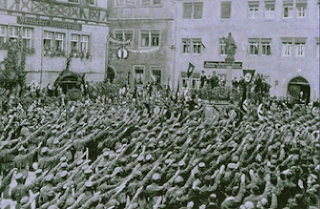

Dedication
of the SA-Sturmfahne by the protestant minister and Nazi member Max
Sauerteig from Ansbach in front of the Seelbrunnen on Kapellenplatz in
1933.
 Looking from the other direction, comparing the damage from the war with today


The main square and rathaus during the Third Reich, in 1945, and in front today

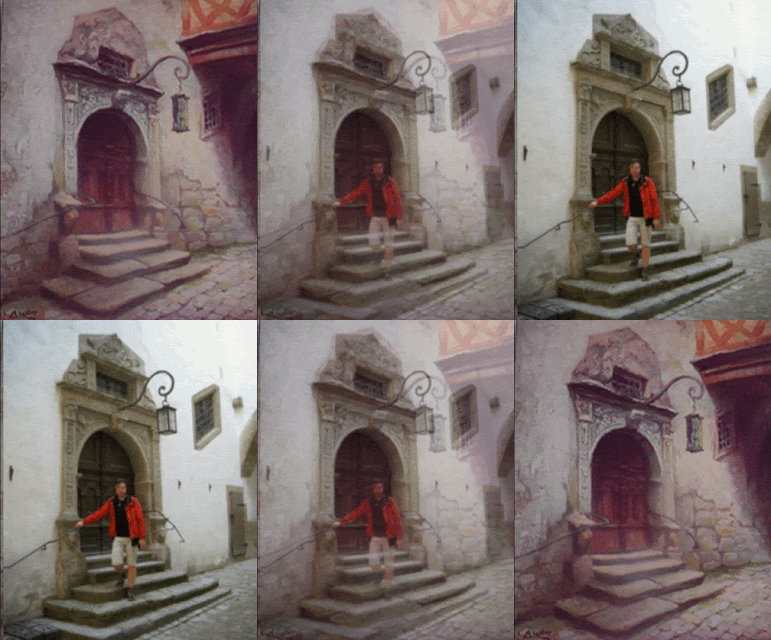
The entrance to the old rathaus within the portal behind in paintings and today
 Hitler leaving the Hotel Eisenhut on April 16, 1935 with me in front today. Arriving from Heidelberg, a large crowd had already gathered to Hitler, who was already in the hotel. Eventually the crowd had grown so much that SA, ϟϟ and labour service members had to be called to provide crowd control. Honorary ϟϟ guards stood in front of the portal as several BDM girls and children gathered in the lobby of the hotel where they waited for Hitler to finish his lunch before presenting him with bouquets of flowers. The hotelier's wife Paula Pirner was also allowed to hand over a hastily ordered bouquet of carnations to the guide as soon as he had arrived. Deputy Nazi Kreisleiter Zoller conveyed the greetings of the Rothenburg party members and the population. Rothenburg had beautified himself very much, he said in a small talk to Zoller, who responded diligently that many houses could be repaired by granted Reich loans. Within an hour Hitler had left, without deigning to sign the guest book. Leaving the hotel, Hitler entered his Mercedes to screams of "Heil Hitler" as the motorcade slowly drove through the crowd across the Marktplatz, and along Georgengasse and Galgengasse. Hitler's visit lasted no more than an hour. During this brief visit to Rothenburg for which apparently Hitler had wanted nothing more than lunch before leaving again, Hitler remarked that during his youth, he had seen many pictures of Rothenburg, which he took particular joy in drawing, and he felt the town had been "beautified" since his last visit in 1927. Although Hitler did not refer to any improvements in particular, he had lunch in a recently remodeled hotel. This extensive remodeling effort had placed great emphasis on creating a cozy atmosphere for tourists but had given less thought to preserving this historical building. The new decor, which remains more or less to this day, used wooden materials wherever possible. New art work, both interior and exterior, depicting medieval scenes added a romantic charm to the building; the façade is unchanged...
...as is the interior for the most part- the lobby shown as it was in 1936 and today. Although most Strength through Joy guests were lodged in private homes, and Rothenburg had numerous hotels for other tourists, the town and several Nazi organizations undertook or planned several projects to provide more suitable accommodations. The town converted its usual exhibition space into “KdF Sleeping Quarters" with a plaque on the building that read “Promote creative strength/ through joy of living/is the Führer's commandment/and is our endeavor". Another historical building served as a "Relaxation Home for German Artists” at the initiative of the Reich Association of the Visual Arts. Both interiors featured historicized mediaeval decors as still seen at the Eisenhut.

The Marktplatz then and now; the Loewen Apotheke is still operating
In contrast to larger urban areas, small-town Rothenburg embodied an almost utopian place and way of life where Germans could be rejuvenated physically through a traditional lifestyle and spiritually by gaining a deeper understanding of the almost mystical bond between nature and the national community. Rothenburg offered an ideal place where Germans could see and experience Nazi visions of an idealised community, an historical landscape, and legends of a golden age. After experiencing downward trends during the general economic crisis of the early 1930s, tourism in Rothenburg had rebounded to pre-Depression levels by 1936 and 1937. The appearance of the first regular KdF tourists coincided with this general upswing in the travel industry and
allowed KdF to take much of the credit for this recovery. The first KdF-sponsored trip to Rothenburg appears to have been a day trip from Nuremberg on November 21, 1934. Regular extended vacations to Rothenburg, however, did not begin until KdF designated the town as its main tourist destination for the Franconia region in early 1935.
Calling attention to Rothenburg's new importance for exemplifying the Nazi regime's rhetoric of national
 |
| The Burgtor |
Calling attention to Rothenburg's new importance for exemplifying the Nazi regime's rhetoric of national
community, the regional KdF chief declared:
For the first time we will have the opportunity to show the true socialism in action and the real spirit of comradeship.... [T]his year for the first time a number of working comrades will be sent to Rothenburg in order to relax in the old historical town, and to experience the remaining impressions from an earlier great time. But they will also take away confirmation that the true spirit of comradeship is at home in Rothenburg. Only then can the Rothenburgers say that they have fulfilled a great duty to the German nation and fatherland.
By the end of 1935, KdF had sponsored trips for about a thousand weekend and day visitors to Rothenburg from across Germany.


Hermann Göring and Gauleiter Julius Streicher in front of the Gasthof Marktplatz during their June 23, 1935 visit whilst the right GIF shows Major Kraus presenting the Rothenburger Soldatenkmeradschaft flag the same year and me at the site today

Oil paintings by Ludwig Mossler from the book Fränkische Städtebilder. Nürnberg/ Rothenburg/ Dinkelsbühl published in 1940 and today. definite anticommercial overtones in Rothenburg's "cleansing program." Under the Nazis, Rothenburg's town council called for a more "German," commercial culture marked by tradition, self-restraint, and discipline in consumption so that by the end of 1936, advertisements and signs considered obtrusive to Rothenburg's medieval landscapes were outright banned.

In keeping with the overall emphasis on aesthetic improvements, foreign words, like restaurant, cafe, and hotel, were to be replaced by their German equivalents, Gasthaus or Gaststätte, and they should appear in Old German or gothic, rather than Latin script. Businesses should also replace mass-produced neon or metal signs with handcrafted wrought iron or wooden signs or murals with medieval themes. Once inside the Gasthaus, patrons should hear traditional German folk music instead of jazz. The town and historical society then organised an exhibition on "Artistic Exterior Advertising” to demonstrate and promote this more German form of commercialism. Visitors to the exhibit could see examples of good and bad advertising and compare their respective effects on Rothenburg's historic streets. Special attention was also required to ensure that traffic signs, electricalIn many respects, Rothenburg functioned as a stage where Nazi conceptions of nation, culture, and society could be displayed and performed. In comparison to larger cities, small-town Rothenburg offered a venue that was relatively easy to manage and simple for visitors to absorb during a brief visit. In contrast to the rural landscape, Rothenburg could better represent the idea of a national community with a long history of cultural greatness. The idea of a walled and racially pure German community also paralleled the notion of a tightly bounded national community, both territorially and racially. It was these ideas that served as the impetus for Rothenburg's "cleansing campaign." These diverse efforts to beautify Rothenburg to further Nazism's hideous agenda demonstrate the dangers inherent in disconnecting our desires for aesthetically pleasing places, an essential component of culture, from complementing moral concerns.power lines, and radio antennae did not disturb Rothenburg's medieval ambience.
Hagen (216) The Most German of Towns: Creating an Ideal Nazi Community in Rothenburg ob der Tauber

Looking along Markusturm towards the Röderbogen in 1934 and today.
Nazi Germany is often regarded as the epitome of a totalitarian state, yet the experience of Rothenburg during this period highlights another side of the regime's power. While violence, or at least the threat of violence, was indispensable, the Nazi regime could not have undertaken such wide-ranging programs without a cohort of ideologically motivated local leaders and significant support from ordinary Germans. Given the strength of local support for the Nazi party, Rothenburg is likely not an accurate reflection of Germany as a whole, but it still demonstrates that many Germans did indeed consent to Nazi leadership. Although orders should come exclusively from the top within an authoritarian state like Nazi Germany, local leaders in Rothenburg appeared to have considerable room to form and implement their own policies. Indeed, the most surprising aspect of Rothenburg's history during the Nazi period may be the high degree of initiative demonstrated by local leaders in their efforts to further the goals of the regime. Rothenburg's evolution into a totalitarian space was a much more interactive and contingent process than one might initially assume as local leaders sought active participation by recasting Rothenburg as the "most German of towns."Hagen (223) The Most German of Towns


The Wehrmacht marching down Herrngasse in 1939. Further
down at Herrngasse 17 shown on the right was the Headquarters of the Nazi Party district
leadership, shown in a 1936 drawing by Ernst Unbehauen- note the
reichsadler beside the door.

Featured inside the building was artwork by Rothenburg Ernst
Unbehauen. Here above the door to the main hall is a Nazi eagle to
which four men are depicted raising their arms in the Hitler salute
symbolising the rising of the people, party and state
towards the idea of the Führer whose bust stood on the opposite wall.
One represents "the simple man of the people," another an SA man,
followed by a political fighter and a soldier.

The Reichsarbeitsdienstlager Abteilung 6/282 Rothenburg in the mid-1930s and as it appears today. The RAD ('Reich Labour Service') was a major Nazi organisation set up to help mitigate the effects of unemployment on German economy, militarise the workforce and indoctrinate it with Nazi ideology.
.jpg)

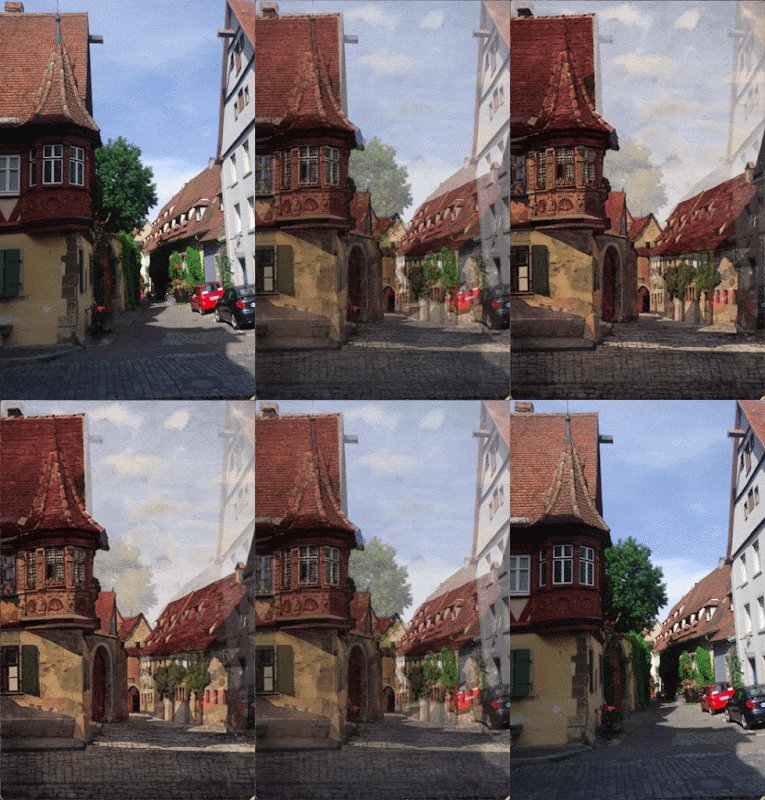

The Klingentor and Feuerleins Erker on Klingengasse. From 1937 to 1941 Friedle's entire property in Germany was confiscated. Rothenburg's tax office here estimated his tax arrears at the ridiculously high sum of 473,100.40 Reichsmarks resulting in him losing all his property in the town. The Nazi Party in Rothenburg thus came into possession of the double house at Klingengasse 4 and 4a (the historic "Deutschherrenhof") for 45,000 RM, which had a minimum value of 51,600 RM for which the tax office collected the purchase price. In April 1940, John M. Friedle was forced to sell his villa at Nuschweg 9 to the savings bank director Georg Küspert, district head of the Nazi Party, within an hour for a mere 14,000 Reichsmarks, the real value being 25,000 RM. Again, the entire proceeds went to the Rothenburg tax office. After the war Friedle asked the American military government in Rothenburg to declare all of the declarations he had made to the tax office under pressure as having been invalid, applying for the repayment of the 168,000 Reichsmarks that the Rothenburg tax office had taken, to reverse the acquisition of his houses, to cancel the previous tax assessment at the Rothenburg tax office and to issue a new one. In the end however, he never lived to see the result, dying in San Francisco on February 26, 1950 after a long illness. According to Stegeman, this was the only known case of confiscation in Rothenburg to date that was not directed against Jews.


The Weißer Turm then and now from both sides and on the right as it appeared in a 1934 Nazi propaganda image by Hans Prentzel seen from Galgengasse, bedecked with swastikas

Hitlerjugend before the Galgentor July 28, 1939. Numerous such Hitler Youth groups camped in a tent city alongside Rothenburg's medieval town wall, including one group of 1,400 ethnic German boys from over 27 countries in 1935.
Over the next two years, the Hitler Youth expanded this facility and made several aesthetic improvements. Most notably, designers mounted the image of an eagle clutching a swastika, with a wingspan measuring perhaps five meters, on the town wall overlooking the encampment. During their stay in this tent city, Hitler Youth groups marched through Rothenburg's mediaeval streets or held "battle games" in the town's recently completed sports complex. The town also had plans to remodel two medieval tithe barns as a Reich Youth Hostel with 250 to 300 beds and a Youth Home, but higher officials diverted the delegated funds to finance similar projects in Austria. Altogether, such groups were in Rothenburg to reacquaint themselves with the "spirit of the Middle Ages, here German spirit and the strength of the nation are expressed through the splendid old buildings which not only served notice to German construction history, but also demonstrate German history and the German situation in general." One Hitler Youth group that marched through Rothenburgin 1936 was described as not conducting "a romantic trip, rather a faith and belief march.”
Over the next two years, the Hitler Youth expanded this facility and made several aesthetic improvements. Most notably, designers mounted the image of an eagle clutching a swastika, with a wingspan measuring perhaps five meters, on the town wall overlooking the encampment. During their stay in this tent city, Hitler Youth groups marched through Rothenburg's mediaeval streets or held "battle games" in the town's recently completed sports complex. The town also had plans to remodel two medieval tithe barns as a Reich Youth Hostel with 250 to 300 beds and a Youth Home, but higher officials diverted the delegated funds to finance similar projects in Austria. Altogether, such groups were in Rothenburg to reacquaint themselves with the "spirit of the Middle Ages, here German spirit and the strength of the nation are expressed through the splendid old buildings which not only served notice to German construction history, but also demonstrate German history and the German situation in general." One Hitler Youth group that marched through Rothenburgin 1936 was described as not conducting "a romantic trip, rather a faith and belief march.”
 |
| The Hegereiterhaus |
Rothenburg's efforts to restore and improve its mediaeval architecture were eventually rewarded by the Nazis. For example, the town's medieval fortifications had been steadily deteriorating since the beginning of the 19th century; by the late 1920s the situation had become critical, yet the ensuing economic depression left the town and state without the resources to finance anything beyond stopgap measures. In an April 26, 1937 letter, Rothenburg's mayor informed the Bavarian government that portions of the town wall had been closed to tourists because these sections threatened to collapse causing bad publicity for Rothenburg. Already by June 30, Bavarian President Siebert announced a three-year plan to restore Rothenburg's mediaeval fortifications and other endangered historical buildings. Siebert planned to personally oversee this new "Ludwig-Siebert-Assistance Program for Old Rothenburg" to "preserve the town's historical structures as a resource for international opinion toward and the reputation of Germany." Germany's main journal for historical preservation reported that Rothenburg's medieval fortifications and architecture deserved national attention, protection, and restoration because they were, "as the Führer said, continually an inexhaustible source of strength for the nation and a starting point for its inner renewal in cloudy times". One guidebook published by an avid local historian and founding member of Rothenburg's historical society was updated to allow readers to find declarations of support for the Nazi regime, especially when the author thanked the "absolutely essential support from the highest protector of all German strength, art, and defence, our beloved Führer Adolf Hitler" for his help in restoring the town wall. Another guidebook, first published in the 1920s, received a new introduction in 1936, which reminded Germans not to visit Rothenburg in order to romanticise about the past, “but rather to be invigorated from the strength and ability of our ancestors."

The
Waldschwimmbad, opened with Nazi fanfare by Nazi district leader
Zoller and Mayor Dr. Liebermann in 1935 on the outskirts of the town, is
now surrounded by suburbia. It had originally been surrounded by pine
trees with fountains, showers with fresh water inflow, a lawn for
sunbathing, and a 5,000-square-foot playground. The town soon built a new swimming pool and sports complex as well. Although KdF did not finance these projects, it nonetheless featured the swimming pool, sports facility, and the new network of nature trails prominently in its brochures. The KdF did eventually become directly involved in promoting health by choosing Rothenburg as the site for its only official sport camp for Franconia. The KdF planned to offer sport instruction courses to locals and also provide tourists the opportunity for a "sporty vacation". These additions contributed to ongoing efforts to recreate Rothenburg as an ideal tourist destination; a place rich in history, renowned architectural, and natural beauty, and in step with the Nazi regime's cultural, aesthetic, political, and eventually racist policies.
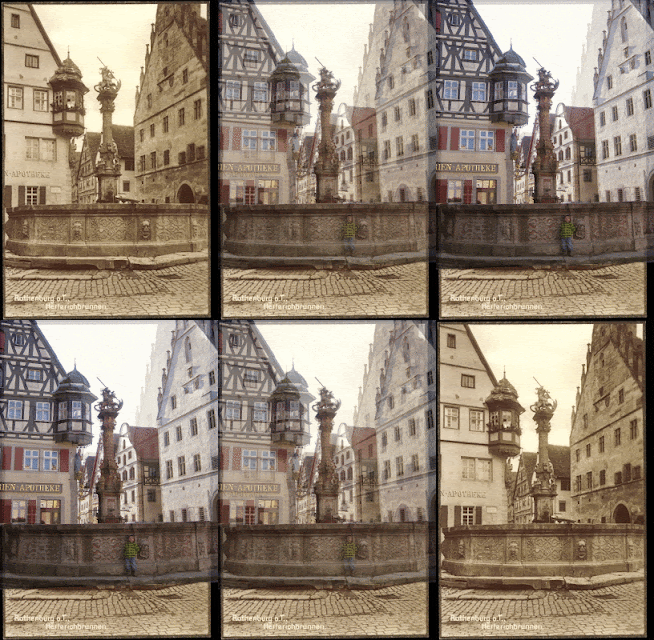

Little Drake Winston in front of the Georgsbrunnen dating from 1608. On the right is another fountain nearby beside the Hotel Bären on Hofbronnengasse which was the site
of a 1929 battle between the SA and members of the Sozialdemokraten

The Goldenes Fass guesthouse during the Nazi era and today. Here in November 1937 NSDAP-Zelle 7 met where its cell-leader Kathmann asked rhetorically what would become of Germany if there were only praying, but no fighting men had been available. According to the local newspaper, "The solution of all existential questions of the German people, among which is the colonial problem, current is found from the life of our Führer Adolf Hitler, whose outstanding, God-gifted personality he described in moving words."
 The Gasthaus Schwarzes Lamm then and now- November 9, 1937 commemorations had paid especial tribute to "the skilful leader of God," the Hereditary Farm Law, the four-year plan and the Winterhilfswerk.

Below from the other side within the walls showing the Gasthaus zum Breiterle then and now. Rothenburg
played an important role in framing and mediating images of landscape
and nation during the Nazi period. As Bavarian President Siebert
declared in October 1936, “Rothenburg ob der Tauber is one of the
windows through which one sees Germany". This was true for the foreign
diplomats and tourists as well as the Germans who visited Rothenburg.
The KdF arranged visits to Rothenburg to bring Germans from different parts of the Reich together, as well as to create connections with ethnic Germans living abroad. The town's tourism office had recognised this new "political significance of tourism" by early 1936. Domestically, tourism served to overcome the reluctance of certain regions to embrace fully the national community.Internationally, tourism countered the “hateful and dishonest propaganda" of the supposedly Jewish-dominated foreign press by promoting an image of Germany as a "land of peace". In Rothenburg as late as August 1939, "guests from every country could realise with 100 percent surprise that nowhere is more quiet or friendlier than with us 'Nazis'”. Rather than merely furthering certain leisure policies, tourism and KdF in Rothenburg can be seen as an integral part of the regime's overall domestic and foreign policy goals. Tourism in Rothenburg served to cement the bonds of national community among those already residing within Germany's borders, while also helping to forge new connections with ethnic Germans living abroad or those recently incorporated into the Reich. As the "most German of towns," Rothenburg seemed an ideal place through which a new national community in line with Nazi ideology could emerge.
Hagen (213) The Most German of Towns

On
May 1, 1933, in the presence of Oberbürgermeister Dr. Liebermann and
representatives of the SA, ϟϟ other Nazi Party organisations, a so-called
Hitler Oak was planted within the Castle gardens by members of the
Hitler-Jugend Gefolgschaft VIII Rothenburg. Shown after the war during
the American occupation, its ultimate fate is unclear.


Also
within the Burggarten in 1934, Bavarian Prime Minister Ludwig Siebert
formally presented a
memorial by Johann Oertel commemorating Hitler's seizure of power- the
Machtergreifung. This name has remained to this day. Long gone, another memorial has been erected inside the
Castle garden walls- the Jewish Memorial Stone in front of St. Blaise
Chapel which remembers Rothenburg Jews who were killed in the pogrom of
1298, erected exactly 700 years later. This event, which culminated in
the burning to death of the remaining Jews within the castle as shown at
the top of the memorial, was celebrated by the Nazis as shown in the
propaganda above. As an aside, Rothenburg had already renamed a street as “Siebert Street” in 1920 to
honour his mayoral tenure in Rothenburg, but the name was changed in 1945
because of Siebert's prominent role in the Nazi party. Yet, in
gratitude for his preservation efforts, the town re-renamed the same
street Ludwig Siebert Street in 1955.

In the Weimar Republic, Rothenburg developed into a stronghold of the DNVP , which was able to achieve votes of around 80% on several occasions, and later of the Nazi Party, which won 83% of the votes there in the elections on March 5, 1933. In the same year there were anti-Semitic attacks in Rothenburg. Indeed, attacks
on Rothenburg's Jews began immediately after the Nazis took power. On
August 6 1933 they paraded leather dealer Leopold Westheimer through the
streets barefoot (seen here in the market square in front of Untere
Schmiedgasse) for "racial defilement" with a sign around his neck
reading “Ich Judenschwein wollte ein arisches Mädchen schänden!” (I am a Jewish pig who wanted to desecrate an Aryan girl.)
He had first started his business in 1899 at Herrngasse 12, eventually
purchasing property on Kirchgasse with a 150 square metre garden. On
August 31, 1938 Westheimer met with the town clerk Hans Wirsching at at
Kapellenplatz 7, as the city of Rothenburg wanted this garden plot,
setting the purchase price at 500 Reichsmarks. Westheimer was later
deported and murdered in the Theresienstadt concentration camp on December 31, 1943. In 1948 his son Ivan filed
legal claims to get back the property only for Rothenburg's mayor,
Friedrich Hörner, to claim incredibly that that the purchase had been
completed "before the criminal Jewish program:"
I am aware that your family suffered particularly hard as early as 1933, but I must ask you to provide me with evidence in support of your claim for the return of the property, that the acquisition of the property by the city is subject to particular pressure or that coercion was exercised on your father. Personally, I do not doubt for a moment that this was the case, because I know the extortion methods of the past rulers who used them against Jews and non-Jews, but it would be valuable if you could provide me with special proofs for your case which I could then submit to the city council. But I can already inform you that the redress of past injustice is not only recognised as a legal duty for the city council of Rothenburg, but also as a moral obligation and is also practiced in your case.


Judengasse
then and now. This has been its name since 1371 when Jews and
Christians had lived side-by side. This is the only surviving late
mediaeval Jewish street in Europe. Such streets were in most mediaeval
cities of German-speaking countries which were the enclosed living
quarters of Jews who were mostly traders. Such accommodation also
considered the religious principles of the Jews themselves, who sought
to fulfil the commandment to live no more than a thousand steps from the
synagogues.
 Judenstrasse
between the wars and from the same site. My bike is shown in front of
house no. 10 which still contains a Jewish ritual bath, known as a
mikvah, which is still filled with groundwater. Racism and anti-Semitism
were certainly present in Rothenburg before 1933, but only after the
Nazi party came to power did they directly impact decisions concerning
tourism and historical preservation. Although the KdF excluded Jews and
other non-Aryans from its programme, it was not until after 1936 that
anti-Semitism began to take
Judenstrasse
between the wars and from the same site. My bike is shown in front of
house no. 10 which still contains a Jewish ritual bath, known as a
mikvah, which is still filled with groundwater. Racism and anti-Semitism
were certainly present in Rothenburg before 1933, but only after the
Nazi party came to power did they directly impact decisions concerning
tourism and historical preservation. Although the KdF excluded Jews and
other non-Aryans from its programme, it was not until after 1936 that
anti-Semitism began to take  a
more virulent and public form in Rothenburg. In March 1937, Mayor
Schmidt opened another exhibit in Rothenburg entitled "Blood and Race."
About 2,400 people, about equal to one-quarter of Rothenburg's total
population, visited the exhibit. Less
than one year after beginning to reframe the tourist experience,
historical preservation, and consumer culture in Rothenburg, a racial
cleansing programme began to crystallise around the same themes of
cleanliness, purity, and national belonging. Although ideas of a "pure"
German nation were certainly implicit in efforts to cleanse Rothenburg's
built environment and consumer culture, the campaign against the local
Jewish community brought the ideological linkages between race, space,
and place into much sharper focus. After energetically pursuing a
campaign to cleanse the town's built environment, local leaders soon
turned their attention to purging the town of, what was in their eyes,
its most objectionable pollutant, the town's Jews. First local leaders
rewrote the history of Rothenburg's Jewish community to conform to Nazi
thinking. Anti-Semitism was then incorporated into the town's mediaeval
architecture before finally turning directly against the Jewish
community. By October 10, 1938, the last seventeen Jews of
Rothenburg were driven out of the tow by Nazi district leader
Steinacker, SA people and Hitler Youth. On
October 22 the inventory of the synagogue was madelooted and destroyed
at Herrngasse 21. A "joyful festival" took place in Rothenburg on the
occasion of the "liberation from the Jews".
a
more virulent and public form in Rothenburg. In March 1937, Mayor
Schmidt opened another exhibit in Rothenburg entitled "Blood and Race."
About 2,400 people, about equal to one-quarter of Rothenburg's total
population, visited the exhibit. Less
than one year after beginning to reframe the tourist experience,
historical preservation, and consumer culture in Rothenburg, a racial
cleansing programme began to crystallise around the same themes of
cleanliness, purity, and national belonging. Although ideas of a "pure"
German nation were certainly implicit in efforts to cleanse Rothenburg's
built environment and consumer culture, the campaign against the local
Jewish community brought the ideological linkages between race, space,
and place into much sharper focus. After energetically pursuing a
campaign to cleanse the town's built environment, local leaders soon
turned their attention to purging the town of, what was in their eyes,
its most objectionable pollutant, the town's Jews. First local leaders
rewrote the history of Rothenburg's Jewish community to conform to Nazi
thinking. Anti-Semitism was then incorporated into the town's mediaeval
architecture before finally turning directly against the Jewish
community. By October 10, 1938, the last seventeen Jews of
Rothenburg were driven out of the tow by Nazi district leader
Steinacker, SA people and Hitler Youth. On
October 22 the inventory of the synagogue was madelooted and destroyed
at Herrngasse 21. A "joyful festival" took place in Rothenburg on the
occasion of the "liberation from the Jews".
On February 4, 1936 Nazi foreign group leader Wilhelm Gustloff was assassinated in Davos, Switzerland. He had joined the Nazi Party in 1929, expending much effort into the distribution of the antisemitic propaganda book The Protocols of the Elders of Zion, to the point that members of the Swiss Jewish community sued the book's distributor, the Swiss NSDAP/AO, for libel. Gustloff was shot and killed in 1936 by David Frankfurter, a Croatian Jewish student incensed by Gustloff's antisemitic activism. This would play into Nazi  propaganda as more supposed proof of of a "conspiracy of world Jewry". As an aside, Gustloff would later give his name to the MV Wilhelm Gustloff, a German passenger ship which would be sunk on January 30, 1945 by a Soviet submarine in the Baltic Sea while evacuating German civilians, officials and military personnel from Gdynia (Gotenhafen), its 9,400 victims making it the largest loss of life in a single ship sinking in history. Franconian Gauleiter Julius Streicher chose, on his 51st birthday, to use this incident to once again inflame anti-Semitism for which he would later be hanged at Nuremberg. Above is the plaque that was placed in the Rödertor shown right with Nazi district leader Karl Steinacker shown at its dedication in February 12 1936. The plaque read
 propaganda as more supposed proof of of a "conspiracy of world Jewry". As an aside, Gustloff would later give his name to the MV Wilhelm Gustloff, a German passenger ship which would be sunk on January 30, 1945 by a Soviet submarine in the Baltic Sea while evacuating German civilians, officials and military personnel from Gdynia (Gotenhafen), its 9,400 victims making it the largest loss of life in a single ship sinking in history. Franconian Gauleiter Julius Streicher chose, on his 51st birthday, to use this incident to once again inflame anti-Semitism for which he would later be hanged at Nuremberg. Above is the plaque that was placed in the Rödertor shown right with Nazi district leader Karl Steinacker shown at its dedication in February 12 1936. The plaque read
On October 24, 1938, local Nazi leaders announced to "thunderous applause" that "the last of Rothenburg's Jews have left the walls of Rothenburg behind them, to be sure it is forever and for eternity". After enduring a night of supposedly spontaneous mob vandalism and violence, the last of Rothenburg's Jews left town. Not surprisingly, the expulsion of the Jews was framed in decidedly historical terms. "Our Rothenburg is Jew free," read the headline, "The centuries long defensive struggle of our ancestors has found its fulfillment." "The fact that Rothenburg is once again Jew free,” explained one local official, "corresponds to the glory of the history of the town," whilst another added, "Rothenburg has again become the symbol of a German town.""World history mentions the names of the people who perished at the hands of the Jews. Their tragic end is a terrible reminder for the people who are still alive. 12 February 1936. Julius Streicher "
 Other
such Judentafeln were placed in the town's mediaeval gates including
these at Klingentor, Galgentor and Spitaltor respectively which all portray a stereotypical image of a mediaeval Jew combined with various anti-Semitic texts- one contained a short anti-Semitic rhyme from 1520, whilst another repeated a town council edict from 1577 barring Rothenburgers from having business dealings with Jews. Since these gates were the only major entrances through Rothenburg's fortifications, it would have been difficult for any tourist to enter or leave town without passing by one of them. Rothenburg's town wall, a symbol of shelter, refuge, and civic liberty during the Middle Ages, now symbolised a clear demarcation between a pure German place inside and an unclean outside world. These plaques combined anti-Semitism with the main themes already guiding the redesign of the town. The plaques were wooden and handcrafted and incorporated historic elements in both the choice of the text and the visual representation of the Jew. Roughly translated, one read: "An imperial town lies on the Tauber/it is named Rothenburg. For a long time the Jews there have/pursued great disgrace./With profiteering and sharp cunning/so that quite a few of the pious/were ruined completely". Two of the other plaques also identified Jews with greed or dishonesty in business, thereby connecting the Jew to the Nazi party's critique of liberal capitalism and commercialism. Reproductions of these same three plaques were available as postcards, adding an anti-Semitic element to Rothenburg's burgeoning Nazi consumer culture.
Other
such Judentafeln were placed in the town's mediaeval gates including
these at Klingentor, Galgentor and Spitaltor respectively which all portray a stereotypical image of a mediaeval Jew combined with various anti-Semitic texts- one contained a short anti-Semitic rhyme from 1520, whilst another repeated a town council edict from 1577 barring Rothenburgers from having business dealings with Jews. Since these gates were the only major entrances through Rothenburg's fortifications, it would have been difficult for any tourist to enter or leave town without passing by one of them. Rothenburg's town wall, a symbol of shelter, refuge, and civic liberty during the Middle Ages, now symbolised a clear demarcation between a pure German place inside and an unclean outside world. These plaques combined anti-Semitism with the main themes already guiding the redesign of the town. The plaques were wooden and handcrafted and incorporated historic elements in both the choice of the text and the visual representation of the Jew. Roughly translated, one read: "An imperial town lies on the Tauber/it is named Rothenburg. For a long time the Jews there have/pursued great disgrace./With profiteering and sharp cunning/so that quite a few of the pious/were ruined completely". Two of the other plaques also identified Jews with greed or dishonesty in business, thereby connecting the Jew to the Nazi party's critique of liberal capitalism and commercialism. Reproductions of these same three plaques were available as postcards, adding an anti-Semitic element to Rothenburg's burgeoning Nazi consumer culture.

The holes from the plaque are still evident at the latter
In Rothenburg ob der Tauber, anti-Semitism became a central component of the tourist experience. In 1937, the town erected four wooden, handcrafted plaques on its medieval gates. They bore stereotypical images of ‘the Jew’ and a number of anti-Semitic texts, which visitors could purchase in the form of postcards. KdF holidaymakers were greeted there with speeches about local anti-Semitic agitation in the Middle Ages.Semmens (95) Seeing Hitler's Germany: Tourism in the Third Reich


The Spitaltor before the war

American
soldiers in front of the Spitalbastei on April 17, 1945. We went on a
'Nightwatchman's tour' and were told the incredible story of how it had
been saved- The month before, German soldiers were stationed in
Rothenburg to defend it. On March 31, bombs were dropped over Rothenburg
by 16 planes, killing 37 people and destroying 306 houses, six public
buildings, nine watchtowers, and over 2,000 feet of the wall. On April 17, 1945, the war ended in Rothenburg, while fighting continued for three weeks elsewhere. The American High Commissioner for Germany at the time John McCloy , wrote in 1950 that he had prevented an artillery attack planned on Rothenburg by intervening with General Devers. McCloy only knew Rothenburg from stories told by his mother, who had visited the city before the war and raved about the medieval town. She had visited the town
before the Great War and sketched as many scenes as possible. When she
returned to the United States, her impressionable son would study the
picture of the city that hung in the McCloy living room and vow to one
day visit himself. Now, he was responsible for saving it. He ordered American Army General Jacob L. Devers not use artillery in taking Rothenburg.
Battalion commander Frank Burke (Medal of Honour) ordered six soldiers
of the 12th Infantry Regiment, 4th Division to march into Rothenburg on a
three-hour mission and negotiate the surrender of the town. First
Lieutenant Noble V. Borders of Louisville,
Kentucky; First Lieutenant
Edmund E. Austingen of Hammond, Indiana; Private William M. Dwyer of
Trenton, New Jersey; Private Herman Lichey of Glendale, California;
Private Robert S. Grimm of Tower City, Pennsylvania; and Private Peter
Kick of Lansing, Illinois were sent on the mission. When stopped by a
German soldier, Private Lichey who spoke fluent German and served as the
group’s translator, held up a white flag and explained, “We are
representatives of our division commander. We bring you his offer to
spare the city of Rothenburg from shelling and bombing if you agree not
to defend it. We have been given three hours to get this message to you.
If we haven’t returned to our lines by 1800 hours, the town will be
bombed and shelled to the ground.” The local military commander Major
Thömmes gave up the town, ignoring the order of Hitler for all
towns to fight to the end and thereby saving it from total destruction
by artillery. American troops of the 12th Infantry Regiment, 4th
Division occupied the town on April 17, 1945, and in November 1948
McCloy was named Honourable Protectorate of Rothenburg. After the war,
the residents of the city quickly repaired the bombing damage. Donations
for the rebuilding were received from all over the world and the
rebuilt walls feature commemorative bricks with donor names (hence the numerous plaques from Japanese).
 |
| The Tauber bridge, blown up by German troops in 1945. It was finally reopened on November 10, 1956. |

What remained of Galgengasse after the war and its reconstruction.The
growth of tourism during the Weimar period reinforced the town’s
reputation as an obligatory stop for those touring Romantic Germany.
Rothenburg also gained prominence within Nazi tourism policy as Nazi
officials recast Rothenburg as ‘the most German of towns’. Yet
Rothenburg’s international renown could not protect it on March 31, 1945
when a flight of American bombers destroyed between 40 and 45% of the town’s
historic centre. The air raid destroyed residential buildings and six
public buildings and damaged an additional 52 buildings. Over 700 metres
of Rothenburg’s mediæval wall lay in ruins, as well as several
fortified towers. The human toll was also significant; 39 Rothenburgers
lost their lives and 741 families were left homeless. With nearly half
of its historic centre ruined, Rothenburg’s reputation as one of
Germany’s best-preserved medieval towns, its status as a national icon,
and its continued popularity among tourists were in doubt. Galgengasse
had been hit hardest by the air raid. Every single building along this
street was destroyed. The reconstructed buildings are not exact copies
of the old, but they generally mimic the heights and proportions of the
previous structures. Once again, the façades are simple and largely free
of ornamentation. One of the few buildings along the Galgengasse to partially survive the bombing dated to the 19th century. Although the structure’s façade was intact and Florin specifically encouraged the reuse of intact building parts, many regarded the facade as too modern. Although at least one local felt it had been a ‘pleasant diversion in the streetscape,’ this façade was torn down and rebuilt in a manner more appropriate to Rothenburg’s architectural unity.

