

Frankfurt am Main
 The swastika being hoisted on March 13, 1933 from the rathaus
the day after the Nazis' victory in the city council elections. Two
days earlier, Nazi Jakob Sprenger delivered a hateful, anti-Semitic
speech: "It's a shame that Jews and fellow Jews still officially rule
Frankfurt's town hall at this hour. I think Frankfurt will follow the
voice of the Führer of the Germans tomorrow. Tomorrow these bugs from
Frankfurt will be burned out like bugs, they will be smoked out like
rats suspected of having the plague, which (...) don't want to leave the
ship. Frankfurt will be German tomorrow, from tomorrow it will be a
foundation of the National Socialist Third Reich.” Jakob Sprenger was
the Gauleiter of the district of Hesse-Nassau. The Nazi Party had the
majority in the Frankfurt city council and appointed the new mayor, the
Nazi Friedrich Krebs. Under great pressure from the Nazis, the Jewish
Lord Mayor Ludwig Landmann submitted his resignation on March 11 and
fled to Berlin because the SA wanted to arrest him.
The swastika being hoisted on March 13, 1933 from the rathaus
the day after the Nazis' victory in the city council elections. Two
days earlier, Nazi Jakob Sprenger delivered a hateful, anti-Semitic
speech: "It's a shame that Jews and fellow Jews still officially rule
Frankfurt's town hall at this hour. I think Frankfurt will follow the
voice of the Führer of the Germans tomorrow. Tomorrow these bugs from
Frankfurt will be burned out like bugs, they will be smoked out like
rats suspected of having the plague, which (...) don't want to leave the
ship. Frankfurt will be German tomorrow, from tomorrow it will be a
foundation of the National Socialist Third Reich.” Jakob Sprenger was
the Gauleiter of the district of Hesse-Nassau. The Nazi Party had the
majority in the Frankfurt city council and appointed the new mayor, the
Nazi Friedrich Krebs. Under great pressure from the Nazis, the Jewish
Lord Mayor Ludwig Landmann submitted his resignation on March 11 and
fled to Berlin because the SA wanted to arrest him.
.gif) the areas of trade and transport, was now called the City of German Crafts.
the areas of trade and transport, was now called the City of German Crafts.
The "wild" terror of the SA and ϟϟ
in the course of the seizure of power in 1933 was followed by the
establishment of the Gestapo, which moved to its own headquarters in
Lindenstrasse 27 in 1939, and a section of the SD secret service with
twelve branch offices. In 1933, a special court was created, at the
opening of which Roland Freisler made the opening speech. The
Contemporary Art department in the Städel was closed in 1937 with its
Expressionist paintings were confiscated and auctioned abroad.

Heinz Woelcke's 1933 painting of the May 10 book-burning on the Römerberg and me at the site today
About
15,000 people gathered here on the Römer, many of them students in SA
uniforms (sadly not a surprise in today's climate where academics are
threatened and dismissed for continuing to recognise scientific truth),
but also teachers and professors in robes and berets on their heads, in
Frankfurt's staging of the Nazi book burnings conducted throughout the
country by the Deutsche Studentenschaft to ceremonially burn books in
Nazi Germany.c
The books targeted for burning were those viewed as being
subversive or as representing ideologies opposed to Nazism including
those written by Jewish, communist, socialist, anarchist, liberal and
pacifist authors among others. A plaque at the site near the
Gerechtigkeitsbrunnen contains the same line from Heine's Almansor as that in Berlin- "Das war ein Vorspiel nur. Dort wo man Bücher verbrennt, verbrennt man auch am Ende Menschen."
 |
| After the war and today |
The
books were carried to the pyre on an ox cart with a pitchfork stuck in
the middle to mark it as a dung wagon. The chaplain giving the so-called
fire speech was Otto Fricke, a German Protestant pastor and later
member of the leadership of the Confessing Church. gave the fire speech
on the burning of books on the Römerberg in Frankfurt, "enthusiastic
about National Socialism " From 1936 to 1938 the Fricke became a "now
convinced Nazi opponent," taken into protective custody in 1937 and temporarily transferred. In 1942 Fricke was drafted into the Wehrmacht.
 |
Richard J. Evans describes the increasing violence against Jews beginning on December 23-24 1934 when
Party members in civilian clothing blocked the entrances to Jewish-owned shops and department stores in Frankfurt am Main, and shouted insults at customers, beating up those who persisted in trying to go in. They smashed the shop windows, and when police arrived to arrest them, they became so threatening that the officers had to draw their weapons. This campaign proved the prelude to a much wider wave of economic terror, in which local Party organisations threatened to withdraw welfare payments from anyone seen entering a Jewish-owned shop. Civil servants and municipal employees in many localities were ordered to stay clear of such establishments.
This would culminate from October 1941 to March 1945 with the deportations of Jews from Frankfurt and the surrounding area. Between October 1941 and September 1942, the Gestapo rented the basement of the Grossmarkthalle for 24 hours before the deportations. Here the ϟϟ, Gestapo officials, municipal welfare workers and officials from the tax office took away their last valuables, money, ID cards, ration cards and their apartment keys befoe forcing them onto the waiting trains and taken to various ghettos, concentration camps, extermination camps, and other places of execution.

Hitler speaking from the town hall balcony March 31, 1938 after the anschluß with Austria. That evening, at a mass rally in the Festival Hall in Frankfurt, Hitler began his campaign speech encouraging Germans to vote to accept the annexation of Austria with the following words:
In these historic times, I come into this historic city in which ninety years ago the attempt was launched to bestow upon the German Volk one Reich. Hitler continued to describe the history of the development of the concept of a Greater Germany. This idea had first been evident in the parliament of 1848, which had convened in the Frankfurt Paulskirche. Bismarck had expanded upon the idea, and up to the year 1918, the thought had been nurtured.[...]I have been in power for five years. And in this time period I have torn page upon page from the book of the disgraceful Treaty of Versailles. I have done so not in defiance of law, but rather as a man who preserves law and order, a man who is not in breach of contract, but rather as a man who refuses to acknowledge a shameful Diktat as a holy contract! After a detailed rendition of the events in Austria, Hitler ended his speech on the following note: I have taken great risks for our Volk. In my youth, I knew nothing but the German Volk. In the Great War, I fought for it, and afterwards I went on a pilgrimage throughout Germany, always filled by the only desire to bring about the resurrection of this Volk. The story of my life lies like an open book before every one of my Volksgenossen. I have done my duty! Now German Volk, do yours!

Hitler inside the Kaisersaal within where he was greeted ceremoniously. In reply to the welcome extended by the Mayor, Dr. Krebs, Hitler declared:
I am happy that today I am able to enter this city as the man who has realized a yearning which once found its most profound expression in this location. Above all, I am happy that—for the first time in my life—I am able to stand in this magnificent hall. The cause for which our ancestors struggled and shed their blood ninety years ago may now be regarded as accomplished. I am firmly convinced and confident that this cause—the new Greater German Reich—will remain in existence for all time to come, for it is supported by the German Volk itself and founded upon the eternal yearning of the German Volk to possess one Reich.


Adolf-Hitler-Bridge
in 1936 and a view of the bridges over the river Main. The Untermain
Bridge was built between 1872 and 1874 as the fourth Main Bridge in
Frankfurt, but was only the second road bridge after the Alten Brücke
from the Middle Ages.
In 1933 the bridge was renamed Adolf Hitler Bridge. On March 26, 1945,
three of the arches along with the other Main bridges were blown up by a
Wehrmacht demolition squad. At the end of 1945, a provisional wood and
steel construction was placed on the largely undamaged pillars in order
to make the bridge – which has now been renamed – at least usable again
for pedestrian traffic. Reconstruction began in June 1948. Instead of
the old arches, a beam bridge was built on the existing pillars, which
was opened on July 23, 1949. The sandstone arches on the northern and
southern banks were preserved. The cost of the reconstruction was
2,640,000 Deutschemarks. In 1989/90 the bridge had to be completely
renewed due to the structural damage that had occurred in the meantime.
The entire bridge girder was removed and rebuilt. The arches and the
sandstone railings of the approach bridges were reconstructed in what was described as an historically accurate manner. A modern steel-concrete composite beam bridge spans between them.
 On
April 7, 1932, Hitler made a campaign speech here in the Festhalle and
stressed his financial independence in the following remark:
On
April 7, 1932, Hitler made a campaign speech here in the Festhalle and
stressed his financial independence in the following remark: It may be that I am the only politician who is not employed by his party. I have placed my salary as senior executive officer in Brunswick at the disposal of the Brunswick State Bank to be distributed among disqualified unemployed.
Hitler speaking at the Festhalle March 16, 1936 and the venue today. On this occasion Hitler
came to speak of the introduction of the swastika as the national flag
of Germany and maintained that he had "abolished these sixteen or
seventeen flags of the Länder and placed a single flag in their stead
with the aim of giving Germany what all nations of the world call their
own."  Later
that year on the night of November 8 to 9, during the November pogroms
hundreds of Frankfurt's Jewish citizens were driven across the city
centre in the Festhalle and some seriously ill-treated. The noted
Frankfurt Opera singer Hans Erl was forced to sing "In Diesen Heilgen
Hallen". From here, the first mass transports went into the
concentration camps. The Festhalle is thus of considerable importance
for the Holocaust. Since 1991, a plaque points in the rotunda of the
Festhalle in it.
Later
that year on the night of November 8 to 9, during the November pogroms
hundreds of Frankfurt's Jewish citizens were driven across the city
centre in the Festhalle and some seriously ill-treated. The noted
Frankfurt Opera singer Hans Erl was forced to sing "In Diesen Heilgen
Hallen". From here, the first mass transports went into the
concentration camps. The Festhalle is thus of considerable importance
for the Holocaust. Since 1991, a plaque points in the rotunda of the
Festhalle in it.
 Later
that year on the night of November 8 to 9, during the November pogroms
hundreds of Frankfurt's Jewish citizens were driven across the city
centre in the Festhalle and some seriously ill-treated. The noted
Frankfurt Opera singer Hans Erl was forced to sing "In Diesen Heilgen
Hallen". From here, the first mass transports went into the
concentration camps. The Festhalle is thus of considerable importance
for the Holocaust. Since 1991, a plaque points in the rotunda of the
Festhalle in it.
Later
that year on the night of November 8 to 9, during the November pogroms
hundreds of Frankfurt's Jewish citizens were driven across the city
centre in the Festhalle and some seriously ill-treated. The noted
Frankfurt Opera singer Hans Erl was forced to sing "In Diesen Heilgen
Hallen". From here, the first mass transports went into the
concentration camps. The Festhalle is thus of considerable importance
for the Holocaust. Since 1991, a plaque points in the rotunda of the
Festhalle in it.
During the war, the hall was used for the storage of uniforms of the
armed forces. On December 18, 1940, inflamed the textiles and the
Festhalle has been through the resultant severe fire severely damaged.

The
Synagogue on Boerneplatz, in flames on Reichskristallnacht 1938, and a
memorial on the site today. At the November pogrom in 1938, the
Synagogue was burnt down by the SA men in Gartenstraße 35-37 as
well as all other synagogues and numerous prayer rooms in
the city were destroyed without the intervention of the Frankfurt
police. The Westend synagogue on Freiherr-vom-Stein-Strasse is the only
synagogue in the city to have survived the Reichskristallnacht. Shops
and apartments of Jewish Frankfurters were devastated and
looted and the male wealthy Jewish residents were deported to Buchenwald
and Dachau concentration camps in order to force them to emigrate and
to aryanise their assets. A deportation camp for Roma and Sinti was
built in Dieselstrasse in 1937. The basement of the Frankfurt wholesale
market hall was used for the transport and deportation of the Jews from
the wholesale market station to the murder in the concentration camps.
Dates of the large Nazi deportations of Jews with whole trains from
Frankfurt are October 19, 1941 (the first transport train), November 11,
November 21, May 8, 1942, May 24, June 11, August 18, September 1,
September 15, September 24, 1942, February 14, 1945. There
were smaller and smaller transports from March 11, 1943 to October 25,
1944. On March 9, 1943, about an hundred Sinti and Roma were deported from
Frankfurt to the Auschwitz-Birkenau concentration camp. The
deportations were organised by Frankfurt crime officers and men of the
SA standard F / M, Sturmbann IV / 63. A memorial
stone on the Jewish cemetery north of the B 28 in the direction of
Wankheim commemorates fourteen Jewish victims of the Holocaust. The
Jewish victim of the Nazi dictatorship have also been commemorated on
the wall of the church on the wooden market since 1983 with a
commemorative plaque, likewise since 2000 with the monument Synagogue
Square on the Gartenstraße.
 |
| Westend synagogue on the right |
.gif)
Johanna
Tesch (SPD), a former member of the Reichstag, was also arrested and
died in 1945 in the Ravensbrück concentration camp. Of the approximately 29,000 Jews living in Frankfurt in the mid-1920s, there were still 140
after the war. Around 11,500 had been murdered during the Holocaust, and
around 700 had committed suicide before being deported. More than a
thousand stumbling blocks and numerous memorials commemorate Nazi
victims at the Paulskirche, in the main cemetery, and the Neuer
Börneplatz memorial next to the old Jewish cemetery in Battonnstrasse.
During the war, around 25,000 prisoners were permanently employed in
Frankfurt as forced labourers. There were forced labour camps all over
the city. Concentration camp inmates of the Walldorf concentration camp
worked at the airport; in 1944, the concentration camp subcamp Frankfurt
am Main was set up in the Adlerwerke and the Heddernheim labour
education camp, which represented a special form of punishment, existed
in Heddernheim. In addition, there were numerous civil workers' camps
and prisoners of war camps directed by the German Labour Front and the
Wehrmacht.

In
1928, IG Farben was the world's fourth-largest company and its largest
chemical companyso consequently, the space requirements for the building
were for one of the largest office buildings ever constructed. IG
Farben did not want a specifically 'Bauhaus' styled building but rather,
according to Georg von Schnitzler, IG Farben Director, in 1930,
"[a] symbol, in iron and stone, of German commercial and scientific
manpower." The 250-metre long and 35-metre tall building has nine
floors, but the height of the ground floor varies which is reflected in
the roof line which looks taller at the wings than the spine. The façade
is clad with Travertine marble, punctuated in bands of windows
decreasing in height with each storey with only the corners interrupted
for emphasis by glazed strips. Until the 1950s, the building was the largest and most modern office building in Europe.
 The
building was the headquarters for production administration of dyes,
pharmaceutical drugs, magnesium, lubricating oil, explosives, and
methanol, and for research projects relating to the development of
synthetic oil and rubber during the war. I.G. Farben thus became an
indispensable part of the Nazi industrial base. This
building was the
headquarters for research projects for the development of wartime
synthetic oil and rubber, as well as the production administration of
magnesium, lubricating oil, explosives, and methanol. However, it went
far beyond such mundane commodities as this large memorial in front of
the building attests.
The
building was the headquarters for production administration of dyes,
pharmaceutical drugs, magnesium, lubricating oil, explosives, and
methanol, and for research projects relating to the development of
synthetic oil and rubber during the war. I.G. Farben thus became an
indispensable part of the Nazi industrial base. This
building was the
headquarters for research projects for the development of wartime
synthetic oil and rubber, as well as the production administration of
magnesium, lubricating oil, explosives, and methanol. However, it went
far beyond such mundane commodities as this large memorial in front of
the building attests.I. G. Farben also manufactured nerve gas that was used in poison gas experiments on Auschwitz prisoners. These experiments, conducted in secret laboratories at I. G. Farben factories, were used to determine how fast nerve gas would kill Allied soldiers. The helpless victims of these experiments died instantly. According to British intelligence, Ambros and other I. G. Farben officials "justified the experiments not only on the grounds that the inmates of concentration camps would have been killed anyway by the Nazis, but also . . . that the experiments had a humanitarian aspect in that the lives of countless German workers were saved."
 During
the course of the war, the surrounding neighbourhood was devastated,
but the building itself was left largely intact (and inhabited by the
homeless citizens of a bomb-ravaged Frankfurt). In March 1945, Allied
troops occupied the area and the IG Farben Building became the American
headquarters of General Dwight D. Eisenhower. It was there that he
signed the "Proclamation No. 2", which determined which parts of the
country would be within the American zone. Eisenhower vacated the
building in December 1945 but his office was still used for special
occasions: the constitution of the state of Hesse was signed there, the
West German Ministerpräsident received his commission to compile the
Grundgesetz (German constitution) and the administration of the
Wirtschaftsrat der Bizone (Economic Council of the Bizone) was also
located there.
During
the course of the war, the surrounding neighbourhood was devastated,
but the building itself was left largely intact (and inhabited by the
homeless citizens of a bomb-ravaged Frankfurt). In March 1945, Allied
troops occupied the area and the IG Farben Building became the American
headquarters of General Dwight D. Eisenhower. It was there that he
signed the "Proclamation No. 2", which determined which parts of the
country would be within the American zone. Eisenhower vacated the
building in December 1945 but his office was still used for special
occasions: the constitution of the state of Hesse was signed there, the
West German Ministerpräsident received his commission to compile the
Grundgesetz (German constitution) and the administration of the
Wirtschaftsrat der Bizone (Economic Council of the Bizone) was also
located there. The
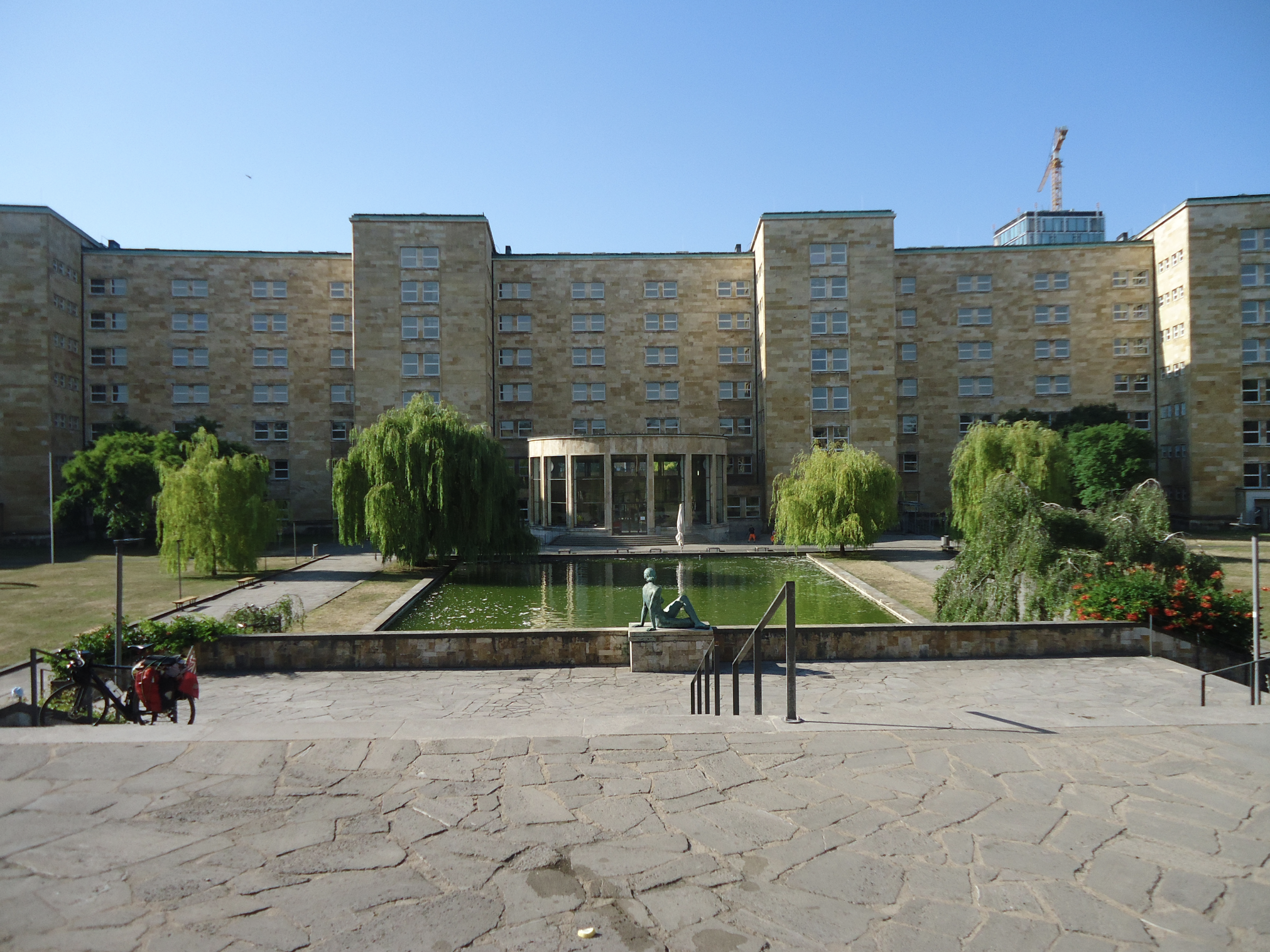
view of the buildings at the rear of the site, the so-called "casino,"
is maximised by the curved walls that afford vistas to the subsidiary
buildings separated from the main building by parkland and a pool.
During the American occupation of the building, this rotunda housed a
small kiosk; later, it was used as a conference room. Today it is called
the Dwight D. Eisenhower room and accommodates a café. Behind it stands a flat
building on a hill with a terrace—the casino of IG Farben and the former
American Army Officers Club, "The Terrace Club," which now houses a
refectory and lecture-rooms.
The
view of the buildings at the rear of the site, the so-called "casino,"
is maximised by the curved walls that afford vistas to the subsidiary
buildings separated from the main building by parkland and a pool.
During the American occupation of the building, this rotunda housed a
small kiosk; later, it was used as a conference room. Today it is called
the Dwight D. Eisenhower room and accommodates a café. Behind it stands a flat
building on a hill with a terrace—the casino of IG Farben and the former
American Army Officers Club, "The Terrace Club," which now houses a
refectory and lecture-rooms. Eisenhower
issued orders to preserve the building during the bombardment of
Frankfurt, because he intended to use it after the war as his
headquarters. It may also have been that the building was saved by its proximity to Grüneburgpark with its prisoner of war camp holding captured American airmen.
 Behind the
rotunda is an oblong pool with a Nymphenskulptur at the water's edge
created by Fritz Klimsch entitled "Am Wasser."Klimsch is controversial for
the fact that he created commissioned works such as Hitler busts for
the Nazi regime and was included in “the Führer’s God-gifted list”. "By
the Water" disappeared from its pedestal by the fountain after the war,
allegedly because Mamie Eisenhower was bothered by the sight of the naked woman.
The Frankfurter Rundschau reported that with the arrival of the
Americans in 1945, the sculpture had to disappear on Mamie Eisenhower's
orders because "it could not endure bare flesh in the field of view of
demure soldiers. Not even a bronze one.” During a visit in the early
post-war period, she feared that young soldiers
would be confused by the naked woman, whereupon she was dismantled and
given a new home in front of Hoechst chemical company high-rise sales
building. However, the figure had apparently already been evacuated in 1945 when the Americans arrived.
Behind the
rotunda is an oblong pool with a Nymphenskulptur at the water's edge
created by Fritz Klimsch entitled "Am Wasser."Klimsch is controversial for
the fact that he created commissioned works such as Hitler busts for
the Nazi regime and was included in “the Führer’s God-gifted list”. "By
the Water" disappeared from its pedestal by the fountain after the war,
allegedly because Mamie Eisenhower was bothered by the sight of the naked woman.
The Frankfurter Rundschau reported that with the arrival of the
Americans in 1945, the sculpture had to disappear on Mamie Eisenhower's
orders because "it could not endure bare flesh in the field of view of
demure soldiers. Not even a bronze one.” During a visit in the early
post-war period, she feared that young soldiers
would be confused by the naked woman, whereupon she was dismantled and
given a new home in front of Hoechst chemical company high-rise sales
building. However, the figure had apparently already been evacuated in 1945 when the Americans arrived. 
Tax office built in 1935 with main entrance still enclosed within Nazi iconography

A
Nazi eagle allowed to remain prominently on the former Praunheimer
Luftschutzbunker at Eberstadtstraße 35 on he outskirts of Frankfurt
completed in 1942. At the moment it provides about two dozen flats.
Frankfurt had been severely bombed during the war. About 5,500 residents
were killed during the raids, and the once famous medieval city centre,
by that time the largest in Germany, was almost completely destroyed.
It became a ground battlefield on March 26, 1945, when the Anglo-American
advance into Germany was forced to take the city in contested urban
combat that included a river assault. The American 5th Infantry Division and the
6th Armoured Division captured Frankfurt after
several days of intense fighting, and it was declared largely secure on
March 29, 1945.
Wiesbaden
 Adolf-Hitler-Platz
then and now. With the end of the First World War, Wiesbaden's time
ended as a popular spa town. In 1918 it was occupied by the French and
in 1921 the Wiesbaden agreement on the German reparation payments to
France was concluded. In 1925, Wiesbaden became the headquarters of the
British army of the Rhine and remained so until the withdrawal of
occupying powers from the Rhineland in 1930. After taking power in 1933 several offices of the Nazi regime were established in the city, including the General Command of the XII Arms corps in October 1936. The Lebensborn organisation maintained the Kinderheim Taunus here from 1939 to 1945. On the morning of November 10, 1938 during the so-called Reichskristallnacht pogrom the great Synagogue at Michelsberg, built in 1869 by Philipp Hoffmann in the Moorish style. was destroyed.
During the Third Reich about 1200 Wiesbaden Jews were deported and
murdered. Some residential buildings in the inner city were used as
so-called "Jewish houses", in which Jews were forced to be quartered
before they were transported to the site of the then slaughterhouse.
This, in close proximity to Wiesbaden's main station, was the last stop
before the deportation.
Adolf-Hitler-Platz
then and now. With the end of the First World War, Wiesbaden's time
ended as a popular spa town. In 1918 it was occupied by the French and
in 1921 the Wiesbaden agreement on the German reparation payments to
France was concluded. In 1925, Wiesbaden became the headquarters of the
British army of the Rhine and remained so until the withdrawal of
occupying powers from the Rhineland in 1930. After taking power in 1933 several offices of the Nazi regime were established in the city, including the General Command of the XII Arms corps in October 1936. The Lebensborn organisation maintained the Kinderheim Taunus here from 1939 to 1945. On the morning of November 10, 1938 during the so-called Reichskristallnacht pogrom the great Synagogue at Michelsberg, built in 1869 by Philipp Hoffmann in the Moorish style. was destroyed.
During the Third Reich about 1200 Wiesbaden Jews were deported and
murdered. Some residential buildings in the inner city were used as
so-called "Jewish houses", in which Jews were forced to be quartered
before they were transported to the site of the then slaughterhouse.
This, in close proximity to Wiesbaden's main station, was the last stop
before the deportation.The Wiesbadener Ludwig August Theodor Beck was involved in Hitler's assassination attempt on July 20, 1944 and paid for this with his life. In honour of this, the city annually awards the Ludwig Beck prize for civil courage. Martin Niemoller, a resistance fighter, co-founder of the parish priesthood and the honorary citizen of Wiesbaden, held the last sermon before his arrest in the market church.

The Hotel Nassauer Hof flying the Nazi flag and today, noticeably reduced. The Nassauer Hof was the venue of the Waffenstillstandskommission
initiated June 27, 1940. Presided over by General von Stülpnagel, the
joint Franco-German commission on details of the Cease-Fire Agreement
convened in the Nassauer Hof Hotel in Wiesbaden for many months. The
photo on the bottom-right shows the entrance to the Hotel Rose where the
French delegation stayed. Stülpnagel
took charge of the Franco-German Armistice Commission in Wiesbaden, but he did not remain at his post for long. In early 1941 he assumed command of the 17th Army and began to prepare for the invasion of the Soviet Union as part of Army Group South. He briefly opposed ‘security measures’ that included the ‘relocation’ of Jews and other potential subversives from the rear area of his command but abandoned his complaints after seeing Hitler’s Commissar Order and talking with State Secretary Josef Bühler, a leading official in Poland’s Generalgouvernment. By the time Germany invaded the Soviet Union, Stülpnagel’s misgivings had fallen by the wayside. His 17th Army earned praise from an ϟϟ execution squad (Sonderkommando) for its attitude towards Jews, but ϟϟ accolades could not deflect Hitler’s ire when Stülpnagel’s command lagged behind neighbouring units. Unable or unwilling to endure censure from OKW, Carl-Heinrich once again reported sick and gave up his post on 4 October 1941.
Laub (171) After The Fall
 The
final resting site of Baron Manfred von Richthofen, known as the 'Red
Baron', the most feared and celebrated pilot of the German air force in
the Great War, within the south cemetery in Wiesbaden. Killed on April
21 1918 in aerial combat, he was buried with military
honours by the British. Later his remains were transferred first to Fricourt,
then to the Invalidenfriedhof Cemetery in Berlin where the Nazi regime
held a further grandiose memorial ceremony over this grave, erecting a
massive new tombstone with the single word: "Richthofen", and finally
to a family plot here in Wiesbaden. In 1935 Göring introduced the "Day
of Honour for the German Air Force", which was celebrated on the
anniversary of Richthofen's death until the war. As early as March 14,
1935, Hitler had issued a decree that stipulated that a fighter squadron
with the designation "Jagdgeschwader Richthofen" should be set up; from
May 1, 1939 to May 7, 1945, Jagdgeschwader 2 of the Luftwaffe bore the
honorary name "Richthofen".
The
final resting site of Baron Manfred von Richthofen, known as the 'Red
Baron', the most feared and celebrated pilot of the German air force in
the Great War, within the south cemetery in Wiesbaden. Killed on April
21 1918 in aerial combat, he was buried with military
honours by the British. Later his remains were transferred first to Fricourt,
then to the Invalidenfriedhof Cemetery in Berlin where the Nazi regime
held a further grandiose memorial ceremony over this grave, erecting a
massive new tombstone with the single word: "Richthofen", and finally
to a family plot here in Wiesbaden. In 1935 Göring introduced the "Day
of Honour for the German Air Force", which was celebrated on the
anniversary of Richthofen's death until the war. As early as March 14,
1935, Hitler had issued a decree that stipulated that a fighter squadron
with the designation "Jagdgeschwader Richthofen" should be set up; from
May 1, 1939 to May 7, 1945, Jagdgeschwader 2 of the Luftwaffe bore the
honorary name "Richthofen". The
town hall in 1933 flying the Nazi flag and now; the kurhaus is shown
below. During the war, Wiesbaden was largely spared by allied bombing
raids. The heaviest bomb attack in the night from February 2 to February
1945 was flown by the Royal Air Force and missed the planned target
area due to the bad weather and thus the full effect was lost. However,
570 people died and 28,000 were homeless. But between August 1940 and
March 1945, Wiesbaden was attacked by allied bombers for 66 days. In the
attacks, about 18% of the city's homes were destroyed. During the war,
more than 25% of the city's buildings were damaged or worse and 1,700
people were killed. Wiesbaden was captured by American Army forces on
March 28, 1945. The 317th Infantry Regiment attacked in assault boats
across the Rhine from Mainz while the 319th Infantry attacked across the
Main River near Hochheim am Main.
The
town hall in 1933 flying the Nazi flag and now; the kurhaus is shown
below. During the war, Wiesbaden was largely spared by allied bombing
raids. The heaviest bomb attack in the night from February 2 to February
1945 was flown by the Royal Air Force and missed the planned target
area due to the bad weather and thus the full effect was lost. However,
570 people died and 28,000 were homeless. But between August 1940 and
March 1945, Wiesbaden was attacked by allied bombers for 66 days. In the
attacks, about 18% of the city's homes were destroyed. During the war,
more than 25% of the city's buildings were damaged or worse and 1,700
people were killed. Wiesbaden was captured by American Army forces on
March 28, 1945. The 317th Infantry Regiment attacked in assault boats
across the Rhine from Mainz while the 319th Infantry attacked across the
Main River near Hochheim am Main.  The
attack started at 1.00 and by early afternoon the two forces of the
80th American Infantry Division had linked up with the loss of only
three dead and three missing. The
Americans captured 900 German soldiers and a warehouse full of 4,000
cases of champagne. The suburb of Amstetten, Kastel and Kostheim, was
subdivided into the administrative district of Wiesbaden by order of the
military government, which became a cause of today's rivalry between
Mainz and Wiesbaden. Eisenhower founded the state of Gross-Hesse and
Wiesbaden became the capital of the military government of Groß-Hesse on
October 12, 1945 through the Order of Order No. 1. After the founding
of the state of Hesse on December 1, 1946, the day of popular vote on
the constitution of the state of Hesse, no capital was defined in the
constitution. From 1948, the American Air Base at Wiesbaden-Erbenheim
belonged to the eight supply airports, which supplied food via an air
bridge to West Berlin during the Soviet blockade from June 24, 1948 to
May 12, 1949.
The
attack started at 1.00 and by early afternoon the two forces of the
80th American Infantry Division had linked up with the loss of only
three dead and three missing. The
Americans captured 900 German soldiers and a warehouse full of 4,000
cases of champagne. The suburb of Amstetten, Kastel and Kostheim, was
subdivided into the administrative district of Wiesbaden by order of the
military government, which became a cause of today's rivalry between
Mainz and Wiesbaden. Eisenhower founded the state of Gross-Hesse and
Wiesbaden became the capital of the military government of Groß-Hesse on
October 12, 1945 through the Order of Order No. 1. After the founding
of the state of Hesse on December 1, 1946, the day of popular vote on
the constitution of the state of Hesse, no capital was defined in the
constitution. From 1948, the American Air Base at Wiesbaden-Erbenheim
belonged to the eight supply airports, which supplied food via an air
bridge to West Berlin during the Soviet blockade from June 24, 1948 to
May 12, 1949.
Marburg
This was the site where, on June 17, 1934 Vice-Chancellor Franz von Papen held the the last speech made publicly, and on a high level, in Germany against Nazism at the University, which had become known as the Marburger speech, against the Nazis' comprehensive claim to power.
This was the site where, on June 17, 1934 Vice-Chancellor Franz von Papen held the the last speech made publicly, and on a high level, in Germany against Nazism at the University, which had become known as the Marburger speech, against the Nazis' comprehensive claim to power.
 The speech is
said to be The man who had been so instrumental in the destruction of
the Weimar Republic expressed the frustrations and disappointments of
many conservatives about developments since Hitler’s rise to power. The
Nazi storm-troopers had grown into an organisation with several million
members. Many of the SA rank and file called for a “second revolution,” a
euphemism for the distribution of offices and spoils to Nazi Party
members. Radicals in the SA, conditioned by the years of struggle for
power to oppose the “establishment,” had long been critical of Hitler’s
policy of cooperation with the elites. Papen’s speech attacked the
socially radical aspects of the Nazi Party, not on Hitler or Nazi
ideology. Papen was critical of the excessive thought-control,
anti-religious forces in the Nazi Party, the lack of deference for
established law and traditional hierarchies, and the subordination of
the state to the party. Whilst conservatives certainly appreciated and
supported the goals and accomplishments of the Nazi regime, especially
the re-establishment of a unified national community, it was
paradoxically this unity and stability that seemed threatened by the
radicalism and lawlessness embodied in the SA.
The speech is
said to be The man who had been so instrumental in the destruction of
the Weimar Republic expressed the frustrations and disappointments of
many conservatives about developments since Hitler’s rise to power. The
Nazi storm-troopers had grown into an organisation with several million
members. Many of the SA rank and file called for a “second revolution,” a
euphemism for the distribution of offices and spoils to Nazi Party
members. Radicals in the SA, conditioned by the years of struggle for
power to oppose the “establishment,” had long been critical of Hitler’s
policy of cooperation with the elites. Papen’s speech attacked the
socially radical aspects of the Nazi Party, not on Hitler or Nazi
ideology. Papen was critical of the excessive thought-control,
anti-religious forces in the Nazi Party, the lack of deference for
established law and traditional hierarchies, and the subordination of
the state to the party. Whilst conservatives certainly appreciated and
supported the goals and accomplishments of the Nazi regime, especially
the re-establishment of a unified national community, it was
paradoxically this unity and stability that seemed threatened by the
radicalism and lawlessness embodied in the SA.
Above
the door the small bust replaces the one of Hitler's during the Third
Reich whilst outside one can find another eagle defaced on the Hausecke
der ehemaligen Jägerkaserne in Marburg. During the night of November
9/10 1938, the synagogue in the university street was destroyed by
members of the Marburger SA. That same night 31 Jews were arrested,
beaten and sent to Buchenwald concentration camp by the SA. It was only
after months that 30 of them were released. In December 1941, as well as
May and September 1942, the last 267 Jews from Marburg and the
surrounding area were deported to concentration camps. Marburg survived
the war with relatively little destruction. Allied bombs destroyed
about 4% of the city, including 281 dwellings. The main railway station
was attacked as an important railway junction point and was seriously
damaged during a bomb attack on February 22, 1945, so there are
relatively many houses from the post-war period in the station quarter. A
few days before American reconnaissance flyers had dropped flyers with
the following imprint: We want to spare Marburg and Bad Nauheim, we want
to live with you later. On March 28, 1945 at around 11:00 the Major
General Maurice Rose of the 1st US Army reached the town which was
surrendered by the provisional mayor without a fight. The division had
advanced from the Brückenkopf Remagen / Rhine over the Westerwald
(following in the main direction of today's B 255) and had already
reached the Dill on the 27th of March. The city was occupied by the
Combat Command B of the 1st US Army.
 The Eagle remains sans swastika within the Hessian State Archives,
but the ceiling maintains them. There are still numerous bomb craters
in the city today whilst the University's Chemical Institute and several
clinic buildings, including the Ophthalmic Clinic and the Surgical
Clinic, as well as the Reithalle am Ortenberg have been destroyed. As
an aside, in order to protect the mortal remains of Paul von Hindenburg
and his wife Gertrud, as well as Frederick the Great and his father
Frederick William I from the advancing Red Army, the coffins had been
stored by the Wehrmacht in a Thuringian salt mine. The Americans, who
conquered large parts of Thuringia, brought the famous dead to Marburg,
where Hindenburg and his wife were finally buried in the northern tower
chapel of the Elisabethkirche. The coffin of Frederick William I is now
in the Kaiser Friedrich mausoleum in Potsdam; Frederick II has been
buried in a tomb at Sanssouci Castle since 1991.
The Eagle remains sans swastika within the Hessian State Archives,
but the ceiling maintains them. There are still numerous bomb craters
in the city today whilst the University's Chemical Institute and several
clinic buildings, including the Ophthalmic Clinic and the Surgical
Clinic, as well as the Reithalle am Ortenberg have been destroyed. As
an aside, in order to protect the mortal remains of Paul von Hindenburg
and his wife Gertrud, as well as Frederick the Great and his father
Frederick William I from the advancing Red Army, the coffins had been
stored by the Wehrmacht in a Thuringian salt mine. The Americans, who
conquered large parts of Thuringia, brought the famous dead to Marburg,
where Hindenburg and his wife were finally buried in the northern tower
chapel of the Elisabethkirche. The coffin of Frederick William I is now
in the Kaiser Friedrich mausoleum in Potsdam; Frederick II has been
buried in a tomb at Sanssouci Castle since 1991.
Kassel

 Under the Nazis, the town received the honorary title of City of the Reich Warrior Days. Such days had been organised since 1925 by the Kyffhäuserbund, the umbrella organisation of the local and regional associations of former soldiers that have existed since the 19th century. On the one hand they fulfilled social tasks such as in helping war invalids, on the other hand they maintained militaristic and monarchist traditions. In the Weimar Republic, the formally apolitical Kyffhäuser League provided fertile ground for the glorification of the First World War and the spread of the stab in the back legend and the alleged war guilt lie. Ultimately, it was oriented tightly to the right. A Reichskriegertag was to take place in Kassel for the first time in 1934. The preparations had been made when it was canceled because of the Röhm putsch. In the Vorderen West, these preparations included the construction of a 200 metre-long grandstand on Kaiserplatz (Goethestrasse). The influx of visitors from veterans from all over Germany was enormous and is said to have doubled the number of people from Kassel. In 1937 Himmler and in 1939 Hitler were guests. In order to cope with these crowds of visitors, all Kassel residents were called upon to accommodate at least one guest. Schools, in particular, also served as accommodation, in whose classrooms straw bedding and camp beds were introduced. Photos from the archive of the Albert Schweitzer School document how the former soldiers were received here. Reichskriegertage took place in 1935, 1936 and 1937. In 1938 they dropped out because of Austria's “annexation”. After the annexations by Germany, there was a Greater German Reichskriegertag in 1939, but there were no more such events during the war. The main focus of the Reichskriegertage with an extensive program of events were parades, including those in front of the General Command in the Western Front.
He
now maintained that Germany itself bore responsibility for its dismal
performance in the First World War and its ignominious defeat, as it had
“through a criminal neglect of German armament” allowed an “incompetent
state leadership” to decide its fate.

Eckhaus at Königsstraße 2 surrounded by swastikas and today


The corner of Steinweg and Oberste Gasse and the view of the Elisabethhospital through the Zwehrenturm archway then and now
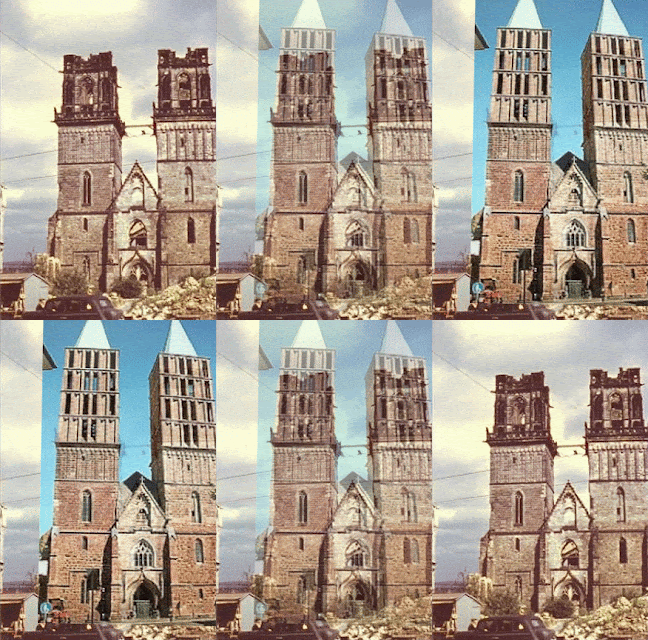


It was not until 1960 that the Zwehrener Turm, dating from the 14th century and which had originally served as a gaol for the higher classes, was finally rebuilt after the war. The most severe bombing of Kassel during the war destroyed 90% of the downtown area, some 10,000 people were killed, and 150,000 were made homeless. Most of the casualties were civilians or wounded soldiers recuperating in local hospitals, whereas factories survived the attack generally undamaged. Karl Gerland replaced the regional Gauleiter, Karl Weinrich, soon after the raid. The Allied ground advance into Germany reached Kassel at the beginning of April 1945. The American 80th Infantry Division captured Kassel in bitter house-to-house fighting during April 2-4 1945, which included numerous German panzer-grenadier counterattacks, and resulted in further widespread devastation to bombed and unbombed structures alike. Post-war, most of the ancient buildings were not restored, and large parts of the city area were completely rebuilt in the style of the 1950s.
.gif)


The Staatstheater has been completely rebuilt, offering support to Lonely Planet's assertion that

The Fuldabrücke before the war and today, rebuilt by 1952.


Christened
the Die Stadt der Reichskriegertage (City of Reich Warrior Days).
Although the "Reichskriegertag" was held in Kassel in 1933, the city
played no special role under Nazi rule.
 Under the Nazis, the town received the honorary title of City of the Reich Warrior Days. Such days had been organised since 1925 by the Kyffhäuserbund, the umbrella organisation of the local and regional associations of former soldiers that have existed since the 19th century. On the one hand they fulfilled social tasks such as in helping war invalids, on the other hand they maintained militaristic and monarchist traditions. In the Weimar Republic, the formally apolitical Kyffhäuser League provided fertile ground for the glorification of the First World War and the spread of the stab in the back legend and the alleged war guilt lie. Ultimately, it was oriented tightly to the right. A Reichskriegertag was to take place in Kassel for the first time in 1934. The preparations had been made when it was canceled because of the Röhm putsch. In the Vorderen West, these preparations included the construction of a 200 metre-long grandstand on Kaiserplatz (Goethestrasse). The influx of visitors from veterans from all over Germany was enormous and is said to have doubled the number of people from Kassel. In 1937 Himmler and in 1939 Hitler were guests. In order to cope with these crowds of visitors, all Kassel residents were called upon to accommodate at least one guest. Schools, in particular, also served as accommodation, in whose classrooms straw bedding and camp beds were introduced. Photos from the archive of the Albert Schweitzer School document how the former soldiers were received here. Reichskriegertage took place in 1935, 1936 and 1937. In 1938 they dropped out because of Austria's “annexation”. After the annexations by Germany, there was a Greater German Reichskriegertag in 1939, but there were no more such events during the war. The main focus of the Reichskriegertage with an extensive program of events were parades, including those in front of the General Command in the Western Front.
Here Hitler is seen speaking on Reich Veterans Day on June 4, 1939 at Friedrichsplatz with the Staatstheater in the background on the occasion of the first Greater German Reich Warriors’ Convention convened in Kassel and the site today.
 |
| The Louis Spohr memorial then and now |
Times had changed, so Hitler insisted. Under his leadership, there would
be no more such nonsense. And he would not allow himself to be
threatened by foreign statesmen pursuing their “policy of encirclement”
of the German Reich. Further he declared: “I do not in the least suffer
from an inferiority complex.” This fact assured that “threats by
whatever party do not intimidate me in the least.” Though the “British
policy of encirclement has remained the same as before the war,
Germany’s policy of defence has undergone thorough revision!” Hitler
then expressed his hopes that this policy of strength “should not only
be warmly welcomed by the veterans, but also merit their zealous
support.”
Over 300,000 German front-line soldiers had attended the speech in Kassel, according to official reports. To hear Hitler speak, the military attachés of Italy, Hungary, Bulgaria, and Slovakia had assembled along with the Japanese Ambassador, the Spanish general Queipo de Llano, a Finnish military delegation, and the President of the Italian Front-Line Soldiers’ Association.


Over 300,000 German front-line soldiers had attended the speech in Kassel, according to official reports. To hear Hitler speak, the military attachés of Italy, Hungary, Bulgaria, and Slovakia had assembled along with the Japanese Ambassador, the Spanish general Queipo de Llano, a Finnish military delegation, and the President of the Italian Front-Line Soldiers’ Association.
Hitler on Königstraße, three months before the invasion of Poland, and from Königsplatz then and now


Königsplatz during the Third Reich and today. It was here in 1870 after the Battle of Sedan that
Napoleon III was sent as a prisoner to the castle of Wilhelmshohe above
the city. He was the last Head of State to have been captured on the
field of battle. During the Great War the German military headquarters
were located in the castle of Wilhelmshohe above the town. During the
Second World War Kassel was the Headquarters for Germany's Wehrkreis IX,
and a local subcamp of Dachau concentration camp provided forced labour
for the Henschel facilities, which included tank production plants.

Eckhaus at Königsstraße 2 surrounded by swastikas and today
The corner of Steinweg and Oberste Gasse and the view of the Elisabethhospital through the Zwehrenturm archway then and now
St. Martin's church after the war and today. Given the 1 million DM spent towards the reconstruction
of Martinskirche, it still remains in a ruined state. It was during
Reichskristallnacht that by the late 1930s the Nazis destroyed Heinrich Hübsch's Kassel Synagogue. On
the evening of November 7, 1938, members of SA and ϟϟ began to
devastate the Kassel synagogue and other Jewish institutions in Kassel.
They entered civilian clothes to paint a "Volkszorn", two days before
the 9th of November, the pogroms of which were to be incorporated into
German history as a novelty. Any resistance was limited to a few
antifascist groups. After the pogroms of the Reichskristallnacht,
deportations of Jewish fellow citizens from Kassel's main station took
place.

It was not until 1960 that the Zwehrener Turm, dating from the 14th century and which had originally served as a gaol for the higher classes, was finally rebuilt after the war. The most severe bombing of Kassel during the war destroyed 90% of the downtown area, some 10,000 people were killed, and 150,000 were made homeless. Most of the casualties were civilians or wounded soldiers recuperating in local hospitals, whereas factories survived the attack generally undamaged. Karl Gerland replaced the regional Gauleiter, Karl Weinrich, soon after the raid. The Allied ground advance into Germany reached Kassel at the beginning of April 1945. The American 80th Infantry Division captured Kassel in bitter house-to-house fighting during April 2-4 1945, which included numerous German panzer-grenadier counterattacks, and resulted in further widespread devastation to bombed and unbombed structures alike. Post-war, most of the ancient buildings were not restored, and large parts of the city area were completely rebuilt in the style of the 1950s.
.gif)
Untere Königsstrasse after the war and today. In
the course of the Second World War several air raids on Kassel
destroyed large parts of the old town and further urban development and
demanded many human lives. The city experienced the most severe attack on October 22, 1943. Over 10,000 people died that night and 80%
of the houses were destroyed. Because Kassel, especially in the old town
areas, was a town with many half-timbered houses, it became the perfect
destination for fire bombs under the "Area Bombing Directive". Due to
the targeted mass shedding of phosphorus and rod bombs a firestorm
arose, for example in Dresden, Hamburg, Pforzheim, Wurzburg or
Darmstadt.

The Orangerieschloß in 1943 and today, largely rebuilt by 1981. The Orangerieschloß today stands as a testament to the complex and often dark history of the 20th century. Built in the early 18th century, this Baroque palace underwent significant transformations during the Nazi era, becoming a symbol of the regime's ideological and cultural ambitions. Browning's analysis of Nazi architecture posits that buildings like the Orangerieschloß served dual purposes: they were both utilitarian structures and ideological statements. In 1936, the Orangerieschloß was converted into a "Kunsthalle," or art gallery, to house works that aligned with Nazi ideology. This move was part of a broader effort to consolidate cultural assets in line with the regime's values, effectively turning art into propaganda. The palace's transformation into a Kunsthalle also reflects the Nazis' broader ambition to reshape German cities as part of their vision for a new Reich, thus becoming a microcosm of the regime's ideological project, embodying its efforts to manipulate art and architecture for propagandistic purposes.

Friedrichsplatz
then and now. The White Palace was blown up November 1948; today's
façades are a modern replica with only the balcony enjoying the original
section with the ornate grid.

The Staatstheater has been completely rebuilt, offering support to Lonely Planet's assertion that
The term ‘architectural crimes’ could well have been coined to describe the reconstruction of Kassel, nestled on the Fulda River, 11⁄2 hours north of Frankfurt. The label still fits some parts of town, but Kassel has gradually reinvented its cityscape over the past few years, and it also has some wonderful parkland.

The Fuldabrücke before the war and today, rebuilt by 1952.
Fritzlar
 Hitlerplatz then and now. Responding to the district chief of the Landrat from February 15, 1934, the Bürgermeister of Fritzlar reported on February 23, 1934 that "[t]he Jews have adjusted to the new situation in the town. They had not engaged in political activity in the past either."
Two years after on September 18, 1936 when new flags were handed over to the troops of the Ninth Army Corps Hitler personally visited. In front of a parade formation of soldiers, Hitler delivered the following short address:
Darmstadt
.gif) Adolf-Hitler-Platz then and standing at the site, now renamed Luisenplatz. On
April 7, 1932 Hitler declared at a campaign rally here: "When I
prophesied six million unemployed one year ago, I was laughed at and
made out to be an irresponsible agitator. I have been proven right in my
theory that the loss of liberty leads to loss of work." Darmstadt
was the first city in Germany to force Jewish shops to close in early
1933, shortly after the Nazis took power in Germany. The shops were only
closed for one day, for "endangering communal order and tranquillity".
In 1942, over three thousand Jews from Darmstadt were first forced into a
collection camp located in the Liebigschule, and later deported to
concentration camps where most eventually died.Several
prominent members of the German resistance movement against the Nazis
were citizens of Darmstadt, including Wilhelm Leuschner and Theodor
Haubach, both executed for their opposition to Hitler's regime.
Adolf-Hitler-Platz then and standing at the site, now renamed Luisenplatz. On
April 7, 1932 Hitler declared at a campaign rally here: "When I
prophesied six million unemployed one year ago, I was laughed at and
made out to be an irresponsible agitator. I have been proven right in my
theory that the loss of liberty leads to loss of work." Darmstadt
was the first city in Germany to force Jewish shops to close in early
1933, shortly after the Nazis took power in Germany. The shops were only
closed for one day, for "endangering communal order and tranquillity".
In 1942, over three thousand Jews from Darmstadt were first forced into a
collection camp located in the Liebigschule, and later deported to
concentration camps where most eventually died.Several
prominent members of the German resistance movement against the Nazis
were citizens of Darmstadt, including Wilhelm Leuschner and Theodor
Haubach, both executed for their opposition to Hitler's regime.
.gif) Standing
in front of the schloß and as it appeared when flying Nazi flags.
Darmstadt was first bombed on July 30, 1940, and 34 other air raids
would follow before the war's end. The old city centre was largely destroyed in an RAF bombing raid on September 11, 1944. This
attack was an early use of the firestorm technique, which was
subsequently used against the historic city of Dresden in February 1945.
To create a firestorm, a number of incendiary bombs are dropped around
the city before the explosive blast bombs are dropped, thus beginning a
self-sustaining combustion process in which winds generated by the fire
ensure it continues to burn until everything possible has been consumed.
Darmstadt was selected as the secondary target for the raid, but was
promoted to the primary target after clouds were observed over the
primary which would have hindered any reconnaissance of the
after-effects. During this fire attack an estimated 11,000 to 12,500 of
the inhabitants burned to death, and 66,000 to 70,000 were left
homeless. Over three quarters of Darmstadt's inner city was destroyed.
Post-war rebuilding was done in a relatively plain architectural style,
although a number of the historic buildings were rebuilt to their
original appearance following the city's capture on 20 March 1945 by
American 4th Armoured Division. After its nearly complete destruction of
the inner city, Darmstadt was forced to surrender the title of the
capital city of to Wiesbaden after the war.
Standing
in front of the schloß and as it appeared when flying Nazi flags.
Darmstadt was first bombed on July 30, 1940, and 34 other air raids
would follow before the war's end. The old city centre was largely destroyed in an RAF bombing raid on September 11, 1944. This
attack was an early use of the firestorm technique, which was
subsequently used against the historic city of Dresden in February 1945.
To create a firestorm, a number of incendiary bombs are dropped around
the city before the explosive blast bombs are dropped, thus beginning a
self-sustaining combustion process in which winds generated by the fire
ensure it continues to burn until everything possible has been consumed.
Darmstadt was selected as the secondary target for the raid, but was
promoted to the primary target after clouds were observed over the
primary which would have hindered any reconnaissance of the
after-effects. During this fire attack an estimated 11,000 to 12,500 of
the inhabitants burned to death, and 66,000 to 70,000 were left
homeless. Over three quarters of Darmstadt's inner city was destroyed.
Post-war rebuilding was done in a relatively plain architectural style,
although a number of the historic buildings were rebuilt to their
original appearance following the city's capture on 20 March 1945 by
American 4th Armoured Division. After its nearly complete destruction of
the inner city, Darmstadt was forced to surrender the title of the
capital city of to Wiesbaden after the war.

 The buildings still provide platforms for Nazi iconography; here
a Nazi eagle remains on the façade of the Psychologiegebäude, shown in
1939 and today withthe swastika smoothed away and eagle appearing
damaged. The
"Law Against Overcrowding in German Schools and Universities" reduced
the number of students with special quotas for non-Aryans and women and
the university was structured to reflect the Nazi spirit and organised
according to the Führer principle. As part of the Nazi mobilisation,
Professors Walter Brecht and Georg Jayme became directors of four-year
plan institutes in the fields of paper manufacture and textile
chemistry. At least six other professors received individual
research assignments as part of the four-year plan. The 1939
establishment of “Project Peenemünde” saw the incorporation of the
Technical Universities into the organisation of the V2 rocket
development by the Army Weapons Office. Through this TH Darmstadt became
the largest partner with 92 employees involved mostly in engine
research, development of radio and control technology devices,
calculation of rocket trajectories. By 1943 the number of students
dropped to 410 by the summer semester. The next year, on the orders of
Heinrich Himmler, the “German Ahnenerbe Research Association” set up
research facilities in concentration camps. In cooperation with the IPM
under Alwin Walther, Jewish scientists were made to calculate
mathematical formulae in the research centre M (mathematics) in the
Sachsenhausen concentration camp. 75 percent of the TH is destroyed in
air raids on Darmstadt. The Americans reached Darmstadt at the end of
March; ten professors who were involved in the research on the V2 were
arrested and interrogated in England and Augsburg.
The buildings still provide platforms for Nazi iconography; here
a Nazi eagle remains on the façade of the Psychologiegebäude, shown in
1939 and today withthe swastika smoothed away and eagle appearing
damaged. The
"Law Against Overcrowding in German Schools and Universities" reduced
the number of students with special quotas for non-Aryans and women and
the university was structured to reflect the Nazi spirit and organised
according to the Führer principle. As part of the Nazi mobilisation,
Professors Walter Brecht and Georg Jayme became directors of four-year
plan institutes in the fields of paper manufacture and textile
chemistry. At least six other professors received individual
research assignments as part of the four-year plan. The 1939
establishment of “Project Peenemünde” saw the incorporation of the
Technical Universities into the organisation of the V2 rocket
development by the Army Weapons Office. Through this TH Darmstadt became
the largest partner with 92 employees involved mostly in engine
research, development of radio and control technology devices,
calculation of rocket trajectories. By 1943 the number of students
dropped to 410 by the summer semester. The next year, on the orders of
Heinrich Himmler, the “German Ahnenerbe Research Association” set up
research facilities in concentration camps. In cooperation with the IPM
under Alwin Walther, Jewish scientists were made to calculate
mathematical formulae in the research centre M (mathematics) in the
Sachsenhausen concentration camp. 75 percent of the TH is destroyed in
air raids on Darmstadt. The Americans reached Darmstadt at the end of
March; ten professors who were involved in the research on the V2 were
arrested and interrogated in England and Augsburg. 


 One of the two Spitzbunkers of the "Winkel" type, probably built in 1939
in preparation for the already threatening air war to protect the
Reichsbahn employees, in an industrial estate in the north of the town.
Leo Winkel was a German architect who became known, among other things,
for his air-raid towers designed as a pointed bunker. This type of
construction was registered in 1934 by the Reich Patent Office. The
outer walls of the two pointed-cylindrical bunkers consist of reinforced
concrete walls about two metres thick inside which a flat ramp spirals
around a central spindle. Originally preserved traces such as numbered
wooden benches, inscriptions on the concrete walls, ventilation pipes,
measuring devices and toilet facilities provide an insight into the time
of the war. Such a bunker offered shelter to 530 people. In addition to
the two pointed bunkers, there is also a flat bunker set up to protect
the employees on the site, in which numerous original traces from the
war have also been preserved. A total of two hundred Winkeltürme were
erected throughout the Reich.
One of the two Spitzbunkers of the "Winkel" type, probably built in 1939
in preparation for the already threatening air war to protect the
Reichsbahn employees, in an industrial estate in the north of the town.
Leo Winkel was a German architect who became known, among other things,
for his air-raid towers designed as a pointed bunker. This type of
construction was registered in 1934 by the Reich Patent Office. The
outer walls of the two pointed-cylindrical bunkers consist of reinforced
concrete walls about two metres thick inside which a flat ramp spirals
around a central spindle. Originally preserved traces such as numbered
wooden benches, inscriptions on the concrete walls, ventilation pipes,
measuring devices and toilet facilities provide an insight into the time
of the war. Such a bunker offered shelter to 530 people. In addition to
the two pointed bunkers, there is also a flat bunker set up to protect
the employees on the site, in which numerous original traces from the
war have also been preserved. A total of two hundred Winkeltürme were
erected throughout the Reich.
 Hitlerplatz then and now. Responding to the district chief of the Landrat from February 15, 1934, the Bürgermeister of Fritzlar reported on February 23, 1934 that "[t]he Jews have adjusted to the new situation in the town. They had not engaged in political activity in the past either."
Two years after on September 18, 1936 when new flags were handed over to the troops of the Ninth Army Corps Hitler personally visited. In front of a parade formation of soldiers, Hitler delivered the following short address:
"You shall stand by these banners in good times and bad! Never shall you abandon them, you shall carry them in your fists before a nation grown great once again. It gazes upon you with the greatest of pride and with blind trust. Prove yourselves worthy of this trust and always place your service and your actions before the phrase: ‘Germany, our German Volk and our German Reich.’"
The
night of May 17-18, 1943 was of particular importance for the place
after the bombing of the Edertalsperre led to a devastating tidal wave
spilling through the low-lying districts of Fritzlar. The 1945 Easter holidays were also of significance as American armoured
units reached the city outskirts on Good Friday, coming from Bad
Wildungen through the Edertal. Around noon the German defenders exploded
the 13th century stone bridge fover the Eder. In the next 36 hours
about 40 German and 120 American soldiers were killed before the city
was occupied by the Americans on Easter Sunday.
German troops had retreated to Werkel, and this village was largely
destroyed in the ensuing battles by American artillery fire. After the
end of the war, a DP camp existed in the Watter barracks from 1946 to 1949, which were no longer used for military purposes. It was initially occupied with former forced labourers followed by Jewish concentration camp survivors and homeless.
Darmstadt
.gif)
.gif)

The Technische Universität Darmstadt einst und jetzt. Once
the Nazis took power in Germany, the university was heavily funded to
focus on armament research, especially aeronautics and motor vehicle
research. An alliance is formed between science, industry and the
military within the framework of an active Nazi science policy that
privileged technical sciences and technical universities.
Due
to the "Law for the Restoration of the Professional Civil Service" in
1933, thirteen professors here were dismissed or forced to retire -
roughly every fifth of the 54 professors and ten associate professors;
and around a fifteenth of associate professors. Architecture, chemistry
and physics were the fields most affected. Students were a driving force
behind the dismissal of politically unpopular lecturers; already in
the winter semester of 1930-31 before the Nazis even took power, the Nazi student union became the
strongest force for the first time with 46 percent of the votes.
Karl Emil Lieser, an assistant at the faculty for architecture and who
had just joined the Nazi Party, complained to the rector about the
"spiritual Jewisation" of the faculty. Lieser's subsequent dismissal led
to riots among the Nazi student body. Lieser was reinstated by the
Reich Governor Jakob Sprenger.

My bike parked below the eagle
above the rear main entry to the Robert-Piloty building, department of
Computer Science.

This was the site of the headquarters of the Gestapo in Darmstadt at what is now Wilhelm-Glässingstraße 21-23.

Gießen
Hitler
at the Volkshalle in June 17, 1932. The year before he spoke on the
anniversary of the Beer Hall Putsch to 8,000 in the audience; in 1932
this had increased to 15,000 people. The photograph on the right shows
Gregor Strasser, Nazi organisation and propaganda leader and MdR for the
Nazi Party, three days earlier.
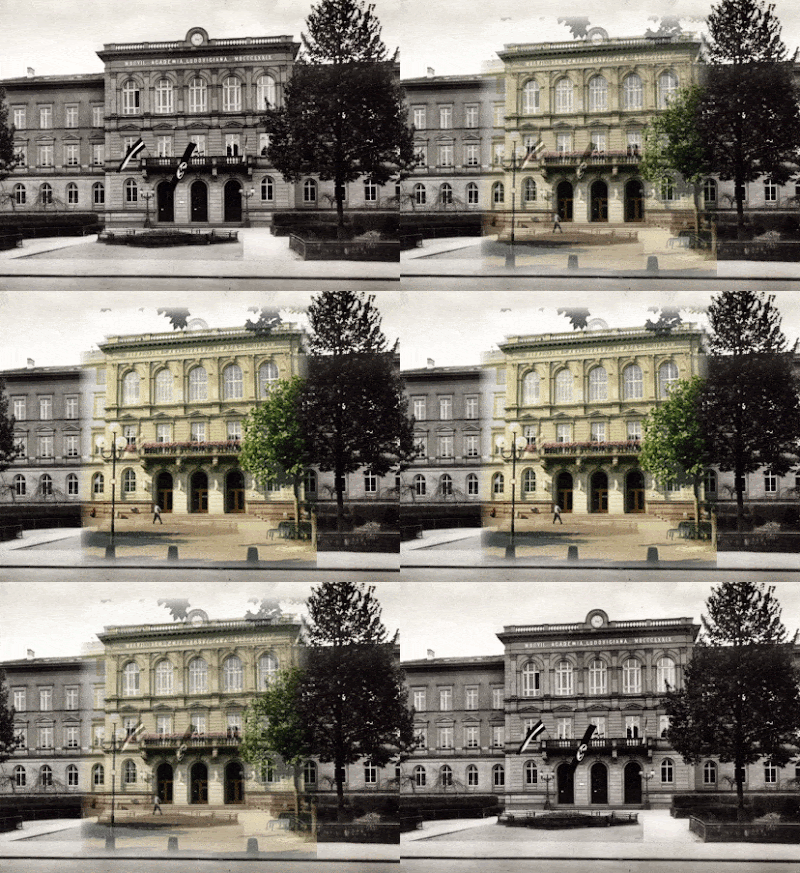 The swastika adorning the Ludwigsburg University on April 16, 1933,
now renamed the Justus-Liebig-Universität Gießen. It is one of the
oldest institutions of higher educations in the German-speaking world,
founded in 1607. It faced mounting challenges during the disintegration
of the Weimar Republic which was intensified during the Nazi regime,
when in 1934 a uniform university administration began to be
established. The intention of the Nazis, announced soon after their
so-called seizure of power, was to reduce the number of universities.
This threatened smaller colleges like this one and so, in order to
avert a possible closure, the professors and lecturers at the University
of Ludwigsburg - partly out of conviction, often out of opportunism -
made every effort to accommodate the Nazis through the burning of books,
the expulsion of professors from office, the exclusion of Jewish
students, a rector in uniform, and the withdrawal of doctoral degrees.
The sharp decline in the number of students and extreme shifts that
favoured individual faculties contrary to the basic idea of the
University further questioned the continued existence of the University
of Ludwigsburg before the city and University of Giessen were largely
destroyed by bomb attacks in December 1944. In protracted negotiations
with the government of the new state of Groß-Hessen and the university
officer of the American occupying power, the end of Ludwig University
began to appear in the first post-war months. It was replaced in May
1946 by the "Justus-Liebig-Hochschule für Bodenkultur und
Veterinärmedizin", in which initially only those disciplines survived
that were not represented at the other Hessian universities.
The swastika adorning the Ludwigsburg University on April 16, 1933,
now renamed the Justus-Liebig-Universität Gießen. It is one of the
oldest institutions of higher educations in the German-speaking world,
founded in 1607. It faced mounting challenges during the disintegration
of the Weimar Republic which was intensified during the Nazi regime,
when in 1934 a uniform university administration began to be
established. The intention of the Nazis, announced soon after their
so-called seizure of power, was to reduce the number of universities.
This threatened smaller colleges like this one and so, in order to
avert a possible closure, the professors and lecturers at the University
of Ludwigsburg - partly out of conviction, often out of opportunism -
made every effort to accommodate the Nazis through the burning of books,
the expulsion of professors from office, the exclusion of Jewish
students, a rector in uniform, and the withdrawal of doctoral degrees.
The sharp decline in the number of students and extreme shifts that
favoured individual faculties contrary to the basic idea of the
University further questioned the continued existence of the University
of Ludwigsburg before the city and University of Giessen were largely
destroyed by bomb attacks in December 1944. In protracted negotiations
with the government of the new state of Groß-Hessen and the university
officer of the American occupying power, the end of Ludwig University
began to appear in the first post-war months. It was replaced in May
1946 by the "Justus-Liebig-Hochschule für Bodenkultur und
Veterinärmedizin", in which initially only those disciplines survived
that were not represented at the other Hessian universities.
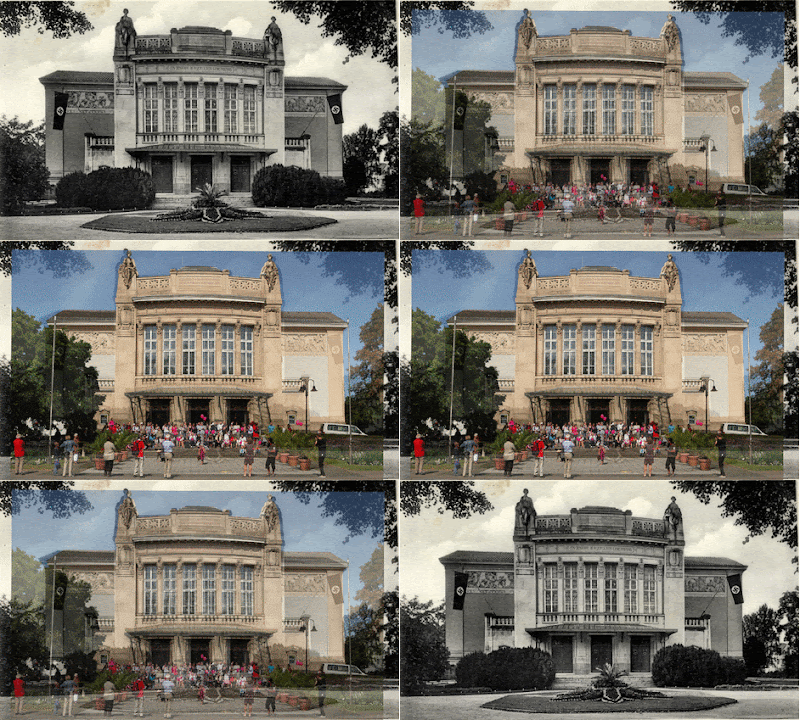 The Stadttheater sporting Nazi flags and today. Gießen was not affected after the First World War by the provisions of the Treaty of Versailles as a military base because it lay just outside the demilitarised
zone. In the 1930s and 1940s about 467 hectares of urban land were
handed over to the Wehrmacht and the Luftwaffe for a small price. Other
barracks were created: artillery barracks (Bleidorn barracks, Pendleton
barracks) and forest barracks (Verdun barracks, river barracks). A
military training place was set up between the former Steubenenkaserne
Gießen and the Hohenwarte. Other barracks included the Zeughauskaserne
and the Neue Barracks (Berg-Kaserne).
The Stadttheater sporting Nazi flags and today. Gießen was not affected after the First World War by the provisions of the Treaty of Versailles as a military base because it lay just outside the demilitarised
zone. In the 1930s and 1940s about 467 hectares of urban land were
handed over to the Wehrmacht and the Luftwaffe for a small price. Other
barracks were created: artillery barracks (Bleidorn barracks, Pendleton
barracks) and forest barracks (Verdun barracks, river barracks). A
military training place was set up between the former Steubenenkaserne
Gießen and the Hohenwarte. Other barracks included the Zeughauskaserne
and the Neue Barracks (Berg-Kaserne).
Between 1936 and 1939 a military hospital was built, at the corner of Schubertstraße / Karl-Franz-Straße. It remained undisturbed in the Second World War and was used by the American forces after the war, and by the French forces from 1951 until 1957 when it was returned and put into service as a Bundeswehrlazarett later renamed Bundeswehrkrankenhaus. It was closed in 1997 and the building is now used as a financial office.
 Captured German officers watching as the American 6th Armoured Division passes by under the motorway bridge outside Gießen.
During the war over 1,000 Gießen Jews were deported from the interim camp of Goetheschule at the end of 1942 to Nazi extermination camps. On the present site of the utomeile, the Wehrmacht sited the news bunker Gisela, which was used, inter alia, to coordinate the attacks on France. Even today large parts of the facility are available.
Through two RAF air raids on the 2nd and in particular the night of the December 6-7, 1944 under the Area Bombing Directive nearly the entire historic city core of Gießen was destroyed by a fire storm. In the second air attack alone, 813 people were killed, and around 30,000 were homeless. On the other hand, railway installations and numerous military installations remained largely intact. In the following months, many more people died as a result of deep-sea attacks. On March 28, 1945, the entry of the American Army ended the war for the destroyed city. The city was destroyed to 67%, the city centre was 90%. Despite this high destruction rate, it would have been even worse for Gießen. A not inconsiderable part of the bomb load of the second air attack was inadvertently dropped over the Bergwerkswald, where the consequences are still visible today.

 The Stadttheater sporting Nazi flags and today. Gießen was not affected after the First World War by the provisions of the Treaty of Versailles as a military base because it lay just outside the demilitarised
zone. In the 1930s and 1940s about 467 hectares of urban land were
handed over to the Wehrmacht and the Luftwaffe for a small price. Other
barracks were created: artillery barracks (Bleidorn barracks, Pendleton
barracks) and forest barracks (Verdun barracks, river barracks). A
military training place was set up between the former Steubenenkaserne
Gießen and the Hohenwarte. Other barracks included the Zeughauskaserne
and the Neue Barracks (Berg-Kaserne).
The Stadttheater sporting Nazi flags and today. Gießen was not affected after the First World War by the provisions of the Treaty of Versailles as a military base because it lay just outside the demilitarised
zone. In the 1930s and 1940s about 467 hectares of urban land were
handed over to the Wehrmacht and the Luftwaffe for a small price. Other
barracks were created: artillery barracks (Bleidorn barracks, Pendleton
barracks) and forest barracks (Verdun barracks, river barracks). A
military training place was set up between the former Steubenenkaserne
Gießen and the Hohenwarte. Other barracks included the Zeughauskaserne
and the Neue Barracks (Berg-Kaserne).Between 1936 and 1939 a military hospital was built, at the corner of Schubertstraße / Karl-Franz-Straße. It remained undisturbed in the Second World War and was used by the American forces after the war, and by the French forces from 1951 until 1957 when it was returned and put into service as a Bundeswehrlazarett later renamed Bundeswehrkrankenhaus. It was closed in 1997 and the building is now used as a financial office.

During the war over 1,000 Gießen Jews were deported from the interim camp of Goetheschule at the end of 1942 to Nazi extermination camps. On the present site of the utomeile, the Wehrmacht sited the news bunker Gisela, which was used, inter alia, to coordinate the attacks on France. Even today large parts of the facility are available.
Through two RAF air raids on the 2nd and in particular the night of the December 6-7, 1944 under the Area Bombing Directive nearly the entire historic city core of Gießen was destroyed by a fire storm. In the second air attack alone, 813 people were killed, and around 30,000 were homeless. On the other hand, railway installations and numerous military installations remained largely intact. In the following months, many more people died as a result of deep-sea attacks. On March 28, 1945, the entry of the American Army ended the war for the destroyed city. The city was destroyed to 67%, the city centre was 90%. Despite this high destruction rate, it would have been even worse for Gießen. A not inconsiderable part of the bomb load of the second air attack was inadvertently dropped over the Bergwerkswald, where the consequences are still visible today.
Bad Wildungen

Adolf-Hitler-Strasse then and now as Brunnenstraße with the rathaus and church in the background. The town
synagogue was built in 1914, replacing the hired prayer room. In 1933
150 Jewish persons lived in about 35 families in Bad Wildungen. In the
following years some of them withdrew or emigrated because of increasing
reprisals and deprivation. During Kristallnacht of November 9th, 1938, the synagogue was plundered and destroyed by fire. The fire brigade was present but only protected the neighbouring
buildings. The district council had to hand over the property shortly
afterwards to the city of Bad Wildungen, which removed the remains of
the synagogue "in return". Today, no remains of the synagogue are
visible. In October and November 1939, the last forty Jewish inhabitants
were compelled to gather in Kassel, and from there they were sent to
extermination camps in three transports in 1941-42.
Offenbach am Main


Just
outside Frankfurt is this town with the Reichsadler remaining over the
entrance of the former Luftschutzbunker on Friedhofstrasse, with the
date 1941 below.  The
eagle, as expected for such a structure, is shown protecting a mother
embracing her child under one wing and a working man on the right. The
swastika has been removed. On the left is the building as seen directly
across the street; a tree seems to have been planbted specifically to
cover up the offending symbol.
The
eagle, as expected for such a structure, is shown protecting a mother
embracing her child under one wing and a working man on the right. The
swastika has been removed. On the left is the building as seen directly
across the street; a tree seems to have been planbted specifically to
cover up the offending symbol.
 The
eagle, as expected for such a structure, is shown protecting a mother
embracing her child under one wing and a working man on the right. The
swastika has been removed. On the left is the building as seen directly
across the street; a tree seems to have been planbted specifically to
cover up the offending symbol.
The
eagle, as expected for such a structure, is shown protecting a mother
embracing her child under one wing and a working man on the right. The
swastika has been removed. On the left is the building as seen directly
across the street; a tree seems to have been planbted specifically to
cover up the offending symbol. Hitler
spoke on June 16, 1932 in Offenbach at its Sports Grounds. As late as
1936, parts of the Offenbach population were resisting the takeover of
power and the equalisation policy of the Nazis. During the November
pogroms, the synagogue was desecrated and several apartments and shops
were damaged. In 1942 the last incorporation was carried out with
Rumpenheim. During the war 36% of Offenbach was destroyed by allied air
raids. The damage concentrated in particular on the old town and the
Weststadt. The heaviest attack was on March 18, 1944 by 750 British and
Canadian bombers who dropped 3,600 tonnes of explosives and bombs over
the city. On this day there were 176 victims; eventually the bomb
attacks on Offenbach would see a total of 467 dead. On March 26 1945 the
city was occupied by American forces.
Naumburg

The
town hall decked out in Nazi flags on March 11, 1934 on the occasion of
the integration of the Evangelical Youth into the Hitler Youth and
today. In the 1930s three new barracks were built in Naumburg- one on
the Schönburger Straße and two on the Flemminger Weg (then
Adolf-Hitler-Strasse) as part of the re-armament programme of the
Wehrmacht. On August 20, 1935, the 53rd Infantry Regiment paraded for the first time on the old market square. This regiment was later deployed in Poland.
On
April 9 and 11, 1945 American aircraft bombed the city. Part of the
military installations in the east of the city as well as parts of the
old town and adjacent areas were destroyed or severely damaged. More
than 400 people died, about 700 houses were damaged. On April 12,
American troops occupied the city, and three months later on, July 2, troops of the Red Army entered Naumburg. The influx of refugees and
displaced persons resulted in seeing up to 60,000 people in the city.

Hitler Youth marching in front of the Reichskrone topped with the Nazi eagle in 1940 and what's left today. It was here on November 10, 1918 that the Naumburg Workers' and Soldiers' Council was constituted. On December 2, 1918, the local branch of the German National People's Party and on December 18 that of the German Democratic Party were founded here. On March 14, 1920, the Naumburg resistance against the Kapp Putsch was formed here to coordinate the strike measures. Under the Nazis the building served as their party headquarters. On March 17, 1936, the Reich Youth Leader Baldur von Schirach gave a speech in front of the Reichskrone.Today the Reichskrone stands empty and is increasingly exposed to structural decay.

Hitlerjugend in front of the Schützenhaus, renamed the Haus der deutschen Jugend in 1937 and Generalleutnant Peter Weyer swearing in recruits the following year.

The Schlösschen on the Marktplatz with St. Wenzel church in the background during a Nazi-sponsored festival.
This was the site of a remarkable stand against the Nazis the day after
Hitler was apointed chancellor when Gustav Thate spoke against the
Nazis on the market square in front of a few hundred communists and
sympathizers march through the city in an orderly manner and protest
against the Hitler-Hugenberg government demanding a "general strike
against the fascist reign of terror!" In 1939 he was released from the
Buchenwald concentration camp and worked as an engine fitter at the Opel
headquarters in Naumburg. On February 4, 1943, he was drafted into the
Wehrmacht for probation at the front. After four months in Russian
captivity, he returned to his family and the city of Naumburg in 1945.
The evening before the last semi-free national election in 1933 the SA, ϟϟ-Standarte 4, deputations from Vaterland associations, school classes
and ordinary citizens took part in a rally. Thousands of them stood in
rank and file on the market. From 9.30 that morning to 22.30 the
loudspeakers on the square broadcast Hitler's speech Marxismus und seine
Helfershelfer from Königsberg. At the end, the procession of the
willing intoned the Horst-Wessel-Lied and concluded with a triple
Sieg-Heil before commemorating the fallen of the Great War and laying a
wreath.
Windecken

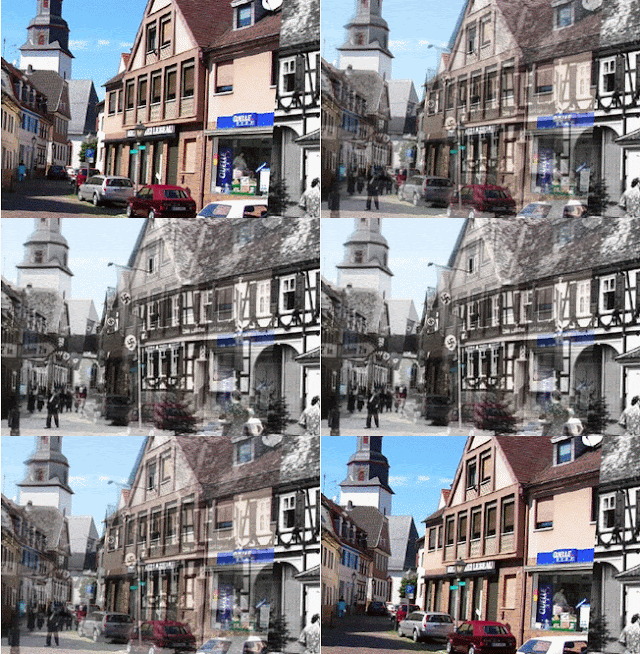
View from the Marktplatz towards Kirchgassse in 1938 on the town's 650th anniversary.
 The church from Spitalgasse. Windecken, now part of Nidderau in the Main-Kinzig district of Hesse, experienced a tumultuous period during the Nazi era and the subsequent American occupation. Its absorption into the Nazi regime began swiftly after Hitler's ascension to power in 1933, with the town's local administration and populace exhibiting a mix of compliance and resistance. The Nazi Party's local branch was established in Windecken as early as 1932, with records showing a membership of 150 by 1935, indicating a significant level of local support. The mayor during this period, Friedrich Krappe, was not a Nazi Party member, yet he facilitated the implementation of Nazi policies, such as the dismissal of Jewish teachers from the local school in 1933, following the Law for the Restoration of the Professional Civil Service. However, instances of resistance were also evident. For example, the local Catholic and Protestant churches openly criticised the Nazi ideology, with Pastor Heinrich Schäfer delivering sermons contradicting the Nazi worldview, as noted in the parish records. This nuanced local response challenges Taylor's argument that small towns were uniformly Nazified, as he contends in "The Third Reich," citing the pervasive influence of Nazi propaganda and intimidation. Whilst Taylor's perspective is supported by the swift Nazi takeover of local institutions, the examples of dissent in Windecken indicate that the reality was more complex, with pockets of resistance persisting despite the regime's efforts.
  The church again from Gutegasse. Windecken's role in the war effort was multifaceted, with the town contributing to the Nazi regime's military and industrial capacities, whilst also experiencing the hardships of war. The town's most notable contribution was the Windecken POW Camp, established in 1939, which housed predominantly Polish and later Soviet prisoners. The camp's population fluctuated, reaching a peak of 1,200 prisoners in 1944, who were employed in local agricultural and industrial tasks, supplementing the depleted local workforce. The treatment of these prisoners was harsh, with records indicating a mortality rate of 15% due to malnutrition, disease, and executions. This reality contradicts Lübbers' assertion in "Stalag" that POW camps were generally more humane than concentration camps, as whilst this may have been true for camps housing Western European prisoners, the experience of Eastern European prisoners in Windecken tells a different story. Meanwhile, the Allied bombing campaign resulted in significant damage to Windecken, with the most devastating raid occurring on 18 March 1944, destroying 30% of the town's buildings and resulting in 103 civilian deaths, as recorded in the municipal archives. This destruction challenged the Nazi narrative of German invincibility, contributing to a decline in local morale and support for the regime.
 The American takeover of Windecken in late March 1945 marked a significant turning point for the town, bringing an end to Nazi rule whilst introducing new challenges. The US 3rd Army's 14th Armoured Division seized Windecken with minimal resistance, with the town's defenders, a contingent of the Volkssturm, retreating hastily. The initial American approach to governing Windecken was characterized by a strategy of denazification and democratisation, with the immediate dismissal of known Nazi Party members from public offices. However, this policy was soon tempered by pragmatism, as evidenced by the reinstatement of former mayor Krappe, despite his complicity with the Nazi regime, due to his administrative competence. This shift reflects Merritt's perspective in "Democracy Imposed," which posits that the initial idealism of American denazification efforts was quickly replaced by a focus on rebuilding and stabilising Germany, even if it meant tolerating former Nazis. Whilst Merritt's argument is convincing, it is essential to recognise that this pragmatic shift was not universally accepted, with some local residents criticising the reinstatement of former Nazi collaborators. The American occupation also facilitated a reckoning with the past, as seen in the war crimes trial of former PoW camp commandant Heinrich Ritter, who was convicted and sentenced to life imprisonment in 1947. This trial served as a stark reminder of the atrocities committed under Nazi rule and contributed to a process of collective reflection and memory in Windecken.


The Amtshaus: "Das Lämmchen


The Rathaus and Burgtor


By the East Gate in Schloßgasseand view from Schloßberg towards the clock tower
Fliegerdenkmal, Wasserkuppe

1923 memorial to the fallen airmen of the First World War. On every second Sunday in August (originally set to August 9) a memorial service for all deceased airmen takes place. The sculpture was made by
Prof. August Gaul and was originally designed for the entrance gate of
the villa of Albert Ballin, now site of the UNESCO Institute for
Education. After the war, the eagle was targeted by the occupation
soldiers and eventually repaired in 1954.
Practically every German aeronautical engineer and test pilot of note during the 1920s and 1930s spent time building, testing, and flying aircraft at the Wasserkuppe including the Günter brothers, Wolf Hirth, the Horten brothers, Robert Kronfeld, Hans Jacobs, Heini Dittmar, Alexander Lippisch, Willy Messerschmitt, Hanna Reitsch, Peter Riedel and Alexander Schleicher. In the 1930s the "Ehrenhalle" (Hall of Honour) was constructed in the Lilienthal Haus, with heavy bronze doors opening into a large hall with a stained glass window featuring a larger-than-life bronze figure of Otto Lilienthal lying on an empty tomb as its centrepiece to serve as a memorial to all pilots who have died in aviation accidents. The inscription on the memorial is Lilienthal's famous last words: "Opfer müssen gebracht werden" roughly meaning "Sacrifices must be made." During the Third Reich, gliding activities became largely controlled by the state, and for Hitler Youth pilots and their instructors, proficiency in gliding was viewed as the first step towards the Luftwaffe.
Practically every German aeronautical engineer and test pilot of note during the 1920s and 1930s spent time building, testing, and flying aircraft at the Wasserkuppe including the Günter brothers, Wolf Hirth, the Horten brothers, Robert Kronfeld, Hans Jacobs, Heini Dittmar, Alexander Lippisch, Willy Messerschmitt, Hanna Reitsch, Peter Riedel and Alexander Schleicher. In the 1930s the "Ehrenhalle" (Hall of Honour) was constructed in the Lilienthal Haus, with heavy bronze doors opening into a large hall with a stained glass window featuring a larger-than-life bronze figure of Otto Lilienthal lying on an empty tomb as its centrepiece to serve as a memorial to all pilots who have died in aviation accidents. The inscription on the memorial is Lilienthal's famous last words: "Opfer müssen gebracht werden" roughly meaning "Sacrifices must be made." During the Third Reich, gliding activities became largely controlled by the state, and for Hitler Youth pilots and their instructors, proficiency in gliding was viewed as the first step towards the Luftwaffe.
The Niederwalddenkmal

Hitler
spoke here on August 28, 1933. Hitler mentions seeing this monument on
his way to the front at the start of the Great War in Mein Kampf:
Finally, the day came when we left Munich in order to start fulfilling our duty. Now for the first time I saw the Rhine as we were riding towards the west along its quiet waters, the German river of all rivers, in order to protect it against the greed of the old enemy. When through the delicate veil of the dawn's mist the mild rays of the early sun set the Niederwalddenkmal shimmering before our eyes, the 'Watch on the Rhine' roared up to the morning sky from the interminably long transport train and I had a feeling as though my chest would burst.
Rüdesheim

Drosselgasse
adorned in swastikas and today; the Hotel Lindenwirt remains.
Drosselgasse is one of six narrow streets that lead down from
Oberstrasse to the banks of the Rhine. The hotel prospered particularly
when the Nazi leisure organisation “Kraft durch Freude” sent special
trains to Rüdesheim. However, as during the First World War, tourism
almost came to a standstill during the war. November 25, 1944, consecrated to the holy calendar of the
Catherine of Alexandria, became a black day for Rüdesheim, when a heavy
bomb attack laid the quarters around the Catholic and Protestant parish
church in ruins and claimed as many as 200 dead. Even decades after the
war, the Katharine Day is devoted to the memory of this event and the
dead. Because the oldest buildings in the old town had been spared, and
the reconstruction took place rapidly, Rüdesheim soon recovered its
tourist attractiveness. Only the
"Drosselhof" survived the bombing less than six months before the end of
the war, almost unscathed although Drosselgasse flourished again in the
economic boom of the fifties and sixties.

The Jugendherberge auf dem Niederwald remains a youth hostel today although the swastika above the entrance is gone.
Rotenburg an der Fulda

Two months after the Nazi takeover of power saw the first act of violence against Rotenburg Jews on March 30, 1933 when the shop windows were broken in four Jewish shops. No investigation was carried out against the perpetrators; rather, the injured business people were held responsible for the act because they " flaunt a messy state ..., worry the population ... and thereby endanger peace and security." Most of the Jewish residents left Rotenburg in the mid-1930s, moving either to other German places or emigrating abroad. During 1938's Kristallnacht, SA actions against Jews also took place in Rotenburg; apartments were demolished and household items thrown onto the street.
 |
| The schloss flying Nazi flags and today |
Schloß Dehrn
 The Hitler Youth flag flying above Castle Dehrn on the river Lahn in Runkel within the Limburg-Weilburg district when it served as a Kindererholungsheim. Shortly after the First World War, the Dungern
family lost their fortune, including the Schloss Dehrn. Its value was
estimated at 3.5 million reichsmarks, with lands of more than 85
hectares. In 1925, the castle became a "Fürstenhof" for a few months,
then came into the possession of the province of Hesse-Nassau, which in
1925 it was still a training centre for male youth. In 1933 the lands belonging to the castle were privatised. The main building served as a BDM warehouse starting in 1934, the economic building as a childcare centre.
With the beginning of the war the castle
became a Reservelazarett and from September 19, 1944 to March 26, 1945 location of
the Oberkommandos of the German Luftwaffe West. In 1945, the fleeing
military power burst the chapel in the park where equipment was stored.
In the 1960s the remains of the ruins were removed and a memorial stone
was erected for the tomb of the family of Dungern. From April to August
20, 1945 the American occupation troops used the building and then five
days later served as a home for girls who had lost their relatives
during the war.
The Hitler Youth flag flying above Castle Dehrn on the river Lahn in Runkel within the Limburg-Weilburg district when it served as a Kindererholungsheim. Shortly after the First World War, the Dungern
family lost their fortune, including the Schloss Dehrn. Its value was
estimated at 3.5 million reichsmarks, with lands of more than 85
hectares. In 1925, the castle became a "Fürstenhof" for a few months,
then came into the possession of the province of Hesse-Nassau, which in
1925 it was still a training centre for male youth. In 1933 the lands belonging to the castle were privatised. The main building served as a BDM warehouse starting in 1934, the economic building as a childcare centre.
With the beginning of the war the castle
became a Reservelazarett and from September 19, 1944 to March 26, 1945 location of
the Oberkommandos of the German Luftwaffe West. In 1945, the fleeing
military power burst the chapel in the park where equipment was stored.
In the 1960s the remains of the ruins were removed and a memorial stone
was erected for the tomb of the family of Dungern. From April to August
20, 1945 the American occupation troops used the building and then five
days later served as a home for girls who had lost their relatives
during the war.
Erlensee
 Nazi flags hanging from the Grundschule Langendiebach on what is now Friedrich-Ebert-Straße. Twinned since 2000 with Biggleswade, the town itself is located just outside Hanau in Mainz.
In 1937 the Luftwaffe built an airfield known as Langendiebach
Fliegerhorst in the town. During the war limited plans to expand it into
a larger airfield took place. Glider and nightfighter units of the
Luftwaffe stationed here participated in the 1939 invasion of Poland and
the 1944-45 defence of Germany against allied invasion. Multiple
bombings by Anglo-American allied forces rendered the airfield
unserviceable by the war's end. Under the name Fliegerhorst Kaserne
American forces occupied the facilities from 1945 until 2007 with
artillery, aviation, ordnance, quartermaster, transportation,
meteorological, and military police units.
Nazi flags hanging from the Grundschule Langendiebach on what is now Friedrich-Ebert-Straße. Twinned since 2000 with Biggleswade, the town itself is located just outside Hanau in Mainz.
In 1937 the Luftwaffe built an airfield known as Langendiebach
Fliegerhorst in the town. During the war limited plans to expand it into
a larger airfield took place. Glider and nightfighter units of the
Luftwaffe stationed here participated in the 1939 invasion of Poland and
the 1944-45 defence of Germany against allied invasion. Multiple
bombings by Anglo-American allied forces rendered the airfield
unserviceable by the war's end. Under the name Fliegerhorst Kaserne
American forces occupied the facilities from 1945 until 2007 with
artillery, aviation, ordnance, quartermaster, transportation,
meteorological, and military police units.
Bad Sooden-Allendorf
 The Nazi flag flying at the Hotel zur Post
and the site today. Bad-Sooden Allendorf, a small community in the
northern Hessian Werra-Meißner-Kreis directly on the border with
Thuringia, has recently reached national attention given that the leader
of the AfD in the Thuringian state parliament, Björn Höcke, has been
teaching sports and history for nearly a decade. If it were up to
Hessian Minister of Culture Alexander Lorz (CDU), Höcke would be banned
from returning as a teacher. Höcke, who recently made headlines because
of a racist lecture on the "life-affirming African type of propaganda,"
promptly responded on Sunday with an open letter on the impending ban on
his profession. One former student of Höcke's described him as a decent
teacher who often made lessons more exciting than many of his
colleagues which led to his popularity with students. His involvement in
the AfD since spring 2013, however, quickly got around in school. Höcke
once claimed that his grandfather had met Hitler who had had
"unbelievably blue eyes" which Höcke regarded as a central element of
the Führer cult. Whilst other history teachers focused on the Nazis,
Höcke instead focuses on the German Revolution of 1848. The
President of the German Teachers' Association, Josef Kraus, suggests
that it would be almost impossible to prevent his return to school,
stating that "[i]f I were assigned to Mr. Höcke as Headmaster, then I
would first have a serious conversation with him and get a picture of
myself at regular intervals by unannounced class visits."
The Nazi flag flying at the Hotel zur Post
and the site today. Bad-Sooden Allendorf, a small community in the
northern Hessian Werra-Meißner-Kreis directly on the border with
Thuringia, has recently reached national attention given that the leader
of the AfD in the Thuringian state parliament, Björn Höcke, has been
teaching sports and history for nearly a decade. If it were up to
Hessian Minister of Culture Alexander Lorz (CDU), Höcke would be banned
from returning as a teacher. Höcke, who recently made headlines because
of a racist lecture on the "life-affirming African type of propaganda,"
promptly responded on Sunday with an open letter on the impending ban on
his profession. One former student of Höcke's described him as a decent
teacher who often made lessons more exciting than many of his
colleagues which led to his popularity with students. His involvement in
the AfD since spring 2013, however, quickly got around in school. Höcke
once claimed that his grandfather had met Hitler who had had
"unbelievably blue eyes" which Höcke regarded as a central element of
the Führer cult. Whilst other history teachers focused on the Nazis,
Höcke instead focuses on the German Revolution of 1848. The
President of the German Teachers' Association, Josef Kraus, suggests
that it would be almost impossible to prevent his return to school,
stating that "[i]f I were assigned to Mr. Höcke as Headmaster, then I
would first have a serious conversation with him and get a picture of
myself at regular intervals by unannounced class visits."  The
Edersee Dam spanning the Eder river in northern Hesse, built between
1908 and 1914. It was famously breached during the war by bouncing bombs
dropped by Lancaster bombers of No. 617 Squadron RAF as part of Operation Chastise.
The early morning raid of May 17, 1943 created a massive 230 foot wide
by 72 foot deep breach in the structure. Water emptied at the rate of
eight thousand cubic metres per second into the narrow valley below,
producing a 20–26 foot flood wave which roared as far as 19 miles
downstream. By the time it diminished in the widening floodplains of the
lower Eder, into the Fulda and into the Weser, a total of about 160
cubic meters per hectare had flowed, wreaking widespread destruction and
claiming the lives of some 70 people. Some non-German sources
erroneously cite an early total of 749 for all foreigners killed in all
PoW and labour camps downriver of the Möhne dam as casualties at a
supposed PoW or labour camp just below the Eder Dam. The dam was rebuilt
within months by forced labour drawn from construction of the Atlantic
Wall under command of Organisation Todt. The 1955 film The Dam Busters chronicled this famous British attack on the dam.
The
Edersee Dam spanning the Eder river in northern Hesse, built between
1908 and 1914. It was famously breached during the war by bouncing bombs
dropped by Lancaster bombers of No. 617 Squadron RAF as part of Operation Chastise.
The early morning raid of May 17, 1943 created a massive 230 foot wide
by 72 foot deep breach in the structure. Water emptied at the rate of
eight thousand cubic metres per second into the narrow valley below,
producing a 20–26 foot flood wave which roared as far as 19 miles
downstream. By the time it diminished in the widening floodplains of the
lower Eder, into the Fulda and into the Weser, a total of about 160
cubic meters per hectare had flowed, wreaking widespread destruction and
claiming the lives of some 70 people. Some non-German sources
erroneously cite an early total of 749 for all foreigners killed in all
PoW and labour camps downriver of the Möhne dam as casualties at a
supposed PoW or labour camp just below the Eder Dam. The dam was rebuilt
within months by forced labour drawn from construction of the Atlantic
Wall under command of Organisation Todt. The 1955 film The Dam Busters chronicled this famous British attack on the dam. Ending
my tour of Hessen by indulging my personal interest in ancient history
at the recreated Roman fort outside Bad Homburg in the Taunus mountains. The Saalburg fort, originally
constructed around 83-84 AD during the Roman Empire's expansion into
Germania, was part of the Limes Germanicus, a frontier defence system.
It was rebuilt and expanded in the late 2nd century AD and remained in
use until the early 3rd century. The fort's ruins were rediscovered
in the late 19th century, and extensive archaeological excavations began
in 1892 under the direction of Louis Jacobi. By 1907, the fort had been
almost entirely reconstructed, making it one of the most complete Roman
forts in Germany. The entrance is shown here as imagined
in a turn of the centry book on the site with the statue of Antoninus
Pius created by Berlin sculptor Johannes Götz from 1901. The statue
rests on a pedestal with the following inscription: "To Emperor of the
Romans, Titus Aelius Hadrianus Antoninus Augustus Pius, Wilhelm II,
Emperor of the Germans [dedicates this monument]." The inscription over
the gateway on the plaque behind reads: "Wilhelm II, son of Friedrich
III, grandson of Wilhelm the Great, restored the Saalburg fort of the
Roman Limes in the 15th year of his reign to commemorate and honour his
ancestors." The
first Roman buildings on the Saalburg Pass were two small, rectangular
earthworks built as bases when the Limes was built. Following these two
earth works of the Domitian wars, a simple wood and earth fort for a
numerus- an auxiliary troop unit, usually consisting of two centuries (a nominal strength of about 160 men)-
was erected around the year 90 CE, facing north towards the Limes. Some
isolated finds suggest that the Saalburg's numerus could have been a
numerus Brittonum, a unit that was originally recruited in Britain.
Ending
my tour of Hessen by indulging my personal interest in ancient history
at the recreated Roman fort outside Bad Homburg in the Taunus mountains. The Saalburg fort, originally
constructed around 83-84 AD during the Roman Empire's expansion into
Germania, was part of the Limes Germanicus, a frontier defence system.
It was rebuilt and expanded in the late 2nd century AD and remained in
use until the early 3rd century. The fort's ruins were rediscovered
in the late 19th century, and extensive archaeological excavations began
in 1892 under the direction of Louis Jacobi. By 1907, the fort had been
almost entirely reconstructed, making it one of the most complete Roman
forts in Germany. The entrance is shown here as imagined
in a turn of the centry book on the site with the statue of Antoninus
Pius created by Berlin sculptor Johannes Götz from 1901. The statue
rests on a pedestal with the following inscription: "To Emperor of the
Romans, Titus Aelius Hadrianus Antoninus Augustus Pius, Wilhelm II,
Emperor of the Germans [dedicates this monument]." The inscription over
the gateway on the plaque behind reads: "Wilhelm II, son of Friedrich
III, grandson of Wilhelm the Great, restored the Saalburg fort of the
Roman Limes in the 15th year of his reign to commemorate and honour his
ancestors." The
first Roman buildings on the Saalburg Pass were two small, rectangular
earthworks built as bases when the Limes was built. Following these two
earth works of the Domitian wars, a simple wood and earth fort for a
numerus- an auxiliary troop unit, usually consisting of two centuries (a nominal strength of about 160 men)-
was erected around the year 90 CE, facing north towards the Limes. Some
isolated finds suggest that the Saalburg's numerus could have been a
numerus Brittonum, a unit that was originally recruited in Britain.  As imagined in the 1925 book Im Kampf um die Saalburg.
It wasn't until 135 in the late Hadrianic period that the numerus fort
was replaced by a 3.2-hectare camp for a cohort, an infantry unit of
just under 500 men built
by the Cohors II Raetorum civium Romanorum equitata, a cohort
originally based in Aquae Mattiacorum (Wiesbaden). Initially, the
fort's defences were made of wood and stone, but were replaced in the
second half of the 2nd century by a mortar wall with an earthen ramp.
This form of the fort remained until the end of the Limes approximately
260. At the beginning of the 3rd century, times at the Limes became more
troubled. A preventive war by Caracalla, who advanced from Raetia and
Mogontiacum (Mainz) in 213 against the Alamanni and their Chatti allies,
only temporarily eased the Germanic pressure on the Roman border. Nida
(today Frankfurt-Heddernheim), the civilian capital of the Civitas
Taunensium, received a ring of fortifications and already in the year
233 the Alemanni invaded Roman areas again. There were further major
Alemannic invasions in 254 and 260. Finally, the entire area on the
right bank of the Rhine was lost during the internal and external
political and economic crisis of the empire around the middle of the 3rd
century. In connection with these events, the Saalburg fort seems to
have been evacuated without fighting. After the end of the Upper German
Limes, the dilapidated fort was used as a quarry until protection
measures and excavation activities began around the middle of the 19th
century.
As imagined in the 1925 book Im Kampf um die Saalburg.
It wasn't until 135 in the late Hadrianic period that the numerus fort
was replaced by a 3.2-hectare camp for a cohort, an infantry unit of
just under 500 men built
by the Cohors II Raetorum civium Romanorum equitata, a cohort
originally based in Aquae Mattiacorum (Wiesbaden). Initially, the
fort's defences were made of wood and stone, but were replaced in the
second half of the 2nd century by a mortar wall with an earthen ramp.
This form of the fort remained until the end of the Limes approximately
260. At the beginning of the 3rd century, times at the Limes became more
troubled. A preventive war by Caracalla, who advanced from Raetia and
Mogontiacum (Mainz) in 213 against the Alamanni and their Chatti allies,
only temporarily eased the Germanic pressure on the Roman border. Nida
(today Frankfurt-Heddernheim), the civilian capital of the Civitas
Taunensium, received a ring of fortifications and already in the year
233 the Alemanni invaded Roman areas again. There were further major
Alemannic invasions in 254 and 260. Finally, the entire area on the
right bank of the Rhine was lost during the internal and external
political and economic crisis of the empire around the middle of the 3rd
century. In connection with these events, the Saalburg fort seems to
have been evacuated without fighting. After the end of the Upper German
Limes, the dilapidated fort was used as a quarry until protection
measures and excavation activities began around the middle of the 19th
century.  The
background to the long-standing interest in rebuilding the fort was the
research first undertaken by Friedrich Gustav Habel from 1841 and continued from 1870 by Karl August von
Cohausen. The first reconstruction work was carried out in 1895 by the Homburg building officer
and Cohausen's employee Louis Jacobi who, two years later, convinced Kaiser
Wilhelm II of the idea of rebuilding the building. He
told the Kaiser that a replica of the main gate had been built from
wood and canvas in 1896 for members of the meeting of German
naturalists and physicians but due to a lack of resources, a
proper reconstruction could not be carried out upon which Wilhelm
agreed to raise funds for the reconstruction of the Roman fort. One
of Wilhelm II's educators was Georg Hinzpeter, a classics scholar, and
that is probably how it came about that Schliemann's discoveries in
historicist Germany also inspired the young prince. Indeed his father, Crown
Prince Friedrich Wilhelm, had had a soft spot for antiquity and the
ancient historian Ernst Curtius, who was one of the prince's tutors, was
held responsible for this. The heir to the throne and Curtius were
particularly fond of ancient Rome and Greece, because Curtius was the
main excavator of ancient Olympia. This was pursued and supported in a
prestigious campaign by Friedrich Wilhelm.
The
background to the long-standing interest in rebuilding the fort was the
research first undertaken by Friedrich Gustav Habel from 1841 and continued from 1870 by Karl August von
Cohausen. The first reconstruction work was carried out in 1895 by the Homburg building officer
and Cohausen's employee Louis Jacobi who, two years later, convinced Kaiser
Wilhelm II of the idea of rebuilding the building. He
told the Kaiser that a replica of the main gate had been built from
wood and canvas in 1896 for members of the meeting of German
naturalists and physicians but due to a lack of resources, a
proper reconstruction could not be carried out upon which Wilhelm
agreed to raise funds for the reconstruction of the Roman fort. One
of Wilhelm II's educators was Georg Hinzpeter, a classics scholar, and
that is probably how it came about that Schliemann's discoveries in
historicist Germany also inspired the young prince. Indeed his father, Crown
Prince Friedrich Wilhelm, had had a soft spot for antiquity and the
ancient historian Ernst Curtius, who was one of the prince's tutors, was
held responsible for this. The heir to the throne and Curtius were
particularly fond of ancient Rome and Greece, because Curtius was the
main excavator of ancient Olympia. This was pursued and supported in a
prestigious campaign by Friedrich Wilhelm. And so at
a banquet in the castle in Wiesbaden on October 18, 1897, Kaiser Wilhelm II announced
that he wanted to have the Saalburg rebuilt. The construction of the
porta praetoria began, which was completed in 1898. However, the
construction of the principia (staff building) was particularly
important to the emperor, which is why the foundation stone of this
building was laid two years later, on October 11, 1900, as part of a
magnificent ceremony. In his speech the Kaiser stated:
And so at
a banquet in the castle in Wiesbaden on October 18, 1897, Kaiser Wilhelm II announced
that he wanted to have the Saalburg rebuilt. The construction of the
porta praetoria began, which was completed in 1898. However, the
construction of the principia (staff building) was particularly
important to the emperor, which is why the foundation stone of this
building was laid two years later, on October 11, 1900, as part of a
magnificent ceremony. In his speech the Kaiser stated: The first thought of today goes back to melancholy thanks to my unforgettable father, the Kaiser Friedrich III.; The Saalburg owes its resurrection to his energy and willingness to create. [...] So I dedicate this stone with the first blow to the memory of Emperor Friedrich III.; with the second wave of German youth and the growing generations who may learn here in the newly created museum what a world empire means. Let the future of our German fatherland, which may be destined to become as powerful, as firmly united and as authoritative in future times through the unified cooperation of the princes and peoples, their armies and their citizens, as the Roman world empire once was, so that in the future it may also be called, as in the old days "Civis Romanus sum" now: "I am a German citizen."
 Cecilie,
Crown Princess of Prussia and wife of Crown Prince William of Prussia
(for whom the Cecilienhof where the Potsdam conference was held was
named) and entourage visting the site. However,
the completion of the fortification, the principia , the praetorium and
the horrea (granary) went on until 1907. The museum, which had been
planned from the start, was sited in the spacious rooms of the horrea
and richly stocked with finds from the previous excavations. Jacobi
had attached great importance to the historical authenticity of the
reconstruction of the Saalburg. After all, it was the first
reconstruction of Roman military architecture on the original site in
its time. But even Kaiser Wilhelm II himself was concerned about
historical accuracy, as seen in his words "[a]s true as possible to
Roman construction" at the laying of the foundation stone for the
principia reveal.
Cecilie,
Crown Princess of Prussia and wife of Crown Prince William of Prussia
(for whom the Cecilienhof where the Potsdam conference was held was
named) and entourage visting the site. However,
the completion of the fortification, the principia , the praetorium and
the horrea (granary) went on until 1907. The museum, which had been
planned from the start, was sited in the spacious rooms of the horrea
and richly stocked with finds from the previous excavations. Jacobi
had attached great importance to the historical authenticity of the
reconstruction of the Saalburg. After all, it was the first
reconstruction of Roman military architecture on the original site in
its time. But even Kaiser Wilhelm II himself was concerned about
historical accuracy, as seen in his words "[a]s true as possible to
Roman construction" at the laying of the foundation stone for the
principia reveal. 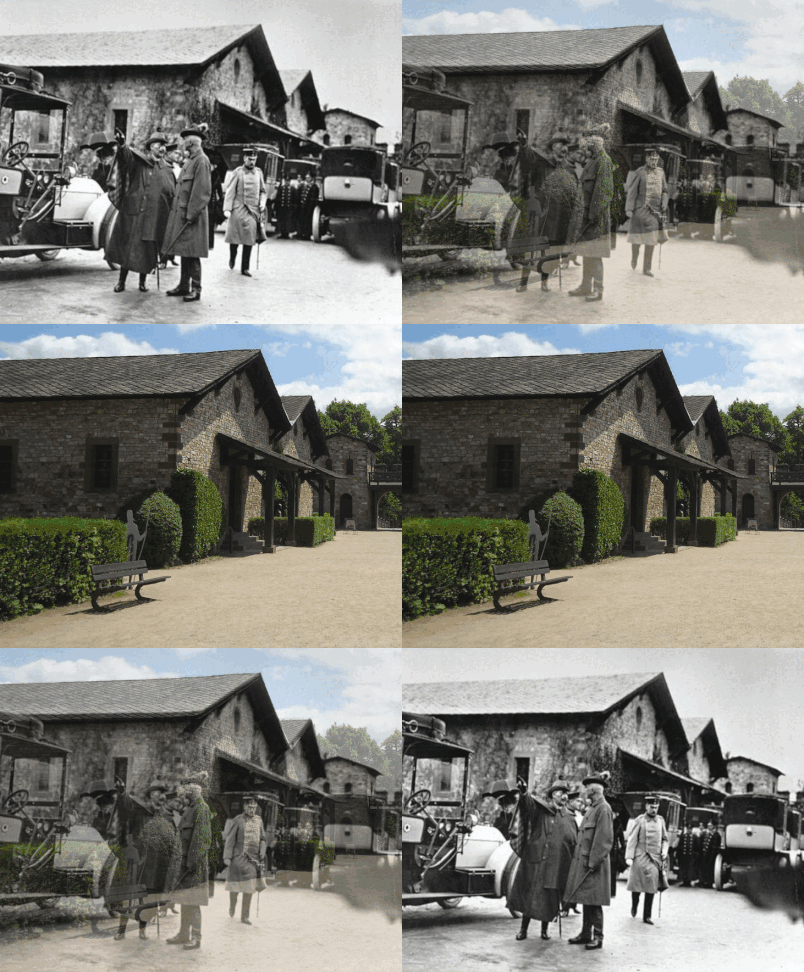 The
Kaiser not only participated ideally and
financially, but also professionally in the reconstruction of the
Saalburg as seen in the GIF on the right in front of the horreum in 1913
which now houses the museum. His interest was shown by annual visits to
the Saalburg during
the reconstruction in order to monitor the construction progress and to
give technical advice on inspections of the system. After the discovery
and excavation of the Roman entrenchments, it was Wilhelm II who
expressed the desire to carry out an archaeological experiment in 1913.
This included the erection of the redoubts, with tools made in the Roman
way, which was welcomed by experts as a new path of knowledge.
Nevertheless, the reconstruction of the Saalburg divided opinion. When
the Saalburg was originally reconstructed, the Kaiser wanted it to be
built of stone, and for the stone to be left undressed, rather than be
plastered over – giving the fort a somewhat bleak appearance. It's
been increasingly accepted that outside walls were normally plastered,
and painted with lines to imitate proper cut-stone.
The
Kaiser not only participated ideally and
financially, but also professionally in the reconstruction of the
Saalburg as seen in the GIF on the right in front of the horreum in 1913
which now houses the museum. His interest was shown by annual visits to
the Saalburg during
the reconstruction in order to monitor the construction progress and to
give technical advice on inspections of the system. After the discovery
and excavation of the Roman entrenchments, it was Wilhelm II who
expressed the desire to carry out an archaeological experiment in 1913.
This included the erection of the redoubts, with tools made in the Roman
way, which was welcomed by experts as a new path of knowledge.
Nevertheless, the reconstruction of the Saalburg divided opinion. When
the Saalburg was originally reconstructed, the Kaiser wanted it to be
built of stone, and for the stone to be left undressed, rather than be
plastered over – giving the fort a somewhat bleak appearance. It's
been increasingly accepted that outside walls were normally plastered,
and painted with lines to imitate proper cut-stone. .gif) I'm standing on the left in
front of the principia with its aedes, the shrine containing the signa
militaria or standards and how it appeared when Wilhelm II visited,
shown here second from the left. This housed the offices for the command staff and armouries. It can be seen by comparing the site then and today in my GIFs that the buildings have
undergone numerous, if slight, alterations over the century. For example, both
statues have since been removed to the interior of the basilica which
served as a roll call and practice hall. The fort's reconstruction and the detailed knowledge of Roman military architecture it provided made it an attractive location for the Nazis, who sought to draw parallels between the Roman Empire and their own aspirations for a new German Reich. The regime saw the Roman Empire as a model of military prowess, territorial expansion, and cultural dominance, which they sought to emulate. In Mein Kampf, Hitler wrote, "[w]e see in Rome the greatness of an empire that united the world under its rule, and we aim to achieve the same for Germany." This perspective is supported by the regime's architectural projects, such as the plans for Germania, which aimed to recreate Berlin in the style of ancient Rome. The Saalburg, with its well-preserved Roman structures, fit perfectly into this narrative. The Saalburg's role as a site of archaeological interest continued during the Nazi era, but it was also transformed into a tool of propaganda. In 1937, the fort was incorporated into the Reichsarbeitsdienst (RAD), the Reich Labour Service, which used it as a training camp for young German men. The RAD was a paramilitary organisation that prepared young Germans for military service and indoctrinated them with Nazi ideology. The choice of the Saalburg as a training site was not accidental. The fort's Roman ruins provided a tangible link to Germany's ancient past, reinforcing the regime's message of historical continuity. Additionally, the fort's location in the Taunus mountains offered a rugged and challenging environment for training. This perspective is supported by the RAD's own publications, which frequently featured images of young men training at the Saalburg. However, Smith's argument can be critiqued for overlooking the practical considerations that also influenced the choice of the Saalburg as a training site. The fort's location, its existing infrastructure, and its symbolic value all played a role in its selection. Furthermore, the regime's use of the Saalburg for RAD training was not unique; many other historical sites and natural landscapes were similarly appropriated for military and ideological purposes. In addition to its role in RAD training, the Saalburg was also used as a site for military exercises and manoeuvres. The German Wehrmacht conducted training exercises in the surrounding Taunus mountains, using the fort as a base and a symbol of German military strength. The fort's Roman ruins provided a backdrop for these exercises, reinforcing the regime's message of historical continuity and military prowess. The Wehrmacht's use of the Saalburg is evidenced by photographs and reports from the period, which show soldiers training in and around the fort.
I'm standing on the left in
front of the principia with its aedes, the shrine containing the signa
militaria or standards and how it appeared when Wilhelm II visited,
shown here second from the left. This housed the offices for the command staff and armouries. It can be seen by comparing the site then and today in my GIFs that the buildings have
undergone numerous, if slight, alterations over the century. For example, both
statues have since been removed to the interior of the basilica which
served as a roll call and practice hall. The fort's reconstruction and the detailed knowledge of Roman military architecture it provided made it an attractive location for the Nazis, who sought to draw parallels between the Roman Empire and their own aspirations for a new German Reich. The regime saw the Roman Empire as a model of military prowess, territorial expansion, and cultural dominance, which they sought to emulate. In Mein Kampf, Hitler wrote, "[w]e see in Rome the greatness of an empire that united the world under its rule, and we aim to achieve the same for Germany." This perspective is supported by the regime's architectural projects, such as the plans for Germania, which aimed to recreate Berlin in the style of ancient Rome. The Saalburg, with its well-preserved Roman structures, fit perfectly into this narrative. The Saalburg's role as a site of archaeological interest continued during the Nazi era, but it was also transformed into a tool of propaganda. In 1937, the fort was incorporated into the Reichsarbeitsdienst (RAD), the Reich Labour Service, which used it as a training camp for young German men. The RAD was a paramilitary organisation that prepared young Germans for military service and indoctrinated them with Nazi ideology. The choice of the Saalburg as a training site was not accidental. The fort's Roman ruins provided a tangible link to Germany's ancient past, reinforcing the regime's message of historical continuity. Additionally, the fort's location in the Taunus mountains offered a rugged and challenging environment for training. This perspective is supported by the RAD's own publications, which frequently featured images of young men training at the Saalburg. However, Smith's argument can be critiqued for overlooking the practical considerations that also influenced the choice of the Saalburg as a training site. The fort's location, its existing infrastructure, and its symbolic value all played a role in its selection. Furthermore, the regime's use of the Saalburg for RAD training was not unique; many other historical sites and natural landscapes were similarly appropriated for military and ideological purposes. In addition to its role in RAD training, the Saalburg was also used as a site for military exercises and manoeuvres. The German Wehrmacht conducted training exercises in the surrounding Taunus mountains, using the fort as a base and a symbol of German military strength. The fort's Roman ruins provided a backdrop for these exercises, reinforcing the regime's message of historical continuity and military prowess. The Wehrmacht's use of the Saalburg is evidenced by photographs and reports from the period, which show soldiers training in and around the fort. .gif)
